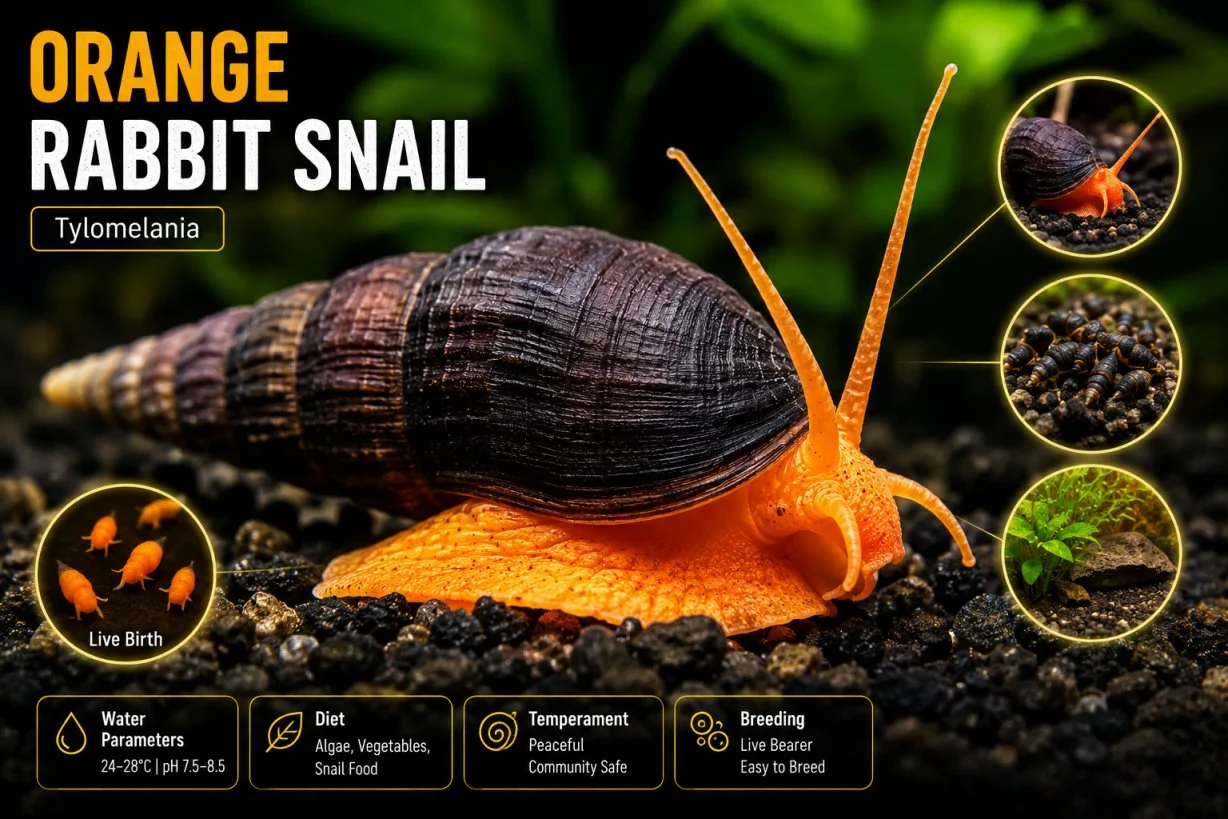
I have a funny story about these Rabbit Snails; when I first saw the Orange Rabbit Snail on an online aquarium site, I thought it was just a gimmick or a publicity stunt. It had a neon-orange shell, a wrinkled face resembling an elephant’s trunk, and a slow, leisurely pace—like a retired mailman relaxing on a Sunday. Still, finding them attractive, I eventually bought six.
And honestly, I have never regretted it. Originating from the volcanic lakes of Sulawesi, Indonesia, these snails have become permanent residents of my fish room, and I genuinely stop by their tank every morning to watch them move about.
📌 Quick Answer: The Orange Rabbit Snail (Tylomelania sp.) is a large, slow-breeding, freshwater snail native to Sulawesi, Indonesia. Now that you know the basic stats.
- Water Parameters: Thrives in warm, hard, alkaline water (24.5°C–30°C / 76°F–86°F, pH 7.5–8.5).
- Diet: Eats biofilm, algae, and blanched vegetables.
- Breeding: Extremely slow; gives birth to a single live baby every 4–8 weeks.
- Tank Safety: One of the safest snails you can own. They won’t overrun your tank, they won’t bother tankmates, and they leave plants alone—(mostly!).
🐚 What You’ll Get in This Post
- 🟠 What exactly is an orange rabbit snail — the Sulawesi origin story competitors skip
- 🏡 Orange rabbit snail care guide — tank size, substrate, water parameters
- 🌡️ Ideal water conditions — why Texas hard water is actually perfect
- 🍽️ What and how to feed them — the feeding mistake most US hobbyists make
- 🔬 Orange rabbit snail breeding — how do rabbit snails reproduce, and what to expect
- 🐣 What do rabbit snail eggs look like (spoiler: there aren’t any)
- ❌ Do rabbit snails eat other snails — answered directly
- ❓ FAQ — targeting every People Also Ask question on this topic
Jump to: Care Guide | Water Parameters | Feeding | Breeding | Tank Mates | FAQ
What Is an Orange Rabbit Snail? (Tylomelania sp.)
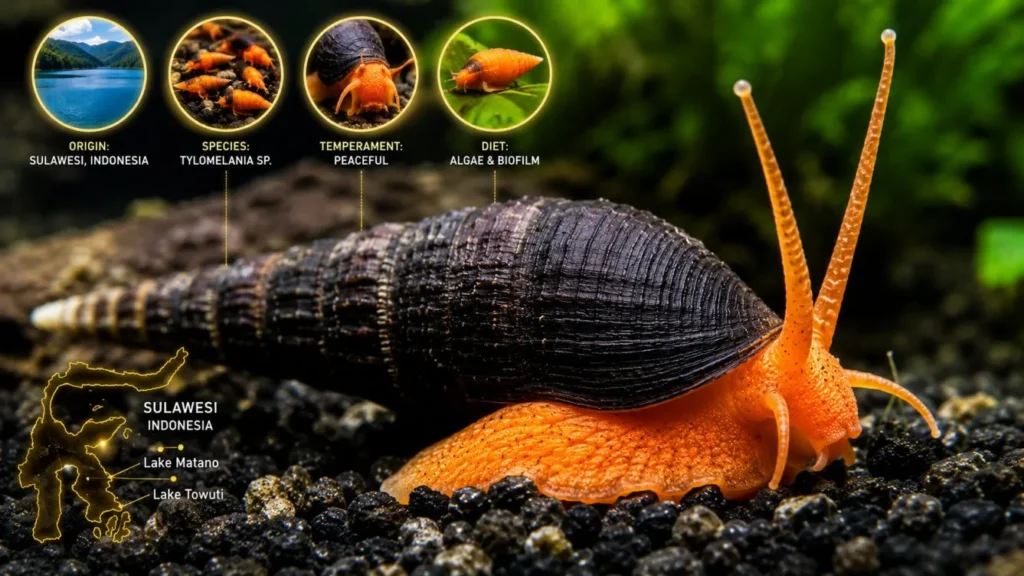
The orange rabbit snail — sometimes called Tylomelania orange rabbit snail or the orange volcano rabbit snail — belongs to the genus Tylomelania, a fascinating group of freshwater snails found exclusively in the ancient lakes of Sulawesi, Indonesia. The most commonly kept species include Tylomelania gemmifera (the most widely available orange form) and related Tylomelania sp. variants.
In the US aquarium hobby, you’ll also see them sold as the orange giant Sulawesi rabbit snail or Tylomelania sp. orange rabbit snail, depending on the vendor. The orange volcano rabbit snail and the volcano rabbit snail are trade names used by certain sellers for forms collected near volcanic lake regions of Sulawesi — specifically the Malili lake system, which includes Lake Matano (one of the world’s deepest lakes) and Lake Towuti.
Why should this origin matter to you? These lakes are geologically ancient, isolated, and chemically distinct from typical Southeast Asian rivers. Lake Matano is estimated to be over 1–2 million years old, making the snails inside it some of the most specialized freshwater mollusks on Earth. They evolved in warm, mineral-rich, extremely stable water. If you replicate that stability in your aquarium, they thrive. If you don’t, they decline slowly, and you won’t even know why until it’s too late.
That’s the part competitors gloss over: the Sulawesi origin isn’t just interesting trivia — it’s the key to keeping these snails alive long-term.
Orange Rabbit Snail Care Guide
What Does an Orange Rabbit Snail Look Like?
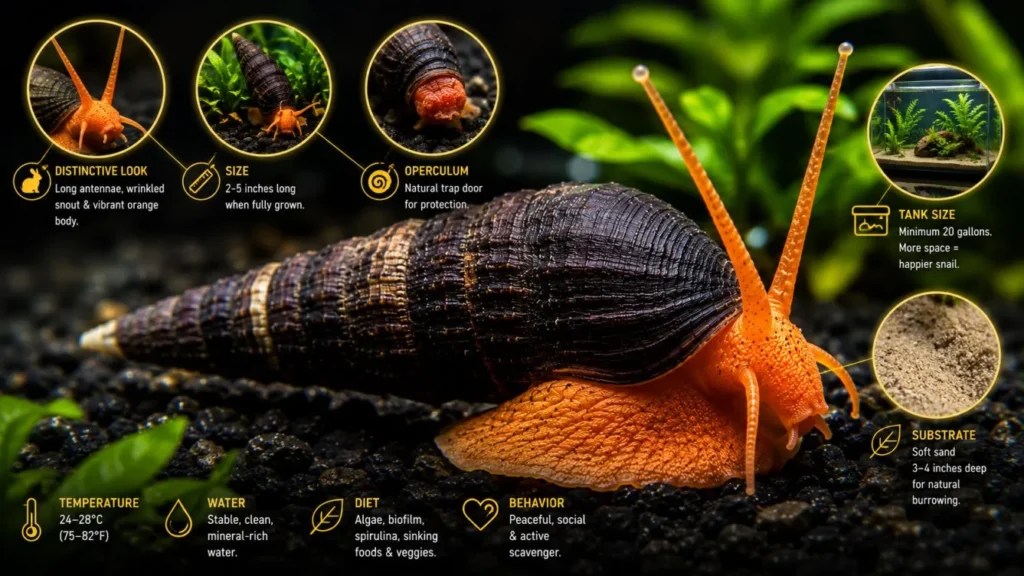
These snails are impossible to miss. They have:
- A tall, cone-shaped shell 2–5 inches long (the orange giant Sulawesi rabbit snail reaches the upper end of this range)
- Vivid orange-to-reddish-orange body and shell coloration — this is what draws people to them in the first place
- A distinctive wrinkled, elongated snout that resembles an elephant’s trunk, giving rise to their alternate nickname, elephant snail
- Two long antennae reminiscent of rabbit ears — hence “rabbit snail”
- A single operculum (trap door) they use to seal themselves inside their shell when threatened
They move slowly and deliberately, but they’re almost constantly active during feeding hours. Their snout roots through substrate looking for organic material — it’s oddly calming to watch.
Tank Size for Orange Rabbit Snails
The minimum tank size for a single orange rabbit snail is 10 gallons, but this species does much better in 20 gallons or more. They produce a fair amount of bioload, and as they grow large, they need floor space to roam.
In my Texas fish room, I keep a group of 5 in a 29-gallon dedicated Sulawesi community tank. That’s the sweet spot — enough space for natural behavior, enough hardscape for them to explore.
For a breeding colony: 20–30 gallons minimum. You’ll want sand depth (more on this below), plus surface area for multiple snails to coexist without competing aggressively for food.
Water Parameters — The Most Important Section
This is where most orange rabbit snail deaths happen, quietly, weeks after purchase. People get the temperature right but fail to maintain the water parameters.
Ideal Water Parameters for Orange Rabbit Snails
| Parameter | Ideal Range | Why It Matters |
| Temperature | 76–86°F (24–30°C) | Sulawesi lakes are consistently warm; temperatures below 74°F cause stress |
| pH | 7.5–8.5 | Sulawesi lakes are alkaline; low pH dissolves shells slowly |
| GH (General Hardness) | 8–15 dGH | Hard water = strong shells; soft water = shell erosion over months |
| KH (Carbonate Hardness) | 4–8 dKH | Buffering keeps pH stable, which keeps snails stable |
| Ammonia | 0 ppm | Non-negotiable; any spike causes retraction and stress |
| Nitrite | 0 ppm | Same as ammonia — zero tolerance |
| Nitrate | Under 20 ppm | Elevated nitrate causes long-term decline |
| TDS | 200–400 ppm | Reflects the mineral richness of their native lake water |
Scientific context: According to research published in Hydrobiologia (Von Rintelen & Glaubrecht, 2005) on endemic Sulawesi gastropods, the Malili lake system maintains remarkably stable water chemistry year-round, with pH values typically between 7.8–8.2 and conductivity indicating high mineral content. These snails have never evolved mechanisms to handle soft, acidic, or variable water — because they’ve never needed to.
Texas hobbyist advantage: Here in Texas, many areas have naturally hard tap water with GH readings of 10–20 dGH. If you’re in Austin, Dallas, or San Antonio, your tap water is often already close to what these snails need. I’ve run my Sulawesi tank on treated Austin tap (with dechlorinator) for years without mineral supplementation.
If you’re in a soft-water region (Pacific Northwest, northeast US, or anywhere your GH reads below 6 dGH): add crushed coral or aragonite to your filter media, or pick up Seachem Equilibrium. A half-cup of crushed coral in a mesh bag inside your HOB filter can raise and maintain GH in a 20-gallon tank without ongoing effort.
Temperature critical note: Don’t let these snails drop below 74°F for extended periods. I learned this one winter when my heater malfunctioned overnight in my fish room. The tank dropped to 72°F. My orange rabbit snails were visibly stressed for almost a week after — retracted, not eating, not moving. The lesson cost me one snail. Get a backup heater or a heater with a built-in thermostat alarm if you’re serious about Sulawesi species.
Substrate and Tank Setup for Orange Rabbit Snail
Orange rabbit snails need sand. Not gravel, not coarse pebbles — fine sand, at least 1.5 to 2 inches deep. Their snout works best plowing through soft substrate. Sharp gravel can physically injure their face (yes, their face) over time, and the wounds increase the risk of infection.
I use pool filter sand in all my snail tanks. It’s cheap, inert, doesn’t affect water chemistry, and the snails love it. Fine aquarium sand (like CaribSea Super Naturals) works great too.
Other tank setup recommendations:
- Sponge filter or canister with pre-filter sponge — strong intakes can trap and injure juveniles
- A tight-fitting lid. Rabbit snails are surprisingly good climbers and will escape if there’s a gap. I’ve found them on the floor more than once.
- Driftwood and smooth rocks for surfaces to graze biofilm from
- Slow-growing plants like Java fern, Anubias, or Cryptocoryne — they generally won’t eat these (though the occasional leafy Java fern has paid the price at my place)
Feeding Orange Rabbit Snails
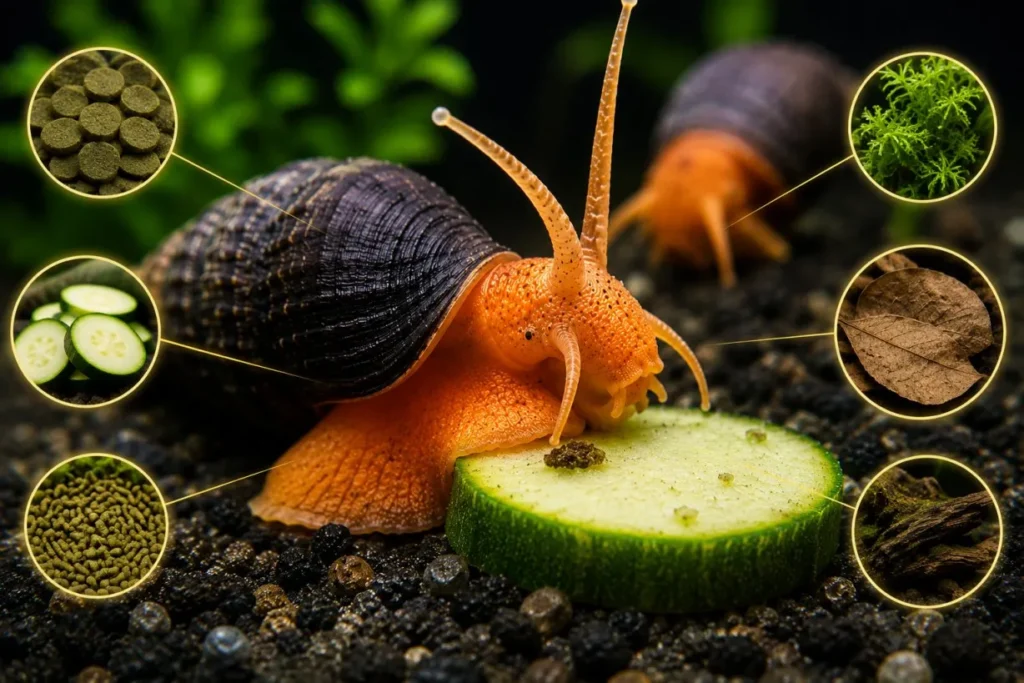
Orange rabbit snails are detritivores and herbivores — they graze algae, biofilm, and decaying plant matter. In a mature planted tank, they can largely feed themselves. But if you want them healthy and breeding, supplemental feeding matters.
What to Feed Orange Rabbit Snails:
- Algae wafers — the standard. Drop one near them at night; they’ll find it. Hikari Algae Wafers and Omega One Veggie Rounds are both widely available at US chain stores like Petco, PetSmart, and online through Chewy.
- Blanched vegetables — zucchini, spinach, kale, cucumber. Blanch for 30 seconds in boiling water, cool, clip or weigh down in the tank. My snails go absolutely wild for zucchini rounds.
- Commercial sinking pellets — Repashy Soilent Green, NLS Algaemax, or similar. These are particularly good for Sulawesi snails because their formulations include spirulina and plant matter.
- Biofilm — established tanks accumulate biofilm on glass, driftwood, and rocks. Orange rabbit snails graze this constantly and it provides important micronutrients.
- Leaf litter — Indian almond leaves (available from US vendors like Flip Aquatics) break down slowly and grow biofilm that these snails love. A secondary benefit: the tannins slightly acidify the water, but your buffering substrate will offset this.
Feed every 2–3 days. Remove uneaten food within 24 hours to avoid ammonia spikes — especially important in smaller tanks.
Important: Do NOT feed them carnivorous foods like bloodworms or meat-based pellets. Orange rabbit snails are not assassin snails. Their digestive systems are herbivore-adapted, and high-protein foods cause digestive issues over time.
Orange Rabbit Snail Breeding (How Do Rabbit Snails Reproduce?)
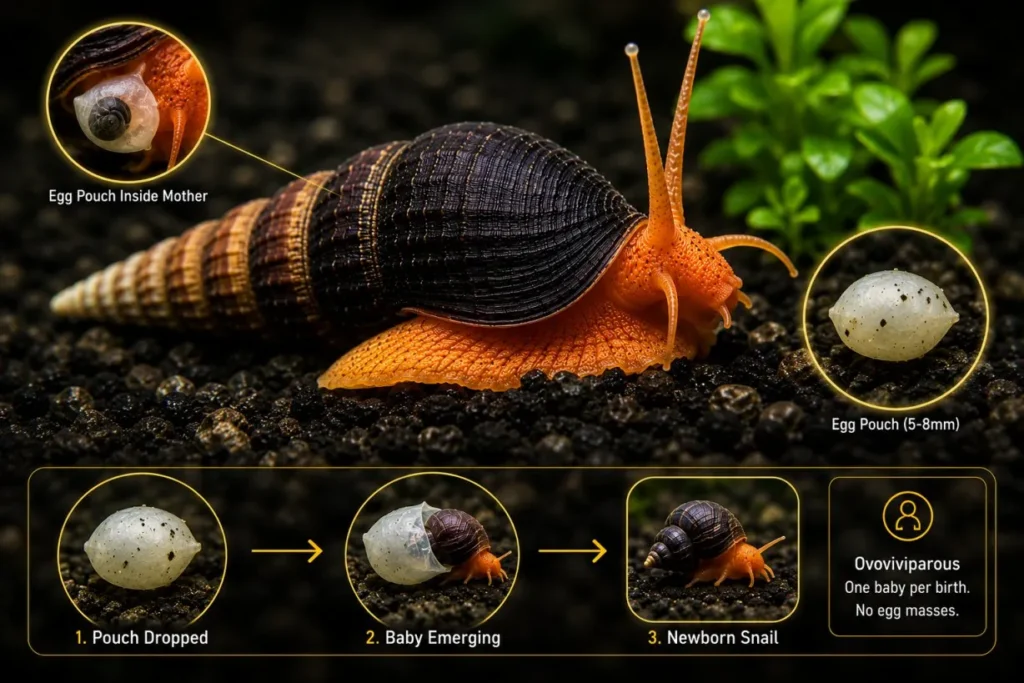
This is the section every competitor either skips or gets wrong. Let me walk you through exactly how do rabbit snails reproduce — because orange rabbit snail breeding is genuinely different from almost every other aquarium snail you’ve kept.
What Do Rabbit Snail Eggs Look Like?
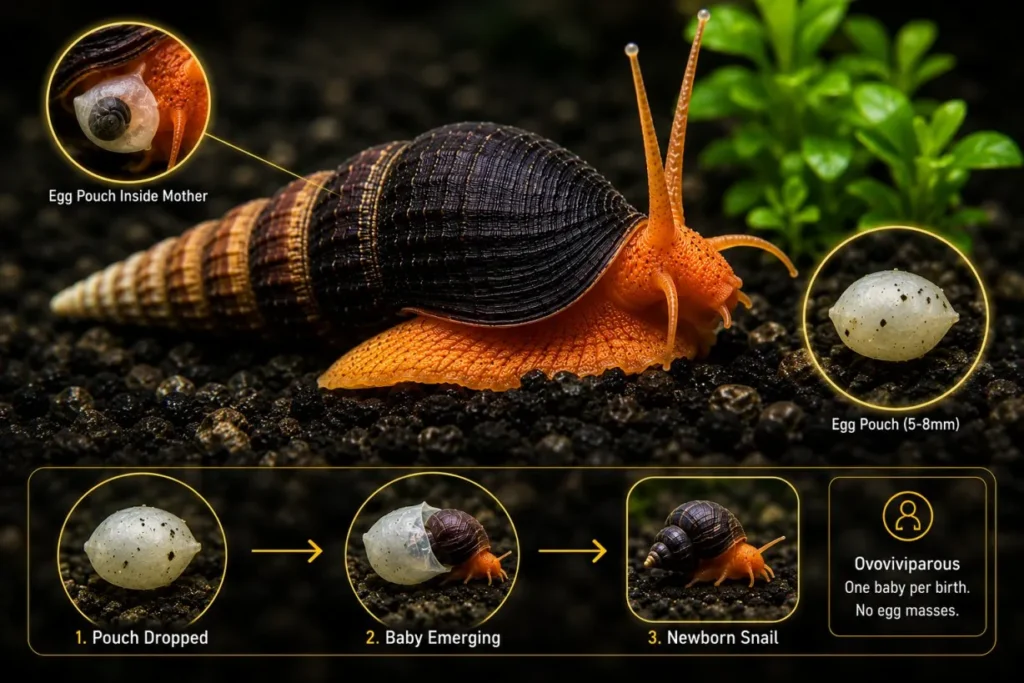
Here’s the thing: orange rabbit snails don’t lay eggs in the traditional sense. They are ovoviviparous — meaning the eggs develop inside the mother’s body, and she gives birth to a single, fully formed juvenile snail enclosed in a small white egg-like pouch.
What do rabbit snail eggs look like? If you spot one, you’ll see a small, whitish, oval-shaped pouch roughly 5–8mm across, often dropped near the substrate. Inside is a single baby snail with a tiny but complete shell. Within hours of being dropped, the baby emerges from the pouch and starts exploring. There’s typically only one baby per birth event.
This is dramatically different from ramshorn snails or bladder snails that lay gel masses of dozens of eggs. You will never get overrun by orange rabbit snails.
Orange Rabbit Snail Reproduction — The Real Timeline
“While exact gestation timelines are difficult to observe due to the snail’s internal anatomy, hobbyist consensus notes an inter-birth interval of roughly 4–8 weeks under optimal conditions. From a purely scientific standpoint, this slow reproductive rate is dictated by their highly unique uterine brooding strategy.” According to the foundational study by von Rintelen & Glaubrecht (2005)
Here’s what that means in practice:
- A group of 5 adults (2–3 females) might produce 12–20 juveniles per year under ideal conditions
- Juveniles grow slowly — expect 6–12 months to reach reproductive maturity
- You will never have an explosion. A 20-gallon with 6 orange rabbit snails won’t become 60. It might become 10–12 after a year.
This slow, controlled reproduction is one of the biggest selling points for US hobbyists who’ve been burned by bladder snail or ramshorn infestations.
How to Encourage Orange Rabbit Snail Breeding
Orange rabbit snail breeding happens most reliably when:
- You have both males and females — they’re not hermaphrodites. Tylomelania requires a mate. Buy at least 4–6 snails to improve the odds of a mixed group.
- Water temperature stays at the warmer end — 80–84°F consistently encourages more frequent reproduction. I run my breeding tank at 82°F.
- Water chemistry is stable and mineral-rich — breeding shuts down under stress. Any parameter swings, and the female will stop producing.
- They’re well-fed — a thin snail doesn’t breed. Make sure they’re getting consistent food with good nutrition.
- The tank is mature and stable — a newly set-up tank with unstable parameters will suppress breeding even if all other conditions look right. Give it a minimum of 6–8 weeks before expecting offspring.
🏆 Expert Insight: The “Volcano” Variant Difference
The volcano rabbit snail (sold under this name by US vendors including Aquatic Arts) refers to forms collected from regions around Sulawesi’s volcanic lake zones. Some hobbyists report these forms are slightly smaller and more prolific breeders than the broader-shell Tylomelania gemmifera forms. The water chemistry needs are essentially identical, but if you’re specifically chasing breeding output, the volcano variant might have a slight edge.
Do Rabbit Snails Eat Other Snails?
No. Orange Rabbit Snails are completely peaceful and herbivorous. They do not harm, chase, or eat other snails—not even small ones. This is one of the most common questions on US aquarium forums, and the fear is entirely unfounded.
In fact, the real concern is quite the opposite: you need to be careful about what might eat them. Orange Rabbit Snails are large and slow-moving, making them easy targets for the following:
- Pufferfish — don’t mix these. Ever.
- Loaches (especially clown loaches and yoyo loaches) — they will crack the shells
- Large cichlids — even if they don’t eat the snail, harassment and stress cause decline
- Assassin snails — there’s some debate, but assassin snails have been known to prey on Tylomelania juveniles
Best tank mates for orange rabbit snails in a US community tank:
- Peaceful small tetras (cardinal tetras, rummy-nose tetras)
- Small rasboras
- Corydoras catfish (excellent companions — same water hardness preference)
- Freshwater shrimp (Neocaridina and Caridina)
- Nerite snails, mystery snails, ramshorn snails
- Otocinclus catfish
Avoid: any fish with a snail-crushing jaw, aggressive cichlids, puffers, and large loaches.
The Mistakes I See US Hobbyists Make Constantly
Mistake #1: Keeping them in soft, acidic water.
Due to certain mistakes we make, these beautiful creatures often die within a short time; in the US, soft water is the leading cause of death for Orange Rabbit Snails. People often keep them in “standard” tropical community tanks with a pH of 7.0 and a hardness of 4 dGH. Initially, the snails survive, but then their shells begin to develop pits; eventually, they stop eating and die within 3–4 months. It may seem like a “mysterious illness,” but in reality, it is caused by improper water chemistry.
Mistake #2: Overcrowding in a small, uncycled tank.
These are Sulawesi animals. Even a slight ammonia spike causes visible stress — retraction, not eating, shell degradation. They’re not forgiving of cycling errors the way goldfish are.
Mistake #3: Buying them from generic pet stores with standard tropical water.
Big box stores in the US often keep all snails in the same tank at neutral, soft water. Orange rabbit snails that have been sitting in pH 7.0, GH 4 dGH water for weeks are already compromised. Buy from specialty vendors (Aquatic Arts, The Shrimp Farm, Flip Aquatics) who keep dedicated Sulawesi setups.
Mistake #4: Panicking over inactivity.
Orange rabbit snails will seal themselves inside their shell for days at a time — this is normal behavior during acclimation, after water changes, or when stressed. Before assuming they’re dead, gently smell near the opening. If there’s no sulfur smell (the definitive death indicator), they’re probably just waiting you out. Give it a week.
Orange Rabbit Snail vs. Other Popular Aquarium Snails
| Feature | Orange Rabbit Snail | Mystery Snail | Ramshorn Snail | Assassin Snail | Nerite Snail |
| Size | 2–5 inches | 1–2 inches | 0.5–1.5 inches | 0.5–1 inch | 0.5–1 inch |
| Breeding Rate | Very slow (1 baby/4–8 weeks) | Moderate (lays egg clusters above water) | Fast (can become pest) | Slow | Doesn’t breed in freshwater |
| Water Requirements | Hard, warm, alkaline | Moderate, hard preferred | Very tolerant | Moderate | Hard preferred |
| Eats other snails? | No | No | No | Yes | No |
| Beginner-friendly? | Intermediate | Yes | Yes (too easy) | Yes | Yes |
| Available in US? | Yes (specialty vendors) | Yes (everywhere) | Yes (everywhere) | Yes (everywhere) | Yes (everywhere) |
| Price range (USA) | $6–20 per snail | $3–8 | Free (pest) | $4–8 | $4–8 |
Orange Rabbit Snail FAQ
What is an orange rabbit snail?
An orange rabbit snail is a large freshwater snail from the ancient volcanic lakes of Sulawesi, Indonesia. Scientifically classified as Tylomelania sp. (genus), they’re known for their vivid orange coloration, elephant-trunk-like snout, and slow, peaceful nature.
How do rabbit snails reproduce?
Rabbit snails are ovoviviparous — the female carries developing young inside her body and gives birth to a single live juvenile in a small white pouch every 4–8 weeks. There are no egg masses; each birth produces just one baby snail.
What do rabbit snail eggs look like?
Rather than traditional eggs, you’ll find a small white oval pouch (roughly 5–8mm) near the substrate. Inside is a single fully-formed juvenile. Within hours of being dropped, the baby snail emerges from the pouch ready to explore.
Do rabbit snails eat other snails?
No. Orange rabbit snails are herbivores and completely peaceful. They will not harm, hunt, or eat any other snail species in your aquarium.
How long do orange rabbit snails live?
With proper care (warm temperature, hard alkaline water, stable parameters), orange rabbit snails live 3–5 years in captivity, with some reports of individuals reaching longer. Poor water chemistry significantly shortens lifespan.
How big do orange rabbit snails get?
The orange giant Sulawesi rabbit snail can reach 3–5 inches (7–12cm) in length. Most individuals in captivity reach 3 inches within 1–2 years.
Can orange rabbit snails live with shrimp?
Yes — they’re excellent tank mates for Neocaridina (cherry shrimp, blue velvet) and Caridina (bee shrimp) in appropriately mineralized water. Neither species bothers the other.
Why is my orange rabbit snail not moving?
Temporary inactivity (1–7 days sealed in shell) is normal after acclimation, water changes, or parameter shifts. Check for a sulfur smell — if absent, give them time. If sealed for more than 10 days or you smell sulfur, the snail may have died.
📌 Next Steps: Resources You Must Read 🔖
Orange rabbit snails are part of a whole world of fascinating freshwater snail-keeping. These posts will round out your knowledge:
- 🐌 Blue Mystery Snail Care Guide — if you’re dealing with mystery snails and considering adding a blue mystery snail, read this first
- 🐌 Rabbit Snail Care Guide — the complete FishioHub care sheet for all Tylomelania variants, including tank setup from scratch.
- 🐌 Rabbit Snail Breeding Guide — deep dive into breeding orange rabbit snails, conditions that trigger reproduction, and raising juveniles.
Final Word: The Snail That Changed How I Think About Aquariums
I’ve kept aquariums in Texas for years. I’ve had cichlid tanks, planted tanks, shrimp tanks. But my Sulawesi community — with these glowing orange snails moving through the dark at night — it’s something different. Quieter. More intentional.
Here’s the thing nobody tells you about keeping orange rabbit snails: they slow you down. In a good way. Because success with these animals isn’t about adding more gadgets or more fish. It’s about getting the water chemistry exactly right, feeding them consistently, and then getting out of the way.
They’ll give birth to one tiny orange baby every couple of months. That baby will grow slowly for a year before you barely notice it. Your tank will never explode with snails. It’ll just quietly, steadily, become more alive.
If you’ve been on the fence — just get them. Set the tank up right, buy from a reputable US vendor like Aquatic Arts or Flip Aquatics, match that hard alkaline water, and watch something remarkable happen.
Got questions about your orange rabbit snail setup? Drop a comment below — I read every one.
Was this guide helpful?
First-Hand Experience
Based on animals I've personally kept and bred - not summarized from other articles.
Zoological Foundation
Claims are checked against my M.Sc. Zoology training and published aquatic biology research, not recycled aquarium myths.
No Paid Influence
No sponsorship shaped this guide. Affiliate links, if any, are disclosed separately and never hidden.
Kept Current
Errors are corrected as soon as they're found, with the update noted at the bottom of the article.
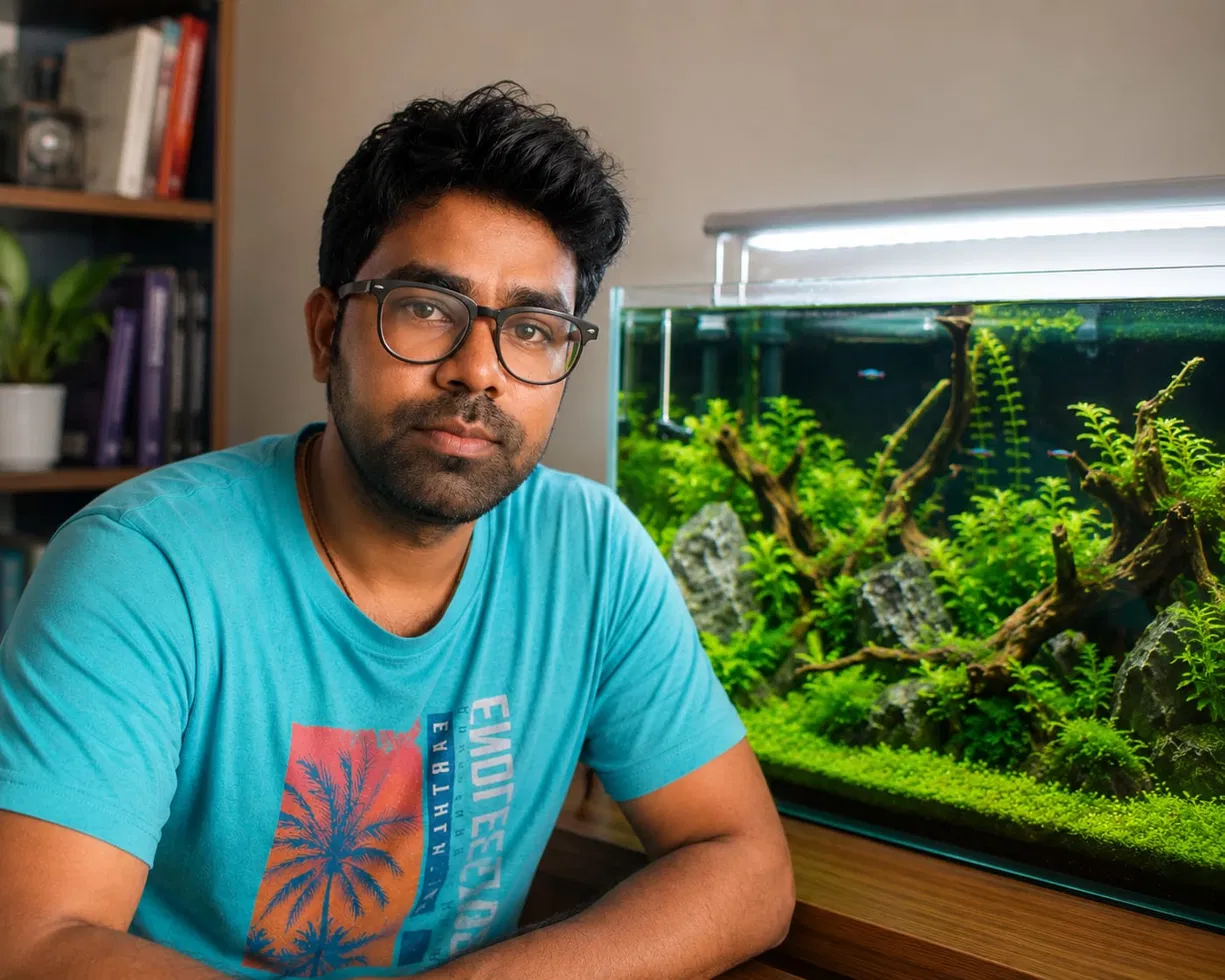
Anil Satak M.Sc. Zoology · Founder, FishioHub
Grew up in a fishing family in India and holds a Master's in Zoology. FishioHub is a one-person operation - every guide is personally researched, kept-tested, and written by Anil. No team, no outsourced writers, no AI-generated content. Read his full bio →