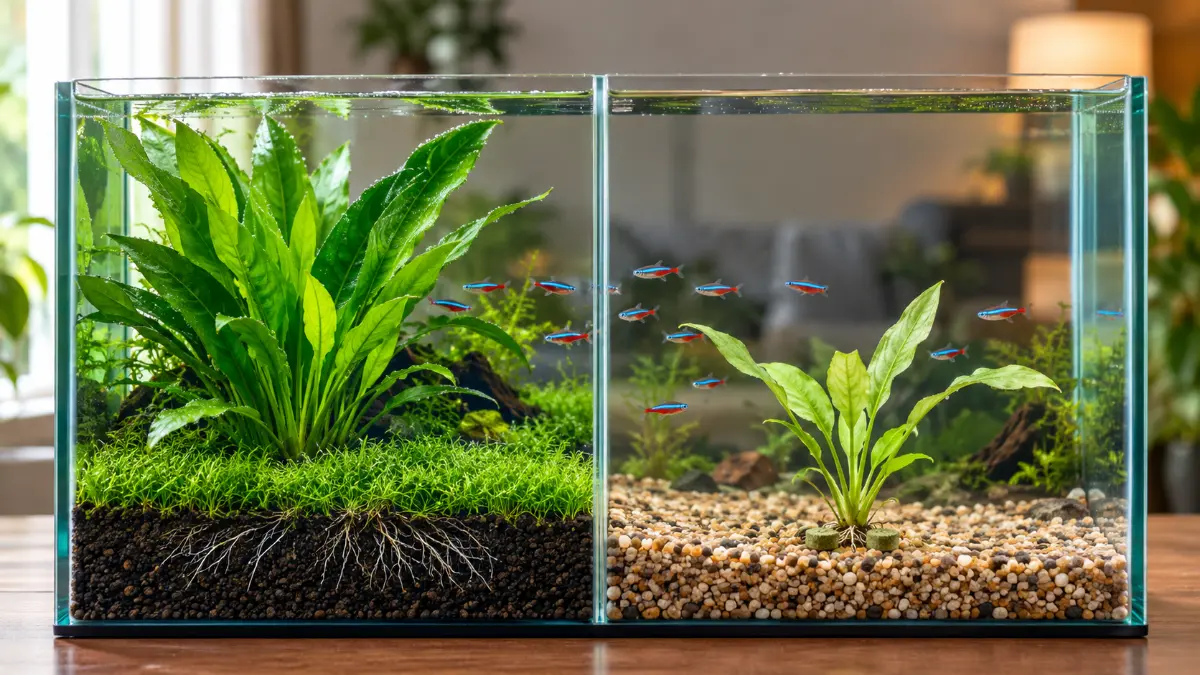
The best substrate for planted aquarium tanks is aquasoil. But your old gravel can grow plants too, if you add root tabs.
Aquasoil contains important nutrients, so roots can start feeding right away. In contrast to aquasoil, Gravel and sand have none, so you have to feed the plants yourself. I’d pick soil for carpets and heavy root plants, and gravel for easy plants and small budgets.
I actually used plain gravel and root tabs in my very first tank, and my Amazon swords grew surprisingly thick. My old betta, Raja, absolutely loved swimming through that budget-friendly jungle.
3 Things to Remember
- Soil has food-Nutrients in it. Gravel and sand don’t.
- Gravel works if you are going to pick easy plants and add root tabs. Still, I think It’s just not the best substrate for planted aquarium carpets.
- Warning: New aquasoil leaks ammonia. Keep fish and shrimp out until your test kit reads 0 ppm.
What Aquarium Substrate Is Best for Plants?
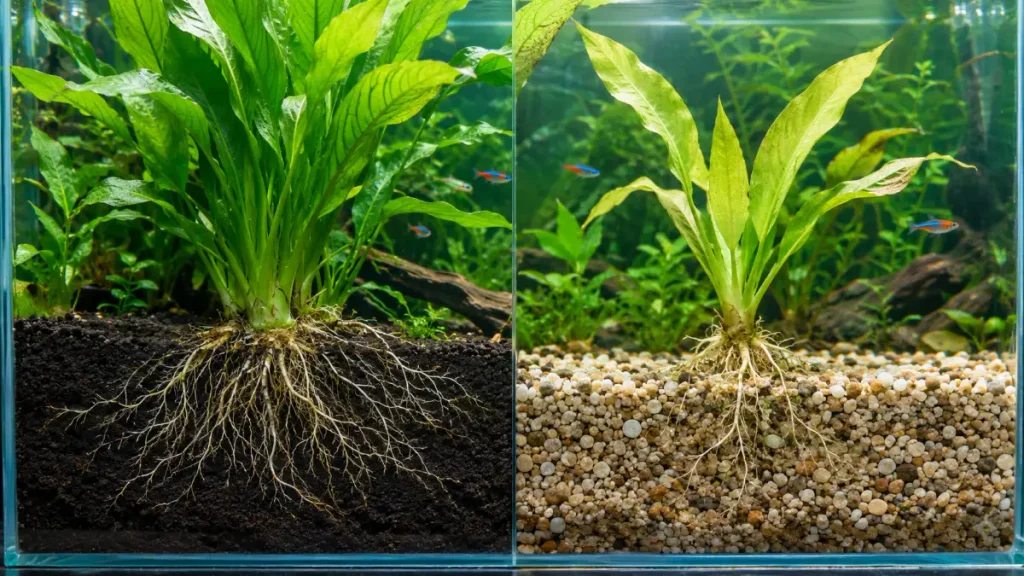
What aquarium substrate is best for plants? I say a nutrient-rich aquasoil, because roots eat from the ground just like garden plants do. That’s why the best substrate for planted aquarium tanks with heavy root plants is soil, not plain gravel.
An experiment also proved the science backs this up, with one catch. In a U.S. Army Corps of Engineers greenhouse study, Hydrilla grew up to 66% less on poor sediment than on fed sediment (McFarland & Barko, 1994).
Hydrilla is a pond weed, not a tank plant. So treat this as a strong hint, not the actual proof.
A similar study found that plants on poor ground grow more roots, as if hunting for food. You see something similar when a sword plant sits in bare gravel.
What Is the Best Substrate for a Planted Aquarium?
The one that fits your plants. Root feeders and carpets want soil, and stem plants are happy with almost anything.
What Substrate Should I Use for Aquarium Plants?
Follow these 3 steps:
- For Heavy root feeders or a carpet? Pick aquasoil.
- Easy plants and a small budget? Pick gravel or sand, then add root tabs.
- Only anubias and java fern? Pick anything. They grow on wood and rock, not in the ground.
What Substrate to Use for Aquarium Plants, by Plant Type
What substrate to use for aquarium plants depends on how each plant feeds:
- Root feeders (Amazon sword, cryptocoryne): soil, or gravel with root tabs.
- Carpet plants (Monte Carlo, dwarf hairgrass): fine soil or fine sand, plus fertilizer. See my carpet plants for beginners guide.
- Stem plants: almost anything. They eat through leaves and roots. See how to plant stem plants.
- Epiphytes (java fern, anubias): no substrate needed. ⚠️ Never bury the rhizome. It rots.
What Substrate to Use for Live Plants in Aquarium Tanks
What substrate to use for live plants in aquarium tanks comes down to effort. Soil is easy on you, but gravel needs a little weekly care.
What Substrate to Use for Planted Aquarium Tanks
What substrate to use for planted aquarium tanks if you’re stuck? Start with your animals, then your budget, then your plants.
Shrimp tank? Shrimp-safe soil. Big messy fish? Smooth sand. Tight budget? Gravel plus root tabs.
What Substrate to Use in a Planted Aquarium: My Quick Pick
In a planted aquarium, I will go with soil with a sand cap. It feeds roots, stays put, and looks clean.
Aquasoil vs Sand vs Gravel for Plants
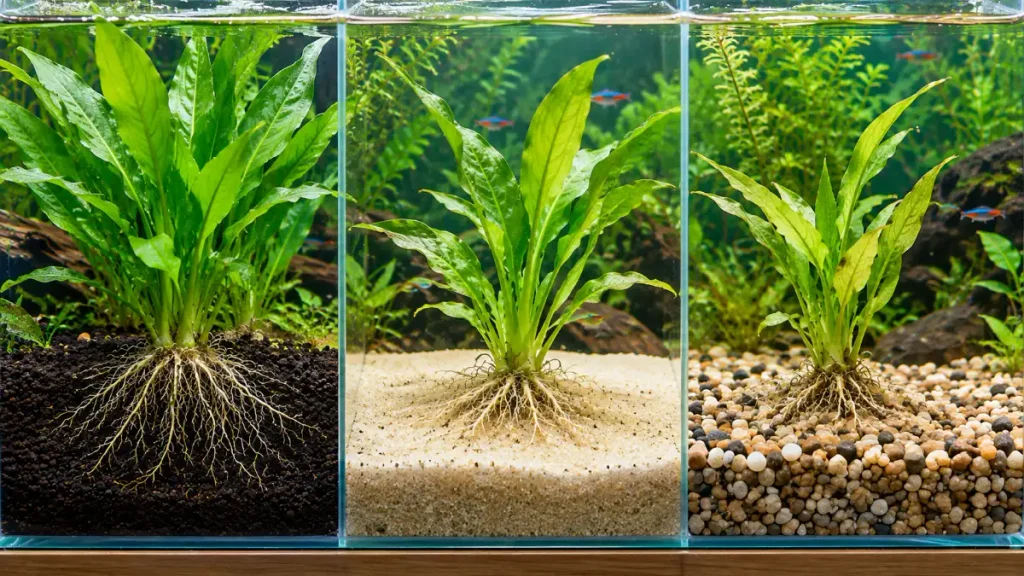
Aquasoil vs sand vs gravel for plants really comes down to food/nutrients, pH, and price. Here’s the side-by-side:
| Aquasoil | Sand | Gravel | |
| Food for roots | Yes | No (inert) | No (inert) |
| Root feeders | Excellent | Poor without tabs | OK with tabs |
| Effect on pH | Lowers pH, softens water | None | None |
| Ammonia at start | Yes, for weeks | No | No |
| Price | Highest | Low | Low |
| Best for | Carpets, root feeders, shrimp tanks | Bottom feeders, easy plants | Beginners, easy plants |
On a budget, I still pick gravel plus tabs. For the best substrate for planted aquarium results, I pick soil under a cap.
Aquarium Substrate vs Soil: What’s the Difference?
Aquarium substrate vs soil is a bit of a trick question. Soil is just one kind of substrate. “Substrate” means anything that covers your tank floor.
The real question is aquasoil vs ordinary soil from a bag. Aquasoil is actually made for tanks, and bagged soil is not. That’s why the best substrate for planted aquarium health is one made for tanks.
⚠️ Warning: I do not recommend garden soil or potting mix that has fertilizer, pesticides, or a mystery history. It can rot into ammonia and cloud your water. So strictly avoid it.
The Walstad method does use plain organic potting soil under a cap. If you try it, read the label first. Look for no fertilizer, no perlite, no vermiculite, and no wetting agents (Walstad, Ecology of the Planted Aquarium).
Best Soil Substrate for Planted Aquarium Tanks
Pick a real aquasoil made for tanks, like ADA Amazonia, Fluval Stratum, or Tropica’s aquarium soil. They’re made to hold their shape and not turn to mud.
Will Gravel Substrate Grow Aquarium Plants?
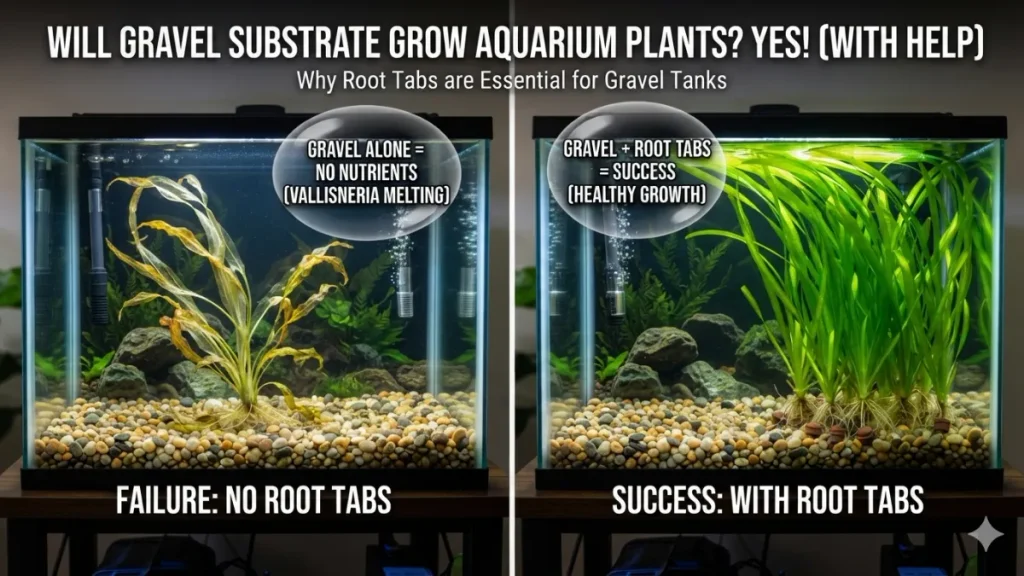
Yes, if you pick easy plants and feed them. Gravel holds the roots in place, but it has no nutrients. That’s why it is not considered the best substrate for planted aquarium tanks full of heavy root feeders.
The Corps of Engineers tested this on pond plants too. Sandy sediments grew plants poorly, and the cause was nutrients, not texture (Barko & Smart, 1986). So the fix for gravel is the same as for sand: add food.
Myth: “Gravel can’t grow plants.” It can. It just can’t feed them.
I made the mistake of rushing out to buy a premium Vallisneria species, planting it directly into a fresh gravel bed without adding any root tabs. Within a week, the leaves turned completely translucent and melted away because the roots had absolutely nothing to feed on.
Can You Do a Planted Aquarium With Gravel Substrate?
Yes. Do these 3 things:
- Pick easy plants.
- Add liquid fertilizer for leaf feeding.
- Push root tabs near the roots of hungry plants.
⚠️ Skip hard carpets like Monte Carlo until you try soil.
Can Aquarium Plants Survive in Gravel Substrate?
Most easy ones do, like vallisneria, cryptocoryne, and simple stem plants. Amazon swords survive too, but they sulk without root tabs.
Root Tabs for Gravel
Root tabs for gravel are small fertilizer capsules you push into the ground. Put one near each hungry root plant. Follow the pack for spacing and refill time, because every brand is different.
Can I Separate Aquarium Gravel From Plant Substrate?
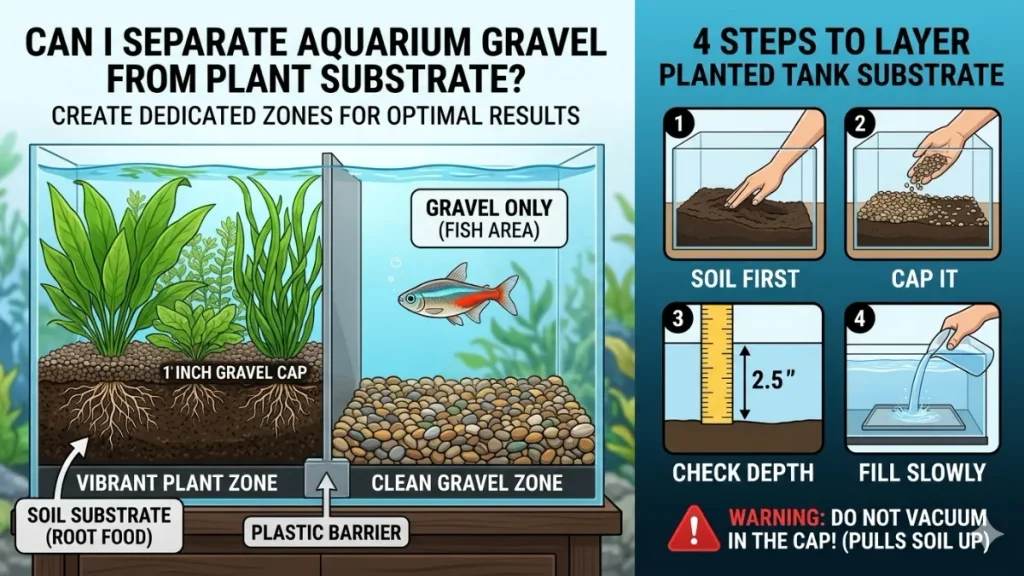
Yes, and it’s smart when your fish like gravel but your plants want soil. A soil zone gives you the best substrate for planted aquarium roots, with gravel everywhere else.
Use a rock line or a plastic strip, and push it down to the glass. If it’s loose, the two layers will slowly mix.
How to Layer Substrate in Planted Tank (4 Steps)
How to layer substrate in planted tank setups, one step at a time:
- Soil first. Spread about 1 inch of soil, higher at the back.
- Cap it. Add 1 to 1.5 inches of sand or fine gravel on top. The cap keeps soil from clouding the water.
- Check depth. About 2 to 2.5 inches total is a common planted-tank depth.
- Fill slowly. Pour water onto a plate or bag so you don’t dig craters.
This soil-under-sand setup is the best substrate for planted aquarium growth with the fewest problems.
⚠️ Don’t push your gravel vacuum deep into the cap. You’ll pull soil up with it.
The Aquasoil Ammonia and pH Warning
Even the best substrate for planted aquarium growth has a catch. New aquasoil releases ammonia into the water.
How much depends on the brand and the bag. One US shop says fresh ADA Amazonia can spike to about 2 ppm, while another shop’s guide reports 4 to 8 ppm. So test, don’t guess.
It also pulls pH down. In one shop’s test with hard tap water (pH 7.5 to 8), new Amazonia dropped pH to about 6.2 within 2 days.
That’s great for shrimp and soft-water plants. It’s rough on fish that like hard water. See my pH levels guide and my ammonia guide.
How to cycle new aquasoil (5 steps):
- Add the soil, fill the tank, and run the filter.
- Do big daily water changes in week one. Many shops suggest about 50%.
- Test ammonia every other day.
- Keep fish and shrimp out until ammonia and nitrite both read 0.
- Then switch to normal weekly water changes.
Best Substrate for Planted Aquarium by Tank Type
Best Substrate for Planted Aquarium With Fish
Substrate for a planted aquarium with fish: I will choose a smooth, fine grain, since bottom feeders like corydoras dig. Soil under a smooth sand cap is a great mix.
Best Substrate for Planted Aquarium With Shrimp
A shrimp-friendly soil, like Fluval’s Plant & Shrimp Stratum, will be a very good option. Cycle it first, because ammonia is deadly to shrimp.
Best Substrate for Planted Aquarium for Beginners
Go with fine gravel or sand, root tabs, and easy plants. No ammonia spike, no pH swings, and nothing costly to waste while you learn.
Best Substrate for Planted Freshwater Aquarium
Best substrate for planted freshwater aquarium setups? Aquasoil if you want lush growth, or capped inert sand if you want it simple.
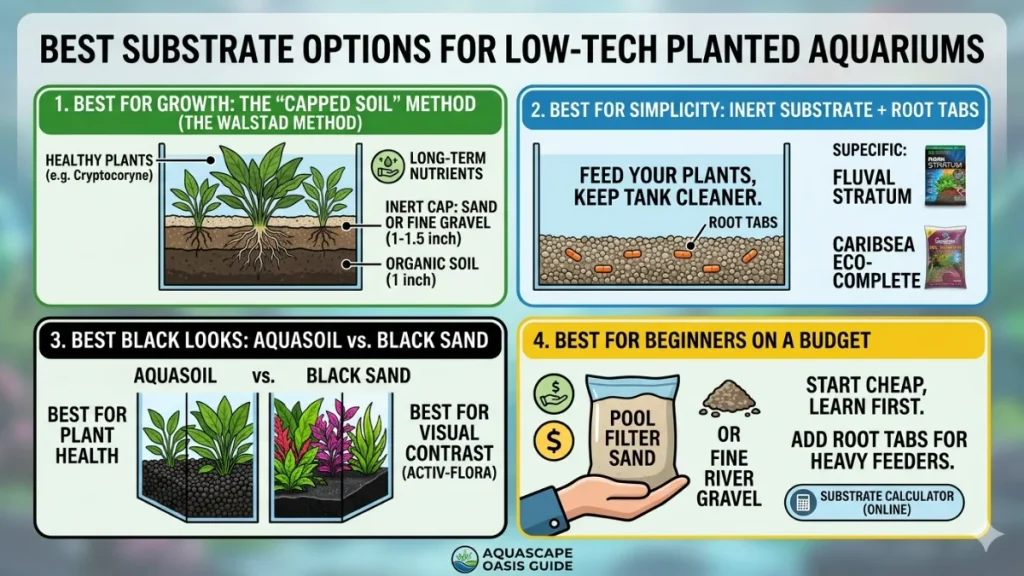
Best Substrate for Low Tech Planted Aquarium
Best substrate for low tech planted aquarium builds? Inert ground with root tabs, or the capped-soil method. Pair it with my no CO2 plants list.
Want to skip the filter? See my no-filter tank guide.
Best Black Substrate for Planted Aquarium
Best black substrate for planted aquarium looks? Dark aquasoil if you want plants to grow, or black inert sand for contrast. PetSmart sells Activ-Flora Floracor Black as a planted-tank option.
⚠️ Check the pack says aquarium-safe, because coated gravel can chip.
Cheap Substrate for Planted Tank
Use fine gravel or sand with root tabs. Rinse it well, and skip anything not labeled aquarium-safe.
Best Substrate for Beginner Planted Tank
Best substrate for beginner planted tank budgets? Start cheap, learn, then upgrade on your next tank. Use my substrate calculator to see how much to buy.
FAQ
What is the best substrate for planted aquarium tanks?
Aquasoil for most tanks, because it feeds roots. Sand or gravel with root tabs works for easy plants and tight budgets.
What substrate to use in a planted aquarium?
Match it to your plants. Root feeders and carpets want soil. Stem plants and epiphytes are fine with gravel or sand.
Can I use regular gravel for live plants?
Yes. Pick easy plants, add liquid fertilizer, and use root tabs.
Do root tabs work in gravel?
Yes. They feed roots directly, which plain gravel can’t do.
Is sand or gravel the best substrate for planted aquarium tanks?
Neither one feeds plants. Sand is gentler on bottom feeders. Gravel lets water move through more easily.
How deep should substrate be in a planted tank?
About 2 to 2.5 inches total is common. Go a bit deeper at the back for a slope.
How long does new aquasoil leak ammonia?
Plan on 2 to 4 weeks, sometimes longer. Test until ammonia reads 0 before adding livestock.
Can I use garden soil in my fish tank?
I wouldn’t. Soil with fertilizer, pesticides, or an unknown history can rot into ammonia. Use proper aquasoil, or plain organic potting soil with no additives, under a good cap.
Next Steps: Resources You Should Read
Related FishioHub reading
- How to Plant Freshwater Aquarium Plants
- Aquarium Plants That Don’t Need CO2
- Aquarium Substrate Calculator (Sand & Gravel)
Scientific references
- McFarland, D.G. & Barko, J.W. (1994). Growth and Rooting Depth Characteristics of Hydrilla verticillata and Myriophyllum spicatum on Fertilized and Unfertilized Sediments. Technical Report A-94-2, U.S. Army Corps of Engineers Waterways Experiment Station.
- Barko, J.W. & Smart, R.M. (1986). Effects of Sediment Composition on Growth of Submersed Aquatic Vegetation. Technical Report A-86-1, U.S. Army Corps of Engineers.
- Walstad, D. Ecology of the Planted Aquarium.
USA aquarium resources
- Greater Washington Aquatic Plant Association, a US planted-tank hobbyist club
- The Shrimp Farm: Cycling Aquasoil Amazonia
Closing
While you are going to buy any substrate, remember a very simple thing: Plants don’t care about brands or pretty tanks. They care about what’s under their roots.
The best substrate for planted aquarium success is the one they can eat from. Give them something to hold, something to eat, and a little patience. That first new leaf will make it all worth it.
I will summarise this whole insight as “Don’t go for the best substrate”; go for “Valuable substrate for plants”.
Was this guide helpful?
First-Hand Experience
Based on animals I've personally kept and bred - not summarized from other articles.
Zoological Foundation
Claims are checked against my M.Sc. Zoology training and published aquatic biology research, not recycled aquarium myths.
No Paid Influence
No sponsorship shaped this guide. Affiliate links, if any, are disclosed separately and never hidden.
Kept Current
Errors are corrected as soon as they're found, with the update noted at the bottom of the article.

Anil Satak M.Sc. Zoology · Founder, FishioHub
Grew up in a fishing family in India and holds a Master's in Zoology. FishioHub is a one-person operation - every guide is personally researched, kept-tested, and written by Anil. No team, no outsourced writers, no AI-generated content. Read his full bio →