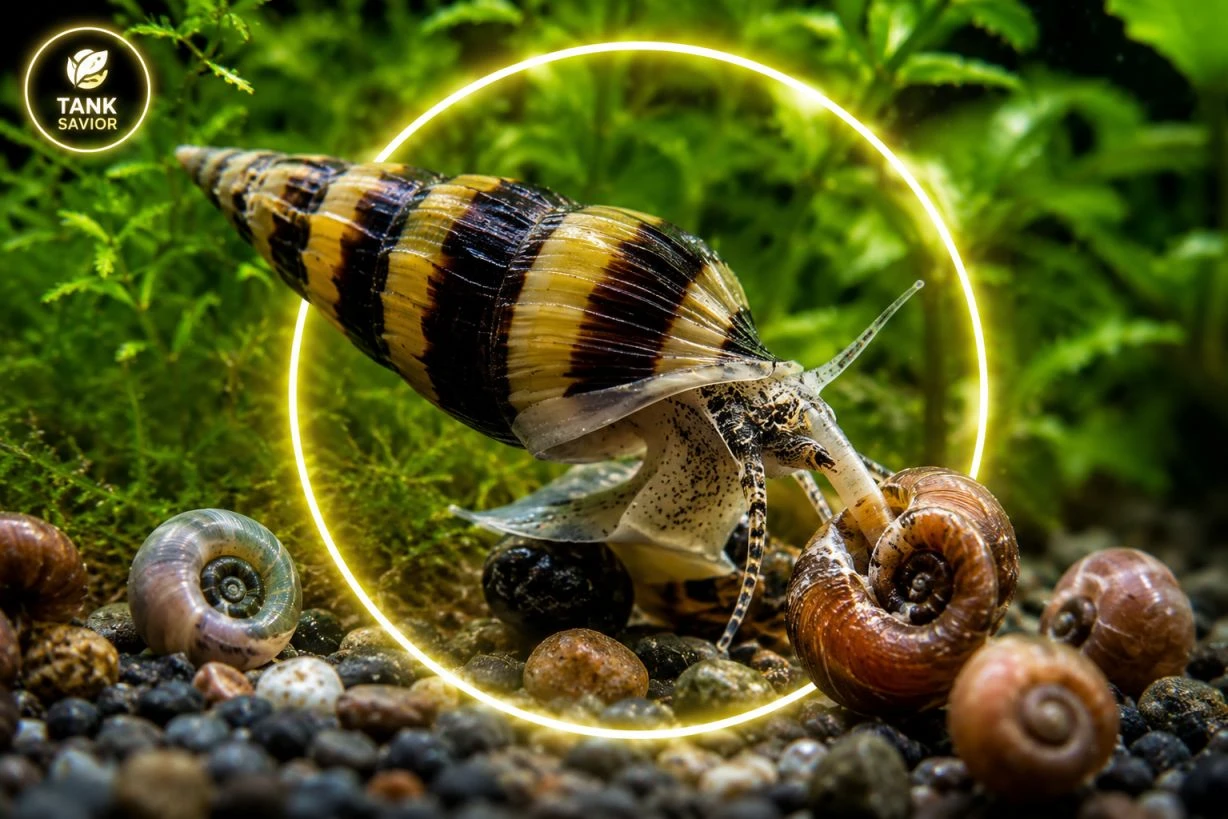
There is a specific reason why I am writing this post about Assassin Snail care: I can never forget the morning I discovered—to my surprise—that around 400 Ramshorn snails had suddenly taken over my community tank. For a few days, I was so baffled that I simply watched; eventually, they completely overran the tank.
Then, during a casual conversation, the owner of my local fish store gave me six small, cone-shaped snails with yellow and brown striped shells, saying, “These will fix the problem.”
He was right. Within a month, that swarm of snails was gone. And to be honest? Those ‘Assassin Snails’ became my favorite inhabitants of that tank.
Quick Answer: Assassin snail care is straightforward for most hobbyists. They need a 10-gallon minimum tank with soft substrate, stable water parameters (pH 7.0–8.0, temp 75–80°F), and a diet of other snails plus high-protein supplements. They’re slow breeders, low-maintenance, and genuinely fascinating to watch hunt.
What You’ll Get in This Post
- What assassin snails look like and how to spot a healthy one at the store
- Assassin snail care guide — tank setup, water, substrate, the works
- What do assassin snails eat, and how to feed them when pest snails run out
- The shrimp question everyone asks (and the real answer)
- Assassin snail lifespan and how long they actually live
- Assassin snail eggs — what they look like and how breeding works
- FAQ targeting every question you’re probably googling right now
Jump to: What They Look Like | Tank Setup | Feeding | Breeding & Eggs | FAQ
What Do Assassin Snails Look Like?
Before you buy one, you need to know you’re getting the real deal — and not some random trumpet snail the pet store mislabeled.
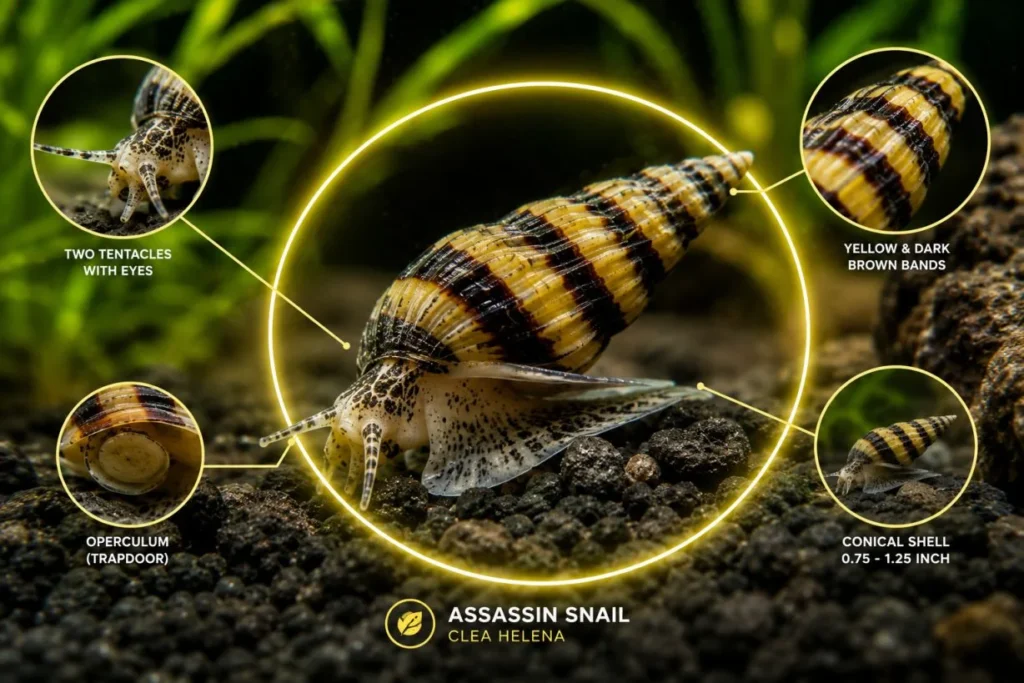
Assassin snails (Clea helena, formerly Anentome helena) have a distinctive conical shell with alternating yellow and dark brown bands that spiral from tip to opening. The pattern looks almost like a tiny, candy-striped ice cream cone — if that ice cream cone ate other snails for breakfast.
Their body is a creamy beige color with darker speckling. You’ll spot two small tentacles up front with an eye near the base of each. They also have a visible operculum — that little trap door on the back of their foot — which is a sign of a healthy, living snail.
How big do assassin snails get? Adults typically reach 0.75 to 1.25 inches in shell length, with some well-fed specimens in the US hobby pushing close to 1.5 inches. They’re not huge, but they punch above their weight class in a big way.
At the store, look for snails actively moving on glass or decorations. Avoid any floating, motionless on the bottom, or in tanks with sick-looking neighbors.
Why are they called assassin snails?
If you’ve ever watched an assassin snail in action, the name makes perfect sense. These snails don’t spend their days grazing on algae like most aquarium snails. Instead, they actively track down and kill other snails, including common pests such as bladder snails, pond snails, and ramshorn snails. Using a specialized feeding tube called a proboscis, they locate their prey and feed on it with surprising efficiency.
In my experience, few aquarium creatures live up to their name as well as assassin snails do. They may be small, slow-moving, and peaceful toward fish, but when it comes to unwanted snails, they are relentless predators. That’s exactly why aquarists around the world know them as assassin snails—the tiny hunters of the freshwater aquarium.
Assassin Snail Care: The Complete Setup
Tank Size and Substrate
A 10-gallon tank is the recommended minimum, though I personally keep mine in a 20-gallon long, where they have room to patrol. If you’re planning a group of 6 or more (which I’d recommend for breeding), a 20-gallon tank gives them enough territory.
Here’s the part most care guides miss: substrate matters more for assassin snails than almost any other freshwater snail.
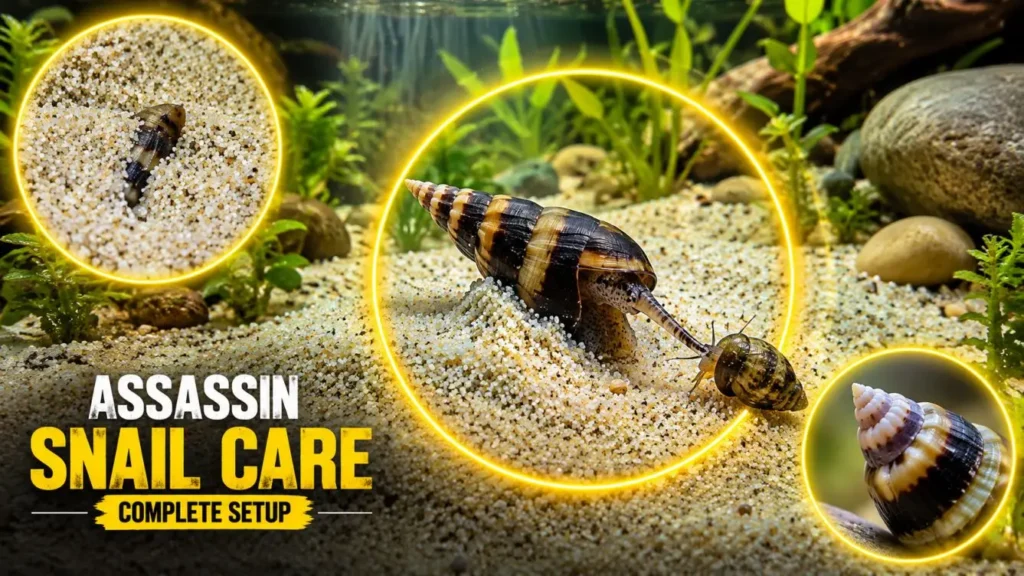
These guys are burrowers. They hunt by partially burying themselves in the substrate and ambushing passing snails. A deep layer (2–3 inches) of fine sand — like pool filter sand or CaribSea Super Naturals — is ideal. They struggle on coarse gravel and will spend more time stressed than hunting.
I learned this the hard way. My first batch went into a gravel-bottom tank and spent three days trying to burrow unsuccessfully. Switched to sand, and within 24 hours, they were doing their creepy little ambush thing like pros.
Water Parameters for Assassin Snails
Assassin snails are native to slow-moving rivers and lakes in Southeast Asia — Thailand, Malaysia, Indonesia — where the water is warm and moderately hard. In the US, most tap water with a dechlorinator works just fine, especially in Texas and other hard-water states.
| Parameter | Ideal Range |
| Temperature | 75–80°F |
| pH | 7.0–8.0 |
| Hardness (GH) | 8–15 dGH |
| Ammonia / Nitrite | 0 ppm |
| Nitrate | Under 20 ppm |
| Tank Size (min) | 10 gallons |
One critical note: Like all snails, assassin snails need calcium for healthy shell growth. A hardness below 5 dGH can cause pitting and cracking in shells — which I’ve seen in soft-water setups in the Pacific Northwest. Add a cuttlebone or crushed coral to the filter media if your tap runs soft.
According to a 2019 study published in the Journal of Molluscan Studies, Clea helena exhibits the highest activity rates at temperatures between 26–28°C (78–82°F), with feeding behavior declining notably below 23°C. That’s your science-backed reason to keep that heater cranked properly.
Filtration and Flow
A standard sponge filter or HOB filter works great. Assassin snails prefer low-to-moderate flow — again, matching their native slow-river habitat. Strong flow stresses them and can prevent burrowing behavior.
Avoid using copper-based medications anywhere near assassin snails. The EPA classifies copper as highly toxic to mollusks even at concentrations as low as 0.02 mg/L — far below levels used in some fish treatments. One careless dose of a copper medication once wiped out an entire assassin snail colony in a tank I saw at a local aquarium club meeting in Austin. Heartbreaking.
Assassin Snail Feeding: What Do Assassin Snails Eat?
This is the fun part. And also the part where reality sometimes bites new keepers.
Assassin snail diet — What does assassin snail eat? Natural
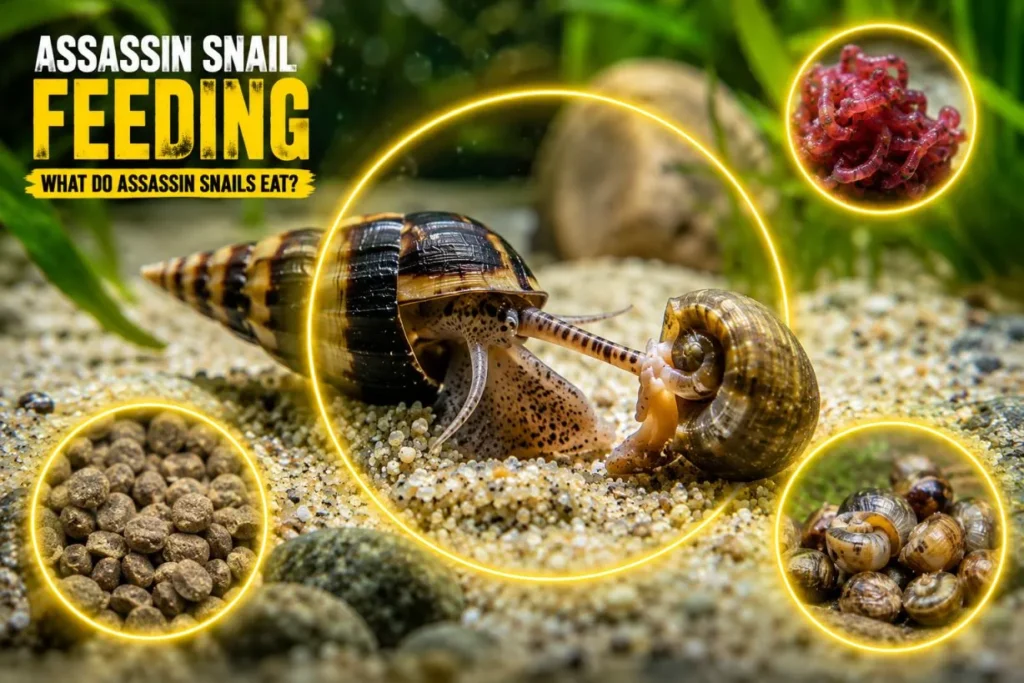
In the wild and in your tank, assassin snails are carnivorous predators. Their primary and preferred food is other snails — particularly smaller, soft-bodied pest snails like ramshorns, bladder snails, and Malaysian trumpet snails. They use their proboscis (a long, retractable feeding tube) to essentially drill into the prey snail’s shell and consume the soft body. It’s brutal. It’s efficient. It’s nature.
What do assassin snails eat when pest snails run out? This is the question nobody warns you about. Once they clear your tank — and they will — you need a backup plan:
- Sinking shrimp pellets (Hikari, Omega One)
- Bloodworms (frozen or freeze-dried)
- Blanched meaty proteins like small pieces of shrimp or fish fillet
- Snail pellets — yes, you can buy feeder snails (bladder snails breed like crazy and are free in most LFS tanks)
I keep a small 5-gallon “bladder snail farm” going specifically to feed my assassins. It costs nothing and solves the diet problem entirely.
Do assassin snails eat algae? No — and this is a common misconception. They are not algae eaters. Don’t count on them for algae control. If you’ve got algae, you need nerite snails or a bristlenose pleco, not assassins.
Assassin Snail Feeding Schedule
Feed every 2–3 days if supplementing beyond pest snails. These guys are slow metabolizers — they’re not rushing to the surface like guppies. Drop a pellet near where they typically burrow, and they’ll find it overnight.
Will Assassin Snails Eat Shrimp? (The Honest Answer)
When you are buying assassin snail for an aquarium, this is the #1 question in every hobbyist forum, and the answer is: it depends, but probably not in a healthy adult shrimp colony.
Here’s the nuance the other care guides gloss over:
Assassin snails can and will eat shrimp eggs, very small shrimp fry, and injured/molting shrimp that are essentially defenseless. There are documented cases in the US shrimp-keeping community of assassins targeting freshly molted Neocaridina. I’ve seen it myself exactly once in four years of keeping both together.
Healthy, active adult shrimp — cherry shrimp, amano shrimp — are generally too fast and aware. The risk is real but low in a well-planted, spacious tank. If you’re running a serious Neocaridina breeding operation, I’d be cautious. If you’ve got a community tank with some cherry shrimp and a snail problem, you’re probably fine.
Does assassin snail eat shrimp? The safer alternative: remove assassin snails after the pest snail population is controlled.
Assassin Snail Lifespan: How Long Do Assassin Snails Live?
Assassin snails live approximately 2–3 years in captivity under good conditions — some hobbyists have reported individuals reaching closer to 5 years in stable, well-maintained tanks.
They’re not a burst-and-burn species. They grow slowly, breed slowly, and live quietly. Think of them as the stoic, disciplined Navy SEALs of your cleanup crew — methodical, patient, and surprisingly long-lived.
The biggest assassin snail lifespan killers in captivity are:
- Overly aggressive tank mates — large cichlids will crack their shells
- Copper medications (instant death)
- pH below 6.5 (shell erosion, stress)
- Starvation after pest snails are cleared (slow decline)
Assassin Snail Eggs: Breeding in Your Tank
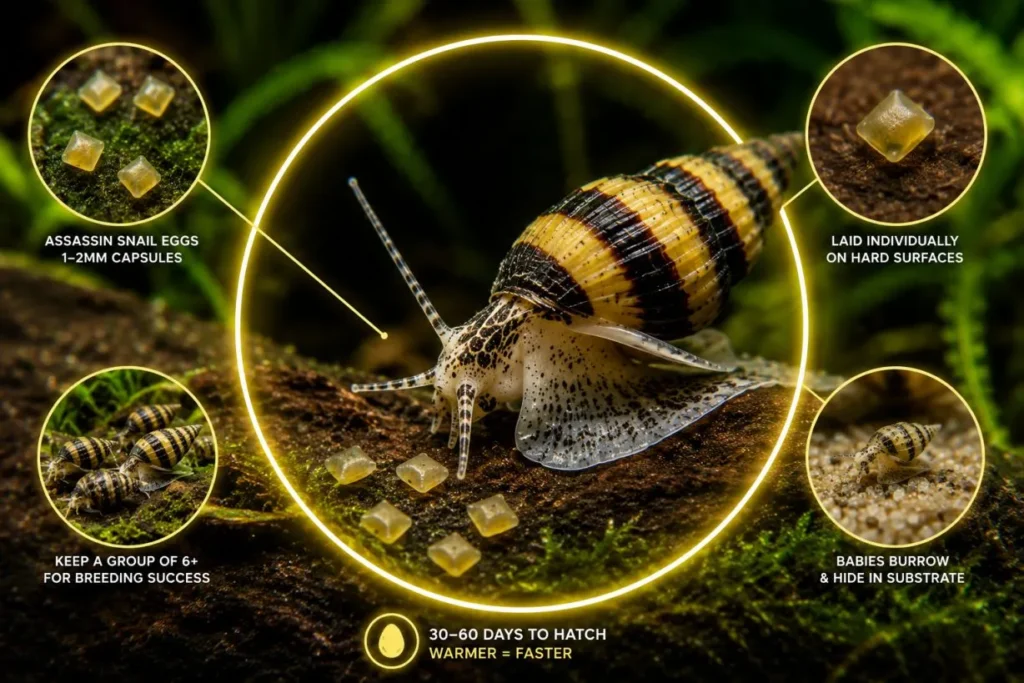
Here’s something interesting that most care guides don’t explain clearly: assassin snails breed very differently from most freshwater snails. Get more detailed information about assassin snail breeding here.
They are not hermaphrodites like ramshorns or bladder snails. They have distinct sexes (though males and females look identical to us). They require a mate to reproduce, and they reproduce slowly — which is actually a feature, not a bug.
What do assassin snail eggs look like?
Assassin snail eggs are tiny, individual, square-ish capsules — almost like minuscule amber or yellowish tiles about 1–2mm across. They’re laid one at a time on hard surfaces: driftwood, plant stems, aquarium glass, or decor. A female might lay 1–5 eggs after mating, and the eggs take 30–60 days to hatch depending on temperature (warmer = faster).
You won’t wake up to 300 baby assassin snails. That’s the beautiful part. Population explosions are basically impossible with this species, which is a massive plus for US aquarists who’ve been burned by bladder snail invasions before.
Baby assassin snails immediately burrow into the substrate and are rarely seen until they’re nearly adult-sized.
How to encourage assassin snail breeding
- Keep a group of 6 or more to ensure you have both sexes
- Maintain water temperature consistently at 78–80°F
- Provide plenty of prey snails — well-fed snails breed more
- Soft, deep sand substrate for egg-laying and juvenile development
A group of 6 assassin snails in a food-rich tank can very slowly build to a self-sustaining colony — some US hobbyists sell surplus assassins at local aquarium club swap meets for $1–3 each.
Tankmates: Who Gets Along with Assassin Snails?
Good tankmates:
- Most peaceful community fish (tetras, rasboras, corydoras, livebearers)
- Larger shrimp like amano shrimp (mostly safe)
- Mystery snails and nerite snails (shells too thick to be prey)
- Rabbit snails (generally too large)
Avoid:
- Copper medication users (fatal to snails)
- Large cichlids, pufferfish, and large loaches — these will eat or harass assassin snails
- Neocaridina breeding colonies (risk to shrimp fry)
Assassin Snail Care: Common Mistakes to Avoid
I’ve made most of these personally. Learn from my errors:
- Soft water — shell erosion in low-GH tanks is slow and sad to watch
- Gravel substrate — they can’t burrow, they stress, they don’t hunt effectively
- Only buying 1–2 — they won’t breed without mates, and you’ll underestimate how many pest snails you actually have
- Forgetting a backup food source — starved assassins after pest snail clearout is a real and avoidable problem
- Adding copper meds to a tank with assassins — I cannot stress this enough
FAQ: Assassin Snail Questions Answered
How long do assassin snails live?
Assassin snails typically live 2–3 years in captivity, with optimal care extending that up to 5 years. Stable water parameters and consistent feeding are the biggest factors.
What do assassin snails eat besides pest snails?
They eat frozen bloodworms, sinking carnivore pellets, blanched shrimp meat, and freeze-dried protein foods. They do not eat algae or plant matter.
Will assassin snails eat shrimp?
They can eat shrimp eggs, tiny fry, and molting adults — but healthy, active adult shrimp are usually fast enough to avoid them. Risk is low but not zero in breeding tanks.
Do assassin snails eat algae?
No. Assassin snails are strictly carnivorous and will not help with algae problems. Use nerite snails or otocinclus for algae control.
How big do assassin snails get?
Most adults reach 0.75–1.25 inches in shell length. Well-fed specimens in warm water can occasionally reach 1.5 inches.
What do assassin snail eggs look like?
Small, individual, square-cornered amber capsules about 1–2mm wide, laid one at a time on hard surfaces. They hatch in 30–60 days.
How many assassin snails do I need for pest snail control?
For a 20–30 gallon tank with a moderate snail infestation, 4–6 assassin snails is a good starting point. Larger infestations or bigger tanks may need 8–10.
Can assassin snails live alone?
They can survive alone but won’t breed. They’re also more active and better hunters in small groups, which triggers natural competitive behavior.
🪸 Next Steps: Resources You Must Read
If you’re building out a snail-friendly community tank or dealing with a freshwater snail situation, these posts go deeper on everything assassins connect to:
- Ramshorn Snail Care Guide — The #1 pest snail assassin target. Understand them, manage them, or embrace them.
- Rabbit Snail Care Guide — A peaceful giant that coexists fine with assassins — and adds serious visual interest.
- Ramshorn Snail Breeding — Want a free, self-sustaining feeder snail colony for your assassins? This is exactly how you set one up.
Final Word: Should You Get Assassin Snails?
If you’ve got a pest snail problem and you want a natural, chemical-free solution that doesn’t involve spending an hour hand-picking snails while questioning your life choices — yes. Absolutely. Get some assassin snails.
They’re peaceful with fish, fascinating to watch, slow to reproduce (no second snail invasion incoming), and genuinely effective. The assassin snail care requirements are minimal compared to most aquarium inhabitants. They don’t need special food when pest snails are present. They’re tough, quiet, and do their job without drama.
And honestly? There’s something deeply satisfying about watching that little striped cone-shell inch deliberately across the sand, close in on an unsuspecting bladder snail, and get to work. It’s the circle of aquarium life, Texas-style.
Get six. Get some sand. Watch them work. You won’t regret it.
Was this guide helpful?
First-Hand Experience
Based on animals I've personally kept and bred - not summarized from other articles.
Zoological Foundation
Claims are checked against my M.Sc. Zoology training and published aquatic biology research, not recycled aquarium myths.
No Paid Influence
No sponsorship shaped this guide. Affiliate links, if any, are disclosed separately and never hidden.
Kept Current
Errors are corrected as soon as they're found, with the update noted at the bottom of the article.
Anil Satak M.Sc. Zoology · Founder, FishioHub
Grew up in a fishing family in India and holds a Master's in Zoology. FishioHub is a one-person operation - every guide is personally researched, kept-tested, and written by Anil. No team, no outsourced writers, no AI-generated content. Read his full bio →