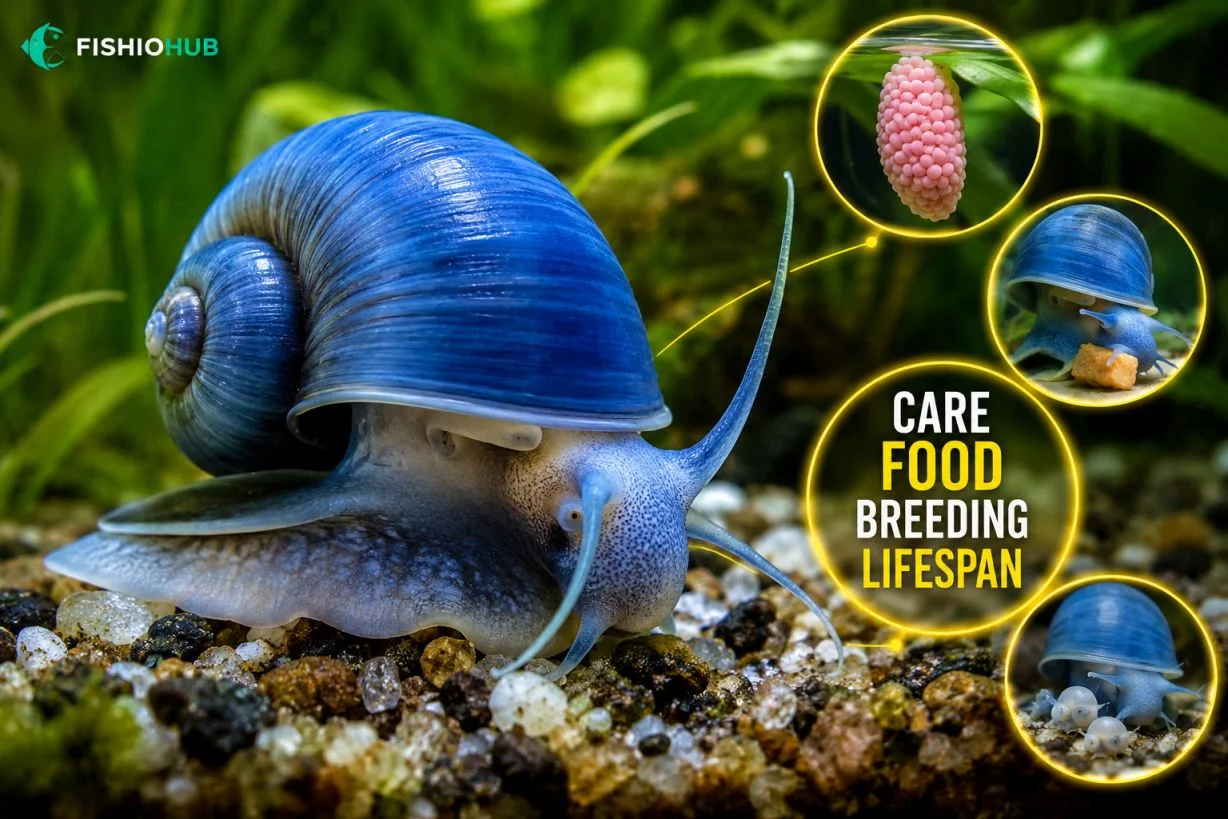
Okay, confession time.
The first time I spotted a blue mystery snail at my local fish store, I genuinely stopped and stared. I stood there with my mouth open while some guy with a 10-gallon fish bag nudged past me. Because I’d kept ramshorn snails, rabbit snails, assassin snails — but this? This was something else. That deep, inky blue-grey shell against a pale ivory body looked like something out of a sci-fi aquascape. I bought two on the spot, knowing absolutely nothing about them.
Big mistake? No — actually, one of the best impulse buys I’ve ever made.
📋 What You’ll Get in This Post
- What Is a Blue Mystery Snail?
- Blue Mystery Snail Size & Lifespan
- Blue Mystery Snail Care: Water & Tank Setup
- Blue Mystery Snail Food: What Do They Eat?
- Blue Mystery Snail Poop: The Real Talk Nobody Covers
- Blue Mystery Snail Breeding & Eggs
- Baby Blue Mystery Snails: Raising the Clutch
- Best Tank Mates
- FAQ
What Is a Blue Mystery Snail?
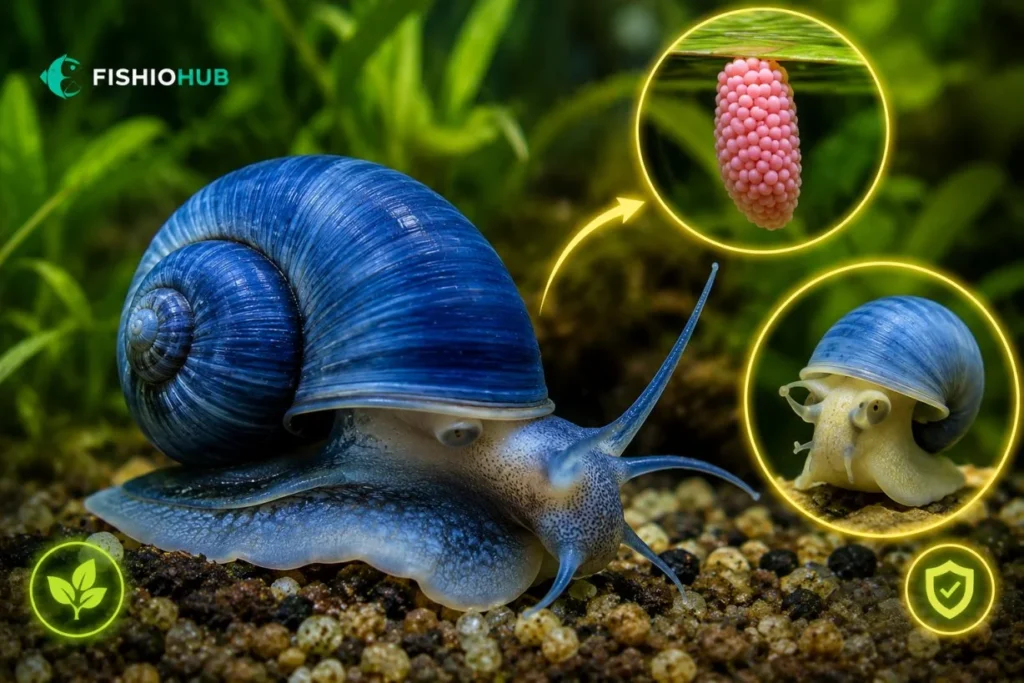
Quick Answer: A blue mystery snail (Pomacea bridgesii) is a color variant of the mystery snail species — a peaceful, fully freshwater snail native to South America. They get their name from the fact that females lay eggs above the waterline, and the babies seem to mysteriously appear in the water one day. The “blue” color refers to their dark, blue-grey shell over a light-colored body.
They are not invasive apple snails. This matters in the USA because Pomacea canaliculata — the giant apple snail — is actually federally regulated in some states due to agricultural damage. Pomacea bridgesii (your mystery snail) is the legal, hobbyist-safe species. If you’re buying from a reputable US retailer, you’re getting bridgesii. But it’s worth knowing the difference.
Blue Mystery Snail Size: Full-grown Blue Mystery Snail
How Big Do They Get?
A full-grown blue mystery snail typically reaches 1.5 to 2.5 inches in shell diameter, with some well-fed specimens hitting close to 3 inches. I measured my biggest one at just over 2 inches — about the size of a large grape, or for my fellow Texans, roughly the same as a medium pecan.
Compare that to Pomacea canaliculata, which can reach 6 inches and is the reason Florida has quarantine zones on certain water bodies. Blue mystery snails are the polite, apartment-sized version of the family.
Blue Mystery Snail Lifespan
Here’s the part that breaks hearts if you don’t know it going in: blue mystery snail lifespan is typically 1–2 years, even under ideal conditions. Research published in Malacologia confirms that most Pomacea bridgesii in captivity live 12–18 months, with some specimens under very stable alkaline conditions reaching 24 months.
When your snail starts slowing down, spending more time on the bottom, and shell growth stops — that’s often natural aging, not disease. I lost my first blue mystery snail after 14 months and genuinely grieved a little. Don’t judge me.
Shell health = lifespan. This is the underrated key. Low pH slowly dissolves their shells — a process called etching — which shortens their life dramatically. More on that below.
How to Take Care of a Blue Mystery Snail: Water & Tank Setup
Blue Mystery Snail Water Temperature
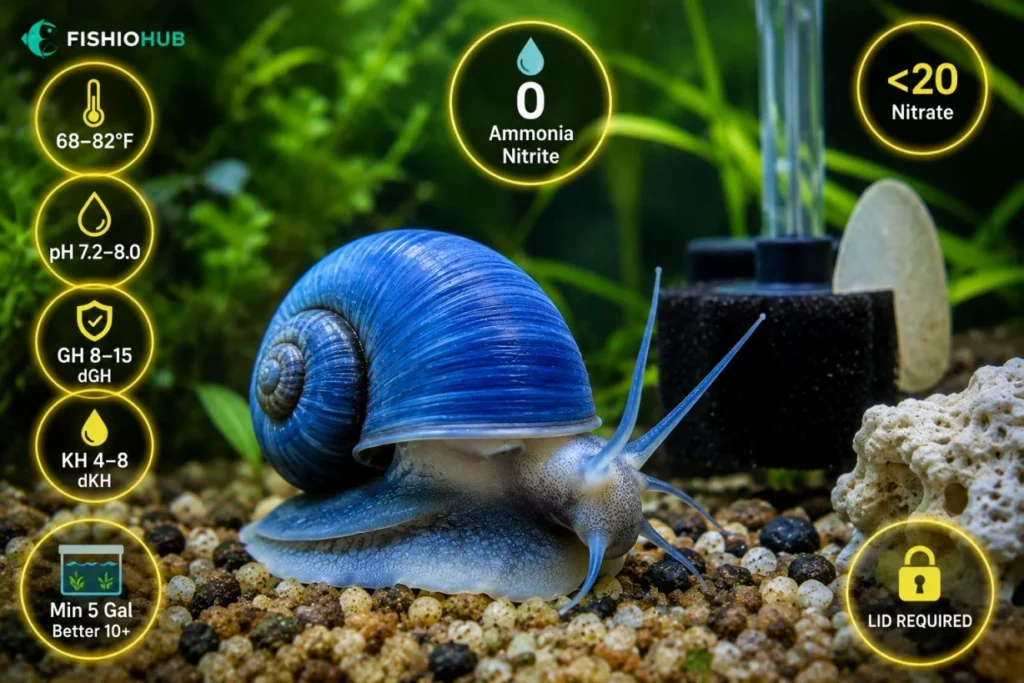
Keep your blue mystery snail water temperature between 68°F and 82°F (20–28°C). The sweet spot is around 72–76°F. In my Texas summers, my fish room can creep up to 80°F without a chiller — they’ve handled it fine.
Cold warning: Below 65°F and they’ll go nearly dormant. Not fatal, but not great for their metabolism or breeding.
Water Parameters at a Glance
| Parameter | Ideal Range | Why It Matters |
| Temperature | 68–82°F | Metabolism, activity, reproduction |
| pH | 7.2–8.0 | Shell integrity — critical |
| GH (Hardness) | 8–15 dGH | Calcium availability for the shell |
| KH (Alkalinity) | 4–8 dKH | pH stability |
| Ammonia/Nitrite | 0 ppm | Lethal even at low doses |
| Nitrate | Under 20 ppm | Long-term health |
The pH/Calcium Problem Most Beginners Ignore
A 2019 study in Aquatic Toxicology found that Pomacea bridgesii shell dissolution accelerated significantly at pH below 6.8, even with adequate calcium in the water. Soft, acidic water will literally eat your snail’s shell while it’s alive. I learned this the hard way when I had a snail in a planted tank buffered with CO2 — the shell started pitting within two months.
Fix: crushed coral in the filter, cuttlebone in the tank, or regular top-offs with hard water. I keep a small cuttlebone wedged behind my sponge filter 24/7 in any tank with mystery snails.
Blue Mystery Snail Aquarium Size
The minimum is a 5-gallon tank, but honestly, a 10-gallon makes life easier and your snail happier. For a small group of 3–4, go 20 gallons. The rule of thumb many US hobbyists use is 1 snail per 2.5 gallons as a loose bioload guide.
Critical: lid required. Mystery snails are escape artists. Not in a cute way — in a “I found it dried out behind my aquarium stand at 2 a.m.” kind of way. Every. Single. Hobbyist. Has a story. A tight-fitting lid with a small gap for gas exchange is non-negotiable.
Blue Mystery Snail Food: What Do They Eat?
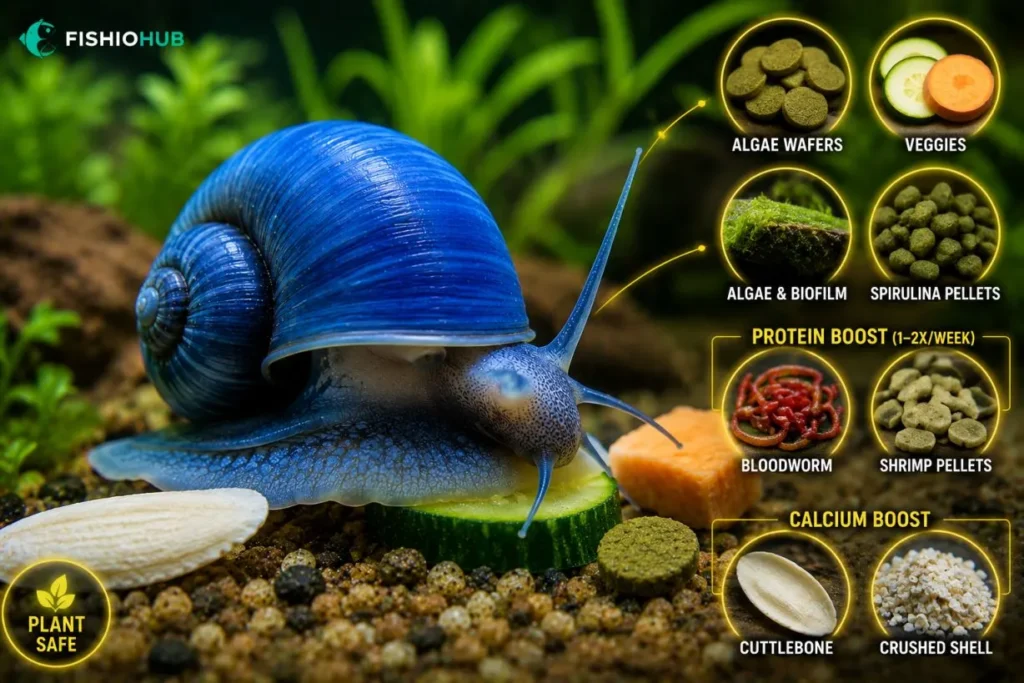
Mystery snails are opportunistic omnivores with a strong lean toward plant matter. In the wild, they feed on decaying vegetation, biofilm, algae, and the occasional protein from decomposing matter along South American riverbanks.
Blue Mystery Snail Food List
Staple foods:
- Sinking algae wafers (Hikari, Repashy) — I go through a ton of Hikari Algae Wafers in my snail tanks
- Blanched vegetables: zucchini, cucumber, spinach, kale, sweet potato
- Biofilm and algae naturally growing on glass and decorations
- High-quality spirulina-based pellets
Supplemental protein (1–2x per week):
- Blanched shrimp pellets
- Small amounts of bloodworm
- Crushed snail-safe pellets
Calcium boosters:
- Cuttlebone (free-floating — they’ll find it)
- Crushed oyster shell in substrate
- Blanched kale (naturally calcium-rich)
What they won’t (usually) eat: Healthy, living plants. Blue mystery snails have a reputation as plant-safe snails — and it’s mostly deserved. They’ll rasp on algae and dead leaves but leave Java fern, anubias, and stem plants alone. Occasionally, soft plants like hornwort or water sprite might get nibbled if they’re hungry. Keep them fed, and your plants will thank you.
Don’t Starve Them for “Tank Cleaning”
I have seen newcomers make this major mistake in every US-based aquarium Facebook group. People buy ‘Mystery Snails’ as tank cleaners but fail to provide them with proper, dedicated food. If your Blue Mystery Snail isn’t eating, there is definitely a problem—either it is sick, the water quality is poor, or it is dying. In my experience, a healthy snail is almost constantly foraging for food.
Blue Mystery Snail Poop: The Real Talk
Nobody wants to talk about it. I will.
Blue mystery snail poop is copious. Like, genuinely surprising for a snail that size. Long, tube-shaped brownish waste. If you have multiple mystery snails in a smaller tank and you’re not on top of water changes, waste builds up fast.
Here’s the genuinely interesting part that competitors seem to skip: snail waste contains partially digested material that is actually beneficial for biofilm and bacterial colonies. Some research in the shrimp hobby world suggests that mystery snail waste acts as a secondary food source for dwarf shrimp, which is why snail-shrimp combos are such a common recommendation. The snails process food; the shrimp scavenge behind them — it’s a mini-ecosystem.
The practical implication: weekly water changes of 20–30% and a good sponge filter are not optional in a mystery snail aquarium. Sponge filters are especially great because snails can’t get sucked into them, unlike powerheads.
Blue Mystery Snail Breeding: Eggs and Reproduction
How Blue Mystery Snail Reproduction Works
Here’s what makes mystery snails so uniquely different from most aquarium snails: they cannot reproduce alone. They are not hermaphroditic like ramshorn snails or trumpet snails. You need a male and a female — and they’ll breed freely without any special intervention from you.
You’ll know mating is happening when you see the male positioned on top of the female’s shell and slightly behind her, for sometimes hours at a time. Don’t panic; don’t disturb them.
Blue Mystery Snail Eggs
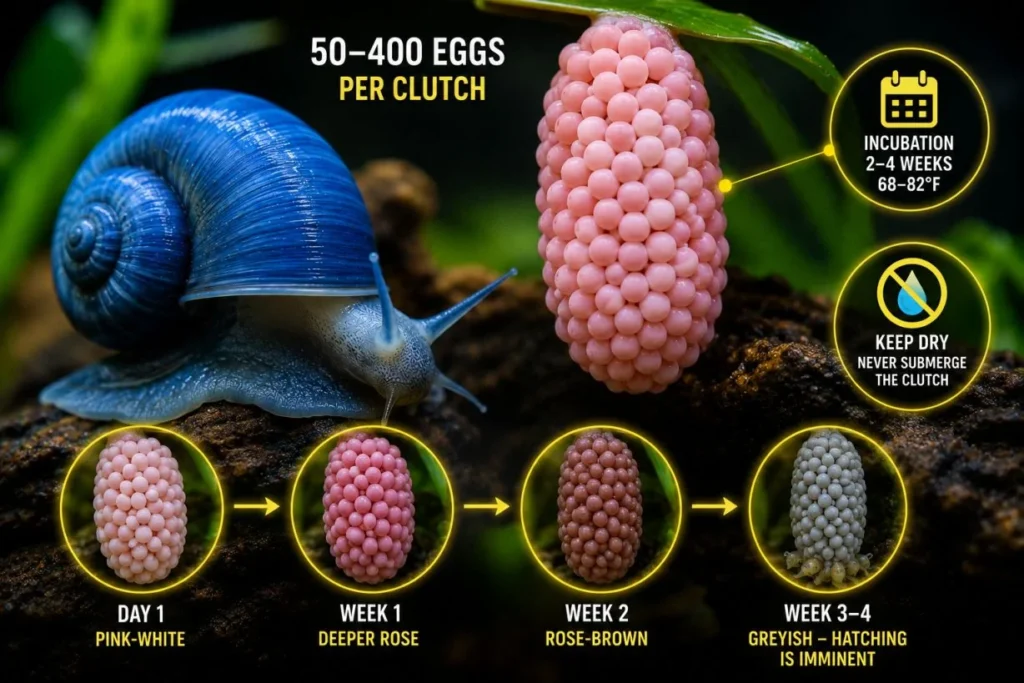
After mating, the female crawls above the waterline to lay her clutch. This is the famous “mystery snail egg cluster” — a calcified, bubblegum-pink mass that looks disturbingly like a tiny raspberry. She might lay it on the aquarium glass, the hood, a hang-on-back filter rim, or the lid itself.
Blue mystery snail eggs facts:
- A single clutch contains approximately 50–400 eggs
- Incubation takes 2–4 weeks depending on humidity and temperature (68–82°F air temperature, high humidity preferred)
- Never submerge the clutch — the eggs need air to develop. They breathe through their outer membrane.
- The eggs start pink-white, darken to a deeper rose-brown as they develop, and just before hatching, you’ll see the clutch turn greyish as the babies absorb the calcium casing
I keep a spray bottle nearby to lightly mist the clutch once a day if my fishroom gets dry. In humid Texas summers, they hatch fine without any intervention.
Blue Mystery Snail Breeding Setup Tips
You do not need a separate tank to breed Blue Mystery Snails—they can breed in a community tank as well. However, to maximize the survival rate of the offspring, it is best to create a dedicated setup for the species featuring a tightly fitting lid (leaving 4–6 inches of air space above the water surface) and a slightly higher temperature—around 76–78°F—to achieve the best breeding results.
Important: In a community tank, the clutch is usually fine above the waterline, but watch for any fish that can jump — a clutch within fin-reach of a large cichlid will disappear. Not that I’m speaking from experience. (I am.)
Baby Blue Mystery Snails: Raising Them
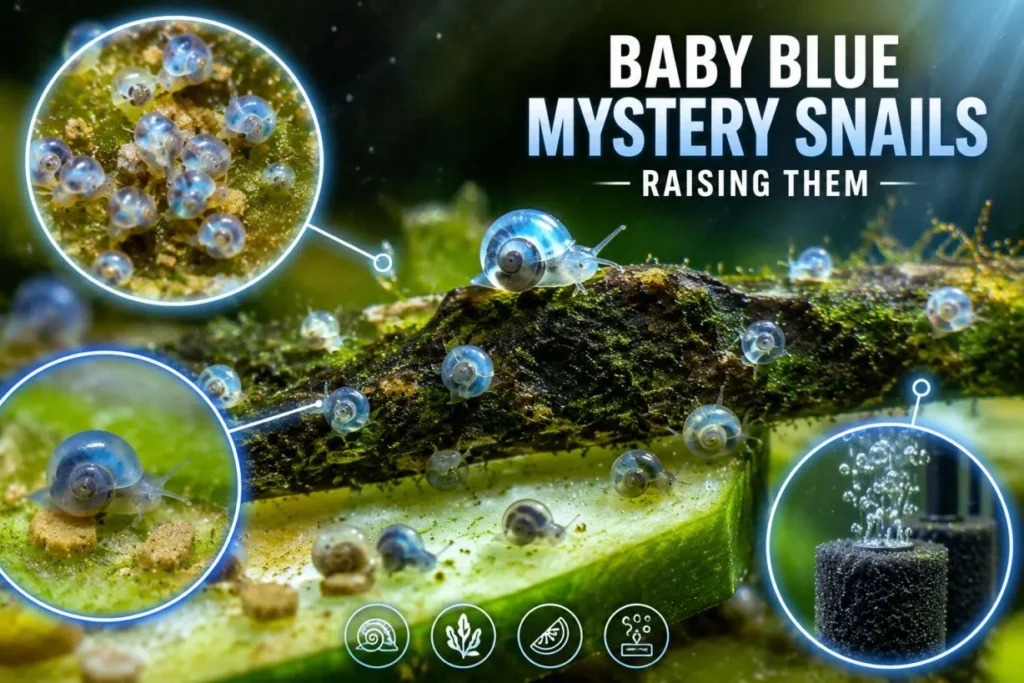
When the clutch hatches, baby blue mystery snails drop into the water — fully formed miniature snails about the size of a pinhead. They are immediately independent and will start foraging.
Feeding baby blue mystery snails:
- Powdered algae wafers or spirulina powder
- Blanched zucchini sliced very thin
- Biofilm is their best early food — don’t overclean a new snail tank
- Baby shrimp foods work well too (I use Bacter AE in fry tanks)
Baby snails are surprisingly hardy. However, the biggest threats to them are:
- Low calcium → deformed shells early on
- Getting sucked into a filter intake (sponge filter only for fry tanks)
- Being eaten by fish (even “snail-safe” species will eat tiny hatchlings)
A small 5-gallon breeder with a sponge filter and plenty of biofilm is perfect for raising a clutch. Once they’re pea-sized (about 3–4 weeks), they can safely go into most community tanks.
Best Tank Mates for Blue Mystery Snails
Blue mystery snails are absolutely peaceful and won’t bother any other tank mates. The worry goes the other direction — what will bother them.
Safe tank mates for blue mystery snails:
- Neon tetras, cardinal tetras
- Corydoras catfish
- Otocinclus
- Dwarf shrimp (cherry, amano)
- Other mystery snail colors
- Small rasboras
Avoid these with blue mystery snail:
- Assassin snails (they will eat mystery snails — read our assassin snail care guide)
- Large cichlids, goldfish
- Clown loaches, yoyo loaches (notorious shell-crackers)
- Pea puffers (they’ll eat snails as fast as you add them)
- Crayfish (will clip antenna and destroy shell)
A note for Texas hobbyists especially: crawfish sold at bait shops are sometimes tempted into tanks. I’ve seen people try it. The snail loses every time.
Mistakes That’ll Wreck Your Blue Mystery Snail
- Overfeeding then ignoring waste — The mini-ecosystem balance breaks down if nitrates climb above 20 ppm
- Soft acidic water — The #1 snail killer disguised as “natural” tank conditions
- No lid — Just trust me on this one
- Removing the clutch — If you don’t want babies, you can let it dry out. But don’t toss healthy clutches into the water — the embryos will die and spike ammonia
- Copper in the water — Many fish medications contain copper sulfate. Hence, their trace amounts are lethal to all invertebrates. Always check medication labels before dosing any tank with snails or shrimp
FAQ: Blue Mystery Snail
What is a blue mystery snail?
A blue mystery snail (Pomacea bridgesii) is a color morph of the mystery snail — a peaceful, freshwater snail from South America with a distinctive dark blue-grey shell and light body. They’re popular in US aquariums for their algae-eating, their striking color, and their easy breeding behavior.
How long do blue mystery snails live?
Blue mystery snail lifespan is typically 1–2 years in captivity. Water quality and calcium levels are the biggest factors — snails kept in alkaline, hard water consistently outlive those in soft, acidic tanks.
What does a full grown blue mystery snail look like?
A full grown blue mystery snail reaches 1.5–2.5 inches in shell diameter. The shell is a deep blue-grey, and the body is pale ivory or cream. Some specimens in exceptional conditions reach 3 inches.
What do blue mystery snails eat?
Blue mystery snail food includes algae wafers, blanched vegetables (zucchini, spinach, kale), biofilm, and the occasional protein source. Calcium supplementation via cuttlebone is important for healthy shell growth.
What temperature do blue mystery snails need?
Blue mystery snail water temperature should stay between 68–82°F. The optimal range for active feeding and breeding is 72–78°F.
How do blue mystery snails reproduce?
Blue mystery snail reproduction requires a male and a female — they are not hermaphroditic. After mating, females lay calcified pink egg clutches above the waterline. Eggs hatch in 2–4 weeks, producing fully-formed baby blue mystery snails.
Why is my blue mystery snail not moving?
A mystery snail that hasn’t moved in 24–48 hours could be sleeping (they sleep in 3-day cycles), adjusting to new water, or dying. The smell test: lift it gently — if it smells sulfurous or rotten, it’s dead and must be removed immediately to prevent an ammonia spike. No smell? Put it back and wait.
Is blue mystery snail poop harmful to the tank?
Blue mystery snail poop itself isn’t harmful, but volume matters. Heavy waste loads in small tanks elevate ammonia and nitrate. Weekly water changes of 20–30% keep levels safe. In well-maintained tanks, snail waste actually feeds biofilm that benefits shrimp and other invertebrates.
Next Steps: Resources You Must Read
The blue mystery snail is part of a much bigger freshwater snail world — and these posts will fill in every gap:
- 🐌 Mystery Snail Care Guide — Deep dive into the full mystery snail species, all color variants, and advanced care tips
- 🥚 How to Breed Mystery Snails — Step-by-step guide to maximizing clutch survival, incubation setups, and raising fry
- 🔪 Ramshorn Snail Care — If you ever think of a ramshorn snail, why are Ramshorn Snails Underrated? Read my full guide.
Final Word: Should You Get Blue Mystery Snails?
If you’ve made it this far, here’s my honest verdict after years of keeping virtually every popular freshwater snail available in the US hobby: blue mystery snails are the single most rewarding “beginner” snail you can keep. They’re visually stunning; they breed readily and fascinatingly; they pull their weight as tank cleaners; and they’re genuinely interactive — they’ll come to the front of the tank at feeding time, and you will, embarrassingly, start giving them names.
The catch is the 1–2 year lifespan. It hits harder than you’d expect for an invertebrate. But watching a clutch hatch, seeing those pinhead babies become full-grown snails over six months — there’s something genuinely moving about that tiny life cycle playing out in a box of water in your living room.
Keep the pH up, feed them well, and put a lid on that tank.
Was this guide helpful?
First-Hand Experience
Based on animals I've personally kept and bred - not summarized from other articles.
Zoological Foundation
Claims are checked against my M.Sc. Zoology training and published aquatic biology research, not recycled aquarium myths.
No Paid Influence
No sponsorship shaped this guide. Affiliate links, if any, are disclosed separately and never hidden.
Kept Current
Errors are corrected as soon as they're found, with the update noted at the bottom of the article.
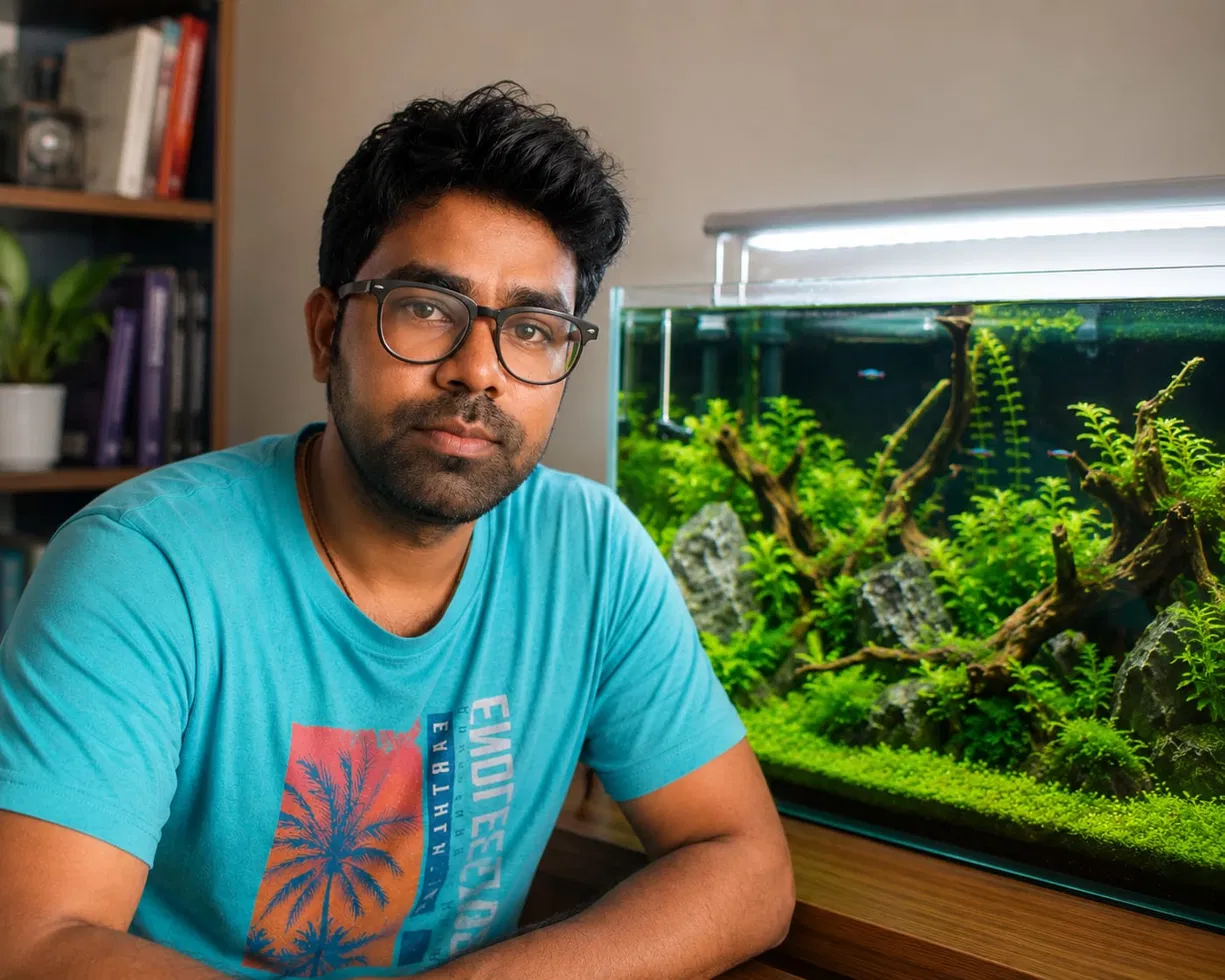
Anil Satak M.Sc. Zoology · Founder, FishioHub
Grew up in a fishing family in India and holds a Master's in Zoology. FishioHub is a one-person operation - every guide is personally researched, kept-tested, and written by Anil. No team, no outsourced writers, no AI-generated content. Read his full bio →