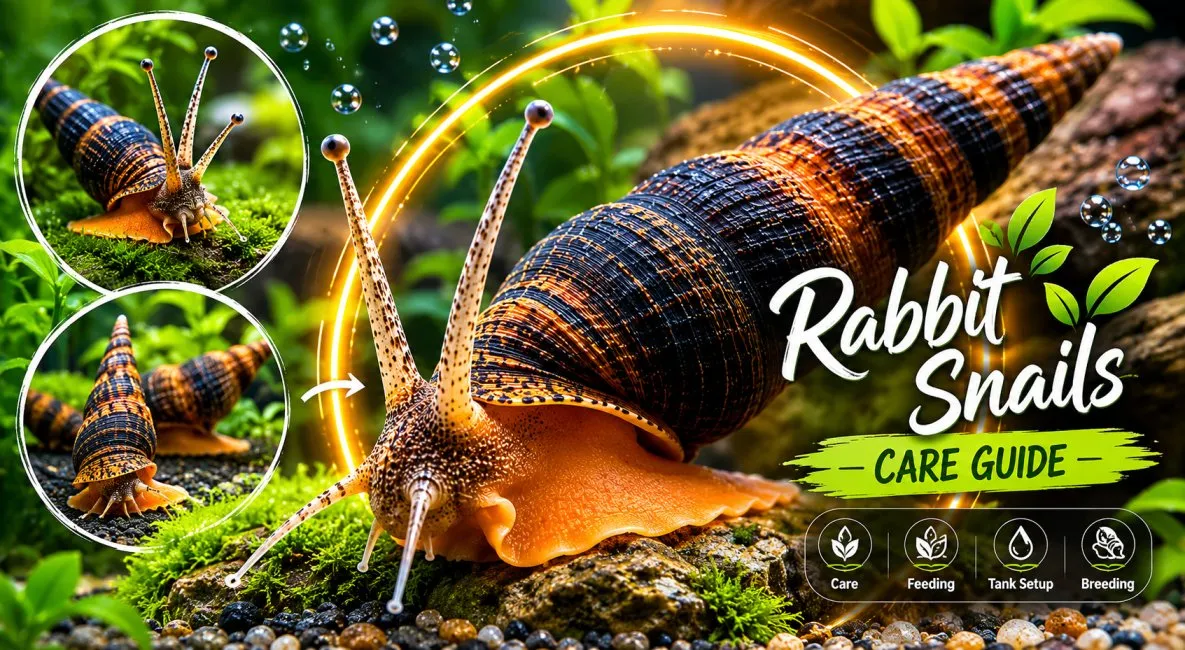
I still remember the first time I saw a rabbit snail at my local fish store. A striking orange-bodied snail with a long, spiraling chocolate-brown shell, moving with a mesmerizing, unhurried swagger as if it owned the place. I liked it; I bought two on the spot without knowing a single thing about them.
That impulse buy led to one dead snail within three weeks. The other? It’s still alive in my tank today — almost four years later.
That mistake cost me a little over $12, but it taught me more about rabbit snail care than any forum post ever did. Since then, I’ve kept multiple color morphs and successfully bred them. This guide is everything I wish I had on day one.
Here’s the short answer on how to care for rabbit snails: Rabbit snails (Tylomelania species) are peaceful, hardy freshwater snails that thrive in warm, slightly alkaline water with a soft, sandy substrate and a high-calcium diet. They’re slow breeders, live 1–3 years, and are safe with most community fish.
📋 What You’ll Get in This Post
- Rabbit Snails Care- Quick Summary — the cheat sheet you’ll bookmark
- Rabbit Snail Types & Color Morphs — golden, yellow, orange, blue & more
- Tank Setup & Water Parameters — what actually keeps them alive
- Feeding Guide — they’re pickier than you think
- Compatible Tank Mates — safe choices for USA community tanks
- Breeding Rabbit Snails — the egg sac secret nobody talks about
- Rabbit Snail Lifespan & Health — warning signs to watch for
- FAQ — People Also Ask answered
Jump to: Care Sheet | Types | Tank Setup | Feeding | Breeding | FAQ
Rabbit Snails Care Sheet: Quick Summary
| Parameter | Ideal Range for Rabbit Snails |
| Scientific Name | Tylomelania spp. (20+ species) |
| Common Names | Rabbit Snail, Elephant Snail, Poso Snail etc. |
| Origin | Lake Poso & Sulawesi, Indonesia |
| Tank Size | Minimum 20 gallons is good |
| Rabbit Snails Size | 3–5 inches (some up to 5.5″) |
| Temperature | 74–86°F (ideal: 78–82°F) |
| pH | 7.3–8.5 |
| Hardness | 6–15 dKH (hard water preferred) |
| Ammonia / Nitrite | 0 ppm |
| Nitrate | Under 20 ppm |
| Substrate | Fine sand or smooth gravel |
| Rabbit Snails Food/ Diet | Algae, blanched veggies, sinking pellets, calcium supplements |
| Rabbit Snail Lifespan | 2–3 years in captivity ( Few exceptions with 5- 8 years) |
| Temperament | Peaceful, slow-moving |
| Rabbit Snails Breeding | Live-bearing (ovoviviparous), 1 offspring at a time |
| Difficulty Level | Beginner-Intermediate |
Rabbit Snail Types & Color Morphs
When I consider keeping Rabbit Snails in a freshwater aquarium, what I appreciate most is the sheer variety of colors they come in. And each one is absolutely captivating.
Golden Rabbit Snails
Golden rabbit snails (sometimes sold as Tylomelania towutensis “gold”) are probably the most popular morph in American fish stores. Their bright yellow-gold body with a dark, elongated shell makes them look like little living fossils. I keep three of these in my 30-gallon planted tank, and they’re constantly on display. They give a stunning look to the aquarium.
Yellow Rabbit Snail
The yellow rabbit snail is similar to the golden but often features a slightly paler, more cream-yellow body tone. Visually stunning against dark substrates — looks amazing in planted tanks with black sand.
Orange Rabbit Snail
The Orange Rabbit Snail possesses a vibrant, vivid orange body color and is often the first variety that new hobbyists encounter. These are typically easy to find at Petco and at independent fish stores throughout the Midwest and Pacific Northwest.
Blue Rabbit Snail
The blue rabbit snail (Tylomelania “blue”) is the rarest and most sought-after variety in the US hobby. Its dark steel-blue body with a nearly black shell is genuinely stunning. I’ve only seen these at specialty aquarium stores and online retailers like AquaticArts or BucePlant. If you get this, keep it.
Black & Chocolate Morphs
Less colorful but equally hardy, chocolate poso rabbit snails and black rabbit snails are great for hobbyists who want a more natural look in a biotope setup.
Expert Tip: This is very shocking that different stores often label the same species with different names. “Poso Rabbit Snail,” “Elephant Snail,” and “Sulawesi Snail” may all refer to the same animal. Focus on the physical traits and water parameters rather than the store’s label. Do check before buying. This is more important as rabbit snails care.
Rabbit Snail Aquarium Setup
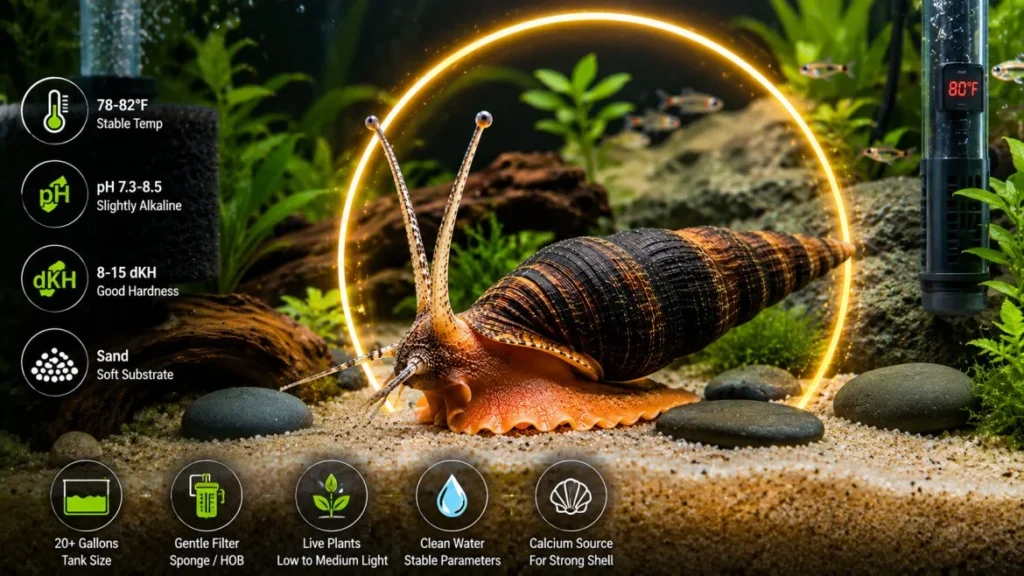
This is one of the big reasons why a rabbit snail dies in an aquarium. It is not due to disease, but to the tank, which was never set up correctly.
Tank Size
A 20-gallon tank is the true minimum for rabbit snails care, not 10 gallons as some older guides suggest. Here’s why: these snails generate significant bioload and need stable water chemistry. Smaller tanks crash faster. I keep mine in a 30-gallon, and I’ve seen some American hobbyists do great with groups in 40-gallon breeders.
According to a 2021 review published in Tropical Fish Hobbyist Magazine, snail species from Sulawesi island (where Tylomelania originates) require unusually stable warm water compared to most other freshwater invertebrates — a parameter that’s much easier to maintain in larger volumes.
Water Temperature — The #1 Killer
Rabbit snails are warmwater species. Their native Lake Poso in Sulawesi, Indonesia, sits at a near-constant 82–84°F year-round. The Temperature is the single most common reason rabbit snails die in US tanks — most American hobbyists run their tanks at 72–75°F, which is too cold long-term.
For successful rabbit snails care, invest in a reliable heater (I use Cobalt Aquatics Neo-Therm in my tanks — precise and reliable). Target 78–82°F consistently.
pH & Water Hardness
As i earlier stated in quick summary of this rabbit snails care guide. Freshwater rabbit snails need hard, slightly alkaline water. A pH of 7.3 to 8.5 is ideal, with water hardness between 8–15 dKH. Soft, acidic water (common in the US Pacific Northwest with municipal water sources) will slowly dissolve their shells — this is what killed my first snail.
NOAA water quality data show that many US municipal water supplies fall between pH 6.5–7.5 — often on the lower end for rabbit snails. Test your tap water before setting up your tank, and buffer with crushed coral or aragonite if needed.
Substrate — Sand Is Non-Negotiable
In my experience, rabbit snails care becomes much easier when you use soft sand substrate, as these snails naturally love to burrow and forage, while rough gravel can damage their delicate foot. Fine sand (Carib Sea Super Naturals, pool filter sand, or black diamond blasting sand — popular with US aquarists for budget builds) is ideal.
Filtration & Oxygenation
A gentle sponge filter or an HOB (hang-on-back) filter with a pre-filter sponge on the intake is perfect. Rabbit snails can get sucked into bare intakes — I learned this the hard way. Keep flow moderate; these are not fast-water animals.
What Do Rabbit Snails Eat?
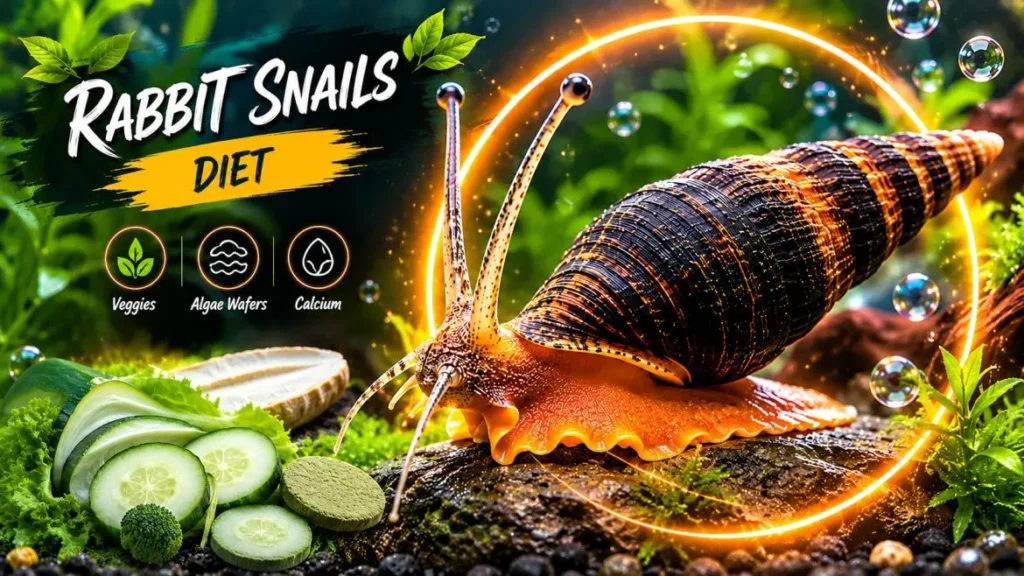
Rabbit snails are detritivores and herbivores. They eat decaying plant matter, algae, biofilm, and soft vegetables. They will not destroy your live plant collection the way some snails do because they don’t eat healthy plant tissue, but they’ll readily munch on dying leaves and algae buildup. Food matters a lot when you are serious about rabbit snails care.
The following are the Best foods for rabbit snails:
- Blanched vegetables — zucchini, spinach, cucumber, and kale are favorites. Blanch for 2 minutes, let cool, then drop in.
- Sinking algae wafers — Hikari Algae Wafers, Repashy Soilent Green, and similar products are excellent.
- Calcium-rich foods — cuttlebone (sold at Petco/PetSmart for birds, works perfectly for snails), crushed eggshells, or calcium blocks.
- Biofilm & tank algae — a well-established tank gives them something to graze on naturally.
Calcium is critical. A 2018 study in the Journal of Molluscan Studies found that calcium availability directly correlates with shell density and growth rate in freshwater gastropods. Insufficient calcium = thin, cracked, pitted shells. I add a small piece of cuttlebone to all my snail tanks permanently.
If you are truly serious about your rabbit snails care, then avoid these Foods: Copper-based medications are lethal to all snails and shrimp, salty foods, and any plant-based medications that alter pH rapidly. Don’t feed them.
Tank Mates for Rabbit Snails: Good & Bad
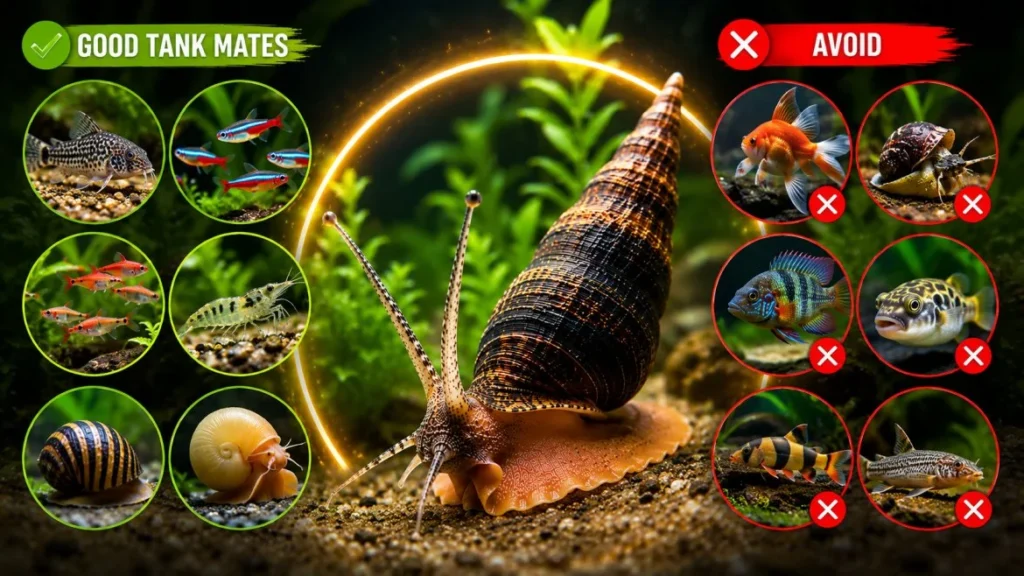
Rabbit snails are peaceful and slow — which means picking the right neighbors is also a very important part of rabbit snails care, and this matters a lot.
Great Tank Mate Choices (USA Community Tanks)
- Corydoras catfish — bottom dwellers that won’t hurt or bother snails
- Tetras (cardinal, neon, ember) — midwater swimmers, zero interest in snails
- Rasboras (chili, harlequin) — are peaceful and beautiful
- Freshwater shrimp (Amano, Neocaridina) — same water parameters, peaceful coexistence
- Nerite snails, mystery snails — compatible snail companions
Avoid These Species
- Large goldfish — Deadly and will try to eat anything that moves slowly enough
- Assassin snails — they will actively hunt and kill rabbit snails
- Cichlids (most species) — too aggressive, will flip and attack snails
- Pea puffers — notorious snail hunters; they’ll pick shells apart
- Loaches (yoyo, clown) — snail predators; don’t risk your rabbit snails life
Breeding Rabbit Snails
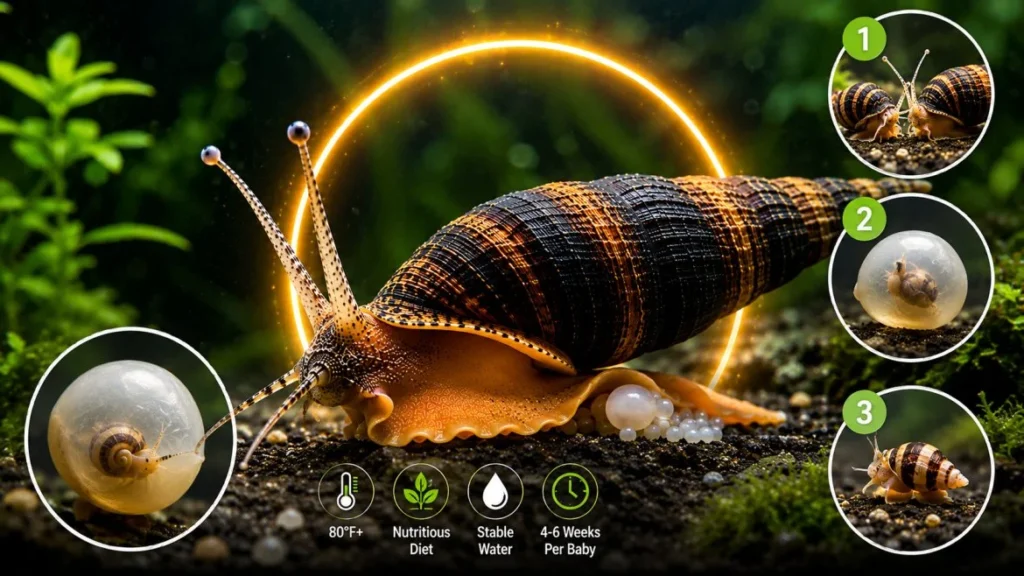
Here’s the section most guides either skip or get wrong. Breeding rabbit snails is fascinating precisely because they don’t lay traditional eggs.
How Rabbit Snails Reproduce
Rabbit snails are ovoviviparous — the female retains a fertilized egg internally and gives birth to a single live offspring encased in a rubbery, balloon-like sac. This is completely different from mystery snails or nerite snails that lay eggs externally.
That white, squishy blob you noticed in your tank? That’s a rabbit snail egg sac — and there’s already a fully formed baby snail inside. Don’t remove it. Don’t poke it. Within 24–48 hours, the baby will emerge on its own, about 5–8mm long and fully functional.
Breeding rabbit snails requires:
- A male and female in the same tank (they do not self-fertilize)
- Stable warm temperatures (80°F+ encourage breeding)
- Excellent nutrition — a calcium-rich diet triggers reproduction
- Patience — they reproduce extremely slowly (every 4–6 weeks per female, one baby at a time)
Sexing Rabbit Snails
You cannot reliably determine the sex of rabbit snails from external appearance alone. The only reliable method requires observing them mating (the male mounts the female) or having a large enough group that you’re statistically likely to have both sexes. Most hobbyists keep groups of 4–6 to ensure mixed sexes.
Baby Rabbit Snail Care
Baby rabbit snails are miniature copies of adults. They eat the same foods (offer soft blanched veggies and calcium) and need the same water parameters. No special breeding tank or fry setup required — they’re surprisingly self-sufficient from day one.
Real Talk: Don’t expect a rabbit snail population explosion. These are the slowest-breeding aquarium snails in the hobby — one baby every 4–6 weeks per female. This makes them zero pest risk and ideal for controlled, beautiful planted tanks.
Rabbit Snail Eggs Explained
One of the most searched topics is the mysterious rabbit snail egg. Technically, rabbit snails do produce eggs, but not like mystery snails. Instead of laying large egg clutches, they produce a single egg capsule where the baby develops before being released. Because of this, many hobbyists never actually see a rabbit snail egg. When visible, the capsule is usually white to cream-colored, oval-shaped, and attached briefly to a surface before hatching. Unlike mystery snail eggs, rabbit snail eggs are never laid in large clusters above the waterline.
Rabbit Snail Lifespan and Health
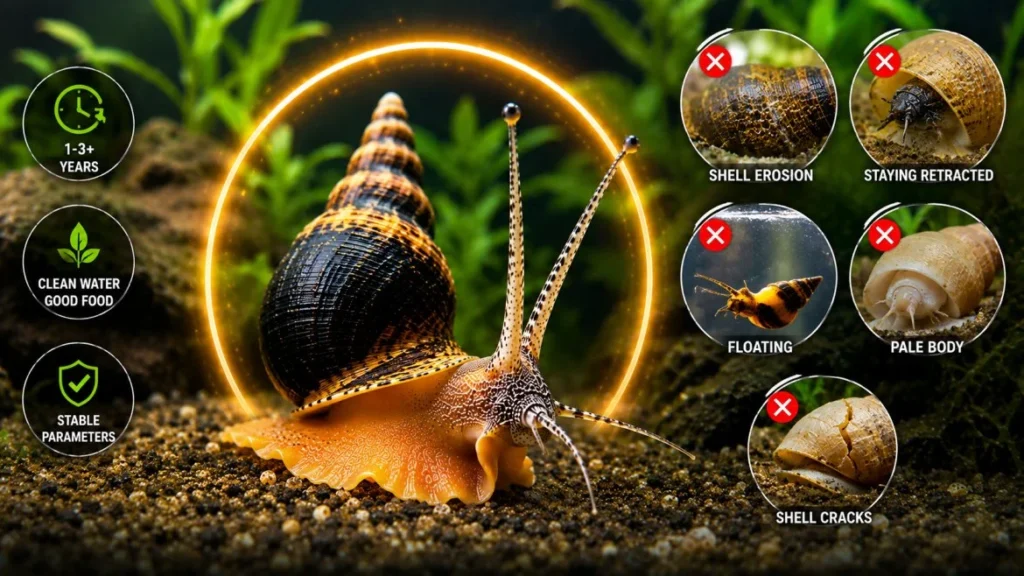
Rabbit snail lifespan in captivity typically ranges from 1 to 3 years, though specimens with optimal water conditions and nutrition have been reported living up to 3+ years in the US hobbyist community with top-level rabbit snails care.
Warning Signs Your Rabbit Snail Is Struggling
- Shell erosion or pitting — almost always a calcium deficiency or low pH
- Staying retracted for days — check water parameters immediately; ammonia spikes are common culprits
- Floating — often means the snail is dead or severely stressed; do the “sniff test” (a dead snail smells strongly of ammonia)
- Pale or faded body color — often a nutritional deficiency; increase feeding variety
- Shell cracks — supplement calcium and raise pH slightly
The “Snail Test” for New US Hobbyists
When buying rabbit snails at your local fish store, watch the snail for 2–3 minutes. A healthy snail will be actively moving, have a firm foot gripping the glass or substrate, and a shell with clean, defined ridges. Avoid any snail that’s upside down, floating, or has a cloudy-smelling tank.
Frequently Asked Questions
Are rabbit snails Care hard for beginner?
No. Rabbit snails are considered beginner-friendly when water quality and nutrition are maintained properly.
How big can rabbit snails size become?
Most rabbit snails’ size ranges from 2–5 inches depending on species and care.
How long is the rabbit snail lifespan?
Most live 2–3 years, though some may exceed 10 years under excellent conditions.
Do rabbit snails reproduce quickly?
No. They reproduce very slowly and usually release one baby at a time.
What do rabbit snail eggs look like?
A rabbit snail egg capsule is small, oval-shaped, and usually contains a developing baby snail.
Are rabbit snails safe with shrimp?
Yes. Rabbit snails are peaceful and generally safe with shrimp.
Do rabbit snails eat aquarium plants?
Healthy plants are usually ignored. They prefer algae, biofilm, and decaying matter.
What is the best food for rabbit snails?
Algae wafers, blanched vegetables, sinking pellets, and natural biofilm are excellent options.
📚 Next Steps: Resources You Must Read
- 🐚 Nerite Snails Care Guide — Compare care requirements and discover how rabbit snails and nerites can coexist in the same planted tank
- 🐌 Mystery Snail Care Guide — Another popular large freshwater snail with very different breeding behavior (external egg clutches vs. rabbit snail egg sacs)
- 🔬 How to Breed Nerite Snails — A deep dive into breeding aquarium snails, with comparisons to the ovoviviparous method rabbit snails use
Conclusion: The Slow-Lane Gems of Your Aquarium
There is something deeply satisfying about watching a golden rabbit snail methodically work its way across a mossy rock, proboscis probing every crevice, completely unbothered by the chaos of your community tank.
After four years and multiple color morphs — golden, orange, and one blue rabbit snail I’m absolutely obsessed with — I can say with confidence: these snails are among the most rewarding freshwater invertebrates you can keep. They’re elegant.
My final words for rabbit snails care are: Get the water right. Feed them calcium. Give them sand. The rest takes care of itself.
Was this guide helpful?
First-Hand Experience
Based on animals I've personally kept and bred - not summarized from other articles.
Zoological Foundation
Claims are checked against my M.Sc. Zoology training and published aquatic biology research, not recycled aquarium myths.
No Paid Influence
No sponsorship shaped this guide. Affiliate links, if any, are disclosed separately and never hidden.
Kept Current
Errors are corrected as soon as they're found, with the update noted at the bottom of the article.
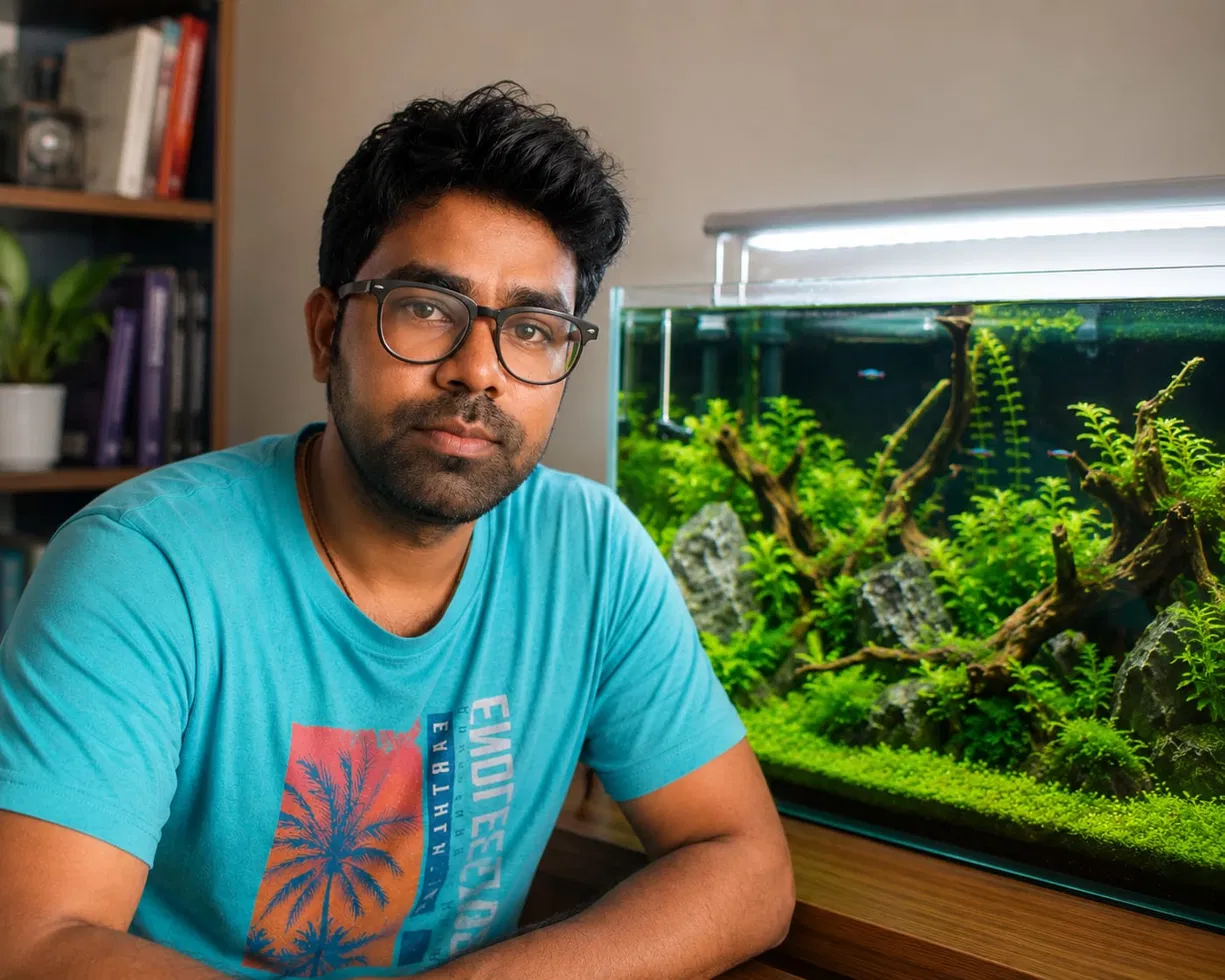
Anil Satak M.Sc. Zoology · Founder, FishioHub
Grew up in a fishing family in India and holds a Master's in Zoology. FishioHub is a one-person operation - every guide is personally researched, kept-tested, and written by Anil. No team, no outsourced writers, no AI-generated content. Read his full bio →