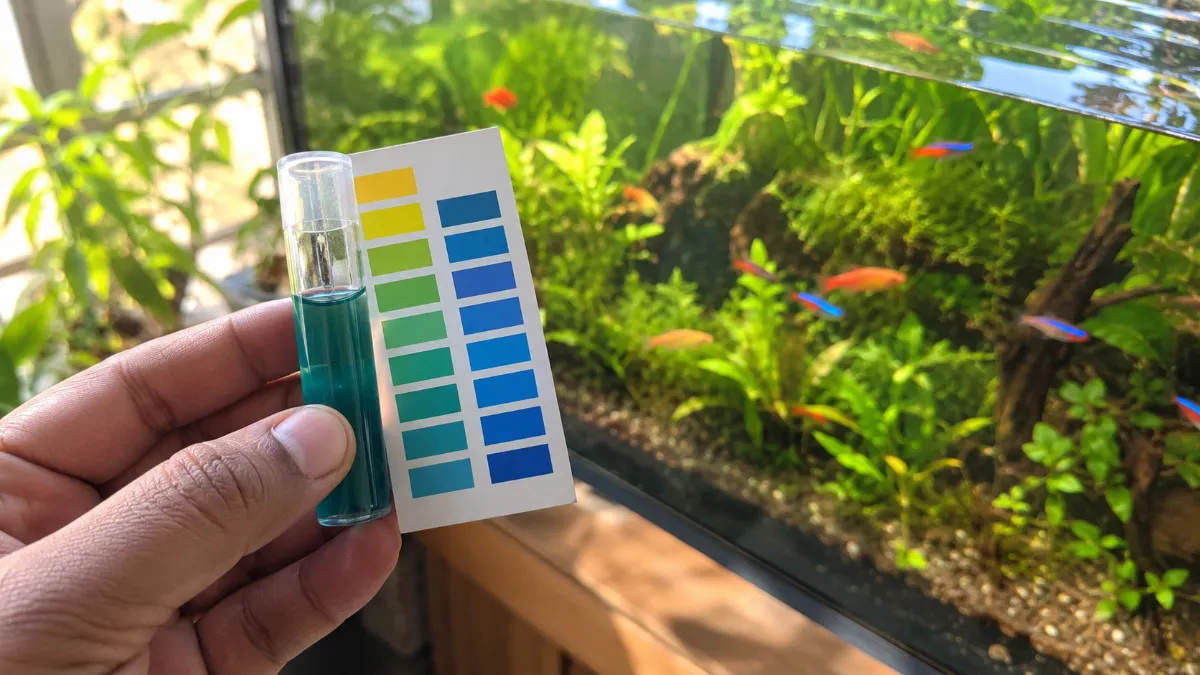
Most freshwater fish do fine with freshwater aquarium pH levels somewhere between 6.5 and 7.5. That’s the short answer.
But here’s the thing — the exact number matters way less than most beginners think. A stable 7.2 beats a “perfect” 7.0 that keeps bouncing around.
It had always been my habit to check my tank water daily, striving to keep the pH level exactly at 6.5 for my Neon Tetras. I would constantly add ‘pH-down’ powder while keeping a hawk-like watch on the digital meter.
Yet, my fish still appeared stressed, and their colors had faded. Eventually, I stopped tinkering with chemicals and let the water remain at its natural pH level of 7.4. Online, this figure was “wrong,” but the fluctuations stopped. Almost immediately, the Tetras’ colors became vibrant, and they began swimming happily. The real problem was my obsession with achieving that “perfect number.”
If you only remember 3 things
- Most freshwater fish are happy between 6.5 and 7.5 pH.
- A stable number beats a “perfect” one. Swings stress fish way faster than a slightly-off reading does.
- Test with a liquid kit once a week. Strips work too, but they go bad faster than people think.
Freshwater Aquarium pH Levels: The Basics
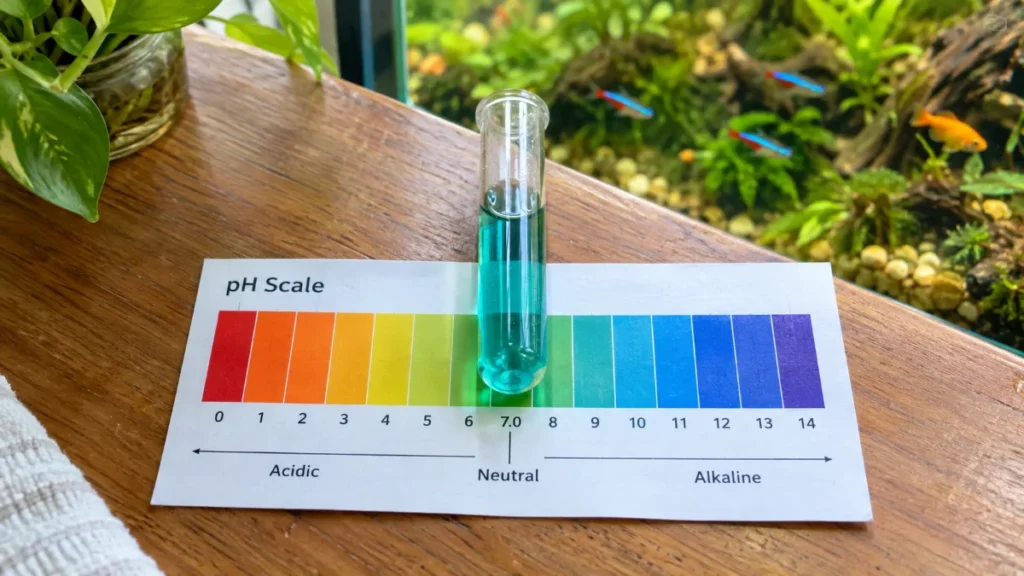
Freshwater aquarium pH levels just tell you how acidic or basic your tank water is. The scale runs 0 to 14. Right in the middle, 7.0, is neutral.
Below 7 is acidic. Above 7 is basic (also called alkaline). Most fish tanks land somewhere between 6.0 and 8.0.
Here’s the part people miss: your freshwater aquarium pH level doesn’t just sit there quietly. It changes how toxic ammonia is in your tank.
Ohio State University Extension’s aquaculture program notes that as pH rises, more of your tank’s ammonia shifts into its more toxic form. This means the same ammonia reading can be a lot more dangerous in a high-pH tank than a slightly acidic one.
What Is pH Level in Fish Tank?
Quick answer to what is pH level in fish tank water: it’s a number from 0-14 that tells you how acidic or alkaline the water is.
Your fish’s gills and slime coat are built for a fairly narrow comfort zone. That’s why this one number quietly affects almost everything else going on in the tank.
Normal pH Levels in Freshwater Aquarium
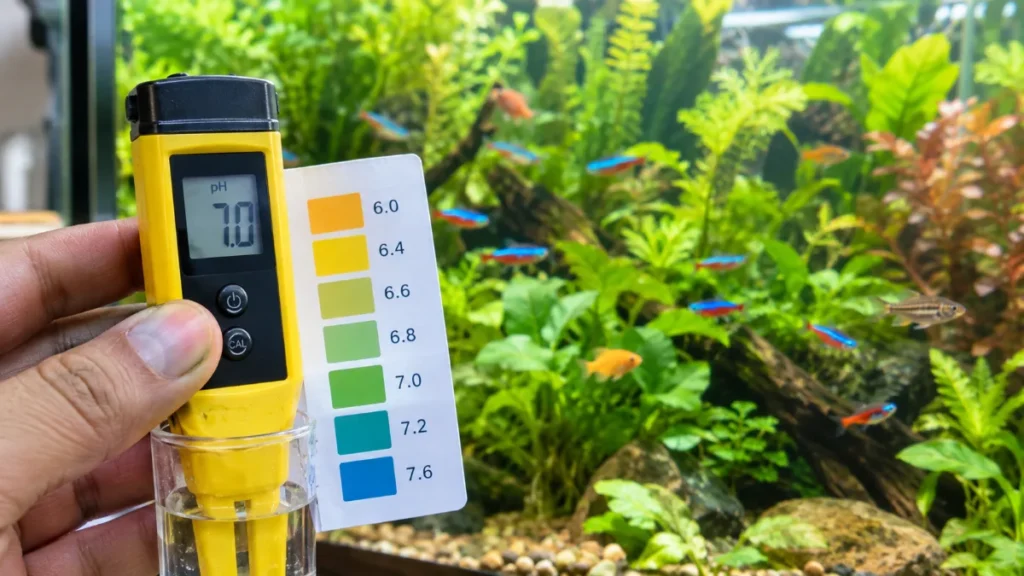
So what’s actually normal pH levels in freshwater aquarium setups? For a general community tank, 6.5 to 7.5 covers most popular fish just fine.
The University of Florida’s IFAS Extension program lists 7.0 as ideal for a mixed community tank. Goldfish and livebearers like it closer to 7.5. Tetras and angelfish usually prefer 6.5-6.8.
Aquarium pH levels in freshwater tanks also depend on where the fish come from, not just the species chart. Amazon fish evolved in soft, acidic water. African Rift Lake cichlids evolved in hard, alkaline water. Don’t force either one into a “neutral 7.0” just because a chart said so — match the water to what the fish actually grew up in.
Freshwater Fish Tank pH Level Chart
Here’s a simple freshwater fish tank pH level chart you can screenshot and keep handy. These are general guidelines, not hard rules, so always check your specific fish before breeding or keeping anything sensitive.
| Fish | Ideal pH | Tolerance Range |
| Betta | 6.5-7.5 | 6.0-7.8 |
| Goldfish | 6.5-7.5 | 6.0-8.0 |
| Neon Tetra | 6.0-6.8 | 5.5-7.0 |
| Angelfish | 6.0-7.5 | 6.0-7.8 |
| Guppy | 7.0-7.5 | 6.0-8.4 |
| Corydoras Catfish | 6.5-7.5 | 6.0-8.0 |
| African Cichlid | 7.8-8.6 | 7.5-8.8 |
What Should Aquarium pH Be?
Honestly, what should aquarium pH be depends on what’s already in your tank. Don’t chase a random number.
A mixed community tank is safest around 7.0. A discus or wild-caught tetra tank should trend acidic. An African cichlid tank should trend alkaline. Test your tap water first — it’s a lot easier to keep fish that match your water than to fight your tap chemistry every single week.
How to Check pH in Aquarium
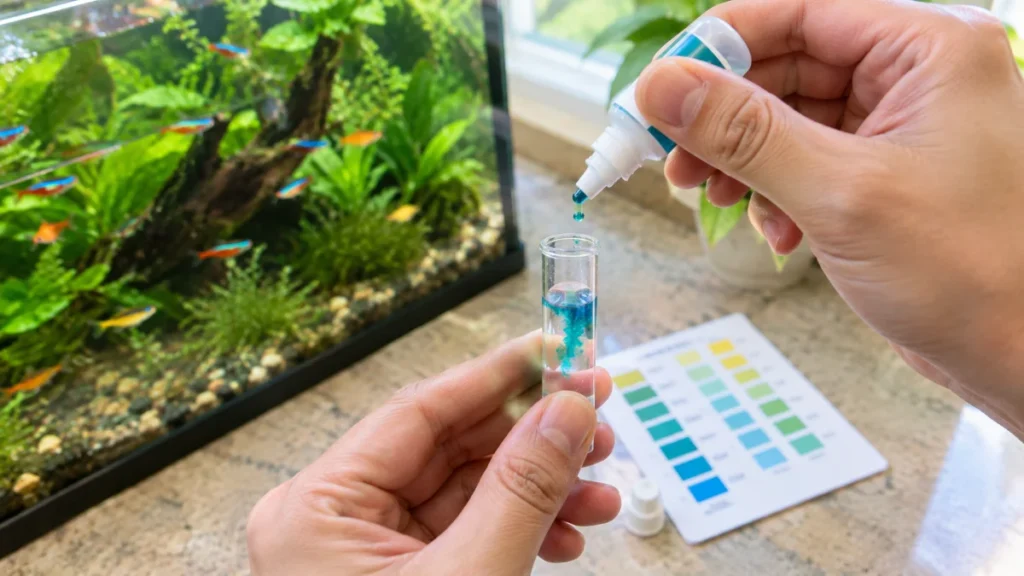
Learning how to check pH in aquarium water is the single most useful habit in this whole post. Catch a pH problem early and it’s a five-minute fix. Catch it late and it’s a full tank emergency.
How to Check Water pH in Aquarium
How to check water pH in aquarium water the right way, every time:
- Grab a sample straight from the tank, away from the filter outflow.
- Add your test reagent following the kit’s instructions.
- Compare the color in good natural light. A tinted aquarium light will throw the reading off.
- Write down the number and date so you can spot a trend, not just react to one reading.
pH also drifts a little over 24 hours as plants photosynthesize. So test on the same day, same time each week, for readings you can actually compare.
How to Check pH Level of Water in Aquarium
If you want more accuracy, here’s how to check pH level of water in aquarium water with a liquid kit instead of strips. Liquid kits like the API Freshwater Master Kit hold up better over time and don’t fade the way test strips do after a few months in a humid bathroom cabinet.
How to Check Water pH in Aquarium Without a Kit
Out of test kit and need a rough number right now? Here’s how to check water pH in aquarium without a kit: boil some shredded red cabbage, strain the liquid, and add a bit to your water sample. It shifts pink for acidic, blue-green for alkaline.
It’s a fine emergency backup. Just don’t use it for breeding projects or anything where you need a precise number.
How to Adjust pH Level in Aquarium
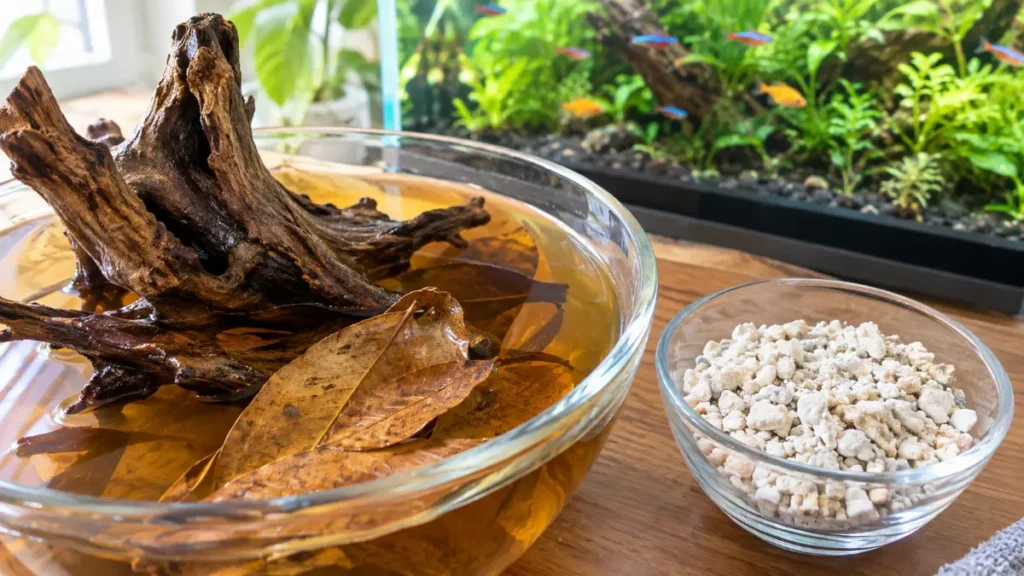
If your test comes back off, how to adjust pH level in aquarium water safely comes down to one rule: go slow.
A change bigger than about 0.3 in a single day stresses fish more than the “wrong” pH ever would. Small water changes, driftwood or Indian almond leaves to nudge pH down, or crushed coral to nudge it up — all gentler than chemical pH-up/pH-down products, which tend to cause rebound swings if you overdo it.
How to Control Water pH Level in Aquarium
The real goal isn’t a one-time fix. It’s how to control water pH level in aquarium conditions so you’re not fighting the same battle every week.
That comes down to your KH (carbonate hardness) — think of it as a buffer that soaks up acid before it can swing your pH. Low KH means small waste buildups swing pH fast. Healthy KH keeps things steady. If your pH keeps drifting no matter what you do, check your KH before reaching for another bottle of chemicals.
A Mistake Worth Learning From
Sometimes, striving for too much perfection can be counterproductive. When I first started out, I panicked because the pH level of my municipal tap water was 7.8, whereas online forums insisted that my angelfish required a “perfect” pH of 6.8.
I spent money on pH-lowering liquids and kept adding them to the water, but due to the hard groundwater in our area, the pH level would rapidly bounce back up every day.
The fluctuations in water chemistry caused the fish so much stress that they developed ‘Ich,’ and the infection spread to almost the entire tank. Once I gave up, stopped buying those bottles, and simply let them live in the 7.8 pH tap water, they recovered completely and lived for years.
FAQ
What are normal freshwater aquarium pH levels?
Most freshwater community fish do well between 6.5 and 7.5. Goldfish and African cichlids prefer it a bit higher; Amazon species like tetras prefer it a bit lower.
Does pH matter more than temperature for freshwater fish?
Both matter, but pH swings tend to cause faster, more obvious stress — gasping, erratic swimming, clamped fins — than a similar temperature change does.
Can I use tap water straight from the faucet?
Often, yes. Just test it first and dechlorinate before it goes in the tank.
Will driftwood really lower my tank’s pH?
Yes, slowly. Driftwood releases tannins that soften and acidify the water over a few weeks.
How often should I test pH?
Weekly for an established tank. Daily if you’re mid-cycle, just did a big water change, or your fish are acting stressed.
Why did my pH crash overnight?
Usually low KH (no buffer left), an overdue water change, or something rotting in the tank driving it down fast.
Do plants affect aquarium pH?
Yes. Plants pull in CO2 during the day, which nudges pH up slightly, then release it at night, nudging pH back down. Totally normal.
Can test strips go bad?
Yes. They soak up moisture from the air over time and start giving unreliable readings, especially past the expiration date. Keep them sealed.
Next Steps: Resources You Should Read
Related FishioHub reading
- How to Raise pH in an Aquarium
- What Causes pH Problems in a Fish Tank
- How to Lower pH in a Freshwater Aquarium Safely
Scientific references
- University of Florida IFAS Extension — aquarium water testing and recommended pH by species.
- Ohio State University Extension — water chemistry and pH’s role in ammonia toxicity
USA aquarium resources
- American Cichlid Association— species-specific water parameters
- Your local university extension aquaculture program (Florida, Ohio, and Texas all publish free guides)
- Your local fish store — most US chains test a water sample free if you’re troubleshooting
Closing
Your fish can’t tell you the water feels wrong. The only warning you get is whatever your test kit shows you.
Check it weekly, keep it steady, and your freshwater aquarium pH levels stop being something to worry about. They just become one more small habit that keeps your tank quietly working.
Was this guide helpful?
First-Hand Experience
Based on animals I've personally kept and bred - not summarized from other articles.
Zoological Foundation
Claims are checked against my M.Sc. Zoology training and published aquatic biology research, not recycled aquarium myths.
No Paid Influence
No sponsorship shaped this guide. Affiliate links, if any, are disclosed separately and never hidden.
Kept Current
Errors are corrected as soon as they're found, with the update noted at the bottom of the article.

Anil Satak M.Sc. Zoology · Founder, FishioHub
Grew up in a fishing family in India and holds a Master's in Zoology. FishioHub is a one-person operation - every guide is personally researched, kept-tested, and written by Anil. No team, no outsourced writers, no AI-generated content. Read his full bio →