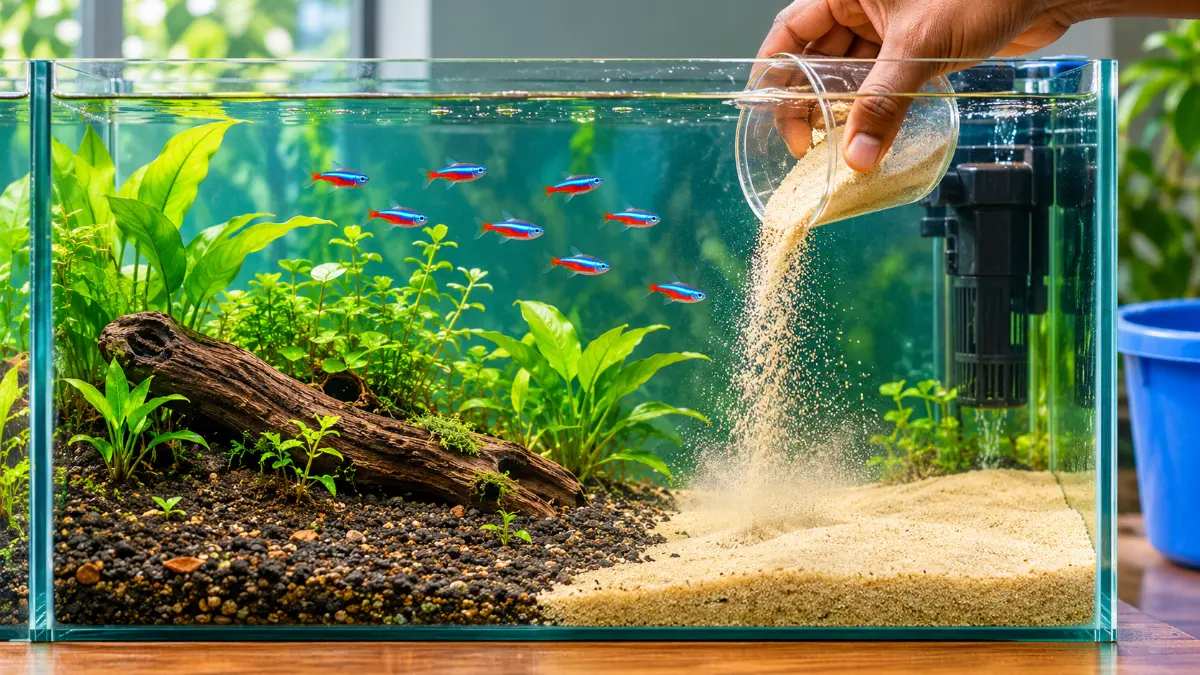
How to change aquarium substrate without hurting your fish? Go slow, keep your filter wet, and test your water every day. That’s the whole secret.
I always follow 7 crucial steps to change aquarium substrate: move the fish, lower the water, and scoop out the old gravel or sand. Rinse the new substrate, add it, and refill with treated water. Keep your filter media alive, then test ammonia and nitrite for about two weeks.
When I replaced the sharp, epoxy-coated gravel in my 20-gallon community tank with fine, black pool-filter sand, I expected the entire process to take all day. What truly surprised me, however—even more than the water becoming cloudy—was how quickly the behavior of my timid Corydoras catfish changed; they immediately began, with great enthusiasm, to sift the sand through their gills. It was a natural foraging behavior—a behavior I had never seen them exhibit before.
Before You Do Anything: 3 Things to Remember
- Save your filter. Most good bacteria live in the filter media, not in the gravel. Never rinse the filter in tap water.
- Test every day. While replacing it, Old substrate hides waste. Digging it up can spike ammonia.
- Go slow if you’re unsure. Don’t change everything at once. Small steps are safer than one big swap.
Keep these in mind, and changing aquarium substrate stops feeling scary.
Warning: Any ammonia reading above zero after a swap needs action. I will recommend a water change right away.
Can I Change the Substrate in My Aquarium?
Yes, you can change the substrate in your running aquarium. You just need a plan.
The bottom holds waste, plant roots, and some bacteria. If your tank is healthy, you may never need to learn how to change aquarium substrate at all.
When to Change Aquarium Substrate (and When to Wait)
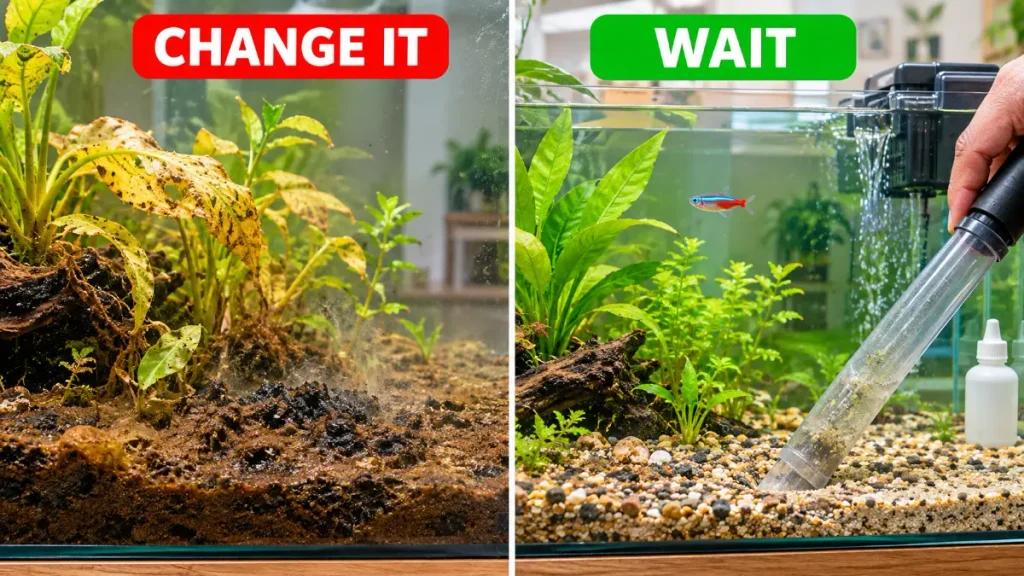
Only change it for a real reason. “It looks old” is not one.
Reasons to Change Aquarium Substrate:
- Aqua soil is mushy, and your plants look hungry
- You want a different type, like gravel to sand
- A rotten-egg smell or black patches keep coming back (read the warning signs in my too-deep substrate section)
Wait if:
- Your fish are sick or on medicine
- Don’t replace substrate if you just added new fish or a new filter
- Your gravel is only dirty (vacuum it first)
Gravel and sand don’t wear out. Dirty isn’t dead.
How Often to Change Aquarium Substrate
Most people asking how to change aquarium substrate don’t need to do it often. Surely, Gravel and sand have no schedule, so swap them only for a new look or to fix a problem.
Aqua soil is different because it wears out. Fluval says its soil usually lasts about 1.5 to 2 years. Other brands vary, so check your bag. So you should be very carefull to keep it long.
How to Change Aquarium Substrate: All at Once or in Stages?
You can replace substrate at once or in parts, Both ways work. Pick based on your filter and your fish.
| Method / Feature | All at once | In stages |
| Time | One long session | Short sessions over 1–2 weeks |
| Waste spike | One big spike | Small spikes, spread out |
| Best for | Strong filter, few fish | Small filter, full tank, nervous fish |
| Main risk | Ammonia jump, stressed fish | Takes longer |
I have noticed that many people say bacteria live in the filter. Others argue that you shouldn’t replace everything at once. The truth, however, lies somewhere in between.
In a PLoS ONE study of home aquarium biofilters, the filters did at least 81–86% of the nitrogen conversion in the three freshwater tanks that were measured. So your filter is the hero. But the substrate isn’t zero, so I’d pick stages if your filter is small or your tank is full.
The Staged Method in 5 Steps
Here’s how to change aquarium substrate one piece at a time:
- Remove about one third of the old substrate.
- Fill new substrate in that spot.
- Test ammonia and nitrite the next day.
- Wait until both read 0. This can take a few days.
- Repeat for the next third, then the last one.
Warning: Don’t rush step 4. Moving on while ammonia shows up is how fish get hurt.
How to Change Fish Tank Substrate: What You Need
Get everything ready first. It makes the job much calmer.
- 2–3 clean buckets that never touched soap
- A cup or small scoop, plus a gravel siphon
- Dechlorinator
- New substrate (my aquarium substrate calculator tells you how much)
- An ammonia and nitrite test kit
How to Change Aquarium Substrate With Fish in Tank
- Only keep fish in if they’re calm, the tank is big, and you are only changing a thin layer. If not, move them.
- Take out shrimp, loaches, and tiny fish first. They get hurt or buried easily.
- To move fish, net them into a lidded bucket of old tank water. Keep it in a quiet spot. Add an air stone if the job takes more than an hour.
Warning: Don’t use fresh tap water in the fish bucket. Use old tank water.
How to Replace Aquarium Substrate: 7 Steps
Here’s the one-day way for how to change aquarium substrate:
- Rinse the new gravel or sand in a bucket until the water runs mostly clear. No soap. Don’t rinse aqua soil hard.
- Move the fish into a bucket of old tank water.
- Lower the water until it just covers the old substrate. Save it in clean buckets.
- Switch off the filter. Keep the media wet in old tank water, never tap water.
- Scoop out the old substrate. Siphon the last bits.
- Add the new substrate. Put rocks on bare glass first, then slope the bed higher at the back.
- Refill slowly over a plate with treated, same-temperature water. Restart the filter, return the fish, and test.
Warning: Keep the room calm and the lights low while the fish are out. Stress hurts them quietly.
How to Change Substrate Without Cycling Again
Your filter, not your gravel, keeps the cycle alive. So when you plan how to change aquarium substrate, protect it with these four habits:
- Keep the filter media wet in old tank water, and don’t replace it the same day.
- Feed lightly for a day or two.
- Test daily for a week, then every 2–3 days for another week. This is my routine, not a rule.
- Do a 25–50% water change if ammonia or nitrite shows up.
Here’s why I’m so strict. UF/IFAS Extension says ammonia should always be zero in a healthy tank. It also says the toxic form can harm fish from 0.05 mg/L, and nitrite can be toxic at levels as low as 0.10 mg/L.
Your kit shows total ammonia, and the toxic part rises with pH and heat. So treat any reading above zero as a warning.
How to Change Gravel to Sand in Aquarium
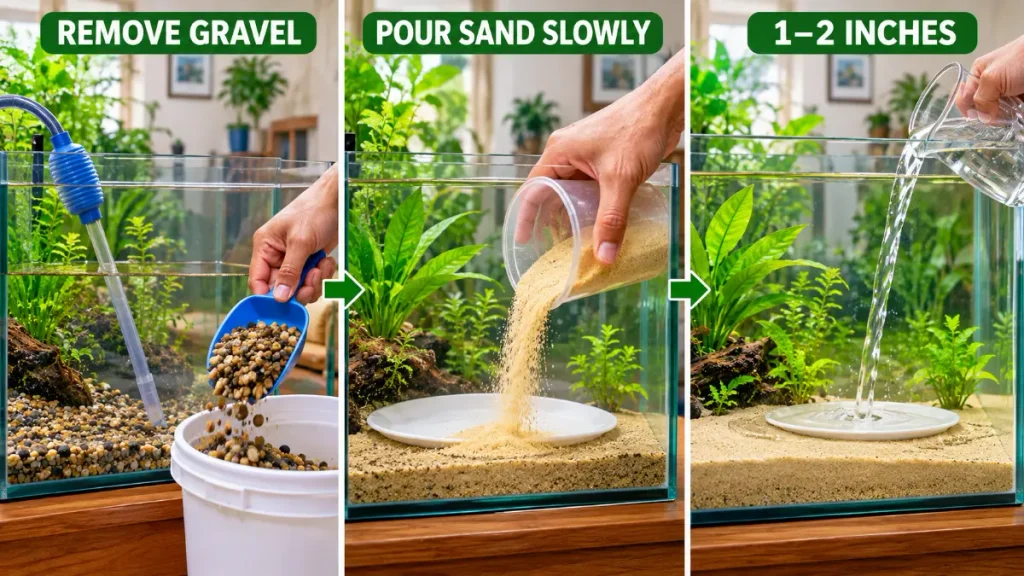
Sand is a top reason to change aquarium substrate. Take all the gravel out first, because sand poured over gravel will mix with it for good.
- Rinse the sand in small batches.
- Scoop out the gravel and siphon the dirt.
- Pour the sand slowly through a cup held low.
- Keep it about 1–2 inches deep.
- Smooth it, then refill over a plate.
Warning: Sand packs down tight. A thick bed can trap waste and make smelly gas.
How to Change Aquarium Sand
Swapping old sand takes more patience, because it can hide waste pockets. Scoop it out in small amounts. If you smell rotten eggs, do a water change before you go on, because the water is also infected.
How to Change Aquarium Gravel
This is the easiest swap. Gravel is heavy, so it rinses fast and sinks fast. Use the 7 steps above.
How to Replace Aquarium Gravel
Gravel is the best type to do in stages. Use the 5 staged steps above and replace one third at a time.
How to Add Substrate to an Established Aquarium
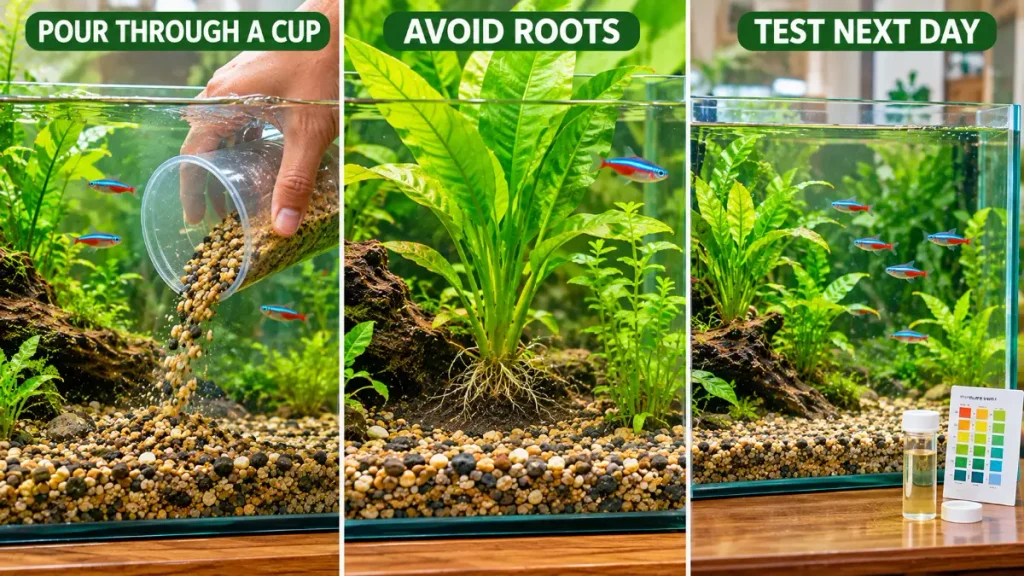
A thin new layer is the easiest part of how to change aquarium substrate. Do it like this:
- Pour small amounts through a cup held underwater.
- Keep it away from plant roots.
- Test the next day.
Top-ups are fine. But don’t bury dirty old gravel under new gravel, because the waste stays trapped. My full steps are in how to put substrate in aquarium.
A Common Myth (and a Mistake)
Myth: “Changing substrate always restarts the cycle.” Not always. Most of the work happens in the filter, as the study above showed.
People worry about how to change aquarium substrate because of this myth. The cycle only wobbles if you wreck the filter, overload it, or stir up too much waste.
My mistake moment: When I hastily replaced the substrate (the bottom layer) in my planted tank, I also made the mistake of cleaning my canister filter on the same day, aiming for a “fresh start.” By removing both the bacterial colonies in the substrate and those already established in the filter, I caused a sudden, sharp spike in ammonia levels in the tank. That was my mistake.
FAQ
Is there a how to change aquarium substrate with fish in tank youtube video I can follow?
Videos help you see the scooping and siphoning. Check that the video keeps the filter media wet and tests ammonia after, because many skip that.
How often to change fish tank substrate?
Gravel and sand: only when you have a problem or want a new look. Aqua soil: usually every year or two, so check your brand.
How often to replace aquarium gravel?
There’s no set schedule. Vacuum it during water changes, and replace it only if it’s damaged, stained, or smelly.
How to change aquarium substrate without stressing fish?
Keep the filter media wet, keep the room calm and the lights low, and finish in one tidy session or use short stages.
Do I need to remove my fish?
Move them for big swaps, small tanks, or tiny fish. Keep them in only for a thin swap in a large tank with calm fish.
How long will the water stay cloudy?
Usually a few hours to a day. Rinsing the new substrate first helps a lot.
What if my ammonia spikes?
Do a 25–50% water change with treated water, and test again the next day. Keep feeding light until it reads 0.
Next Steps: Resources You Should Read
Want more help beyond how to change aquarium substrate? Start here.
Related FishioHub reading
- How to Put Substrate in Aquarium
- What Is Aquarium Substrate?
- How to Remove Ammonia from Fish Tank Naturally
Scientific references
- Francis-Floyd, Watson, Petty & Pouder, “Ammonia in Aquatic Systems” (UF/IFAS Extension, FA031)
- Fluval Aquatics, Stratum soil substrate guide (manufacturer information, about 1.5–2 years)
USA aquarium resources
- Aquatic Gardeners Association
- Seachem Laboratories
- Your local fish store, for advice on the substrate they sell
Closing
At the end of a good change (cleaning), there comes a peaceful moment—a truly beautiful moment, I might add. The water clears up, the fish emerge, and the tank looks brand new.
Now you know how to change the substrate in an aquarium. Do share your own experiences in the comments!
Was this guide helpful?
First-Hand Experience
Based on animals I've personally kept and bred - not summarized from other articles.
Zoological Foundation
Claims are checked against my M.Sc. Zoology training and published aquatic biology research, not recycled aquarium myths.
No Paid Influence
No sponsorship shaped this guide. Affiliate links, if any, are disclosed separately and never hidden.
Kept Current
Errors are corrected as soon as they're found, with the update noted at the bottom of the article.

Anil Satak M.Sc. Zoology · Founder, FishioHub
Grew up in a fishing family in India and holds a Master's in Zoology. FishioHub is a one-person operation - every guide is personally researched, kept-tested, and written by Anil. No team, no outsourced writers, no AI-generated content. Read his full bio →