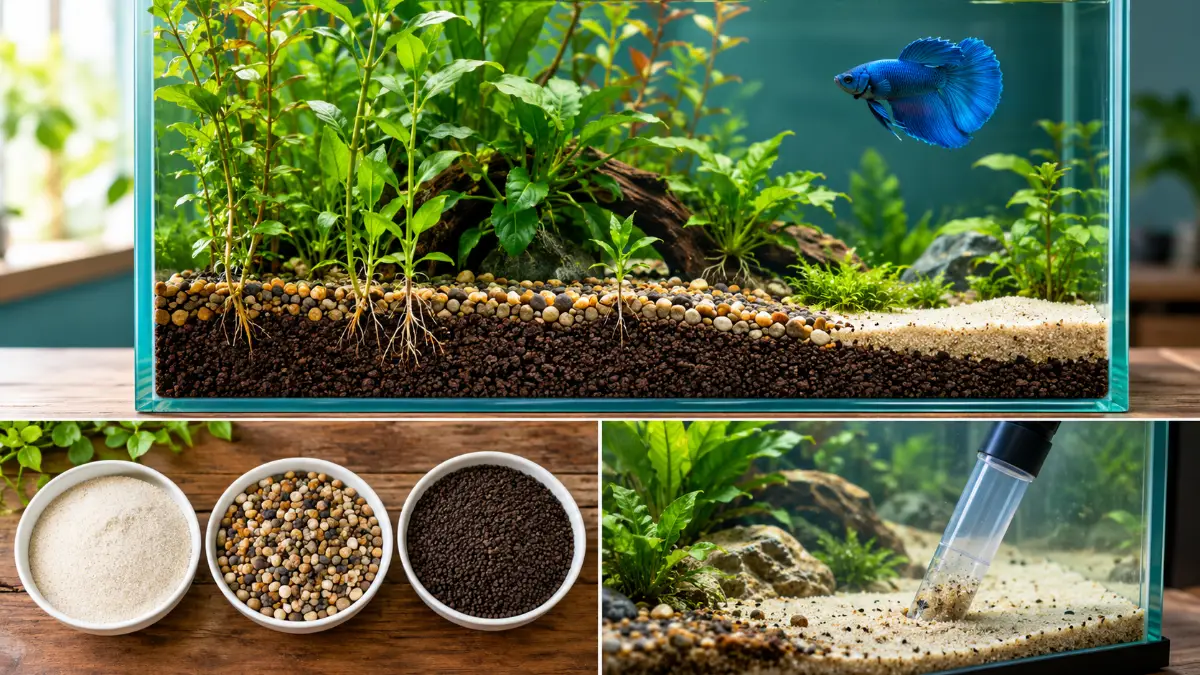
When you will have your first aquarium, you will definately question yourself what is aquarium substrate actually? I would say in short, it is a thin layer of material inside bottom of aquarium. It’s the sand, gravel, or soil on the floor of your tank. I’d call it the most ignored part of a fish tank, and it does a lot more work than you think.
Short answer: What is aquarium substrate? It’s the layer of sand, gravel, soil, or crushed coral on the bottom of a tank. Good bacteria live on it, plants root in it, and fish dig and hide in it. For most freshwater tanks, I’d pick smooth, dark gravel or fine sand.
When I first started, I used bright neon gravel that trapped debris and looked completely unnatural. Today, Raja’s tank features dark volcanic sand that makes his scales pop and keeps the water pristine. Seeing that contrast taught me that the right foundation changes everything.
If You Only Remember 3 Things
- What is aquarium substrate? Just the tank floor: sand, gravel, aquasoil, crushed coral, or nothing (bare bottom).
- Sand grains are up to about 2 mm. Anything bigger is gravel.
- Pick for your fish first, your plants second, and your cleaning habits third.
⚠️ Warning: Don’t use crushed coral with soft-water fish like bettas, tetras, or shrimp. It slowly pushes pH and hardness up.
What Is Aquarium Substrate? Types and How to Choose?
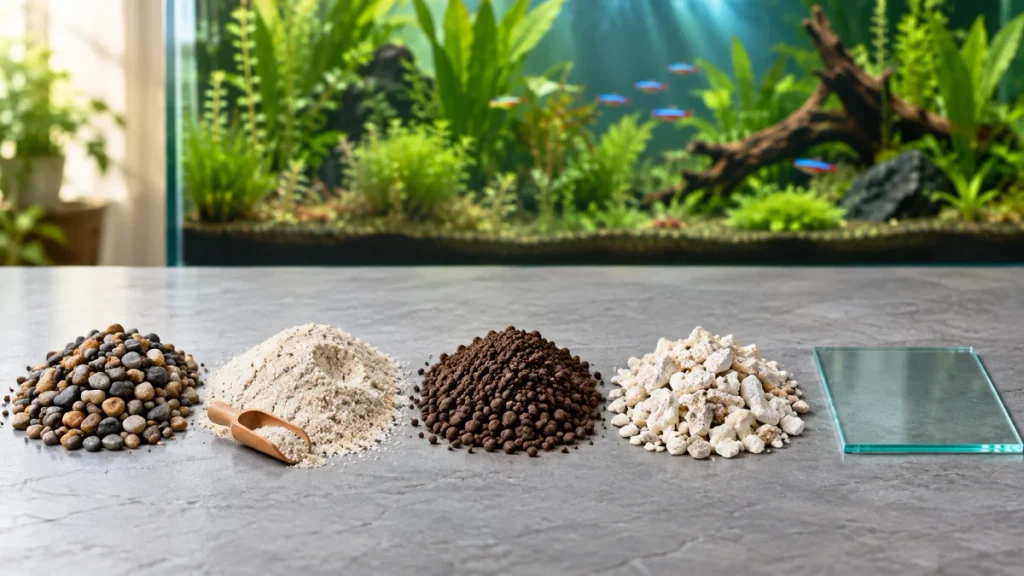
Here’s how I’d choose a substrate in 5 easy steps.
- Name your fish. Diggers, bottom feeders, and goldfish need different grain sizes.
- Check your water. Crushed coral raises pH. Aquasoil lowers it a little.
- Decide on plants. Heavy root feeders need nutrients in the floor.
- Pick the grain size. Too big to swallow, but not so small that it packs down.
- Think about cleaning. Be honest about how often you’ll vacuum.
What is substrate in an aquarium? It’s any material you put on the bottom glass. That can be stone, baked clay, or crushed shell. Think of it as the soil of your underwater garden. Everything else sits on it or grows from it.
What is aquarium substrate made of?
The aquarium substrate most is quartz or basalt stone, baked clay (aquasoil), or calcium carbonate (crushed coral and aragonite). Some colored gravel also has a coating.
Plain stone is inert. It doesn’t change your water. Coral and aragonite dissolve slowly and do change it.
Purpose of Substrate in Aquarium Tanks
So what is aquarium substrate really for? Why you should use it? The purpose of substrate in aquarium setups is 4 jobs.
- Bacteria: Good bacteria turn toxic ammonia into nitrite, then nitrate. They grow as a thin film on surfaces like filter media and gravel.
- Plants: Roots hold on to it, and some plants feed from it.
- Fish behavior: Many fish dig, sift, or hide in it.
- Looks: A dark floor makes colors pop. A light one makes the tank feel bigger.
Do Aquariums Need Substrate?
Not always. It is not mandatory, But most fish seem to do better with it.
Bare bottom tank vs substrate
Bare bottom tank vs substrate is a choice between easy cleaning and natural comfort. Bare tanks are great for quarantine, hospital, and fry tanks. Waste is easy to see and siphon out.
So what is aquarium substrate worth to the fish themselves? Science leans toward giving them a floor. A 2014 study in Laboratory Animals found zebrafish groups preferred substrate over barren tanks, and gravel was the favorite (p < 0.01). A 2025 study found gravel-type enrichment gave more viable eggs in zebrafish.
That’s zebrafish, not every species. So treat it as a strong hint, not a rule.
Types of Aquarium Substrate
What is aquarium substrate if you sort it by type? The types of aquarium substrate are gravel, sand, aquasoil, crushed coral, and bare bottom. They look alike on the shelf, but they act very differently.
Types of substrate for aquarium tanks: pros and cons
Here’s the quick comparison of the types of substrate for aquarium use.
| Type | Pros | Cons | Best for |
| Gravel | Easy to vacuum, good water flow | Traps waste if too deep | Community tanks |
| Sand | Natural look, waste stays on top | Packs down if too deep | Bottom feeders, diggers |
| Aquasoil | Feeds plants, lowers pH a little | Costs more, leaks ammonia early | Planted tanks, shrimp |
| Crushed coral | Raises pH and hardness | Wrong for soft-water fish | African cichlids |
| Bare bottom | Easiest to clean | Plain look, no roots | Quarantine, breeding |
Sand vs Gravel Aquarium: Which Is Better?
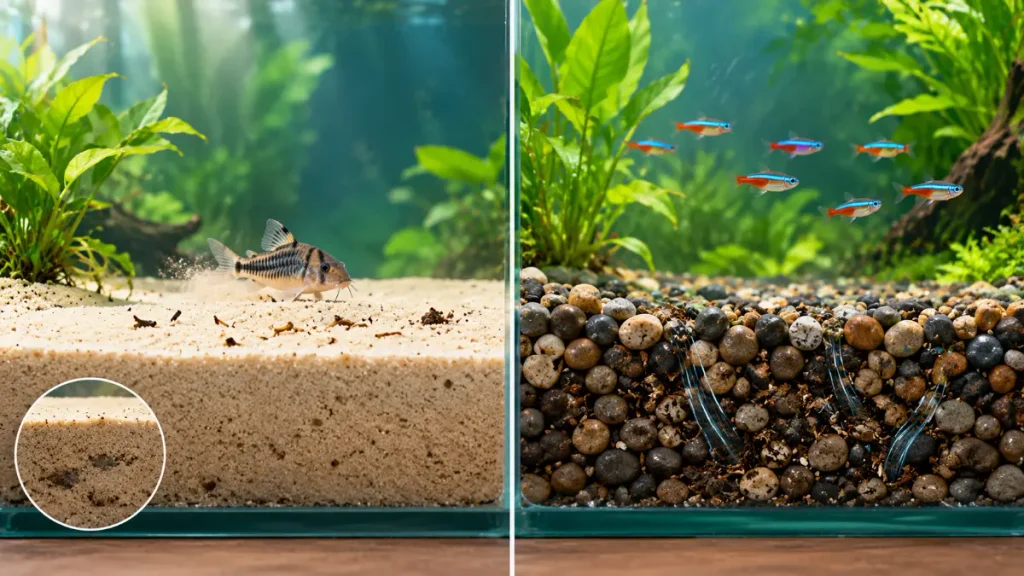
Sand vs gravel aquarium? This debates never end. So here’s my short version. Sand looks natural and keeps waste on top. Gravel lets water flow through and is easier to clean deep down.
Is sand a good substrate for aquariums?
Is sand a good substrate for aquariums? Yes, for many tanks. But it has a few catches.
Pros: It’s gentle on bottom dwellers and looks like a real riverbed.
Cons: Deep sand can pack down and form low-oxygen pockets. Most hobbyists keep it around 1 inch (2.5 cm) deep. Sometimes a strong filter flow can also blow it around.
Myth: “Sand always rots.” Not true. Thin, lightly disturbed sand is usually fine. Trouble starts with deep, never-touched beds.
⚠️ Warning: If you see black patches or smell rotten eggs, don’t stir the whole bed. That can release toxic gas. Remove the bad spots slowly and carefully, thin the substrate layer, and also do a water change.
I once piled sand nearly three inches deep, thinking it would look more natural. Within months, hidden black pockets formed, and stirring it released a foul, sulfur smell that spiked my ammonia levels overnight. Reducing the depth to a single inch taught me the hard way that less is definitely more.
Which Aquarium Substrate Is Best?
The one that fits your fish, not the one that looks best in photos. Use this table.
| Tank type | Best pick | Why |
| Community | Smooth gravel or fine sand | Safe and neutral |
| African cichlid | Sand or crushed coral | Matches hard, alkaline water |
| Planted | Aquasoil, or gravel with root tabs | Feeds the roots |
| Shrimp | Inert sand or aquasoil | Stable water, safe for tiny legs |
| Goldfish | Large smooth gravel or fine sand | They can’t swallow it |
Best substrate for freshwater aquarium tanks
The best substrate for freshwater aquarium tanks in general is inert, smooth, and dark. Quartz gravel and fine silica sand are the usual safe picks.
African cichlids are the big exception. Lake Malawi water is alkaline, with a commonly reported pH of about 7.7 to 8.6. So crushed coral suits them.
What aquarium substrate to use for a first tank
What aquarium substrate to use for a first 10-gallon community tank? I’d go with smooth, dark, inert gravel about 3 to 5 mm (1/8 to 1/4 inch) in size. Beginners often ask what aquarium substrate is safest, and this is my answer.
Follow these 3 steps:
- Rinse it until the water runs clear.
- Spread about 2 inches (5 cm) in a gravel tank.
- Fill the tank slowly so the floor doesn’t get messy.
⚠️ Warning: Goldfish can swallow small gravel. Pick stones too big to swallow, or use fine sand.
Which Aquarium Substrate Is Easiest to Clean?
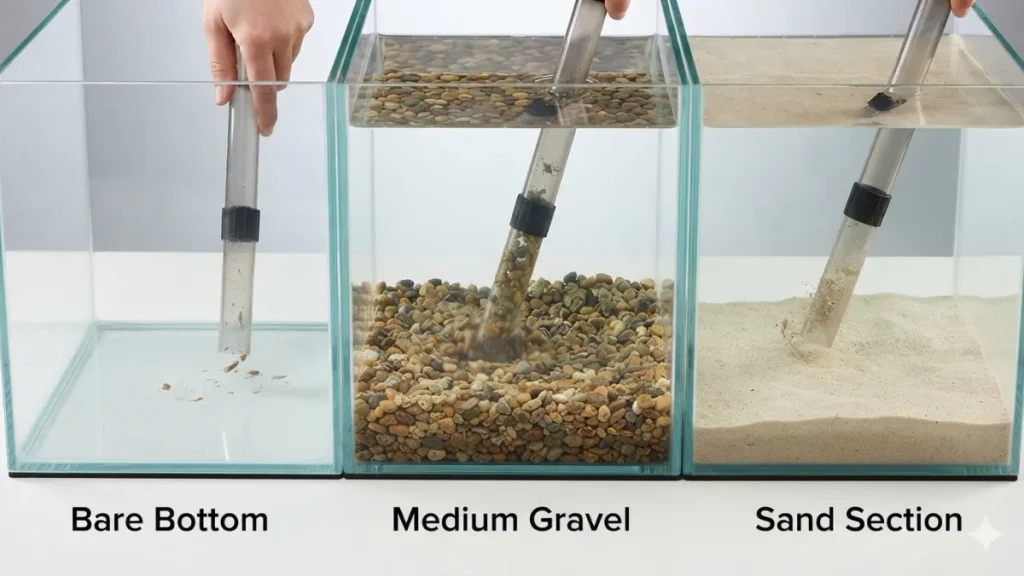
At sooner or later you will need to clean the substrate, So, which aquarium substrate is easiest to clean? Bare bottom wins. Medium gravel comes second, and sand comes third.
A gravel vacuum pulls waste from between the stones. With sand, you hover the vacuum just above the surface so you don’t suck it up.
Planted Aquarium Substrate Layers
What is aquarium substrate for a planted tank? Planted aquarium substrate layers usually mean a nutrient-rich base with a cap of gravel or sand on top. The cap keeps the soil in place and the water clear.
That’s the short answer. For layers, root tabs, and whether your gravel is enough, read my full guide: Best Substrate for Planted Aquarium: Can You Just Use Gravel?
Where to Buy Aquarium Substrate
You can buy aquarium substrate from Pet chains, local fish stores, online shops, and pool or landscape suppliers (for plain silica sand) all sell it.
What is aquarium substrate quality on a label? Check these 5 things:
- Material: stone, clay, or coral?
- Grain size: listed in mm?
- Water effect: “inert” or “raises pH/KH”?
- Coating: any dyes or polymers?
- Rinse needed: most need a wash.
Not sure how much to buy? Use my Aquarium Substrate Calculator.
FAQ
What is aquarium substrate?
It’s the sand, gravel, soil, or coral layer on the bottom of a fish tank. It supports bacteria, plants, and fish behavior.
Do aquariums need substrate?
Not always. Quarantine and breeding tanks work fine bare. Most display tanks do better with a floor.
Is sand a good substrate for aquariums?
Yes, if you keep it thin, about 1 inch (2.5 cm). Deep sand can form bad pockets.
Which aquarium substrate is easiest to clean?
Bare bottom is easiest. Smooth gravel is next.
Can I use play sand?
Many hobbyists do. Make sure it’s plain sand with no additives, and rinse it until the water runs clear.
Is colored gravel safe for fish?
Usually, if the coating is intact. Skip any that flakes or smells odd.
What is the best substrate for goldfish?
Large, smooth gravel they can’t swallow, or fine sand.
Next Steps: Resources You Should Read
You should read from Fishiohub
- Best Substrate for Planted Aquarium: Can You Just Use Gravel?
- Aquarium Substrate Calculator
- How to Plant Freshwater Aquarium Plants
Scientific references to read
- Schroeder, P., Jones, S., Young, I.S., & Sneddon, L.U. (2014). What do zebrafish want? Laboratory Animals, 48(4), 328–337.
- McKay-West, J., Green, M., & Chance, R. (2025). Evaluating the suitability of substrate enrichment for zebrafish in high-capacity research aquaria. Animal Technology and Welfare, 24(2), 108–112.
USA aquarium resources
- Aquatic Gardeners Association
- Your local fish store. Ask what the substrate is made of and whether it changes pH.
Closing
Look down at your tank tonight. Every fish in there swims above it, hides in it, and eats near it.
So, what is aquarium substrate? It’s the ground your whole tank stands on. Choose it like you’d choose the ground under your own feet.
Was this guide helpful?
First-Hand Experience
Based on animals I've personally kept and bred - not summarized from other articles.
Zoological Foundation
Claims are checked against my M.Sc. Zoology training and published aquatic biology research, not recycled aquarium myths.
No Paid Influence
No sponsorship shaped this guide. Affiliate links, if any, are disclosed separately and never hidden.
Kept Current
Errors are corrected as soon as they're found, with the update noted at the bottom of the article.

Anil Satak M.Sc. Zoology · Founder, FishioHub
Grew up in a fishing family in India and holds a Master's in Zoology. FishioHub is a one-person operation - every guide is personally researched, kept-tested, and written by Anil. No team, no outsourced writers, no AI-generated content. Read his full bio →