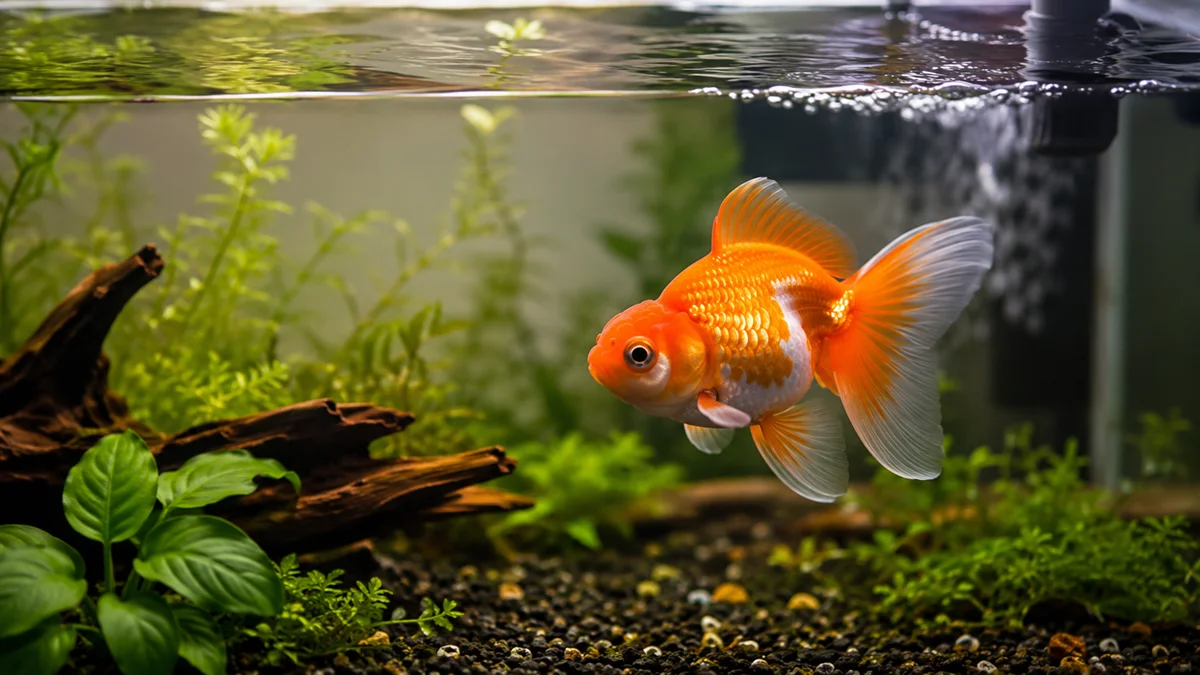
Do Goldfish Need a Filter? I learned the answer the hard way with my first carnival fish, “Bubbles.” I kept him in a classic, unfiltered glass bowl, only to find him gasping at the surface three days later with raw, red gills from ammonia poisoning. I thought weekly water changes were enough, but without a biological filter, his own waste turned that tiny bowl into a toxic trap overnight.
Yes, goldfish need a filter — and in almost every home setup they need one running continuously, not just “when things look cloudy.” A filter does two jobs a goldfish can’t survive long-term without: it hosts the bacteria that break down the ammonia goldfish constantly produce, and it keeps oxygen moving through the water. A heater is usually optional for fancy goldfish kept indoors at normal room temperature, and an air pump is a nice-to-have rather than a must, as long as your filter agitates the surface enough.
That’s the short version. The reasons behind it — and the specific situations where the “usually” and “nice-to-have” flip into “essential” — are what actually matter, so let’s get into it.
If You Only Remember 3 Things
- A filter isn’t optional for goldfish. They produce an unusually heavy bioload for their size, and without biological filtration, ammonia builds to toxic levels within days, not weeks.
- A heater is situational, not universal. Fancy goldfish do fine in stable, unheated room-temperature water (65–75°F); a heater becomes necessary mainly if your room temperature swings widely or drops below the mid-50s°F.
- An air pump is about surface agitation, not emergency oxygen. If your filter’s output already ripples the surface, a dedicated air pump is optional — it becomes important in overstocked, planted, or warm tanks where oxygen demand is higher.
Do Goldfish Need a Filter in Their Tank?
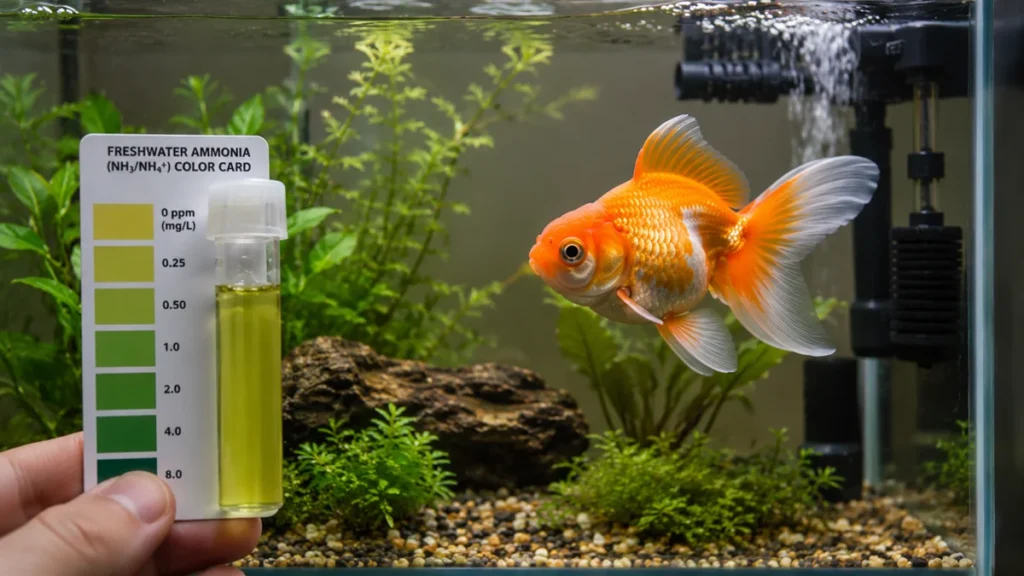
Yes — do goldfish need a filter in their tank is one of the most searched goldfish questions for good reason, and the honest answer is that filtration isn’t a luxury for this species the way it might be for a lightly-stocked betta tank. Goldfish eat almost constantly, produce a lot of solid waste, and — unlike many fish that only release ammonia passively through their gills — goldfish also excrete it directly as waste, adding to the load faster than their body size would suggest.
That waste becomes ammonia, and ammonia is toxic well before it’s visible or smelly. A peer-reviewed review of ammonia toxicity in aquarium fish puts the danger threshold at just 0.1 mg/L of unionized ammonia (NH₃) for chronic stress and disease — a concentration well below what most home test kits make obvious at a glance.
A filter matters here for a specific biological reason: its media becomes home to colonies of nitrifying bacteria that convert ammonia into nitrite, then into far less harmful nitrate — the process aquarists call the nitrogen cycle. Without that bacterial colony, there’s nowhere for the ammonia to go except into the water your goldfish is breathing through.
Does Goldfish Need a Filter, Even the “Hardy” Varieties?
Does goldfish need a filter even if they’re famously one of the toughest fish in the hobby? This is where a lot of pet-store advice goes wrong. Goldfish are unusually hardy against temperature swings and low oxygen — but hardiness against physical stress isn’t the same as immunity to ammonia poisoning.
Their resilience is often the exact reason people skip filtration in the first place, and it’s also exactly why the mistake takes longer to show up: a goldfish can look fine for days while ammonia climbs, then crash hard once its gills and immune system are compromised.
What Do Goldfish Need in Their Tank?
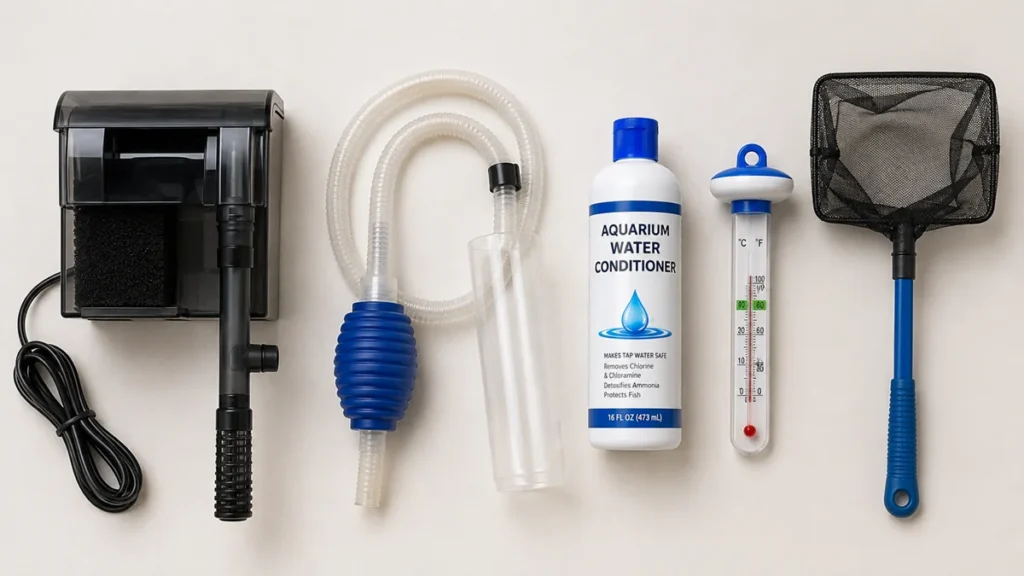
Since the filter question rarely comes up in isolation, it’s worth zooming out to what do goldfish need in their tank as a whole, because filtration is really one piece of a small system:
- A filter sized for a heavier bioload than the tank’s gallon count alone would suggest (many keepers rate their filter for double the tank size when it’s stocked with goldfish).
- Enough water volume — goldfish are large-bodied, long-lived fish, and cramped quarters concentrate waste faster than any filter can process it.
- Stable temperature, even if that’s unheated room temperature rather than a heated tropical range.
- Surface movement, from either the filter outflow or a dedicated air pump, to keep oxygen exchange happening at the water’s surface.
- A gravel vacuum and a regular water-change routine — no filter, however good, replaces the need for partial water changes.
Do Goldfish Need a Heater?
For most indoor setups, no — do goldfish need a heater is a question with a more nuanced answer than the filter question. Goldfish are a cold-water species, native to a temperature range far wider than tropical fish tolerate, and fancy goldfish varieties in particular do well anywhere in the roughly 65–75°F band that most homes sit at naturally.
Do Goldfish Need a Heater in the Tank if the Room Is Cold?
This is where do goldfish need a heater in the tank stops being a simple no. If your home regularly drops into the high 50s°F overnight, sits near a drafty window, or swings by more than a few degrees across the day, a heater set to hold a steady point in that ideal range does more good than harm — not because goldfish can’t tolerate cold, but because they tolerate stable temperatures far better than fluctuating ones.
Rapid temperature swings stress a goldfish’s immune system more than a slightly-too-cool but steady tank ever would.
Do Goldfish Need an Air Pump?
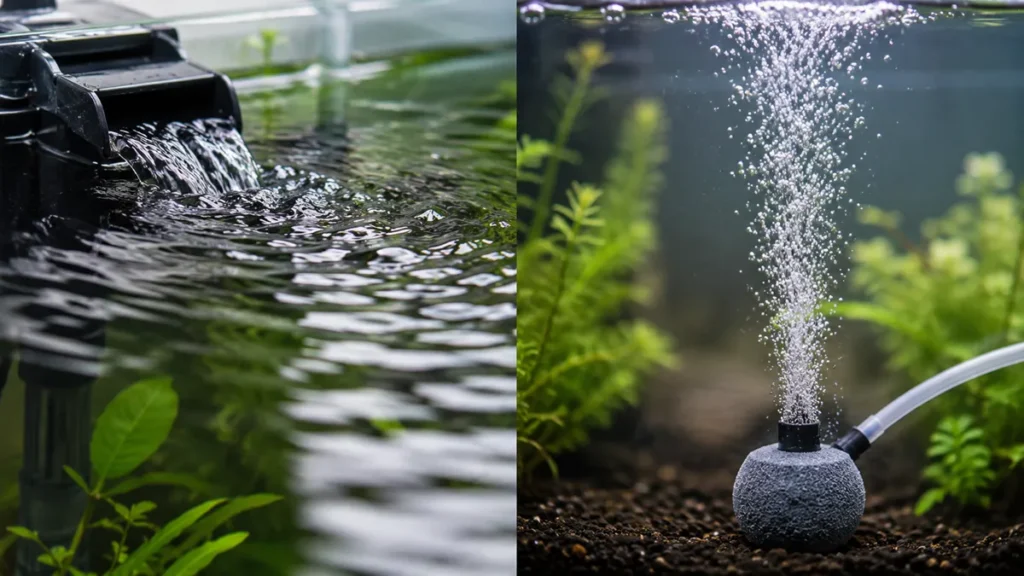
Usually not as a separate purchase — do goldfish need air pump is a question that gets conflated with the oxygen question. Still, a filter that returns water to the surface with some turbulence is already doing most of that job. Surface agitation is what actually drives oxygen exchange; the bubbles from an airstone look dramatic, but it’s the disturbance at the surface, not the bubbles themselves, that matters.
Do Goldfish Need Oxygen Pump Support in a Heavily Stocked or Warm Tank?
Do goldfish need oxygen pump support? In specific conditions, the answer is a real yes: warmer water holds less dissolved oxygen to begin with, and a heavily stocked or heavily planted tank increases oxygen demand at the same time.
According to University of Florida IFAS Extension research on dissolved oxygen for fish production, water at 90°F can hold only about 7.4 mg/L of dissolved oxygen at saturation, compared to roughly 11.9 mg/L at 45°F — a real physical ceiling that gets tighter exactly when your goldfish’s metabolism, and oxygen demand, is running hottest.
How Long Can Goldfish Go Without Oxygen?
Here’s the genuinely surprising part of the how long can goldfish go without oxygen question, and it’s one most goldfish-and-filter articles skip entirely: goldfish belong to the genus Carassius, along with their wild relative the crucian carp, and this genus has one of the most extreme anoxia tolerances documented in any vertebrate. A 2017 study published in Scientific Reports identified the biochemical pathway behind it.
Goldfish and crucian carp can convert anaerobic metabolic byproducts into ethanol, which diffuses out through their gills, thereby avoiding the lactic acid buildup that kills most vertebrates within minutes of oxygen loss.
Research summarized alongside that study notes crucian carp can survive months in ice-covered, oxygen-depleted ponds, while goldfish specifically have been shown to withstand hours of anoxia at room temperature.
That’s a remarkable adaptation, but it’s not a reason to skip aeration. Surviving anoxia is a last-resort emergency response, not a comfortable baseline — a goldfish enduring low oxygen isn’t thriving; it’s metabolically shutting down non-essential functions to avoid dying. Comparing this species-level curiosity is fun trivia; treating it as a license to under-filtrate or under-aerate a tank is a different thing entirely.
Can Goldfish Survive Without a Filter?
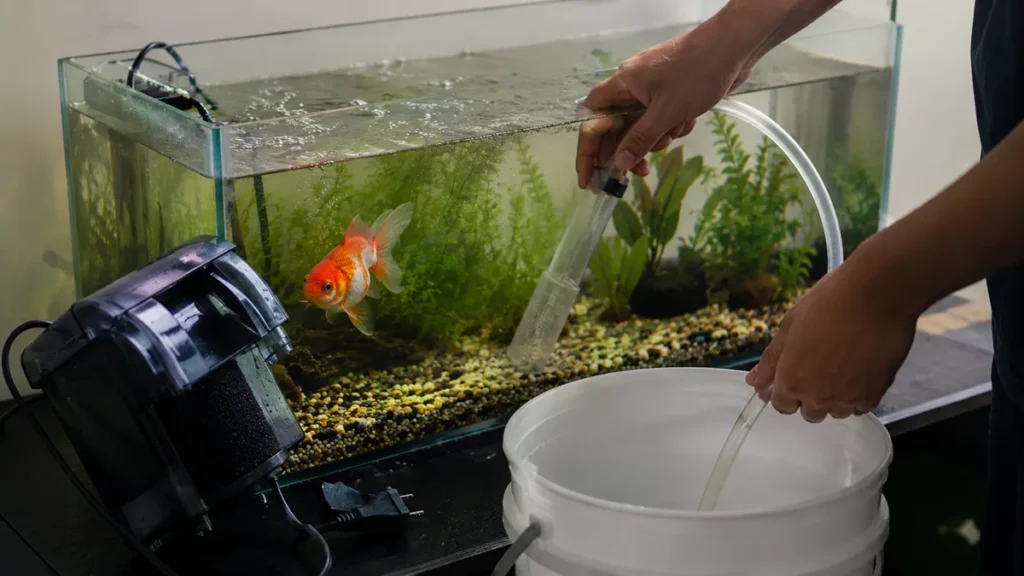
Technically, for a while, in the right conditions. Can goldfish survive without a filter comes down to timeframe: short-term, in an emergency (a broken filter over a weekend, say), a goldfish in a properly-sized, lightly-stocked tank with good water movement can hold on.
That’s a survival window, not a housing plan — the ammonia math above doesn’t pause just because the emergency is temporary, so treat any filterless stretch as something to fix quickly, backed by extra water changes in the meantime. For how much bioload a given tank can realistically absorb before that math turns against you, our aquarium bioload guide walks through the calculation.
Can a Goldfish Live Without a Filter Long-Term?
Can a goldfish live without a filter as a permanent setup is a different, harder question than short-term survival. It’s possible in narrow circumstances — heavily planted tanks, very light stocking, and a disciplined, frequent water-change schedule can substitute for biological filtration by exporting nutrients and diluting ammonia manually.
But “possible” is doing a lot of work in that sentence: without a filter’s continuous nitrifying bacteria colony, waste accumulates faster than most manual routines keep pace with, especially in smaller volumes. If ammonia does start climbing, knowing how to bring it down quickly matters — see our guide to removing ammonia from a fish tank naturally.
If you’re specifically weighing a no-filter, bowl-style setup rather than a filtered tank, that’s a deeper question than this post can do justice to — we’ve covered the bowl-specific version of this, including how long goldfish can realistically last and what a no-filter routine actually requires, in our guide to keeping goldfish in a bowl without a filter.
Filter vs. Heater vs. Air Pump: What Each One Actually Does
| Equipment | Primary job | Essential for goldfish? | When it becomes critical |
| Filter | Hosts bacteria that convert toxic ammonia into safer nitrate; also clears debris | Yes, in nearly all setups | Always — the nitrogen cycle depends on it |
| Heater | Holds a stable temperature | Usually optional | Cold, drafty, or fluctuating rooms |
| Air pump | Adds surface agitation for oxygen exchange | Optional if filter output already agitates the surface | Warm water, heavy stocking, or dense planting |
A Mistake Worth Learning From
During a summer heatwave, I added a heater to my tank to “stabilize” the temperature. Instead, the warmer water caused oxygen levels to crash, and since my filter wasn’t agitating the surface enough, my fish spent hours gasping at the top. It taught me that higher temperatures always demand aggressive aeration.
FAQ
Do goldfish need a filter?
Yes — goldfish produce enough waste, and enough ammonia specifically, that biological filtration is close to non-negotiable in a standard tank, not an optional upgrade.
Does a goldfish need a filter in a small bowl?
Yes, even more urgently than in a larger tank — smaller water volumes concentrate ammonia faster, so a filterless bowl needs an aggressive water-change schedule to compensate for what filtration would otherwise handle.
Do goldfish need a heater and air pump together?
Not necessarily both — most indoor goldfish tanks at stable room temperature need neither a heater nor a dedicated air pump if the filter provides adequate surface movement, but each becomes worth adding independently based on your room’s temperature stability and your tank’s stocking level.
Can a goldfish live without a filter permanently?
It’s possible in very specific setups — heavily planted, lightly stocked, with disciplined frequent water changes — but it’s a harder standard to maintain consistently than most beginners expect, and a filter makes it far more forgiving.
How long can goldfish go without oxygen in a power outage?
Goldfish have unusually strong tolerance for short-term low oxygen thanks to their species’ anoxia adaptations, but that’s an emergency survival mechanism, not a target to plan around — restore aeration as quickly as possible rather than relying on it.
What do goldfish need in their tank besides a filter?
Adequate water volume for their adult size, stable temperature, surface water movement, and a consistent water-change routine — a filter handles ammonia, but it doesn’t replace any of the others.
Do goldfish need a heater in the tank during winter?
Only if your indoor temperature drops meaningfully below the mid-60s°F range or fluctuates sharply; goldfish tolerate cooler water far better than unstable water.
Do goldfish need an air pump if they’re gasping at the surface?
Gasping at the surface is usually a sign of low dissolved oxygen or an ammonia spike, and while adding aeration can help immediately, it’s worth testing water parameters too — an air pump treats a symptom the filter and water changes should be preventing.
Next Steps: Resources You Should Read
Related FishioHub reading:
- Can a Fish Tank Run Without a Filter?
- Can Goldfish Live in a Bowl Without a Filter?
- How to Choose the Right Aquarium Air Pump
- Understanding Aquarium Bioload
- How to Remove Ammonia from a Fish Tank Naturally
Scientific references:
- Fagernes, C.E. et al. (2017). “Extreme anoxia tolerance in crucian carp and goldfish…” Scientific Reports 7, 7884.
- University of Florida IFAS Extension, “Dissolved Oxygen for Fish Production” (FA002)
USA aquarium resources:
- Goldfish Society of America
- American Cichlid Association’s regional aquarium clubs (many maintain goldfish-specific care resources)
- Your local fish store’s water-testing counter — most U.S. pet retailers test ammonia/nitrite/nitrate for free
Bottom Line
A goldfish bowl on a nightstand looks peaceful. What’s actually happening in that water — bacteria racing to keep ammonia in check, oxygen thinning as the temperature climbs a few degrees — is anything but. So if a friend asks you whether do goldfish need a filter is really worth worrying about, you’ll know: give the filter its due, and the rest gets a lot easier.
Was this guide helpful?
First-Hand Experience
Based on animals I've personally kept and bred - not summarized from other articles.
Zoological Foundation
Claims are checked against my M.Sc. Zoology training and published aquatic biology research, not recycled aquarium myths.
No Paid Influence
No sponsorship shaped this guide. Affiliate links, if any, are disclosed separately and never hidden.
Kept Current
Errors are corrected as soon as they're found, with the update noted at the bottom of the article.
Anil Satak M.Sc. Zoology · Founder, FishioHub
Grew up in a fishing family in India and holds a Master's in Zoology. FishioHub is a one-person operation - every guide is personally researched, kept-tested, and written by Anil. No team, no outsourced writers, no AI-generated content. Read his full bio →