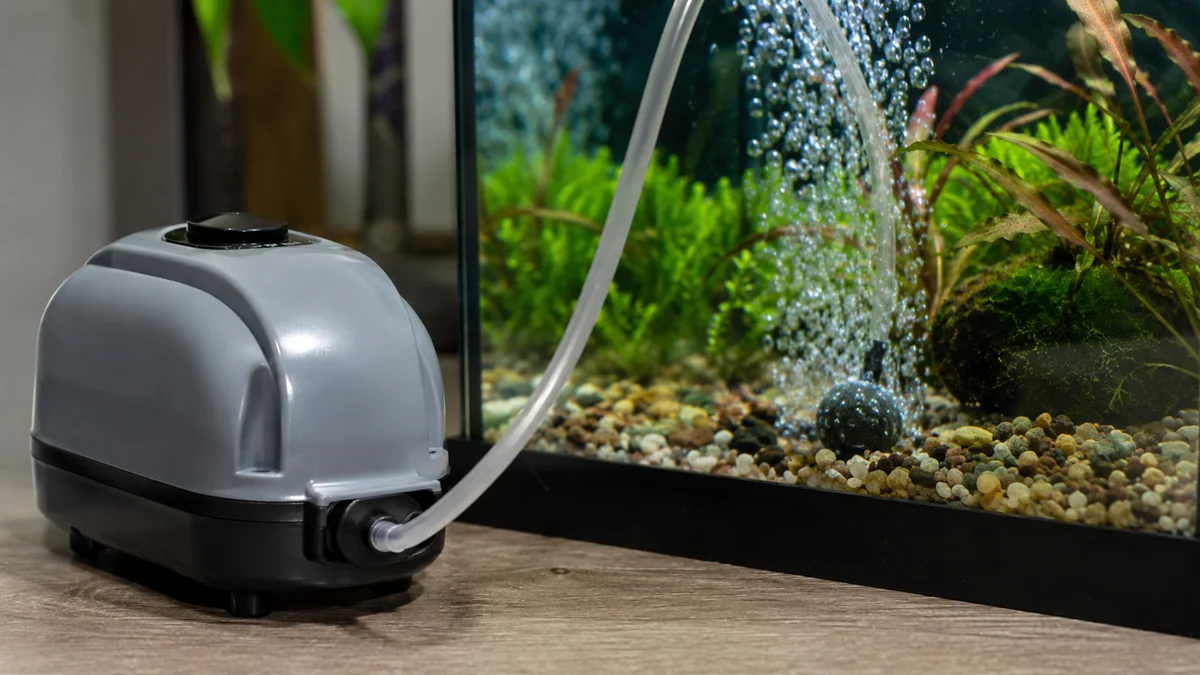
Here’s something most buying guides never tell you: those bubbles rising from your air stone aren’t actually the main source of oxygen in your tank. It’s the surface agitation they create that does most of the work. Get that wrong, and you can run an air pump 24/7 and still leave your fish gasping.
When learning how to choose the right aquarium air pump, I’ve watched more beginners oversize or undersize this gear than almost any other piece of equipment. It’s one of those “how hard can it be” purchases — until your tank tells you otherwise.
Quick answer: To choose the right aquarium air pump, match its airflow rating (LPM/CFM) to 1–2x your tank’s total water volume per hour, factor in tank depth for pressure needs, and check the noise rating — under 40 decibels for a silent air pump for tank use in bedrooms or living rooms. Add a check valve regardless of pump size.
What Does an Aquarium Air Pump Do?
What does an aquarium air pump do, exactly? It pushes air through tubing into your tank, usually through an air stone, sponge filter, or bubble wall. That’s the mechanical part. The biological part is more interesting.
Here’s the mechanism most people get wrong: the bubbles themselves don’t transfer much oxygen while they’re rising. Research on aeration in aquatic systems generally attributes most of the oxygen gain to the surface disturbance those bubbles create at the top of the water column, not the bubble-water contact during the rise itself. A bubble simply doesn’t spend enough time in the water to exchange meaningful oxygen before it pops.
What this means for your setup: an air stone positioned to maximize surface ripple matters more than cramming in extra bubbles. It’s why two smaller air stones spread across the tank often outperform one large one in the center.
What an Air Pump Actually Does for Your Tank
- Increases dissolved oxygen by driving surface agitation
- Powers sponge filters, air stones, and bubble walls
- Prevents dead water zones in corners and along the substrate
- Supports beneficial bacteria that need oxygen to process ammonia
- Provides backup oxygenation during power outages (with a battery model)
- Helps fish cope with low-oxygen stress during summer heat waves
How to Choose the Right Aquarium Air Pump, Step by Step
1. Match Airflow to Tank Volume (The Rule Most Guides Skip)
Here’s the number that actually matters: aim for an air pump rated to move 1–2 times your tank’s total water volume per hour, measured in liters per minute (LPM) or gallons per hour (GPH).
- 10–20 gallons: Small pump, roughly 100–150 GPH output
- 20–55 gallons: Medium pump with adjustable airflow
- 55–100 gallons: High-output or dual-outlet pump
- 100+ gallons: Commercial-grade or piston pump
This is a starting point, not the final word — depth changes the math too.
2. Factor In Tank Depth, Not Just Volume
A pump rated for a certain flow at the surface loses power pushing air down through deeper water. For tanks deeper than 18 inches, the water pressure at the bottom is genuinely higher, and a low-pressure pump will struggle to push bubbles that far down.
- Shallow tanks (under 18″): low-pressure, standard-flow pump works fine
- Deep tanks (18″+): choose a high-pressure model, or a piston pump built for depth
3. Check the Noise Rating
For US bedrooms, living rooms, and offices, this is where most buyers get burned — they check gallons and skip decibels entirely. More on this below.
4. Decide on Outlets
- Single outlet: one air stone or one sponge filter, tanks up to 20 gallons
- Dual outlet: two devices, or one device with extra flow to spare
- Multiple outlets: rack systems, divided tanks, or multiple filters
5. Choose Pump Type
Covered in full detail in the next section — this is worth getting right, not skimming.
6. Check Energy Consumption
Most US aquarium air pumps run 2–10 watts. Since these run continuously, the difference between a 3-watt and 8-watt pump adds up over a year, even if it feels trivial on the shelf.
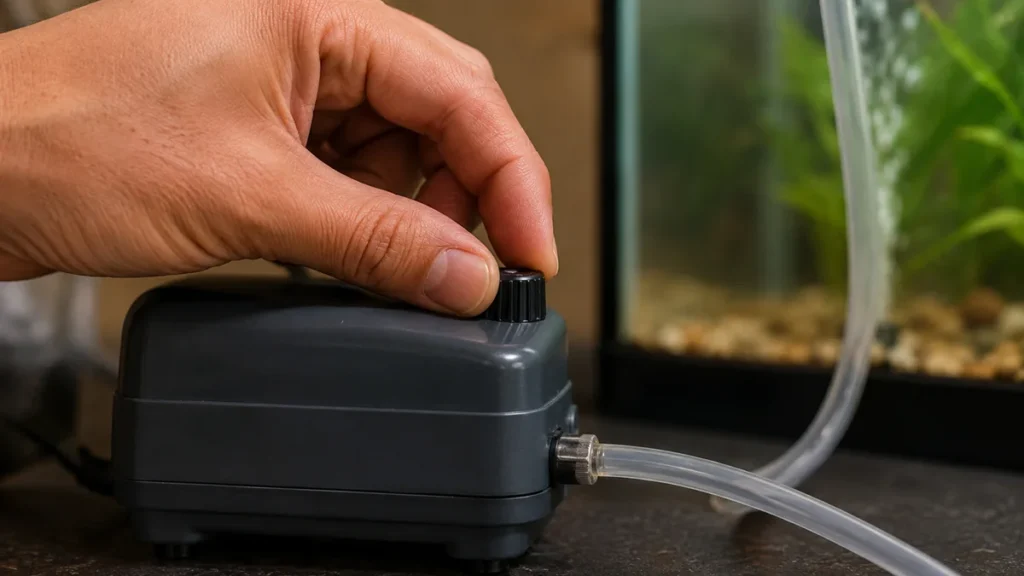
7. Look for Adjustable Airflow Control
A built-in flow knob, or a separate airline control valve, lets you dial back bubble intensity without straining the pump’s diaphragm.
8. Check Brand Reputation and Warranty
A 1–3 year warranty and available replacement diaphragms matter more long-term than the sticker price. Diaphragms wear out — that’s normal — but only if parts are actually available when yours does.
Silent Air Pump for Tank: Getting the Noise Level Right
If your tank lives anywhere near where you sleep or work, a silent air pump for tank use isn’t a luxury — it’s the difference between forgetting the pump exists and regretting the purchase within a week.
What to look for:
- Noise rating under 40 decibels — below 30 dB is genuinely whisper-quiet
- Rubber feet to reduce surface-transmitted vibration
- Dual-chamber sound insulation in the pump housing
- DC brushless motors, which run noticeably quieter than older AC diaphragm designs
Why pumps get loud even when the specs look fine: noise usually comes from vibration transfer, not the motor itself. A quiet-rated pump sitting directly on a hard shelf or glass tank lid will still buzz audibly. A cheap foam pad or dedicated rubber mat under the pump solves this more often than buying a more expensive pump does.
Diaphragm vs Piston vs DC: Which Type Actually Fits Your Tank
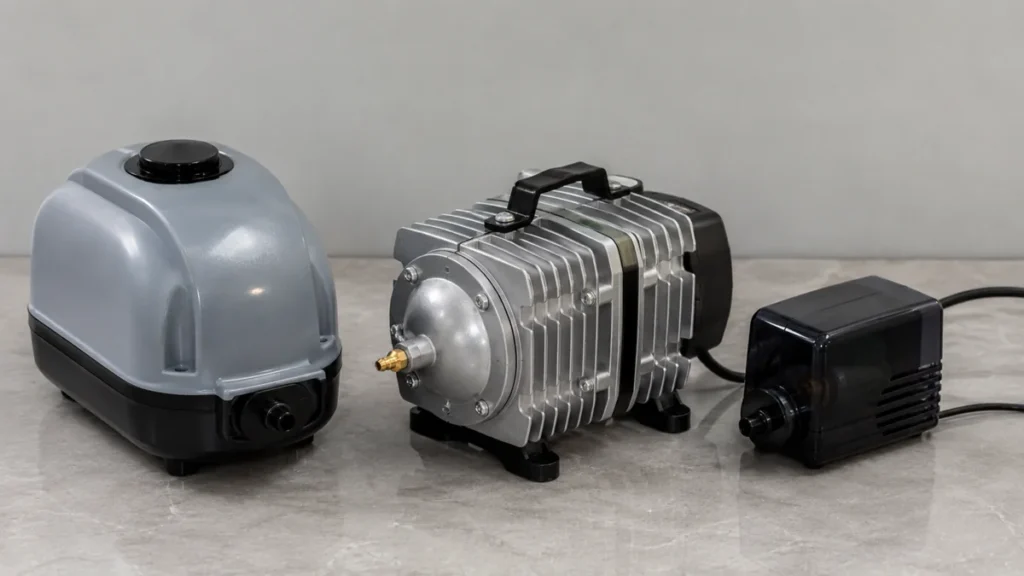
Most buying guides list these three types without explaining why the mechanism matters for your decision. Here’s the real difference.
Diaphragm Air Pumps (Most Common)
An electromagnet vibrates a rubber diaphragm at high speed, changing chamber volume to push air out. Simple, affordable, and the default choice for small-to-medium tanks. The tradeoff: the diaphragm is a wear part, and cheaper models can run noticeably loud as it ages.
Piston Air Pumps (Commercial-Grade)
A motor drives a piston back and forth in a cylinder, generating stronger and more stable pressure. This is the type you want for deep tanks, fish rooms, or anything needing to drive multiple devices at once. More expensive, but usually quieter than a diaphragm pump of similar output once you’re past the entry-level tier.
DC / USB Nano Air Pumps
Driven by a brushless DC motor. The quietest option by a wide margin, and the most energy-efficient. The catch: output is genuinely lower, so these are built for nano tanks and desktop setups, not anything over about 20 gallons.
Best Aquarium Air Pump by Tank Size (USA Picks)
There’s no single best aquarium air pump — the best air pump for fish tank use depends entirely on your setup. Here’s how I’d match them:
| Tank Size | Best Fit | Why |
| Nano (under 10 gal) | DC/USB nano pump | Quiet, low power, enough output for one small air stone |
| 10–20 gal | Single-outlet diaphragm pump | Affordable, reliable, matches small-tank flow needs |
| 20–55 gal | Dual-outlet diaphragm pump with adjustable flow | Flexibility to run a sponge filter and air stone together |
| 55–100 gal | High-output diaphragm or entry piston pump | Handles depth and higher flow demand |
| 100+ gal / fish room | Piston pump, multiple outlets | Stable, strong output for driving several devices |
What the Science Says vs What Hobbyists Believe
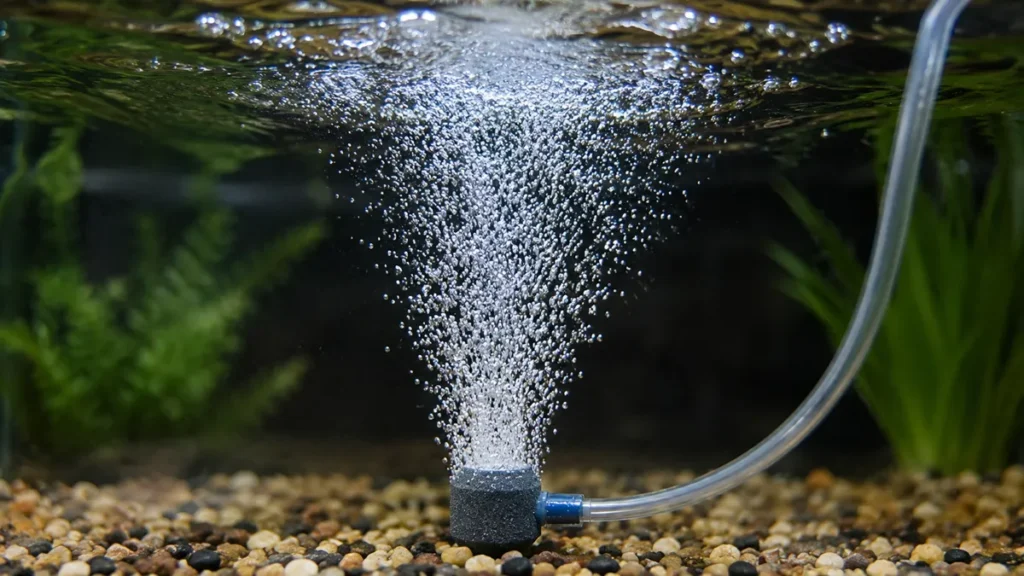
Myth: “More bubbles means more oxygen.”
Reality: As covered above, the bubbles themselves transfer relatively little oxygen during their brief rise through the water. What actually raises dissolved oxygen is the surface ripple those bubbles create, which increases the surface area exposed to air. A wide, gentle ripple pattern across more of the surface does more for oxygen levels than a single column of large, fast bubbles in one spot.
What this means for your tank: placement of your air stone matters as much as pump strength. Spreading output across a wider area of the surface — rather than concentrating it in one corner — genuinely improves oxygenation for the same pump output.
What Happens If You Undersize Your Air Pump
This is the scenario nobody warns you about clearly enough. An undersized pump doesn’t just “underperform” quietly — it creates specific, visible problems:
- Dead zones form in corners and along the bottom where waste and debris settle undisturbed
- Beneficial bacteria colonies in your filter media get less oxygen, slowing ammonia processing right when your bioload is highest
- Fish start gasping at the surface during warm weather, when dissolved oxygen capacity in water drops naturally as temperature rises
- Sponge filters connected to an undersized pump barely bubble at all, which defeats their entire filtration purpose
The fix is rarely “buy a bigger pump” alone — check your air stone isn’t clogged and your airline isn’t kinked first, since both can make a correctly sized pump behave like an undersized one.
What I Got Wrong My First Time
It was in april, 2019, When I bought my first 40-litre tank, I completely oversized the filter, thinking more filtration was always better and also it was hot summer. I ended up installing a heavy-duty canister filter that turned my peaceful tank into a chaotic whirlpool. My poor neon tetras spent all their energy fighting the brutal current until I finally swapped it for an adjustable sponge filter.
USA Buyer’s Note
If you’re shopping in the US:
- PetSmart and Petco stock Tetra Whisper and Aqueon pumps in most stores — reliable, budget-friendly diaphragm pumps for small-to-medium tanks
- Amazon is usually faster for DC/USB nano pumps (Pawfly, Uniclife) and commercial piston pumps (EcoPlus) than most local stores carry
- US aquarium pumps typically run on 110–120V, so if you’re importing a pump from a UK or EU retailer, confirm voltage compatibility before buying — this trips up more people than you’d expect
- Battery-backup pumps are worth the extra $15–20 if you live somewhere with frequent summer storms and power outages — a few hours without aeration on a heavily stocked tank can turn serious fast
FAQs on How to Choose the Right Aquarium Air Pump
How to choose the right aquarium air pump for a specific tank size?
Match the pump’s airflow rating to 1–2 times your tank’s total water volume per hour, then adjust upward for tank depth over 18 inches. A pump correctly sized for volume alone can still underperform in a deep tank without enough pressure to push air to the bottom.
How often should I run my air pump?
Most US aquarists run their air pump continuously, 24/7, since oxygen demand doesn’t stop overnight. The one common exception is heavily planted tanks using CO2 injection, where some owners run the pump only at night to avoid disrupting daytime CO2 levels.
Is it safe to use a strong air pump in a small tank?
Not without a flow control valve. Excessive bubble turbulence in a small tank can stress fish and disturb delicate species like bettas or shrimp. Choose an adjustable model or pair any pump with an inline airline control valve.
What’s the biggest mistake people make buying an air pump?
Sizing the pump to gallons alone while ignoring noise rating and tank depth. A pump that looks correctly sized on paper can still be too weak for a deep tank, or too loud for a bedroom setup, if those factors are skipped.
Where can US buyers find a quiet, reliable aquarium air pump?
PetSmart and Petco carry Tetra Whisper and Aqueon diaphragm pumps in most locations, while Amazon offers a wider range of DC and piston pumps for larger or noise-sensitive setups.
Do I need an air pump if I already have a filter?
Not always — a strong filter with good surface agitation may provide enough oxygen exchange on its own. Air pumps become more important in heavily stocked tanks, during medication treatments, or when running sponge filters that rely entirely on air-driven flow.
Does a louder air pump mean it’s more powerful?
No — noise usually comes from vibration transfer through a hard surface or an aging diaphragm, not from actual air output. A quiet pump on a rubber mat can outperform a loud one sitting directly on glass.
Can one air pump run two aquariums at once?
Yes, if the pump has dual outlets or you use a splitter, provided the combined flow rate still meets both tanks’ needs. Splitting a single-outlet pump across two tanks usually leaves both underpowered.
Bottom Line
Choosing the right aquarium air pump isn’t about buying the biggest one you can afford — it’s matching flow rate to your actual tank volume and depth, then getting the noise level right for where the tank lives. Skip the flow-rate math, and you’ll either starve a deep tank of oxygen or run a needlessly loud pump on a small one. Get that one calculation right, and everything else — outlets, pump type, accessories — falls into place around it.
Scientific References
- General aquaculture and limnology research on gas transfer in aerated water systems, consistent with findings summarized in aquaculture engineering literature (e.g., C. Boyd, Water Quality: An Introduction), attributing most oxygen gain in diffused aeration to surface renewal rather than bubble-water contact time during ascent.
- Manufacturer and aquaculture engineering guidance on flow-rate-to-volume ratios for diffused aquarium aeration systems.
Read More from FishioHub:
- How to Remove Ammonia From a Fish Tank Naturally — beneficial bacteria need the oxygen your air pump provides to process ammonia effectively
- Why Is My Fish Breathing Fast? — surface gasping is one of the clearest signs of an undersized air pump
Next Steps: Resources You Should Read
- Understand what your bacteria need to survive — How to Remove Ammonia From a Fish Tank Naturally explains why oxygen and ammonia processing are directly connected.
- Recognize oxygen stress early — Why Is My Fish Breathing Fast? covers the exact symptoms an undersized air pump can cause.
- Scaling up your setup? — Biofloc Fish Farming Cost and Profit Calculator helps plan aeration costs for larger systems.
Was this guide helpful?
First-Hand Experience
Based on animals I've personally kept and bred - not summarized from other articles.
Zoological Foundation
Claims are checked against my M.Sc. Zoology training and published aquatic biology research, not recycled aquarium myths.
No Paid Influence
No sponsorship shaped this guide. Affiliate links, if any, are disclosed separately and never hidden.
Kept Current
Errors are corrected as soon as they're found, with the update noted at the bottom of the article.

Anil Satak M.Sc. Zoology · Founder, FishioHub
Grew up in a fishing family in India and holds a Master's in Zoology. FishioHub is a one-person operation - every guide is personally researched, kept-tested, and written by Anil. No team, no outsourced writers, no AI-generated content. Read his full bio →