
Quick Summary Fact Card
- Aquarium bioload is not a fixed number — it shifts as fish grow, feeding increases, and biofilter colonies age, exactly like the carrying-capacity math NASA-linked researchers use for closed-loop life-support systems
- Biosphere 2’s oxygen crisis was caused by a hidden capacity-consumer nobody had sized correctly — the same failure pattern behind most “sudden” aquarium crashes
- You can calculate your own tank’s real aquarium bioload in four steps, no equipment beyond what you already own
Direct answer: Your aquarium’s bioload is the total waste-processing demand your fish, feeding, and decay place on your biofilter and water volume at any given moment. It rises as fish grow even if you never add another fish, and most “sudden” tank crashes happen when bioload quietly outgrows biofilter capacity until a tipping point is crossed — not because anything visibly changed.
The Tank That Was “Fine” for Months — Until It Wasn’t
I thought my system was bulletproof because my water tests were clean. I didn’t account for the sheer physical mass my fish were gaining, or the fact that my feeding habits had quietly doubled to keep up with their growth. The plants were eating the nitrates, but the oxygen demand was skyrocketing.
During an unseasonably warm weekend, the ambient room temperature spiked. Warmer water holds less oxygen. The combination of massive fish, decaying substrate waste, restricted filter flow, and heat caused a sudden midnight oxygen crash. i woke up to find his prize Angelfish dead and the loaches gasping at the surface—a classic carrying-capacity failure.
If you’ve kept fish for more than a year, you’ve probably lived some version of this. A tank runs clean for months. Parameters look fine on every test. Then, over the course of a week, ammonia spikes and fish start gasping at the surface — and you’re left wondering what changed, because on the surface, nothing did.
Here’s the reframe that’s helped me troubleshoot dozens of these cases, both my own and readers’: your aquarium isn’t a decoration with fish in it — it’s a closed-loop life-support system, running the same fundamental math as the systems researchers have spent decades trying to perfect for long-duration space habitats. Aquarium bioload is that math. And once you understand why those larger systems fail, you understand exactly why your tank does too.
Aquarium Carrying Capacity: What Biosphere 2 Got Wrong
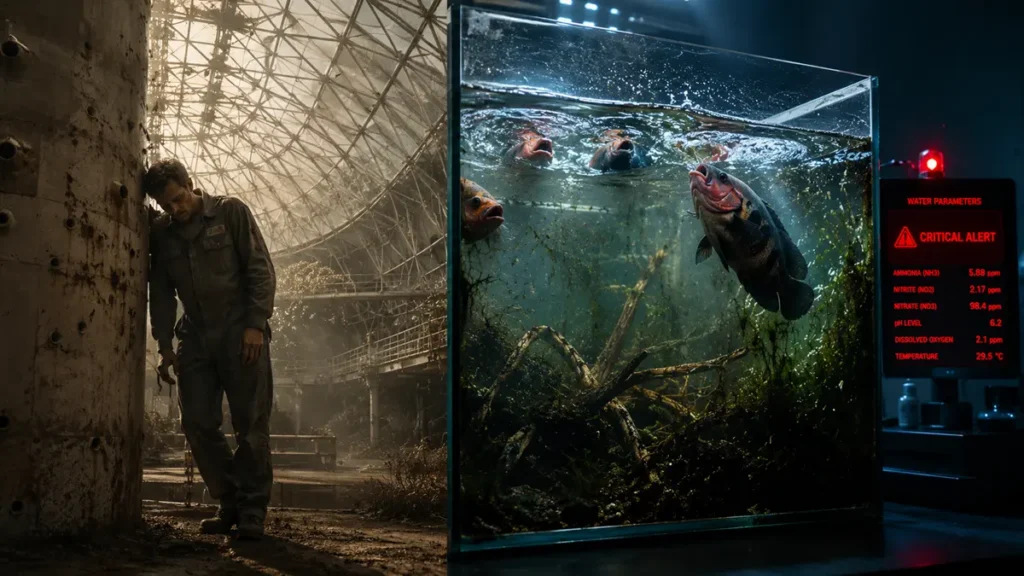
Aquarium carrying capacity is the ceiling on how much waste your fish, feeding, and biological processes can generate before your system can no longer keep up — and it’s a moving target, not a fixed number.
In 1991, eight researchers sealed themselves inside Biosphere 2, a 3-acre glass structure in the Arizona desert built to test whether humans could live inside a fully self-sustaining closed ecosystem — the kind of infrastructure a future Mars colony would need. On paper, the oxygen its plants produced should have balanced the oxygen its inhabitants and soil consumed.
It didn’t. Over the first 16 to 17 months, oxygen inside the sealed structure fell from a normal 20.9% down to 14.2% — thin enough that the crew developed chronic fatigue and sleep problems, and engineers eventually had to pump in supplemental oxygen just to keep the mission going (Severinghaus et al., oxygen loss analysis).
The unsettling part wasn’t that oxygen declined — some drift was expected. It’s why the decline outpaced every calculation: the soil was so rich in organic matter that microbes in it consumed oxygen far faster than modeled, and much of the CO2 they produced never cycled back to the plants — it reacted with the structure’s exposed concrete and locked away permanently, vanishing from the system’s usable gas cycle.
There was a hidden consumer of aquarium-carrying capacity — or rather, habitat-carrying capacity — that nobody had accounted for in the original design. That is precisely what happens inside a tank that crashes “suddenly.”
What This Means for Your Tank
Aquarium bioload is a live balance between three things:
- Waste input — what your fish and any decaying food or plant matter add to the system
- Processing capacity — what your biofilter’s bacterial colony, substrate, and live plants can actually break down right now, today
- Buffer margin — the surface agitation, water volume, and water-change schedule keeping you from running at the very edge of that processing capacity
Important: None of these three numbers is fixed. Your biofilter’s processing capacity on day one of cycling is not its capacity six months later, once your fish have doubled in size and your feeding has crept up without you noticing. That’s the aquarium version of Biosphere 2’s concrete sink — a consumer of capacity you didn’t originally size for.
Aquarium Nitrogen Cycle Crash: Why It Happens Without Warning
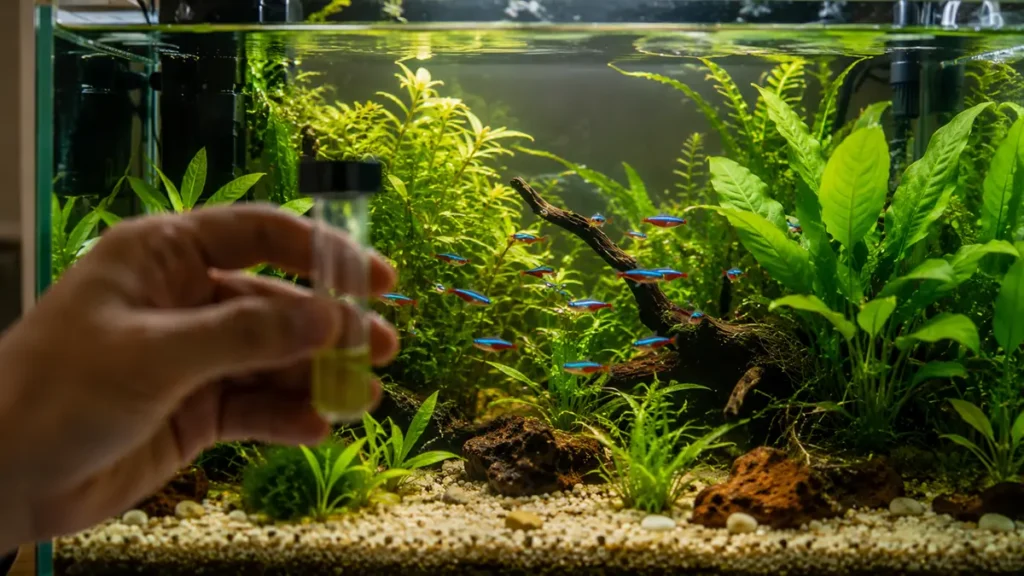
An aquarium nitrogen cycle crash rarely happens gradually — it happens like a threshold failure: stable, stable, stable, and then ammonia and nitrite spike within days once bioload creeps past what your biofilter colony can process.
Biosphere 2’s own oxygen data shows this same pattern — the decline wasn’t a smooth straight line, it accelerated as the gap between production and consumption widened. Your tank’s nitrogen cycle behaves the same way. Everything upstream of an aquarium nitrogen cycle crash can look completely normal: your test strips read fine last week, nothing about your routine changed. But your fish grew, your feeding volume grew with them, and your biofilter’s fixed processing capacity didn’t grow at the same pace — until the gap tipped over.
This is why “I do a 20% water change every week, and my tank still crashed” is one of the most common frustrations I hear from readers. A water change addresses the buffer margin. It does nothing to fix a system in which aquarium bioload has permanently outgrown its processing capacity.
Building Your Own Aquarium Bioload Calculator
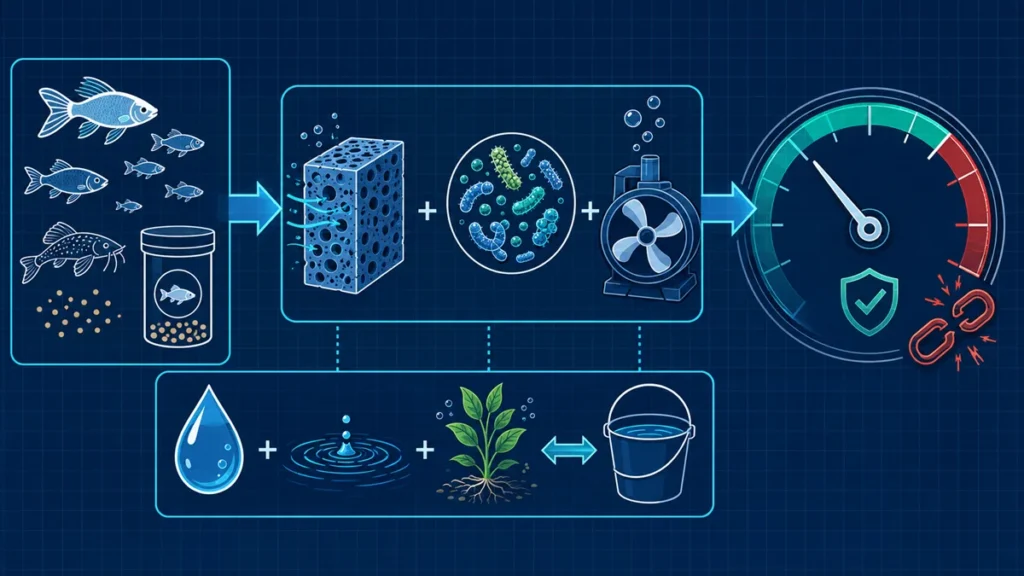
Here’s an aquarium bioload calculator framework, adapted directly from how closed life-support systems are sized — the same four variables engineers plan for, translated into something you can calculate for your own tank this weekend.
- Input rate — Estimate realistic waste output: species and adult size (not current size), total count, and actual feeding frequency. A tank stocked for juvenile fish carries a different aquarium bioload than the same tank six months later.
- Processing rate — Your biofilter’s real, current capacity: media surface area, colony maturity (a colony seeded two weeks ago is not equivalent to one running six months), and flow rate through that media.
- Buffer margin — Water volume, surface agitation (which governs oxygen exchange and off-gassing), live plant biomass offsetting nitrogen load, and water-change frequency.
- Safety threshold — The gap between input rate and processing rate. A tank running at 90% of its biofilter’s capacity has almost no room for a heavier feeding week or a new addition — exactly the gap that turns into a sudden aquarium nitrogen cycle crash.
Run this aquarium bioload calculator not just at stocking, but every few months as your fish grow. That single habit catches the hidden-capacity-consumer problem before it catches you.
Fish Tank Bioload Capacity: Building In Redundancy
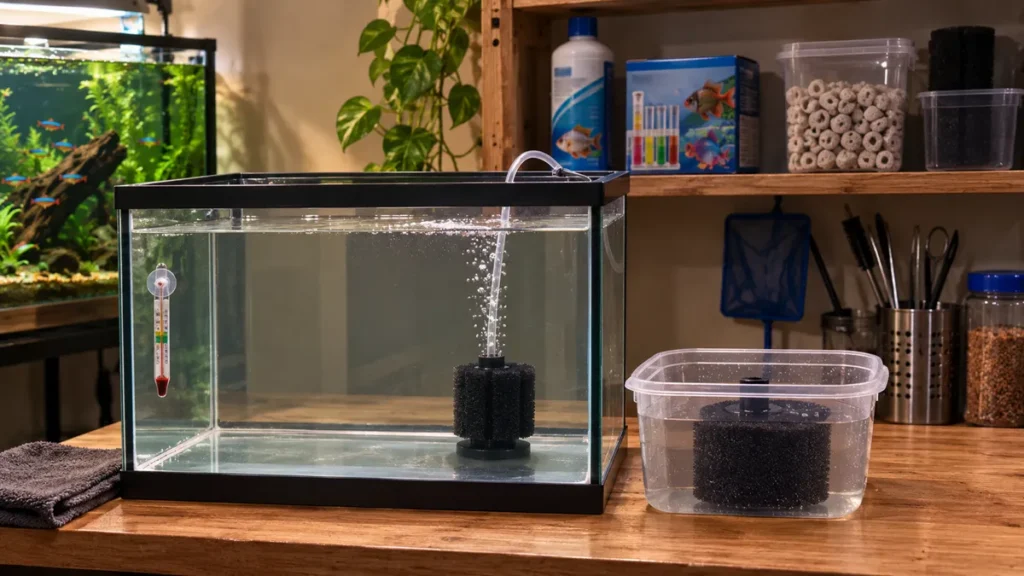
Fish tank bioload capacity should never be planned right up to the edge — the same way every functioning closed life-support system is built with redundancy, because a single point of failure in a sealed system is catastrophic, not just inconvenient.
Translate that into your fishroom:
- A running, cycled quarantine tank, so a new fish or disease outbreak never has to be handled inside your main system under pressure
- Backup filter media (a spare sponge or cartridge kept wet in your display tank’s own water) ready to seed a second filter instantly if your primary ever fails
- A buffer stock of dechlorinator and test kit reagents, so a bad week doesn’t become a bad month because you ran out at the wrong time
None of this is expensive. Building margin into your fish tank bioload capacity costs far less than recovering from a crash.
A Practical Monthly Aquarium Bioload Audit
Once a month, run through this:
- Recalculate aquarium bioload input — have your fish grown, has feeding crept up?
- Check biofilter maturity and flow — any drop in flow rate through the media?
- Confirm your buffer margin still holds — does your water-change schedule match the current bioload, not the bioload from three months ago?
Five minutes a month, and it catches the gap between “stable” and “at capacity” before it becomes a crash.
FAQ
What is aquarium carrying capacity?
Aquarium carrying capacity is the maximum aquarium bioload — waste input from fish, feeding, and decay — that your biofilter, water volume, and maintenance routine can process without ammonia or nitrite accumulating. It isn’t fixed; it shifts as fish grow and biofilter colonies mature.
Why did my aquarium crash suddenly after months of stability?
Most sudden crashes are an aquarium nitrogen cycle crash caused by bioload slowly outgrowing biofilter processing capacity without a visible warning sign, until the gap crossed a threshold and ammonia/nitrite spiked within days.
How do I calculate my tank’s aquarium bioload?
Estimate waste input (species, adult size, feeding frequency), your biofilter’s current processing capacity (media surface area and colony maturity), and your buffer margin (water volume, surface agitation, water-change frequency). The gap between input and processing rate is your real safety threshold.
How do I prevent my fish tank bioload capacity from being exceeded again?
Run a monthly aquarium bioload audit as your fish grow, keep a cycled quarantine tank and backup filter media on hand, and scale your water-change schedule to current bioload — not the bioload you had at setup.
Is the 1-inch-per-gallon rule an accurate bioload measure?
It’s a rough starting heuristic at best. It ignores adult fish size, actual feeding load, biofilter maturity, and water volume dynamics — all of which matter more to real aquarium bioload than fish length.
Next Steps
More from FishioHub:
- How to Remove Ammonia From a Fish Tank Naturally — direct follow-up once bioload has already tipped into an ammonia spike
- Most Common Aquarium Problems and Solutions — covers overcrowding and filter problems that feed directly into bioload miscalculation
- Why Is My Fish Breathing Fast? — one of the first visible symptoms of a bioload-driven crash
- Why Is My Fish Tank Cloudy Overnight? — a bacterial bloom symptom of the same capacity-gap problem
- How Many Times a Day Should You Feed Aquarium Fish? — directly controls the input-rate variable in the bioload calculator
- How to Choose the Right Aquarium Air Pump — relevant to the buffer-margin/oxygen exchange variable
Scientific references:
- Severinghaus, J.P., et al. — oxygen loss dynamics in Biosphere 2 (biogeochemical analysis of the 1991–93 closure)
- Nelson, M. et al. — Biosphere 2 closed ecological system technical retrospectives
- Standard aquarium nitrogen cycle literature (nitrifying bacteria colonization and capacity research)
Was this guide helpful?
First-Hand Experience
Based on animals I've personally kept and bred - not summarized from other articles.
Zoological Foundation
Claims are checked against my M.Sc. Zoology training and published aquatic biology research, not recycled aquarium myths.
No Paid Influence
No sponsorship shaped this guide. Affiliate links, if any, are disclosed separately and never hidden.
Kept Current
Errors are corrected as soon as they're found, with the update noted at the bottom of the article.

Anil Satak M.Sc. Zoology · Founder, FishioHub
Grew up in a fishing family in India and holds a Master's in Zoology. FishioHub is a one-person operation - every guide is personally researched, kept-tested, and written by Anil. No team, no outsourced writers, no AI-generated content. Read his full bio →