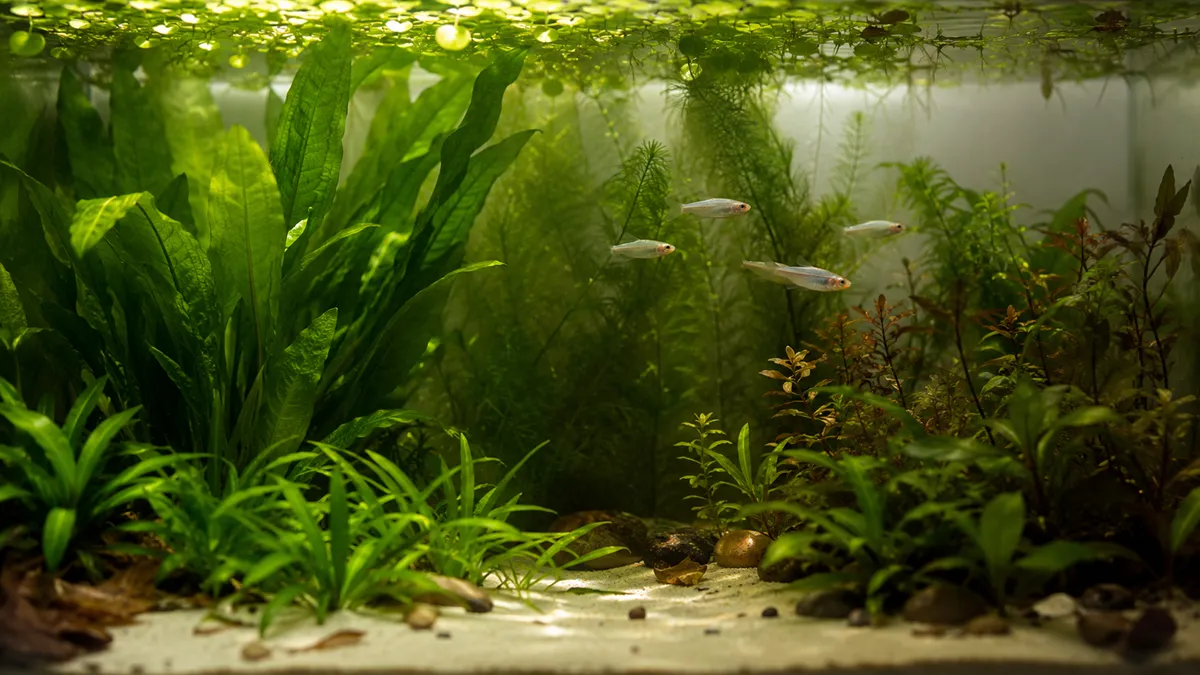
Can a fish tank run without a filter? Yes — but only if the tank is heavily planted, lightly stocked, fully cycled, and backed by water changes of 30–50% twice a week. Skip any one of those four conditions and ammonia will climb past the 0.05 ppm threshold that starts damaging gill tissue within days, not weeks.
I set up my first filterless tank as a grad-school experiment more than anything — partly curiosity, partly a cracked filter housing I couldn’t replace that week. It worked, eventually. But it took me three algae blooms and one dead rasbora to understand why it worked, and that gap between “it can work” and “here’s exactly when it doesn’t” is where most of the advice online falls short.
Why Filters Matter (And What Plants Can and Can’t Replace)
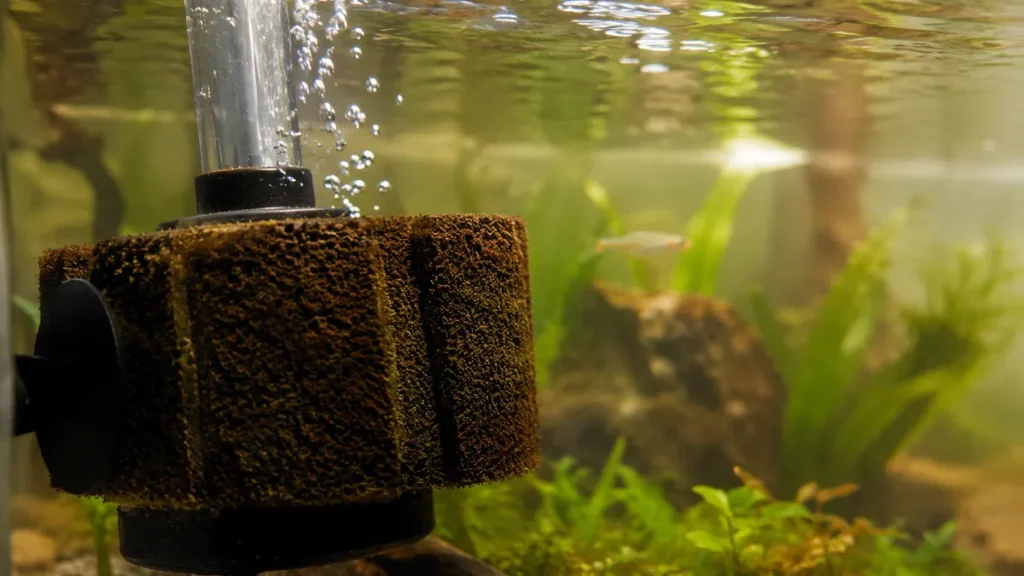
A filter in a healthy aquarium is really doing three separate jobs at once, and each one degrades differently if you remove it.
1. Biological filtration — housing the bacteria that detoxify waste
Fish excrete ammonia (NH₃) directly through their gills as a byproduct of protein metabolism. Nitrifying bacteria — mainly Nitrosomonas and Nitrobacter species — convert that ammonia to nitrite, then to far-less-toxic nitrate. These bacteria don’t float in the water column; they colonize solid surfaces, and a filter’s media is built to maximize that surface area. Pull the filter and you haven’t removed the bacteria’s home entirely — your gravel, glass, and driftwood still host some — but you’ve cut the available colonization surface dramatically, which is why ammonia spikes happen faster in a filterless tank that loses its plant balance.
The toxicity math here is specific: unionized ammonia (the toxic form, as opposed to the mostly-harmless ammonium ion) starts causing measurable gill damage above roughly 0.05 mg/L, and concentrations near 2.0 mg/L are lethal to most freshwater species. A newly set up tank with no established bacterial colony can blow past both thresholds within 48–72 hours if it’s stocked before it’s cycled.
2. Water movement — oxygen exchange: your fish and bacteria both need
Filters create surface agitation, and surface agitation is what actually drives gas exchange — oxygen in, CO₂ out. This matters most overnight: aquatic plants photosynthesize (producing oxygen) only when lit, but they respire and consume oxygen around the clock. In a heavily planted, unfiltered tank with no surface movement, dissolved oxygen can drop noticeably between lights-off and sunrise, which is exactly when fish gasping at the surface tends to show up.
3. Mechanical filtration — trapping the debris before it decays
Uneaten food, waste, and dying leaf matter cloud the water and feed algae if nothing removes them physically. Plants and bacteria handle the chemical byproducts of decay; neither one physically removes a floating chunk of debris. That’s a job only mechanical filtration (or your gravel vac and hands) actually does.
The 3 Types of Aquarium Filtration
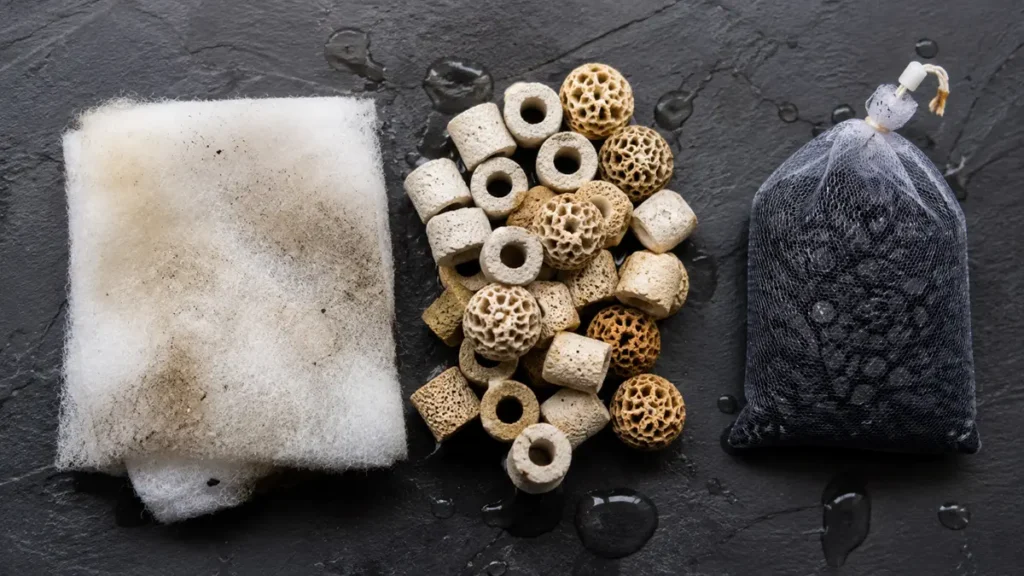
Every filter on the market — canister, hang-on-back, sponge, internal — is really running one, two, or all three of these processes simultaneously:
- Mechanical filtration: physically straining particles out of the water via filter floss, sponge, or foam. This is the only one of the three that a plant-based setup cannot substitute for at all.
- Biological filtration: the nitrifying bacteria colony described above, living on filter media, gravel, glass, and plant surfaces.
- Chemical filtration: media like activated carbon that adsorbs dissolved organics, medications, and odor compounds. This is the easiest of the three to live without — most stable, well-planted tanks never need it.
Knowing which of the three you’re removing is the actual answer to “do I need a filter for a fish tank.” If your plants can out-compete the bioload biologically, and you’re vacuuming debris manually during water changes, you’re only losing the mechanical piece — which is a far smaller gap than most beginners assume.
The 5 Real Conditions That Make a Filterless Tank Possible
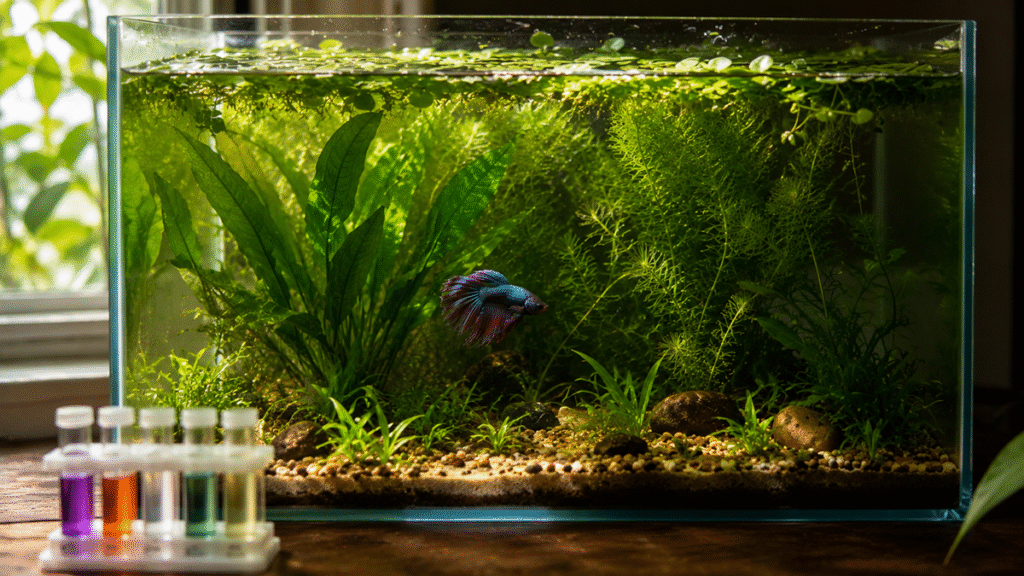
Filterless tanks aren’t a myth, but they only work when all five of these are true together — not any one in isolation.
1. Heavy, fast-growing plant mass
Species like hornwort, water sprite, Amazon sword, and floating plants such as duckweed or frogbit take up ammonia and nitrate directly as fertilizer — a process sometimes called the “nitrogen skip,” since it bypasses the bacterial conversion step entirely. The catch: plants only pull nutrients when they’re actively growing. A struggling, melting plant stops absorbing waste and starts contributing to it.
2. Genuinely light stocking
This is where most filterless attempts fail — people underestimate their bioload. Realistic examples that hold up:
- 1 betta in a 5–10 gallon, heavily planted tank
- 5–6 shrimp or nerite snails in a 3–5 gallon nano
3. Water changes of 30–50%, twice weekly
Without mechanical filtration pulling debris continuously, water changes are doing double duty: diluting nitrate and physically exporting waste before it decays.
4. A fully matured, cycled tank
A tank needs an established nitrifying bacteria colony before it can handle any bioload safely — that colonization typically takes several weeks to a couple of months, even with daily ammonia dosing to feed the bacteria. Stocking a brand-new, uncycled tank without a filter is the single fastest way to lose fish.
5. An experienced keeper who tests water routinely
Filterless tanks have a smaller margin for error. Without a filter’s stabilizing buffer, plant die-off, overfeeding, or a missed water change shows up in ammonia and pH swings faster — and beginners without a test kit habit often don’t catch it until fish are already stressed.
The Mistake I Made the First Time I Tried It
My grad-school filterless tank held six white cloud minnows in a 10-gallon planted with hornwort and a few Amazon swords. It ran clean for about five weeks. Then I added three more fish without thinking about it, because the tank “looked like it had room.” Ammonia crept up over the next ten days — not overnight, which is what made it dangerous. By the time cloudiness and one lethargic fish tipped me off, I’d already lost a rasbora. The plants had been keeping pace with six fish, not nine. Nothing failed suddenly; I just moved the goalposts on a system that had zero backup capacity once I did.
That’s the real risk profile of a filterless tank: it’s forgiving of stability and completely unforgiving of small, casual changes.
How Long Can Fish Actually Survive Without a Filter?
If your filter dies unexpectedly rather than you planning around a filterless setup, the tank isn’t in the same situation described above — there’s no established plant mass compensating yet. In a stocked, cycled tank, fish can typically tolerate a filter outage of a few days without disaster, especially if you cut feeding in half (less food means less ammonia) and add an air stone for surface agitation in the meantime. Past roughly a week, test your water — if ammonia or nitrite reads above 0.25 ppm, do an immediate 30–40% water change and repeat every 1–2 days until the replacement filter or media arrives.
Real Filterless Setups That Actually Work
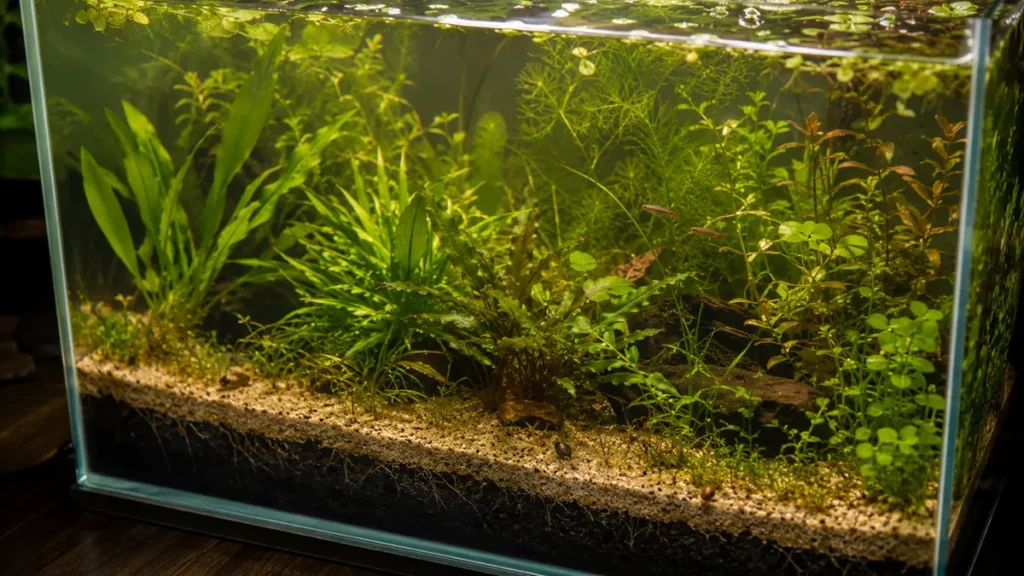
The Walstad Method
Developed by ecologist Diana Walstad and detailed in her book Ecology of the Planted Aquarium, this method uses a nutrient-rich soil substrate capped with sand or fine gravel, dense planting, and moderate lighting to let plants and soil microbes handle the entire nitrogen cycle. Properly built Walstad tanks can run with zero mechanical filtration for years — but Walstad herself recommends adding an air stone the moment fish start gasping at the surface, since it’s a direct signal that oxygen demand has outpaced what the plants are producing.
Shrimp-only nano tanks
Shrimp produce a fraction of the waste a similarly-sized fish does, which is why heavily planted shrimp nanos are one of the most forgiving filterless setups for beginners to try.
Outdoor ponds
Sunlight, algae, floating plants, and a much larger water volume-to-bioload ratio let outdoor ponds self-regulate in a way that’s difficult to replicate in a sealed glass box indoors.
When a Tank Should Never Run Without a Filter
- New, uncycled tanks — there’s no bacterial buffer yet, filtered or not
- Goldfish tanks — goldfish produce a genuinely unusual amount of waste for their size
- Community tanks with mixed species — bioload adds up fast across multiple fish
- Tanks with messy eaters — cichlids and plecos in particular
- Anything under 3 gallons — too little water volume to buffer any ammonia spike
First 24 Hours: What To Do If Your Filter Just Died
- Cut feeding immediately — skip a feeding or halve the portion; less food in means less ammonia produced.
- Add surface agitation — an air stone, powerhead, or even manually stirring the surface keeps oxygen exchange going.
- Test ammonia and nitrite that day, not tomorrow — you want a baseline before anything shifts.
- Don’t do a full water change — a large sudden change can stress fish further; 20–25% is usually enough as a stopgap.
- Order a sponge filter, not just replacement parts — it’s the fastest, cheapest way to restore both mechanical and biological filtration if the original unit needs days to fix.
Best Safe Alternative: Sponge Filters
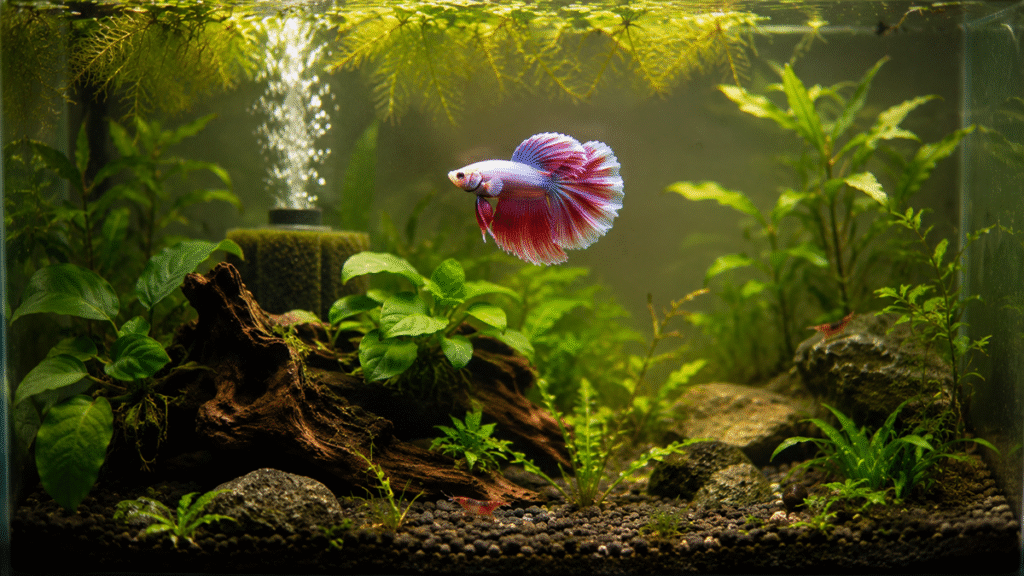
For most beginners weighing “do I need a filter for a fish tank” against the appeal of a clean, tech-free look, a sponge filter is the actual best middle ground — not zero filtration.
Why it works well:
- Inexpensive and simple to run off any air pump
- Silent compared to hang-on-back filters
- Gentle enough for bettas, shrimp, and fry — no intake risk
- Delivers both biological surface area and oxygenation in one unit
Expert tip: tuck it behind driftwood or a plant cluster if the aesthetic bothers you — it disappears visually within a week of algae/biofilm growth on the sponge.
FAQs
Do I need a filter for a fish tank?
Technically no, but practically yes for most setups. A filter gives you a stability buffer that plants and water changes alone don’t — it’s the difference between a system that forgives a missed week and one that doesn’t.
Do all fish tanks need a filter?
Not universally. Heavily planted, lightly stocked tanks — especially shrimp-only nanos — can run stable without one. Community tanks, goldfish tanks, and anything under 3 gallons should always run one.
What are the 3 types of aquarium filtration?
Mechanical (removes physical debris), biological (nitrifying bacteria that process ammonia and nitrite), and chemical (activated carbon and similar media that adsorb dissolved organics). Most filters combine all three; a plant-heavy filterless tank only replicates the biological piece well.
How long can fish live without a filter?
In an already-cycled, appropriately stocked tank, a few days to about a week if you cut feeding and add surface agitation. In an uncycled tank, ammonia can reach damaging levels within 48–72 hours.
Does a fish tank filter need to be fully submerged?
Depends on the type. Internal and canister filters need to run fully underwater. Hang-on-back filters are designed to sit partially above the waterline, drawing water up and returning it as a waterfall.
Do you leave a fish tank filter running 24/7?
Yes. Nitrifying bacteria need continuous oxygen and flow to survive — shutting a filter off for extended periods can crash the bacterial colony, not just pause it.
Final Verdict
Can a fish tank run without a filter? Yes — but it’s a system with zero backup capacity, not a shortcut. It demands heavy planting, light stocking, a fully cycled tank, and water changes that never slip. If any one of those conditions isn’t rock-solid, a small sponge filter removes almost all of that risk for a few dollars and a little bit of noise you’ll stop noticing within a week.
Next to Read
- 20 Common Aquarium Problems and Practical Fixes
- Why Does My Fish Tank Get Cloudy Overnight? (Expert Answer)
- Aquarium Bioload 101: Why Tanks Crash Like Biosphere 2
References
- Francis-Floyd et al., “Ammonia in Aquatic Systems”, University of Florida IFAS Extension (FA16)
- “Ammonia and aquatic ecosystems: A review of global sources, biogeochemical cycling, and effects on fish”, ScienceDirect, 2023
- Diana Walstad, Ecology of the Planted Aquarium
Was this guide helpful?
First-Hand Experience
Based on animals I've personally kept and bred - not summarized from other articles.
Zoological Foundation
Claims are checked against my M.Sc. Zoology training and published aquatic biology research, not recycled aquarium myths.
No Paid Influence
No sponsorship shaped this guide. Affiliate links, if any, are disclosed separately and never hidden.
Kept Current
Errors are corrected as soon as they're found, with the update noted at the bottom of the article.
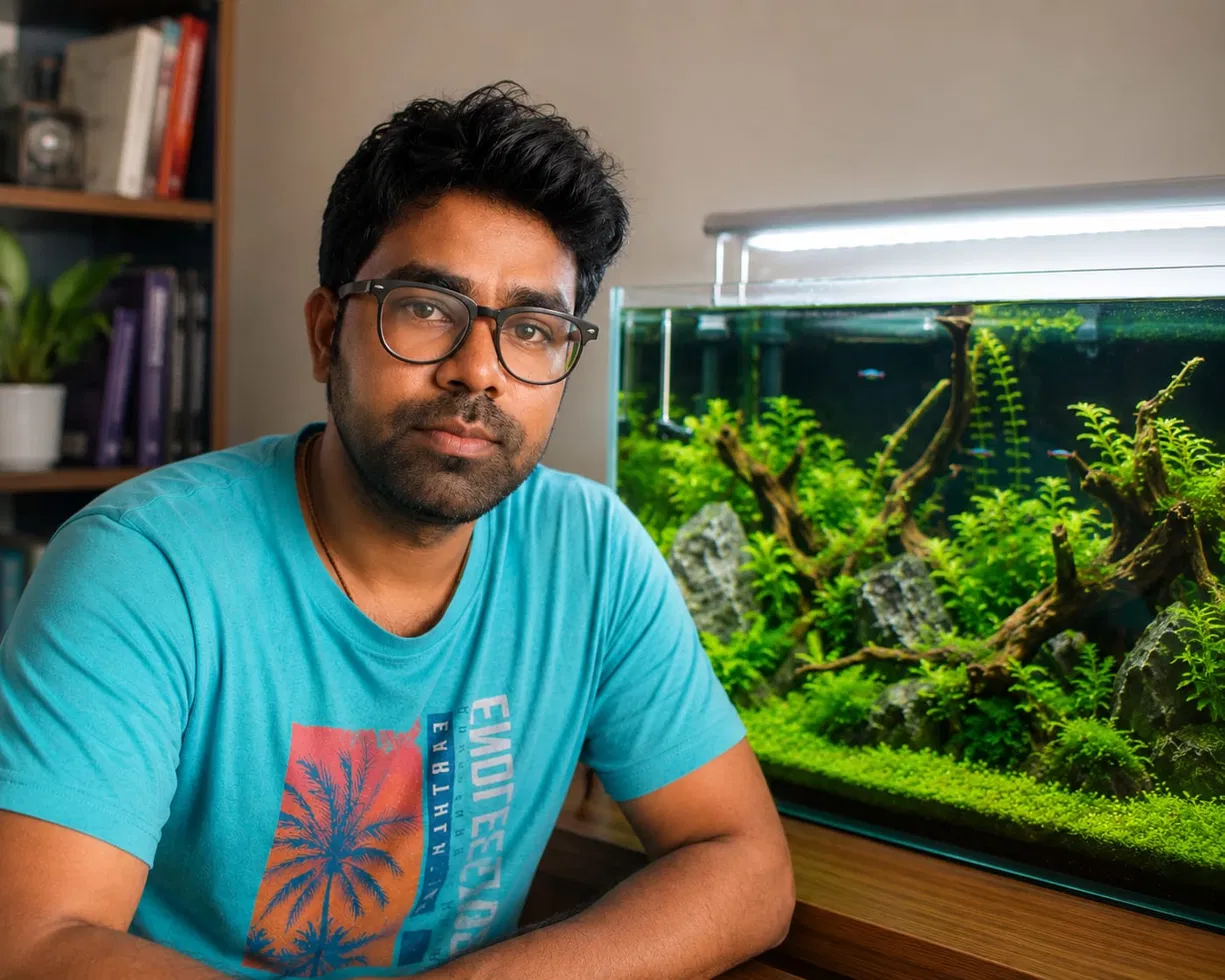
Anil Satak M.Sc. Zoology · Founder, FishioHub
Grew up in a fishing family in India and holds a Master's in Zoology. FishioHub is a one-person operation - every guide is personally researched, kept-tested, and written by Anil. No team, no outsourced writers, no AI-generated content. Read his full bio →