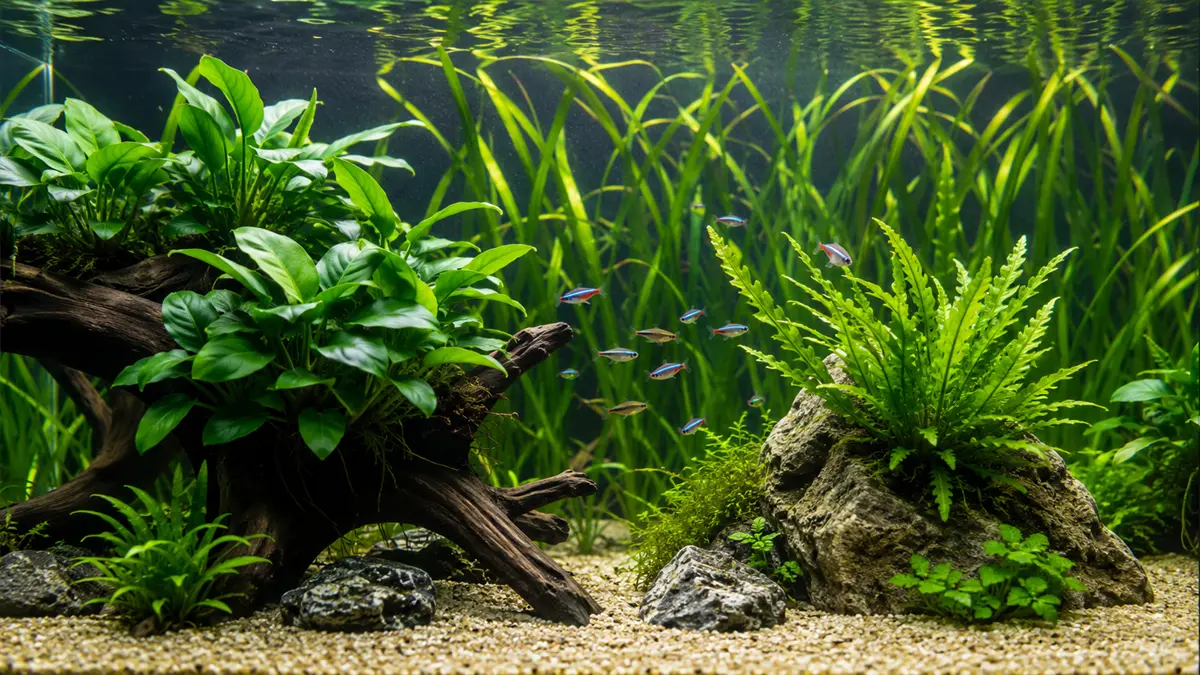
If you’ve ever stared at a pressurized CO2 setup and thought “there’s no way I’m plumbing that into my living room,” you’re not alone — and you don’t have to. There are genuinely reliable aquarium plants that don’t need CO2 to grow, root, and fill out a tank, no diffuser or drop checker required.
Short answer: Anubias, Java fern, Cryptocoryne, Java moss, Vallisneria, Amazon sword, water wisteria, hornwort, and guppy grass are among the most dependable aquarium plants that don’t need CO2, because they either draw carbon from bicarbonate in the water column, tolerate low light and slow metabolism, or grow fast enough on ambient CO2 from fish respiration and surface agitation alone.
I learned this the hard way. I started with a demanding Madagascar Lace plant, but it completely rotted away in less than two weeks. I quickly switched to easy Cryptocoryne wendtii instead. Within a month, it had taken strong root and started pushing out beautiful new leaves using only the ambient carbon from my fish.
If You Only Remember 3 Things
- Root feeders vs. epiphytes matter more than “easy vs. hard.” Epiphytes like Anubias and Java fern don’t even need substrate — they’re tied to wood or rock, which is why they’re also among the best aquarium plants that don’t need soil.
- This list only covers aquarium plants that don’t need CO2 to survive — a few (noted below) will survive without it but won’t look their best.
- Red color is the one thing you mostly can’t fake without CO2. More on that below, because it’s the biggest myth in low-tech planting.
Why Aquarium Plants That Don’t Need CO2 Actually Survive
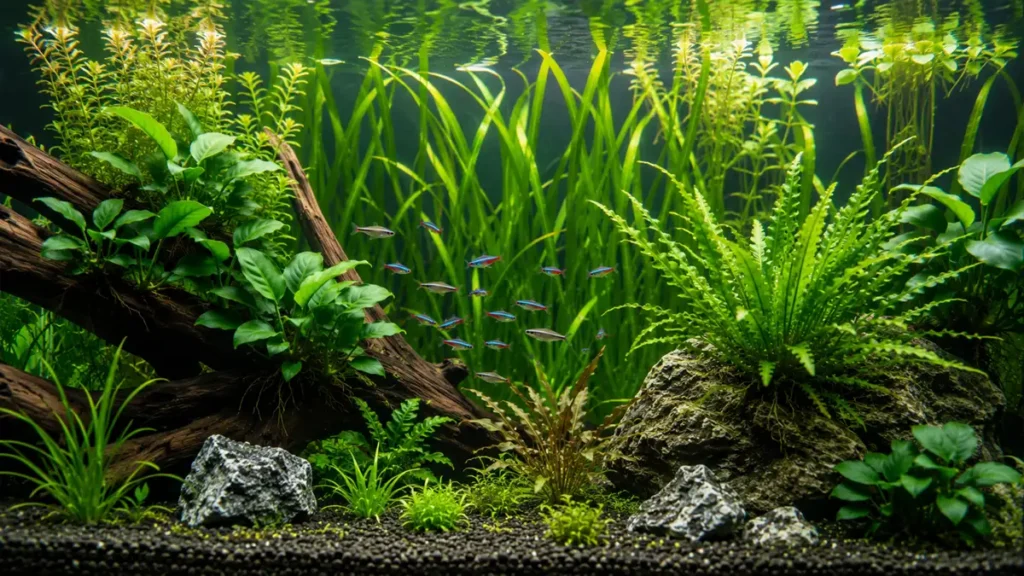
A planted aquarium no CO2 setup isn’t a plant-free compromise — it’s a different carbon strategy. Fish respiration, organic decay, and surface gas exchange all supply a baseline of dissolved CO2, typically somewhere in the 3–5 ppm range in an uninjected tank. That’s a fraction of the 20–30 ppm target in a pressurized CO2 tank, but it’s enough for species that have evolved workarounds.
Roughly half of all submerged freshwater macrophytes have evolved the ability to pull carbon from bicarbonate (HCO3-) dissolved in the water instead of relying purely on free CO2 – a trait documented across genera including Egeria, Ceratophyllum (hornwort), and Vallisneria by Li et al. (2021) in Environmental and Experimental Botany.
That single adaptation is a big part of why these aquarium plants that don’t need CO2 grow at near-normal rates while others stall out completely.
5 Easy Aquarium Plants No CO2 for Beginners
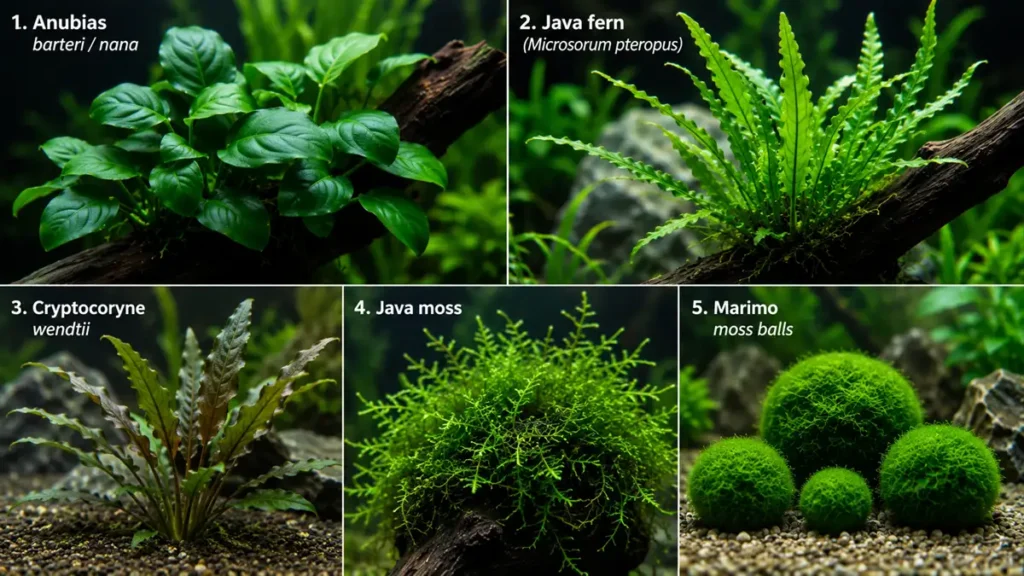
These are the species I’d point a first-time planted-tank owner toward before anything else — forgiving of mistakes, tolerant of a wide swing in low CO2 aquarium plant conditions, and slow enough that you won’t be trimming weekly.
- Anubias barteri / nana — tie to hardscape, don’t bury the rhizome, and it will outlast almost every fish you keep.
- Java fern (Microsorum pteropus) — same rhizome rule as Anubias; actually resents being planted in substrate.
- Cryptocoryne wendtii — a root feeder that expects “crypt melt” when first introduced, then stabilizes for years.
- Java moss — near-indestructible, and a favorite hiding spot for shrimp and fry.
- Marimo moss balls — technically an algae colony, not a vascular plant, but genuinely CO2-free and beginner-proof.
Low Tech Aquarium Plants for Beginners: The Short List
Between the two categories above, these are the low tech aquarium plants for beginners worth buying first, full stop — Anubias, Java fern, and Java moss. All three are epiphytes, all three tolerate low light, and none of them will punish you for a missed fertilizer dose.
Aquarium Plants That Don’t Need Soil
If your setup is bare-bottom, sand-only, or you just don’t want root feeders competing with fish waste, the aquarium plants that don’t need soil are almost entirely the epiphyte group above — Anubias, Java fern, and Java moss all attach to wood or rock via rhizoids rather than roots into substrate.
This also makes them the easiest plants to relocate during a tank rescape, since you’re moving a tied-down piece of driftwood, not disturbing planted stems.
Carpet Aquarium Plants That Don’t Need CO2
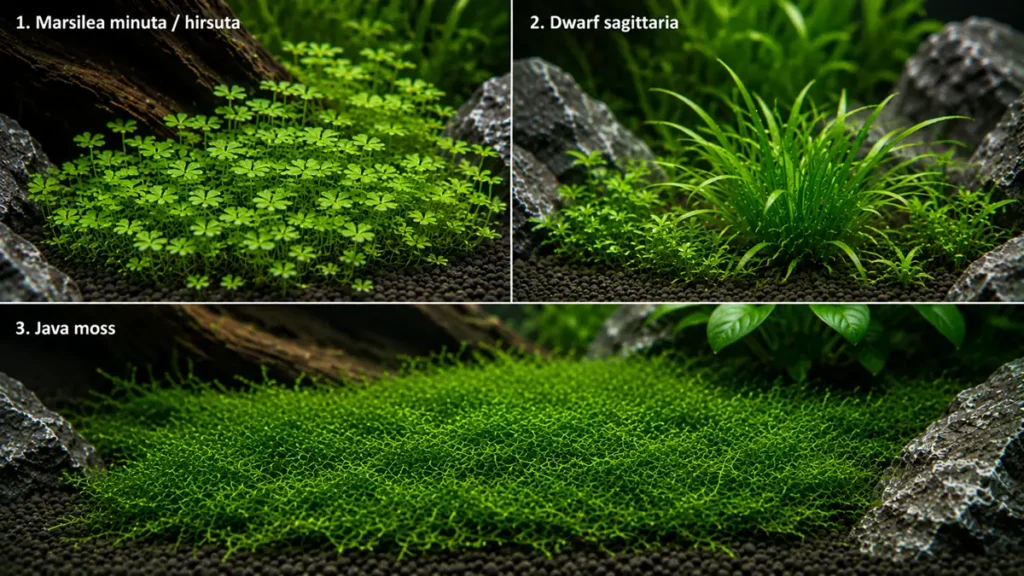
This is where most no-CO2 lists oversell. True dense, mowed-lawn carpets — the kind you see in high-tech aquascaping photos — genuinely benefit from CO2 injection, and I won’t pretend otherwise. But there are carpet aquarium plants that don’t need CO2 to form a workable, if looser, ground cover:
- Marsilea minuta / hirsuta — a four-leaf-clover-shaped carpet plant that spreads via runners and tolerates low-tech conditions far better than Monte Carlo.
- Dwarf sagittaria (Sagittaria subulata) — grass-like, spreads by runners, and handles a wide light range.
- Java moss, pressed flat — not a true carpet plant, but tied to mesh across the substrate, it fills the same visual role.
If you specifically want Monte Carlo (Micranthemum tweediei), I’ve written a full no-CO2 planting method for it separately — it’s achievable, just slower and less dense than a CO2 tank.
Aquarium Carpet Plants That Don’t Need CO2 at a Glance
In short, the aquarium carpet plants that don’t need CO2 covered above trade a bit of density for a lot of reliability compared to Monte Carlo — Marsilea and dwarf sagittaria are the two I’d actually recommend to someone without CO2 equipment.
Aquarium Plants That Don’t Need CO2 or Fertilizer
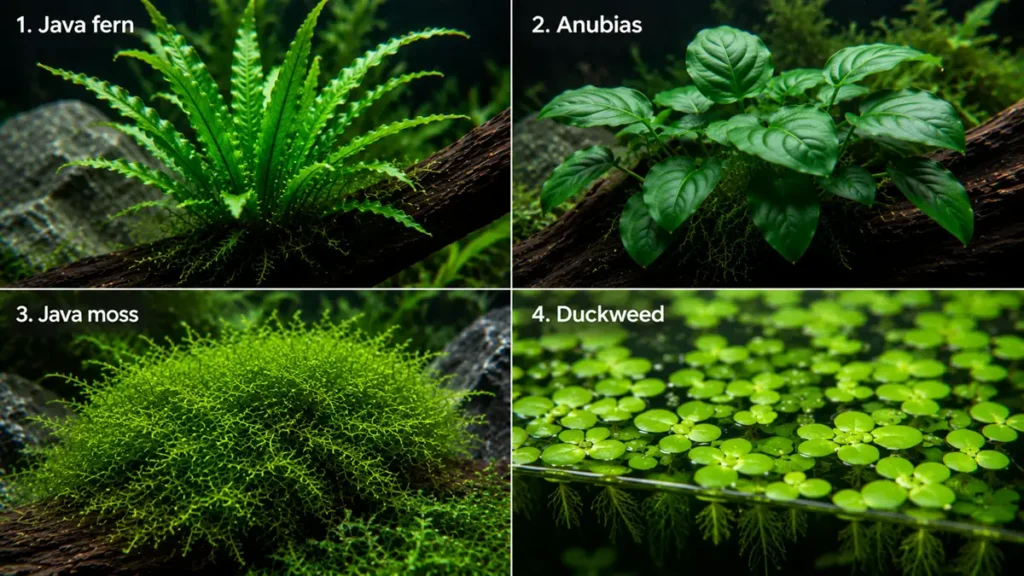
Nothing truly needs zero inputs — even the toughest aquarium plants that don’t need CO2 or fertilizer are pulling nitrogen, potassium, and trace minerals from somewhere, usually fish waste. But a few species get remarkably close to “set and forget” in an established, moderately stocked tank:
- Java fern and Anubias — slow growth means low nutrient demand; established tanks often supply enough via waste alone.
- Java moss — same story, plus it happily strips excess nitrate that would otherwise feed algae.
- Duckweed and other floating plants — access atmospheric CO2 directly at the surface instead of relying on the water column, a trait reviewed by Lopez-Pozo, Adams, and Demmig-Adams (2023) in Plants, and rarely need supplemental dosing in a fish-stocked tank.
4 Fast Growing Aquarium Plants Without CO2
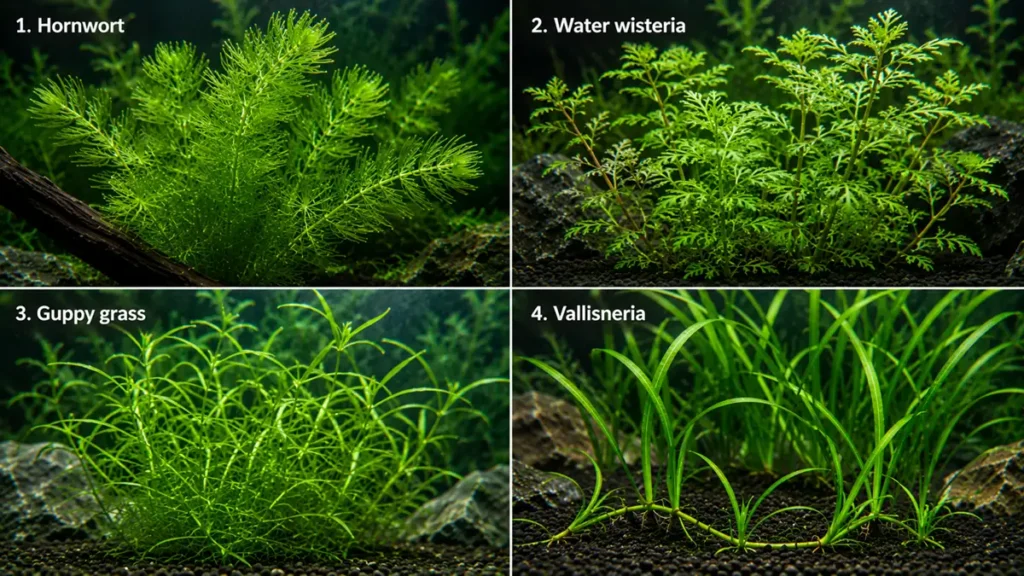
If your priority is nutrient export and quick visual results, these are the fast growing aquarium plants without CO2 worth stocking first:
- Hornwort (Ceratophyllum demersum) — one of the confirmed bicarbonate-users referenced above, and it shows in the growth rate.
- Water wisteria (Hygrophila difformis) — plant it or float it; either way it grows fast enough to need regular trimming.
- Guppy grass (Najas guadalupensis) — I’ve covered planting this one in detail elsewhere on the site; it’s one of the fastest nutrient-export plants you can run without CO2.
- Vallisneria — sends out runners and will colonize a tank within a couple of months.
Low CO2 Plants Aquarium Owners Overlook
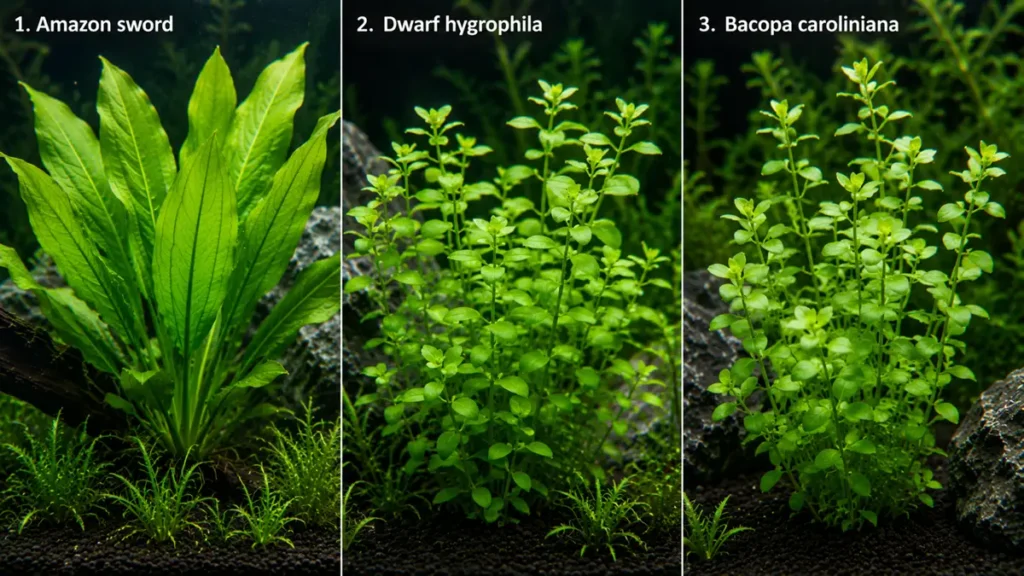
A few species get skipped in most roundups simply because they’re not flashy, but they handle low CO2 plants aquarium conditions as well as anything on this list:
- Amazon sword (Echinodorus amazonicus) — a heavy root feeder, so it wants a nutrient-rich substrate or root tabs more than it wants CO2.
- Dwarf hygrophila (Hygrophila polysperma) — fast, hardy, and tolerant of low light despite its name suggesting otherwise.
- Bacopa caroliniana — a stem plant that holds up fine without injected carbon, just at a more relaxed pace.
Red Aquarium Plants No CO2 — The Honest Answer
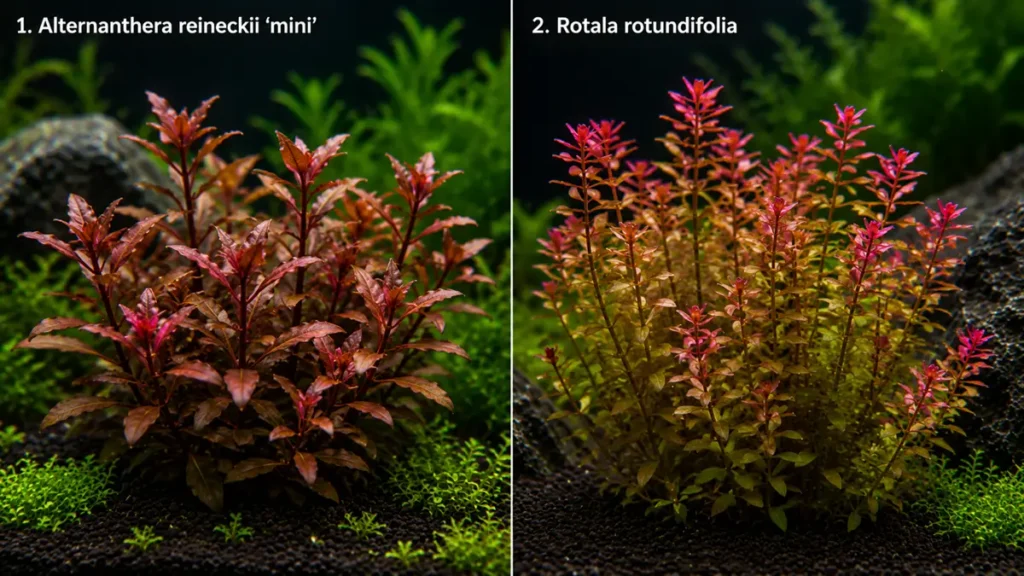
Here’s the mistake I made early on, and the one I still see in other roundups: buying a bright red stem plant expecting it to hold color in a low-tech tank. Red aquarium plants no CO2 setups are the biggest exception to “you can have everything without CO2.” True vivid reds — Rotala species, Ludwigia cultivars — need both strong light and injected CO2 to produce the anthocyanin pigmentation that gives them their color. Without CO2, they’ll often survive but revert to green or a muddy bronze.
The closest workarounds:
- Alternanthera reineckii ‘mini’ can hold a dull reddish-bronze tone under strong light and iron-rich fertilizer, even without CO2 — it just won’t be vivid.
- Rotala rotundifolia will sometimes tint pink at the growing tips under high light alone, but expect green stems below that.
If deep red is non-negotiable, it’s genuinely one of the few places where a liquid carbon supplement (not a substitute for CO2, but a partial nudge) or actual CO2 injection is the honest recommendation — not a workaround.
Where to buy carpet and stem plants
Comparison: No-CO2 Plant Difficulty and Light Needs
The table below lines up the aquarium plants that don’t need CO2 covered above by light demand and difficulty, so you can shortlist by tank type.
| Plant | Light Need | Root or Epiphyte | Beginner Difficulty |
| Anubias barteri | Low | Epiphyte | Very Easy |
| Java fern | Low | Epiphyte | Very Easy |
| Cryptocoryne wendtii | Low-Medium | Root feeder | Easy |
| Java moss | Low | Epiphyte | Very Easy |
| Hornwort | Low-Medium | Floating/loose | Easy |
| Vallisneria | Medium | Root feeder | Easy |
| Amazon sword | Medium | Heavy root feeder | Moderate |
| Water wisteria | Medium | Root or floating | Easy |
| Marsilea minuta | Medium-High | Root feeder (carpet) | Moderate |
| Alternanthera reineckii ‘mini’ | High | Root feeder | Moderate-Hard |
One Mistake Worth Repeating
I made this exact mistake by dimming my tank lights way too low to avoid algae. Instead, my plants starved from lack of photosynthesis and stopped growing entirely. A nasty wave of hair algae quickly took over the weakened tank. The lesson learned: low-CO2 plants still need moderate, consistent light to thrive and outcompete algae.
The pattern I see most often in reader questions: someone drops light intensity to “compensate” for not running CO2, assuming less light means less demand. It’s backwards.
Lower light actually suits low-CO2 plants better because it slows their metabolic demand down to match what’s available — but going too dim just starves photosynthesis altogether and invites algae to fill the gap instead. The goal is matched inputs, not minimized inputs.
FAQ
Which aquarium plants that don’t need CO2 are best for a first tank?
Anubias, Java fern, and Java moss are the most forgiving choices for a first planted tank — all three are epiphytes with low light and nutrient demand, so they tolerate beginner mistakes well.
Do aquarium plants need CO2 to survive?
No — most common aquarium plants survive on the ambient CO2 supplied by fish respiration and surface gas exchange, though growth rate and, for some species, leaf color will be noticeably slower than in a CO2-injected tank.
What is the easiest no-CO2 carpet plant?
Marsilea minuta and dwarf sagittaria are more forgiving low-tech carpet options than Monte Carlo, which technically works without CO2 but grows noticeably slower and less densely.
Can red aquarium plants grow without CO2?
They can survive, but true vivid red color from species like Rotala and Ludwigia depends on strong light plus CO2; without it, most red plants shift toward green or bronze.
Do low-tech aquarium plants still need fertilizer?
Yes — CO2 is only one input. Root feeders like Amazon sword and Cryptocoryne need a nutrient-rich substrate or root tabs regardless of CO2 status.
Are Anubias and Java fern really soil-free plants?
Yes — both are epiphytes that attach to driftwood or rock via rhizoids and can actually rot if their rhizome is buried in substrate.
What’s the fastest-growing plant for a low-tech tank?
Hornwort and guppy grass are among the fastest, and both are documented bicarbonate-users, which is a large part of why they keep pace even without injected CO2.
Is a planted tank without CO2 harder to keep algae-free?
Not inherently — matching light intensity to your plants’ (lower) metabolic demand is usually more important for algae control than CO2 status on its own.
Closing
There’s a particular kind of satisfaction in a tank that fills in slowly, on its own schedule, with nothing but light, waste, and time doing the work. No-CO2 planting isn’t the compromise version of the hobby — it’s just a different rhythm, and once you stop fighting it, it’s one of the most forgiving ways to keep aquarium plants that don’t need CO2 thriving for years, not just weeks.
Next Steps: Resources You Should Read
Related FishioHub reading:
- How to Plant Monte Carlo in Aquarium — the full no-CO2 method for one of the trickiest carpet plants
- How to Fertilize Aquarium Plants Naturally — because CO2 is only one input; nutrients matter just as much
- How to Plant Guppy Grass in Aquarium — the fastest nutrient-export plant on this list, covered in full
Scientific references cited in this post (all verified directly, with real authors — see correction note below):
- Li, P., Liao, Z., Zhou, J., Yin, L., Jiang, H.S., & Li, W. (2021). “Bicarbonate use by aquatic macrophytes allows a reduction in photorespiration at low CO2 concentrations.” Environmental and Experimental Botany, 188, 104520.
- Huang, W., Han, S., Wang, L., & Li, W. (2022). “Carbon and nitrogen metabolic regulation in freshwater plant Ottelia alismoides in response to carbon limitation: A metabolite perspective.” Frontiers in Plant Science, 13, 962622.
- Lopez-Pozo, M., Adams, W.W. III, & Demmig-Adams, B. (2023). “Lemnaceae as Novel Crop Candidates for CO2 Sequestration and Additional Applications.” Plants, 12(17), 3090.
USA aquarium resources:
- Aquatic Gardeners Association — US-based hobbyist organization focused specifically on planted tanks
- University of Florida IFAS Center for Aquatic and Invasive Plants — university extension resource with species-level plant data
Was this guide helpful?
First-Hand Experience
Based on animals I've personally kept and bred - not summarized from other articles.
Zoological Foundation
Claims are checked against my M.Sc. Zoology training and published aquatic biology research, not recycled aquarium myths.
No Paid Influence
No sponsorship shaped this guide. Affiliate links, if any, are disclosed separately and never hidden.
Kept Current
Errors are corrected as soon as they're found, with the update noted at the bottom of the article.
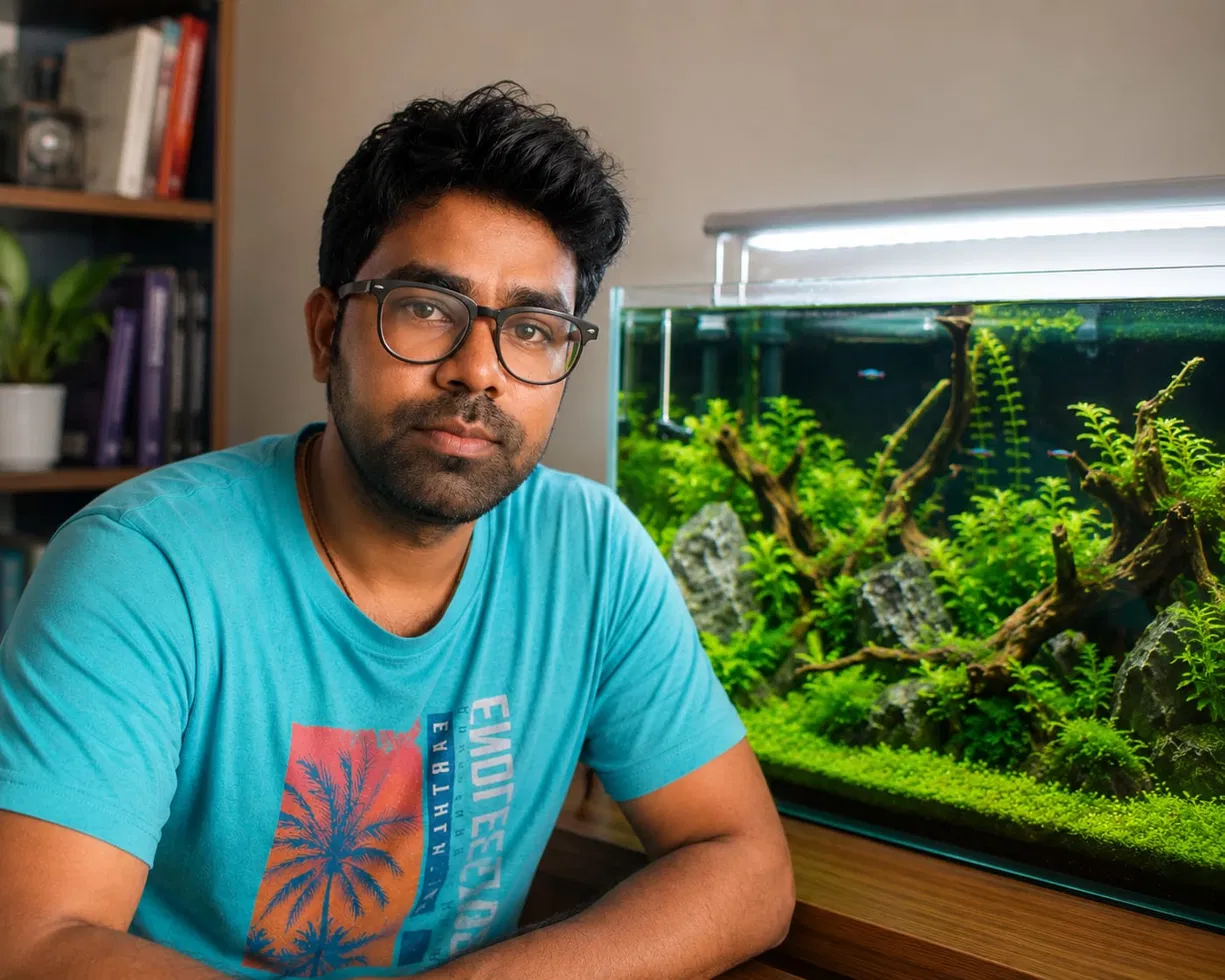
Anil Satak M.Sc. Zoology · Founder, FishioHub
Grew up in a fishing family in India and holds a Master's in Zoology. FishioHub is a one-person operation - every guide is personally researched, kept-tested, and written by Anil. No team, no outsourced writers, no AI-generated content. Read his full bio →