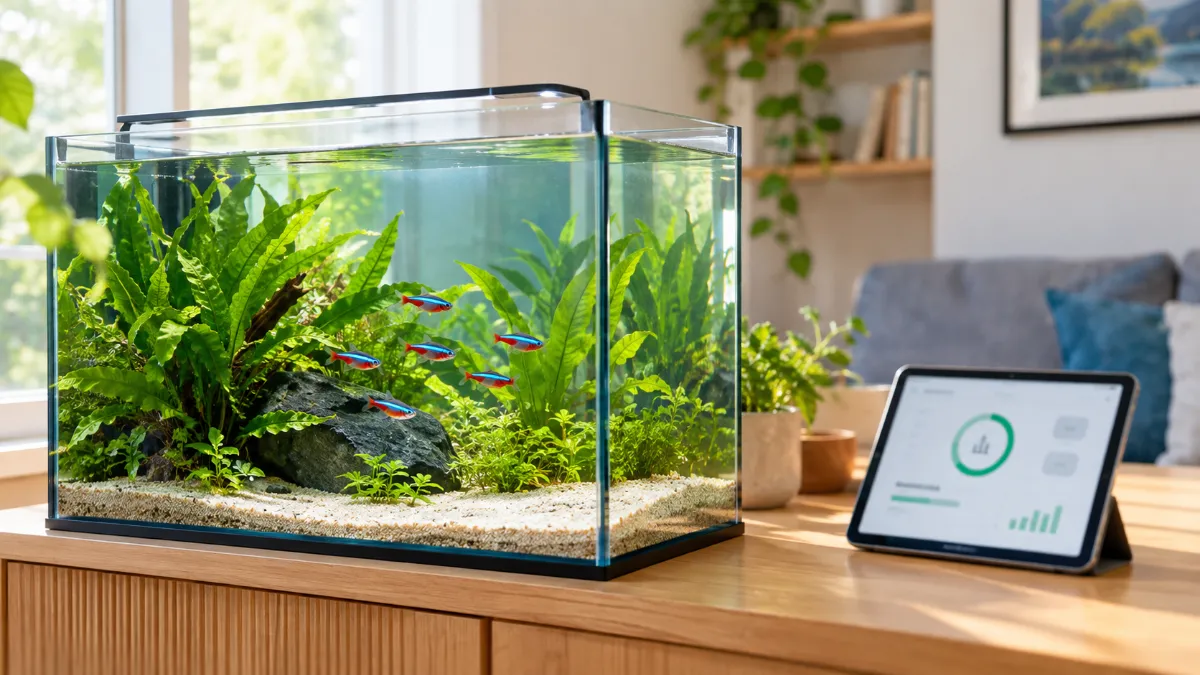
How to use an aquarium stocking calculator is simple: enter your tank size, add every fish with its adult size, set your filter, and keep the result under the limit.
I once stocked a 40-gallon tank with dwarf gouramis, only for them to aggressively chase each other over territory. To fix it, I rescaped the layout with tall driftwood and dense Java fern to completely break up their lines of sight. The structural change worked perfectly, and the tank transformed into a peaceful ecosystem overnight
I grew up in a fishing family and studied zoology. Both taught me one thing: water cannot hold more fish just because you want it to.
Below, I show the aquarium fish stocking calculator on FishioHub screen by screen. Then I test five real tanks, so you can see what the numbers mean.
Quick Facts
- Remember always use the adult size of a fish, not the baby size which you see in the shop.
- Use the real water volume, not the number on the tank box.
- A high stock level is a limit, not a goal.
- A calculator cannot see fights, group needs, or a tank that is not cycled.
What Is an Aquarium Fish Stocking Calculator?
An aquarium fish stocking calculator checks if your tank can handle the fish you want. It compares the waste they make with your tank size and filter.
The traditional, and old 1 inch of fish per gallon rule only counts length. But a fat goldfish and a thin tetra of the same length make very different amounts of waste production.
If I say it directly, the fish waste is mostly ammonia. The UF/IFAS Extension says ammonia is the main waste product of fish, and it depends on amount of diet of fish. Even a fish that is not fed still makes some.
This load is called aquarium bioload, and a good calculator estimates it for you.
Aquarium Stock Calculator or Aquarium Fish Stock Calculator?
An aquarium stock calculator and an aquarium fish stock calculator are the same kind of tool. People just search for it in different ways. The real difference is the method: inches, tank surface, or body mass and bioload.
What an Aquarium Stock Level Calculator Shows
An aquarium stock level calculator shows how full your tank is. Low means you have room. High means you are close to the limit, and above it means overstocked.
Freshwater Aquarium Stocking Calculator: Check These First
A freshwater aquarium stocking calculator only answers one question: can this tank handle the waste? It does not check if your fish like the same water. Before you learn how to use an aquarium stocking calculator, check three things.
- Water that suits every fish. Temperature, pH, and hardness must match. See freshwater aquarium pH levels.
- A cycled tank. The UF/IFAS states that a new filter needs six to eight weeks to grow enough bacteria. See how to remove ammonia from a fish tank naturally.
- A freshwater setup. This tool is for freshwater tanks, not saltwater.
Warning: Do not trust any stocking number in a new, uncycled tank. The calculator assumes your filter bacteria are already working.
How to Use an Aquarium Stocking Calculator: 5 Easy Steps
Follow these steps on the calculator page. Use the same field names you see on the tool.
Step 1: Enter Your Tank Size
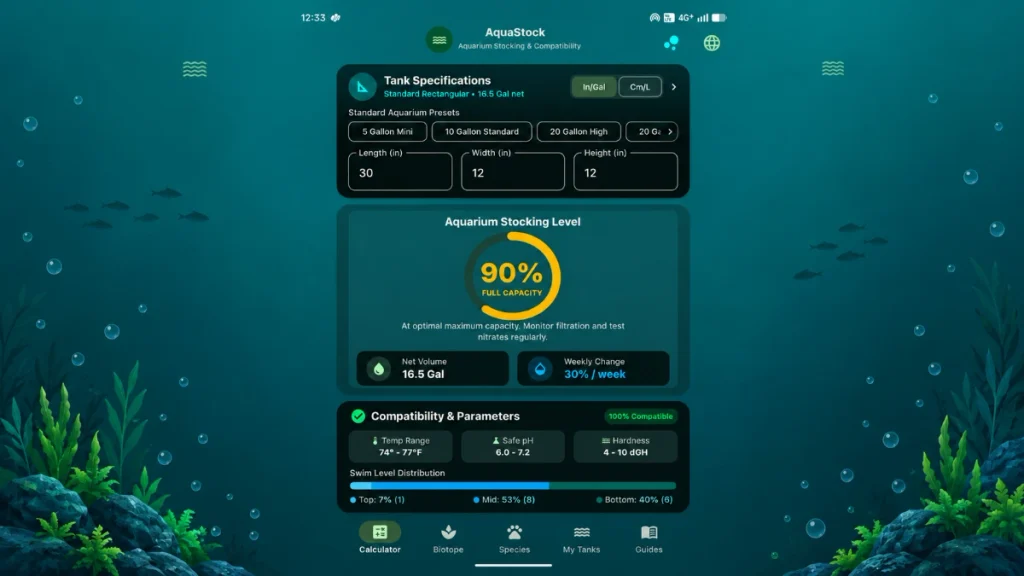
Put information in your tank size. If you only have the length, width, and height in inches, multiply them and divide by 231 to get US gallons.
Then take off a little for sand, gravel, and rocks. They take up space that water would fill.
Step 2: Add Each Fish and How Many
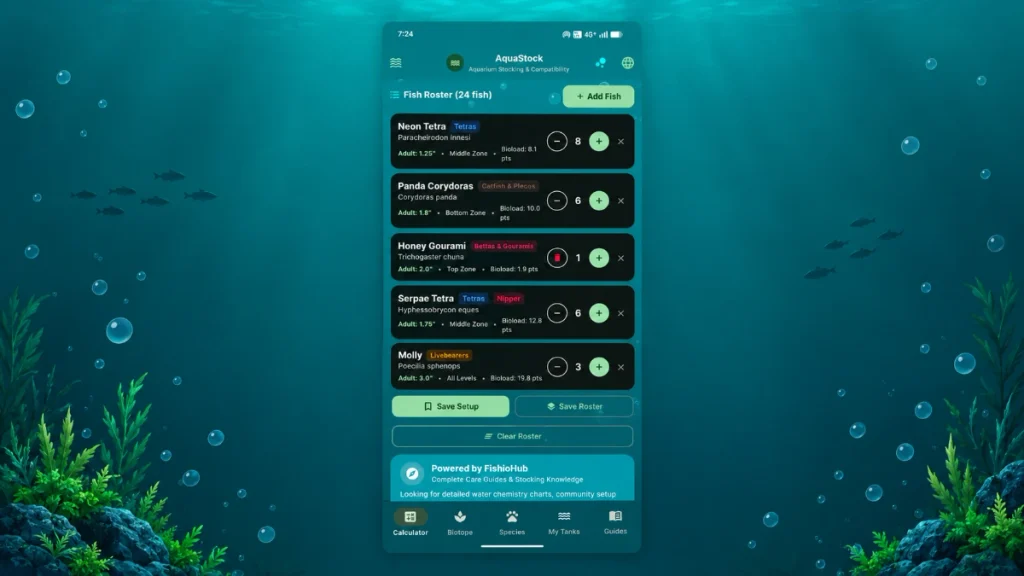
Add every animal as a separate line, shrimp and snails too. They also make waste. Always pick the adult size. The fish you buy small will not stay small.
Step 3: Set Your Filter
This calculator counts filtration, so tell it what you really use. Do not use the number on the box, because a dirty filter moves less water.
Step 4: Read the Result and the Warnings
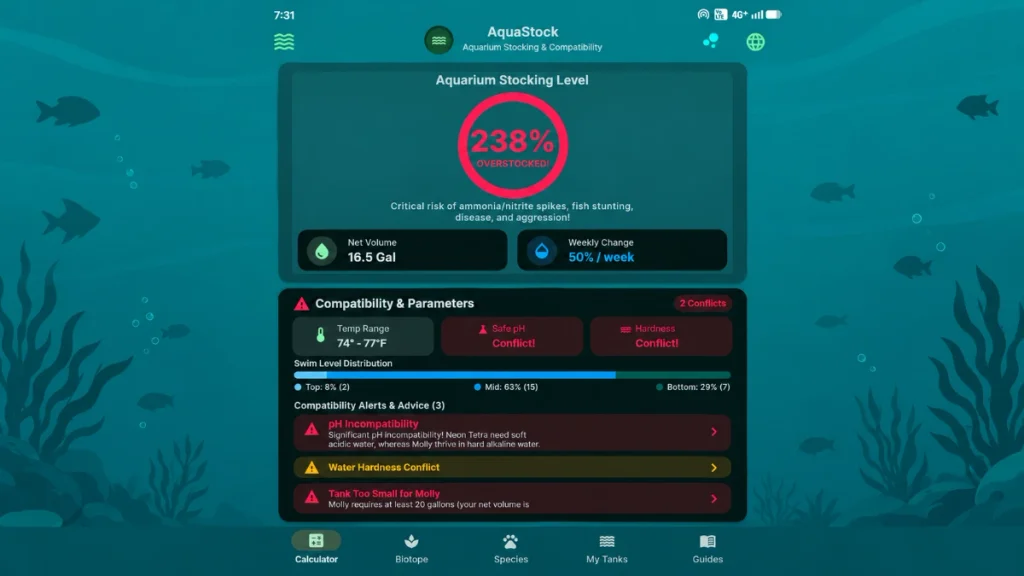
Look at the stock level first. Then read every warning. This screenshot clearly shows the overstocking level with a warning. It also shows compatibility and parameter conflicts. Finally, the stated tank is too small to modify.
Step 5: Change One Thing and Run It Again
Remove one fish, lower one number, or try a stronger filter. Then run it again. This is how to use an aquarium stocking calculator as a planning tool and not just a final check.
Try it on your own tank → Open the Aquarium Stocking Calculator
How to Use an Aquarium Stocking Calculator Safely: 4 Checks
The calculator checks waste. It does not check your fish, so do these four quick checks after every result.
- Adult size, not baby size. Look up the exact full-grown size of every species.
- Group size. Schooling fish need a group, often six or more. Two lonely tetras is a bad plan, even if the number looks fine.
- Behavior. Do not mix fighters with calm fish, and keep one betta alone unless you know the tank well.
- Water match. Every fish must like the same temperature and pH.
Warning: Add fish slowly, a few at a time. Your filter bacteria need time to catch up with each new load.
Worked Examples: 5 Tanks
Now you know how to use an aquarium stocking calculator, so let’s test five tanks. Here are the inputs. The results come from my screenshots.
| # | Tank | Size | Fish |
| 1 | 10-gallon | 20 x 10 x 12 in | 6 neon tetras, 1 nerite snail |
| 2 | 20-gallon long | 30 x 12 x 12 in | 8 harlequin rasboras, 6 corydoras, 1 honey gourami |
| 3 | 55-gallon | 48 x 13 x 20 in | 2 angelfish, 10 cardinal tetras, 6 corydoras |
| 4 | 40-gallon breeder | 36 x 18 x 16 in | 2 fancy goldfish |
| 5 | 10-gallon (overstocked) | 20 x 10 x 12 in | 8 neon tetras, 4 guppies, 1 betta, 1 common pleco |
Example 1: Stocking Calculator for 10 Gallon Aquarium
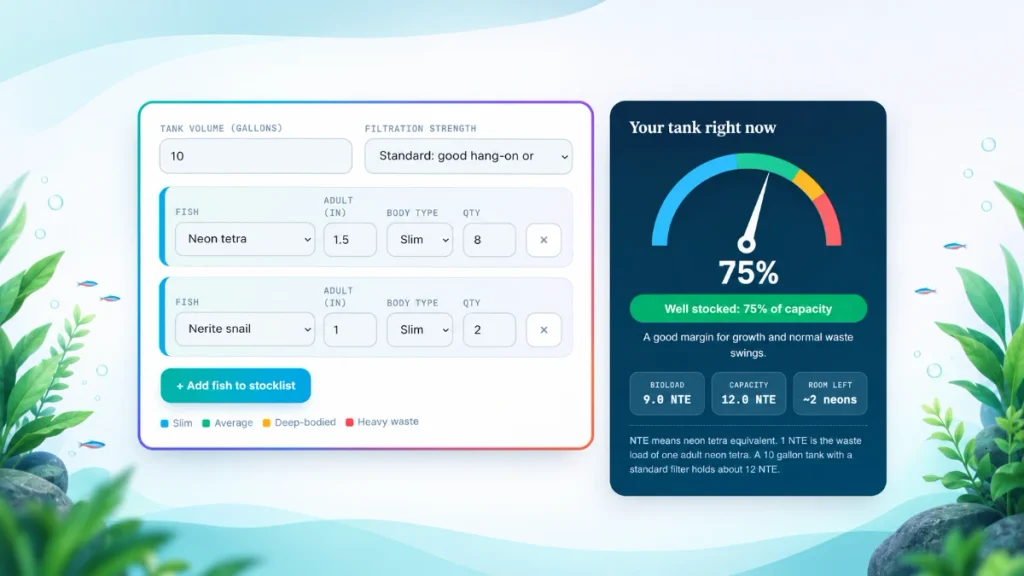
A stocking calculator for 10-gallon aquarium tanks is where most people start. The big question is usually how many neon tetras in a 10-gallon tank.
Result: This calculator clearly shows that a 10 gallon standard aquarium tank contains 9.1 gallon water, it is best compatible with 8 neon tetra and 2 nerite snails. With very good compatibility, 9 NTE bioload.
Why: Neon tetras feel safe in a group, and a group needs room to swim. In a small tank, that rule limits you before waste does. See what to feed neon tetras.
Example 2: 20-Gallon Long Community Tank Stocking Idea
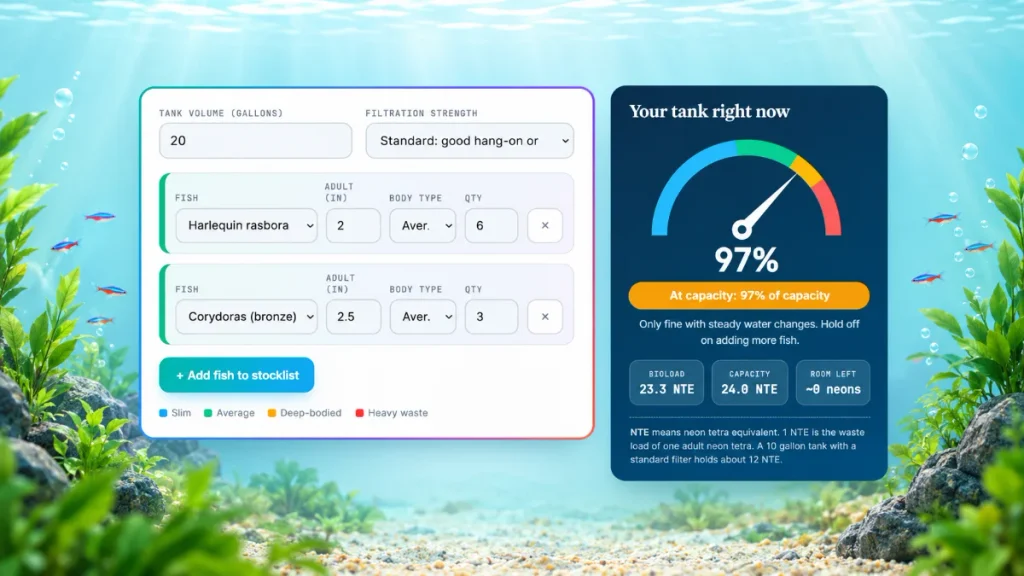
This is a simple community tank stocking idea for a 20 gallon long tank. Long tanks give fish more swimming space than tall ones.
Result: A 20-gallon long community tank can have 6 rasboras and 3 corydoras at 97% capacity; for best you can decrease the number of either.
Why: The rasboras swim in the open, and the corydoras use the floor. Check what cory catfish eat so the bottom stays clean.
Example 3: 55-Gallon Angelfish Community
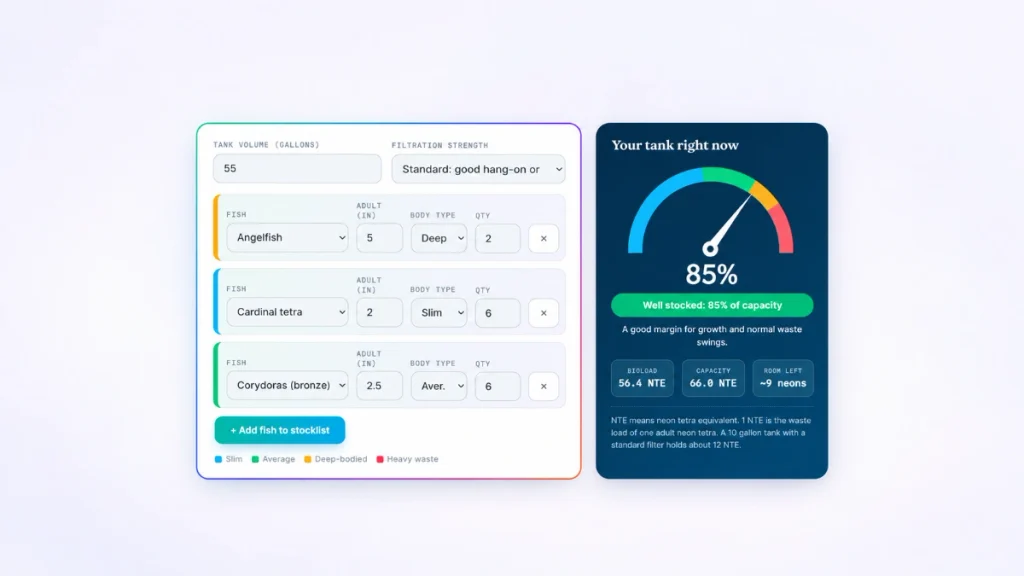
Result: According to this aquarium fish stocking calculator, a standard 55-gallon angelfish community tank can have 2 angelfish, 8 cardinal tetra, and 6 corydoras with 90% tank capacity.
Why: The calculator counts waste, not temperature. Adult angelfish can eat small tetras, so check fish size, not just the percentage.
Example 4: 40-Gallon Breeder Goldfish Tank
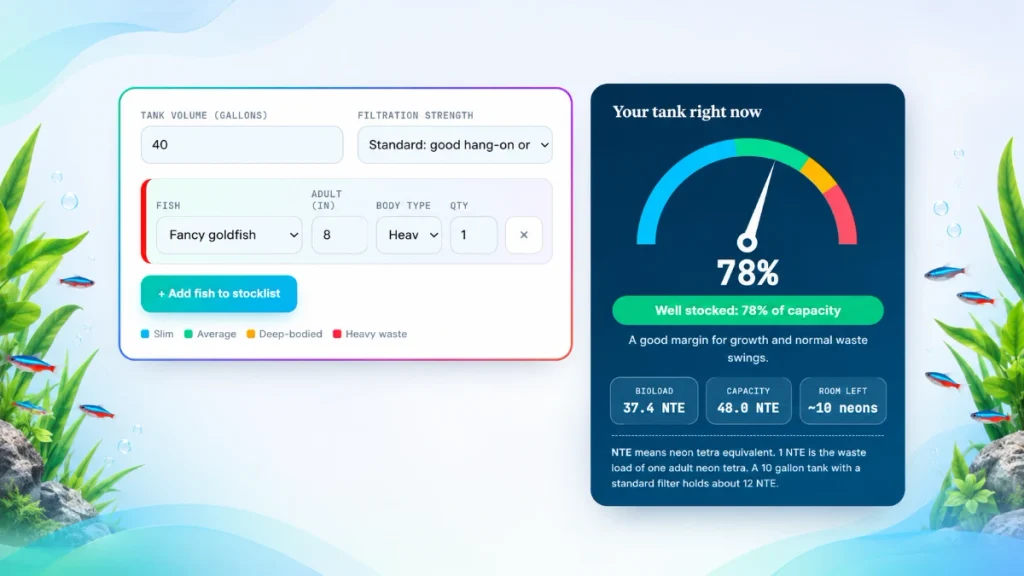
Result: According to this aquarium stocking calculator, the breeding tank can contain a maximum of 2 fancy goldfish in a 40-gallon tank. However, in my recommendation, only one goldfish is enough.
Why: Goldfish are sold small, but they grow. Pennsylvania Sea Grant says goldfish are typically 4 to 8 inches long and can reach 23 inches. Fancy types usually stay smaller, but still grow far beyond shop size. Read fish tank for goldfish.
Example 5: The Overstocked 10-Gallon and the Fix
This is the tank a shop might sell you. It is also the best lesson in how to use an aquarium stocking calculator to catch a bad plan.
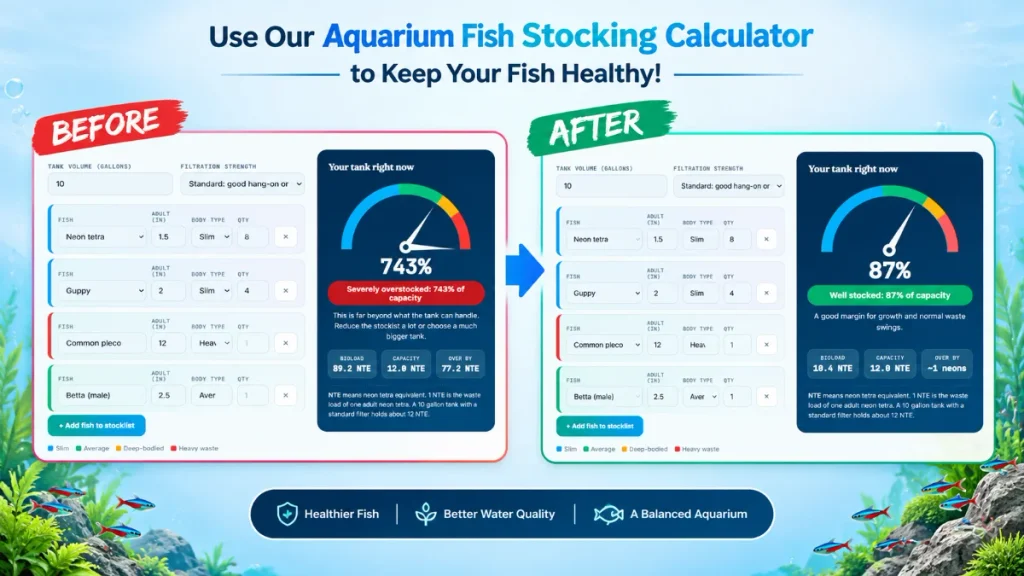
Result: The screenshot clearly indicates that the aquarium was initially highly overstocked; after using the calculator, it was fixed and is now up to 87% of tank capacity, which is very good.
Why: A common pleco grows far too big for 10 gallons. A betta may also chase fast guppies with flashy fins. Learn more in most common aquarium problems and solutions.
Calculate your own stocking → Try the Aquarium Fish Stocking Calculator
Most Accurate Aquarium Stocking Calculator?
No calculator is perfect. The most accurate aquarium stocking calculator is only as good as the numbers you type in, so knowing how to use an aquarium stocking calculator matters more than picking one.
Your adult sizes, your real water volume, your filter, and your cleaning habits all change the result. The method behind the tool matters too.
| Method | What it counts | Weak spot |
| Inch per gallon | Total fish length | Ignores body mass and species |
| Tank surface | Air contact at the water top | Ignores waste and filter |
| Body mass and bioload | Waste from fish size and shape | Needs correct adult sizes |
Heat and pH matter too. UF/IFAS says the toxic form of ammonia grows with higher pH and higher temperature, and it is about 100 times more toxic than the other form. That is why you should leave room under the limit.
Best Aquarium Stocking Calculator: 5 Things to Look For
The best aquarium stocking calculator is not the one with the nicest design. Check any tool, including mine, against this list.
- It uses body mass or bioload, not only inches.
- It lets you add many species at once.
- It counts your filter.
- It works from adult size.
- It explains its warnings.
I built the FishioHub calculator around these points. Compare it yourself and decide.
Common Mistakes
These small mistakes hurt most people who are learning how to use an aquarium stocking calculator.
- Using baby size. The result looks safe today and fails in a few months.
- Using the box volume. A 20-gallon long measures 30 x 12 x 12 inches, which is about 18.7 gallons before sand and rocks.
- Aiming for the limit. Leave room for growth and breeding.
- Buying everything in one day. Your filter needs time.
I bought a cute, tiny Clown Loach for my 20-gallon tank, ignoring how large they actually grow. It quickly outgrew the space and stressed the community, costing me a frantic, expensive weekend upgrade to a 75-gallon setup.
Aquarium Overstocking Signs
Even after you know how to use an aquarium stocking calculator, watch your fish. They will tell you if the tank is too full:
- Fish gasping near the surface
- Cloudy water that keeps coming back
- Ammonia or nitrite above zero on your test kit
- Nitrates that rise fast after every water change
- Fighting and hiding
UF/IFAS says ammonia in a healthy tank should always read zero. If it does not, act fast. Read how to reduce nitrates in an aquarium and fix your stock list.
FAQs
How to use an aquarium stocking calculator for more than one species?
Add each species on its own line with its own number, and the aquarium fish stocking calculator adds them all up. That is how to use an aquarium stocking calculator for a mixed tank.
Does a freshwater aquarium stocking calculator work for planted tanks?
Yes, but do not add extra fish because of your plants. A freshwater aquarium stocking calculator cannot tell how much waste your plants really use.
How many fish does a stocking calculator for 10 gallon aquarium tanks allow?
It depends on fish size and filter. In general, one small school plus a few small helpers works better than many mixed fish. Run your own list to see.
What is the most accurate aquarium stocking calculator?
None is perfect. The most accurate aquarium stocking calculator uses body mass or bioload, counts your filter, and gets honest numbers from you.
What is an aquarium stock calculator?
An aquarium stock calculator checks if your tank can handle the waste from your fish. It uses tank size, fish and filter to give a stock level.
Is an aquarium fish stock calculator the same as a bioload calculator?
Mostly yes. An aquarium fish stock calculator built on bioload estimates waste, and that is what a bioload calculator does.
What is a safe number on an aquarium stock level calculator?
There is no one safe number for every tank. An aquarium stock level calculator shows how close you are to the limit, so stay below it.
What is the best aquarium stocking calculator?
The best aquarium stocking calculator uses adult size, counts your filter and explains its warnings. Use the list above to compare tools.
Next Steps
Now you know how to use an aquarium stocking calculator. Try your own tank and keep some room under the limit.
Check your tank now → Open the Aquarium Fish Stocking Calculator
Keep reading on FishioHub
- Aquarium bioload explained
- The 1 inch of fish per gallon rule
- Best freshwater fish tank fish
- How to buy healthy fish from an aquarium shop
Science and references
- Ammonia in Aquatic Systems (FA16), UF/IFAS Extension, revised 2022
- Goldfish fact sheet, Pennsylvania Sea Grant, 2023
USA aquarium resources
- Habitattitude, a USFWS, NOAA, and pet-industry campaign on what to do with unwanted fish and plants. Do not release them into local waters.
- Your local fish store or aquarium society can help you check adult sizes and compatibility.
Final Thought
The best aquarium stocking calculator takes the guesswork out, but your eyes and a good test kit still matter. Enter your real numbers, leave some room under the limit, and your fish will thank you.
Was this guide helpful?
First-Hand Experience
Based on animals I've personally kept and bred - not summarized from other articles.
Zoological Foundation
Claims are checked against my M.Sc. Zoology training and published aquatic biology research, not recycled aquarium myths.
No Paid Influence
No sponsorship shaped this guide. Affiliate links, if any, are disclosed separately and never hidden.
Kept Current
Errors are corrected as soon as they're found, with the update noted at the bottom of the article.

Anil Satak M.Sc. Zoology · Founder, FishioHub
Grew up in a fishing family in India and holds a Master's in Zoology. FishioHub is a one-person operation - every guide is personally researched, kept-tested, and written by Anil. No team, no outsourced writers, no AI-generated content. Read his full bio →