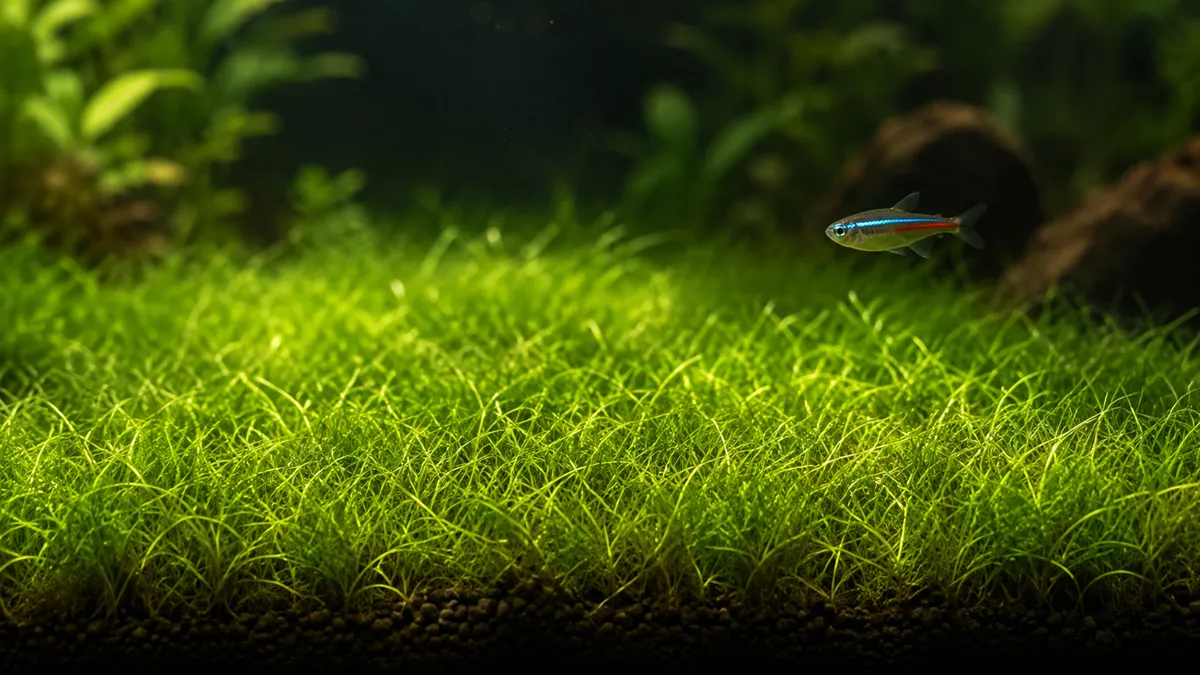
Aquarium carpet plants for beginners don’t have to end the way mine almost did — melted, brown, and floating in clumps by week two.
Here’s the short answer: yes, you can grow a real, dense green carpet without CO2 injection or years of aquascaping experience. You just have to pick a species that matches the tank you actually have, not the one in someone else’s photo.
My first shot at a dwarf baby tears carpet dissolved into clear slime in three days. I blamed the seller, but it took three weeks of testing to uncover my rookie mistakes. I had blasted delicate tissue cultures with max LED intensity while crashing my pH with over-cranked CO2.
Quick Facts: If You Only Remember 3 Things About Aquarium Carpet Plants for Beginners
- Not every carpet plant needs CO2 — several genuinely easy species spread fine under moderate light alone.
- Runners and rhizomes, not seeds, are how most true carpet plants fill in a tank floor.
- The most common beginner mistake is buying a high-light, high-CO2 species like HC or Glossostigma for a low-tech tank.
Aquarium Carpet Plants for Beginners: Where Most People Get Stuck
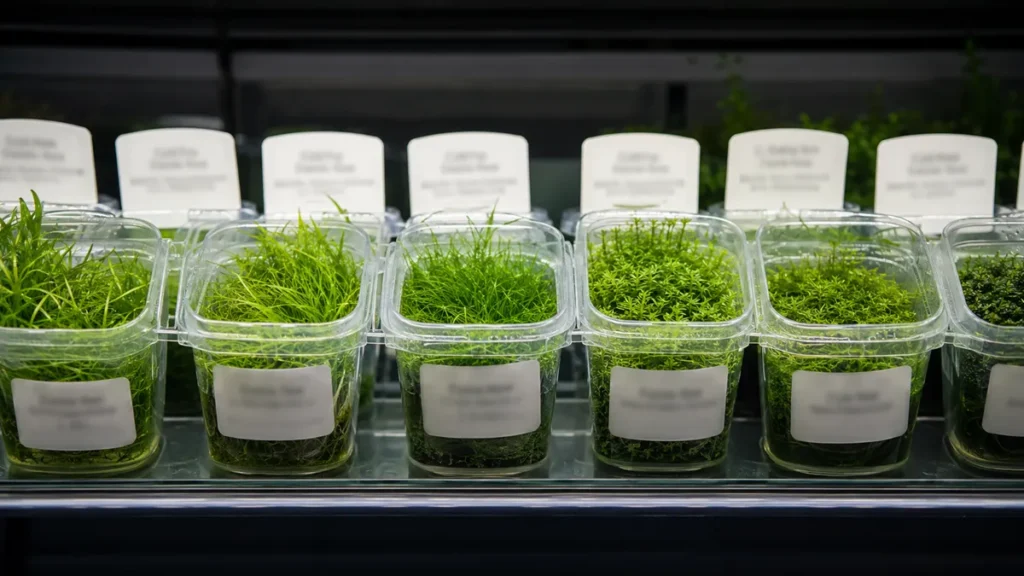
I’ve been keeping tanks since my zoology days, and I still remember staring at a wall of nearly identical-looking “carpet plant” labels at the shop, with no idea which ones would actually survive my setup.
That’s the real problem with aquarium carpet plants for beginners — it’s not a skill gap, it’s a matching problem. Get the species right for your light and your patience level, and the carpet mostly grows itself.
What Are Aquarium Carpet Plants?
Aquarium carpet plants are low-growing aquatic species that spread sideways across the substrate instead of growing upward. Most do this by sending out runners — thin horizontal shoots that root down and produce new plantlets as they travel.
A University of Florida IFAS Extension publication on ornamental aquatic plant production notes that species like dwarf hairgrass (Eleocharis parvula) propagate exactly this way, forming daughter plants along the runner that you can later divide and replant (UF/IFAS Extension, FA251).
Carpeting Aquarium Plants vs. Stem Plants
Carpeting aquarium plants differ from stem plants in one key way. Stem plants grow up toward the light; carpet species grow outward across it, staying low the whole time. For a beginner, that means your light needs to reach the substrate always.
6 Best Types of Carpet Plants for Aquarium: The Full Lineup
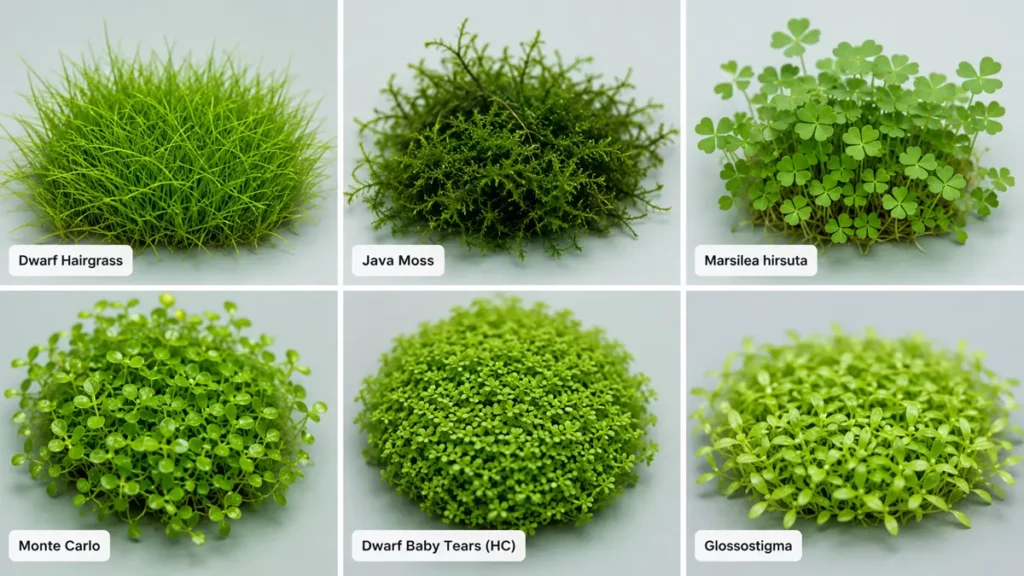
There are more types of carpet plants for aquarium use than most guides to aquarium carpet plants for beginners bother mentioning, and they don’t all belong in the same tank. Some are true CO2-dependent aquascaping showpieces. Others will carpet a low-tech 10-gallon with nothing but a basic LED and a little patience.
Aquarium Carpet Plants Name: Common and Scientific
Here’s how the aquarium carpet plants name options I get asked about most often actually compare, side by side:
| Plant | Scientific Name | Light Need | CO2 Required? | Beginner Friendly? |
| Dwarf Hairgrass | Eleocharis parvula / acicularis | Medium | No — grows slower without it | Yes |
| Java Moss | Taxiphyllum barbieri | Low | No | Yes |
| Marsilea hirsuta | Marsilea hirsuta | Low–Medium | No | Yes |
| Monte Carlo | Micranthemum tweediei | Medium–High | Recommended | Moderate |
| Dwarf Baby Tears (HC) | Hemianthus callitrichoides | High | Yes | Difficult |
| Glossostigma | Glossostigma elatinoides | High | Yes | Difficult |
Notice the pattern. The two plants beginners get frustrated with — HC and Glossostigma — are also the two most photographed in aquascaping magazines. That’s not a coincidence, and it’s exactly why so many people buy them first and quit the hobby second.
Easy Carpeting Aquarium Plants: Where to Start
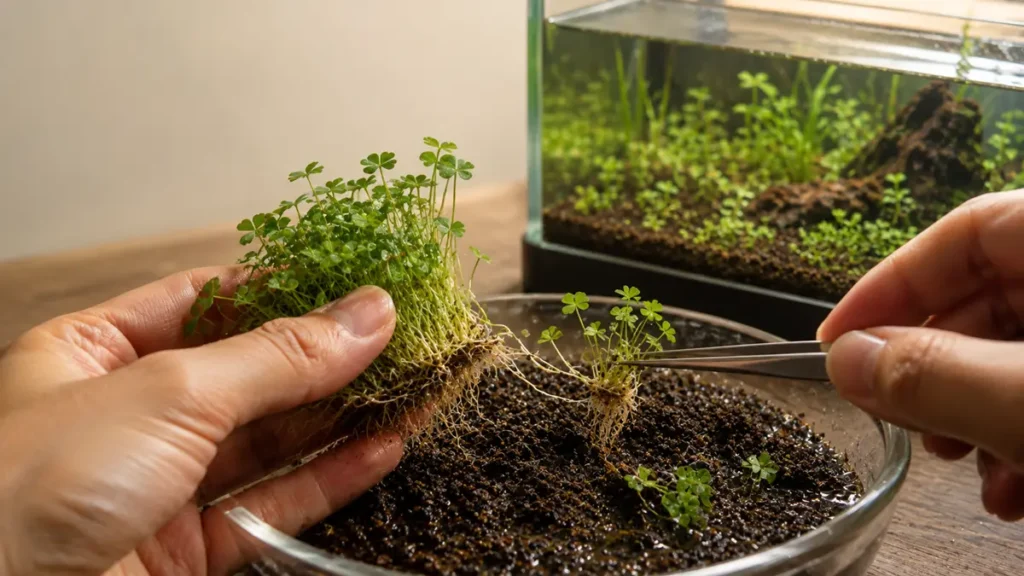
This is the section most guides to aquarium carpet plants for beginners skip in favor of the flashier species. If you want easy carpeting aquarium plants that forgive inconsistent dosing and the occasional missed water change, look at dwarf hairgrass, Marsilea, and Java moss.
All three tolerate a wider light range than the competition-grade species. None of them collapse overnight just because your CO2 ran out.
The Easiest Carpeting Aquarium Plant for True Beginners
If you can only commit to one species for your first attempt, the easiest carpeting aquarium plant is Marsilea hirsuta.
It’s shaped like a tiny four-leaf clover, spreads via rhizomes just under the substrate, and tolerates low-to-medium light without demanding CO2 to hold its shape — it just grows a bit slower without it.
What Are the Easiest Carpeting Plants Overall?
Zooming out past single-species picks, the easiest carpeting plants overall are the ones that spread vegetatively instead of needing precise conditions to trigger carpeting behavior in the first place.
Dwarf hairgrass, Marsilea, and Java moss all fall into this group. You’re dividing an existing clump, not coaxing a fussy species into doing something it doesn’t want to do.
Aquarium Ground Cover Plants: Same Family, Different Look
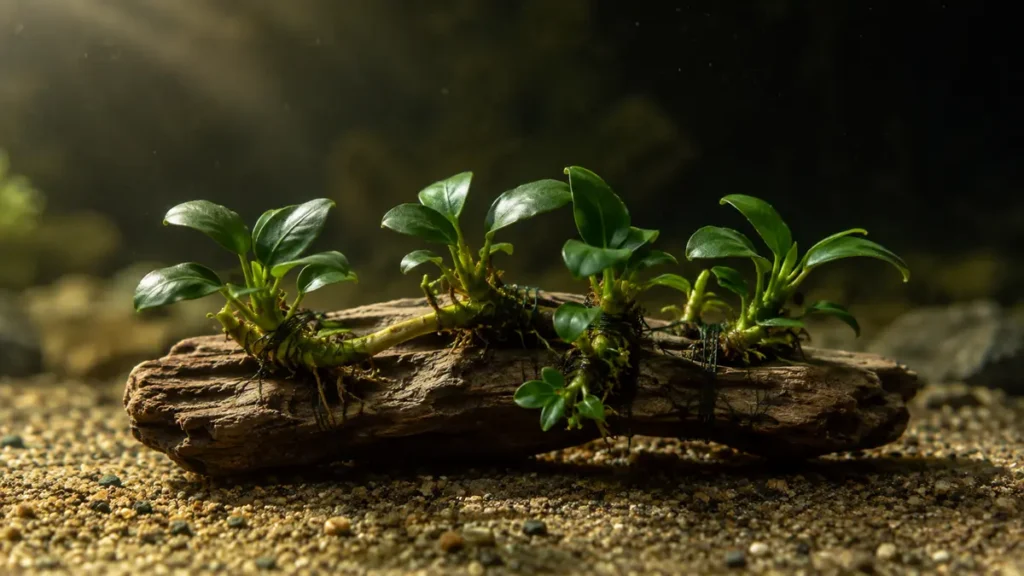
Not everything sold as aquarium ground cover plants is technically a carpet plant in the strict aquascaping sense.
Anubias nana petite, for instance, is usually tied to driftwood or rock rather than planted in substrate, and it never forms the dense mat a true carpet species does. It still fills the same visual role for a beginner who just wants a green tank floor without fussing over substrate chemistry.
Aquarium Carpet Plants No CO2: What Actually Works
If you’re searching for aquarium carpet plants no CO2 — which is one of the most common searches among aquarium carpet plants for beginners — you’ve probably already been burned by a species that melted without it.
Fishiohub cover the full no-CO2 lineup in our dedicated guide to aquarium plants that don’t need CO2. For carpeting specifically, dwarf hairgrass, Marsilea hirsuta, and Java moss will all fill in under moderate LED light with zero injected CO2 — you’re trading speed for simplicity, not giving up on a carpet entirely.
Here’s why that tradeoff exists. Peer-reviewed research on aquatic photosynthesis explains that low rates of CO2 diffusion make inorganic carbon a more limiting factor for aquatic plants than it ever is for their terrestrial cousins.
This is exactly why species bred for aquascaping competitions — the ones with the highest carbon demand — struggle without supplemental CO2 while runner-based species with lower demands don’t (Maberly & Gontero, Journal of Experimental Botany, 2017).
Monte Carlo Aquarium Carpet Plants: Why It’s Everywhere
Monte Carlo aquarium carpet plants show up in nearly every intermediate aquascaping tutorial for a reason. It’s not the easiest plant on this list, but it’s noticeably easier than HC while keeping that dense, mossy-green look — we walk through the full planting process in our Monte Carlo planting guide.
FAQ
What are the best aquarium carpet plants for beginners?
Easy carpeting aquarium plants like Marsilea hirsuta, dwarf hairgrass, and Java moss top the list for aquarium carpet plants for beginners — all three spread without CO2 injection and tolerate a wide light range.
How are carpeting aquarium plants different from stem plants?
Carpeting aquarium plants spread sideways across the substrate instead of growing upward, forming a dense mat rather than a forest of individual stems reaching for the surface.
What’s the easiest carpeting aquarium plant for a first tank?
Marsilea hirsuta is generally the easiest carpeting aquarium plant for a true beginner. It spreads via rhizomes and doesn’t demand CO2 to hold its shape.
What’s the aquarium carpet plants name most beginners search for first?
Most people search by common name — Monte Carlo or dwarf hairgrass — before learning the scientific names behind them, Micranthemum tweediei and Eleocharis parvula.
What types of carpet plants for aquarium tanks should a beginner avoid at first?
Skip HC and Glossostigma until you have CO2 injection and strong, consistent light. These two types of carpet plants for aquarium use demand precise conditions to stay compact instead of melting.
What’s the difference between aquarium carpet plants and aquarium ground cover plants?
Aquarium carpet plants form a dense, low mat by spreading through the substrate. Aquarium ground cover plants like Anubias nana petite are usually just tied to hardscape and never form that same tight mat.
Do aquarium carpet plants no CO2 tanks actually form a full carpet?
Yes. The easiest carpeting plants in a no-CO2 setup — dwarf hairgrass, Marsilea, and Java moss — will all fill in under moderate light, just more slowly than a CO2-injected tank would.
Is Monte Carlo easier to grow than dwarf baby tears (HC)?
Yes. Among Monte Carlo aquarium carpet plants fans, that’s the whole appeal — it tolerates a wider range of light and CO2 conditions than HC, which is why it’s replaced HC as the go-to recommendation for people newer to the hobby.
A Mistake Worth Mentioning
I bought Dwarf Baby Tears (HC) for a low-tech tank, unaware it required high light and pressurized CO2. Within two weeks, the entire carpet turned translucent and melted into mush.
Next Steps: Resources You Should Read
If this is your first attempt at aquarium carpet plants for beginners, these are the reads and the sources worth bookmarking before you head to checkout.
Related FishioHub reading
- Aquarium Plants That Don’t Need CO2
- How to Plant Monte Carlo in Aquarium
- How to Plant Freshwater Aquarium Plants
Where to buy carpet and stem plants
Scientific references
- University of Florida IFAS Extension, “Freshwater Ornamental Aquatic Plant Production in Florida,” Publication FA251
- Maberly, S.C. & Gontero, B., “Ecological imperatives for aquatic CO2-concentrating mechanisms,” Journal of Experimental Botany, Vol. 68, Issue 14, 2017
- UF/IFAS Assessment of Nonnative Plants in Florida’s Natural Areas, Publication AG376 (has evaluated more than 900 species for invasion risk, including 208 proposed for new introduction)
USA aquarium resources
- Habitattitude — the national USFWS/Sea Grant campaign on disposing of unwanted aquarium plants responsibly instead of releasing them into local waterways, relevant the first time you thin out a carpet
- Your local UF/IFAS or state Cooperative Extension office, for region-specific aquatic plant guidance
- Local fish clubs and aquarium societies, for plant trades and free trimmings once your carpet fills in
Closing
A carpet doesn’t happen by accident. It happens because you picked a plant that matches the tank you actually have, not the one in someone else’s aquascaping photo. Get that one decision right, and the rest of this — for aquarium carpet plants for beginners especially — mostly takes care of itself.
Was this guide helpful?
First-Hand Experience
Based on animals I've personally kept and bred - not summarized from other articles.
Zoological Foundation
Claims are checked against my M.Sc. Zoology training and published aquatic biology research, not recycled aquarium myths.
No Paid Influence
No sponsorship shaped this guide. Affiliate links, if any, are disclosed separately and never hidden.
Kept Current
Errors are corrected as soon as they're found, with the update noted at the bottom of the article.
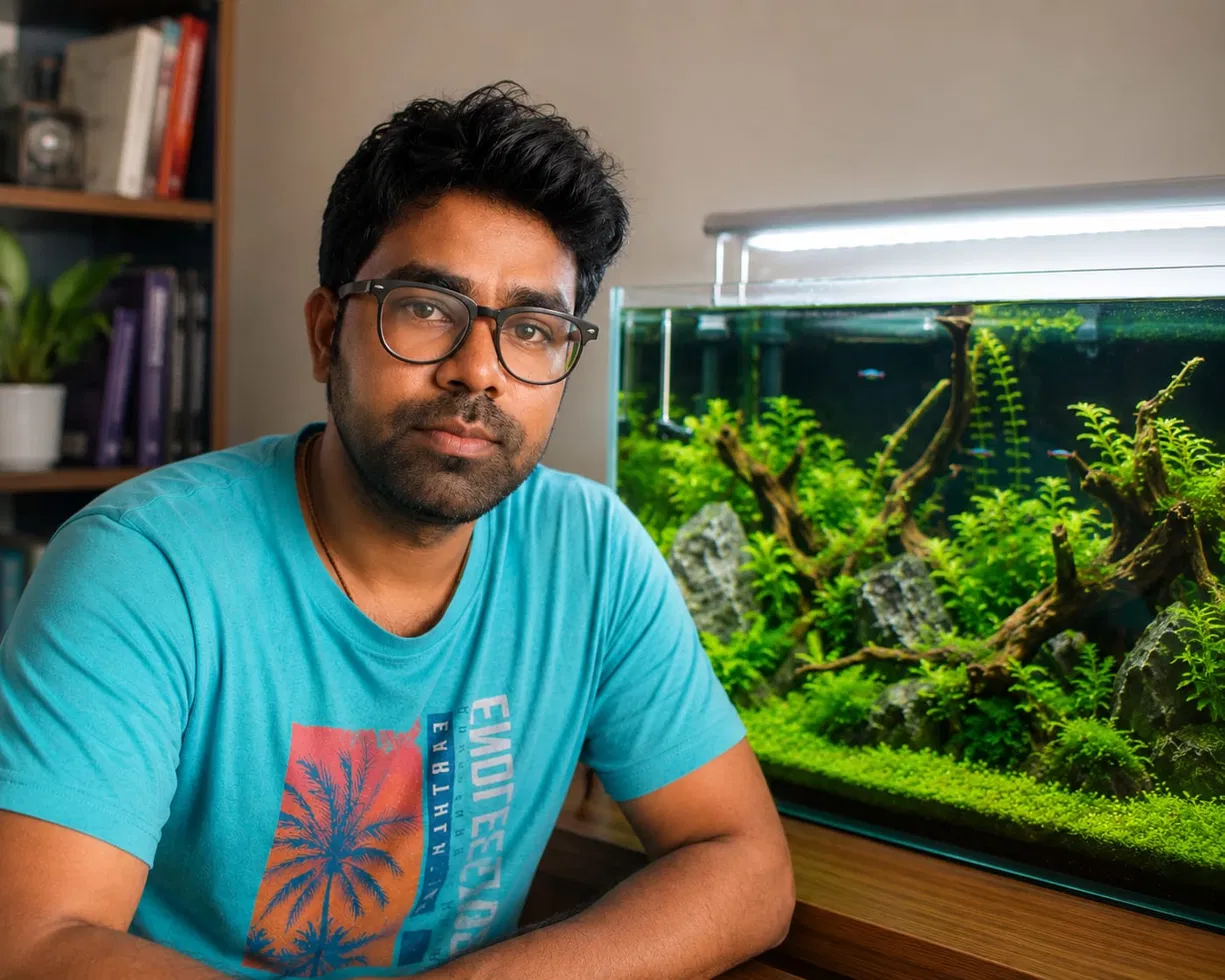
Anil Satak M.Sc. Zoology · Founder, FishioHub
Grew up in a fishing family in India and holds a Master's in Zoology. FishioHub is a one-person operation - every guide is personally researched, kept-tested, and written by Anil. No team, no outsourced writers, no AI-generated content. Read his full bio →