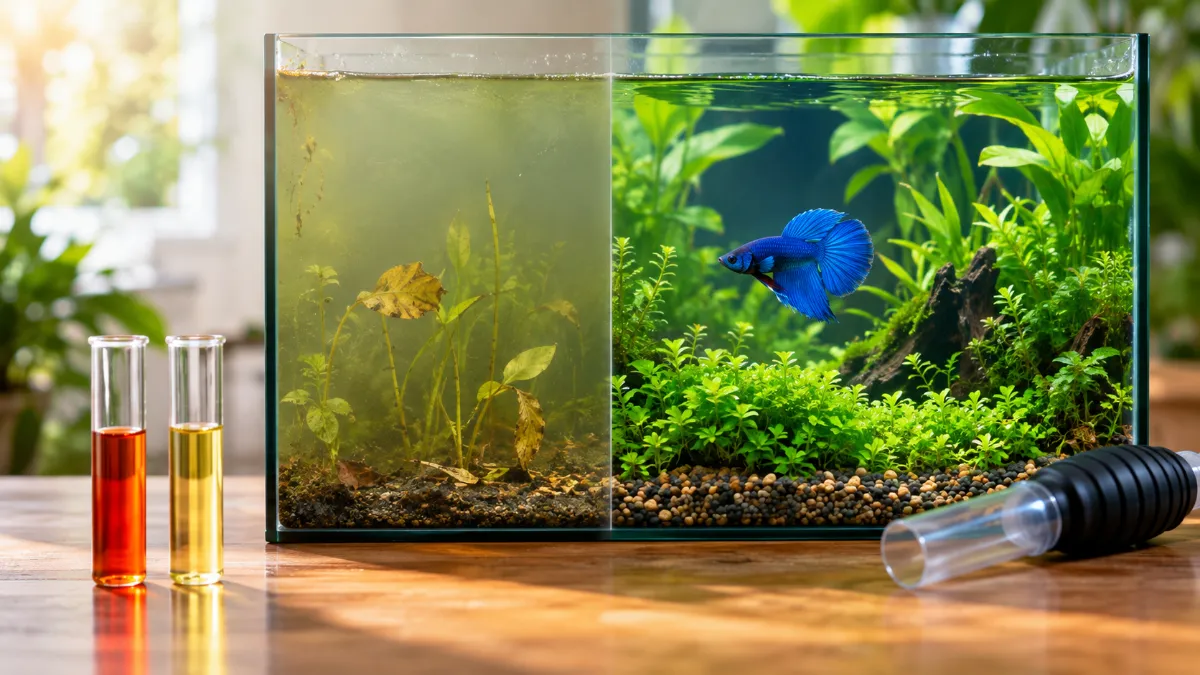
Your tank looks clean, but the test card says nitrate is high. Annoying, right? Here’s how to reduce nitrates in aquarium water fast: change 30–50% of the water, then test again after one hour.
Short answer: How to reduce nitrates in aquarium tanks is simple. Take out 30–50% of the water with a gravel vacuum and refill with clean, dechlorinated water. Then keep nitrate under 20 ppm with weekly water changes, less food and live plants.
I’ll never forget testing my first heavily stocked community tank and watching the API liquid test vial turn a terrifying, deep blood-red—hitting 80+ ppm. Although the water looked absolutely crystal clear, which made the discovery feel like a complete betrayal. I immediately panicked, did a massive 50% water change, and spent the next month aggressively adding Pothos cuttings to the top of my filter to naturally suck up those sneaky nutrients.
Quick Fix Box: Read This First
Here are 7 easy fixes I always use to reduce nitrates in aquarium tanks:
- Change 30–50% of the water.
- Vacuum the gravel.
- Feed less.
- Add fast-growing plants.
- Clean the filter the right way.
- Keep fewer fish.
- Test your tap water.
⚠️ Warnings
- Never change 100% of the water in one go.
- Always use a water conditioner on new water.
- Don’t trust one test. Retest to be sure.
What Should Nitrate Levels Be in Freshwater Tank Setups?
What should nitrate levels be in freshwater tank setups? Under 20 ppm for most fish. Around 5–10 ppm is ideal.
I always use this simple chart:
| Nitrate (ppm) | Status | What to do |
| 0–10 | Ideal | Keep your routine |
| 10–20 | Good | Watch your feeding |
| 20–40 | Rising | Do a water change this week |
| 40–80 | Too high | Change 30–50% now, then retest |
| 80+ | Danger zone | Follow the 5 steps below |
These bands are a hobbyist rule of thumb, not a legal limit.
Safe Nitrate Levels in Aquarium Tanks: What the Science Says
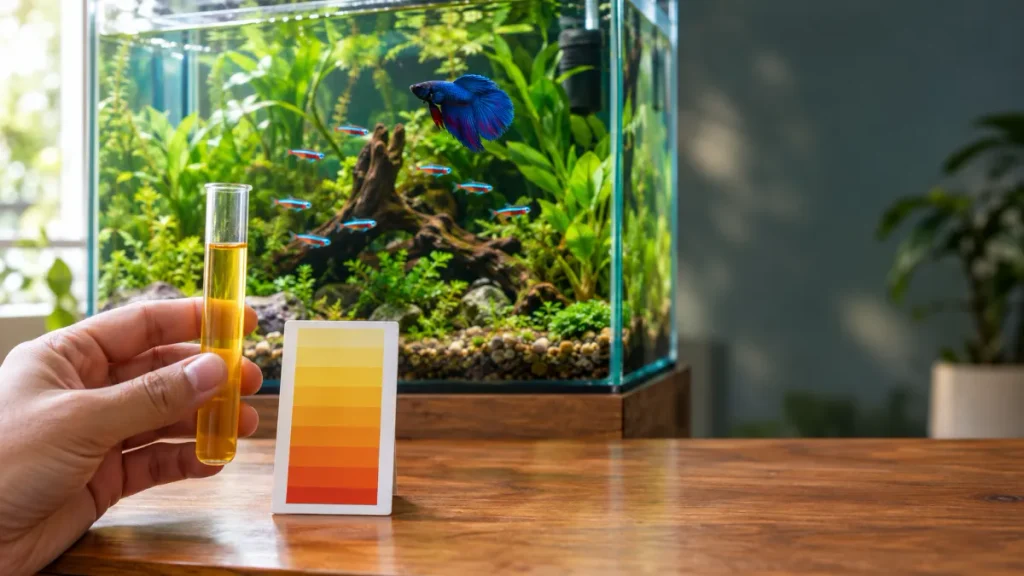
Before you learn how to reduce nitrates in aquarium tanks, know your target. Safe nitrate levels in aquarium tanks aren’t one magic number, but the research says lower is kinder.
- Toxicity review: Camargo, Alonso & Salamanca (2005) reviewed nitrate toxicity in invertebrates, fish and amphibians. Nitrate gets more harmful as the level and the exposure time go up. It also tends to hurt smaller, younger animals more than bigger ones.
- Heavy stocking: A tank with lots of fish and few plants can drift to 80–100 ppm or more, according to Aquarium Co-Op.
- Tap water rule: The US EPA limit for drinking water is 10 mg/L as nitrogen. That’s about 44 ppm on a typical aquarium test card. It’s a human rule, not a fish rule.
High Nitrate in Aquarium Tanks: Where It Comes From
High nitrate in aquarium water is the end of the nitrogen cycle. Fish waste turns into ammonia. Bacteria turn ammonia into nitrite, and then nitrite into nitrate.
Nothing in a normal tank removes nitrate by itself. So it keeps building until you take it out. The usual suspects are:
- Too much food
- Too many fish
- A dirty filter
- Rotting plant leaves
- Tap water that already has nitrate
How to Reduce Nitrates in Aquarium Fast: 5 Steps
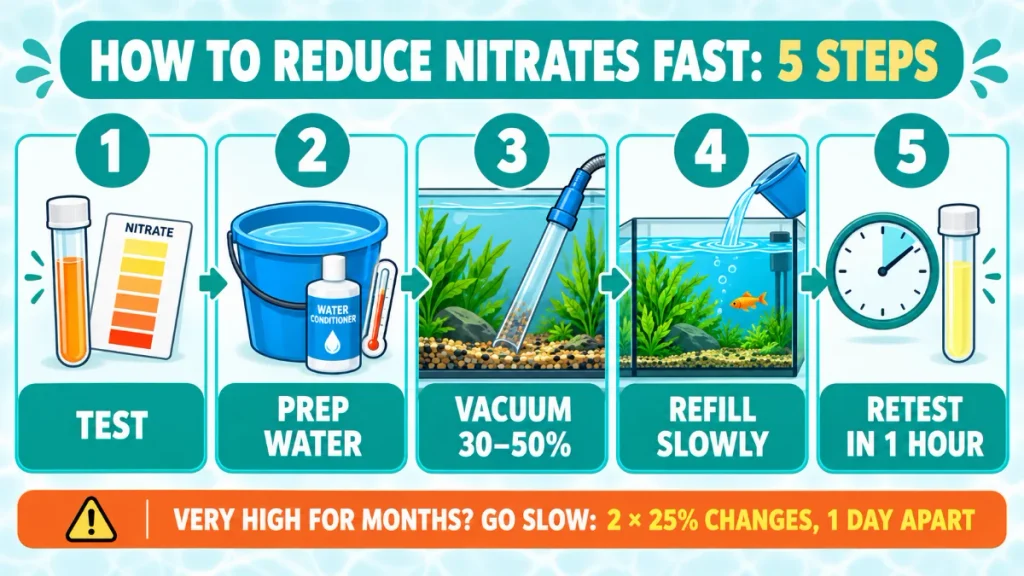
Need to know how to reduce nitrates in aquarium fast? Follow these five steps today.
- Test it properly. Use a liquid test kit. Follow the instructions exactly, because many kits need one bottle shaken hard for about 30 seconds.
- Prep fresh water. Add water conditioner and match the temperature.
- Vacuum 30–50%. Pull water from the gravel with a siphon. A 40–50% change is the usual emergency move.
- Refill slowly. Pour the water in gently so you don’t stress the fish.
- Retest after one hour. Still above 40 ppm? Repeat in 24–48 hours.
⚠️ Warning: If your nitrate has been very high for months, go slower. Two smaller changes (about 25% each) a day apart are gentler than one huge swing.
How to Lower Nitrates in Fish Tank Water: The Easy Math
How to lower nitrates in fish tank water is just dilution. Remove half the water and you remove half the nitrate. A tank at 60 ppm refilled with zero-nitrate water drops to about 30 ppm.
But if your tap water has nitrate, it adds some back. For example, 60 ppm in the tank and 10 ppm in the tap gives about 35 ppm after a 50% change.
How to Lower Nitrate in Aquarium Tanks Every Week
How to lower nitrate in aquarium tanks for good means making water changes a habit. Changing 20–30% of the water each week keeps most tanks steady.
Vacuum the gravel at the same time. Trapped waste is a hidden nitrate source.
How to Reduce Nitrates in Aquarium Without Water Change
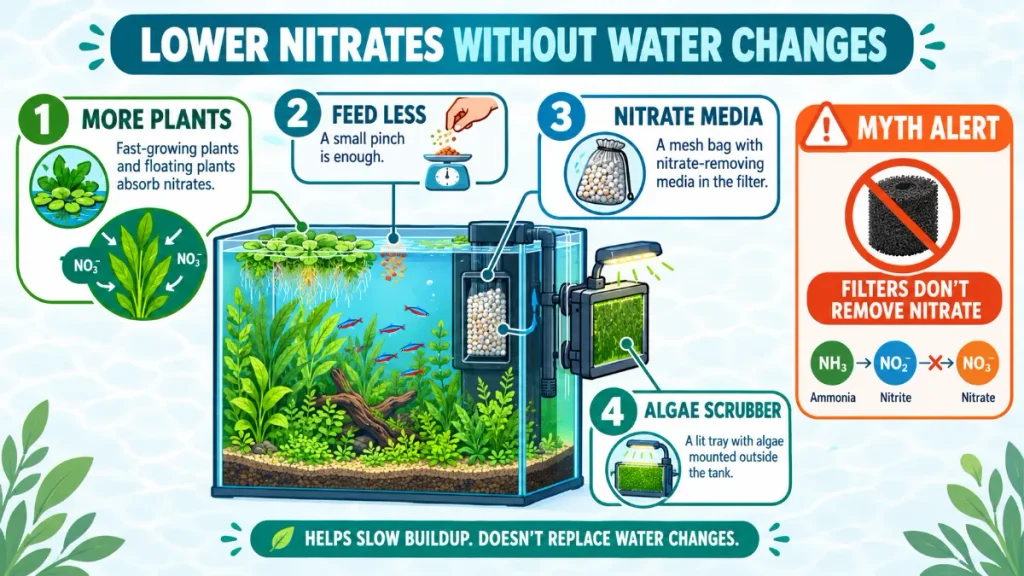
How to reduce nitrates in aquarium without water change? You can slow the buildup, but you can’t fully replace water changes.
Here’s what helps:
- More plants: They use nitrate as food.
- Less food: Less waste means less nitrate.
- Nitrate-removing media: Products like Seachem De*Nitrate or API Nitra-Zorb can help. One FishLore member reports it can take months to see results.
- Algae scrubber: A lit scrubber outside the tank grows algae that eats nitrate.
Myth alert: Your filter does not remove nitrate. Sponges and ceramic rings turn ammonia into nitrate. They don’t take it out.
How to Remove Nitrates From Aquarium Water With Plants
Plants show you how to reduce nitrates in aquarium tanks the natural way. They pull nitrate out of the water as plant food.
Floating plants like water lettuce are easy, and fish usually leave them alone. Seachem adds that plants need good light to keep growing.
⚠️ Warning: Dead leaves rot and can send ammonia back into the tank, says PetMD. Trim yellow leaves quickly.
How to Remove Nitrates From Aquarium Tanks With Media
How to remove nitrates from aquarium tanks with media comes down to patience. These products need time to build up helpful bacteria deep in the pores.
Use media as a helper, not a rescue. It works best alongside water changes and a light feeding routine.
How to Reduce Nitrates in Fish Tank by Feeding Less
The cheapest fix for how to reduce nitrates in aquarium tanks is making less waste. I follow a simple rule: feed only what your fish finish in about two minutes. Scoop out the rest.
Stocking matters too. If nitrate stays high even with careful feeding, you probably have too many fish for the tank, says TFH Magazine.
How to Reduce Nitrates in an Aquarium: Clean the Filter Right
A packed filter can turn into a nitrate factory, as one experienced FishLore member points out. Rinse the media gently in a bucket of old tank water.
⚠️ Warning: Never rinse filter media under the tap. Chlorine can kill the good bacteria that keep your fish safe.
How to Reduce Nitrates in Freshwater Aquarium Tanks for Good
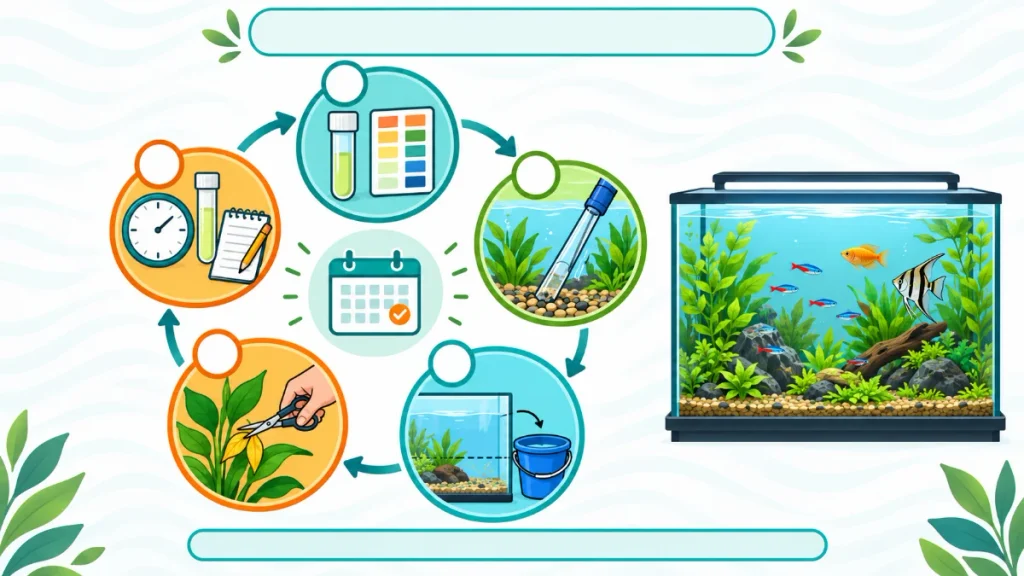
If you want to know how to reduce nitrates in aquarium setups for good, build a routine. It’s boring, but it works.
Here’s an easy weekly plan:
- Test nitrate.
- Vacuum the gravel.
- Change 20–30% of the water.
- Trim dead plant leaves.
- Retest and write the number down.
How to Get Rid of Nitrates in Aquarium Water When Tap Water Is the Problem
Before you keep trying how to reduce nitrates in aquarium water, test your tap. If the tap already reads 20 ppm or more, every water change adds nitrate back.
That’s the hidden answer to how to get rid of nitrate in fish tank problems that never improve. Use a reverse-osmosis (RO) unit or buy suitable water, says TFH Magazine. Many hobbyists mix RO water with tap water to dilute it.
How to Eliminate Nitrates in Aquarium Tanks? The Honest Answer
Wondering how to eliminate nitrates in aquarium tanks completely? You can’t, and you don’t need to. Fish make waste, and waste becomes nitrate.
Knowing how to reduce nitrates in aquarium tanks beats chasing zero. Aim for low and steady.
Nitrates Too High in Fish Tank? 5 Mistakes to Avoid
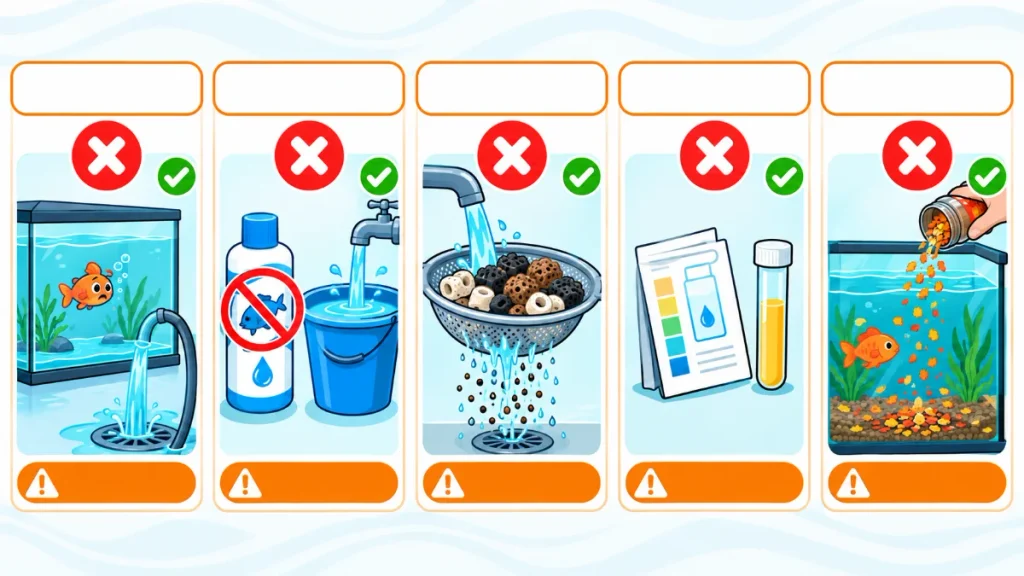
These mistakes ruin most attempts at how to reduce nitrates in aquarium tanks:
- Changing 100% of the water at once
- Forgetting water conditioner
- Washing the filter under the tap
- Skipping the test-kit instructions
- Overfeeding while chasing a number
I fell hard for the “clean filter” trap when I first saw my nitrate levels creeping past 40 ppm. Desperate to fix it, I pulled my canister filter apart and aggressively rinsed the media right under the kitchen tap, thinking I was doing a deep clean. Within three days, I didn’t just have high nitrates—I completely crashed my beneficial bacteria, my water turned milky white from a bacterial bloom, and my poor neon tetras were gasping at the surface.
FAQ
How to reduce nitrates in aquarium tanks quickly?
Change 30–50% of the water with a gravel vacuum and retest after an hour. Repeat in 24–48 hours if it’s still above 40 ppm.
What is a safe nitrate level for a freshwater aquarium?
Under 20 ppm for most fish. Aim for 5–10 ppm if you keep shrimp, fry or sensitive fish.
Can I lower nitrates without water changes?
Partly. Add plants, feed less, vacuum the gravel and use nitrate-removing media. These slow the buildup but don’t fully replace water changes.
Do live plants reduce nitrates?
Yes, they use nitrate as food. Just remove dead leaves so they don’t rot.
Why are my nitrates high right after a water change?
Your tap water may contain nitrate. Test it straight from the faucet.
Can fish live with high nitrate?
They can survive for a while, but long exposure stresses them. Fix it before symptoms show.
How often should I test nitrate?
Once a week, right before your water change. Test more often in new or crowded tanks.
Does a bigger filter remove nitrate?
No. A bigger filter just converts more ammonia into nitrate.
Next Steps: Resources You Should Read
Related FishioHub reading
- Duckweed Nitrate Removal: A Simple Floating-Plant Fix
- How to Remove Ammonia From Fish Tank Naturally
- How Many Times a Day Should You Feed Aquarium Fish?
Scientific references
- Camargo, J.A., Alonso, A. & Salamanca, A. (2005). Nitrate toxicity to aquatic animals: a review with new data for freshwater invertebrates. Chemosphere, 58(9), 1255–1267.
- University of Nebraska–Lincoln Extension, Drinking Water: Nitrate-Nitrogen (EPA limit and unit conversion).
- Seachem, Guide: Controlling Nitrate.
USA aquarium resources
- TFH Magazine, Keeping Up with Nitrate.
Good water is quiet. Nobody sees it, and nobody thanks you for it.
But your fish feel it every single day.
Was this guide helpful?
First-Hand Experience
Based on animals I've personally kept and bred - not summarized from other articles.
Zoological Foundation
Claims are checked against my M.Sc. Zoology training and published aquatic biology research, not recycled aquarium myths.
No Paid Influence
No sponsorship shaped this guide. Affiliate links, if any, are disclosed separately and never hidden.
Kept Current
Errors are corrected as soon as they're found, with the update noted at the bottom of the article.

Anil Satak M.Sc. Zoology · Founder, FishioHub
Grew up in a fishing family in India and holds a Master's in Zoology. FishioHub is a one-person operation - every guide is personally researched, kept-tested, and written by Anil. No team, no outsourced writers, no AI-generated content. Read his full bio →