Quick Summary Fact Card
| Best Salt for Saltwater Aquarium for Beginners | Instant Ocean (~$30-35 for a 160-gallon box) |
| Best for reef tanks | Red Sea Coral Pro Salt (~$45-90 depending on size) |
| Best value for reef starters | Reef Crystals (~$40 for a 200-gallon box) |
| Best for sensitive/advanced reefs | Tropic Marin Pro-Reef (~$50-60 for 25kg) |
| Target specific gravity | 1.024–1.026 |
| Mix time before use | 12–24 hours |
| Water type | RO/DI only, never tap water |
The best salt for a saltwater aquarium is a synthetic sea salt mix formulated to replicate natural ocean water — typically containing sodium chloride, calcium, magnesium, and trace elements at a specific gravity of 1.024–1.026. For beginners, Instant Ocean and Reef Crystals are the most reliable picks. For reef tanks with corals, a higher-calcium mix like Red Sea Coral Pro or Tropic Marin Pro-Reef is worth the extra cost.
I grew up around fishing tanks in India long before I ever touched saltwater, and when I finally mixed my first marine batch, I got the order backwards — salt into water, not water into salt — and spent an hour chasing cloudy water I didn’t need to chase. That’s the kind of mistake this guide exists to save you from.
If you haven’t set up your tank yet, start with setting up a marine fish tank for beginners before you even think about which salt to buy.
What Is Saltwater Aquarium Salt, Really?
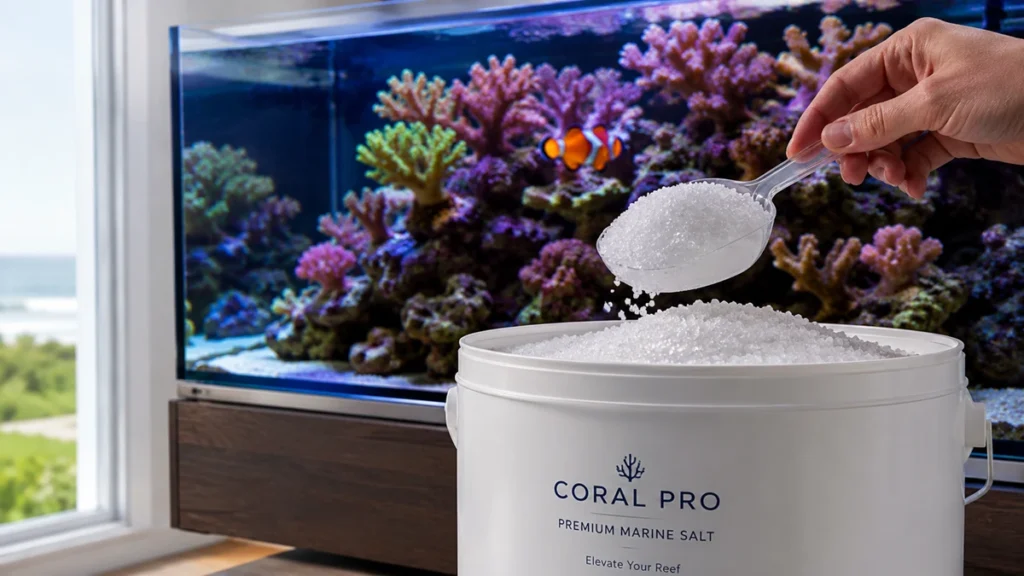
Saltwater aquarium salt — also called marine salt mix — isn’t table salt with extra steps. It’s a carefully formulated blend of:
- Sodium chloride (the base)
- Calcium
- Magnesium
- Alkalinity buffers
- Trace elements (strontium, iodine, potassium)
Manufacturers test these mixes against ASTM International’s D1141 standard, which defines a reference recipe for substitute ocean water. That’s why two “reef salt” brands can still test differently straight out of the bucket — they’re all aiming at the same target, but the exact ratios vary by brand.
Here’s the part most guides skip: natural seawater has a magnesium-to-calcium ratio of roughly 3:1 to 3.5:1. Reef salt mixes are built around that ratio because corals actively pull calcium and carbonate out of the water to build their skeletons out of aragonite (a crystal form of calcium carbonate). Strip too much magnesium relative to calcium, and calcium starts precipitating out of the water uselessly instead of reaching your coral.
👉 Never use table salt or cooking salt in a saltwater aquarium. It has none of this — no buffering, no trace elements, and often contains anti-caking agents that are toxic to fish.
Reef Salt vs Marine Salt: Which One Do You Actually Need?
This is the question I get asked more than any other, so here’s the honest comparison table I wish existed when I started.
| Type | Calcium/Magnesium | Best For | Price Range (US) |
| Fish-Only Salt Mix | Basic levels | Clownfish, damsels, wrasses, lionfish | $25-35/160-200 gal |
| Reef Salt Mix | Elevated Ca/Mg | Soft corals, LPS, SPS, shrimp, snails | $35-50/160-200 gal |
| Premium Reef Salt | Highest, most consistent | Sensitive SPS, advanced reef keepers | $50-90/160-200 gal |
The short version: if you’re keeping fish only, don’t overpay for reef salt — you’re buying trace elements your tank doesn’t need. If you’re keeping any coral, even an easy soft coral like zoanthids, go reef salt from day one. Retrofitting a fish-only tank into a reef tank later means changing your whole water chemistry approach, and that’s a bigger hassle than just starting with the right mix.
Best Salt for Saltwater Aquarium: My Top 4 Picks
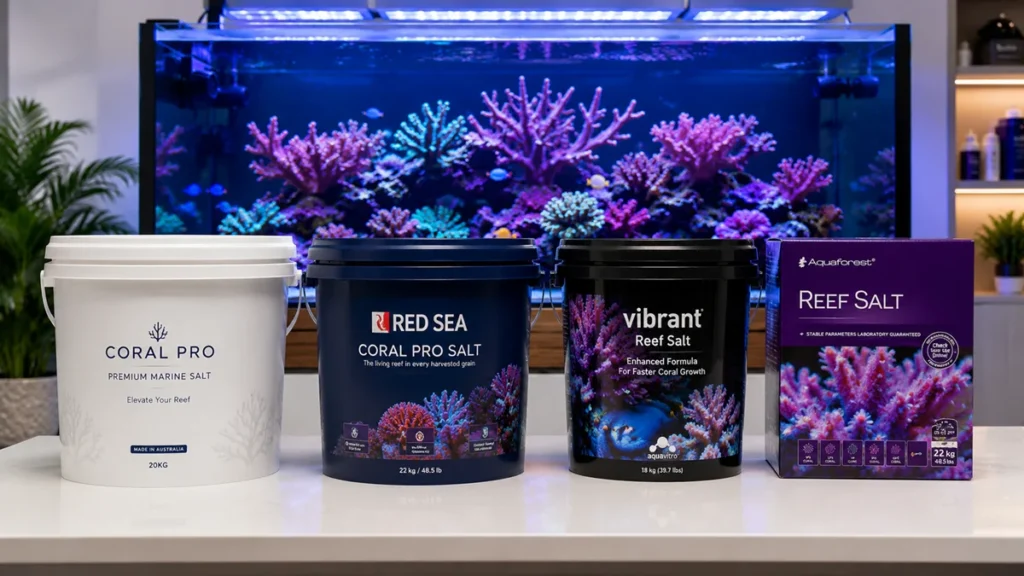
🥇 Instant Ocean Sea Salt
The one I recommend to almost every beginner who asks me. It’s been a hobby staple for decades, it’s stable, and it’s genuinely hard to mess up.
- Best overall for beginner aquarists
- Excellent for fish-only tanks
- Widely stocked — Petco and PetSmart both carry it, and bulk online buckets run cheaper per gallon
- US price: roughly $30-35 for a box that mixes ~160 gallons
🥈 Reef Crystals (by Instant Ocean)
Same manufacturer, dialed up for coral. This is where I’d point someone setting up their first reef tank on a budget.
- Higher calcium and trace elements than standard Instant Ocean
- Great balance of quality and price
- US price: around $40 for a 200-gallon box
🥉 Red Sea Coral Pro Salt
Natural evaporated sea salt, formulated specifically for accelerated coral growth. This is what I switch to once someone’s keeping SPS or LPS seriously.
- Excellent for mixed reef tanks, especially SPS and LPS
- Clean, consistent batch-to-batch
- US price: $45 for smaller buckets up to $90 for larger sizes
🌊 Tropic Marin Pro-Reef
Pharmaceutical-grade purity. More expensive, but I’ve never seen it cause a problem in a sensitive tank.
- Perfect for sensitive marine life and advanced reef setups
- Trusted by professional aquarists and public aquariums
- US price: roughly $50-60 for a 25kg bucket
How to Choose the Right Salt for Your Tank
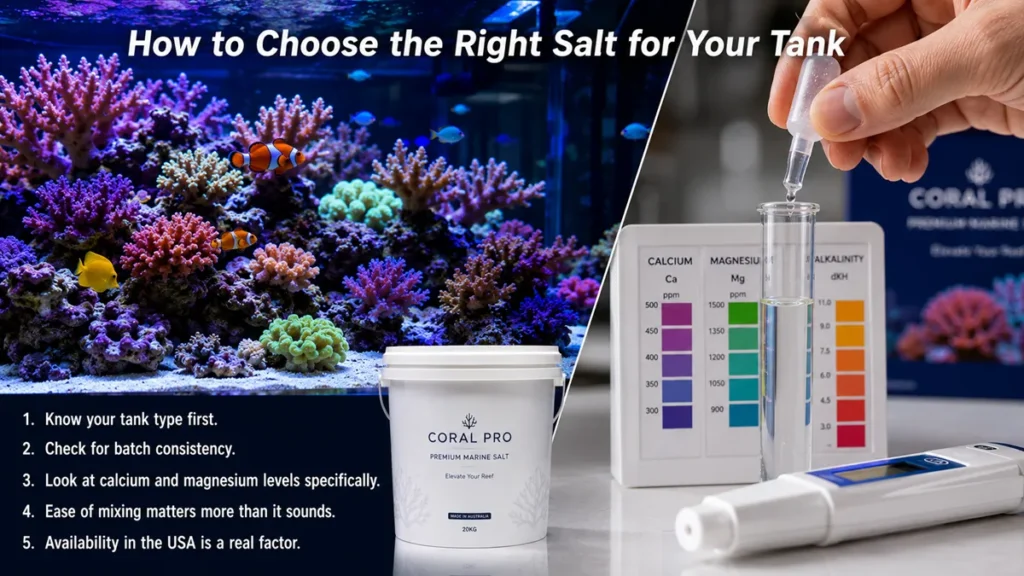
1. Know your tank type first. Fish-only means basic marine salt does the job — don’t pay for calcium and magnesium your tank isn’t using. Reef or coral tanks need the elevated Ca/Mg from day one, because switching later means rebalancing your whole water chemistry mid-stream.
2. Check for batch consistency. Some cheaper mixes vary noticeably between batches. If your fish or corals react differently to every water change, inconsistent salt is often the hidden cause — stick to a brand with a long track record.
3. Look at calcium and magnesium levels specifically. This matters even if you’re “just thinking about” adding coral later. It’s easier to start with reef salt than to retrofit your tank’s chemistry once corals are already in.
4. Ease of mixing matters more than it sounds. A salt that leaves grit at the bottom of your mixing bucket after 24 hours is either old stock or a lower-quality formulation — either way, it’s telling you something.
5. Availability in the USA is a real factor. A salt you can’t reliably rebuy is a salt that’ll force you to switch brands eventually — and switching brands too often is one of the most common ways hobbyists destabilize their own tank.
How to Properly Mix Saltwater (This Is the Part People Rush)
- Use RO/DI water only — never tap water, which carries chlorine, chloramine, and phosphates that stress fish and feed algae.
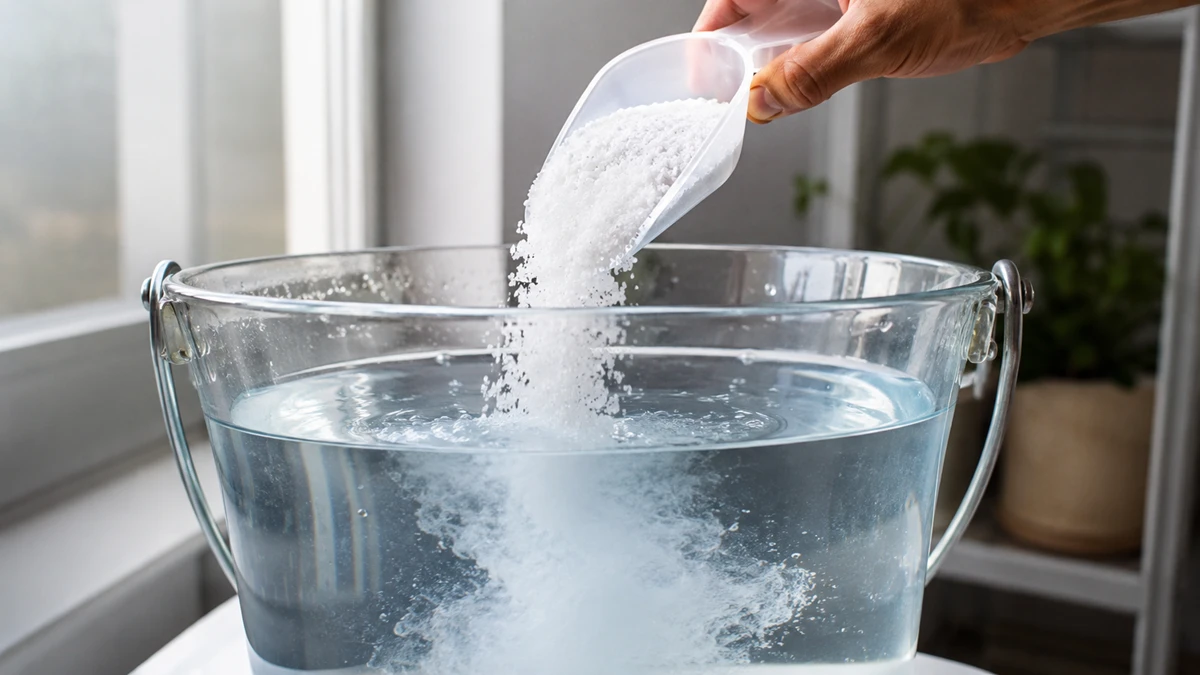
- Add salt to water, not water to salt. This one mistake causes most of the cloudy-water complaints I hear about.
- Mix with a powerhead or pump for 12-24 hours before use.
- Target specific gravity: 1.024–1.026 SG.
- Match the temperature of your tank before doing a water change.
What it should actually look like: properly mixed saltwater is clear, with no floating grit and no oily film on the surface. If you see either after a full 24-hour mix cycle, something’s off — either your salt is old, or your mixing time was too short.
Also worth checking: your water needs to be aerated during mixing, which is where a decent air pump earns its keep — it’s not just for freshwater tanks.
What Happens If You Get the Salt Wrong
Marine fish actively pump salt out through specialized gill cells called chloride cells — this is how they survive in water saltier than their own bloodstream. Get your specific gravity off by even 0.002-0.003, and you’re forcing that pump to work overtime. It’s not usually the brand of salt that stresses fish — it’s a sudden swing in salinity, which is exactly why switching brands abruptly (or eyeballing measurements instead of testing) causes more harm than picking the “wrong” salt in the first place.
If you dose salt directly into a running tank instead of pre-mixing it, you create a localized pocket of extremely high salinity before it fully dissolves — right where your fish are swimming. That’s a fast way to cause serious gill damage.
What I Got Wrong My First Time
My first saltwater mix, I added the water to the salt instead of the other way around. Rookie mistake, but nobody had actually told me why the order mattered — I just assumed it was a suggestion, not a rule.
What happened: clumping. The salt at the bottom of the bucket didn’t fully dissolve, even after stirring for what felt like forever. I tested specific gravity thinking I was ready, got an inconsistent reading, and nearly did a water change with unevenly mixed water — which would have hit different parts of my tank with different salinity.
I caught it because the water still had a faint cloudiness after 18 hours, which shouldn’t happen. I dumped it, started over, salt first this time, and it cleared in under 12 hours. Small mistake, but it taught me that in this hobby, the “obvious” steps are usually obvious for a chemistry reason you haven’t been told yet.
USA Buyer’s Note
Most guides on this topic are written from the UK or EU side of the hobby, where pricing, currency, and even bucket sizes are different. Here’s the US-specific reality:
- Petco and PetSmart both stock Instant Ocean and Reef Crystals in-store, usually at a slight markup compared to buying online in bulk.
- Bulk online buckets (20kg+) bring your per-gallon cost down significantly if you’re running a larger tank or doing frequent water changes — worth it if you’re past the “just testing the hobby” stage.
- Reef-specific salts (Red Sea Coral Pro, Tropic Marin) are less commonly stocked in physical US pet stores and are more reliably bought through specialty online retailers or Amazon.
- Price swings of 15-20% between retailers for the same box aren’t unusual — it’s worth comparing before you commit to a recurring purchase.
Troubleshooting Common Salt-Related Issues
Cloudy water after mixing: Usually means insufficient mix time or a temperature mismatch. Give it the full 24 hours and match tank temperature before use.
Residue at the bottom of your mixing bucket: Extend mixing time and use a proper powerhead, not just a spoon. Manually remove leftover residue rather than pouring it into the tank.
Algae bloom after a water change: Not usually the salt’s fault directly — check phosphate levels, since some tap water and lower-grade RO/DI setups let phosphates through.
Corals reacting badly to a water change: Do smaller, more frequent changes instead of one large one, and make sure your new mix’s parameters are close to your existing tank’s before adding it.
Inconsistent specific gravity readings: Calibrate your refractometer regularly. A swing-arm hydrometer can be off by 0.001–0.003 SG — enough to matter for sensitive SPS corals, less critical for a fish-only tank.
What the Science Says vs What Hobbyists Believe
Myth: All salt mixes are basically the same. Fact: fish-only and reef mixes are formulated with meaningfully different calcium and magnesium targets — using a basic mix in a coral tank will slowly starve your corals of what they need to grow.
Myth: Expensive salt is always better. Fact: if you’re running a fish-only tank, a premium reef salt is money spent on trace elements you’re not using.
Myth: You can switch salt brands anytime. Fact: frequent brand switching is one of the more common (and avoidable) causes of parameter swings that stress a tank — if you switch, do it gradually across a few water changes.
Myth: You don’t need to test water after mixing. Fact: always confirm specific gravity, temperature, and pH before it touches your tank — a “fine by eye” batch can still be off enough to matter.
FAQs — Best Salt for Saltwater Aquarium
What is the best salt for saltwater aquarium beginners?
Instant Ocean is the best salt for saltwater aquarium beginners because it’s stable, affordable, and forgiving of minor mixing errors. Reef Crystals is the next step up if you’re planning to add corals soon.
Is reef salt necessary for fish-only tanks?
No. Fish-only tanks do fine with standard marine salt mixes, and paying for reef-grade calcium and magnesium is money spent on elements your tank isn’t using.
Can you mix different brands of aquarium salt?
You can, but do it gradually across several water changes rather than switching all at once — sudden brand changes can shift your water parameters enough to stress fish and corals.
How long does mixed saltwater last before it goes bad?
Mixed saltwater keeps for about 1-2 weeks if it’s aerated and kept covered. After that, trace elements can start to degrade even if the water still looks fine.
What happens if you use the wrong salt mix?
Using a fish-only mix in a reef tank slowly starves your corals of calcium and magnesium, causing weak or bleached growth over weeks, not days.
Do saltwater salt mixes expire?
Yes. Check the packaging date and store salt in a dry, sealed container — humidity can clump and degrade the mix well before any printed expiration date.
Can I use aquarium salt from a freshwater fish store?
No. Freshwater aquarium salt is a completely different formulation and isn’t a substitute for marine salt mix — it lacks the calcium, magnesium, and trace elements marine life needs.
Why is my mixed saltwater cloudy?
Cloudiness usually means insufficient mixing time, a temperature mismatch, or old salt that’s absorbed moisture in storage. Give it the full 24-hour mix cycle before troubleshooting further.
How much does saltwater aquarium salt cost per gallon in the US?
Fish-only mixes like Instant Ocean run roughly $0.18-0.22 per gallon of mixed saltwater, while reef-grade mixes like Red Sea Coral Pro run closer to $0.30-0.45 per gallon depending on bucket size.
Final Word
Choosing the best salt for a saltwater aquarium comes down to one honest question: fish-only, or reef? Get that answer right, and Instant Ocean, Reef Crystals, Red Sea Coral Pro, or Tropic Marin Pro-Reef will all serve you well. Start simple, mix carefully, test before you trust it, and your tank will thank you.
Next Steps: Resources You Must Read
- New to saltwater entirely? Start with setting up a marine fish tank for beginners before you even buy salt.
- Cycling your tank? Don’t let ammonia spikes undo your water mixing work.
- Stocking soon? Learn to spot a healthy fish before you bring anything home.
Scientific references used in this update:
- ASTM International D1141 — Standard Practice for the Preparation of Substitute Ocean Water
- General marine chemistry: natural seawater Mg: Ca ratio (~3:1 to 3.5:1) and its role in coral aragonite (CaCO₃) skeletal formation
- Fish osmoregulation via branchial chloride cells (gill-based active salt excretion in marine teleosts)
Was this guide helpful?
First-Hand Experience
Based on animals I've personally kept and bred - not summarized from other articles.
Zoological Foundation
Claims are checked against my M.Sc. Zoology training and published aquatic biology research, not recycled aquarium myths.
No Paid Influence
No sponsorship shaped this guide. Affiliate links, if any, are disclosed separately and never hidden.
Kept Current
Errors are corrected as soon as they're found, with the update noted at the bottom of the article.

Anil Satak M.Sc. Zoology · Founder, FishioHub
Grew up in a fishing family in India and holds a Master's in Zoology. FishioHub is a one-person operation - every guide is personally researched, kept-tested, and written by Anil. No team, no outsourced writers, no AI-generated content. Read his full bio →