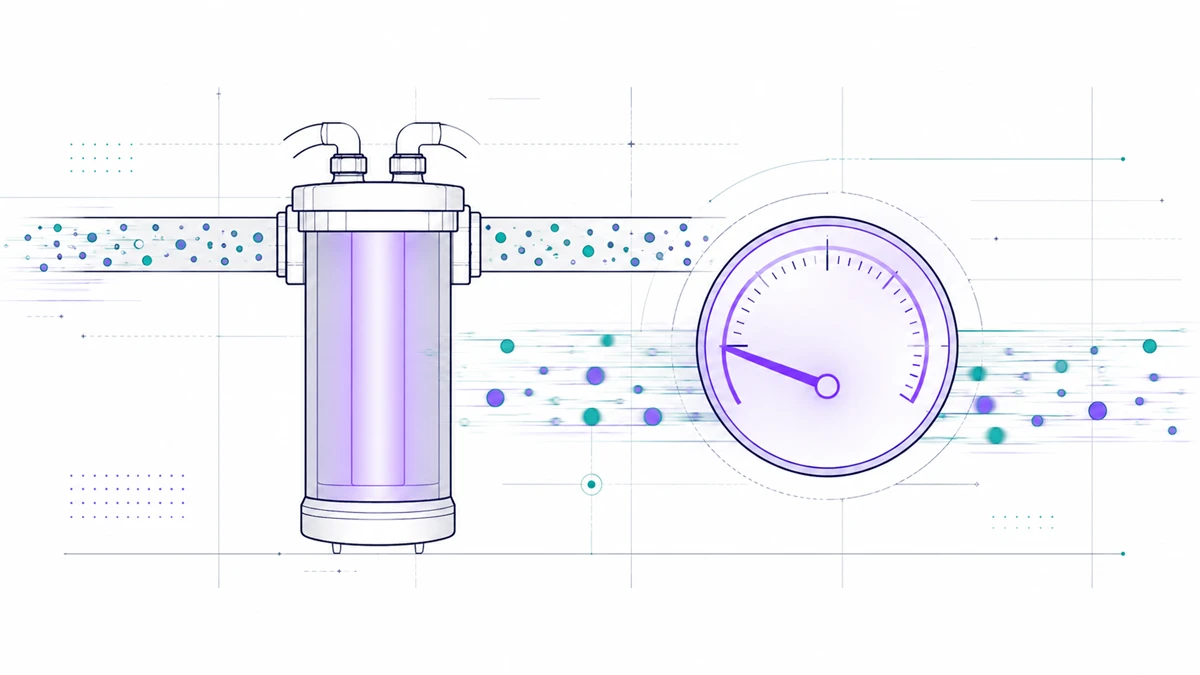
You bought a UV sterilizer because someone said it would help with algae, or Ich, or both. You plumbed it into your existing canister filter’s output, plugged it in, saw the little glow through the housing, and figured that was that. Here’s the uncomfortable part: your UV sterilizer flow rate — not just its wattage — is what actually determines whether it does anything. Run water through the chamber too fast, and even a strong lamp delivers a weak dose, and the light keeps glowing the entire time regardless.
Why UV Sterilizer Flow Rate Matters More Than Wattage
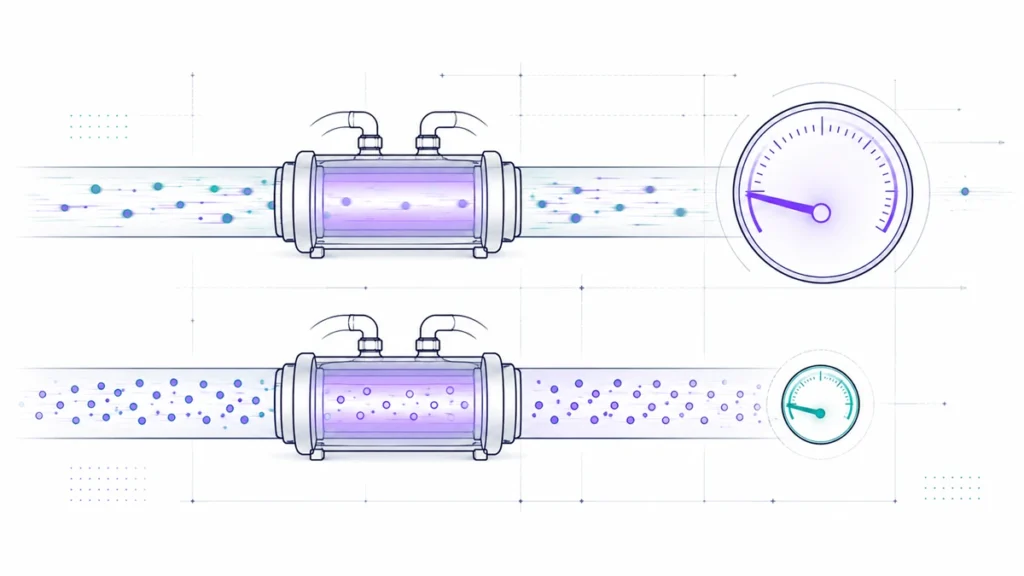
UV sterilizers kill pathogens with a specific wavelength of light (UV-C, around 254nm) — but only pathogens that spend enough time under that light actually absorb a lethal dose. Dose is a function of intensity and contact time together, not intensity alone. Push water through the chamber too fast, and even a strong lamp delivers a weak dose, because nothing stays under the light long enough to matter.
This is why “bigger wattage = better protection” is an incomplete way to think about it. A 25W lamp at a fast flow rate can deliver less real dose than a 15W lamp running slow. Flow rate is the variable most buying guides skip, and it’s the one that actually determines whether your unit does anything against a parasite outbreak versus just adding a faint blue glow to your equipment shelf.
The Dose Math, in Plain Terms
Manufacturers and hobbyist references generally agree on the shape of the relationship — slower flow, higher dose — even where they disagree on the exact numbers (more on that below). One commonly cited formula frames it around exposure time directly: flow rate in GPH relates to tank volume and desired exposure seconds, with roughly 15–30 seconds of exposure time commonly cited as a baseline for meaningful pathogen reduction. Translated to flow rate against wattage, a widely used hobbyist rule of thumb lands around 10–12 GPH per watt for parasite-level control — meaning a 25-watt lamp would need flow slowed to somewhere in the 250–300 GPH range specifically for parasite control, well below what the same lamp is often rated for “general clarity” use.
UV Sterilizer Flow Rate Chart, by Lamp Wattage
The gap between the two bars is the entire point. The same 15-watt lamp that comfortably handles up to 110 GPH for general clarity needs to slow down to roughly 30 GPH the moment the job is parasite control — a nearly 4x difference, driven entirely by how much dose the water needs to absorb before it’s actually lethal to something like Ich. This is the exact math the calculator above runs for your specific setup.
What Experts Actually Disagree On
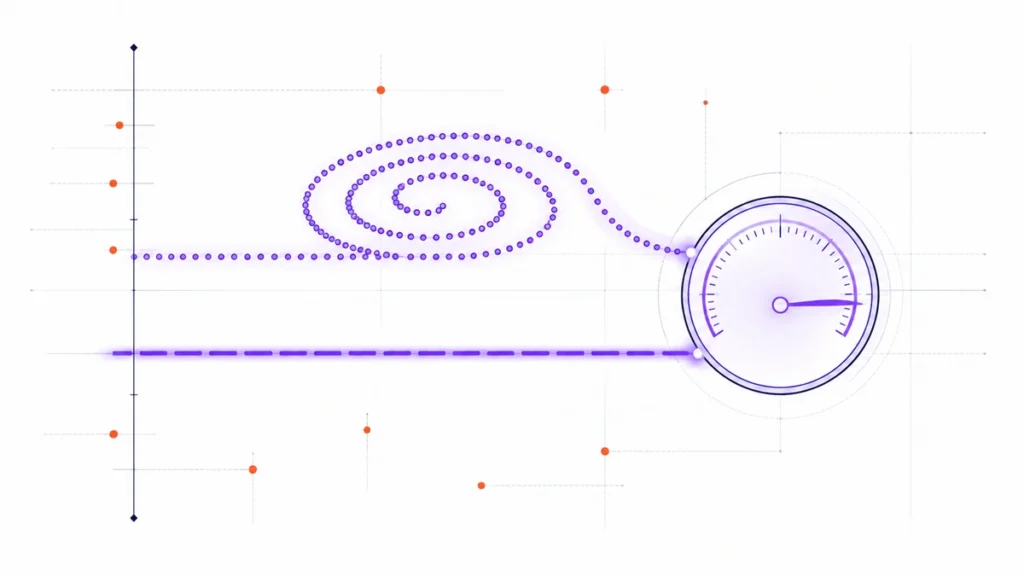
This is worth being upfront about because most articles on this topic present a single dose number as settled fact, and it isn’t. Cited effective doses for killing free-swimming Ich (Ichthyophthirius multifiliis) or its marine cousin Cryptocaryon irritans range enormously depending on the source — hobbyist forum threads citing industry figures put it anywhere from roughly 72,000 up to 280,000 microwatt-seconds per cm², with real disagreement even among experienced reefers about which number to trust.
There’s also a genuine scientific counterargument worth knowing, and it comes from a specific photobiology principle called the reciprocity rule. The basic idea: total UV exposure is what matters, not how it’s delivered.
A dozen quick passes through the sterilizer, each too brief to fully register on its own, could in theory add up to the same cumulative effect as one long, slow pass — since your tank’s water isn’t going through the UV unit once, it’s cycling through it dozens of times an hour, every hour, all day. Applied here, that logic pushes back hard against the “slow the flow way down” advice you’ll read everywhere else. It hasn’t been settled definitively in the hobby either way.
On the exposure-time side, one practical formula worth knowing: flow rate in GPH works out to your tank’s volume divided by however many seconds you want the water exposed, times 60. Aim for roughly 15–30 seconds of exposure per pass as a starting baseline for meaningful pathogen reduction — below that window, you’re increasingly just running a very expensive nightlight.
What this means practically: treat any specific dose number, including the ones in the calculator below, as a working estimate for a single pass through the unit — not a guaranteed kill threshold. Slower flow is very unlikely to hurt, at a minimum.
Check Your Setup- UV Sterilizer Dose Calculator
Try it yourself
The UV Sterilizer Dose Calculator
Enter your lamp’s wattage and your real flow rate — find out if your setup is actually delivering a dose, or just running an expensive nightlight.
Open the Calculator →This calculator does the actual UV sterilizer flow rate math for you. Enter your lamp’s actual wattage and your real flow rate (not the sterilizer’s maximum spec — the flow your pump is actually pushing through it), pick what you’re trying to control, and get a straight verdict instead of guessing from the glow through the housing.
What This Doesn’t Cover
An Ultraviolet sterilizer only affects free-floating pathogens in the water column. It cannot reach:
- Parasites already embedded under a fish’s skin
- Encysted parasites on your substrate or decor
- Anything in your biological or mechanical filter media
If you’re dealing with an active Ich outbreak right now, a UV sterilizer is a supporting layer, not the treatment itself — pair it with the full heat, salt, and quarantine protocol. And if you’ve seen a UV sterilizer marketed as a standalone “cure” for parasite outbreaks: that’s overselling what the technology can physically do, not a product you’re using wrong.
FAQ
Does a bigger wattage UV sterilizer always mean better protection?
Not on its own. A stronger lamp pushed at too fast a flow rate can deliver a weaker actual dose than a smaller lamp running slow, since dose depends on both intensity and how long the water stays under the light.
What UV sterilizer flow rate do I need for Ich specifically?
Estimates vary by source, but a commonly cited hobbyist rule is roughly 10–12 GPH per watt of UV for parasite-level control — meaningfully slower than the flow rate most units are rated for at “general clarity” settings.
Is there scientific disagreement about UV dose for parasites?
Yes, genuinely. Cited effective doses for killing free-swimming Ich range from roughly 72,000 to 280,000+ microwatt-seconds per cm² depending on the source, and some researchers argue that total cumulative dose across many fast passes may matter more than single-pass dose. Treat published numbers as estimates, not settled fact.
Can I tell if my UV water sterilizer is working just by looking at the glow?
No. A visibly lit bulb tells you the lamp is receiving power — it says nothing about UV-C output, which degrades over the bulb’s life, or about whether your flow rate is fast enough to waste that output entirely.
Will a UV sterilizer cure an Ich outbreak by itself?
No. It only affects the free-swimming stage of the parasite in open water — it can’t reach parasites already attached to a fish or encysted on the substrate. Use it alongside a full treatment protocol, not as a replacement for one.
What Next to Read
Resources from FishioHub:
- How to Treat Ich in Fish Naturally — the full heat, salt, and quarantine protocol UV should support, not replace.
- Aquarium Bioload 101 — for readers whose real issue is filtration capacity, not UV dose specifically.
- Most Common Aquarium Problems and Solutions — broader troubleshooting if UV and Ich treatment aren’t the actual root cause.
Scientific resources:
- LiveAquaria. UV Sterilization Selection Guide
(Retailer-published sizing guide with concrete wattage-to-flow-rate figures; source for the “flow rate should not exceed tank gallons” baseline referenced above.) - Aquarium Science. 14.1.1. UV in Depth.
(The specific source for the reciprocity-rule counterargument — a genuinely dissenting, more skeptical technical take worth reading in full if this section interested you.)
Was this guide helpful?
First-Hand Experience
Based on animals I've personally kept and bred - not summarized from other articles.
Zoological Foundation
Claims are checked against my M.Sc. Zoology training and published aquatic biology research, not recycled aquarium myths.
No Paid Influence
No sponsorship shaped this guide. Affiliate links, if any, are disclosed separately and never hidden.
Kept Current
Errors are corrected as soon as they're found, with the update noted at the bottom of the article.
Anil Satak M.Sc. Zoology · Founder, FishioHub
Grew up in a fishing family in India and holds a Master's in Zoology. FishioHub is a one-person operation - every guide is personally researched, kept-tested, and written by Anil. No team, no outsourced writers, no AI-generated content. Read his full bio →