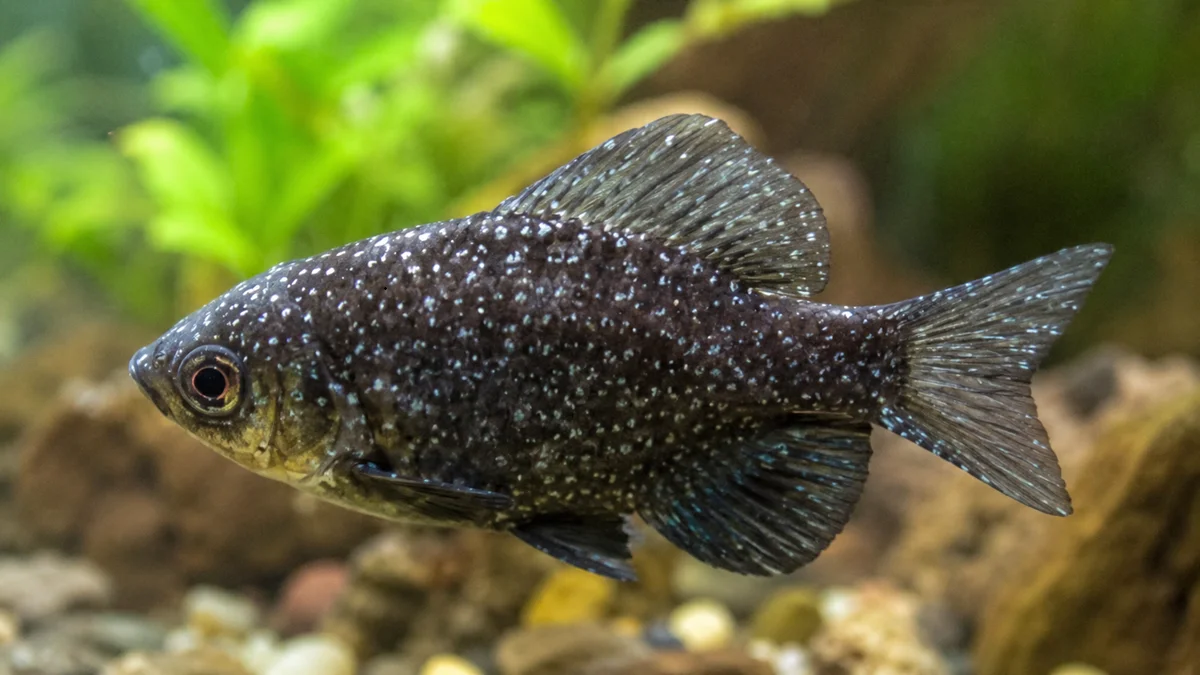
The first time I saw white spots on a fish, I almost missed it. That’s the thing about Ichthyophthirius multifiliis — the parasite behind ich — most of its life cycle happens completely out of sight, buried under the fish’s skin or hiding in your substrate. What you see on the fish is only the visible tip of an infection that’s already well underway, which is why learning how to treat ich in fish naturally at this early stage is absolutely critical.
Here’s the myth I want to clear up first: ich is not “just a cold” that fish shake off on their own. It absolutely can kill a tank, and fast, if you wait for spots to multiply before acting.
Quick answer: To treat ich in fish naturally, raise the water temperature gradually to 82–86°F (28–30°C), add aquarium salt at 1 tablespoon per 5 gallons, increase aeration, and perform daily 20–30% water changes with gravel vacuuming for 10–14 days. Quarantine affected fish immediately to stop it from spreading to the rest of the tank.
What Is Ich in Fish, Really?
What is ich in fish? It’s a parasitic infection caused by a single-celled ciliate called Ichthyophthirius multifiliis — hobbyists just call it “ich” or “white spot disease.” It shows up as small white dots that look like grains of salt scattered across the body, fins, and gills.
Here’s what most care sheets skip: ich isn’t one continuous parasite sitting on your fish. It moves through three distinct life stages, and that’s exactly why treating it takes more than a single dose of anything.
- Trophont — embedded under the fish’s skin, feeding. This is the visible white spot, and it’s protected from any treatment while it’s there.
- Tomont — drops off the fish onto your substrate, encysts, and divides into hundreds of new parasites.
- Theront — free-swimming and actively hunting for a new fish to infect. This is the only stage vulnerable to treatment.
That last point matters more than anything else on this page. Every treatment — heat, salt, medication — works by killing theronts in the water column. None of it touches the trophont stage hiding under your fish’s skin. That’s why you can’t just treat once and call it done.
Symptoms to Watch For
- Small white dots resembling grains of salt
- Fish rubbing or scratching against decor (“flashing”)
- Rapid or labored breathing
- Clamped fins
- Lethargy and appetite loss
What Causes Ich (and Why It Shows Up Out of Nowhere)
Here’s an uncomfortable truth: low levels of ich are present in most established tanks already. It doesn’t need to be introduced — it needs an opening. Something stresses the fish’s immune system, and the parasite population explodes.
The usual triggers:
- Sudden temperature swings — a cold draft, a heater failure, an unheated water change
- New fish added without quarantine — the single most common cause of a serious outbreak
- Poor water quality — elevated ammonia or nitrite weakens immune function
- Overcrowding and stress — more fish competing for the same oxygen and territory
- Dirty filters — organic buildup gives the free-swimming stage more places to hide
How to Treat Ich in Fish Naturally, Step by Step
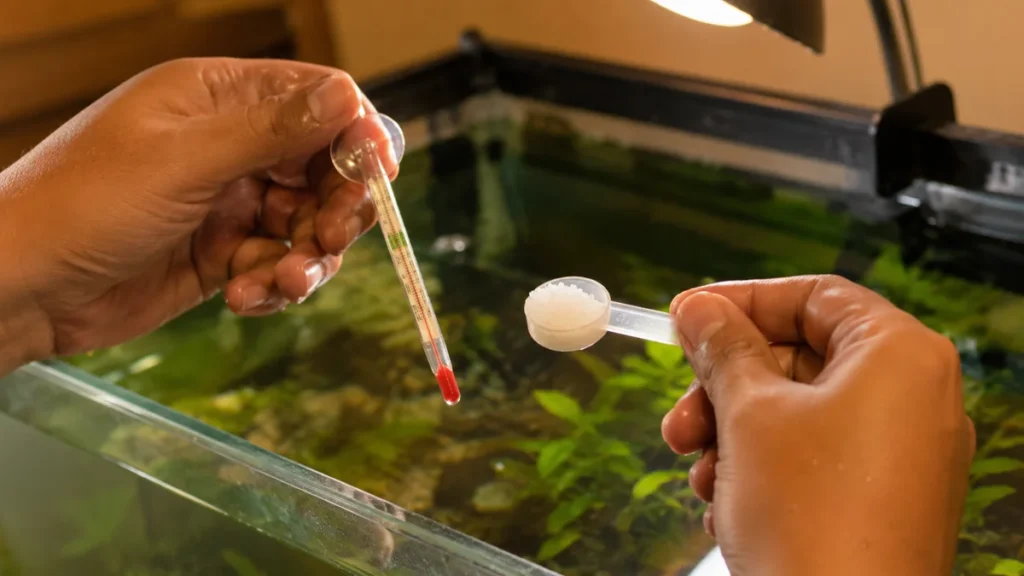
If you catch it early — a handful of spots, fish still eating — natural treatment works well. Here’s exactly how I’d do it.
1. Raise the Temperature (Your Most Effective Tool)
This is the single biggest lever you have, because it directly shortens the parasite’s life cycle. Research on Ichthyophthirius multifiliis documented by the Southern Regional Aquaculture Center shows the full life cycle can run anywhere from about 4 days in warm water to nearly a month in cold water — the temperature you keep is doing real work here.
How to do it:
- Raise temperature gradually to 82–86°F (28–30°C)
- Increase no faster than 1–2°F per day — a sudden jump stresses fish further
- Maintain for 10–14 days, not just until spots disappear
Safe for: most tropical freshwater fish
Not safe for: goldfish, coldwater species, some shrimp — check your species’ tolerance first
2. Add Aquarium Salt
Salt disrupts the parasite’s ability to regulate water balance in its free-swimming stage.
Dosage:
- 1 tablespoon per 5 gallons for a mild dose
- 1 tablespoon per 3 gallons for a stronger dose in serious cases
Never use salt with: snails, shrimp, or salt-sensitive fish like most catfish, loaches, and many tetras. If your tank has any of these, treat in a separate quarantine tank instead of the display tank.
3. Increase Aeration
Warmer water holds less dissolved oxygen, right when your fish need more of it to cope with infection stress. Add an air stone or increase your filter’s surface agitation for the full treatment period — this one step gets skipped more than any other.
4. Daily Water Changes and Gravel Vacuuming
Change 20–30% of the water daily, vacuuming the substrate each time. The tomont stage sinks and encysts in gravel — this is the step that physically removes parasites before they can release theronts back into the water.
5. Support Recovery With Diet
Garlic-soaked food and Indian almond leaves (1 leaf per 10–15 liters) won’t cure ich on their own, but they support immune function and gill health during recovery. Treat them as support, not primary treatment.
6. Quarantine Immediately
Move visibly infected fish to a separate hospital tank with matched, aged water, a heater, and aeration. This does two things: it stops healthy fish from being exposed, and it lets you treat at a stronger dose than you’d risk in a display tank with plants or invertebrates.
Medicine for Ich in Fish: When Natural Isn’t Enough
If natural methods haven’t shown improvement after 3–4 days, or if the outbreak is spreading fast across multiple fish, it’s time for medicine for ich in fish.
- Malachite green + formalin — the hospital-grade standard, highly effective
- Copper-based medication — the go-to for marine/saltwater tanks specifically
- Methylene blue — gentler, good for mild cases and quarantine tanks
- API Super Ick Cure / Seachem ParaGuard — accessible, beginner-friendly options widely available at PetSmart and Petco in the US
Before dosing anything, remove activated carbon from your filter. It will strip the medication out of the water before it can work.
How to Treat Ich in a Fish Tank by Water Type
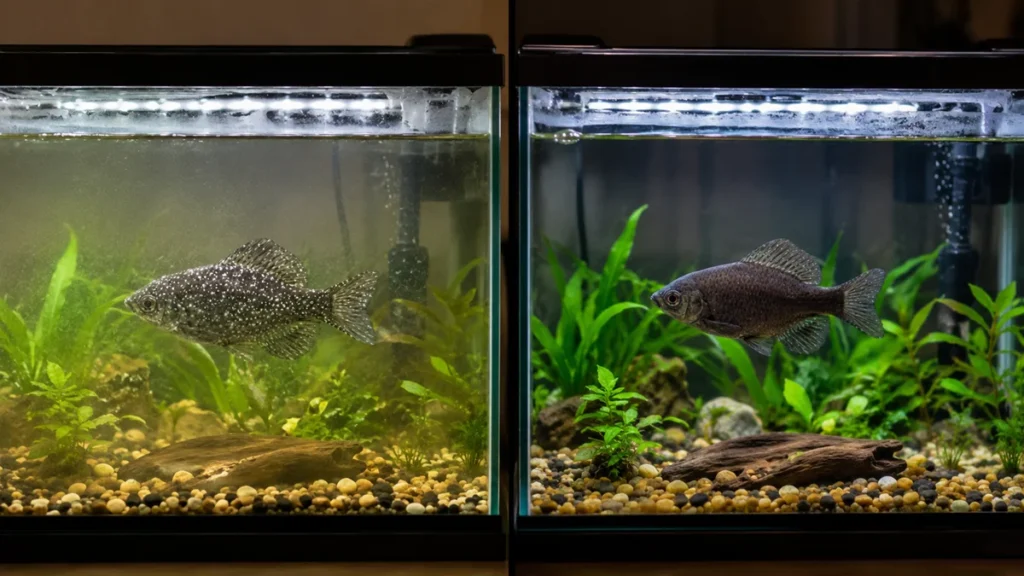
The core mechanism is the same everywhere, but a few details change by system.
Freshwater tanks: heat + salt + medication if needed. The most forgiving system to treat in.
Saltwater/marine tanks: the parasite here is technically Cryptocaryon irritans, a different species with the same “white spot” presentation. Do not raise temperature in a reef tank — it’s unsafe for corals. Copper medication or a brief 3–4 minute freshwater dip are the standard approaches instead.
Pond fish (koi, goldfish): raise temperature only as far as your species tolerates — goldfish and koi can’t handle the 82–86°F range safely. Use pond-safe medication, improve aeration, and do partial water changes instead of pushing heat.
What the Science Says vs What Hobbyists Believe
Myth: “If I don’t see spots anymore, the ich is gone.”
Reality: According to the Southern Regional Aquaculture Center’s Ich publication, the visible trophont stage is only one part of a life cycle that continues in your substrate even after spots disappear from the fish. Stopping treatment the moment spots vanish is one of the most common reasons ich comes back within a week. Continue treatment 3–4 days past the last visible spot, minimum.
Myth: “Salt cures ich permanently.”
Reality: Salt kills the free-swimming theront stage effectively, but it does nothing to prevent a future outbreak once conditions favor the parasite again. Quarantine discipline and stable water quality matter more long-term than any single treatment.
What I Got Wrong the First Time I Treated Ich
About four years ago, I noticed some small white spots on my Neon Tetra fish, but didn’t pay much attention to them for several days. Due to this delay, the parasite rapidly took over the tank’s filtration system. In a panic, I tried administering medication at the last minute, but it was unsuccessful because the fish had already become too weak.
USA Buyer’s Note: Where to Get Treatment Fast
If you’re in the US and need treatment today rather than waiting on a shipment:
- PetSmart and Petco both carry API Super Ick Cure and Seachem ParaGuard in-store
- Amazon is faster for aquarium salt (Instant Ocean or API brand) and Indian almond leaves if your local store is out
- Local fish stores are often your best bet for copper-based marine medication, since it needs more careful dosing guidance than the boxed freshwater treatments
One US-specific water note: if your tap water runs on the harder side (common in much of the Midwest and Southwest), salt dosing calculations don’t need adjustment for hardness — but do make sure your dechlorinator is doing its job before adding fish back to treated water.
Your First Week Treatment Checklist
- Day 0: Identify white spots, move affected fish to quarantine, test water parameters
- Day 0–1: Begin gradual temperature increase, add aeration, add salt if species-safe
- Day 1–7: Daily 20–30% water changes, vacuum substrate, monitor closely for new spots
- Day 3–7: If no improvement or new fish show symptoms, start medicated treatment
- Day 10–14: Continue full treatment through several parasite life cycles before declaring the tank clear
FAQs on How to Treat Ich in Fish Naturally
How to treat ich in fish naturally without medication?
Raise water temperature gradually to 82–86°F, add aquarium salt at the correct dose for your species, increase aeration, and do daily water changes with gravel vacuuming. This combination works well for mild, early-stage infections caught within the first day or two.
How often should I do water changes while treating ich?
Change 20–30% of the water daily during active treatment, vacuuming the substrate each time to remove the tomont stage before it can release new parasites. Skipping days lets the parasite population rebuild between water changes.
Is it safe to treat ich in a tank with shrimp or snails?
Not with salt or copper-based medication — both are toxic to most invertebrates. Move fish to a separate quarantine tank for treatment, or use methylene blue, which is gentler on shrimp and snails than salt or copper.
What’s the biggest mistake people make treating ich?
Stopping treatment as soon as visible spots disappear. The parasite’s life cycle continues in the substrate for days after the fish looks clear, so treatment needs to run 3–4 days past the last spot you see.
Where can I buy ich medicine in the US quickly?
PetSmart and Petco both stock API Super Ick Cure and Seachem ParaGuard in most locations, while Amazon is typically faster for aquarium salt and Indian almond leaves if a local store is out of stock.
Does aquarium salt cure ich permanently?
No. Salt kills the parasite’s free-swimming stage effectively during an active outbreak, but it doesn’t prevent future outbreaks. Long-term prevention depends on quarantining new fish and maintaining stable water quality.
How to treat ich in fish naturally if I have goldfish?
Avoid the 82–86°F heat range used for tropical fish, since goldfish tolerate cooler water better. Focus on aquarium salt, aeration, and daily water changes instead, and use pond-safe medication if the infection worsens.
Can ich come back after treatment is finished?
Yes, if treatment is stopped too early or a new fish is introduced without quarantine. Continue treatment for the full recommended period and quarantine every new arrival for 2–4 weeks going forward.
Bottom Line
Ich is treatable — genuinely, reliably treatable — but only if you respect its life cycle instead of just its symptoms. Heat, salt, aeration, and water changes work because they target the parasite’s vulnerable free-swimming stage, not because they magically make white spots disappear. Treat the full cycle, not just what you can see, and don’t stop the day the spots go away. That’s the difference between curing ich and just postponing it.
Scientific References
- Durborow, R.M., Mitchell, A.J., & Crosby, M.D. Southern Regional Aquaculture Center (SRAC) Publication No. 476, Ich (White Spot Disease).
Next Steps: Resources You Should Read
- Fix the root cause, not just the symptom — How to Remove Ammonia From a Fish Tank Naturally covers the water quality issues that let ich take hold.
- Learn to recognize stress early — Why Is My Fish Breathing Fast? explains the respiratory signs that often show up before visible white spots.
- Protect salt-sensitive species during recovery — Corydoras Catfish Food has feeding guidance for species that can’t be treated with salt in the display tank.
Was this guide helpful?
First-Hand Experience
Based on animals I've personally kept and bred - not summarized from other articles.
Zoological Foundation
Claims are checked against my M.Sc. Zoology training and published aquatic biology research, not recycled aquarium myths.
No Paid Influence
No sponsorship shaped this guide. Affiliate links, if any, are disclosed separately and never hidden.
Kept Current
Errors are corrected as soon as they're found, with the update noted at the bottom of the article.
Anil Satak M.Sc. Zoology · Founder, FishioHub
Grew up in a fishing family in India and holds a Master's in Zoology. FishioHub is a one-person operation - every guide is personally researched, kept-tested, and written by Anil. No team, no outsourced writers, no AI-generated content. Read his full bio →