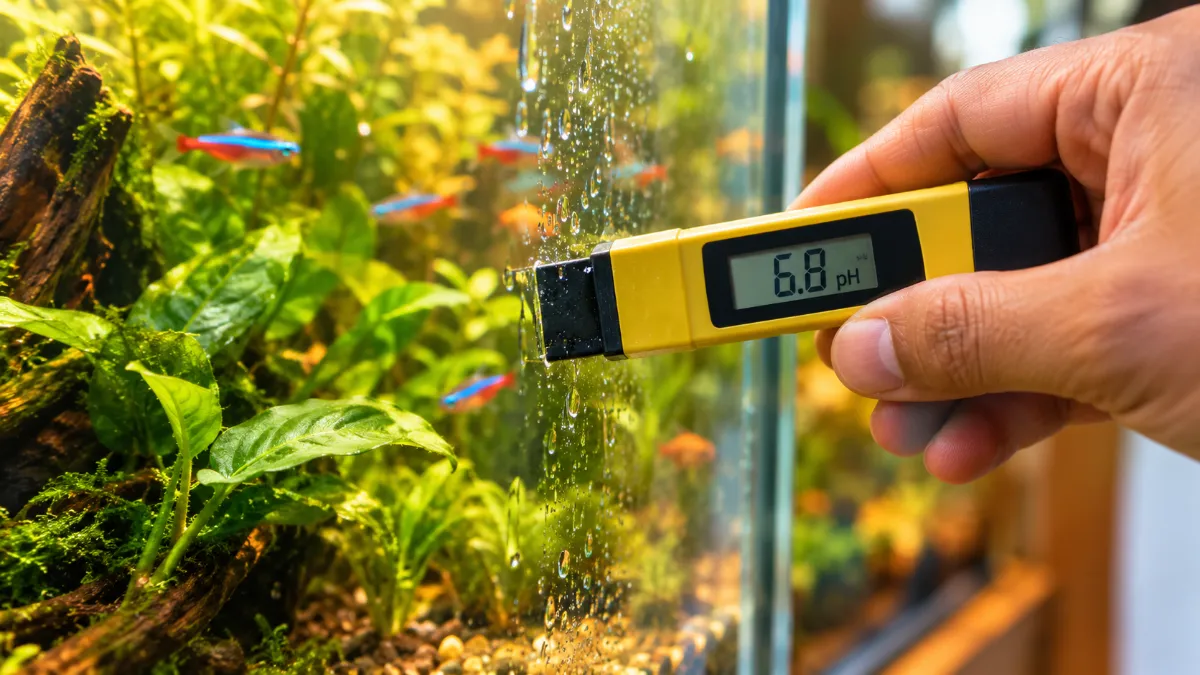
Test strip gone that dull yellow-green on you? Here’s how to raise pH in an aquarium without freaking your fish out: go slow, fix your KH first, and never move more than 0.2–0.3 in a day. Baking soda, crushed coral, or a bottle of API pH Up will all get you there.
If you just typed “how to raise pH aquarium” or “raise aquarium pH” into Google, you’re in the right place — same fix, just different words for it.
I have encountered both high and low pH issues in my aquarium on separate occasions. I once panicked when the pH level in my 20-gallon community tank dropped and stalled at 6.0 due to excessive tannin leaching from a new piece of driftwood. My Neon Tetras were behaving strangely, but instead of immediately resorting to chemicals, I placed a cup of crushed coral into the filter.
It took four days to safely bring the pH level back up to 7.0 through gradual, and steady buffering, without losing a single fish.
If You Only Remember 3 Things
- Slow beats fast. Fish handle a stable “wrong” pH way better than a quick jump toward the “right” one.
- Fix the cause, not the number. Low pH almost always means low KH. Raise the number without raising KH, and it just falls again.
- Match the method to your fish. Baking soda and crushed coral suit most tanks. Save chemical increasers for breeding setups or fussy species.
That’s the short version of how to raise pH in aquarium water. Now let’s get into it properly.
Test Your KH First (Takes Two Minutes)
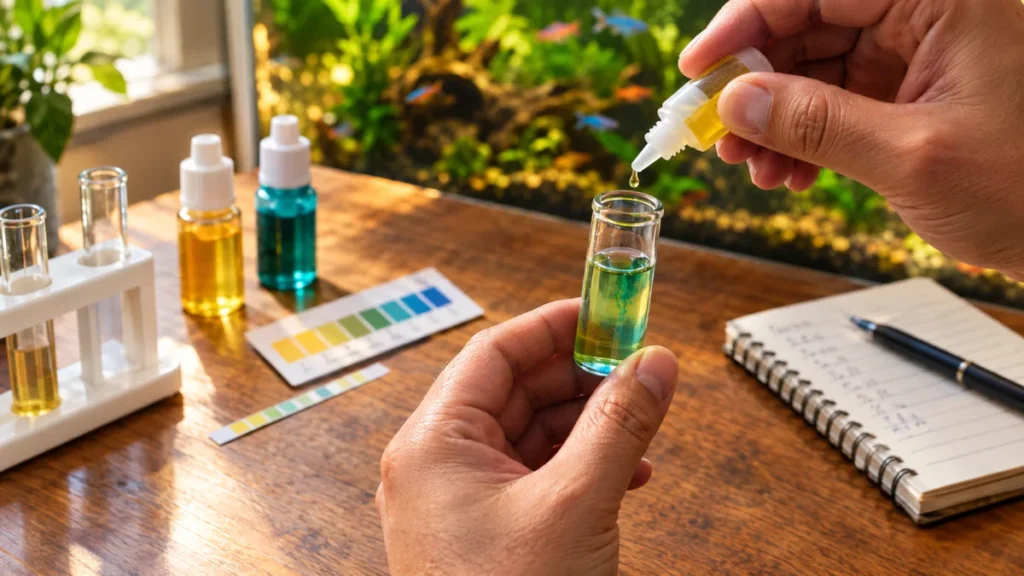
Before you add anything, test your KH along with your pH. Most people skip this step, and it’s the one that decides whether your fix actually holds.
If your KH reads zero, your pH has nothing holding it up. It’ll drift right back down no matter what you add. A cheap KH test kit costs about the same as one bottle of pH increaser, so it’s worth having both.
How to Raise pH in an Aquarium the Safe Way
So how to raise pH levels in an aquarium for good, not just for a day? Raise the KH right alongside the pH, not after it.
Here’s the order I’d use. Start with a bigger water change if your tap water runs higher pH than your tank — that alone fixes a lot of cases. Still low? Add a buffering substrate. Still need more? Dose baking soda or a pH increaser in small steps.
How to Raise pH in an Aquarium Naturally
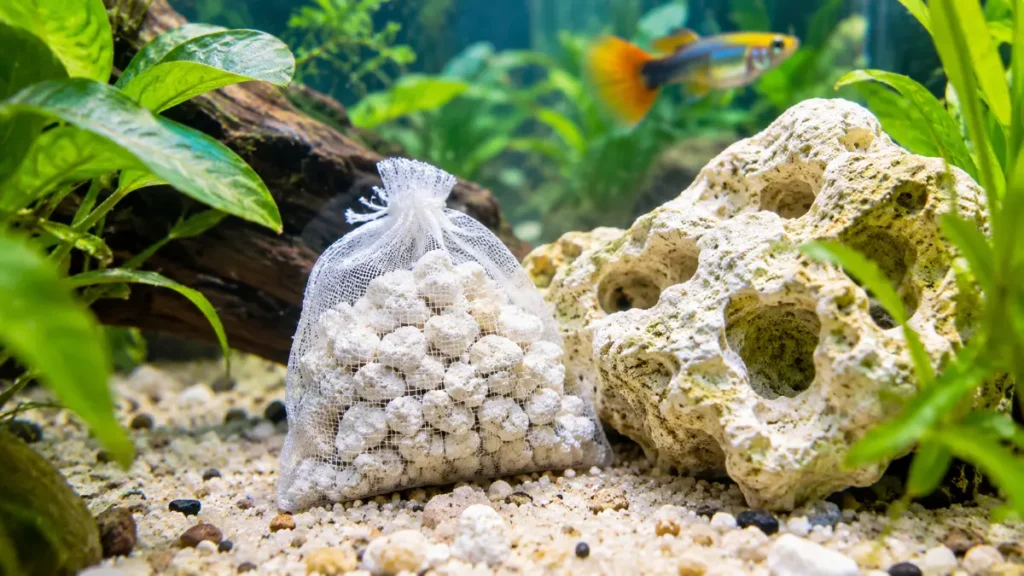
Want to know how to raise pH in an aquarium naturally, with no bottles involved? Add minerals that dissolve slowly and hold the number up on their own.
- Crushed coral or aragonite — in the substrate, or bagged in your filter. It dissolves faster when pH drops and slower once things settle, so it kind of looks after itself.
- Limestone or holey rock — same idea, just slower. Good for bigger tanks.
- Your tap water itself — if it’s already alkaline, use more of it at water changes instead of RO water.
This is how to raise pH in fish tank naturally for cichlids, livebearers, and goldfish — fish that want hard, alkaline water long-term, not a one-time nudge.
How to Increase pH in Fish Tank Levels Fast (Baking Soda Method)
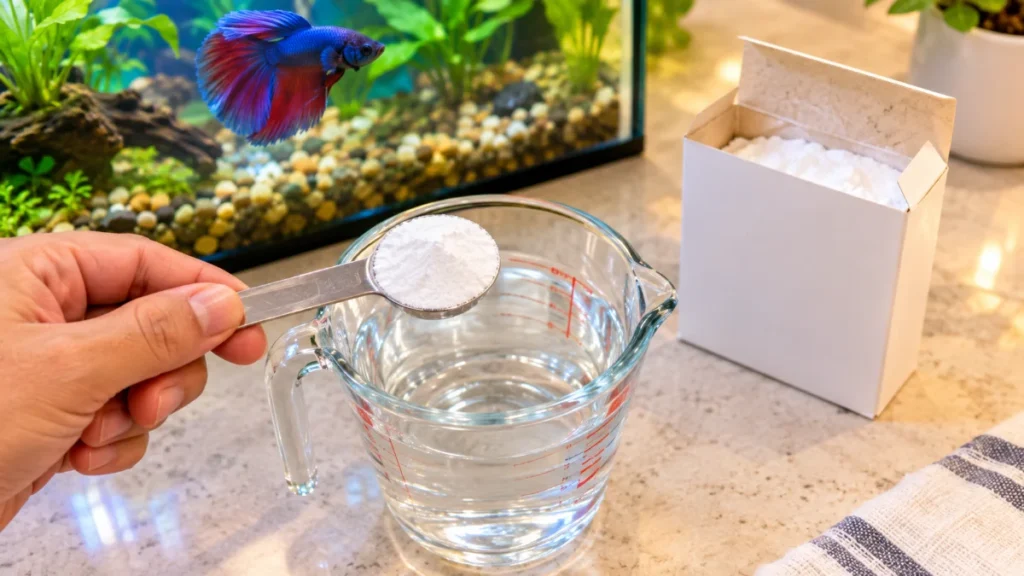
Need to know how to increase pH in fish tank levels quickly? Baking soda is your fastest safe option. It raises pH and KH at the same time, so the new number tends to stick.
So, how much baking soda to raise pH in aquarium water? Start with 1 teaspoon per 5 gallons, dissolved in a cup of tank water first. Add it slowly, then test a few hours later — don’t add more until the next day.
Same goes for baking soda for fish tank betta fish, with one catch. Bettas like it slightly acidic to neutral, around 6.5–7.5. Only raise it if you’re testing well below that range.
Using API pH Up and Aquarium pH Increasers
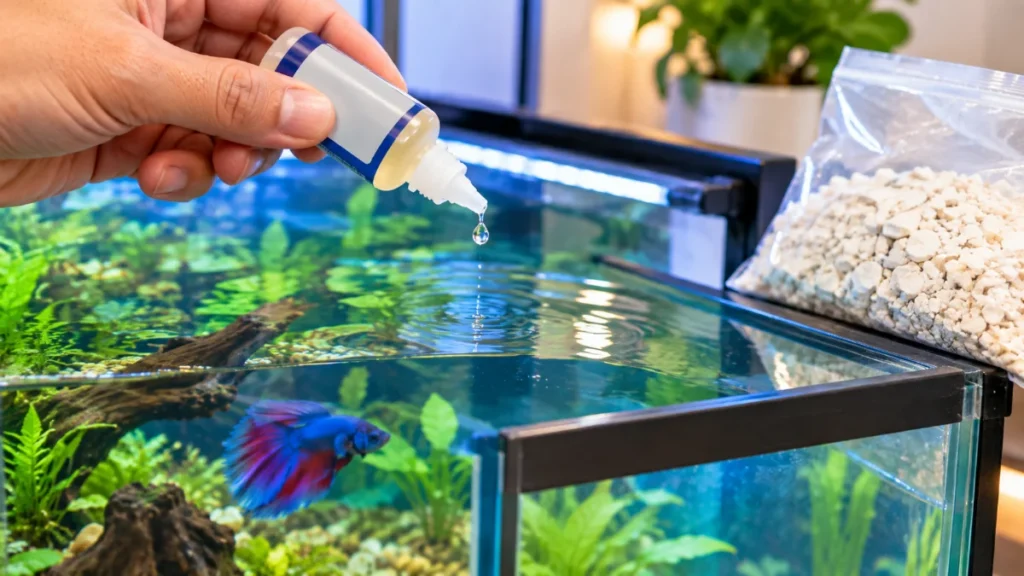
API pH Up is the best-known aquarium pH increaser on the shelf, and it’s precise. Good for breeding tanks or fish with a narrow comfort zone.
The catch: without a KH buffer backing it up, the pH it raises can drift back down in a few days. If you want a pH increaser for fish tank use that actually holds, pair it with crushed coral or a KH buffer.
How to Increase pH in Aquarium Quickly (Without Crashing It)
“Quickly” and “safely” pull in opposite directions. But if you genuinely need to know how to increase pH in aquarium quickly, here’s the safest fast combo.
Do a same-day water change using harder source water first. Test a few hours later, then follow up with a small, measured baking soda dose. You’ll get most of the way there in one day, no giant single dose needed.
Can You Raise pH Without Raising Alkalinity?
People ask how to raise pH without raising alkalinity a lot, hoping for a shortcut. Short answer: not really, in freshwater.
pH and KH are tied together. A pH increase that actually lasts needs more buffering behind it, and that buffering is alkalinity — there’s no way around it.
Peat Moss for Aquarium pH: Does It Work?
Quick myth-bust: peat moss for aquarium pH doesn’t raise it. It lowers it, by releasing tannins into the water.
It’s the classic tool for softening water for discus or blackwater bettas — the opposite of what you want here. If your pH is already low and you toss in peat moss thinking it’ll help, you’ll just make it worse.
A Quick Comparison
Here’s how the main ways to raise pH in an aquarium stack up against each other.
| Method | Speed | Raises KH too? | Best for |
| Water change (harder source water) | Slow, gradual | Yes | Ongoing low pH from soft tap water |
| Crushed coral / aragonite | Slow, self-adjusting | Yes | Cichlids, livebearers, goldfish long-term |
| Baking soda | Fast (hours) | Yes | Emergency fixes, cheap and easy |
| API pH Up / liquid increasers | Fast (hours) | Not alone | Precise targets, breeding tanks |
| Aeration / surface agitation | Slow, mild | No | Small daily swings from CO2 buildup |
Why the Number Isn’t the Whole Story
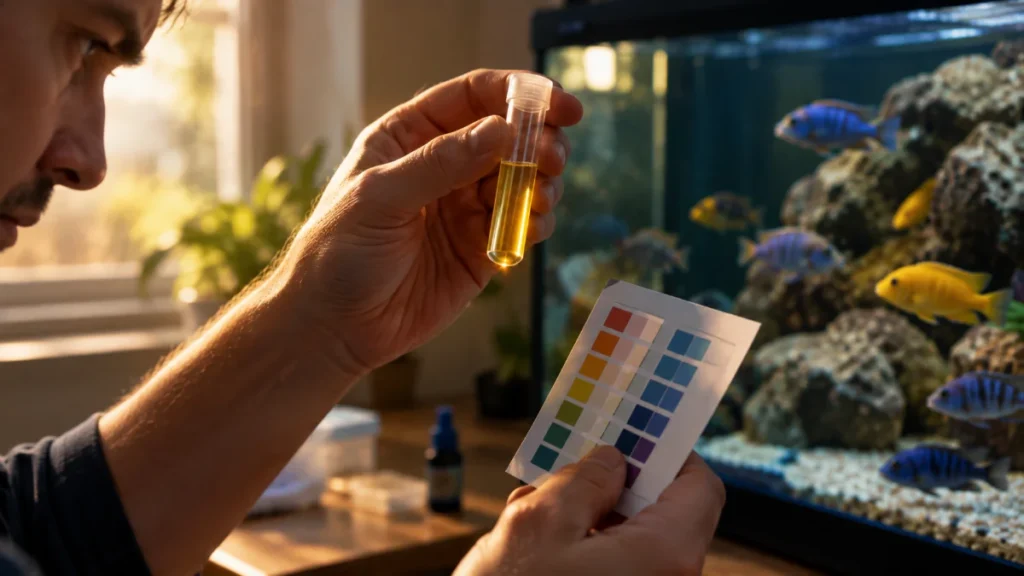
Here’s why you shouldn’t chase pH just for the sake of a number. Un-ionized ammonia — the form that actually hurts fish — gets more dangerous as pH climbs.
At pH 7.0, most of your ammonia reading is harmless. By pH 8.2, the same total ammonia reading can carry over ten times more of the toxic kind (Kentucky State University / Mississippi Cooperative Extension Service, SRAC Publication No. 463.
That’s exactly why you never rush pH up in a tank that isn’t fully cycled. A small ammonia reading can turn dangerous overnight.
Aeration plays a small part too. More surface movement pushes dissolved CO2 out of the water faster, and less CO2 means a slightly higher pH (University of Florida IFAS Cooperative Extension Service, “The Role of Aeration in Pond Management,” FA6.It won’t fix a real problem alone, but it explains why pH creeps up a bit after you add a bubbler.
If you’re aiming for hard water for cichlids with crushed coral, it helps to know your starting point. The U.S. Geological Survey calls water under 60 mg/L soft, 61–120 mg/L moderately hard, 121–180 mg/L hard, and above 180 mg/L very hard. Most U.S. tap water needs a boost to reach the 150–250+ mg/L that Rift Lake cichlids actually want.
I learned this the hard way while setting up a new tank for African cichlids. My tap water was slightly hard, but I wanted to get the parameters just right, so I impulsively added baking soda to raise the pH.
I completely overlooked the fact that my KH level was very low—meaning the water had zero buffering capacity. The pH shot up above 8.4, but because the water was unstable, it plummeted to 6.2 by the next morning.
That fluctuation taught me that trying to hit a target number without first addressing the water’s basic chemistry is just asking for trouble.
How Often to Test After You Raise It
Test daily for the first week after any pH change, then back off to once a week once it’s holding steady. If it keeps sliding back down after a week, your KH is still too low — go back and raise that first.
FAQ
How to raise pH in an aquarium without hurting my fish?
Go slow. Keep changes under about 0.2–0.3 per day, and always fix your KH alongside the pH.
How long does baking soda take to raise pH in an aquarium?
A few hours to start working, up to 24 hours to fully settle. Always re-test before adding more.
Is it safe to raise pH with fish already in the tank?
Yes, as long as you’re slow about it. The danger is speed, not the fix itself.
Will a water change raise or lower pH?
Depends on your tap water. Harder or more alkaline tap water raises it; softer tap water lowers it.
Does driftwood lower pH permanently?
It lowers pH a little through tannins, but usually not enough on its own. Low KH is the more likely culprit.
Can I mix baking soda and API pH Up?
You can, but there’s no real need. Pick one, dose it, test it, and only add the second if you’re still short after 24 hours.
Why does my pH keep dropping back down after I raise it?
Almost always low KH. Nothing’s holding the new number in place, so it slides right back — this is the #1 mistake people make trying to raise pH in an aquarium.
What pH should a freshwater community tank be?
Most community fish — tetras, guppies, corydoras — do fine around 6.8–7.5. Check your specific species first.
Next Steps: Resources You Should Read
Related FishioHub reading
- What Causes pH Problems in a Fish Tank — pairs directly with this post; read this if you want to know why your pH is off before you raise it.
- How to Lower pH in a Freshwater Aquarium Safely — the other half of your pH cluster, for anyone whose pH is too high instead.
- How to Remove Ammonia From a Fish Tank Naturally — ties into the ammonia-toxicity section above; useful if raising pH exposed an ammonia problem.
Scientific references
- Durborow, R.M., Crosby, D.M., & Brunson, M.W. Ammonia in Fish Ponds. SRAC Publication No. 463, Kentucky State University Cooperative Extension Program / Mississippi Cooperative Extension Service, 1997.
- McGee, M. & Cichra, C. The Role of Aeration in Pond Management. FA6, University of Florida IFAS Cooperative Extension Service.
USA aquarium resources
- You can Visit American Cichlid Association — species water chemistry guides
- Livebearer Association of America
- Your local fish store’s test counter — most U.S. chains test KH/GH free if you bring a sample
Closing
A tank sitting at the right pH isn’t just a number on a strip. It’s fish that stop hiding and colors that come back. Get your KH right, move slow, and that calm tank is yours to keep — that’s really all raising pH in an aquarium comes down to.
Was this guide helpful?
First-Hand Experience
Based on animals I've personally kept and bred - not summarized from other articles.
Zoological Foundation
Claims are checked against my M.Sc. Zoology training and published aquatic biology research, not recycled aquarium myths.
No Paid Influence
No sponsorship shaped this guide. Affiliate links, if any, are disclosed separately and never hidden.
Kept Current
Errors are corrected as soon as they're found, with the update noted at the bottom of the article.

Anil Satak M.Sc. Zoology · Founder, FishioHub
Grew up in a fishing family in India and holds a Master's in Zoology. FishioHub is a one-person operation - every guide is personally researched, kept-tested, and written by Anil. No team, no outsourced writers, no AI-generated content. Read his full bio →