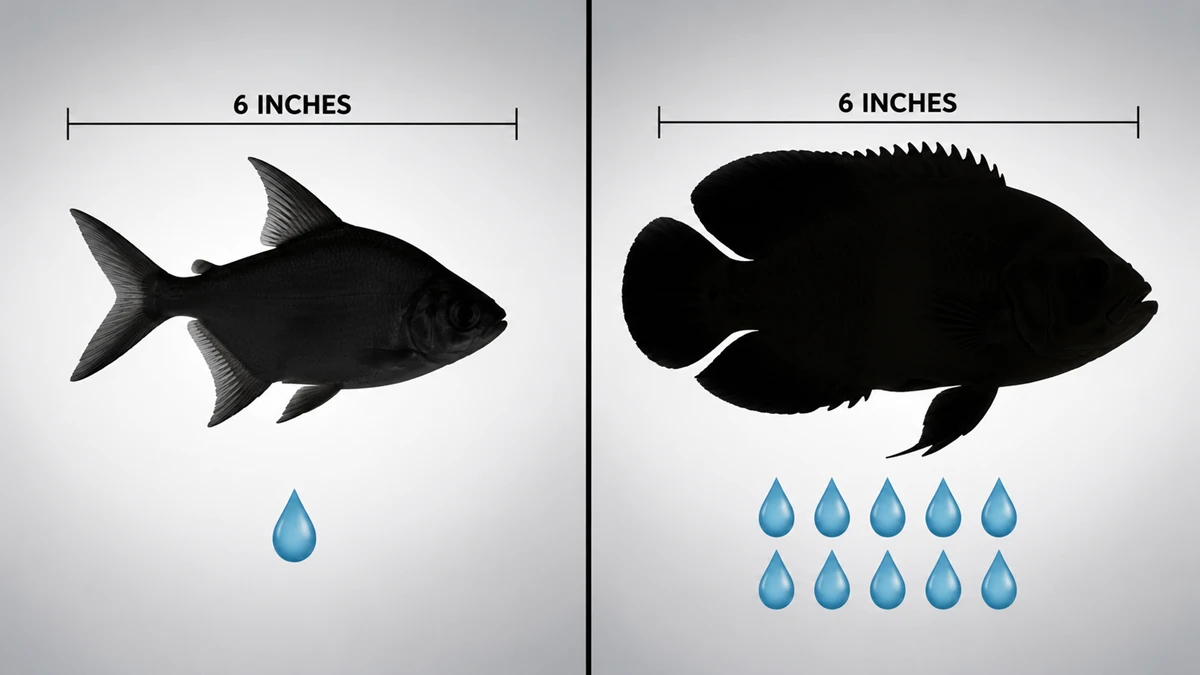
You measured your tank, did the math — 1 inch of fish per gallon, simple enough — and stocked it with room to spare. Then someone suggested an Oscar as your next fish. By the same math, a 10-inch adult oscar “needs” 10 gallons. That number isn’t just optimistic. It’s wrong by roughly two orders of magnitude, and it’s wrong in a specific, provable way that has nothing to do with opinion.
Why a 6-Inch Fish Isn’t Always a 6-Inch Fish
The 1 inch per gallon rule scores every fish the same way it scores length. A 6-inch silver dollar and a 6-inch Oscar come out identical on paper. In the water, they aren’t close.
Fish don’t grow in one dimension. As a fish gets longer, it also gets proportionally taller and wider — and body mass scales with the cube of length, not the length itself. A fish twice as long isn’t twice the fish. It’s roughly eight times the fish, in terms of tissue, appetite, and waste output.
The Cube Law, in Numbers
| Length (in) | Mass multiplier vs. a 1″ fish |
| 1 | 1× |
| 2 | 8× |
| 4 | 64× |
| 6 | 216× |
| 8 | 512× |
| 10 | 1,000× |
| 12 | 1,728× |
A 10-inch fish isn’t “10 units” of fish under the inch rule’s own logic — it’s closer to 1,000 units of actual body mass, waste output, and oxygen demand. This is the exact mechanism that makes the inch rule collapse the moment your stocklist includes anything deep-bodied, large, or a heavy waste producer. It was never built with them in mind — it was built by people mostly stocking similarly-shaped small community fish, where the flaw stays invisible.
How Many Fish Per Gallon, Really? The Formula Aquaculture Uses
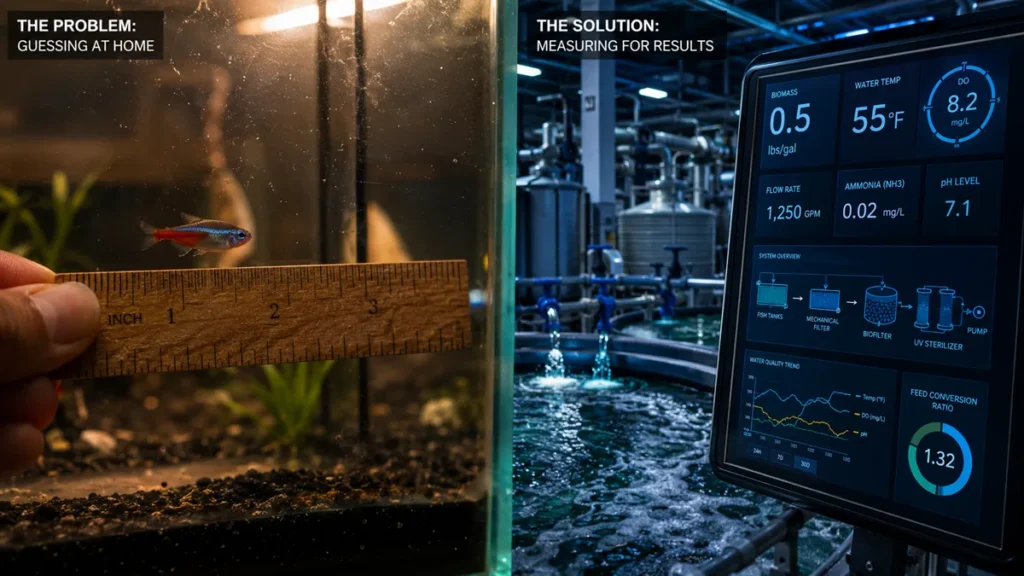
Commercial aquaculture stopped measuring fish in inches decades ago. A 1990 Texas A&M aquaculture extension publication on fish transport, for instance, specifies loading rates in pounds of fish per gallon of water — not inches — down to numbers like 0.5 lb per gallon for short hauls at 55–65°F, tightening to 0.25 lb per gallon for hauls over 8 hours. That’s a transport-specific number, not a permanent-stocking one, but it shows how seriously the industry takes weight over length the moment real animals and real water are involved.
For permanent stocking — the number actually relevant to your display tank — recirculating aquaculture system (RAS) design research works from a similar logic at a different scale: roughly 7.6 liters of water per 454 grams (1 lb) of fish, with a safety margin padded on top in real system designs. Translate that into hobby terms, and two variables decide safe stocking, not one:
- Total fish biomass — driven by weight, which itself is driven by adult size and body shape, not current size and not length alone.
- Filtration capacity — how much biological filtration is actually processing that biomass’s waste before ammonia and nitrite start climbing between water changes.
The inch rule accounts for neither variable properly. It checks length and stops there.
Worked Example: Betta vs. Oscar
A betta, around 2.5 inches, slim-to-average-bodied — the inch rule and a weight-based approach land in roughly the same place here. A single betta in a filtered 5–10-gallon tank is forgiving under either method.
An adult oscar, 12+ inches, deep-bodied, and a genuinely heavy waste producer — the inch rule says “12 gallons.” Hobbyist consensus built from weight and waste output instead lands at 55–75 gallons minimum for a single adult oscar, before adding any tankmates. That’s not a rounding error. That’s the gap between a healthy fish and a stunted, stressed one kept “within the rule.”
| Feature | Betta (2.5″) | Oscar (12″+) |
| Body type | Slim/average | Deep-bodied, heavy waste |
| Inch-rule estimate | ~3 gal | ~12 gal |
| Realistic minimum | 5–10 gal | 55–75 gal |
| Gap | Roughly accurate | Off by 4–6× |
Real Aquarium Fish Stocking Calculator Instead of 1 inch of fish per gallon
Try it yourself
The Real Stocking Calculator
Plug in your actual stocklist and get a biomass-weighted verdict instead of the inch rule.
Open the Calculator →Instead of estimating by hand, plug your actual stocklist into the calculator above. It weighs every fish by adult size and body type — slim, average, deep-bodied, or heavy waste — then adjusts your tank’s usable capacity based on your filtration strength — the same two variables aquaculture design actually uses, scaled down to a home tank.
Fish Stocking Rules That Actually Hold Up
- Stock by adult size, not current size. A juvenile oscar or pleco will blow past the inch rule’s math inside its first year.
- Weight and body shape into the estimate. Treat slim, average, deep-bodied, and heavy-waste fish as four separate categories, not one.
- Let filtration set the ceiling, not gallons alone. The same tank can carry more fish with stronger biological filtration.
- Recheck every few months while fish are still growing. Length can double; mass can grow far faster than that.
FAQ
Is the 1 inch per gallon rule ever accurate?
It’s a reasonable rough guide for a group of small, similarly shaped fish around the same size — a school of tetras, for instance. It falls apart the moment your stocklist includes anything deep-bodied, large-bodied, or a heavy waste producer, since it only measures length and ignores weight and filtration entirely.
How many fish per gallon should I actually keep?
There’s no single fixed ratio — it depends on your tank’s gallons, your filtration strength, and the adult size and body type of every fish on your list. A weight-based calculation gets you a genuinely reliable number; a flat per-gallon ratio doesn’t.
What formula do fish farms use instead of the inch rule?
Aquaculture design works in pounds or kilograms of fish per gallon or liter of water, adjusted for filtration and turnover — not inches. RAS design research uses roughly 7.6 liters of water per 454 grams of fish as a baseline before adding a safety margin.
Is comparing a betta to an oscar a fair test of the inch rule?
It’s actually the clearest test. The inch rule works about as well as a weight-based estimate on small, average-bodied fish like a betta. The gap only opens up — and opens up fast — on large, deep-bodied fish like an oscar, which is exactly where getting stocking wrong causes the most harm.
Does filtration really change how many fish I can keep?
Yes. Filtration strength directly affects how much bioload your biological filter can process before ammonia and nitrite climb between water changes — which is why a real stocking calculation adjusts for filtration level, not gallons alone.
What Next to Read
Resources from FishioHub:
- Aquarium Bioload 101 — Why Tanks Crash Like Biosphere 2 — the deeper mechanism behind why bioload creeps up even when you haven’t added a fish.
- How to Remove Ammonia From a Fish Tank Naturally — for anyone reading this because they’re already overstocked and need to stabilize water quality now.
- Most Common Aquarium Problems and Solutions — broader troubleshooting if overcrowding turns out not to be the only issue.
Scientific resources:
- Jensen, G.L. (1990). Transportation of Warmwater Fish: Loading Rates and Tips by Species. SRAC Publication No. 393, Southern Regional Aquaculture Center.
- Oklahoma State University Extension. Recirculating Aquaculture Tank Production Systems: Aquaponics — Integrating Fish and Plant Culture.
Optional third, only if you want more depth on the filtration-turnover side specifically: Global Seafood Alliance, “Flow Rate Estimation for RAS”
Was this guide helpful?
First-Hand Experience
Based on animals I've personally kept and bred - not summarized from other articles.
Zoological Foundation
Claims are checked against my M.Sc. Zoology training and published aquatic biology research, not recycled aquarium myths.
No Paid Influence
No sponsorship shaped this guide. Affiliate links, if any, are disclosed separately and never hidden.
Kept Current
Errors are corrected as soon as they're found, with the update noted at the bottom of the article.

Anil Satak M.Sc. Zoology · Founder, FishioHub
Grew up in a fishing family in India and holds a Master's in Zoology. FishioHub is a one-person operation - every guide is personally researched, kept-tested, and written by Anil. No team, no outsourced writers, no AI-generated content. Read his full bio →