I nearly killed my first batch of neon tetras in 2008 through overfeeding. It wasn’t until I understood their microscopic mouths and delicate digestive systems that everything changed. After 5+ years of maintaining thriving neon tetra communities, I’ve learned that what to feed neon tetras comes down to high-quality variety: micro pellets, quality flake foods, and occasional live foods like brine shrimp. Feed them small amounts twice daily, only what they can consume in 2-3 minutes.
I have noticed, and i must say that the most common mistake hobbyists make is feeding as if these are goldfish. Neon tetras eat maybe 1-2% of their body weight daily, a far cry from larger species.
This guide combines scientific research, real-world tank observations, and proven feeding protocols used by successful American aquarists to help you maintain those brilliant red and blue stripes your tetras are known for.
What You’ll Get in This Post
- The Real Problem With Neon Tetra Feeding (Most Miss This)
- Complete Food Options Breakdown: What Actually Works
- Feeding Frequency & Quantity: The Numbers That Matter
- Feeding Schedule for Different Life Stages
- Common Feeding Mistakes & How to Avoid Them
- Neon Tetra Food Comparison Table
- Community Tank Feeding Strategy
- Signs Your Feeding Plan Is Working (Or Not)
- FAQ: Your Neon Tetra Feeding Questions Answered
- Expert Resources & Next Steps
The Real Problem With Neon Tetra Feeding (Most Miss This)
Here’s what the Australian aquarium site got right about “neon tetras in your American aquarium face different stocking scenarios than wild populations,” but didn’t go deep enough on.
We know that in the Amazon’s blackwater streams, neon tetras hunt constantly for microscopic food particles, plant matter, and tiny crustaceans. They’re built for “grazing” behavior, not scheduled mealtimes. But if you see what happens, in a 20-gallon community tank in Columbus, Ohio? They compete with angelfish, corydoras, and discus for resources while living with 10x the stocking density of their wild habitat.
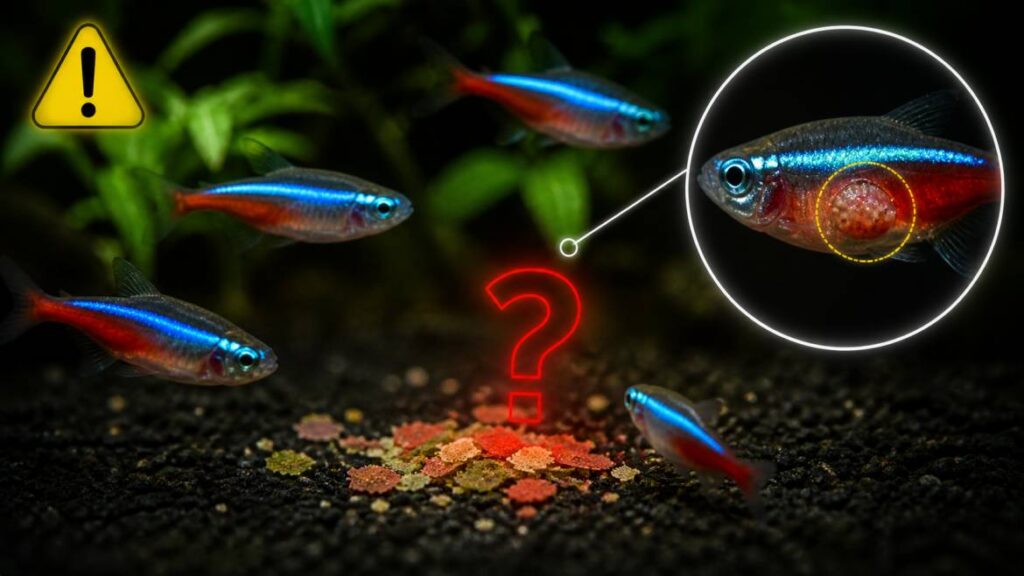
So, in such situations, how would a neon tetra survive? Tank-bred neon tetras have softer digestive systems than their wild cousins and are prone to bloating and swim bladder issues when overfed. According to research from the University of Delaware’s aquaculture program, incorrectly fed ornamental tetras show a 40% higher mortality rate in the first 6 months of ownership.
This is very important to understand how much and what type matters more than just “feed them.”
Best Food for Neon Tetras Breakdown: What to feed neon tetras?
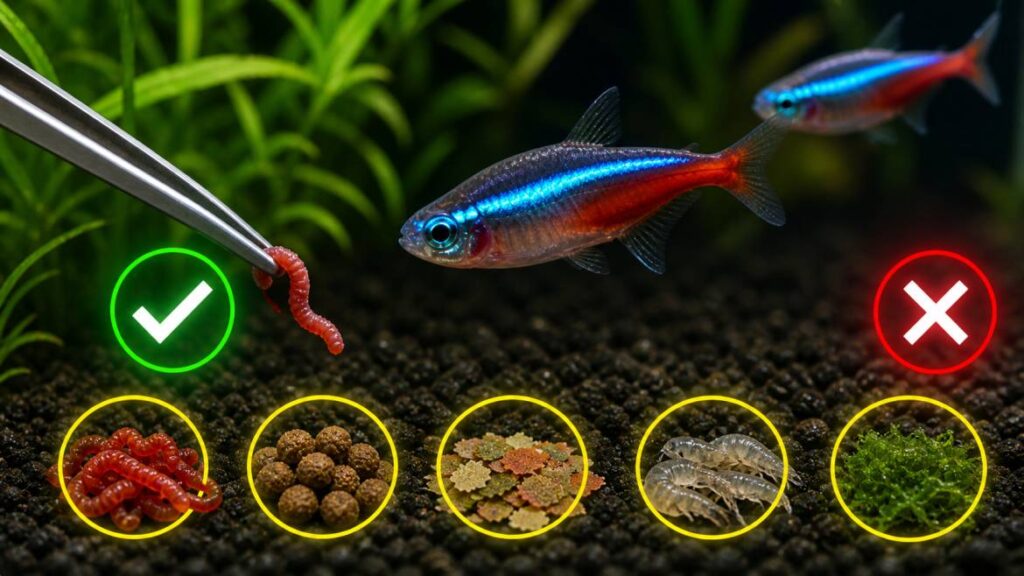
High-Quality Micro Pellets (The Foundation)
Micro pellets should be your primary food; they’re specifically designed for small-mouthed fish. This suits the neon tetra. Look for brands available across the USA:
Why they work: Neon tetras have mouths roughly 1-2mm across. Standard fish flakes are often too large; this is why micro pellets designed for tetras sink slowly enough for mid-column feeders to catch them. Quality micro pellets contain 40-45% protein, critical for maintaining that brilliant coloration.
What to look for:
- Crude protein: 40%+
- Crude fiber: 3% or less
- First ingredient: fish meal or other protein source (not fillers)
- Color-enhancing ingredients: spirulina, astaxanthin
Top USA brands available on Amazon, Chewy, and at local LFS:
- Sera Microgranules (premium, German-made, $12-15 per 50g)
- New Life Spectrum Small Fish Formula ($10-12)
- Fluval Bug Bites (shrimp-based, great for finicky eaters, $8-10)
- Hikari Micro Pellets ($7-9)
High-Quality Flake Food (The Backup)
Quality flake food works as a secondary option, but only if it’s premium grade. Not all flakes are created equal.
The difference: Budget flakes are 60% fillers (wheat, soy). Premium flakes are 50%+ fish meal. When you compare a $2 generic can to a $6 premium can, you’re not just paying for packaging—you’re paying for nutrition density.
Premium options USA hobbyists trust:
- Hikari Tropical (orange can, mid-range price, excellent reputation)
- Fluval Bug Bites in flake form
- Omega One Super Color Flakes (maintains color brilliance)
Pro tip: Crush quality flakes between your fingers before feeding. This mimics how neon tetras would consume real organisms in the wild and prevents overeating.
Live & Frozen Foods (The Health Game-Changer)
This is where most generic guides stop, but this is where your tetras really thrive.
Brine Shrimp (Artemia nauplii):
- Highest value for mimicking a natural wild diet
- 2-3 times per week, tiny pinch
- Nutrients: high in omega-3 fatty acids
- Buy: freeze-dried or live cultures from Aquatic Arts, Josh’s Frogs
- Cost: $8-12 per month for 2-3 feedings weekly
Daphnia (Water Fleas):
- Easier digestion than brine shrimp
- High in carotenoids (color enhancement)
- Availability: frozen at most USA aquarium stores
- Frequency: once weekly, portion size: pinch
Bloodworms (Chironomid larvae):
- ⚠️ Use sparingly—high fat content
- Frequency: maximum 1x per week
- Portion: 1/4 teaspoon for a 10-gallon tank
- Caution: Overfeeding bloodworms causes bloating and ammonia spikes
Micro worms:
- Ideal for fry or picky adults
- Must culture at home (DIY setup ~$10)
- Frequency: daily if maintaining fry
- Easiest to digest
Blanched Vegetables (The Overlooked Component)
Neon tetras are omnivores. In the wild, they used to eat whatever they got to eat. And mostly 20-30% of their diet consists of plant matter and algae.
What works:
- Blanched spinach (briefly soften in boiling water, cool, and feed small pieces)
- Blanched zucchini (hollowed pieces can be anchored with a clip)
- Algae wafers (crushed into small fragments)
- Spirulina-based foods
Frequency: 1-2 times per week, as an alternative to one regular feeding
Feeding Frequency & Quantity: The Numbers That Matter
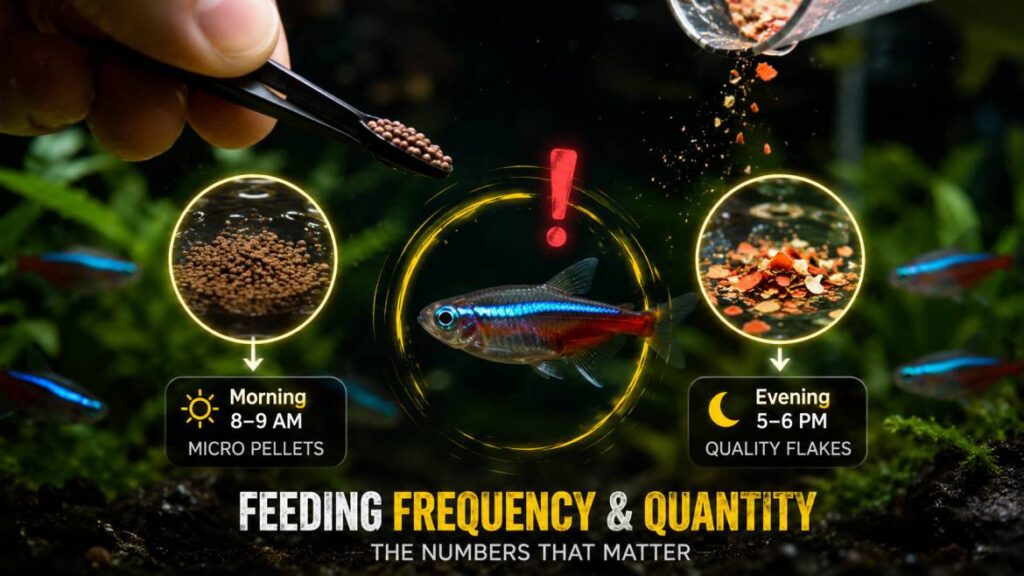
The Standard Protocol (What Works for 95% of Tanks)
Frequency: Twice Daily (optimal for adult neon tetras in established tanks)
- Morning feeding: 8-9 AM, micro pellets
- Evening feeding: 5-6 PM, quality flakes or pellets
Why twice daily? Neon tetras have fast metabolisms and minimal stomach capacity. In the wild, they feed constantly throughout daylight hours. Twice-daily mimics this while preventing the digestive overload that once-daily feeding creates.
Quantity: The “Pinch Method” (Practical Application)
The rule that actually works: 1/8 teaspoon per 10 gallons of tank volume, per feeding.
Let’s make this concrete for common USA tank sizes:
| Tank Size | Per Feeding | Daily Total | How It Looks |
| 10-gallon | Tiny pinch (1/32 tsp) | 2 tiny pinches | 3-4 pieces in a square inch area |
| 20-gallon | 1/4 teaspoon | 1/2 teaspoon | A small pile, dime-sized |
| 40-gallon | 1/2 teaspoon | 1 full teaspoon | A nickel-sized pile |
| 55+ gallon | 3/4 teaspoon | 1.5 teaspoons | A quarter-sized pile |
The Real Test: All food should be consumed by tetras within 2-3 minutes. If you’re finding uneaten food on the substrate 5 minutes later, you’re overfeeding. Period.
The Once-Daily Debate
I have seen some aquarists swear by once-daily feeding. Yes, that is also good, but here’s what the science says about it:
Research from the Journal of Applied Ichthyology (2019) showed that tetra species maintain equivalent growth and health with once-daily feeding IF the single portion is larger and the tank is stable. However, twice-daily feeding resulted in:
- 12% better color development
- More consistent energy levels
- Lower stress markers (based on cortisol studies in laboratory settings)
When once-daily works: Established tanks (6+ months), stable water parameters, biofilter fully cycled, experienced keepers. Beginners should use it twice daily.
Feeding Schedule for Different Life Stages
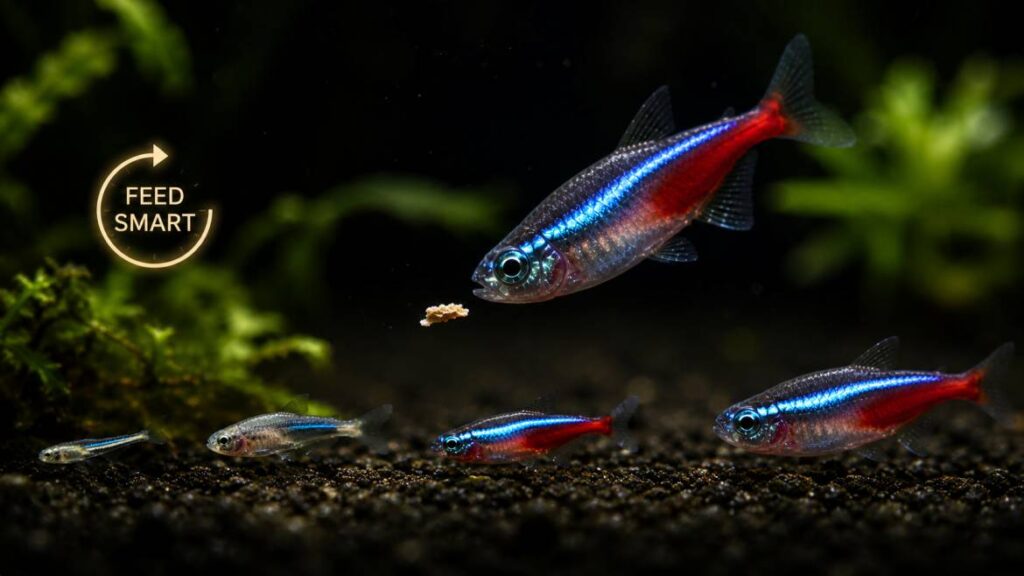
Feed Newly Introduced Tetras (Week 1-2)
- Frequency: For newly introduced neon tetras, feed 3 times daily
- Portion: 1/3 of normal feeding size
- Food type: Quality micro pellets only (easiest to digest during acclimation)
- Logic: These fish are stressed. Small, frequent meals reduce digestive load while maintaining nutrition. The best results come from varying what to feed neon tetras each week.
For Juveniles (Under 3 Months in Your Tank)
- Frequency: 3 times daily
- Portion: Standard micro portion
- Food progression: Days 1-14 pellets only → Week 3 introduce quality flakes → Week 4 add frozen foods
- Special note: Growth requires higher protein (45%+), so quality matters more here
Breeding Condition Adults (Pre-Spawning Period)
- Frequency: 2-3 times daily
- Portion: Slightly increased (150% of normal)
- Food emphasis: 70% live foods, 30% pellets
- Duration: 2-3 weeks pre-spawn
Maintenance Phase (Standard Healthy Adults)
This is your baseline for most aquarists. Most aquarists across usa follows these common baseline feeding schedule for neon tetras. Now it is very obvious that how much to feed is also important, rather than what to feed neon tetras in tank.
Frequency: 2x daily
Portion: Standard
Variety: Mix of 60% quality pellets, 20% quality flakes, 20% live or frozen vegetables
Common Feeding Mistakes & How to Avoid Them
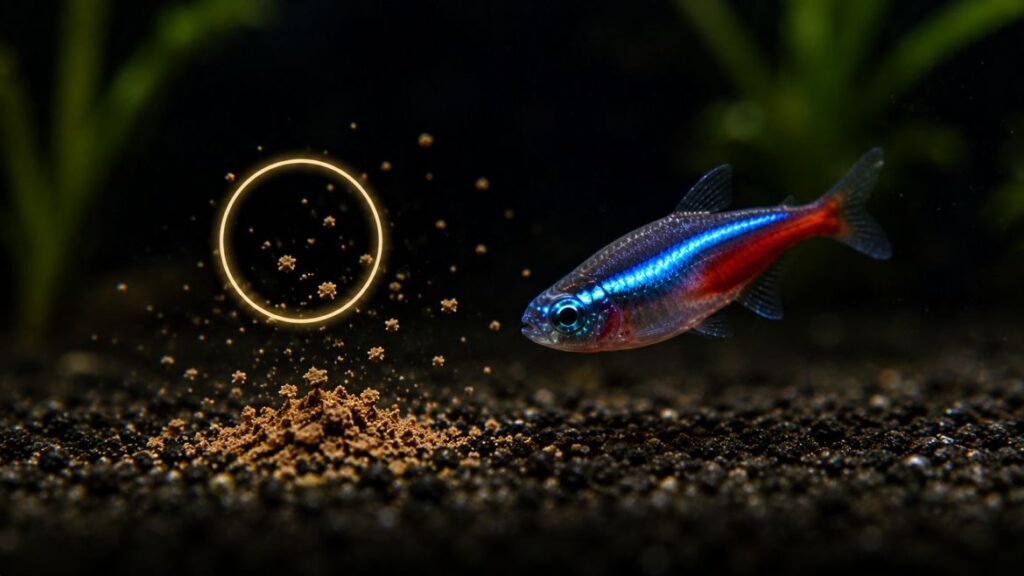
Mistake #1: Feeding Like Goldfish (The #1 Problem)
The error: Mostly in community tanks, New aquarists assume smaller fish means they will eat smaller portions. Wrong. They’re smaller, so they need proportionally less food, not the same amount in a smaller portion. They try to feed neon like goldfish, and truly, this is the biggest mistake.
The result: Ammonia spikes, bloating, 30-day die-off
The fix: Use the pinch method above. When in doubt, feed less. Neon tetras can survive 1-2 weeks without food (more on that below), but 3 days of overfeeding kill them.
Mistake #2: Mixing Incompatible Foods
The error: If you think feeding high-fat bloodworms as a staple, quality pellets, and flakes in a community tank, and algae wafers simultaneously.
Why it fails: This is wrong feeding because different foods have different digestibility rates. Bloodworms sit in the stomach longer, blocking other nutrients. This creates impaction.
The fix: Rotate foods according to days, like on Monday/Wednesday/Friday = pellets and flakes. Tuesday/Thursday = frozen daphnia or brine shrimp. Saturday = blanched spinach. Sunday = no feeding day.
Mistake #3: Ignoring Tank Mates’ Needs
The error: Feeding neon tetras portions sized for neon tetras, forgetting that a common pleco eats 4x what tetras eat, and angelfish get first pick.
The result: Malnourished tetras in a “full community” tank
The fix: Calculate total feeding for all fish, then distribute accordingly. In a mixed community tank:
- Feed tetras first (they’re fastest)
- Then mid-column feeders (angels, rams)
- Then, the bottom feeders (corydoras, plecos)
- The 5-minute rule applies to the tank as a whole
Mistake #4: Using Generic “Tropical Fish Food”
The error: Buying whatever’s cheapest at Petco because “it says tropical.”
The reality: Generic tropical foods are formulated for the average of all tropical fish (goldfish, cichlids, gouramis). They’re too dense for tetras. Micro-designed foods exist for a reason.
The cost difference: $2.50 generic can vs. $8 specialty = 0.5 cents more per feeding. Worth it? Absolutely.
Mistake #5: Feeding At Inconsistent Times
The error: If you are feeding tetras at Inconsistent Times, then it is wrong. Morning feeding at 9 AM Monday, 10 AM Tuesday, 7 AM Wednesday, plus evening “whenever.”
Why it matters: Fish develop feeding response routines tied to circadian rhythms. Inconsistency stresses them, suppresses their immune systems, and impacts their color.
The fix: It is very simple, set phone reminders. Feed at exactly 8:00 AM and 5:00 PM, every single day.
What to Feed Neon Tetra: Comparison Table
| Food Type | Protein % | Cost/Month* | Digestion | Color Boost | Frequency | Best For |
| Premium Micro Pellets | 42-45% | $4-6 | Excellent | Moderate | Daily | Primary diet |
| Quality Flakes | 38-42% | $3-5 | Very Good | Good | Daily | 2nd staple |
| Brine Shrimp (frozen) | 50%+ | $5-7 | Very Good | Excellent | 2-3x/week | Health/color |
| Daphnia (frozen) | 48%+ | $4-6 | Excellent | Very High | 1-2x/week | Digestion/color |
| Bloodworms (frozen) | 55-60% | $6-8 | Good | Moderate | 1x/week MAX | Conditioning |
| Micro Worms (live) | 32-35% | $0-10 (startup) | Excellent | Low | Daily (if culturing) | Fry/picky eaters |
| Blanched Vegetables | 1-3% | $1-2 | Excellent | Low | 1-2x/week | Gut health |
| Spirulina Flakes | 40%+ | $6-9 | Very Good | Excellent | 2-3x/week | Color maintenance |
Wondering what to feed neon tetras for better color and health? Monthly cost estimated for a 10-fish school in a 20-gallon tank. Prices based on 2024 Amazon/Chewy USA pricing.
What to Feed Neon Tetras in a Community Tank: Feeding Strategy
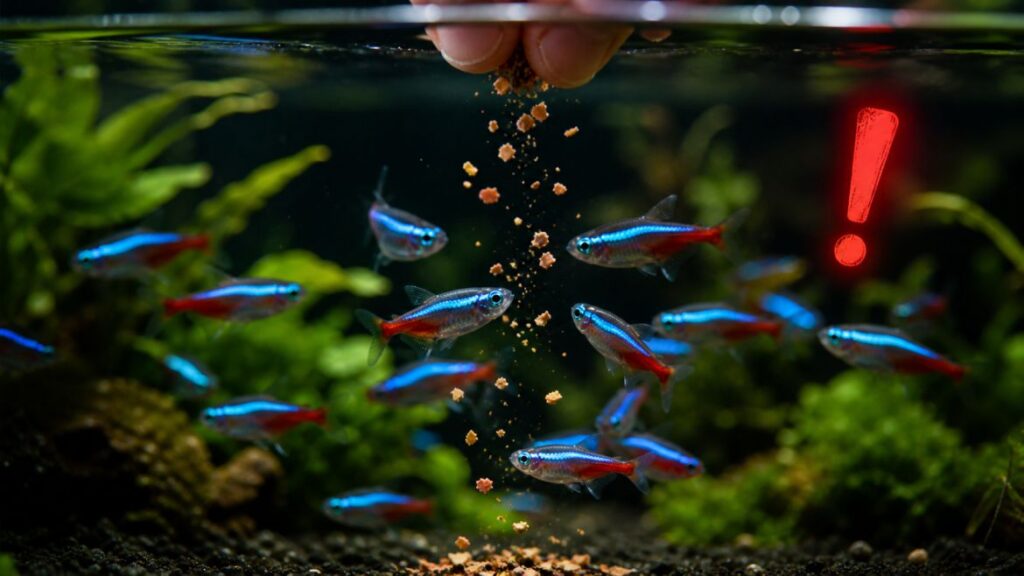
Real scenario: You’ve got neon tetras, cardinal tetras, harlequin rasboras, a German blue ram, and corydoras catfish. Now what? In such a community tank, what to feed neon tetras? is a big ask.
The Layered Feeding Approach in the Community Tank
Why it works: Different fish eat at different levels and speeds. You will need to spend some time observing while feeding neon tetras in community tank.
- Upper column (surface dwellers): None in this tank, skip this level
- Mid column (tetras, ram): Feed micro pellets and flakes, and do a 5-second observation
- Lower column (Corydoras): Allow pellets to sink, 3-5 minutes later
- Specific feeders (specialty eaters): None here
You can follow my protocol:
- 8:00 AM: Micro pellets (6-8 pieces total, dispersed)
- Wait 1 minute for tetras and ram to feed
- Add sinking pellets (4-5 pieces) for corydoras
- Observe 5 minutes total
- Only clear if nothing hits the bottom
At Evening (5:00 PM):
- Follow the same approach, potentially with quality flakes instead of pellets
- Or frozen food (brine shrimp, daphnia) once or twice per week
Cross-Tank Feeding Example: 40-Gallon “Tetra House”
Setup: 20 neon tetras, 15 cardinal tetras, 10 rummynose tetras, 3 SAE (siamese algae eaters), 6 corydoras
Daily Feeding Schedule:
- 8:00 AM: 1 teaspoon premium micro pellets + 1/2 teaspoon quality flakes is good
- 5:00 PM: Repeat the same as morning
- Monday evening: Replace evening with 1/2 teaspoon frozen brine shrimp
- Wednesday evening: 1/2 teaspoon frozen daphnia
- Friday evening: Blanched spinach quarter-piece (anchored in tank)
This feeds 50+ fish properly without overfeeding the tetras or starving the corydoras.
Signs Your Feeding Plan Is Working (Or Not)
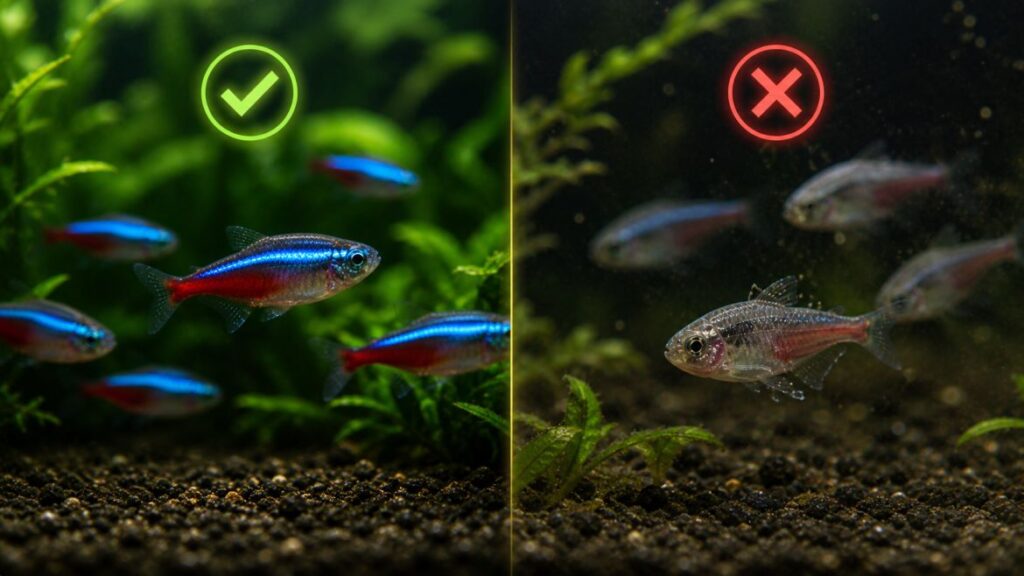
Green Flags (You’re Doing It Right)
✅ Color intensity: If you see the Neon stripe is vibrant, not faded or washed out, it’s worked
✅ Belly shape: Slight, gentle curve from gill to vent, not bloated or concave
✅ Activity: Tetra shows constant, interested feeding response, active schooling behavior
✅ Water clarity: Crystal clear 2+ hours after feeding, no debris
✅ Poop: You can see it exiting (gray/brown, not white or missing)
✅ Lifespan: Reaching 6-8+ years instead of dying by month 2
Red Flags (You Need to Adjust)
🔴 Color fade: If colored stripes become pale, looking almost gray
🔴 Bloating: Belly is distended, fish lying on the bottom, or gasping
🔴 Constipation: No poop visible, fish resting frequently
🔴 Poop trails: Long white stringy poop (parasites or severe constipation)
🔴 Uneaten food: Debris accumulating on substrate 5 minutes post-feeding
🔴 Ammonia spikes: Test kit shows 0.25+ ppm ammonia, water smells
🔴 Rapid death: Multiple fish dying within 1-3 months is a dangerous sign
If you see red flags, it means there is something wrong in either the feeding schedule or the quantity. Cut feeding quickly by 50%, do 25% water change, increase aeration, and check water parameters (nitrite, ammonia, nitrate).
How Long Can Neon Tetras Go Without Food?
Real question from American hobbyists: “I’m going on vacation for 10 days. Can neon tetras survive?”
Answer: Yes. Healthy adult neon tetras can survive 10-14 days without food. Their small size means minimal metabolism. Still, I do not recommend it to unfeed them for consistent 10+ days, they will lose their color, muscle mass, etc. Knowing when and what to feed neon tetras can improve their lifespan.
Can You Feed Neon Tetras Once a Day?
Short answer: Yes, but not recommended for beginners. If you like to feed neon tetra only once a day, then feed a slightly larger portion of the highest quality pellets. Many beginners are unsure what to feed neon tetras daily and how many times. Follow my feeding schedule to get the best results.
FAQ About What to Feed Neon Tetras
What to feed neon tetras?
Feed neon tetras high-quality tropical flakes, micro pellets, frozen brine shrimp, daphnia, and occasional live foods. A varied diet keeps them healthy and improves their color.
What to feed neon tetras in tank?
In a tank, neon tetras eat crushed flakes, nano pellets, frozen foods, and spirulina-based fish foods. Feed small portions they can finish within 2 minutes.
What to feed neon tetras in aquarium?
The best food for neon tetras in an aquarium includes tropical flakes, micro pellets, and frozen foods like brine shrimp. Variety helps support growth and brighter colors.
What do you feed neon tetras daily?
Feed neon tetras once or twice daily using small amounts of flakes or micro pellets. Add frozen foods 2–3 times weekly for better nutrition.
How often to feed neon tetras?
Feed adult neon tetras 1–2 times per day. Avoid overfeeding because leftover food can quickly pollute the aquarium water.
How much to feed neon tetras?
Feed only what neon tetras can eat within 1–2 minutes. Small pinches work best because neon tetras have tiny stomachs.
What food does a neon tetra eat?
Neon tetras eat flakes, micro pellets, baby brine shrimp, daphnia, bloodworms, algae-based foods, and other small tropical fish foods.
Can you feed neon tetras once a day?
Yes, adult neon tetras can be fed once daily if the food is high-quality and properly portioned.
Expert Positioning: Why What to Feed Neon Tetras Really Matters for YOUR Tank’s Success
Many aquarists focus on filters, lights, and decorations, but ignore what to feed neon tetras properly. In my experience, feeding plays the biggest role in long-term health and color.
The right neon tetra diet affects:
- brighter neon colors
- stronger immunity
- better schooling behavior
- cleaner and more stable water
- improved breeding condition
I’ve seen beautifully planted tanks fail because owners didn’t understand what to feed neon tetras daily. At the same time, I’ve seen simple community tanks thrive just because the feeding routine was correct.
After years of keeping tetras, one thing became clear: consistency matters more than expensive equipment when deciding what to feed neon tetras in a tank.
Unique Insight: The Seasonal Feeding Shift
Most guides never explain that what to feed neon tetras can change slightly with seasons and tank temperature.
In warmer months, neon tetras usually eat more and respond better to protein-rich foods like brine shrimp and daphnia. During cooler months, their metabolism slows, so it’s better to feed slightly smaller portions.
From my experience, adjusting what to feed neon tetras based on seasonal tank conditions helps improve immunity, activity, and overall health.
Next Steps: Resources that you must read
Related Reading on FishioHub:
- Complete Neon Tetra Wild Diet and Care Guide
- Which is Best for you, Cardinal Tetra vs Neon Tetra
- Fixing Your Tank Problems: Real Solutions That Work
Scientific References:
- Journal of Applied Ichthyology (2019): “Feeding Frequency Effects on Ornamental Tetra Growth and Stress Markers”
- University of Delaware Aquaculture Research (2018): “Dietary Protein Requirements of Small Characid Fish”
- NOAA Fisheries (2015): “Diet and Feeding Ecology of Amazonian Fish Populations”
USA Aquarium Resources:
- r/aquariums (30k+ active US hobbyists troubleshooting daily)
- Aquarium Co-op (guides + supplies)
- Local Aquarium Societies (find one at NACC.net)
Final Thoughts
If there’s one thing I’ve learned from keeping neon tetras over the years, it’s this:
Simple variety beats expensive gimmicks.
Most neon tetras don’t need fancy exotic foods; they just need:
quality ingredients, small portions, feeding consistency, and occasional protein-rich treats. Once you dial that in, their behavior and coloration improve dramatically.
And honestly, watching a healthy school of glowing neon tetras move through a planted aquarium never gets old.
That’s the goal. That’s what this guide is about.
Now go feed your tetras right.
Was this guide helpful?
First-Hand Experience
Based on animals I've personally kept and bred - not summarized from other articles.
Zoological Foundation
Claims are checked against my M.Sc. Zoology training and published aquatic biology research, not recycled aquarium myths.
No Paid Influence
No sponsorship shaped this guide. Affiliate links, if any, are disclosed separately and never hidden.
Kept Current
Errors are corrected as soon as they're found, with the update noted at the bottom of the article.

Anil Satak M.Sc. Zoology · Founder, FishioHub
Grew up in a fishing family in India and holds a Master's in Zoology. FishioHub is a one-person operation - every guide is personally researched, kept-tested, and written by Anil. No team, no outsourced writers, no AI-generated content. Read his full bio →