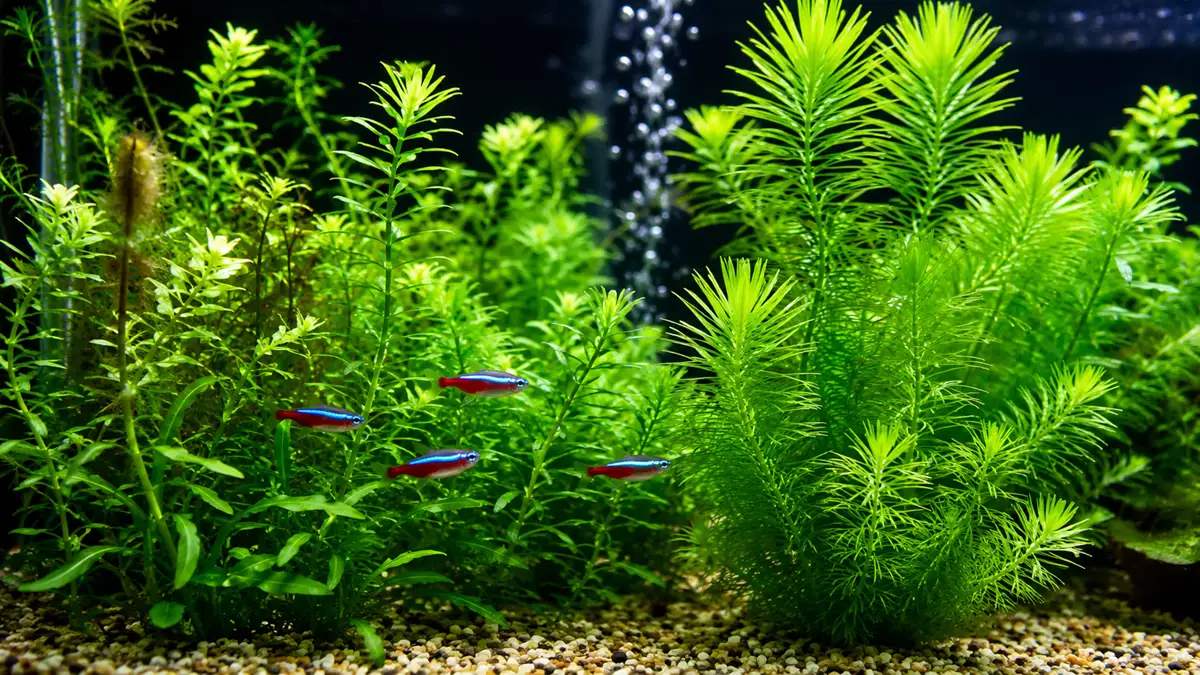
An empty aquarium soon begins to look dated. The fastest growing aquarium plants fix that in days, not months.
Short answer: Floating plants like duckweed and stem plants like hornwort are the fastest growing aquarium plants you can buy. I’ve seen that Duckweed can double its entire population in as little as 1.3 days under strong light, and hornwort routinely adds an inch or more of new growth a week. Neither one needs CO2 injection to hit those numbers.
I first learned this when I tossed some hornwort into Raja’s(my betta fish) tank. Within a week, it completely took over. By Friday, it was curling across the surface and blocking out the light. Seeing a low-tech plant grow inches every single day blew my mind.
Quick Facts: If You Only Remember 3 Things
- Speed leaders: duckweed, hornwort, water sprite, and anacharis are consistently ranked among the fastest growing aquarium plants worth stocking first, CO2 or not.
- No CO2 required. The species on this list evolved to out-compete algae in nutrient-poor water — that’s a beginner-tank skill, not a downside.
- Fast growth means weekly trimming. The same traits that make these plants forgiving also make them the ones you’ll cut back most.
How Fast Do Aquarium Plants Grow?
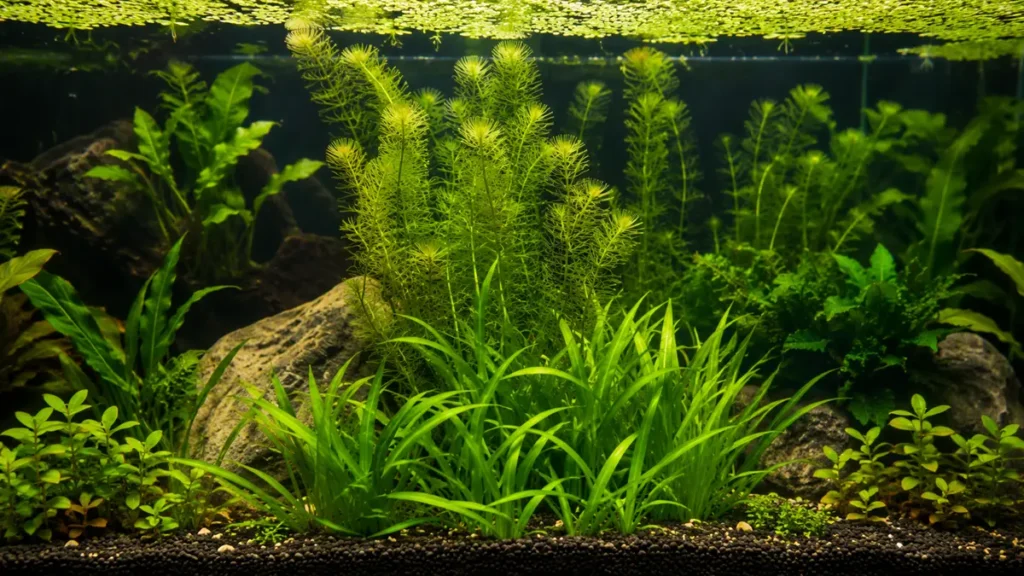
How fast do aquarium plants grow depends entirely on which one you’re growing. There’s no single number for the fastest growing aquarium plants as a group — growth rate ranges from barely-visible to genuinely exponential depending on species.
Duckweed sits at the exponential end. A peer-reviewed study testing 39 duckweed clones under standardized conditions found doubling times of 1.34 to 4.54 days. In a real tank — messier than a lab — you’ll usually see doubling closer to every 2–3 days once light and nutrients are dialed in.
Stem plants run on a slower but still fast clock, usually inches per week instead of days. Hornwort (Ceratophyllum demersum) routinely adds an inch or more of new stem length weekly once it settles in.
Regarding too the Root-and-runner plants like Vallisneria grow differently — sideways, not up. University of Florida IFAS Extension documents Vallisneria americana spreading via underground runners into dense underwater meadows in the wild.
That’s the same mechanism that lets it carpet a tank’s substrate over a few months.
Fastest Growing Aquarium Plants for Beginners
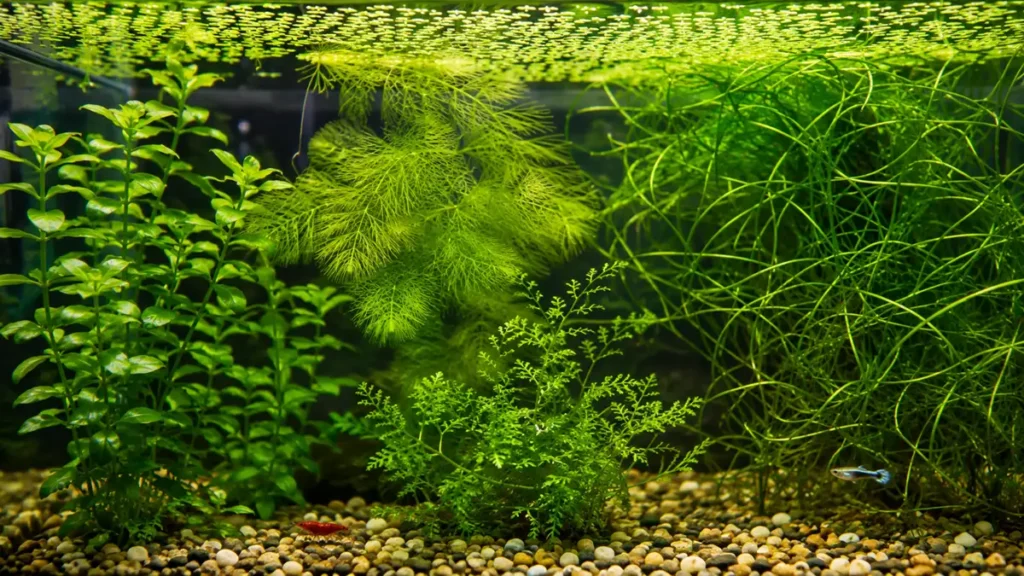
These 5 plants are the fastest growing aquarium plants for beginners aren’t just fast — they’re forgiving. Overdosed fertilizer, patchy lighting, a skipped water change: these five shrug it off.
- Anacharis (Egeria densa) — Cheap, sold in bunches, nearly impossible to starve.
- Hornwort — No substrate needed. You can float it.
- Water sprite (Ceratopteris thalictroides) — Grows rooted or floating, and makes baby plantlets right on its own leaves.
- Duckweed — Almost too easy. The real challenge is controlling it, not growing it.
- Guppy grass (Najas guadalupensis) — Tangles into a dense mass that fry and shrimp treat like a jungle gym.
They all show up on nearly every beginner-proof list for the same reason: wide tolerance for light, hardness, and nutrient swings — which is exactly what a first tank tends to throw at them.
Very Fast Growing Aquarium Plants (For When You Need Results Now)
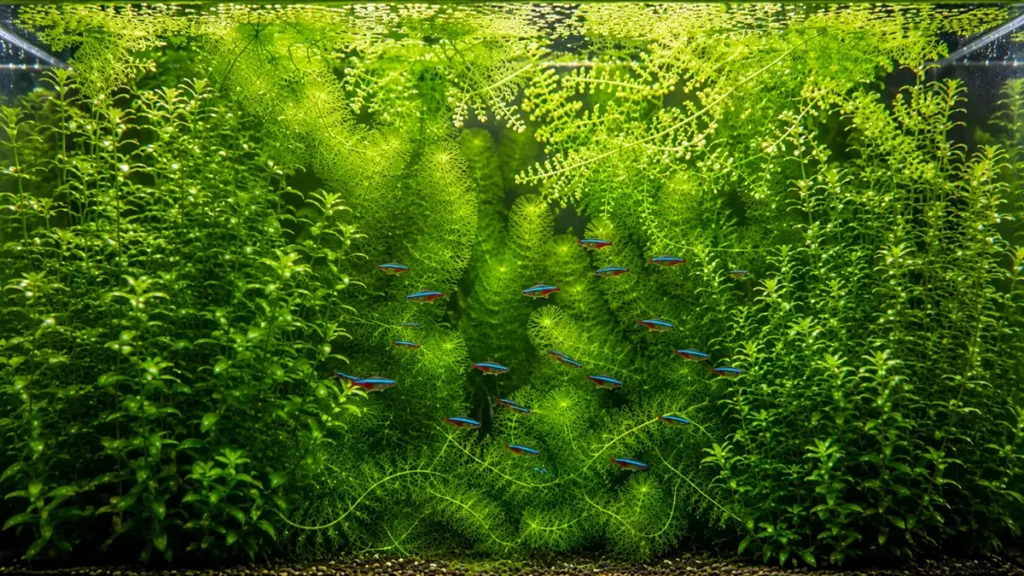
Very fast-growing aquarium plants are almost always stem or floating species. That’s the growth strategy nature gave them to out-race algae for light and nutrients.
Egeria densa thrives due to rapid growth and the ability to absorb nutrients from both water and soil, allowing it to take over environments quickly. A 2009 study highlights that this species maintains this aggressive growth.
Hornwort and water sprite round out this tier — arguably the two fastest growing aquarium plants you can grow without ever touching substrate. Both grow floating with zero planting technique required, and both will visibly fill a tank within 2–3 weeks of a healthy start.
Best Fast Growing Aquarium Plants: Side-by-Side
Here’s how the best fast growing aquarium plants stack up on growth speed, light needs, and whether they’ll ask you for a CO2 system.
Lined up side by side, it’s a fast way to see which of the fastest growing aquarium plants actually fits your setup.
| Plant | Growth Speed | CO2 Needed? | Light Needs | Best For |
| Duckweed | Extreme (days) | No | Low–High | Nutrient export, fry food |
| Hornwort | Very fast (in/week) | No | Low–High | Beginners, fry cover |
| Water sprite | Fast | No | Medium–High | Floating or rooted |
| Anacharis (Egeria densa) | Fast | No | Low–High | Cold or unheated tanks |
| Guppy grass | Fast | No | Low–High | Shrimp/fry tanks |
| Vallisneria | Moderate–Fast (spreads via runners) | No | Low–Medium | Background carpeting |
Every plant on that table earns its spot on any list of fast growing aquarium plants without asking for a CO2 tank. That matters if you’re not ready to invest in pressurized gear yet.
Fast Growing Aquarium Plants Without CO2
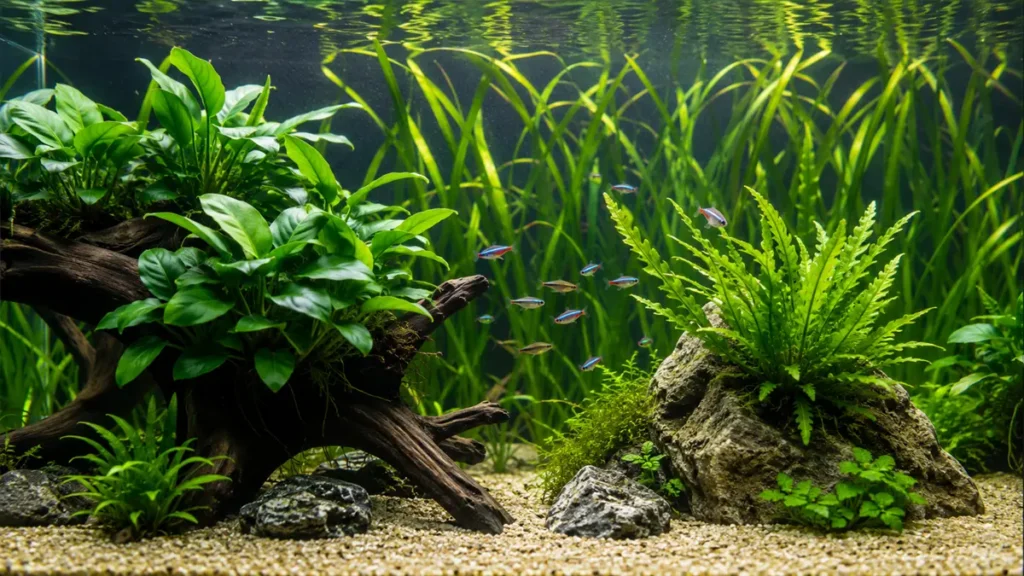
Fast-growing aquarium plants without CO2 aren’t a compromise pick. Several of the fastest growing aquarium plants in the hobby evolved to thrive on the CO2 already dissolved in tank water from fish respiration and surface gas exchange.
Anacharis, hornwort, water sprite, duckweed, and guppy grass all fall into this bucket — the same five plants dominating the lists above.
I went deeper on why certain species skip CO2 entirely, and how to pick the right ones for a low-tech setup, in Aquarium Plants That Don’t Need CO2. This post is about speed specifically; that one is the full no-CO2 species list.
Easy Fast Growing Aquarium Plants (No Green Thumb Required)
Easy fast growing aquarium plants and fast growing easy aquarium plants are really the same list, just read in either direction. The traits that make a plant hard to kill — wide tolerance, low light demand, no substrate dependency — are usually the same traits that make it grow fast.
Floating plants are the easiest entry point since you skip substrate and root management entirely. Duckweed, water sprite, and hornwort can all just sit on the surface and go. Want something rooted without the fuss?
Vallisneria plants itself via runners once it’s established, so one healthy specimen spreads on its own.
I used to think floating plants were maintenance-free since they do not need planting. But after leaving a handful of duckweed in Raja’s tank for two weeks, I returned to a thick green mat that blocked all light and choked the filter. I learned that “easy” floating plants actually require aggressive, weekly scooping.
Fast Growing Freshwater Aquarium Plants for Nutrient Control
Fast growing freshwater aquarium plants aren’t just decoration. They’re pulling ammonia, nitrate, and phosphate out of the water column before algae ever gets a chance to use it.
New leaves and stems need nitrogen and phosphorus to build, and a plant producing new growth every few days is pulling those nutrients out faster than a slow grower ever could.
That’s the real reason fastest growing aquarium plants and cleaner water tend to show up together — duckweed’s rapid biomass production is even studied for wastewater treatment, well outside the aquarium hobby.
How to Make Aquarium Plants Grow Faster
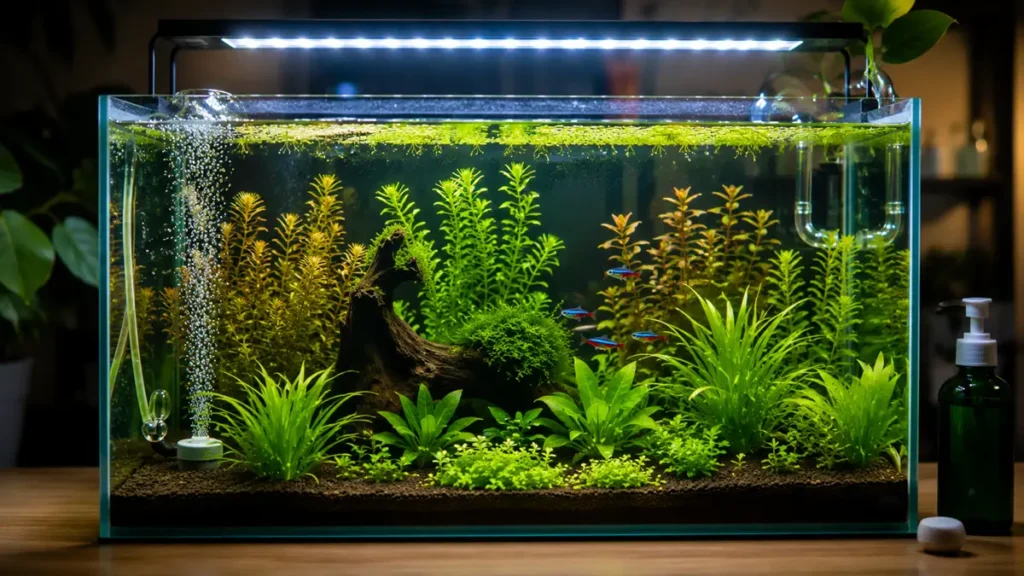
If you already have fast growing plants for aquarium use and they’re still crawling, the bottleneck is almost always one of three things: light, nutrients, or CO2 — usually in that order.
- Light first. Most fast growers stall under weak or short lighting before anything else goes wrong. Aim for a consistent 8–10 hour photoperiod.
- Then nutrients. Root tabs for substrate feeders, liquid fertilizer for stem and floating plants. I go deeper on natural options in How to Fertilize Aquarium Plants Naturally.
- CO2 last. It genuinely speeds things up, but it’s the priciest, highest-maintenance lever. Get light and nutrients right first.
New to planting altogether? Technique matters as much as species pick — see How to Plant Freshwater Aquarium Plants for the full walkthrough.
FAQ
What are the fastest growing aquarium plants overall?
Duckweed wins on population growth, doubling in days. Hornwort and water sprite are the fastest rooted or floating stem plants, typically adding multiple inches a week.
How fast do aquarium plants grow without CO2?
Species like anacharis, hornwort, and water sprite grow fast on the CO2 already present from fish respiration and surface gas exchange — no tank or diffuser needed.
What plants are fast growing climbers for an aquarium?
True climbers are rare underwater, but trailing stem plants like guppy grass and hornwort behave similarly, weaving through decor and other plants instead of climbing a fixed structure.
Are fast growing aquarium plants good for beginners?
Yes. Fast growth usually means wide tolerance for lighting, hardness, and nutrient swings — the same qualities that make the fastest growing aquarium plants forgiving for a first planted tank.
Can fast growing aquarium plants take over a tank?
Duckweed and guppy grass especially can if you let them go untrimmed. Weekly maintenance is the trade-off for their speed.
Do fast growing plants help control algae?
Yes, indirectly — they out-compete algae for the same nitrogen and phosphorus. A tank with strong plant growth usually sees less nuisance algae over time.
What’s the easiest fast growing aquarium plant to start with?
Anacharis or hornwort. Both sell in simple bunches, need no substrate, and tolerate a wide range of water parameters.
Do fast growing aquarium plants need special fertilizer?
Not always. Many draw enough from fish waste alone in a moderately stocked tank; the heavier growers benefit from a basic liquid fertilizer on top.
Next Steps: Resources You Should Read
Related FishioHub reading
- Aquarium Plants That Don’t Need CO2
- How to Fertilize Aquarium Plants Naturally
- How to Plant Freshwater Aquarium Plants
Scientific references
- Relative growth rates and doubling times of 39 duckweed clones — PubMed
- Egeria densa profile, Washington State Noxious Weed Control Board — summarizing Yarrow et al. (2009)(PDF)
- Tapegrass (Vallisneria americana), University of Florida IFAS Extension — EDIS SS-AGR-437 (PDF)
Where to buy carpet and stem plants
USA aquarium resources
- Aquatic Gardeners Association — planted-tank hobbyist community and forums
- Your local university extension office — many, like UF/IFAS, publish free ID guides for aquatic plants sold in the trade
Closing
A tank that visibly grows in front of you — new leaves by the weekend, not the season — changes how you feel about the whole hobby. That’s the real pull of the fastest-growing aquarium plants. Pick one from this list, give it real light, and see what a week actually looks like.
Was this guide helpful?
First-Hand Experience
Based on animals I've personally kept and bred - not summarized from other articles.
Zoological Foundation
Claims are checked against my M.Sc. Zoology training and published aquatic biology research, not recycled aquarium myths.
No Paid Influence
No sponsorship shaped this guide. Affiliate links, if any, are disclosed separately and never hidden.
Kept Current
Errors are corrected as soon as they're found, with the update noted at the bottom of the article.
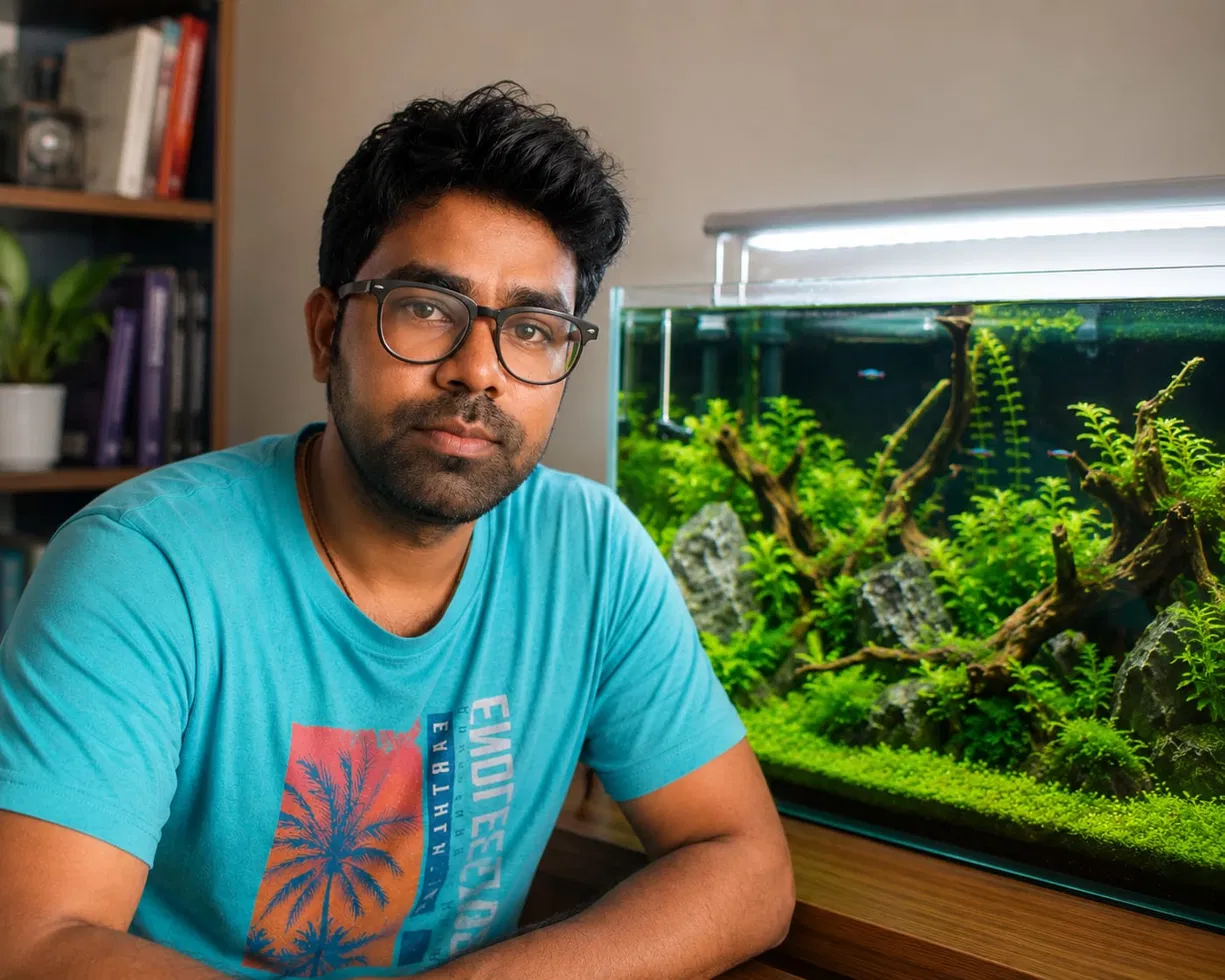
Anil Satak M.Sc. Zoology · Founder, FishioHub
Grew up in a fishing family in India and holds a Master's in Zoology. FishioHub is a one-person operation - every guide is personally researched, kept-tested, and written by Anil. No team, no outsourced writers, no AI-generated content. Read his full bio →