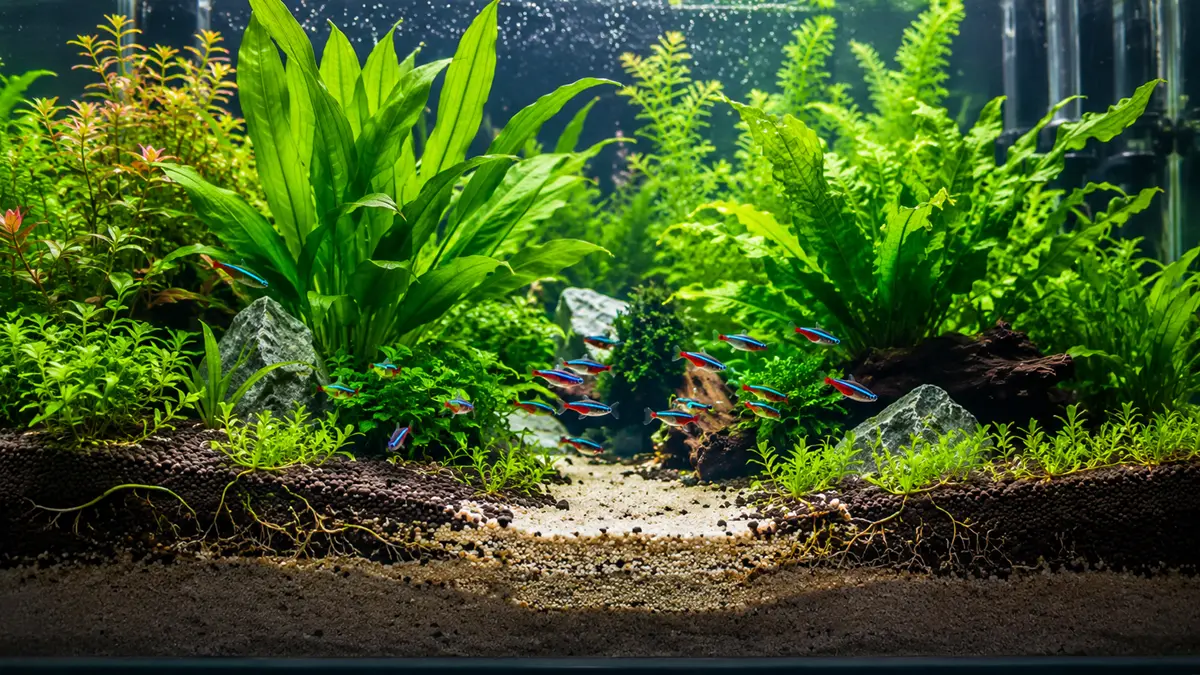
⚡ Quick Summary Fact Card:
How to fertilize aquarium plants naturally: feed nutrients through fish waste, a mineral-rich substrate, root tabs, and decaying leaf litter instead of bottled liquid ferts. This supplies nitrogen, phosphorus, potassium, iron, and trace elements while keeping fish and shrimp completely safe.
- 🚫 Zero synthetic chemicals, safe for shrimp and snails
- 🐟 Fish waste = free nitrogen + phosphorus
- 🪨 Nutrient-rich substrate = long-term iron + potassium
- 🌿 Root tabs = targeted feeding for heavy root feeders
- 🍂 Leaf litter = slow-release micronutrients
- ⏱️ Visible results in 2–4 weeks with consistent care
I’ve lost count of how many yellowing aquarium plants I’ve been sent photos of over the years, and almost every time, the real problem isn’t a nutrient deficiency at all. It’s panic. Someone spots one pale leaf, dumps in a full capful of liquid fertilizer to “fix” it fast, and triggers an algae bloom within days. My M.Sc. in Zoology, plus a childhood spent around water in a fishing family back in India, taught me the opposite lesson early: plants don’t need synthetic shortcuts. They need what their ecosystem already provides.
How to fertilize aquarium plants naturally means feeding nutrients through fish waste, a mineral-rich substrate, root tabs, and decaying leaf litter instead of synthetic liquid fertilizer — supplying nitrogen, phosphorus, potassium, and iron without the algae spikes or shrimp risks that come with bottled products.
In this guide, I’ll walk you through the exact natural fertilizers for aquarium plants I rely on myself — real aquatic plants fertilizer sources, proven methods, and the mistakes that quietly kill more tanks than any deficiency ever could.
Why Aquarium Plants Need Fertilization(And Why “Just Add Fish” Isn’t Enough)
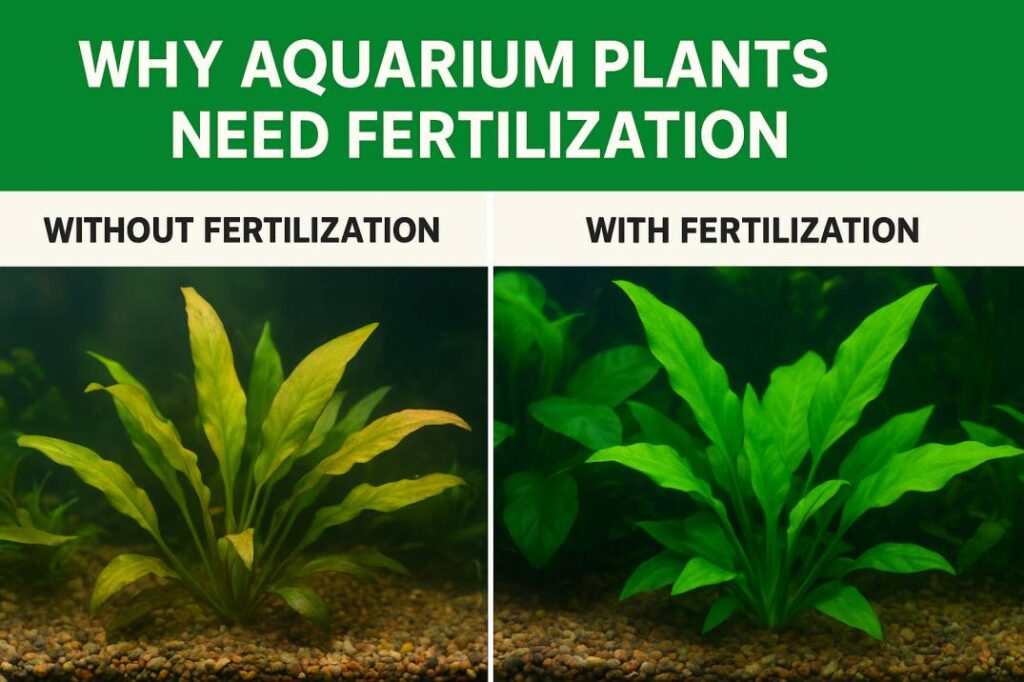
Here’s the myth I hear constantly: “My fish poop, so my plants are fed.” Partly true — and partly how tanks end up with stunted, holey leaves.
Why Aquarium Plants Need Fertilization comes down to basic plant biology. Aquatic plants pull nutrients from three places:
- The water column (leaves absorb dissolved nutrients directly)
- The substrate (roots pull nutrients from below)
- Fish waste and decaying organic matter
The problem is fish waste is nitrogen- and phosphorus-heavy but almost always short on potassium, iron, and magnesium — the exact nutrients your plants need for strong stems, deep color, and disease resistance. A closed aquarium isn’t a river. Nothing new washes in. Once those trace nutrients are used up, plants start showing it:
- Yellow or nearly transparent leaves (classic nitrogen deficiency)
- Holes or melting leaves, especially on Amazon swords
- Stunted growth with tiny new leaves
- An algae bloom that shows up right when your plants stall out
That last point matters more than most guides admit: algae doesn’t appear because you fertilized — it appears when your plants are too weak to out-compete it. A thriving plant chemically suppresses algae through allelopathy (plants releasing natural compounds that inhibit algal growth). A starving plant does the opposite.
Best Natural Nutrients for Aquarium Plants: What’s Actually in the Water

Best Natural Nutrients for Aquarium Plants fall into three groups, and skipping any one of them is the #1 reason “natural” tanks stall out.
Macronutrients (needed in real quantity)
- Nitrogen (N) — leaf and stem growth, chlorophyll production
- Phosphorus (P) — root development and energy transfer
- Potassium (K) — the nutrient fish waste almost never covers; without it, older leaves get pinholes and yellow edges even when everything else looks fine
Micronutrients (small amounts, still essential)
- Iron — comes in two forms. Ferrous iron (Fe²⁺) is what plants can actually use, but it oxidizes into unusable ferric iron (Fe³⁺) within hours once oxygen and pH climb above 7.4. This is exactly why iron delivered through a low-oxygen substrate works better than iron dosed into open water — the substrate protects it long enough for roots to grab it.
- Magnesium — the nutrient every beginner forgets. Without it, leaf veins stay green while the tissue between them yellows (interveinal chlorosis).
- Calcium and manganese — usually sufficient from tap water unless you’re running RO/DI
Carbon (the nutrient nobody talks about)
Carbon dioxide is arguably the most limiting nutrient in a natural setup, supplied through fish respiration, surface agitation control, and a healthy bacterial colony. Skip this and even perfect NPK dosing won’t push growth past a crawl.
A tank that’s missing even one of these three groups plateaus — you’ll add more nitrogen thinking that’s the fix, and nothing improves, because potassium or iron was the actual bottleneck the whole time.
Natural Fertilizers for Aquarium Plants: 5 Methods That Actually Work
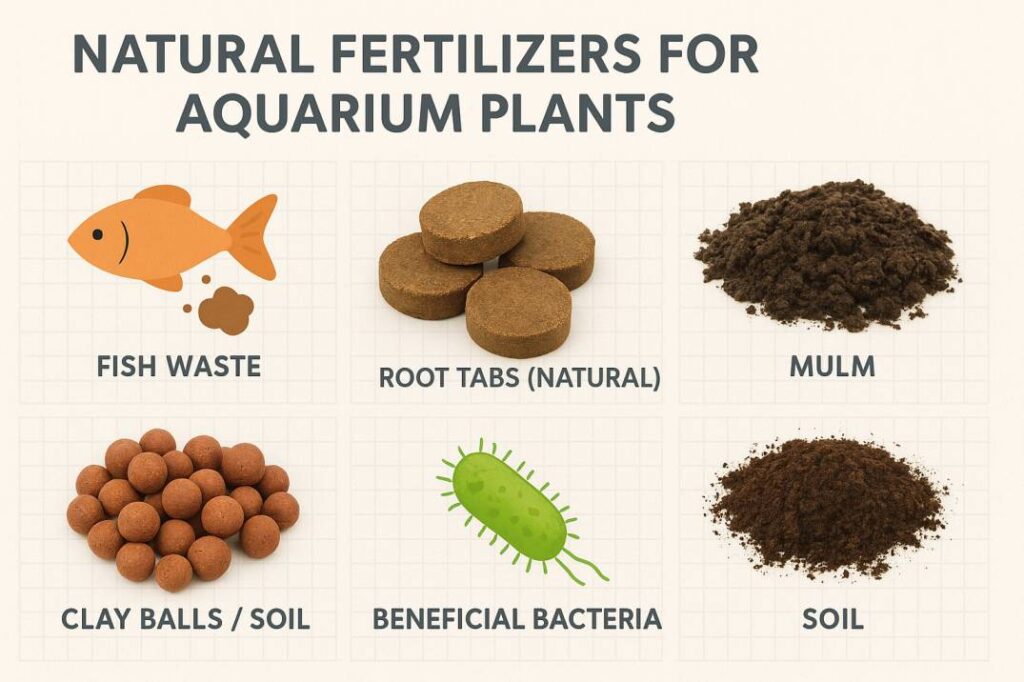
Natural Fertilizers for Aquarium Plants aren’t a single product — they’re a stack of habits. Here’s what I run, ranked by how much each one moves the needle.
1. Fish Waste (Your Free, Constant Nitrogen Source)
Slight under-cleaning genuinely beats over-cleaning in a planted tank. Fish waste supplies steady nitrogen and phosphorus and feeds the beneficial bacteria your filter depends on. The mistake I see constantly: people vacuum every trace of mulm out of a heavily planted substrate, then wonder why growth crashed the next week.
2. Nutrient-Rich Substrate (Your Long-Term Fertilizer)
This is the single highest-leverage decision you’ll make before you even add water. Options that actually deliver:
- Organic soil capped with sand or fine gravel
- Clay-based aquasoils (ADA Amazonia, UNS Controsoil, and similar products are widely stocked at U.S. specialty retailers)
- Mineralized topsoil for experienced keepers
A warning most guides skip: fresh aquasoil leaches ammonia for the first 2–4 weeks. If you add fish immediately, you risk an ammonia spike. Cycle the tank first, or use hardy plants only until levels stabilize.
3. Root Tabs (Semi-Natural, Extremely Effective)
Root tabs aren’t fully “DIY,” but they’re inert, safe, and solve the phosphate/iron problem substrate alone can’t fix long-term. Push them near the root zone of heavy feeders — Amazon swords, crypts, and Vallisneria — and replace them every 2–3 months. Brands like NilocG Thrive Root Tabs and Aquarium Co-op Root Tabs are common at U.S. pet retailers and typically run $8–15 for a pack of 25.
4. Leaf Litter and Driftwood (The Overlooked Micronutrient Source)
Indian almond leaves, boiled oak leaves, and Mopani driftwood slowly release tannins and trace minerals as they break down. This isn’t just aesthetic — it’s a genuine, slow-release nutrient source that also softens water slightly and supports beneficial microbial films on the leaf surface.
5. DIY Natural Fertilizer for Aquarium Plants
For more advanced keepers: mineralized soil balls, clay plus trace-mineral mixes, or heavily diluted compost tea. Handle these carefully — undiluted compost tea is one of the fastest ways to trigger an ammonia spike I’ve seen readers report.
How to Fertilize Aquarium Plants Naturally: Step-by-Step
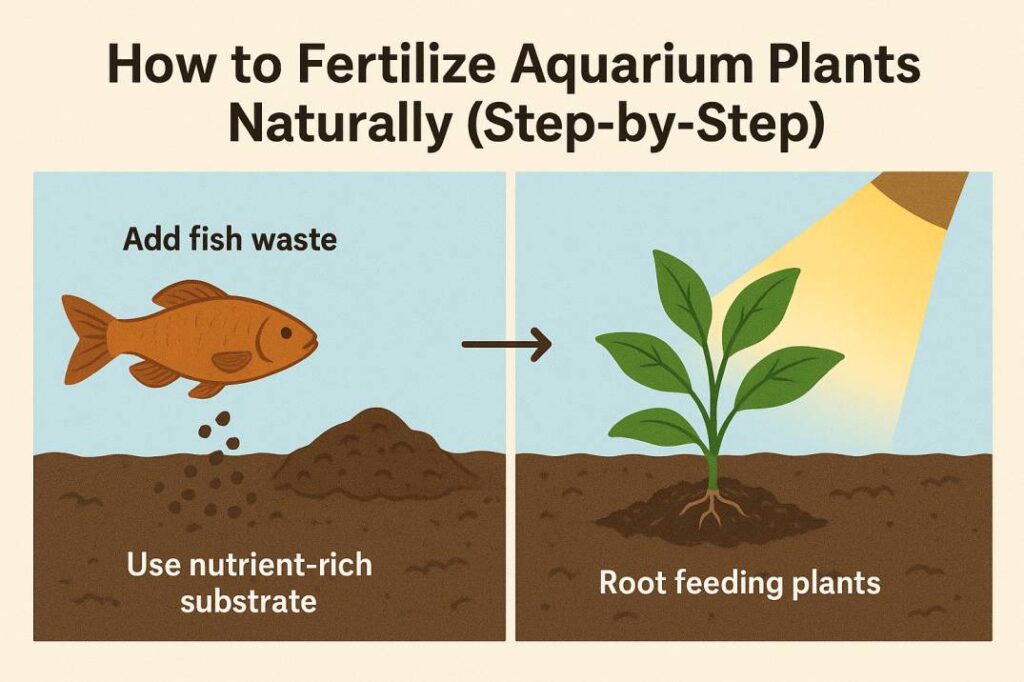
- Choose a nutrient-rich substrate before adding water
- Stock fish moderately — don’t overstock hoping for “more fertilizer”
- Feed fish a consistent, moderate amount (excess food = excess ammonia, not extra plant food)
- Push root tabs near heavy root feeders only
- Run 6–8 hours of consistent lighting daily
- Do 20–30% water changes weekly to reset trace mineral balance
- Resist the urge to deep-clean the substrate every week
This sequence is the backbone of how to fertilize aquarium plants naturally, and it works whether you’re running a 10-gallon nano or a 55-gallon community tank.
The First 24 Hours: What to Do the Moment You Notice Deficiency
Most guides never tell you what to actually do in the moment you spot a problem. Here’s the sequence:
- Identify the symptom first. Yellow older leaves with green veins? Iron or magnesium. Pinholes on older leaf edges? Potassium. New growth stunted and pale? Nitrogen.
- Check your substrate age. If it’s under 6 weeks old, don’t add more nutrients — you’re probably dealing with leftover ammonia, not deficiency.
- Add a root tab near the affected plant if it’s a root feeder, or increase leaf litter if it’s a water-column feeder.
- Wait 7–10 days before judging results. Plants don’t respond overnight, and adding more “just in case” during that window is how algae blooms start.
- Only then adjust your weekly routine if the same symptom returns.
What I Got Wrong My First Time
I did not forgot my planted 20-gallon tank was a disaster. I wanted a lush jungle but wanted to keep it strictly natural. I bought organic root tabs and stuffed them deep into the substrate. Unfortunately, I placed them right next to my Cherry Shrimp colony.
Within two days, the nutrients leeched and turned my water a muddy brown. The sudden spike in nitrates wiped out half my shrimp overnight. I also misread my melting wisteria leaves as “old age.” It was actually a severe potassium deficiency. I learned the hard way that natural methods still require strict precision.
USA Buyer’s Note: What’s Actually Worth Buying
Most “natural fertilization” guides are written by hobbyists outside the U.S., so the products they reference aren’t always what’s sitting on a Petco or PetSmart shelf. Here’s what’s realistically available and reasonably priced for American keepers:
- Root tabs: NilocG Thrive Root Tabs, Aquarium Co-op Root Tabs — both under $15 for 25 tabs, widely available online and in specialty stores
- Aquasoil: Fluval Stratum and UNS Controsoil are common at chain pet stores; ADA Amazonia is the higher-end option usually ordered online
- Leaf litter: Indian almond leaves are sold in bulk packs (50+ leaves) for $10–12 on Amazon and at specialty aquascaping shops
- Water testing: API Freshwater Master Test Kit remains the standard for checking ammonia during the first weeks of a fresh aquasoil setup
If a product isn’t stocked locally, most of these ship within 2–3 days through major online aquarium retailers — no need to substitute with garden-center fertilizer, which is a common and risky shortcut some forums recommend.
Natural CO₂ Boosting Methods (Without Injected CO₂)
For low-tech tanks, natural carbon sources include:
- Fish respiration (a genuinely meaningful CO₂ contributor in a moderately stocked tank)
- Controlled surface agitation — too much off-gasses CO₂ before plants can use it
- A mature, healthy bacterial colony
- Moderate plant density, which raises local CO₂ concentration around leaves
A stable natural CO₂ supply won’t match a pressurized system, but it’s more than enough for hardy species like Anubias, Java fern, and Cryptocoryne — which is exactly why I recommend beginners start there rather than chasing carpeting plants that demand injected CO₂.
Common Mistakes to Avoid
- Over-fertilizing “naturally.” Yes, it’s possible — too many root tabs or too much leaf litter at once still spikes nutrients.
- Adding compost directly to water. Always diluted, always tested first.
- Running excessive lighting without matching nutrients. Light without fuel just feeds algae faster than plants.
- Over-cleaning the substrate. You’re removing the nutrient bank you just built.
- Ignoring early deficiency signs. A single yellow leaf is a warning, not an emergency — but three yellow leaves across different plants means your routine needs adjusting now.
Fertilizing naturally doesn’t mean uncontrolled fertilization — it means matching input to what your specific tank actually needs.
Pro Tips to Get the Best Results
- Start with forgiving plants: Anubias, Java fern, Cryptocoryne
- Keep lighting consistent at 6–8 hours daily — inconsistency confuses both plants and algae control
- Check new leaves weekly, not the whole plant — new growth shows deficiency first
- Be patient. Natural growth is slower, but the resulting plants are noticeably hardier long-term
- Pick one method, run it for a full month, and adjust gradually — don’t stack five new inputs at once
FAQs — Natural Aquarium Plant Fertilization
Q1. How do I fertilize aquarium plants naturally without buying anything?
Use existing fish waste, add leaf litter like Indian almond leaves, and choose a nutrient-rich substrate from the start. This covers nitrogen, phosphorus, and slow-release micronutrients without a single bottled product.
Q2. How often should I fertilize a naturally run planted tank?
Root tabs need replacing every 2–3 months. Leaf litter can be topped up as it breaks down, roughly monthly. There’s no daily dosing involved — that’s the entire point of a natural setup.
Q3. Is natural fertilization safe for shrimp and snails?
Yes, and it’s actually safer than liquid dosing. Concentrated liquid ferts pose a real risk to sensitive shrimp if overdosed; root tabs and substrate nutrients release far more gradually.
Q4. What’s the biggest beginner mistake with natural fertilization?
Adding fish immediately to a tank with fresh aquasoil. New aquasoil leaches ammonia for 2–4 weeks — cycle first, or you risk poisoning the exact fish you’re trying to keep.
Q5. Can I combine natural methods with a commercial liquid fertilizer?
Yes, but dose conservatively. Fish waste and substrate already supply a baseline; stacking a full commercial dose on top is the most common cause of surprise algae blooms in otherwise healthy tanks.
Q6. Where can I actually buy root tabs and aquasoil in the USA?
Petco and Petsmart carry basic root tabs and Fluval Stratum in-store. For wider selection (NilocG, UNS Controsoil, ADA Amazonia), online specialty retailers ship within a few days.
Q7. Do low-tech tanks without CO2 injection still need fertilization?
Yes, but demand is lower. Root tabs plus fish waste is usually enough — heavy dosing on a non-CO2 tank almost always feeds algae faster than it feeds plants.
Next Steps: Resources You Must Read
- How to Plant Freshwater Aquarium Plants — the setup steps that make fertilization actually work
- How to Prevent Aquarium Algae — what to do if your fertilization routine tips into an algae bloom
- How to Remove Ammonia From a Fish Tank Naturally — essential reading if you’re using fresh aquasoil
🌿 Final Word
Natural fertilization isn’t about doing less — it’s about feeding your tank the way its biology already expects to be fed. Fish waste, substrate, root tabs, and leaf litter cover everything a natural fertilizers for aquarium plants routine needs, without a single synthetic bottle. Give it a month, watch the new growth, and adjust from there.
SCIENTIFIC REFERENCES
- Gosselin, C. (2020). Effects of Substrate Nutrients on Growth of Three Submersed Aquatic Plants — University of Florida study finding ammonium nitrogen produced roughly double the growth rate of urea nitrogen and six times the growth rate of an equal amount of nitrate nitrogen in pondweed, hydrilla, and southern naiad.
- Nichols, D.S., & Keeney, D.R. (1976). Foliar uptake study on Eurasian water milfoil showing ammonium absorption occurred several times faster than nitrate absorption when both forms were present.
Was this guide helpful?
First-Hand Experience
Based on animals I've personally kept and bred - not summarized from other articles.
Zoological Foundation
Claims are checked against my M.Sc. Zoology training and published aquatic biology research, not recycled aquarium myths.
No Paid Influence
No sponsorship shaped this guide. Affiliate links, if any, are disclosed separately and never hidden.
Kept Current
Errors are corrected as soon as they're found, with the update noted at the bottom of the article.
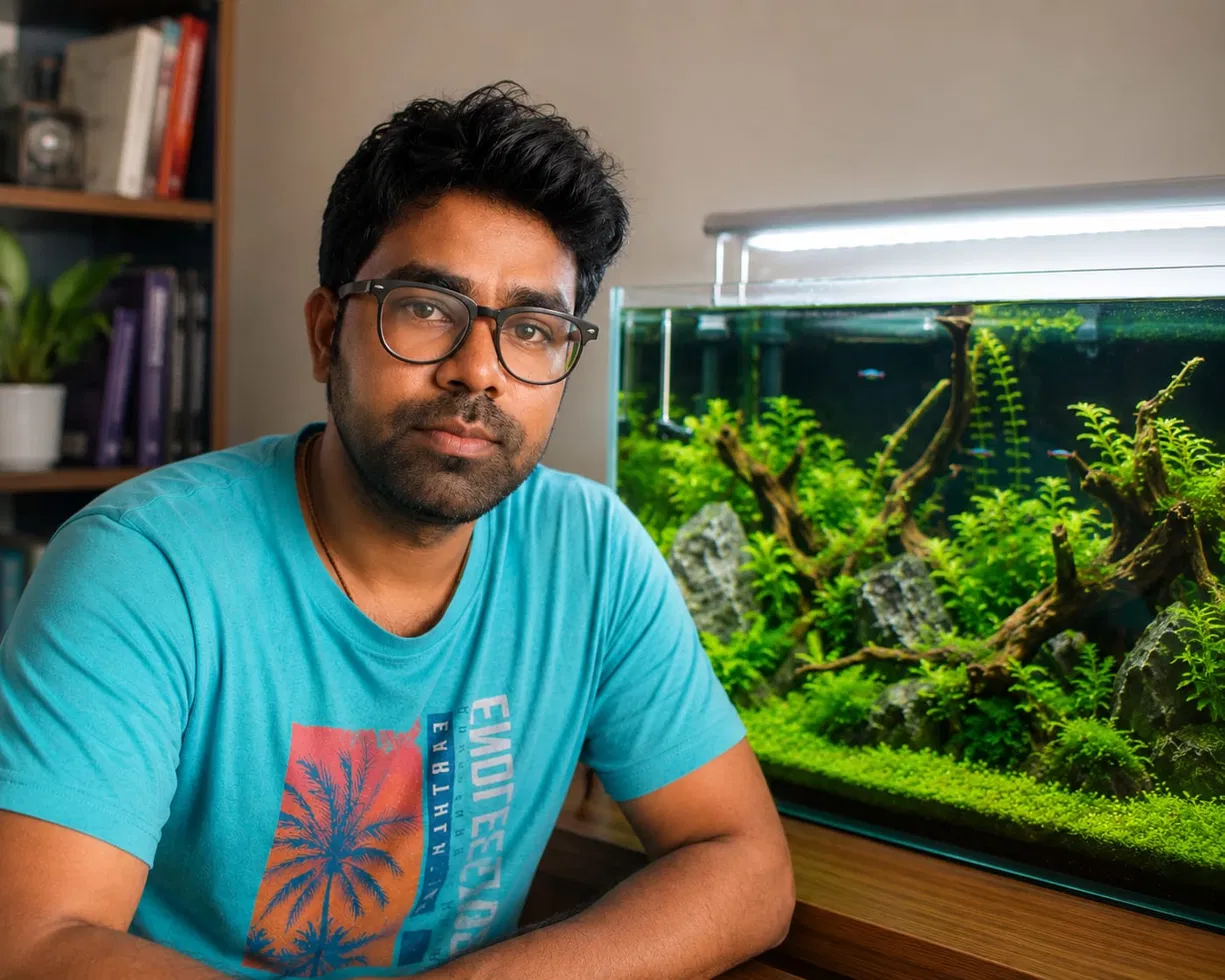
Anil Satak M.Sc. Zoology · Founder, FishioHub
Grew up in a fishing family in India and holds a Master's in Zoology. FishioHub is a one-person operation - every guide is personally researched, kept-tested, and written by Anil. No team, no outsourced writers, no AI-generated content. Read his full bio →