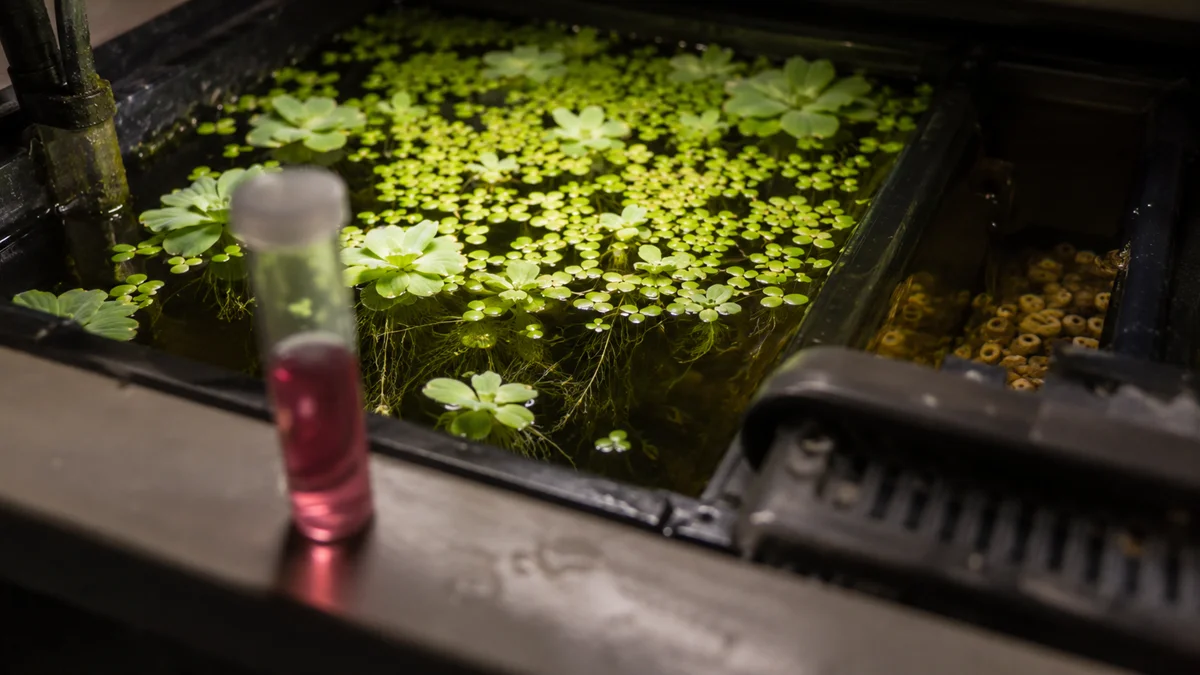
Duckweed nitrate removal gets recommended in nearly every high-nitrate thread, almost always with zero numbers attached. How much duckweed. How fast. Whether it’s doing anything, or just sitting there while your water changes do the real work. Here’s the real research, the catch most articles skip, and a protocol you can run yourself.
What the Duckweed Nitrate Removal Research Actually Found
A phytoremediation study gives a specific, testable claim to work from: water lettuce and duckweed pulling nitrate most efficiently at pH 7, with removal peaking around day 12 before plateauing. That’s precise enough to actually test, which is rare for this kind of hobby advice.
A few other findings worth knowing:
- pH 7 was the uptake sweet spot — removal efficiency for both nitrate and several heavy metals was highest right around neutral pH, which happens to be where most community freshwater tanks already sit.
- Removal peaked around day 12, then plateaued or started reversing as the plant tissue became saturated — meaning there’s a harvest window, not an indefinite “set and forget” filter.
- Separately, a peer-reviewed study specifically on ornamental fish production tanks found nitrate levels in plant-containing tanks rose significantly more slowly than in unplanted control tanks over time — real evidence this isn’t just a hobbyist myth, even if it’s not a guarantee of dramatic results.
- A comparative wastewater study ranked water hyacinth highest for nitrogen removal, with duckweed and water lettuce performing similarly to each other, meaningfully behind water hyacinth but still measurably effective.
Why Real-World Results Vary So Much
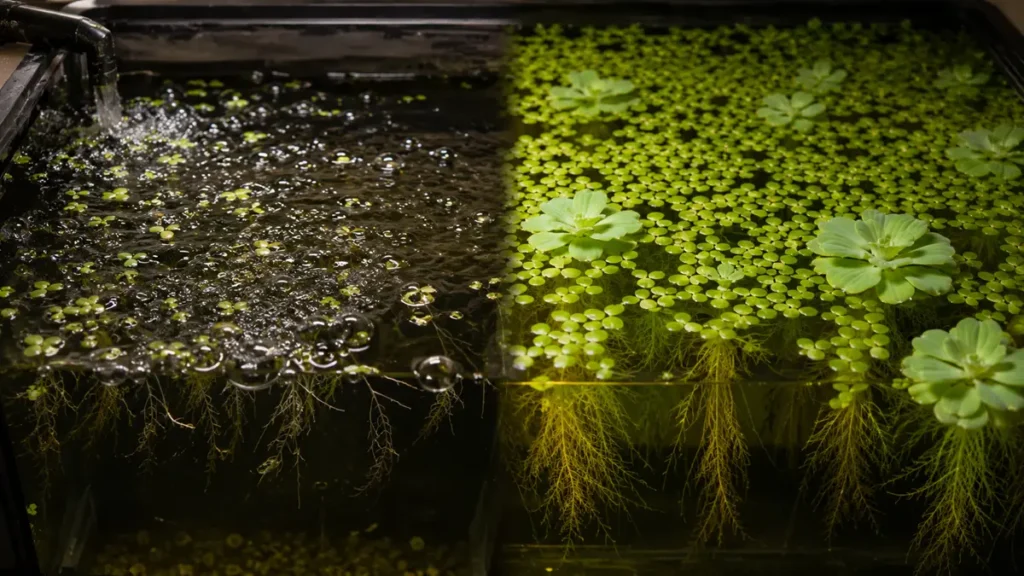
This is the part almost nobody writing about duckweed nitrate removal mentions, and it’s the reason forum reports are so mixed. Multiple hobbyists report duckweed and water lettuce doing very little for their nitrate — while others report a real, visible difference. The likely explanation: surface water movement.
Floating plants that get pushed around by filter output, a spray bar, or a strong surface skimmer don’t establish the same stable root mass as ones sitting in calm water — and root mass is where most of the nutrient uptake actually happens. If your tank runs a strong surface agitation setup, I’d skip floating plants entirely until you can section off a calmer spot. Throwing duckweed into fast-moving surface water and expecting research-level results sets you up to conclude “it doesn’t work,” when it never had a fair shot.
Comparing Your Floating Plant Options
Duckweed and water lettuce aren’t the only choices, and they’re not automatically the best fit for every tank. Here’s how the common floating plants stack up on the two variables that actually matter — flow tolerance and how fast they get away from you:
| Plant | Flow tolerance | Growth rate | Worth knowing |
| Duckweed | Tolerates more surface movement than most floaters | Extremely fast — can cover a tank in days | Notoriously hard to fully remove once established; near-impossible to eradicate by hand |
| Water lettuce | Sensitive — leaves rot if kept consistently wet on top | Moderate | Illegal or restricted to grow outdoors in several US states; check local regulations |
| Frogbit | Moderate tolerance | Fast | Leaves also rot under direct surface splash; needs a calm patch |
| Red Root Floater | Low tolerance — easily stunted by agitation | Slower, more manageable | Best color and growth under iron-rich water and stable, calm conditions |
| Salvinia | Moderate tolerance | Fast | Water-repellent leaf texture; well regarded for nutrient uptake but has less formal research behind it than duckweed |
Water hyacinth, despite ranking highest in nitrogen removal in the research above, isn’t on this table as a realistic hobbyist recommendation — it’s classified as a noxious invasive species and restricted or illegal to grow in many US states.
What Nobody Tells You About the Downsides
Every article pushing floating plants as a nitrate fix skips the tradeoffs. Worth knowing before you commit a chunk of your tank’s surface to them:
- They block light to anything growing underneath. If you’re running substrate plants that need strong light, a thick floating-plant mat can starve them — this is a real tradeoff, not a hypothetical one.
- Some species are genuinely hard to get rid of. Duckweed in particular has a reputation for being nearly impossible to fully remove once it’s established in a tank, since a single stray plant can repopulate the entire surface within days.
- Floating plants have a real access advantage over submerged plants worth understanding: roughly half of a plant’s mass comes from carbon absorbed via CO2, and floating plants draw that CO2 directly from the air — where it’s present at roughly 400 parts per million — rather than from water, where dissolved CO2 typically sits at only 1–2 ppm. This is part of why floating plants often out-compete submerged plants for growth speed and nutrient uptake.
- Overnight oxygen competition is a real, if often overstated, concern in heavily-planted tanks — dense plant mass consumes oxygen in the dark hours, just as your fish do.
How to Test Duckweed Nitrate Removal Yourself
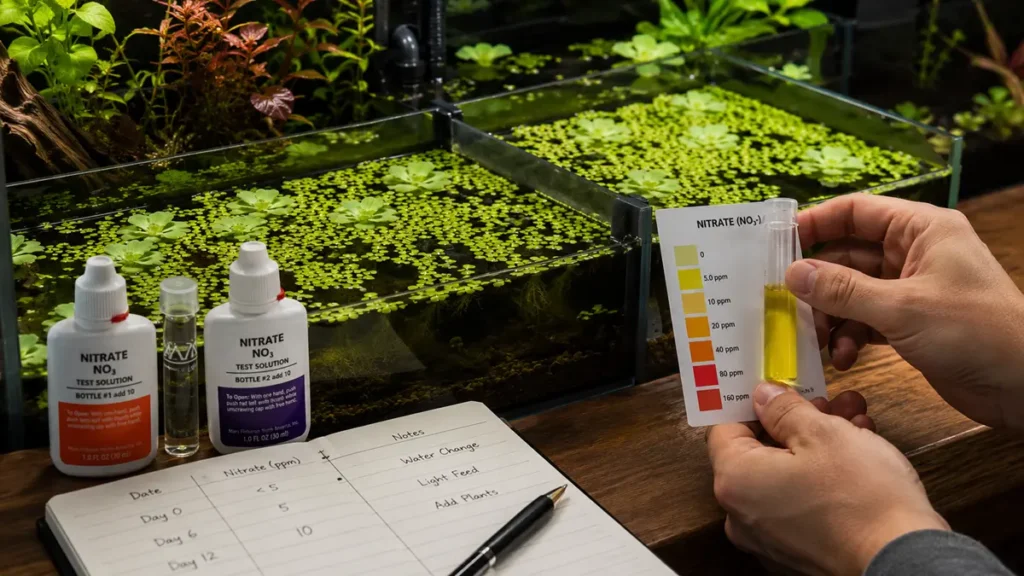
Here’s the actual protocol, built directly from the research above, that you can run in your own tank:
Setup:
- Choose a section of tank or sump with calm surface water — away from filter output, spray bars, or air stones
- Confirm your pH sits at or near 7 before starting, since that’s the study’s stated uptake optimum
- Add duckweed, water lettuce, or both, covering roughly a third of that section’s surface to start
- Take a baseline photo if you want a visual record
Testing schedule — same test kit, same time of day each time, for consistency:
| Day | Nitrate (ppm) | pH | Notes |
| Day 0 | starting point, before plants go in | ||
| Day 6 | midpoint check | ||
| Day 12 | the research’s cited peak-effect day |
How to interpret what you see: a clear, steady drop by day 12 tracks the research closely. A smaller or inconsistent change doesn’t necessarily mean the plants “don’t work” — check your surface flow first, since that’s the single biggest variable separating strong results from weak ones in hobbyist reports. Either outcome is useful information about your specific tank.
The Harvest Rule
Whatever your results show, this part holds regardless: the research found removal peaking around day 12, then declining as plant tissue saturates and can start releasing nutrients back into the water. The practical rule that follows: pull roughly a third of the plant mass every 10–12 days and replace it with fresh growth, rather than letting the same plants sit indefinitely. Treat floating plants used for nitrate control as a rotating crop, not a permanent fixture.
FAQ
Does Duckweed Nitrate Removal actually work to remove nitrate from aquarium water?
The evidence is real but not universally strong — a peer-reviewed study on ornamental fish tanks found nitrate rose more slowly in plant-containing tanks than in unplanted controls, but multiple hobbyist reports describe minimal effect unless surface water movement is kept low. Results likely depend heavily on tank-specific conditions.
Is water lettuce or duckweed better for nitrate removal?
Comparative studies on nutrient removal generally rank water hyacinth highest, with duckweed and water lettuce performing similarly to each other, meaningfully lower than water hyacinth but still measurably effective. Water hyacinth is restricted or illegal to grow in many US states, which makes water lettuce or duckweed the more realistic hobbyist choice.
What’s a better floating plant if my tank has strong surface flow?
Duckweed tolerates more surface movement than water lettuce, frogbit, or red root floater, all of which are prone to leaf rot or stunted growth under direct splash or agitation. If your flow can’t be reduced, duckweed is the more forgiving starting point.
Why does surface water movement affect how well floating plants work?
Multiple hobbyists report duckweed and water lettuce underperforming in tanks with strong surface flow, likely because the plants get pushed around and can’t establish the stable root mass needed for consistent nutrient uptake.
How often should I harvest floating plants used for nitrate control?
Roughly a third of the plant mass every 10–12 days, based on research showing nutrient removal efficiency peaking around day 12 before plateauing or reversing as the plant tissue saturates.
Will floating plants block light to my other aquarium plants?
Yes, a dense floating mat reduces light reaching anything growing underneath. If you’re running light-demanding substrate plants, this is a genuine tradeoff to weigh, not a minor detail.
Is duckweed hard to get rid of once it’s established?
Yes — duckweed has a strong reputation among hobbyists for being extremely difficult to fully remove, since even a few stray plants left behind can repopulate an entire tank’s surface within days.
What Next to Read
Resources from FishioHub:
- Aquarium Bioload 101 — the broader mechanism behind why nitrate creeps up in the first place.
- 1 Inch of Fish Per Gallon Rule — if overstocking is the real source of the nitrate problem, not something floating plants alone can offset.
Scientific resources:
- Removal of nitrate and phosphate by aquatic plants during aquarium-based ornamental fish production. North American Journal of Aquaculture.
- Performance assessment of aquatic macrophytes for treatment of municipal wastewater.
Was this guide helpful?
First-Hand Experience
Based on animals I've personally kept and bred - not summarized from other articles.
Zoological Foundation
Claims are checked against my M.Sc. Zoology training and published aquatic biology research, not recycled aquarium myths.
No Paid Influence
No sponsorship shaped this guide. Affiliate links, if any, are disclosed separately and never hidden.
Kept Current
Errors are corrected as soon as they're found, with the update noted at the bottom of the article.
Anil Satak M.Sc. Zoology · Founder, FishioHub
Grew up in a fishing family in India and holds a Master's in Zoology. FishioHub is a one-person operation - every guide is personally researched, kept-tested, and written by Anil. No team, no outsourced writers, no AI-generated content. Read his full bio →