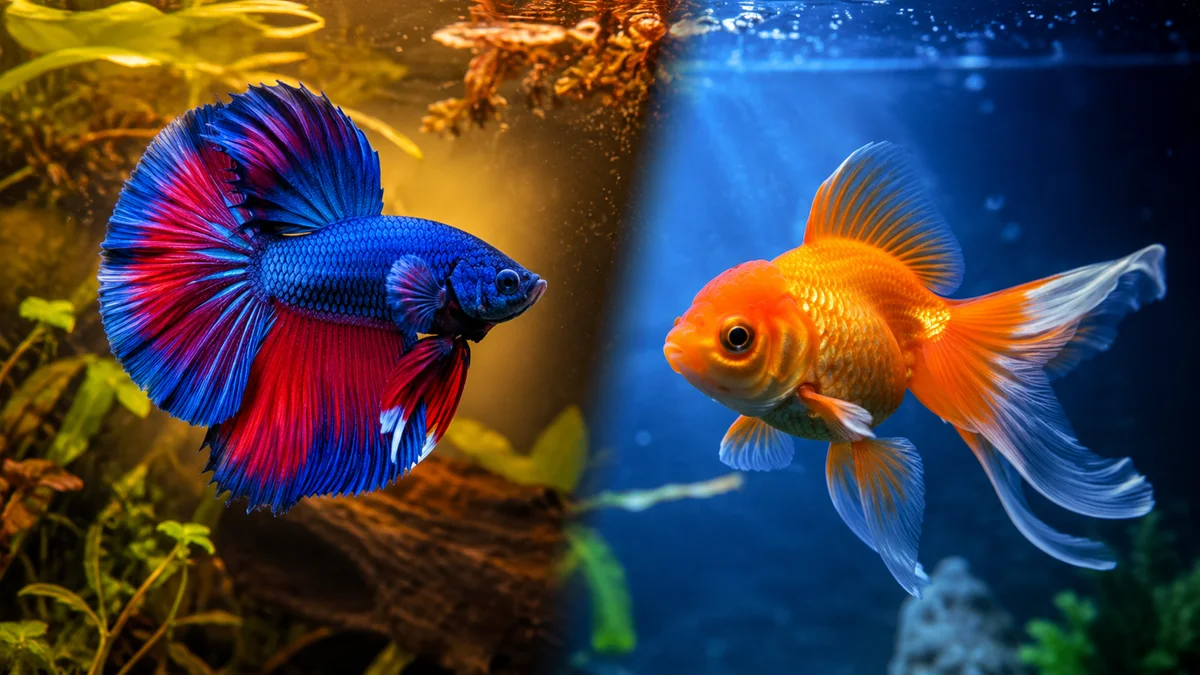
Can Goldfish Live With Betta Fish? No — goldfish and betta fish shouldn’t share a tank. One needs warm tropical water, the other needs cool, cold-water conditions, and there’s no single setup that does right by both.
Once my friend gifted me a beautiful goldfish, I immediately thought of putting him in with Raja(betta). I even had the bag floating in Raja’s heated tank before I looked at Raja, looked at the goldfish, and realized I was about to sentence a cold-water fish to a tropical sauna.
That’s the blunt version. The fuller answer is more interesting, because this pairing isn’t a case of two fish that hate each other on sight — it’s two fish built by evolution for opposite water. That mismatch causes problems slowly, not always immediately. Here’s everything that’s actually going on underneath the question.
If you only remember 3 things
- Temperature conflict: Bettas need warm water around 78–80°F. Goldfish do best below 75°F, often in even cooler water. There’s no shared setting that’s right for both.
- Bioload conflict: Goldfish are heavy waste producers that need far more filtration and space than a typical betta tank provides.
- Behavior conflict: Bettas are territorial and read long, flowing fins as a threat display — which describes most fancy goldfish varieties.
Betta and Goldfish: Why This Pairing Keeps Coming
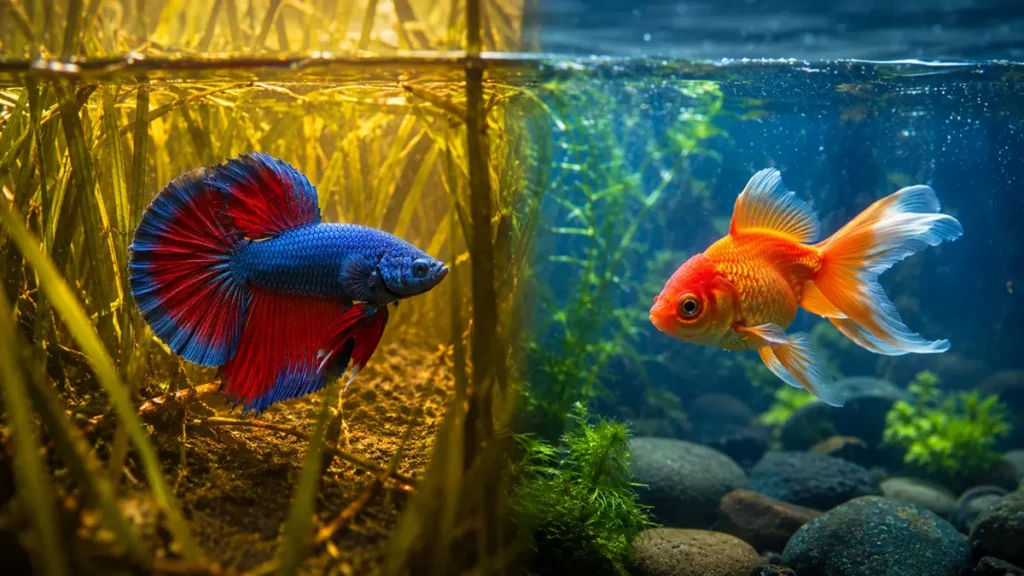
If you’ve landed here, chances are you already own one of these fish and just fell for the other one at the store — the betta and goldfish combination is one of the most common “can I combine these two” questions in the hobby, and it’s an easy trap to fall into. They’re often a new fishkeeper’s first two fish, bought weeks apart, and adding the second one to the first tank feels efficient. The problem is that these two species evolved for completely different water.
Bettas (Betta splendens) are native to the shallow rice paddies, ditches, and slow-moving streams of Thailand, Cambodia, Laos, and Vietnam — a tropical climate where, as National Geographic notes, bettas prefer warm water around 80°F.
Goldfish (Carassius auratus) come from a completely different thermal world. They’re a classic cold-water species, and researchers studying their thermal tolerance found critical minimum temperatures ranging from about 0.3°C to 12.6°C and critical maximums from roughly 30.8°C to 43.6°C depending on acclimation — with acclimation temperature alone explaining about 90% of the variation in what individual goldfish could tolerate.
That wide range is exactly why goldfish thrive in a chilly outdoor pond, but it also means their comfortable zone sits well below what keeps a betta healthy.
Betta Fish and Goldfish: The Water Chemistry Problem
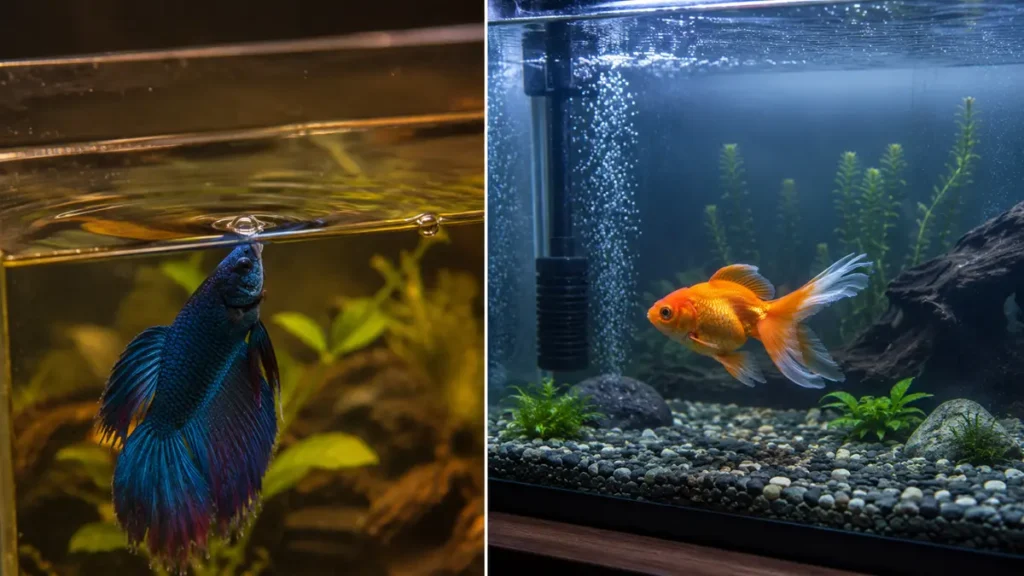
Betta fish and goldfish don’t just disagree on temperature — they disagree on how dirty the water is allowed to get before it becomes dangerous. Bettas can tolerate and survive in adverse water quality thanks to their labyrinth organ, which lets them gulp air at the surface even when oxygen runs low.
Goldfish don’t have that advantage, and my experiences taught me that very well. They’re famously heavy waste producers. Fish ammonia physiology research has found that in goldfish specifically, the liver alone is responsible for 50–70% of total ammonia production — part of why a single fancy goldfish is typically recommended a 20-gallon-plus tank on its own, far more than most betta setups provide.
Put a goldfish into a 5- or 10-gallon betta tank and ammonia climbs fast, no matter how the two fish are getting along.
Will a Betta Fish Kill a Goldfish?
Will a betta fish kill a goldfish is the version of this question worried new owners ask most, and the honest answer is: it’s possible, but I never noticed that and found such an example anywhere on social platforms. It’s usually death by a thousand nips instead.
Betta are territorial, and males in particular rely on fin-flaring, lateral displays, and biting as their core aggression toolkit against anything they read as a rival. Peer-reviewed behavior research on Betta splendens has documented that visual displays like fin spreading and opercular flaring exist specifically to intimidate rivals, with biting kicking in as the primary attack behavior once a display escalates.
A fancy goldfish’s long, trailing tail can visually resemble another betta’s fins — precisely the kind of shape that triggers chasing and nipping, not because the betta is hunting the goldfish, but because it’s reading a territorial challenge that isn’t actually there.
Do Goldfish Eat Betta Fish?
Do goldfish eat betta fish is the reverse worry, and it’s a much smaller risk than the other direction. Goldfish are omnivorous opportunistic feeders, not built to hunt another fish down.
A goldfish is far more likely to nibble a betta’s fins out of curiosity, or mistake trailing fins for food, than to actively pursue and kill it. That said, “unlikely to kill” isn’t the same as “safe” — fin damage from an inquisitive goldfish still opens the door to fin rot and secondary infections in an already-stressed betta.
Can Goldfish Survive With Betta Fish?
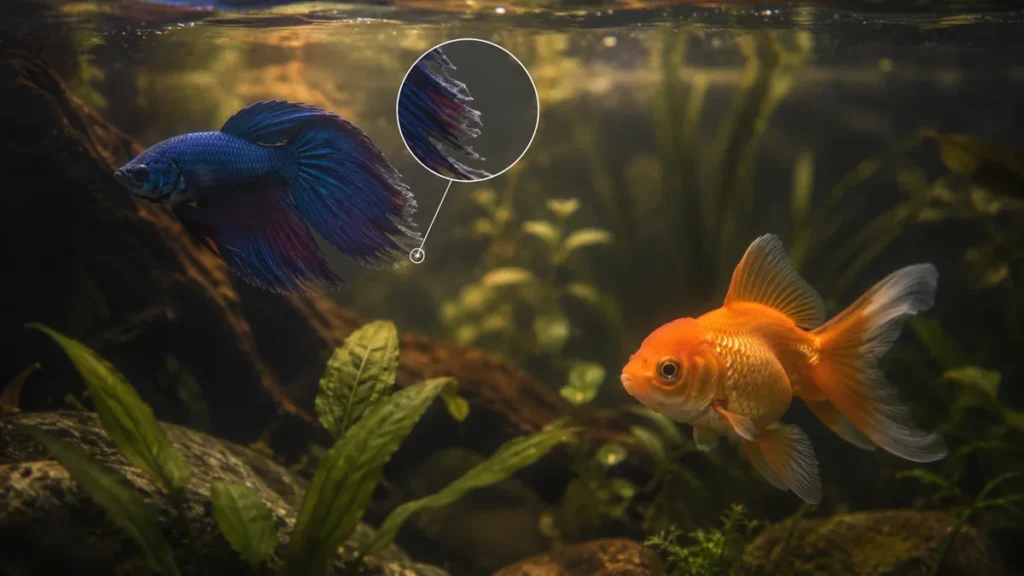
Can goldfish survive with betta fish, at least for a while? Often, yes — you’ll find plenty of forum photos of a goldfish and betta coexisting peacefully for weeks at a time. But “survived so far” isn’t the same as “suitable long-term setup.”
The mismatch in temperature and water quality needs means one or both fish are being kept outside their comfort zone continuously, and that tends to show up later as stress, stunted growth, or a weakened immune system rather than a fight on day one. If your tank looks fine right now, that’s not proof the pairing is working — it’s often just proof the damage hasn’t surfaced yet.
Betta Fish vs Goldfish: Side-by-Side Care Comparison
| Care Requirement | Betta (Betta splendens) | Goldfish (Carassius auratus) |
| Ideal temperature | ~78–80°F (tropical) | Below 75°F (cold-water) |
| Minimum tank size | 5+ gallons | 20+ gallons per fish |
| Waste/bioload | Moderate | Heavy |
| Temperament | Territorial, can be aggressive | Peaceful, but nippy out of curiosity |
| Fin type risk | Long fins can trigger aggression from tank mates | Flowing tails can look like a rival to a betta |
| Diet | Carnivore (protein-heavy pellets) | Omnivore |
| Typical lifespan | 2–5 years | 10–15+ years in good conditions |
Already Keeping Goldfish and Betta Fish in the Same Tank? Here’s What to Watch
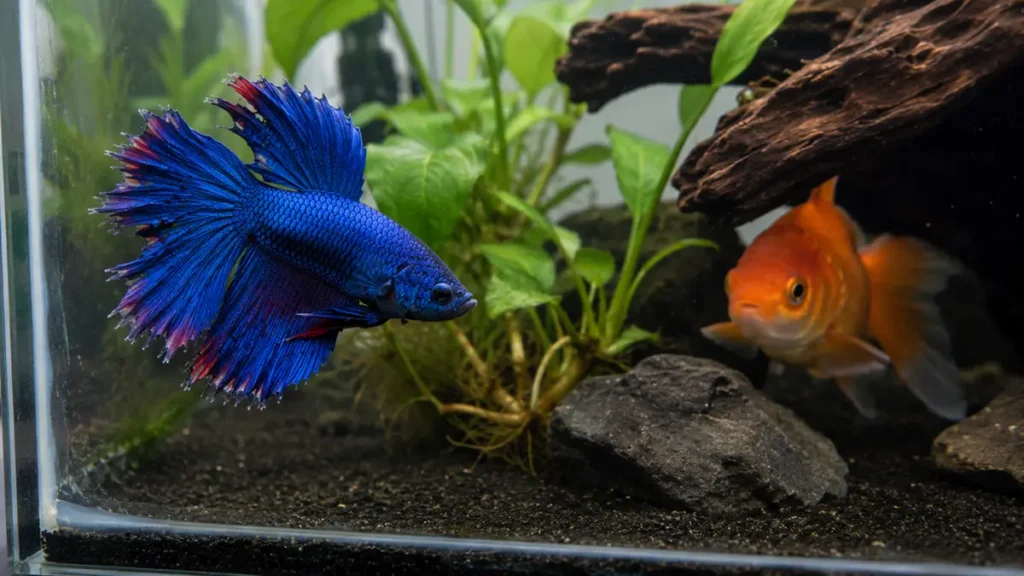
If you’re reading this because you already have goldfish and betta fish in the same tank right now, you’re not in trouble — you just need to know what to look for before it becomes one.
Watch the betta’s fins for fraying or redness at the edges, watch the goldfish for clamped fins or hiding, and test ammonia weekly rather than assuming the tank is fine because nothing looks dramatic. If you see any of that, the fix isn’t a bigger filter — it’s separating the two fish.
A tank divider works as a short-term bridge if you’re mid-upgrade, but it’s not a real fix, since both fish are still sharing water and temperature. The real fix is two tanks, set up for what each species actually needs.
Can Goldfish Live With Betta Fish? — Under One Condition Only
Betta fish can live with goldfish in exactly one scenario worth mentioning: a very large, heavily filtered pond or tank — think 55+ gallons — where both fish have room to establish separate territory and the water can be held at a middle-ground temperature neither species finds ideal but both can tolerate. Even then, most experienced keepers, myself included, don’t recommend it as a standard setup. It’s a “technically possible with a lot of compromise” answer, not a “go do this” one.
Goldfish and Betta Fish in the Same Tank: Better Alternatives for Each Fish
If what you actually want is a lively, colorful setup, goldfish and betta fish in the same tank isn’t the way to get there — but there’s a better path for each fish separately.
For your betta, peaceful, short-finned tank mates like corydoras catfish or a small group of neon tetras tend to work far better than anything with flowing fins.
For your goldfish, other cold-water species like White Cloud Mountain minnows are a much closer temperature and temperament match than a tropical betta will ever be.
Can Betta and Goldfish Live Together Peacefully — Or Is It Always a Gamble?
Can betta and goldfish live together peacefully is really the question underneath all of this, and the honest framing is: it’s a gamble stacked against you from the start, not a coin flip. You’re not just hoping the fish get along personality-wise — you’re asking two species with genuinely different biological needs to both stay healthy in water that can only be tuned for one of them at a time. Give each fish the setup it actually evolved for, and the “will they get along” question stops mattering, because they’re not competing for the same water anymore.
FAQ
Can goldfish live with betta fish long-term?
Not reliably. The temperature and bioload mismatch between the two species makes long-term cohabitation risky for both fish, even if they don’t visibly fight.
Will a betta fish kill a goldfish?
It’s possible but uncommon as a sudden attack. The bigger risk is chronic fin-nipping and stress from the betta treating the goldfish’s long fins as a territorial threat.
Do goldfish eat betta fish?
Goldfish aren’t predators of bettas. They may nip at fins out of curiosity, which can still cause injury and infection risk over time.
What temperature do betta and goldfish tanks need?
Bettas need roughly 78–80°F tropical water; goldfish do best below 75°F in cold-water conditions. There’s no single setting that’s ideal for both.
Can you put a betta fish with a goldfish in a small tank?
No — a small tank makes every risk worse. Ammonia builds faster, territory is smaller, and the betta has nowhere to retreat from a curious goldfish.
Can goldfish survive with betta fish for a few weeks?
Sometimes, yes, short-term. Surviving isn’t the same as thriving — ongoing stress from mismatched water conditions tends to surface later as illness rather than an immediate problem.
I already have them together — what should I check first?
Check the betta’s fins for fraying, watch the goldfish for clamped fins or hiding, and test ammonia weekly. Any of those signs means it’s time to plan a separate tank, not just watch and wait.
What are better tank mates for a betta instead of a goldfish?
Peaceful, short-finned species like corydoras catfish or small schools of neon tetras are generally a safer match than anything with long, flowing fins.
Is a pond an exception to the betta and goldfish rule?
A very large, well-filtered pond with room for both fish to claim separate territory is the closest thing to an exception, but most keepers still don’t recommend it as standard practice.
Next Steps: Resources You Should Read
Related FishioHub reading:
- Can Betta Fish Live With Neon Tetras?
- Can Ghost Shrimp Live With Betta Fish?
- Fish Tank for Goldfish: What Size Do You Actually Need?
Scientific references cited in this post:
- Ford, T. & Beitinger, T.L. (2005). Temperature tolerance in the goldfish, Carassius auratus. Journal of Thermal Biology (via ScienceDirect/PubMed).
- Ammonia Production, Excretion, Toxicity, and Defense in Fish: A Review (PMC/NCBI), citing van den Thillart & van Raaij (1995) on goldfish hepatic ammonia production.
- National Geographic — Betta fish, facts and information.
USA aquarium resources:
- American Livebearer Association and local aquarium society directories for tropical fish compatibility questions
- Cooperative Extension aquaculture fact sheets (state university extension programs) for coldwater species care standards
- A local fish store with a fishless-cycling test kit for checking ammonia/nitrite before adding any new fish
Closing
Some pairings just aren’t meant to share a tank, and that’s not a failure of planning — it’s biology asking for two different things at once. Give your betta the warm, calm water it evolved for, and give your goldfish the room and coolness it needs to live a full decade or more, and you get to enjoy both fish at their best, just in two different homes.
Was this guide helpful?
First-Hand Experience
Based on animals I've personally kept and bred - not summarized from other articles.
Zoological Foundation
Claims are checked against my M.Sc. Zoology training and published aquatic biology research, not recycled aquarium myths.
No Paid Influence
No sponsorship shaped this guide. Affiliate links, if any, are disclosed separately and never hidden.
Kept Current
Errors are corrected as soon as they're found, with the update noted at the bottom of the article.

Anil Satak M.Sc. Zoology · Founder, FishioHub
Grew up in a fishing family in India and holds a Master's in Zoology. FishioHub is a one-person operation - every guide is personally researched, kept-tested, and written by Anil. No team, no outsourced writers, no AI-generated content. Read his full bio →