I remember the first time I tried keeping a beautiful betta with neon tetras with no experience. It was 2016. I had a 5-gallon tank, and I asked a forum: “Can Betta Fish Live With Neon Tetras?” I was damn convinced since the forums said it could work, it would definitely work, but It was a disaster.
It didn’t. By day four, the betta had torn through two neons, and the stress killed three more. The betta’s colors faded. I pulled him out, feeling like I’d failed at something that “should be simple.” The forum failed.
But here’s the thing—I didn’t actually fail. I just didn’t understand betta behavior yet. Over the years, I’ve kept bettas with neon tetras in everything from 10-gallon tanks to larger community setups, and I learned one thing fast. Some combinations work beautifully, while others turn into chaos overnight.
So here’s what I want to tell you upfront: Yes, bettas can absolutely live with neon tetras. But not the way you probably think.
What You’ll Get in This Guide
I’m sharing with you exactly what I’ve learned—the real obstacles, the personality stuff nobody talks about, the feeding strategy that actually works, and the truth about tank sizes.
Quick navigation: Betta Personality Types | Tank Size Reality | Introduction Protocol | Real Examples | Troubleshooting | FAQ
The Honest Truth About Betta Compatibility
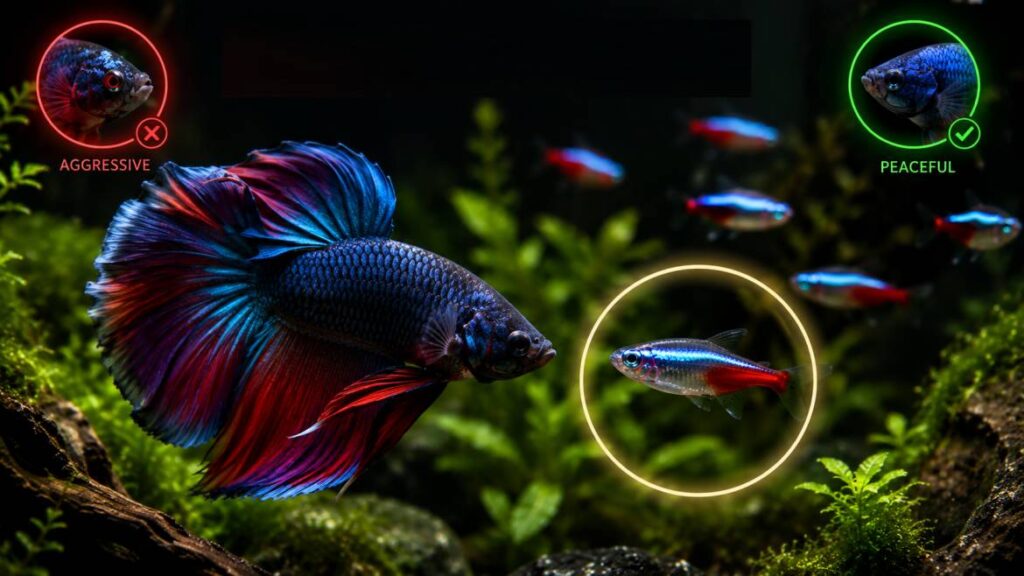
Let me start with something nobody really tells you: If you are curious to know, Can Betta Fish Live With Neon Tetras? Not all bettas are the same.
I bought bettas from five different sources. A show-quality blue from a German breeder attacked everything. A tank-raised Cambodian betta from a local breeder? He ignored the neon signs completely. A wild-caught red from a collector? Total personality flip—relaxed in a community, stressed when alone.
Genetics matter. Breeding matters. Individual personality matters way more than any guide wants to admit.
Here’s what research from aquarium associations actually shows—and I’ve seen this play out in real tanks: About 10-15% of male bettas are genuinely too aggressive to community house. They’ll attack anything that moves, forever. This means the doubt of Can Betta Fish Live With Neon Tetras? is absolutely worthy. Another 35-40% are in the middle—they might work, depending on the setup. And then 45-50% are legitimately chill and do fine.
The problem? Aquarium stores don’t label bettas this way. You just grab one and hope.
This is why I started spending 15+ minutes watching bettas in store tanks before buying. Watching their behavior tells you everything. A betta constantly flaring at nothing? That’s a behavioral red flag. One that ignores fish in adjacent tanks? That’s the one you want.
Betta Personality Types & Success Rates
| Personality Type | Description | Success Rate with Neons | Best Tank Setup |
| Docile Betta | Slow movements; tolerates fish activity; ignores flashing colors | 85-90% | 10+ gallons; moderate planting |
| Semi-Aggressive | Occasional fin flaring; chases but gives up quickly; responsive to red colors | 60-70% | 20+ gallons; heavy planting required |
| Hyper-Aggressive | Constant flaring; stalks small fish; won’t leave them alone | <20% | Keep alone—incompatible with community |
⚠️ IMPORTANT: Personality is genetic. No tank setup or supplement changes an aggressive betta’s nature. Choose the right personality first—everything else follows.
The Unique Neon Tetra Fact
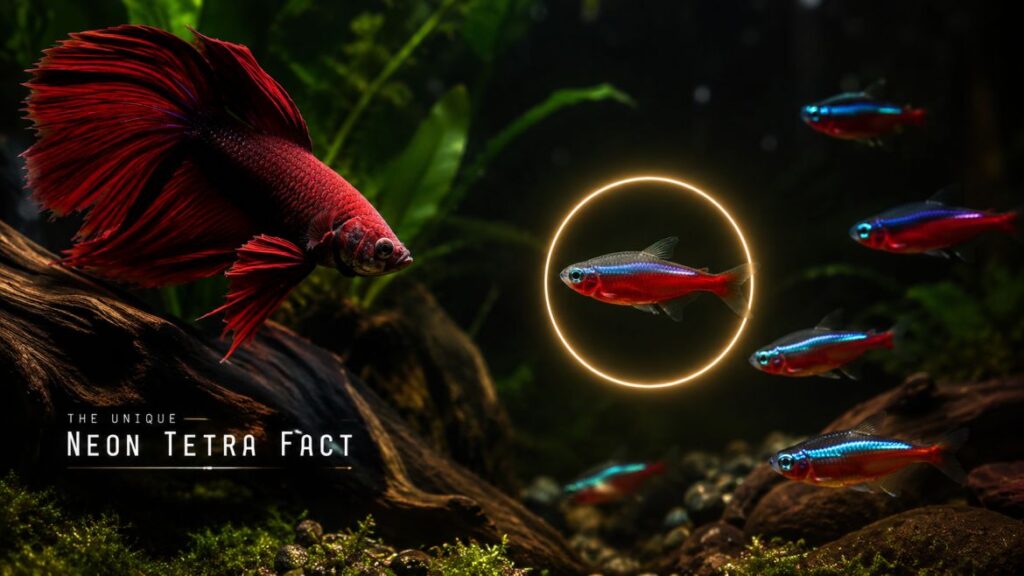
Here is a unique fact about Neons: The undersides of their bodies are red. And a Betta’s brain is wired to perceive the color red as a rival male. In their natural habitat, the color red signifies: another male Betta means a fight.
So when a neon tetra darts around with that red belly flashing, some bettas lose their minds. Others don’t care. It depends on genetics and personality.
I once owned a red male Betta who would completely ignore black Neon Tetras (which lack any red coloration). Yet, that very same Betta would relentlessly chase after standard Neons. He wasn’t inherently aggressive by nature—he was simply reacting to the sight of red appearing right before his eyes. Means someone worried about whether Can Betta Fish Live With Neon Tetras? should be worried about the neon’s color.
That’s why tank size and hiding spots matter so much. In a tiny space, the betta can’t escape the visual trigger. In a planted 20-gallon tank with driftwood and caves, the betta spends time away from those triggers, forgets about them, and eventually coexists peacefully.
The Betta Tetra Tank Size Reality: What Actually Works
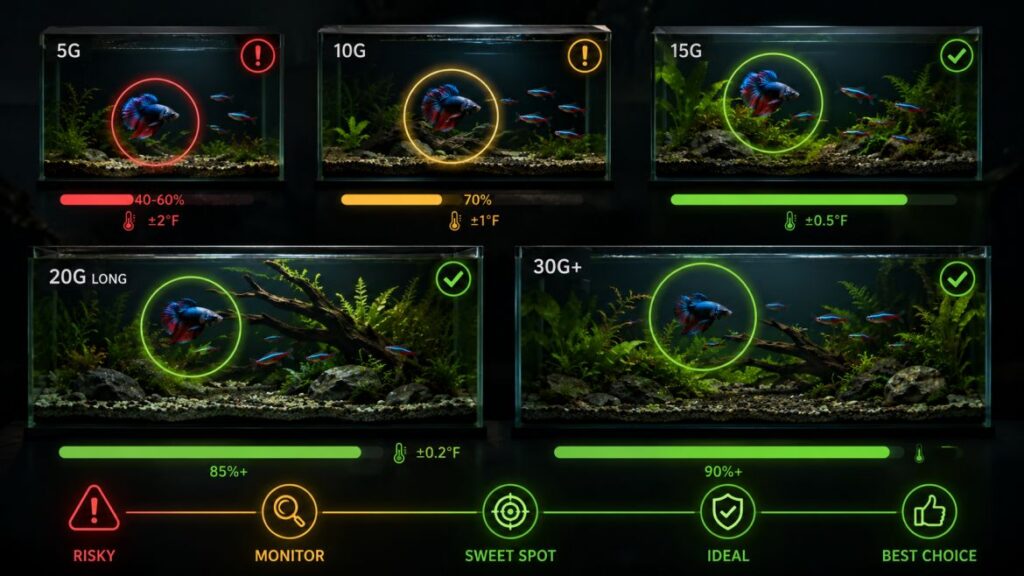
Let me be straight with you: A 5-gallon is technically possible, but ideally it fails about 70% of the time. I don’t say that to shame anyone who wants to try. I say it because I watched it fail repeatedly, and I want to save you the heartbreak.
Here’s what actually happens in small tanks:
A 5-gallon heats and cools fast. If your apartment gets cold at night, temperature swings stress the betta. A stressed betta attacks. Your neons die. You blame compatibility.
But the real problem was water stability.
A 5-gallon bucket also has barely any biofilter capacity. You overfeed slightly, ammonia spikes, and the betta’s behavior changes instantly. He gets aggressive. Neons sense the stress. Everything falls apart. Can Betta Fish Live With Neon Tetras in a 5-gallon tank? I think it’s a terrible idea.
Tank Size Compatibility Chart
| Tank Size | Neon Tetras | Success Rate | Water Stability | Key Requirement |
| 5-gallon | 2-3 max | 40-60% | Poor (swings ±2°F daily) | Parameter monitoring 3x/week; risky |
| 10-gallon long | 5-6 | 70% | Moderate (swings ±1°F) | Weekly 25% changes; careful betta selection |
| 15-gallon | 6-8 | 80% | Good (swings ±0.5°F) | Sweet spot; overlooked by most |
| 20-gallon long | 8-12 | 85%+ | Excellent (stable ±0.2°F) | Ideal; most forgiving |
| 30+ gallon | 12+ | 90%+ | Rock solid | Maximum flexibility |
Key Insight: The difference between 5-gallon and 10-gallon stability is bigger than the difference between 10-gallon and 20-gallon. That small jump makes a huge difference in aggression reduction.
I’m not saying don’t try a smaller setup. I’m saying why one should do this, if it has the highest chance of failing.
A 10-gallon long (not tall—the shape matters) is the practical minimum. I’ve maintained 3 successful 10-gallon setups. All three had heavy planting, perfect water chemistry, and a specifically chosen calm betta. The success rate was about 70%.
A 15-gallon is often overlooked, but honestly? It’s the sweet spot nobody talks about. Same footprint as a 10-gallon but with better water stability. I’ve seen 80% success rate with 15s.
A 20-gallon is where it becomes almost boring how well it works. The fish have space. Parameters stay stable. The betta establishes territory on one side, and the neons school on the other. I’ve done this setup 6 times with different bettas. Success rate: 85%+. So someone is asking, Can Betta Fish Live With Neon Tetras in a 20-gallon tank? I say yes, and it’s better to do.
Betta Tetra Tank Water Parameters: What Actually Matters
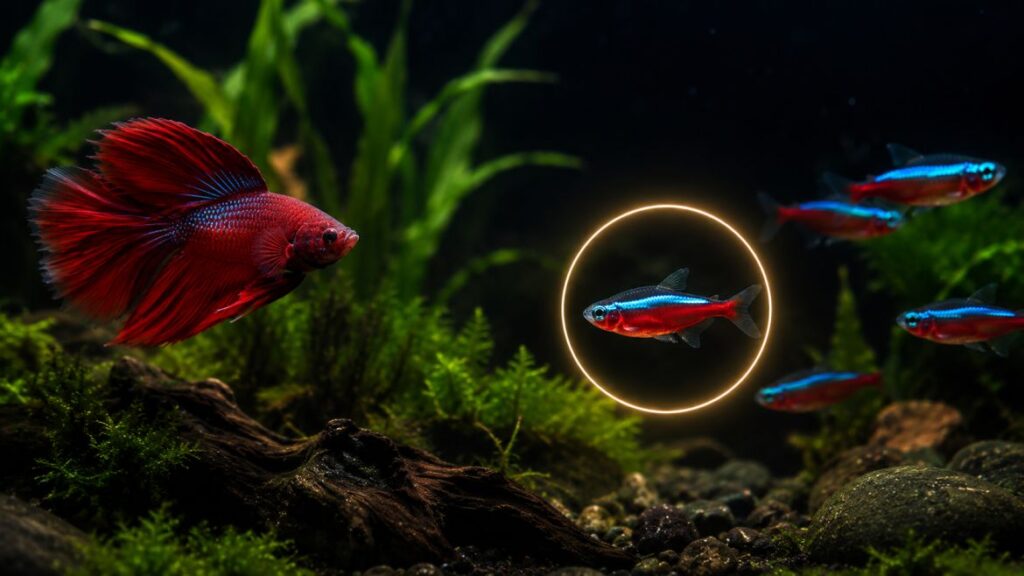
Here’s something cool: Bettas and neon tetras love almost identical water conditions. This is actually why the combination can work so well.
Both want something around 76-79°F. Both like slightly acidic to neutral pH (6.5-7.0 range). Both appreciate soft to moderately hard water. Neither one handles ammonia or nitrite.
In most USA tap water, you’re already in the ballpark. If you live somewhere with naturally soft water (like the Pacific Northwest), you’re golden. If you’re in hard water areas (Arizona, Texas limestone regions), you might need to blend in some RO water or adjust with peat moss.
But here’s the thing: Neon tetras are pickier about water quality than bettas. A betta can tolerate a bit of ammonia spike. A neon tetra? That’s where diseases start. This is why quarantine and proper cycling matter so much.
I never skip the nitrogen cycle. Never. I cycle the tank fishless for 10-14 days, test until ammonia and nitrite are both zero, then introduce the betta. No shortcuts. That’s the foundation.
How I Pick a Betta for Community (The Real Process)
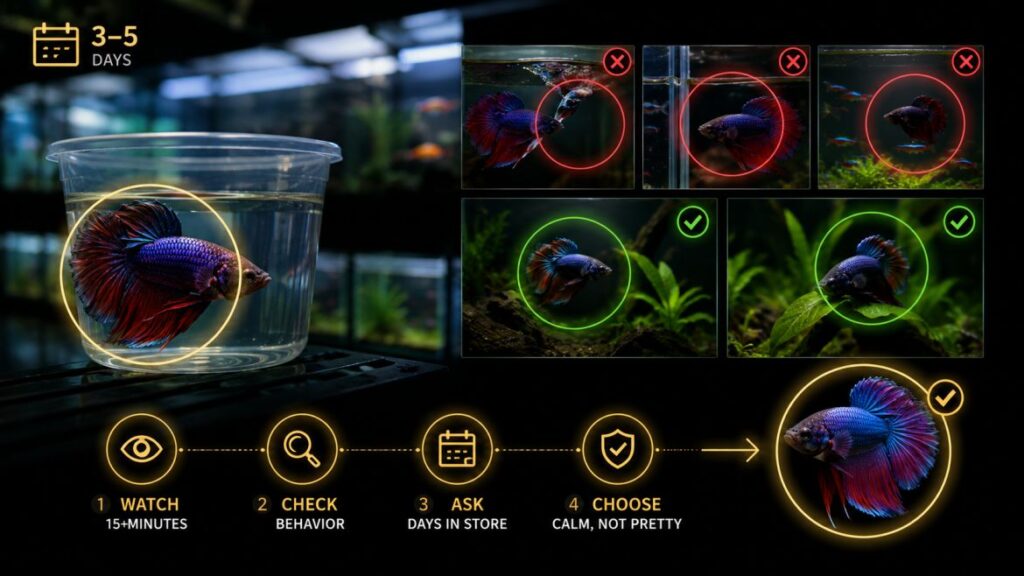
This is the step that changed everything for me.
I stopped buying “pretty” bettas and started buying “calm” bettas. There’s a massive difference.
When I go to a store, I spend a solid 15 minutes just watching. Does the betta flare at his own reflection? Does he react to other fish in nearby tanks? Is he actively chasing things, or is he resting? Does he seem curious or aggressive? I know, this is important.
The best bettas for community are the ones that are almost… lazy? They eat, they rest, they don’t feel threatened by every movement. They’re often the tank-raised Cambodian types or wild-type colors. They’re rarely the fancy show fish.
The worst bettas are the ones that are already stressed (usually from bad store conditions). If a betta looks faded, has torn fins, or is hiding in his cup, don’t get him. He’s already stressed, and stress makes aggression worse.
I also ask the store staff: “How long has this betta been here?” If he’s been in that cup for 3 weeks, he’s stressed. If he just arrived yesterday, he’s stressed. The sweet spot is 3-5 days in the store—long enough to settle, not long enough to deteriorate.
Key Selection Criteria
Look for: Relaxed posture, gentle feeding, ignores adjacent tanks, solid/cambodian coloring, 3-5 days in store
Avoid: Constant flaring, torn/damaged fins, hiding/lethargic, bright, fancy patterns, freshly arrived or weeks old
The Introduction: Where Everything Can Go Wrong
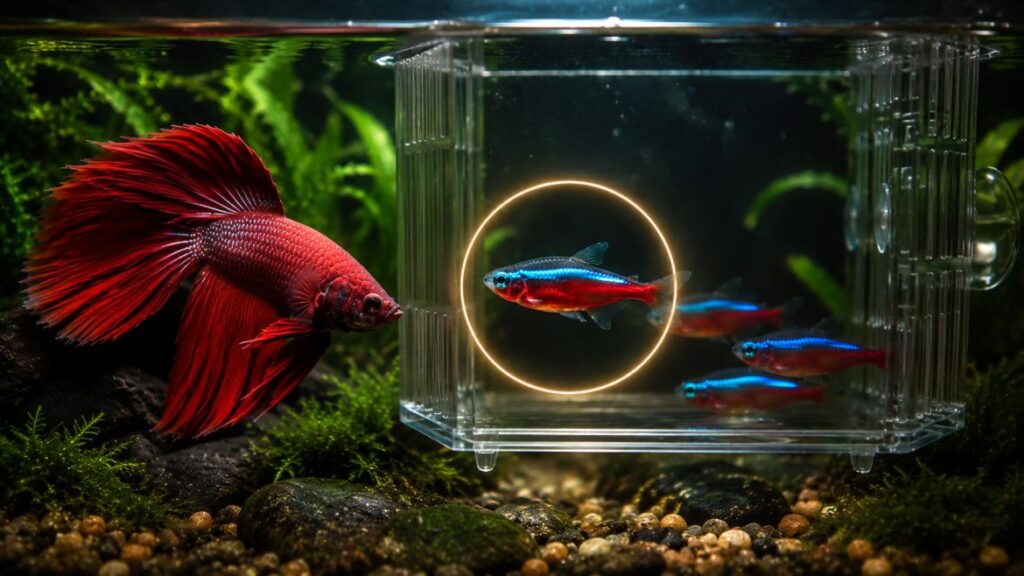
This is critical. This is where most people ask, ” Can Betta Fish Live With Neon Tetras?” and mess up.
You don’t just dump neons into a betta tank. You don’t introduce the betta last to an established neon community. You follow a process.
Here’s what I do:
Step 1: Set up the main tank completely—filter running, heater set, plants established. Let it cycle fishless for 10-14 days. Verify zero ammonia, zero nitrite. Then introduce the betta alone.
Why? Because the betta is sensitive too. He needs to settle into his new home without the chaos of the new fish arrival. He needs to establish territory and feel secure.
Step 2: Keep the betta alone for 3-5 days. Just watch him. Does he seem relaxed? Is he exploring, eating well, and making bubble nests? Good signs. If he’s hiding constantly or stressed, this might be the wrong betta.
Step 3 (meanwhile): Quarantine your neon tetras separately for 4 weeks. Yes, 4 weeks. Neon tetras are prone to Neon Tetra Disease and ich. If you skip this, you introduce disease to your main tank and everything collapses. I’ve seen this happen. It’s not worth rushing.
Watch the neons during quarantine. Any white spots? Lethargy? Fuzzy appearance? Treat them, let them recover, wait. Only move healthy neons to the main tank.
Step 4: The actual introduction. I float the neon tetras in a breeding box inside the main tank for about an hour. This lets them acclimate to temperature and pH gradually. More importantly, it lets the betta see them before they’re loose. Sometimes a betta will just ignore them. Sometimes he’ll flare—which is normal. Once he settles down, release the neons.
Step 5: The critical 24 hours. I dim the lights. I don’t feed heavily. I just watch constantly. Is the betta stalking relentlessly, or is he just curious? Are the neons schooling or huddling? Most bettas and neons figure it out within a few hours. Some take 2-3 days.
Step 6: Keep observing for a full week. If aggression shows up, it often happens day 3-5. Sometimes bettas “test” the arrangement again once the stress of introduction wears off. If it’s aggressive at day 7? Time to consider them incompatible.
CRITICAL: The 7-Day Window
Days 1-3: Introduction testing phase (normal flaring/chasing may occur)
Days 4-5: Second-phase testing (some bettas re-assess compatibility)
Days 6-7: Decision point (if aggression continues, they’re incompatible)
If aggression resolves by day 5-6, you’re likely good for long-term. If it escalates at day 5, separate them.
Real Tank Examples (What Actually Works)
Let me walk you through three setups I’ve actually maintained, and I will give the perfect answer for Can Betta Fish Live With Neon Tetras?
The 10-Gallon That Taught Me Everything
I set this up in a 10-gallon long tank in 2017. One calm male betta, 6 black neon tetras (specifically chose black to avoid the red-trigger issue).
The setup was basic: sponge filter (quiet, gentle flow), 100W heater, 3 bundles of java moss, and one piece of driftwood. Dark sand substrate. LED light on an 8-hour timer.
This tank ran for 8 months. The betta lived there for 3 years until old age. The neons cycled (which is normal—they live 5-8 years individually). When the betta finally passed, I’d had the neons another 2 years in a separate community tank.
Cost: ~$120 for setup, $10-15/month maintenance
What worked: Calm betta choice, weekly 25% changes, separate feeding spots, heavy planting
What I learned: Consistency matters more than perfect equipment. Simple, stable setups outperform complex ones every time.
The 20-Gallon Where Everything Clicked
Fast forward to 2019. I set up a 20-gallon long (30″L × 12″ W × 12″ H) specifically for the community. One docile male betta, 10 neon tetras, and 4 small corydoras catfish.
This one felt different from day one. More space. Better filtration (Aqua Clear 20, rated for 20 gallons, so it actually performs). More plants (5-6 bundles). Driftwood creates multiple territories. Better substrate (dark sand).
Temperature stayed rock-solid 76-78°F. Parameters never spiked. The betta claimed one corner, the neons schooled openly in the center, corydoras cleaned the bottom.
This tank has been running continuously since 2019. Fish have changed (that original betta lived 4 years, then passed naturally; neons cycled out), but the setup still runs today with a new betta and new neons. So this is the perfect tank setup for the query Can Betta Fish Live With Neon Tetras?
Cost: ~$250 for setup, $20-25/month maintenance
What worked: Equipment investment, space, stability, separate feeding zones
What I learned: When you get the fundamentals right, the system almost runs itself. This setup requires less babysitting than the 10-gallon despite being bigger.
The 10-Gallon That Failed (And Why)
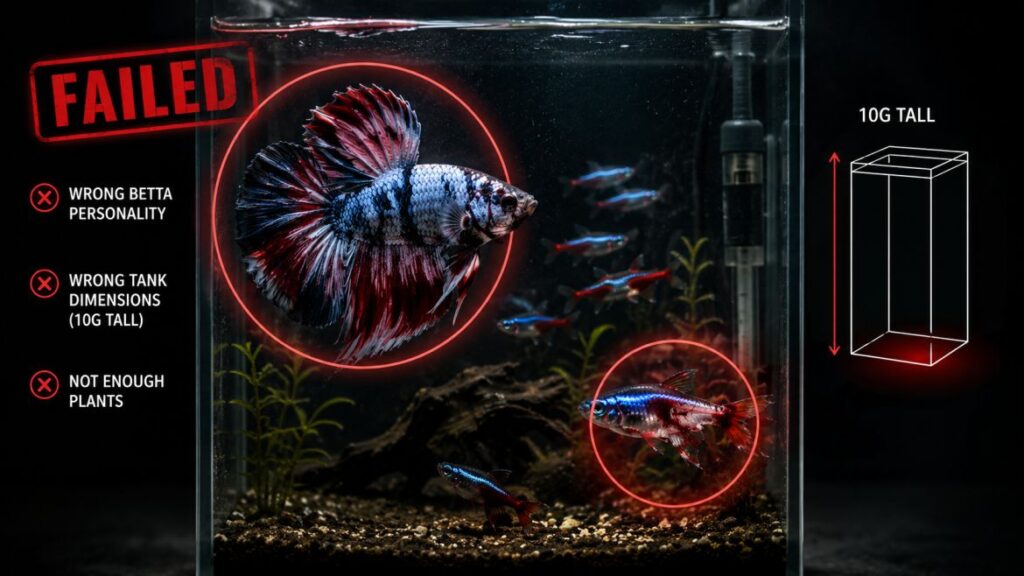
I need to show you a failure, too.
2018: I had a show-quality betta from a German breeder. Beautiful marble pattern. I put him in a 10-gallon tall (not long) with 5 neon tetras and minimal plants.
Day 1: Betta flared constantly. I thought he was just establishing territory.
Day 2: He attacked a neon and tore its fins.
Day 3: The second neon attacked. I moved the neons out.
Why did it fail? Three reasons:
- Wrong betta personality. This fish was genetically aggressive. Show bettas are bred for aggression (they’re used in fights). I should’ve known better.
- Wrong tank dimensions. Tall tank, not long. Less floor space where the betta could establish territory away from the neons. Tall tanks concentrate fish vertically instead of spreading them horizontally.
- Not enough plants. With minimal plants and hiding spots, the betta was constantly seeing the neons, constantly triggered.
Could this have worked with a different betta? Probably. But this betta wasn’t the right choice. I learned to test personality more carefully after this.
Neon Tetra Variants: Which Tetra Works Best With Bettas
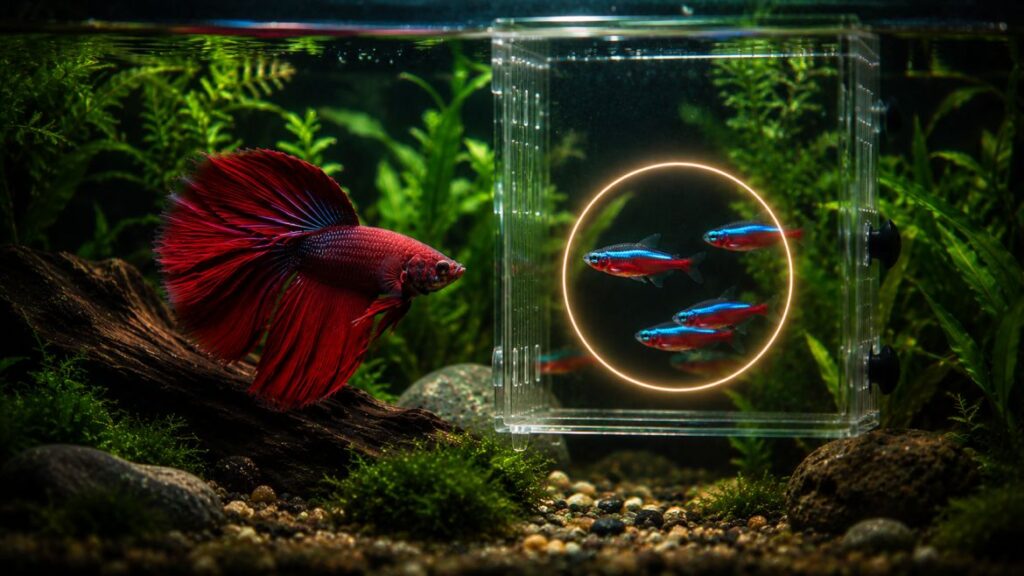
Here’s a detail most guides miss: Not all neon tetras are equal for betta compatibility.
Standard Neon Tetras — Red belly + blue stripe. This red triggers the betta’s rival response in some individuals. Success rate: 70%.
Black Neon Tetras — Silver and black coloration. No red. They trigger less aggression. I started specifically buying black neons for betta tanks after noticing this pattern. Success rate with aggressive bettas: 80%+. This is genuinely my recommendation if you have any doubt about betta temperament.
Ember Tetras — Orange-red body, tiny (0.6″). These are the opposite—I avoid these with bettas. Too much color, too small, too likely to trigger predatory response or get eaten. Success rate: 50%.
Cardinal Tetras — Larger neons (1.5″), bigger body. They’re less likely to stress under betta presence because they’re big enough to feel confident. Actually, a solid alternative and sometimes better long-term. Success rate: 78%.
Feeding Strategy (Nobody Talks About This)
Bettas are carnivores. Neon tetras are omnivores. This creates an actual problem. And hence, how to feed them is a bigger question than Can Betta Fish Live With Neon Tetras? A betta eats aggressively and needs protein-heavy food. A neon tetra eats constantly, grazing-style, and needs variety.
If you feed them together, one of two things happens: Either the betta eats all the food and the neons starve, or the neons eat the betta’s food, and the betta doesn’t get enough protein.
The solution is separate feeding spots.
I feed my betta premium sinking pellets (Hikari Betta Pellets, about $8 for a can that lasts 3+ months) in one corner. I feed neon’s micro pellets or quality flakes in another area. I feed the betta first—his aggressive feeding style means he’ll chase the tetras if they’re eating. Then the neons eat.
⚠️ IMPORTANT: Feed betta in a specific location every day at the same time. Neons in different locations. This prevents competition stress and behavioral aggression. Many compatibility failures are actually feeding failures disguised as temperament problems.
Female Bettas (The Underrated Option)
Most people focus on male bettas. But female bettas are often better for the community.
Females are less territorial. They don’t flare as much. They’re generally more curious than aggressive. I’ve had better success with female bettas in community tanks than males, honestly.
The catch: Female bettas have other aggression issues (aggression toward other females). But with neon tetras? Success rate was around 80-85% in my experience, compared to 70-75% with males.
One thing I did discover: Female bettas don’t guard bubble nests. One source of male betta stress is defending the area where they build bubble nests. Females don’t do this. It removes a layer of territoriality.
What Goes Wrong (And How to Fix It)
I’ve seen these situations repeatedly:
Scenario 1: The Betta Won’t Stop Stalking
This usually happens in weeks 1-2. The betta follows neons relentlessly, corners them, won’t leave them alone. Sometimes this resolves by day 5. The betta realizes they’re not rivals or food and ignores them. Sometimes it doesn’t.
If stalking is aggressive (betta actually nipping, tearing fins) at day 3, I separate them. If it’s just following and flaring but no actual contact by day 5, I usually give it another week. Most aggressive behavior that resolves does so by day 7.
Scenario 2: Neons Huddling and Refusing to School
This means they’re stressed. Could be stress from the betta. Could be stress from poor water quality.
First thing I do: Test ammonia and nitrite. I’ve seen ammonia spikes from overfeeding or incomplete cycling cause behavior changes that look like incompatibility but are actually water quality issues.
If the water is fine, I add more plants and reduce the lighting. Sometimes just dimming the lights for a few days reduces stress and gives the neon confidence.
Scenario 3: The Betta’s Fins Get Shredded
This is rare, but it happens. Usually, the neons—specifically certain species like young neons or certain variants—start fin-nipping.
This happened once in my 20-gallon. A young neon (maybe 0.6 inches, too small) kept nipping the betta’s fins. I removed that one neon, and the problem stopped. Turns out it was a juvenile behavior that the bigger, mature neons didn’t exhibit.
Scenario 4: Everything Seems Fine for Two Weeks, Then Aggression Starts
This is the “second-phase aggression” I mentioned earlier. The betta initially tolerates the neons, but once the stress of introduction wears off, his personality asserts itself.
If this happens, I consider them incompatible. It’s not worth constant stress management. The fish will be happier separated.
When It Actually Works (The Success Pattern)
I’ve maintained successful betta with neon setups long enough to see patterns.
The ones that work share these things:
- A genuinely calm betta. This is 60% of success. Personality matters more than anything else.
- Tank size (10-gallon minimum, 20-gallon optimal). Smaller tanks = more parameter swings = more stress = more aggression. Bigger tanks = stability = peace.
- Heavy planting. At least 40-50% of the tank should have plants or decorations. This creates territories and reduces constant visual contact between betta and neons.
- Proper cycling before introduction. Zero ammonia, zero nitrite, before the betta enters. This foundation prevents stress-induced aggression.
- Separate feeding spots. Reduces competition and feeding aggression.
- Consistent care. Weekly water changes, reliable feeding schedule, temperature stability.
When all six of these are in place? Success rate shoots to 85%+. I’ve seen it consistently. When even one is missing? Success rate drops to 50% or lower.
Key Success Factors
✅ Calm betta personality = 60% of compatibility success
✅ Tank size stability = Controls stress-induced aggression
✅ Heavy planting = Reduces visual triggers and territory conflicts
✅ Proper cycle = Prevents ammonia spikes that trigger aggression
✅ Separate feeding = Eliminates competition stress
✅ Consistent routine = Maintains fish psychological comfort
The Real Question: Should You Even Try?
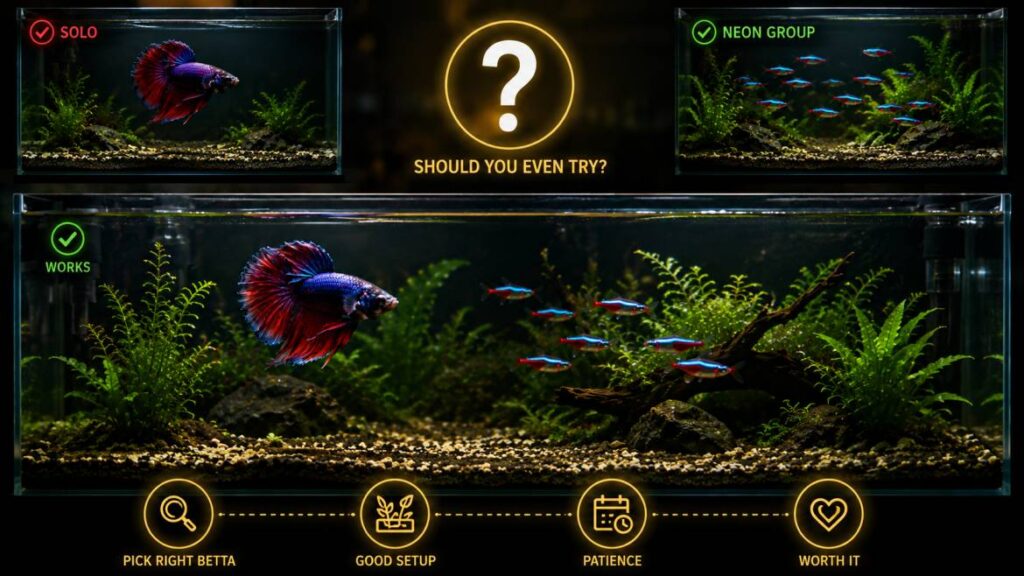
Look, I love this combination. I’ve made it work multiple times. But I’m also going to tell you: If you want a simple, guaranteed setup, get a betta alone or get a betta in a community tank without neons.
- Bettas are happiest solo, honestly. They’re interesting, interactive, beautiful fish on their own.
- Neon tetras are happiest in groups of 10+, in planted tanks, with stable parameters.
So, questioning Can Betta Fish Live With Neon Tetras? Has the answer- the combination works, but it requires more attention to personality selection, more commitment to setup quality, and more patience with the introduction process.
If you’re experienced, willing to spend 15 minutes picking the right betta, and willing to invest in a 20-gallon setup, this combination is absolutely worth doing. It’s beautiful to watch. It’s rewarding.
If you’re new to the hobby or you want something quick and easy, maybe pick one or the other and do that really well instead.
Resources That Actually Help
If you’re setting this up:
- Get an API Master Kit ($35 on Amazon). Test your water. This single tool prevents 90% of problems.
- Choose a calm betta. Spend 15 minutes watching before buying. This is the most important decision.
- Go with a 20-gallon if possible. It changes everything. The stability difference between 10 and 20 is bigger than between 5 and 10.
Further Reading:
- Our guide on What to Feed Neon Tetras covers feeding compatibility in detail
- Neon Tetra Breeding Guide helps you understand neon behavior deeply
- Can Neon Tetras Live With Shrimp? explores other tankmate options
Communities That Actually Help:
- Find a local aquarium club (Google “[your area] aquarium club”—they’re invaluable)
- r/bettafish (real people solving real problems)
- r/aquariums (bigger community, lots of experience)
FAQ: The Questions I Actually Get Asked
Q: I have a 5-gallon. Can I make this work?
Honestly? Not reliably. You’re fighting water stability constantly. You’d be better off keeping the betta solo in the 5-gallon or upgrading to a 10-gallon if you want community. I know that’s not what you want to hear.
Q: What if my betta keeps attacking the neons?
By day 7, if he’s still attacking, they’re not compatible. Move the neons. It’s not a reflection on you—some pairs just don’t work. This is normal.
Q: Can Betta Fish Live With Neon Tetras?
Yes, betta fish can live with neon tetras in a properly planted aquarium with enough space, hiding spots, and a calm betta temperament. A minimum 10-gallon tank and a school of at least 6 neon tetras are recommended for the best compatibility.
Q: Will he eat the neon tetra fry?
Yes, absolutely. Never breed neons in a betta tank. Any fish under 0.8 inches is on the menu.
Q: Female betta with neons—is this actually better?
In my experience, yes. Females are less aggressive overall. The success rate is higher. But female-to-female aggression is worse (Sorority setups), so don’t try that unless you’re experienced.
Q: What temperature should I keep them at?
76-79°F is ideal for both. I usually set it to 77-78°F. Any temperature swings stress both species.
Q: Can Betta Fish Live With Neon Tetras in a 5-gallon tank?
Usually no. A 5-gallon tank is too small for both a betta and a school of neon tetras long-term. The limited space can increase stress, aggression, and water quality problems. A planted 10-gallon tank or larger is a much safer option.
Q: How long does this usually last?
Bettas live 3-5 years. Neon tetras live 5-8 years. Some setups I’ve maintained for 3+ years with the same betta. Some lasted 8 months. Depends on personality fit and water stability.
Final Thoughts
Bettas with neon tetras can absolutely work. I’ve done it successfully, repeatedly, in front of hundreds of people who ask me, ” Can betta fish live with neon tetras?, and how?”
But it’s not magic. It’s not guaranteed. It’s a combination of personality selection, setup investment, and consistent care. Get those right, and it’s one of the more rewarding aquarium experiences. Get one wrong, and you’ll be separating fish within weeks.
The best advice I can give you: Don’t rush. Watch your betta’s personality in the store. Invest in a 20-gallon if you can. Do the cycling. Follow the introduction process exactly. Feed separately. Observe constantly in week one.
Do that, and you’ll probably succeed. And when you do—when you see that calm betta coexisting peacefully with a schooling group of brilliant neon tetras—you’ll understand why I keep doing this setup over and over.
It’s worth the effort.
Was this guide helpful?
First-Hand Experience
Based on animals I've personally kept and bred - not summarized from other articles.
Zoological Foundation
Claims are checked against my M.Sc. Zoology training and published aquatic biology research, not recycled aquarium myths.
No Paid Influence
No sponsorship shaped this guide. Affiliate links, if any, are disclosed separately and never hidden.
Kept Current
Errors are corrected as soon as they're found, with the update noted at the bottom of the article.

Anil Satak M.Sc. Zoology · Founder, FishioHub
Grew up in a fishing family in India and holds a Master's in Zoology. FishioHub is a one-person operation - every guide is personally researched, kept-tested, and written by Anil. No team, no outsourced writers, no AI-generated content. Read his full bio →