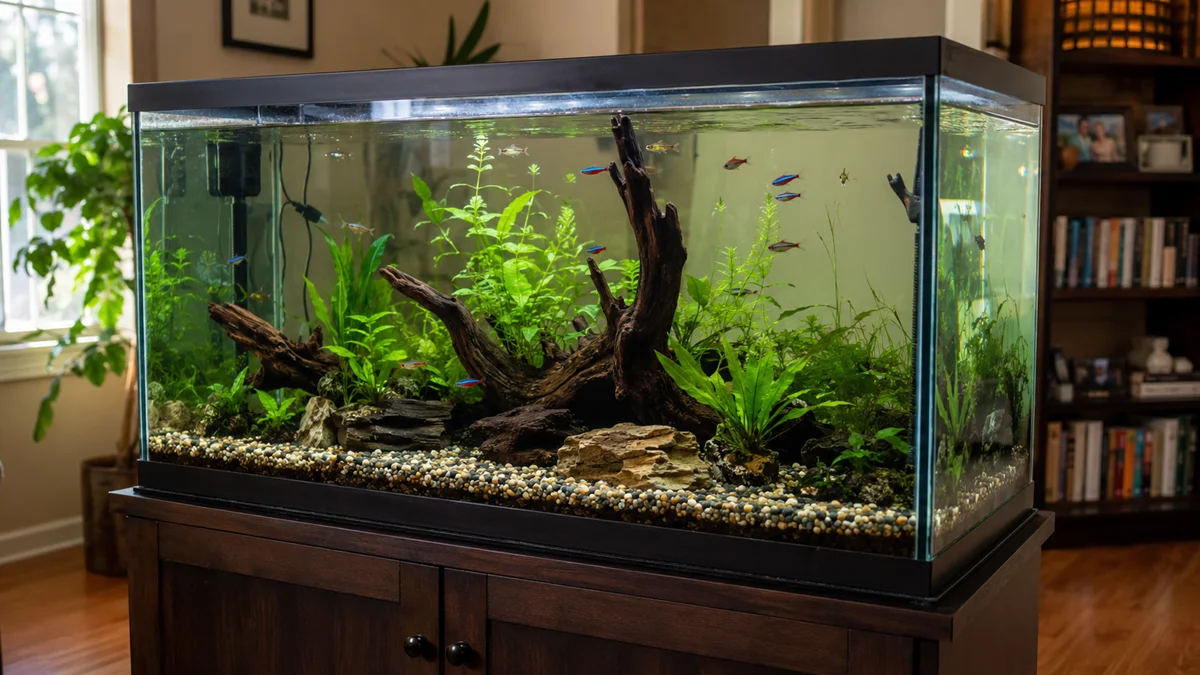
Yes, aquarium glass can break — but not randomly. Every aquarium panel is engineered with a safety factor of roughly 3.8 to 5.0, meaning it’s built to withstand several times the pressure it normally faces. Glass fails when that margin is used up: uneven stands, impacts, thermal shock, or age-worn silicone. Understanding the engineering behind your tank tells you exactly what to watch for — and what’s just internet panic.
What this guide covers:
- Why aquarium glass breaks — the 5 real mechanical causes
- How strong aquarium glass actually is — the safety-factor number nobody explains
- How long glass aquariums last — realistic ranges, not marketing numbers
- Warning signs before it’s too late
- What happens if you ignore a crack
- The most durable glass brands sold in the USA — with real pricing context
- How to fix vs. replace
Can Aquarium Glass Break? The Truth Most Guides Skip
Every fishkeeper has had this moment. You’re staring at your tank; maybe you just heard a faint creak, and you think: is that glass actually going to hold?
Here’s the zoologist’s answer, not the internet-panic one: yes, aquarium glass can break — but it’s built with a huge safety margin, and almost every failure traces back to one of five preventable causes. I’ve handled enough tanks, in my own fishroom and for readers who’ve written in with cracked panels, to know it’s never really “the glass’s fault.” It’s always a setup or maintenance issue that built up over time.
Let’s get into the actual mechanics — not vague warnings.
Why Does Aquarium Glass Actually Break? (5 Real Causes)
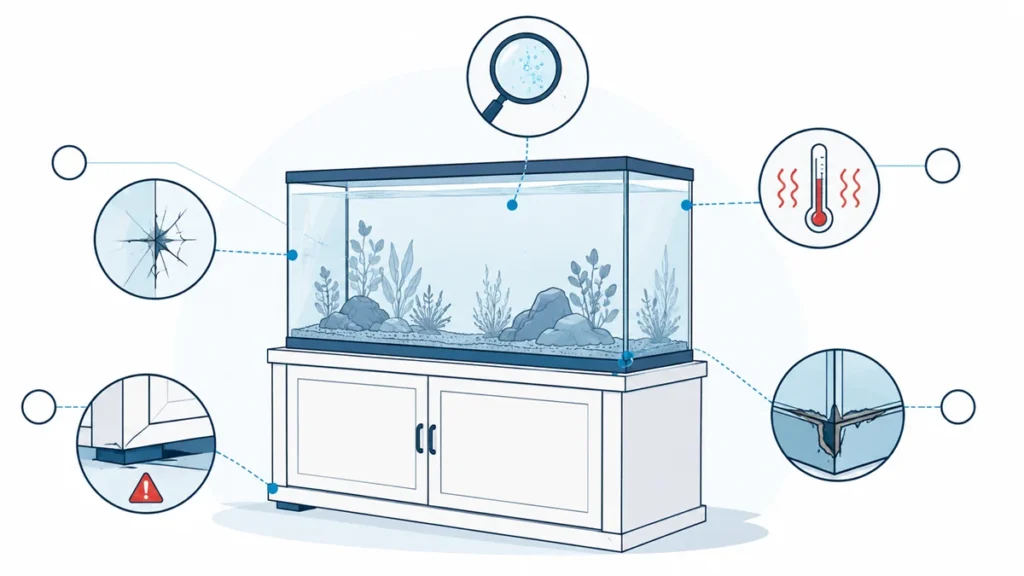
Aquarium glass doesn’t fail from water pressure alone. Manufacturers already account for that — every panel is designed with a safety factor (SF) of about 3.8 for standard tanks, up to 5.0 for large or unbraced builds. That means the glass is rated to hold 3.8 to 5 times the maximum pressure it will ever see in normal use.
So when a tank does crack, it’s because something ate into that margin. Here’s what actually does it.
1. Uneven Stand Support
This is the single biggest cause I see, and it’s completely avoidable. Water pressure on an aquarium isn’t evenly distributed — it’s highest at the bottom edges and corners. If your stand has even a slight dip or a warped board, the glass stops distributing that load the way it was engineered to, and stress concentrates on one seam.
Fix it in 5 minutes: place a level on your stand before you fill the tank. Not “eyeball level” — an actual level. A 1/8-inch gap under one corner of a 55-gallon tank puts real torque on that panel every single day.
2. Impact Damage
Glass doesn’t need a dramatic hit to weaken. A dropped rock, an aquascaping tool knocking the inside wall, even a heavy decoration set down too hard against the pane — these create micro-fractures invisible to the eye. They don’t fail immediately. They fail months later, usually during a water change when pressure shifts.
3. Manufacturing Defects
Low-cost, mass-produced tanks sometimes ship with thin spots, air bubbles in the glass, or under-cured silicone seams. These flaws don’t show up on day one — they show up when the safety margin they were supposed to have gets eaten away faster than a properly made panel.
4. Thermal Shock
Glass expands and contracts with temperature, and it does so unevenly if the change is fast. Pouring water at a very different temperature than the tank, running a space heater right next to the glass, or a heater malfunction that spikes the temperature — all of these create localized stress the glass wasn’t designed to absorb gradually.
5. Silicone and Seal Aging
This one’s overlooked. The glass panels themselves can be structurally fine while the silicone holding them together has degraded from UV exposure, age, or repeated flex. Once a seam lets go, the panel loses the support it was relying on from its neighbors — and the whole structure’s safety factor drops.
How Strong Is Aquarium Glass, Really? (The Numbers Nobody Explains)
Aquarium glass is standard soda-lime float glass — the same base material as window glass — but it’s selected and sized specifically for sustained water pressure, not the impact resistance windows are built for.
Here’s the number that actually matters: soda-lime glass has a tensile strength of around 7 megapascals (roughly 1,000 psi) under real-world conditions, even though the material’s theoretical strength is far higher. That gap exists because surface flaws — scratches, tiny manufacturing imperfections — are what actually trigger failure, not the water pressure itself reaching some limit.
This is why the safety factor matters more than the raw material strength. Manufacturers aren’t just calculating “how much pressure will this water create” — they’re building in a 4-5x buffer specifically because they know real-world glass has flaws.
Annealed vs. Tempered: Which Is Actually Safer?
- Annealed glass — standard, slowly-cooled glass. Used for most side and back panels because it can be drilled and cut after manufacturing. When it fails, it cracks in large, jagged pieces — which sounds scarier, but it usually fails gradually, giving you warning time.
- Tempered glass — rapidly cooled during manufacturing, which makes it 4-5 times stronger than annealed glass of the same thickness. It’s often used for bottom panels because they carry the full weight. The tradeoff: when it does fail, it shatters completely and instantly into small pieces, with no warning crack first. That’s actually why most manufacturers avoid it for side panels — a gradual crack you can catch beats a sudden shatter.
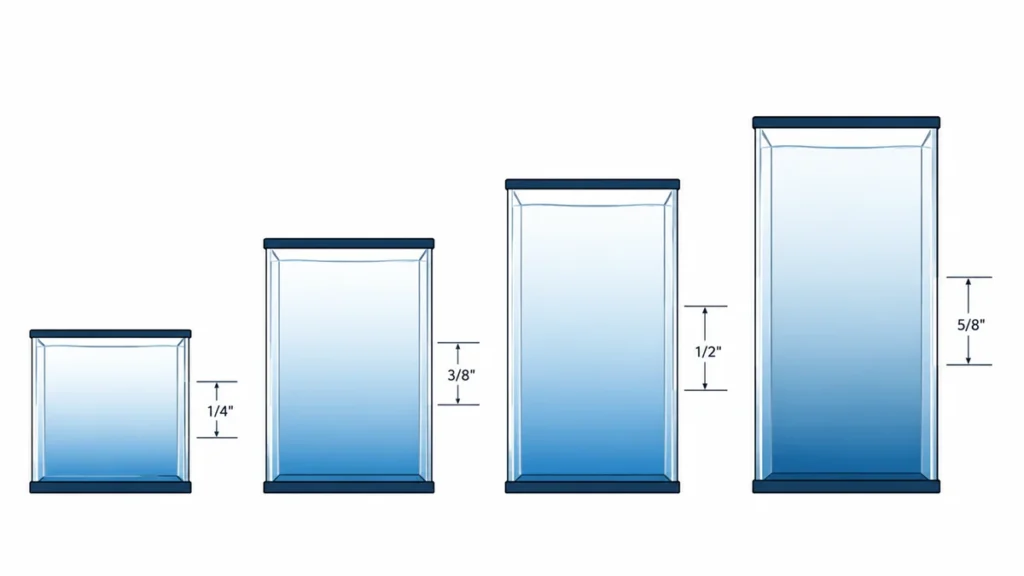
Glass Thickness by Tank Size
Thickness isn’t really about gallons — it’s about water height, since pressure increases with depth, not volume.
| Tank Height | Typical Glass Thickness |
| ~12 in (10 gal) | 1/4 in (6mm) |
| ~21 in (55 gal) | 1/4 in (6mm), with top/bottom bracing required |
| ~23 in (125 gal) | 1/2 in (12mm), with bracing |
| 30 in or taller | 3/4 in (19mm) or more, depending on length |
Note the 55-gallon line — a lot of people assume bigger tank means automatically thicker glass, but a tall, narrow tank can need more thickness than a longer, shallower one holding more total water. Height is what drives the engineering.
How Long Do Glass Aquariums Actually Last?
A well-built, properly maintained glass aquarium realistically lasts 10 to 20+ years. I’ve seen well-cared-for tanks push past that. But “well-maintained” is doing a lot of work in that sentence — the honest range for a cheaply made tank with poor upkeep is closer to 3-5 years before silicone failure becomes a real risk.
What actually determines where your tank falls in that range:
- Silicone condition — this ages faster than the glass itself, especially with UV exposure from nearby windows or aquarium lighting
- Stand quality and levelness — a slightly uneven stand shortens lifespan more than almost any other factor
- Brand and construction quality — thicker bracing, proper edge polishing, and consistent panel gluing all matter
- Environmental stability — a tank that never sees temperature swings will always outlast one near a heater vent or drafty window
Warning Signs Your Aquarium Glass Is at Risk
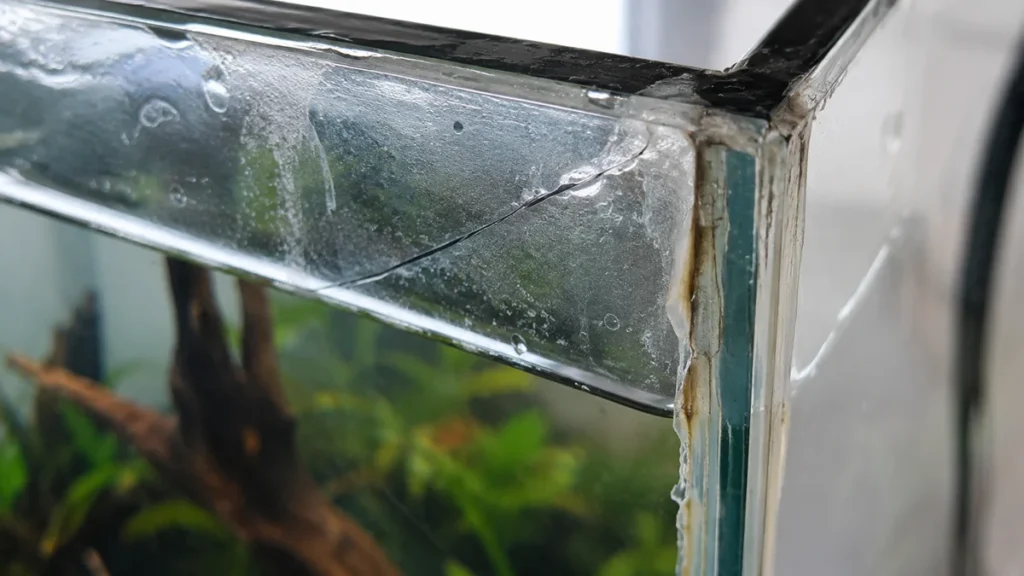
Catch these early and you’ll almost always have time to act before anything actually breaks:
- Hairline cracks — even ones that don’t seem to be leaking yet
- Cloudy or white stress marks near corners or seams
- Popping or creaking sounds, especially right after a water change
- Bulging panels — glass that looks slightly convex when viewed from the side
- Peeling or yellowing silicone at the seams
If you notice any of these, don’t wait. Small hairline cracks in annealed glass tend to be slow to fail — which is a warning sign, not a reason to relax.
What I Got Wrong My First Time
I learned how easily aquarium glass breaks the hard way during my university zoology days. I set up a 55-gallon tank on a sturdy-looking wooden dresser, making the rookie mistake of leveling the stand while it was empty. Once filled with over 450 pounds of water and heavy rockwork, the weight caused the floorboards to compress unevenly, creating an invisible, highly concentrated stress point on one corner.
Three months later, a sharp midnight “ping” woke me up right before the back panel cracked wide open, flooding my room. The glass didn’t fail because it was cheap; it failed because the uneven support twisted the frame. Now, I always check the level during the filling process and use a foam leveling mat to absorb minor floor shifts.
What Happens If You Ignore a Small Crack
This is the question nobody wants to ask, so let’s answer it directly. A hairline crack in annealed glass rarely causes instant catastrophic failure — but it does two things quietly: it removes material from the safety margin the glass was engineered with, and it gives water a path to start working at the crack from both sides.
In practice, that means a hairline crack you notice today and ignore for six months doesn’t stay the same size. Temperature swings and normal water pressure cycling widen it gradually. The failure, when it happens, tends to happen at an inconvenient moment — usually during a water change, when you’re adding or removing water and the pressure distribution shifts.
The financial math also gets worse the longer you wait. A caught-early crack means an empty tank, a new panel or full replacement, and a controlled afternoon project. An ignored crack that lets go with a full tank means water damage to flooring, potential electrical hazard from submerged outlets, and — the part that matters most — a real risk to the fish who have no way out.
USA Buyer’s Note: What’s Actually Durable, and What You’re Paying For
A lot of “top 5 brands” lists online are just repeated names with no reasoning behind them. Here’s what actually differentiates the durable options sold in the US, and roughly what you’re paying for.
Aqueon is the direct descendant of All-Glass Aquarium (the two merged years ago), and it’s the tank most US fishkeepers will actually encounter — widely available at Petco and PetSmart, often on the recurring “dollar-per-gallon” sale pricing. It’s not premium glass, but it’s consistent, and the sale pricing makes it hard to beat for a first tank.
Marineland descends from the old Perfecto lineup and sits in a similar mass-market tier to Aqueon — reliable, widely available, unremarkable glass quality but solid construction.
Custom Aquariums / Lifetime Aquarium builds are a genuine step up — aluminum-framed rather than plastic, polished and beveled edges, and the option to spec low-iron glass on the viewing panel only (to control cost) while using standard clarity elsewhere. This is the tier hobbyists move to for large custom builds, not off-the-shelf tanks.
Low-iron (“ultra-clear”) glass — sold under brand names like Starphire® (Vitro Architectural Glass) and Optiwhite™ (Pilkington) — isn’t about strength at all. It’s about removing the green tint standard float glass has. It costs meaningfully more and is mostly chosen for high-end reef displays and aquascapes where color accuracy matters more than budget.
What to actually check before buying, regardless of brand: ask what safety factor the panels are built to, whether the bottom panel is tempered, and whether the stand is rated for the full filled weight — not just the empty tank weight.
Can You Fix Broken or Cracked Aquarium Glass?
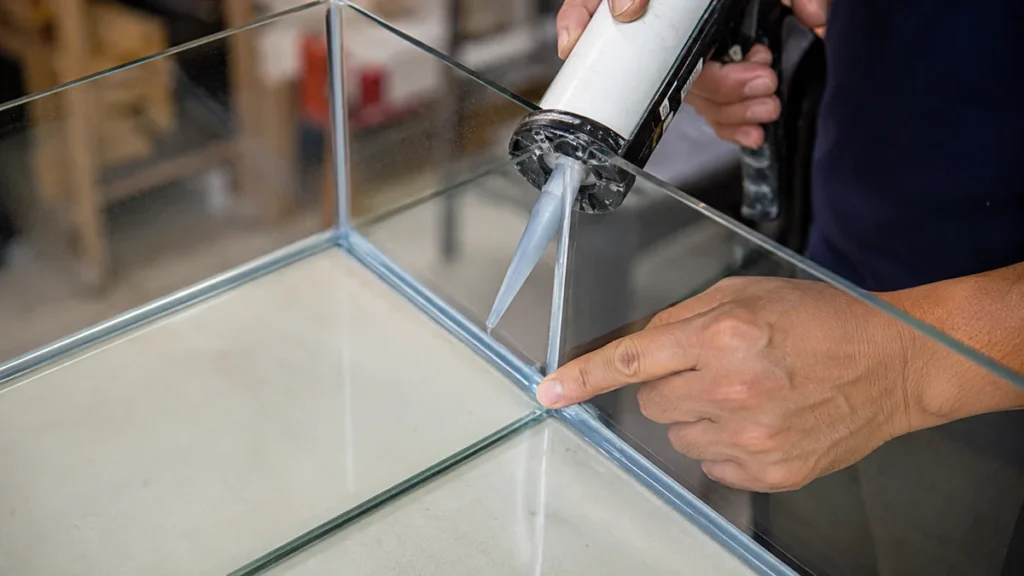
Short answer: not permanently, and not safely for anything beyond a cosmetic chip.
- Small, non-structural chips — can be temporarily sealed with aquarium-safe silicone, but this is a stopgap, not a fix
- Actual panel cracks — the panel needs replacing, or in most cases, the whole tank does. There is no adhesive or patch rated to restore full structural safety factor to a cracked panel
- Silicone-only leaks (glass intact, seam failing) — this one is genuinely fixable. Remove the old silicone completely, clean the seam, and reseal with 100% aquarium-safe silicone
Never trust a DIY glass patch on anything beyond a surface chip. The safety factor the tank was engineered with doesn’t come back with a bead of silicone over a crack.
Tips to Prevent Aquarium Glass From Breaking
✅ Use a perfectly level stand — check with an actual level, not by eye
✅ Add a foam mat under rimless tanks for even pressure distribution
✅ Acclimate water temperature gradually — never pour hot or cold water directly in
✅ Never move a filled aquarium, even a few inches
✅ Match glass thickness to tank height, not just gallons
✅ Keep heavy rocks and hardscape off the glass bottom directly — use a substrate buffer
✅ Inspect silicone seams once a year for yellowing, peeling, or cloudiness
FAQs: Can Aquarium Glass Break?
Can aquarium glass break on its own, with no cause?
No. Aquarium glass doesn’t break without cause — every failure traces back to a specific factor like uneven support, impact, thermal shock, or aging silicone. If your tank is properly set up and level, spontaneous failure is extremely rare.
How often should I check my aquarium glass for cracks?
Do a full visual inspection every 3-6 months, checking seams, corners, and the base. After any move, water change involving heavy scrubbing, or temperature swing in the room, do a quick visual check the same day.
Is it safe to keep using a tank with a small hairline crack?
Not for long. A hairline crack in annealed glass usually won’t fail instantly, but it removes material from the engineered safety margin and tends to widen over time. Drain the tank and address it rather than waiting to see what happens.
What’s the most common beginner mistake that leads to broken aquarium glass?
Skipping the level check on the stand. It takes 30 seconds and prevents the single most common cause of glass failure — uneven pressure distribution from a stand that isn’t perfectly flat.
Are Petco or PetSmart tanks safe, or should I buy elsewhere for durability?
Aqueon and Marineland tanks sold at Petco and PetSmart are mass-market but structurally sound when set up correctly — the durability issue is almost never the glass itself, it’s stand levelness and setup. For large custom builds, dedicated aquarium manufacturers offer meaningfully better construction.
Is it a myth that bigger tanks are more likely to break?
Mostly, yes. Tank size alone isn’t the deciding factor — larger tanks are built with proportionally thicker glass and more bracing specifically to compensate. A poorly supported 20-gallon is more at risk than a properly set up 125-gallon.
Can cold weather or a drafty room cause aquarium glass to crack?
Yes. Extreme cold combined with warm tank water creates the same kind of localized thermal stress as pouring cold water into a warm tank. Keep tanks away from drafty windows and exterior walls in cold climates.
Does tempered glass mean my tank is safer overall?
Not necessarily. Tempered glass is stronger, but it fails without warning — a full, instant shatter rather than a slow crack. Many manufacturers actually prefer annealed glass for side panels specifically because a slow crack gives you time to react.
Next Steps: Resources You Must Read
If you’re checking your glass for safety, don’t stop there — most tanks that fail have more than one issue building up at once.
- 20 Common Aquarium Problems and How to Fix Them Fast — the full troubleshooting guide beyond just glass
- Can a Fish Tank Run Without a Filter? — related equipment-stress questions worth checking
- How to Choose the Right Aquarium Air Pump — for setups where equipment placement affects tank stress points
Scientific & Technical References
- Soda-lime float glass tensile strength (~7 MPa / ~1,000 psi in practical use) — standard glass engineering references
- Aquarium panel safety factor standards (3.8–5.0 SF for home aquarium glass design) — aquarium glass fabrication engineering guides
- Tempered vs. annealed glass strength differential (tempered ~4-5x stronger than annealed at equal thickness) — standard glass manufacturing data
Was this guide helpful?
First-Hand Experience
Based on animals I've personally kept and bred - not summarized from other articles.
Zoological Foundation
Claims are checked against my M.Sc. Zoology training and published aquatic biology research, not recycled aquarium myths.
No Paid Influence
No sponsorship shaped this guide. Affiliate links, if any, are disclosed separately and never hidden.
Kept Current
Errors are corrected as soon as they're found, with the update noted at the bottom of the article.

Anil Satak M.Sc. Zoology · Founder, FishioHub
Grew up in a fishing family in India and holds a Master's in Zoology. FishioHub is a one-person operation - every guide is personally researched, kept-tested, and written by Anil. No team, no outsourced writers, no AI-generated content. Read his full bio →