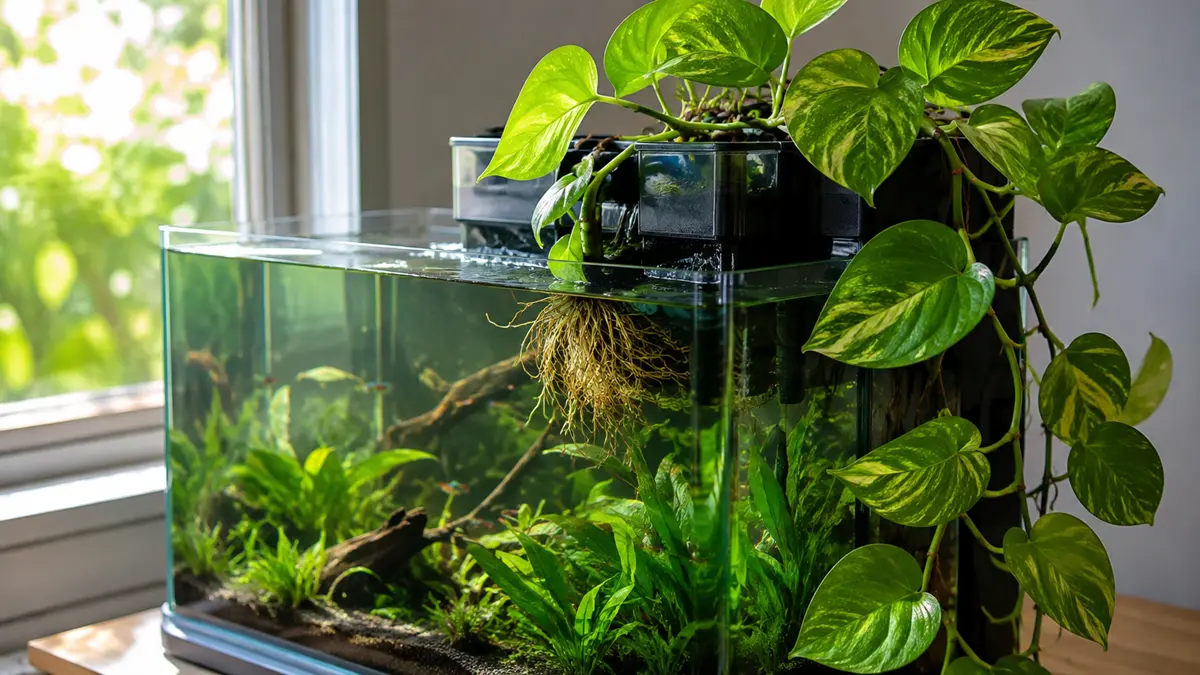
Yes, there are houseplants you can put in aquarium tanks — and some of them will grow faster in your tank than they ever did on your windowsill. Pothos, peace lily, spider plant, philodendron, and syngonium are the safest starting points, and every one of them works the same way: roots go in the water, leaves stay out.
That’s the short answer. Get that one rule wrong — submerge the leaves along with the roots — and you’ll have a rotting mess in your filter within a week, not a thriving plant.
If you study this insight carefully, you will likely achieve better results than I did. My initial attempt with the spider plant went very poorly; I had trapped the entire plant under a glass lid, and due to the accumulated moisture, the crown of the plant rotted and became covered in mold within just 48 hours.
If you only remember three things from this guide, make it these:
- Roots in, leaves out. Every one of the houseplants you can put in aquarium setups on this list is grown emergent, not fully submerged.
- Pothos and peace lily are the two most reliable starting points for nitrate export and hardiness.
- “Aquarium-safe” doesn’t always mean fish-safe if eaten. A couple of these plants are mildly toxic to pets if chewed, and I’d extend the same caution to root-grazing shrimp and plecos.
What Houseplants Are Safe for Aquariums?
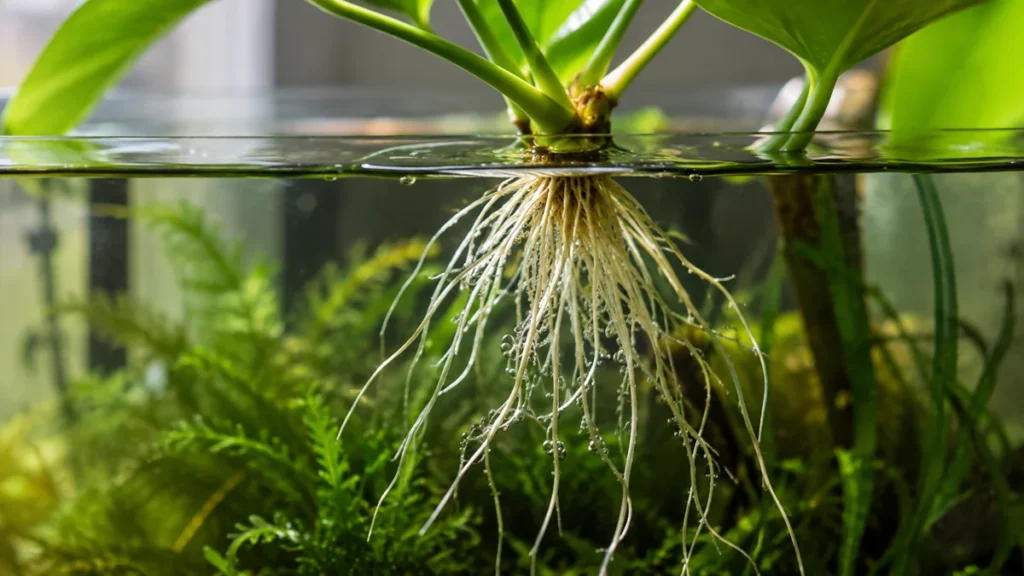
What houseplants are safe for aquariums usually comes down to root structure, not the plant’s looks. Most houseplants evolved in humid tropical understories, where their roots are used to staying wet for long stretches. That’s exactly why they take to a tank’s water column so easily.
The plants that do best share three traits: fast aerial root growth, tolerance for lower light, and leaves firm enough to shrug off the occasional splash. In short, the safest houseplants you can put in aquarium tanks are the same ones that already root readily in a glass of water on your kitchen counter.
Succulents and anything with thick, waxy drought-adapted leaves are the ones that fail — their roots simply weren’t built to sit in standing water.
The mechanism behind all of it is the nitrogen cycle I studied back in my zoology coursework: fish waste breaks down into ammonia, nitrifying bacteria convert that to nitrite and then nitrate, and nitrate is what your water changes exist to dilute. A fast-growing houseplant root system pulls that same nitrate out of the water on its own, for free, between changes.
The Best Houseplants for Aquarium Use
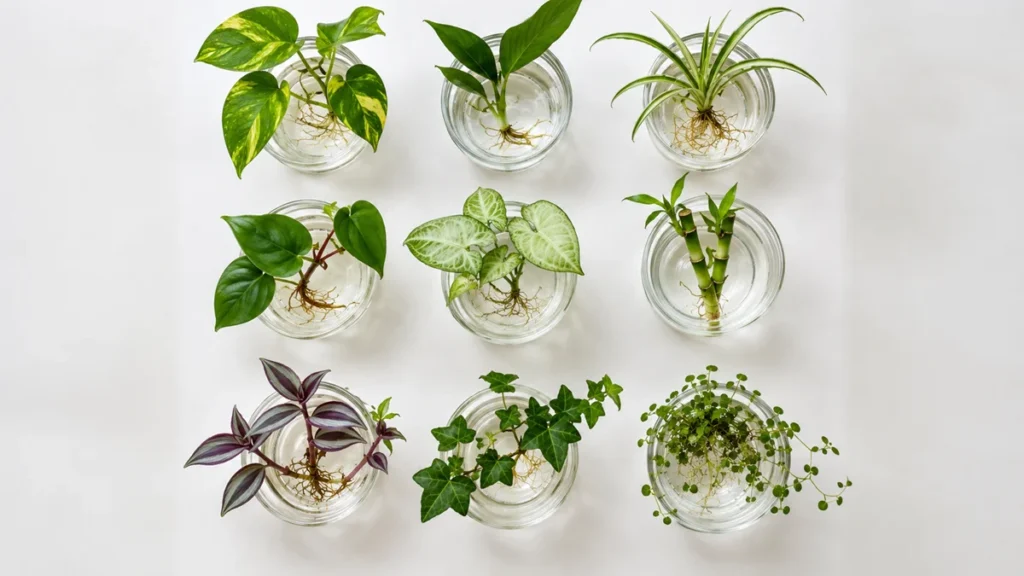
Here’s my working list of houseplants for aquarium setups — the ones that show up again and again in planted-tank and paludarium builds. These are the houseplants you can put in aquarium tanks with genuine confidence, not just ones that survive a week before turning to mush.
| Plant Name | Botanical name | Placement | Growth speed | Notes |
| Pothos | Epipremnum aureum | Roots submerged, leaves above | Fast | Most reliable choice; toxic to pets if chewed |
| Peace lily | Spathiphyllum spp. | Roots submerged, leaves above | Moderate | White blooms above the waterline; mildly toxic if ingested |
| Spider plant | Chlorophytum comosum | Roots submerged | Fast | Good match for hang-on-back filters |
| Philodendron | Philodendron spp. | Roots submerged, leaves above | Fast | Care is nearly identical to pothos |
| Syngonium | Syngonium podophyllum | Roots submerged | Fast | Dense root mass, strong nutrient uptake |
| Lucky bamboo | Dracaena sanderiana | Partly or fully submerged | Slow | One of the few that tolerates deeper submersion |
| Wandering Jew | Tradescantia zebrina | Roots submerged | Fast | Colorful trailing foliage |
| English ivy | Hedera helix | Roots submerged, trimmed | Moderate | Needs regular pruning or it tangles fast |
| Baby’s tears | Soleirolia soleirolii | Emergent, damp substrate | Moderate | Best on paludarium ledges, not full submersion |
House plants you can put in an aquarium outside this table — succulents, cacti, and most flowering bedding plants — simply aren’t built for it. They’ll rot within days.
Small Houseplants You Can Put in Aquarium Nano Tanks
Running a 5- or 10-gallon nano tank? Small houseplants you can put in aquarium lids matter more here than the sprawling vines above. Baby’s tears, single syngonium cuttings, and a lone pothos node all stay compact enough to avoid swallowing a small footprint the way a full-grown pothos vine eventually will.
How to Put Live Plants in Aquarium Setups the Right Way
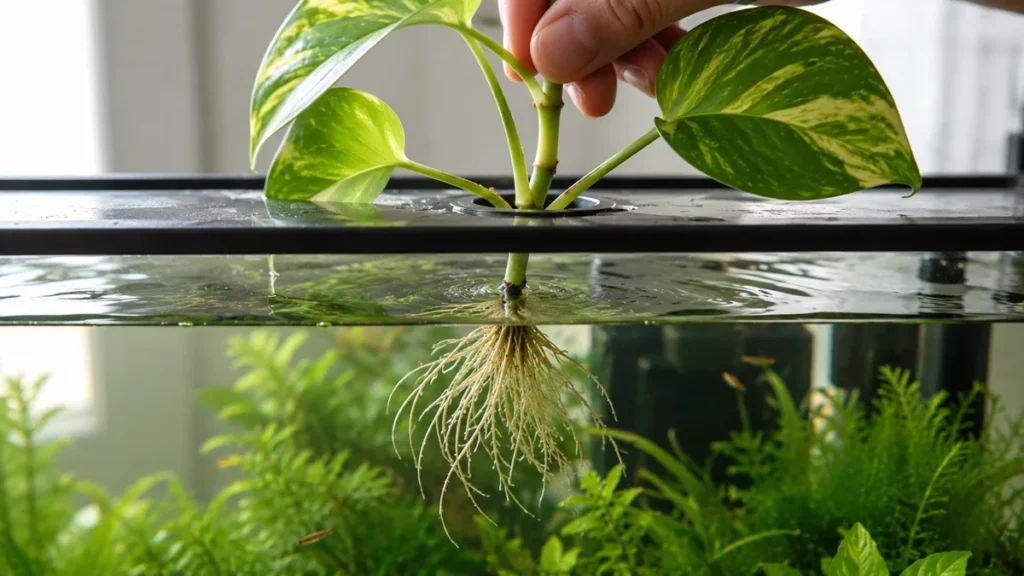
How to put live plants in aquarium tanks safely comes down to a gentle transition, not a dramatic one. Follow this sequence:
- Take a healthy cutting or an established houseplant with a few inches of root already showing.
- Rinse the roots under lukewarm water to strip off potting soil, which clouds water and can spike ammonia.
- Position the plant so only the root mass touches water — leaves and stem base stay dry.
- Anchor it through a lid opening, a floating basket, or a hang-on-back filter intake.
- Wait two to three weeks before judging the results.
Expect some yellowing on the first few leaves nearest the waterline. That’s usually the plant shedding growth it built for soil, not a sign of failure.
If yellowing continues well past the first month, check that leaves genuinely aren’t touching water. Submerged foliage — not submerged roots — is the single most common reason houseplants you can put in aquarium tanks end up failing.
Indoor House Plants in Fish Tank Placement
Indoor house plants in fish tank setups do best near your existing light source, not tucked into a dim corner. A houseplant in aquarium placement that gets indirect window light or spillover from your tank’s hood will root faster and grow noticeably thicker than one left in the shade.
Houseplants You Can Grow in Aquarium Setups Without Soil
Most people don’t realize houseplants you can grow in aquarium tanks never actually need soil in the first place — pothos, philodendron, and Tradescantia are already commonly propagated in plain water on kitchen windowsills. An aquarium is just a much bigger, nutrient-richer glass of water with a built-in light source and filtration current. If you’ve ever rooted a pothos cutting in a jar, you already know the mechanism; the aquarium version just runs indefinitely instead of needing a water change every few days.
Can You Have Too Many Plants in an Aquarium?
Can you have too many plants in an aquarium? Yes — it’s one of the more common mistakes new plant-keepers make. Dense root systems crowd swimming space, tangle in filter intakes, and can stress open-water fish like bettas rather than shelter them.
A workable rule of thumb: keep root mass to roughly a quarter of your water column, and trim monthly. This is the one limit that applies to every houseplant you can put in aquarium tanks, regardless of species.
I fell into this trap with a Monstera. Its roots exploded so fast they filled half my 20-gallon tank, trapping my tetras and choking the filter intake. I literally had to hack the root ball apart with a knife just to free up swimming space. Now, I prune the roots ruthlessly every single month.
Best Plants for Aquaponics Fish Tank Systems
Best plants for aquaponics fish tank setups lean on the same fast-growing, root-heavy houseplants covered above. Aquaponics is really just a scaled-up version of the same nitrate-export principle behind every houseplant you can put in aquarium tanks at home.
Pothos and spider plants are common picks for small home aquaponic grow beds because their roots expand quickly without needing special substrate.
Houseplant in Aquarium: The Mistake Almost Everyone Makes
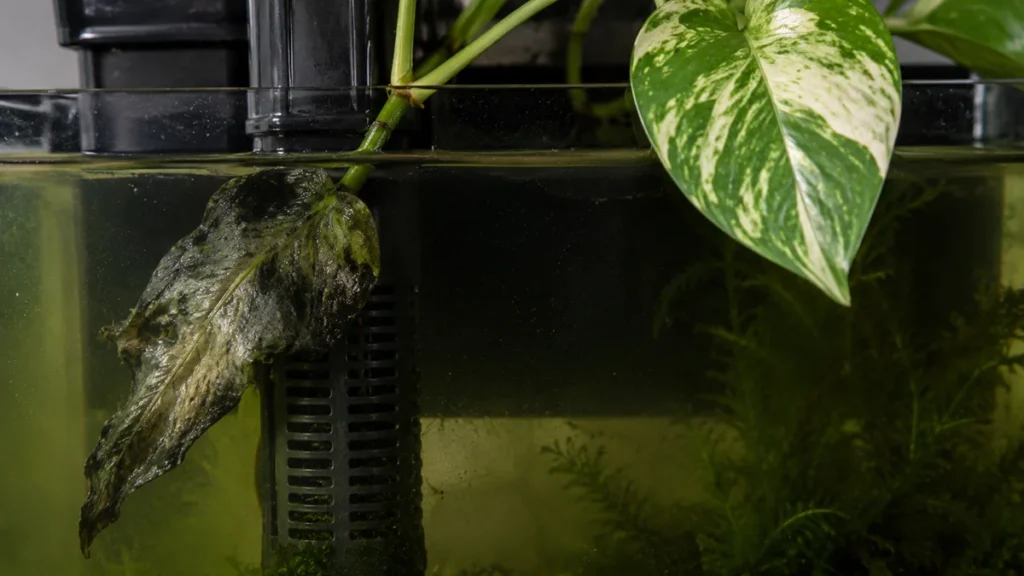
The single most common houseplant in aquarium failure I see isn’t species selection — it’s submerging the whole plant, leaves and all, because it “looks fuller” that way.
I did exactly this with an expensive variegated Philodendron. I pushed the lower three leaves underwater because it made the back corner look incredibly lush and full. Five days later, those leaves melted into a gray, gooey film that clogged my filter grid and triggered a massive algae bloom that took me three weeks to clear.
Submerged foliage can’t photosynthesize efficiently underwater the way it does in air, and decaying plant matter releases the same ammonia and organic waste your filter is trying to remove. If you want a fuller look, add more cuttings rather than dunking the leaves.
Which Houseplants You Can Grow in Aquarium Tanks Should You Skip?
A few houseplants you can put in aquarium tanks — or grow there, technically — still aren’t worth the risk. Peace lily and pothos both contain insoluble calcium oxalate crystals, which the ASPCA lists among plants toxic to cats and dogs if chewed. English ivy shows up on that same ASPCA list for its saponin content.
None of these plants have dedicated fish-toxicity studies I could verify, so treat this as a reasonable caution rather than a confirmed hazard — worth knowing if you keep shrimp or plecos that graze on roots. Succulents, cacti, and most flowering bedding plants are a simpler problem: they rot outright, since they were never built to sit in standing water.
A note on the science: solid, checkable statistics measuring exact nitrate-uptake rates for houseplants in aquariums are genuinely thin on the ground. Most numbers circulating in hobbyist forums are informal, unreplicated home tests rather than peer-reviewed data, so I’m flagging that instead of presenting a specific percentage as settled fact.
FAQ
What are the best houseplants you can put in aquarium tanks?
Pothos, peace lily, spider plant, philodendron, and syngonium are the most reliable, thanks to fast root growth and tolerance for constant moisture.
Which aquatic plants can double as houseplants in an aquarium setting?
Lucky bamboo and baby’s tears straddle both worlds — they tolerate more direct water contact than most houseplants while still being sold as houseplants.
Where can I buy aquarium-safe houseplants online?
Big-box garden retailers, Etsy plant sellers, and specialty aquascaping shops such as Aquarium Co-Op all carry pothos, philodendron, and syngonium cuttings suited to this use.
How do I choose houseplants that thrive both in water and indoors?
Look for a plant with visible aerial roots already forming in its soil pot — that’s a sign it’s primed to adapt to constant water contact.
Do houseplants in an aquarium need fertilizer?
Usually not. They draw nutrients directly from fish waste, which is the whole point of using them.
Can fish or shrimp eat houseplant roots safely?
Most fish ignore roots entirely, but shrimp and some catfish will graze on them. That’s generally harmless in small amounts.
Will a houseplant change my aquarium’s water parameters?
Expect a gradual nitrate drop as the plant establishes, typically over two to three weeks, with little to no shift in pH or hardness.
Do aquarium houseplants need a specific light schedule?
Aim for 8–10 hours of ambient or tank light daily — the same schedule most planted tanks already run.
Next Steps: Resources You Should Read
Related FishioHub reading:
- How to Plant Freshwater Aquarium Plants
- Aquarium Plants That Don’t Need CO2
- How to Fertilize Aquarium Plants Naturally
Scientific references:
- ASPCA Animal Poison Control — Toxic and Non-Toxic Plant List (pothos, peace lily, English ivy)
Where to buy carpet and stem plants
USA aquarium resources:
- Aquarium Co-Op — plant and nano-tank supplies
- Your local university agricultural extension office — for general houseplant propagation guidance
Closing
Raja, my betta, has never once bothered the pothos roots trailing past his fin flares — he just treats them like part of the furniture. There’s something quietly satisfying about watching a plant you’d normally keep on a windowsill send roots into your tank and take off.
Once you’ve tried a couple of the houseplants you can put in aquarium setups for yourself, the line between “houseplant” and “aquarium plant” stops feeling like a real line at all.
Was this guide helpful?
First-Hand Experience
Based on animals I've personally kept and bred - not summarized from other articles.
Zoological Foundation
Claims are checked against my M.Sc. Zoology training and published aquatic biology research, not recycled aquarium myths.
No Paid Influence
No sponsorship shaped this guide. Affiliate links, if any, are disclosed separately and never hidden.
Kept Current
Errors are corrected as soon as they're found, with the update noted at the bottom of the article.
Anil Satak M.Sc. Zoology · Founder, FishioHub
Grew up in a fishing family in India and holds a Master's in Zoology. FishioHub is a one-person operation - every guide is personally researched, kept-tested, and written by Anil. No team, no outsourced writers, no AI-generated content. Read his full bio →