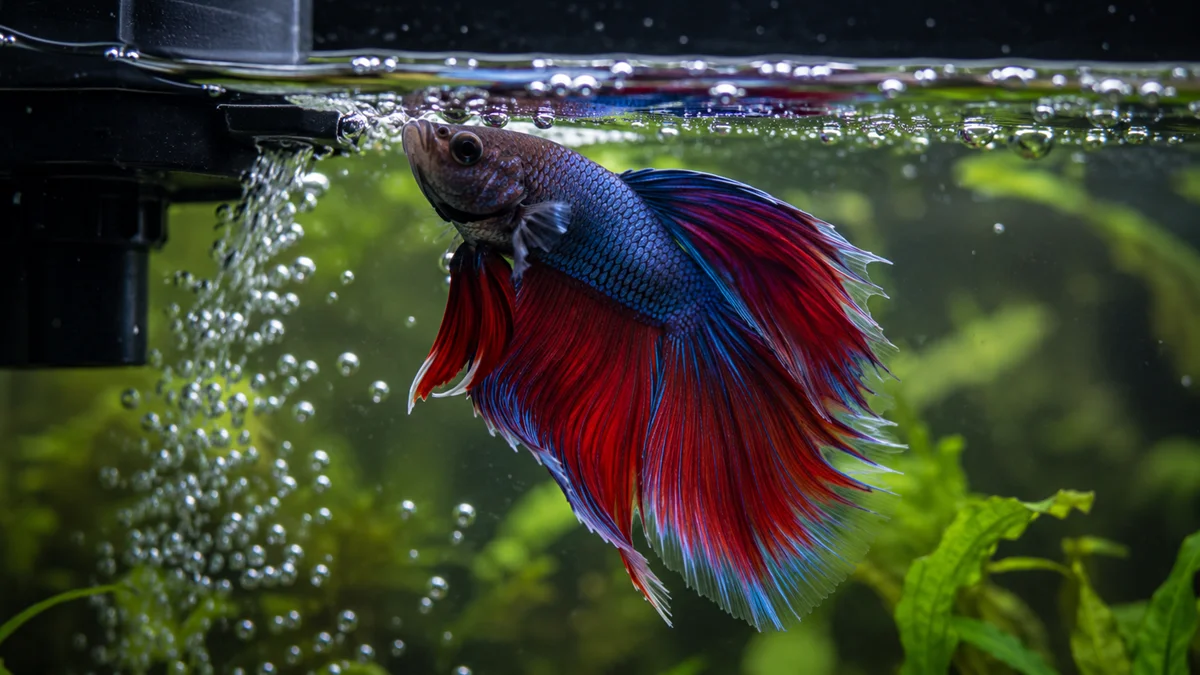
Fish breathing fast is your tank’s dashboard warning light. It’s not the disease — it’s the symptom. And the first time I saw it happen in my own tank, I made almost every mistake in this article.
I still remember it. A batch of my platies started pumping their gills so fast it looked like they were vibrating. I panicked and did a 50% water change on the spot — which, as you’ll see below, is exactly the wrong move if you don’t know the cause first. That mistake cost me two fish. I’m writing this so it doesn’t cost you anything.
Why is my fish breathing fast? In most cases, rapid gill movement means one of four things: low dissolved oxygen, an ammonia or nitrite spike, shock from a recent water change, or an underlying disease like gill flukes. Test your water before you do anything else — the fix for one cause can make another cause worse.
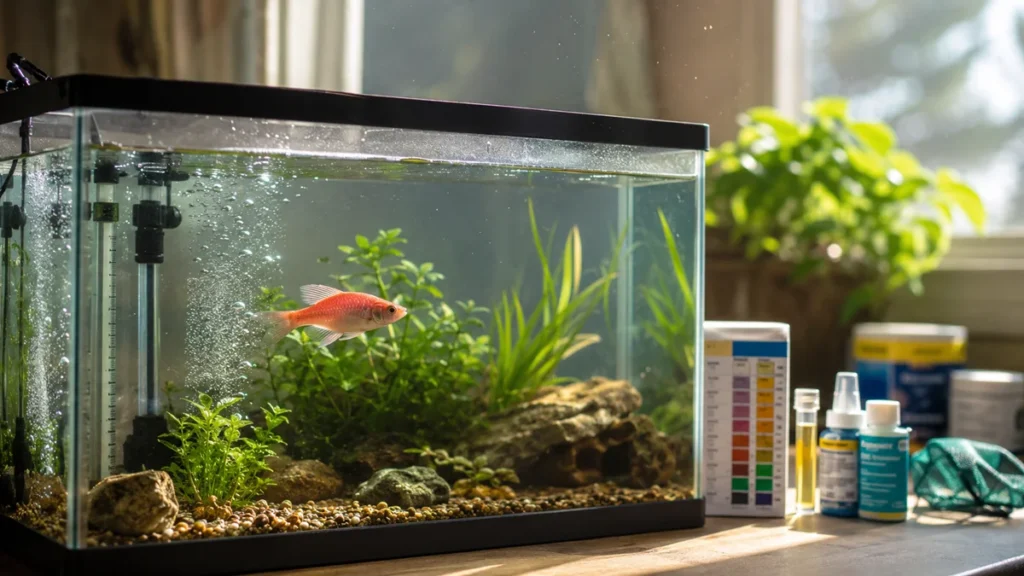
This guide covers the 4 real causes of fast fish breathing, emergency steps, my experience, and necessary equipment.
📋 Quick Summary Fact Card
| Symptom | Most Likely Cause | Test First |
| Gasping at the surface, multiple fish were affected | Low dissolved oxygen | Temperature + surface movement |
| Gasping at the surface + red gills, lethargy | Ammonia or nitrite poisoning | Ammonia/Nitrite test kit |
| Sudden onset right after maintenance | Water change shock | Temperature match, chlorine |
| One fish only, otherwise normal tank | Gill flukes or parasites | Close visual inspection of gills |
Why Is My Fish Breathing Fast? The 4 Real Causes
I’ve kept fish since I was a kid in a fishing family in India, and I’ve since studied the biology behind this in my Master’s in Zoology. Here’s the honest breakdown — not textbook language, just what I actually check in my own tanks.
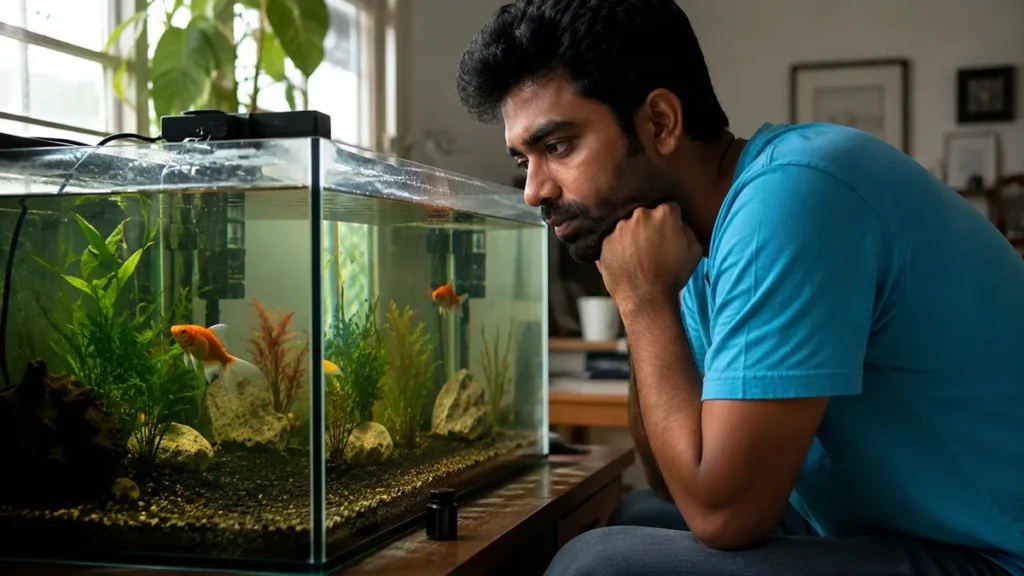
1. Low Dissolved Oxygen (The #1 Cause Nobody Explains Properly)
Fish don’t breathe oxygen the way we do. They pull dissolved oxygen (DO) out of the water through their gills — tiny feathery structures called lamellae that work like a sponge for gas exchange. When DO drops, the fish has to pump water over its gills faster just to extract the same amount of oxygen. That’s the rapid breathing you’re seeing.
What drops dissolved oxygen:
- Warm water — every 10°F rise in temperature reduces how much oxygen water can hold
- Overstocking — too many fish competing for the same oxygen supply
- Poor surface agitation — dissolved oxygen enters mainly where air meets water, so a still surface starves the whole tank
- Live plants at night — they produce oxygen during the day but consume it in the dark, so a heavily planted tank can actually run low on O2 by early morning
- A clogged filter or a dead air pump cutting off circulation
Signs it’s oxygen, specifically: multiple fish gathered at the surface, fish hovering near the filter outlet or bubbles, and — this trips people up — fish that look weak or barely moving but are still breathing hard. That combination often gets searched as “why is my fish not moving but still breathing,” and it’s usually oxygen exhaustion, not death.
Fix: Point your filter outlet at the surface to break it up. Add an air stone. If your tank runs warm in summer, bring it down 1–2°F. In my experience, surface agitation alone solves this 80% of the time — no need to touch the water chemistry.
2. Ammonia or Nitrite Poisoning (The One That Fools You)
Here’s the part most guides get wrong: ammonia poisoning can look identical to low oxygen from the outside, but the mechanism is completely different — and no amount of aeration will fix it.
Ammonia builds up constantly from fish waste, leftover food, and decaying plant matter. In a mature, cycled tank, beneficial bacteria convert it to nitrite, then to safer nitrate. But in a new tank, an overstocked tank, or one where the filter was recently cleaned too aggressively, that bacterial colony can’t keep up — and ammonia climbs fast.
The cruel part, from a biology standpoint: ammonia doesn’t just poison the fish, it physically inflames and damages the gill tissue itself, cutting down the surface area available for gas exchange. So the fish is drowning in oxygen-rich water because its own gills are damaged.
Symptoms: red or inflamed gills, lethargy, sitting at the bottom while breathing heavily, clamped fins, and — a detail worth remembering — this often shows up right after adding new fish or doing a large water change that disturbed the substrate.
Action step: Test immediately. Ammonia and nitrite should both read 0 ppm in a healthy tank — anything above that is dangerous, and anything above 0.5 ppm ammonia needs action within hours, not days. Do a 25–50% water change with dechlorinated water matched to your tank’s temperature. Don’t add new fish until both readings hold at zero for at least a week.
3. After Water Change Shock
If your fish suddenly started breathing fast right after you did maintenance, this is almost always a temperature mismatch or chlorine exposure — not a coincidence.
The mistakes I see most often:
- Adding tap water that’s a few degrees colder or warmer than the tank
- Forgetting the dechlorinator — chlorine and chloramine burn gill tissue almost instantly
- Vacuuming the substrate too aggressively and stirring up a pocket of trapped hydrogen sulfide or ammonia that had been sitting under the gravel
Fix: Always match the new water’s temperature to the tank within 2°F, and always use a conditioner that neutralizes chlorine, chloramine, and heavy metals — Seachem Prime is the one I keep on hand because it also temporarily detoxifies ammonia in an emergency, which buys you time while you diagnose further.
4. Stress, Disease, or Parasites (Gill Flukes)
If oxygen, ammonia, and recent water changes are all ruled out, look at disease — specifically gill flukes, small parasites that attach directly to gill tissue and damage the same oxygen-exchange surface that ammonia attacks. The frustrating part: a fish with gill flukes often looks completely normal everywhere except its breathing.
Other causes in this bucket: bacterial gill infections, aggressive tankmates causing chronic stress, and simple overcrowding.
Signs: one gill held closed or at an odd angle, flashing (rubbing against decor), reduced appetite, and rapid breathing that doesn’t improve even after water parameters check out clean.
Is It One Fish or the Whole Tank? This Tells You Almost Everything
This is the single fastest diagnostic shortcut, and it’s the one thing most guides skip.
If ONE fish is breathing fast and the rest look fine: think gill flukes, an individual injury, or a localized infection. It’s a “that fish” problem, not a “this tank” problem.
If MULTIPLE fish are breathing fast at once: think environmental — low oxygen, ammonia, nitrite, or a sudden temperature swing. This is a “this tank” problem, and it needs water testing immediately, not medication.
How to Save a Fish Breathing Fast (Emergency Steps)
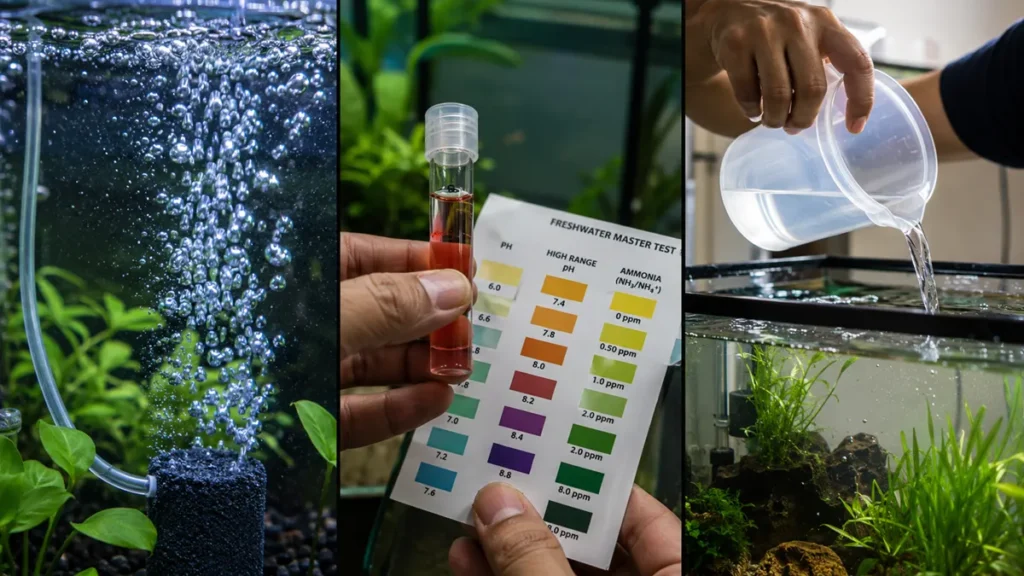
You need to act fast, but not randomly — panicked, unnecessary water changes or dumping in medication before you know the cause can make things worse. Work through this order:
1. Increase oxygen immediately
- Point the filter outlet toward the surface
- Add an air stone if you have one
- Lower the temperature slightly (1–2°F) if it’s running warm
2. Test the water now
Check ammonia, nitrite, nitrate, pH, and temperature — in that order of urgency.
3. Do a safe, measured water change
Match the temperature exactly, use a dechlorinator, and change only 20–30% at a time. A panicked 50%+ change can shock the fish further, especially if temperature isn’t matched precisely.
4. Stop feeding temporarily
If you suspect overfeeding, pause feeding for 24 hours. Uneaten food breaks down into ammonia and makes everything worse while you’re trying to stabilize the tank.
What I Got Wrong My First Time
One morning, I woke up to find my neon tetra fish swimming near the water’s surface with their gills moving rapidly. An immediate check revealed dangerously high levels of toxic ammonia; my habit of overfeeding had turned the tank water nearly lethal. They were saved by an immediate 50% water change and a dose of water conditioner.
USA Buyer’s Note: Testing and Equipment
If you’re testing water in the US, the API Freshwater Master Test Kit is the one I’d point most beginners toward — it covers ammonia, nitrite, nitrate, and pH in one box and is available at Petco, PetSmart, and most local fish stores for roughly $25–30. Liquid test kits are more accurate than dip strips for ammonia specifically, which matters here since ammonia is one of the two most time-sensitive readings you’ll take.
For aeration, a basic air pump and air stone combo runs $10–20 at any US pet retailer and is genuinely one of the highest-value purchases you can make if oxygen turns out to be your issue — it’s a permanent fix, not a one-time patch.
How to Prevent Fast Breathing From Coming Back
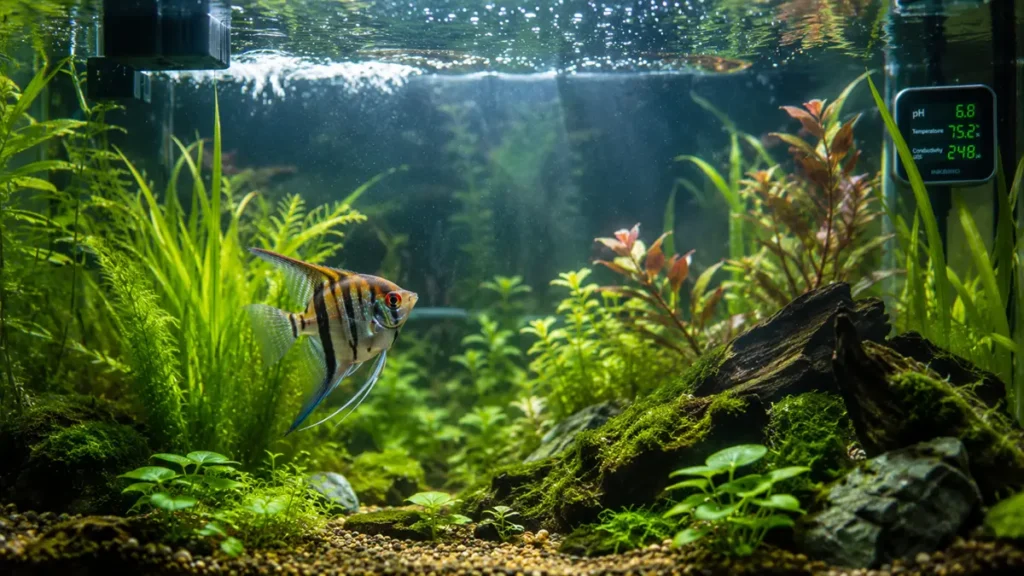
1. Keep water parameters stable
- Ammonia and nitrite at 0 ppm, always
- Nitrate under 20–30 ppm
- Check pH weekly, not just when something looks wrong
2. Improve oxygenation permanently
- Keep visible surface agitation running at all times
- Clean the filter on a schedule, not just when it looks dirty
- Avoid overcrowding — research adult size, not the size the fish is when you buy it
- Add live plants for daytime oxygen support (just remember they consume O2 at night too)
3. Feed with discipline
- Feed 1–2 times a day, only what clears in 2–3 minutes
- Remove uneaten food promptly — it’s the single most avoidable ammonia source
4. Quarantine every new fish
- 7–14 days in a separate tank before adding to your main setup — this is the single biggest thing that would have prevented my own gill fluke scare
5. Make every change slow
- Temperature, pH, and lighting shifts should happen gradually. Fast changes are stressful even when the end parameters are “correct.”
Frequently Asked Questions
Why is my fish breathing fast all of a sudden?
Why is my fish breathing fast all of a sudden usually points to a sudden environmental shift — a water change without matched temperature, a spike in ammonia, or a drop in dissolved oxygen. Test your water first before assuming disease.
How often should I test my water if my fish is breathing heavily?
Test daily until readings stabilize at safe levels, then return to a weekly schedule. During an active ammonia or nitrite spike, testing twice a day helps you track whether your water changes are actually working.
Is rapid fish breathing dangerous, or will it fix itself?
It can be dangerous if left unaddressed for more than a few hours, especially with ammonia or nitrite involved, since both damage gill tissue permanently at high enough levels. Don’t wait it out — test and act the same day you notice it.
What’s the most common beginner mistake when a fish is breathing fast?
The most common beginner mistake is doing an immediate large water change without testing first, which can shock a fish that’s actually suffering from temperature swings rather than water quality. Always test before you act.
Which test kit do US aquarium keepers actually need?
US keepers need a liquid test kit that reads ammonia, nitrite, nitrate, and pH — the API Freshwater Master Test Kit is the standard choice sold at Petco, PetSmart, and most local fish stores.
Is it true that bettas are supposed to breathe at the surface?
Yes, this is a common myth worth correcting — bettas and gouramis have a labyrinth organ that lets them gulp air at the surface normally, so surface visits alone aren’t a red flag for these species the way they are for most community fish.
Next Steps: Resources You Must Read
Related Reading
- How to Remove Ammonia From a Fish Tank Naturally — “carry water test immediately”
- Why Do My Fish Die After a Water Change? —“temperature mismatch or chlorine exposure”
- How to Choose the Right Aquarium Air Pump —“add an air stone”
Scientific References
USA Aquarium Resources
- API Freshwater Master Test Kit (available at Petco, PetSmart, and most local fish stores)
- Seachem Prime water conditioner
Final word: rapid breathing is your fish talking to you the only way it can. Test first, act second, and you’ll catch almost every case before it becomes an emergency.
Was this guide helpful?
First-Hand Experience
Based on animals I've personally kept and bred - not summarized from other articles.
Zoological Foundation
Claims are checked against my M.Sc. Zoology training and published aquatic biology research, not recycled aquarium myths.
No Paid Influence
No sponsorship shaped this guide. Affiliate links, if any, are disclosed separately and never hidden.
Kept Current
Errors are corrected as soon as they're found, with the update noted at the bottom of the article.
Anil Satak M.Sc. Zoology · Founder, FishioHub
Grew up in a fishing family in India and holds a Master's in Zoology. FishioHub is a one-person operation - every guide is personally researched, kept-tested, and written by Anil. No team, no outsourced writers, no AI-generated content. Read his full bio →