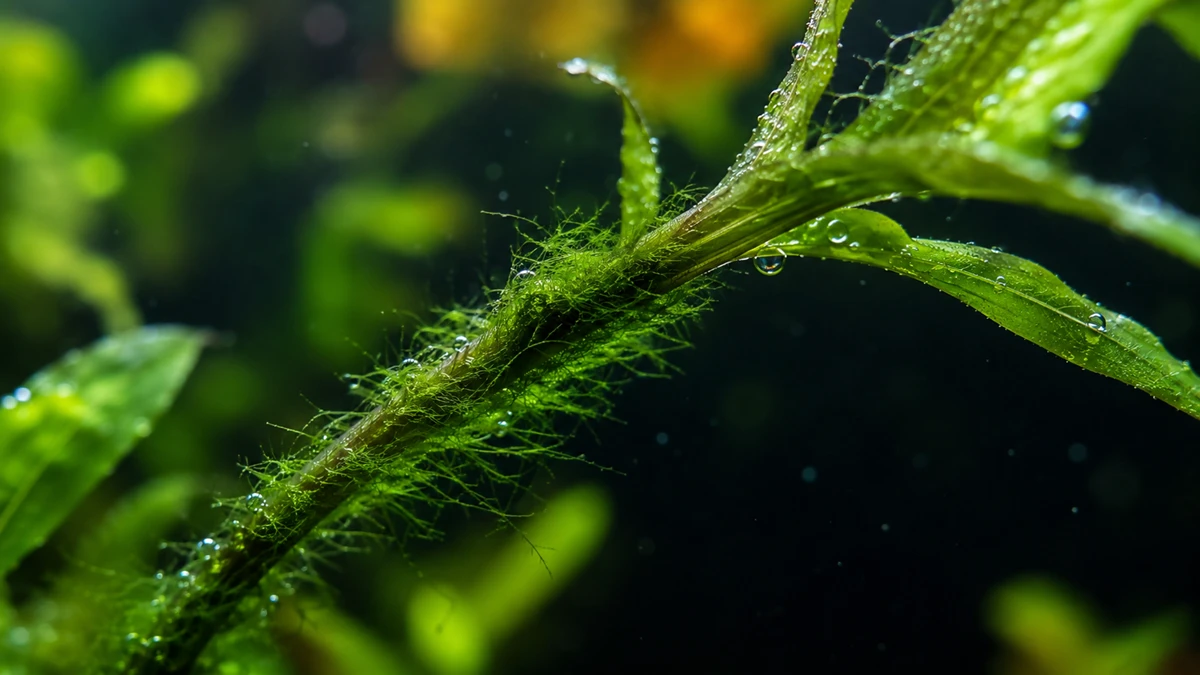
The invasion always starts right when your tank stabilizes. For me, it began as a slight, fuzzy texture on the tips of my pristine Christmas Moss. It wasn’t debris; it was string algae anchoring itself into every single crevice of the hardscape. At that exact moment, my entire search history became a desperate hunt for how to get rid of string algae aquarium setups quickly before it ruined my hard work.
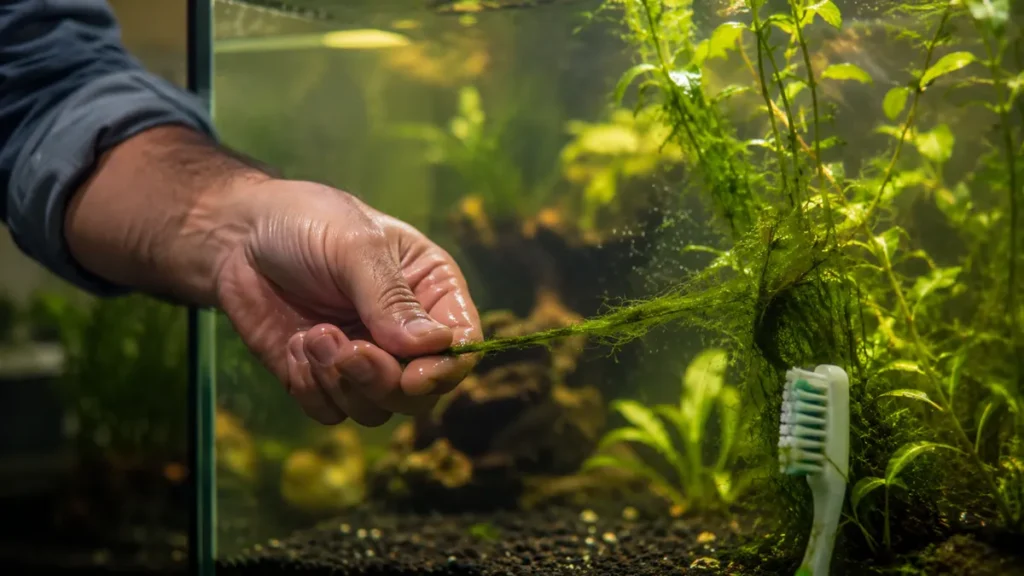
You reach in to trim a stem plant. Your fingers come back wrapped in slimy green thread. During my first major outbreak, I spent an hour daily swirling a toothbrush through the tank to harvest green threads. It was incredibly disheartening. I’d clear the hairgrass completely, only to watch the algae aggressively bounce back 48 hours later, outgrowing my hands.
If you’re standing over your tank right now wondering how to get rid of string algae in your aquarium: pull out what you can by hand, spot-treat what’s left with 3% hydrogen peroxide, then fix the light or nutrient excess that’s feeding it — in that order.
Quick Facts — If You Only Remember 3 Things
- String algae (also called hair algae or filamentous algae) grows fastest when light and nutrients — especially nitrate and phosphate — spike together.
- Getting rid of string algae usually takes a few days to two weeks with manual removal plus hydrogen peroxide. Skip the root-cause fix, though, and it comes right back.
- Hair algae in aquarium tanks won’t poison your fish. But a heavy mat can smother plants and pull oxygen down at night, so it’s still worth clearing.
How to Get Rid of String Algae in Your Aquarium: The Short Version
Here’s the honest, no-fluff answer to how to get rid of string algae aquarium keepers keep Googling at 11 pm: you can’t shortcut past manual removal.
- Twist it off by hand or with an old toothbrush first. That single step does more work than any bottle you’ll buy.
- Once the bulk is gone, hydrogen peroxide mops up what’s left. And once the tank looks clean again, you still have to close the nutrient gap — or you’ll be back here in three weeks doing this all over again.
What’s Actually Causing Filamentous Algae in Your Aquarium?
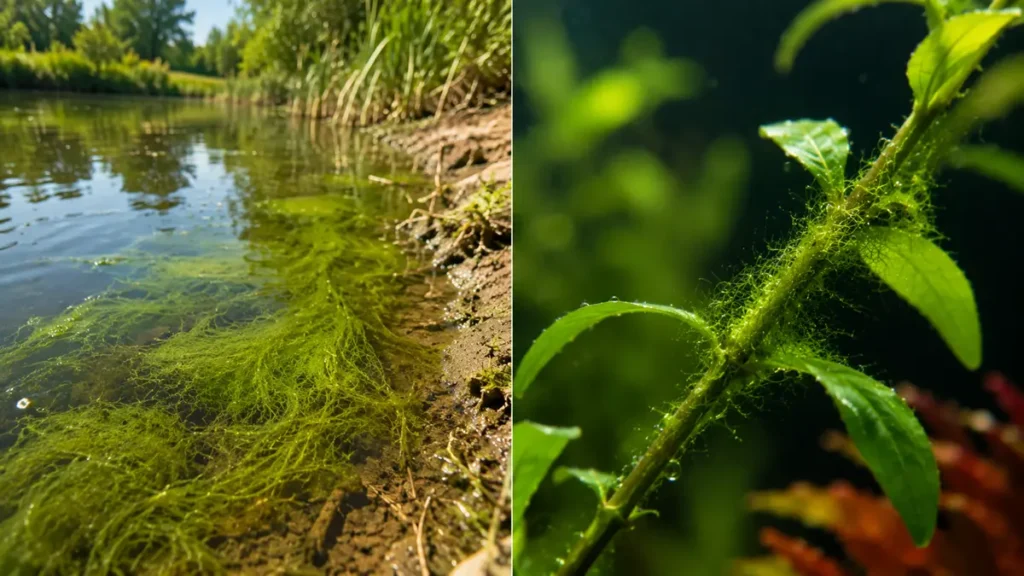
Filamentous algae in aquarium tanks behave almost exactly like it does in ponds and lakes. It’s a nutrient response, not bad luck.
A Rutgers Cooperative Extension study on filamentous algae found that excess nitrogen and phosphorus are the direct trigger for the mats and scum that build up once single algae cells start reproducing. Problems arise when excess nutrients like nitrogen and phosphorus cause excessive growth that results in mats or scum, and single cells reproduce into long strands that grow toward the water’s surface.
Penn State Extension’s research on filamentous algae describes the same pattern in ponds — cells joining into long hairlike strands that eventually form floating mats. Different species of filamentous algae exist, but all have a similar growth habit — single cells reproduce and join together into long hairlike strands or colonies that grow toward the water surface, forming large mats that trap gases and float.
Your tank is just a smaller, faster version of that same system. A dead snail, a few extra hours of light, a bit of overfeeding — any of it can trigger visible string algae within days.
The USGS’s work on nutrients and eutrophication explains why the “both at once” part matters so much. Algal growth is usually limited by the available supply of either phosphate or nitrate, and a water body is nitrogen limited if the ratio of nitrogen to phosphorus is low, or phosphorus limited if that ratio is high. In plain terms: whichever nutrient is scarcer normally acts as the brake. Push both up together, and the brake is gone.
Hair Algae in Aquarium Tanks: What You’re Actually Looking At
“Stringy stuff in fish tank” usually means one of two things. Either fine, hairlike strands wrapped around plant stems and decor, or thicker, tougher threads anchored at a single point.
Hairlike algae in aquarium water often starts as a faint green fuzz on leaf edges. Give it a week or two, and it’s full strands.
Catch it at the fuzz stage, and manual removal takes ten minutes. Wait, and it’s a Saturday-afternoon job.
Green Hair Algae Freshwater Tanks vs. Everything Else
Green hair algae in freshwater tanks grow is bright green, fine, and fastest under strong light. It’s not the same thing as black beard algae — dark, bristly, and much tougher to pull.
It’s also not cyanobacteria (often called blue-green algae), which is actually a bacterium, not a true algae. Cyanobacteria peels off in slimy sheets. String algae comes away in stringy clumps.
If what’s in your hand is threads, not a sheet, you’re dealing with true filamentous algae.
Is Hair Algae Bad for Fish?
Directly? Not really. It isn’t toxic, and most fish ignore it completely.
The real risk is indirect. A heavy mat blocks light from slower-growing plants underneath it. And because algae consumes oxygen overnight — the reverse of what it does in daylight — a severe overgrowth can quietly stress oxygen levels in a heavily stocked tank while everyone’s asleep.
For almost every home aquarium, string algae is a plant-health and cosmetic problem long before it’s a fish-health one.
How to Get Rid of String Algae in a Planted Aquarium — Step by Step
Here’s how to get rid of string algae in a planted aquarium without wrecking your plants or your filter’s beneficial bacteria along the way.
Step 1: Manual Removal First
Twist the strands around a toothbrush or your fingers and pull. This is genuinely the single most effective step — it physically removes both the algae and the nutrients locked up inside it.
If a plant is completely overrun, it’s usually faster to trim the leaf off entirely than to clean it strand by strand.
Step 2: Hydrogen Peroxide for Hair Algae — The Spot-Treatment Method
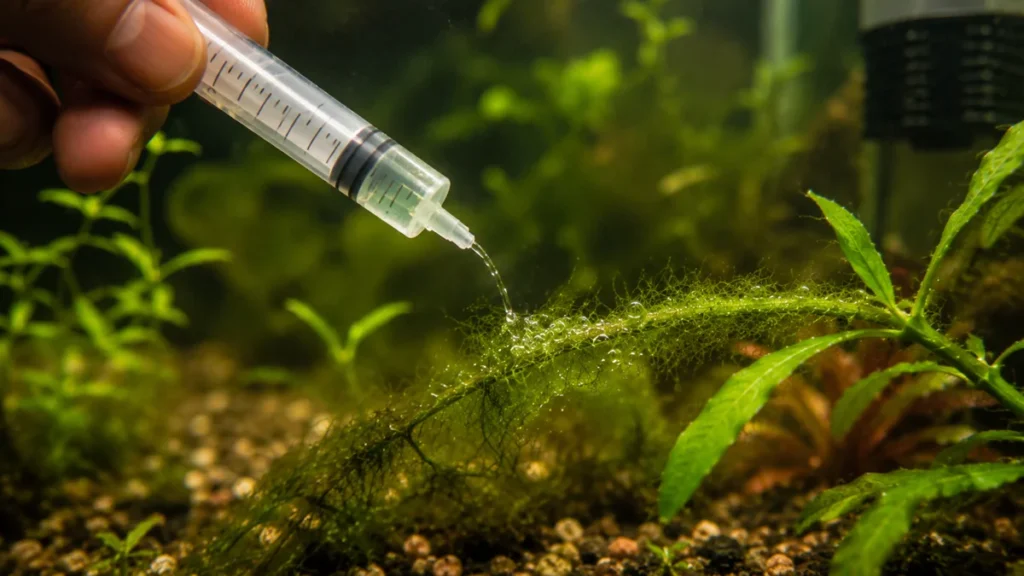
Once manual removal has taken off the bulk, hydrogen peroxide for hair algae handles what’s left. Use a plain 3% solution — the same concentration sold as a basic wound antiseptic.
- Turn off your filter and any air stones so the solution doesn’t disperse too fast.
- With a syringe, apply the 3% hydrogen peroxide directly onto the algae. Avoid fish and healthy plant tissue where you can.
- Let it sit 10–15 minutes. You’ll see fine bubbles — that’s the peroxide breaking down the algae’s cell structure.
- Turn your filter and pumps back on.
- Repeat every few days if needed, until the algae is gone.
This is the core answer to how to get rid of filamentous algae in aquarium tanks once manual removal alone isn’t cutting it.
For a full-tank dose rather than spot-dosing, a reasonable starting point is about 1 mL of 3% hydrogen peroxide per 10 gallons of actual water volume. Start low. Watch your fish closely for any sign of stress before you go higher.
The Simple Cure for Green Hair Algae Freshwater Tanks (The Part That Actually Lasts)
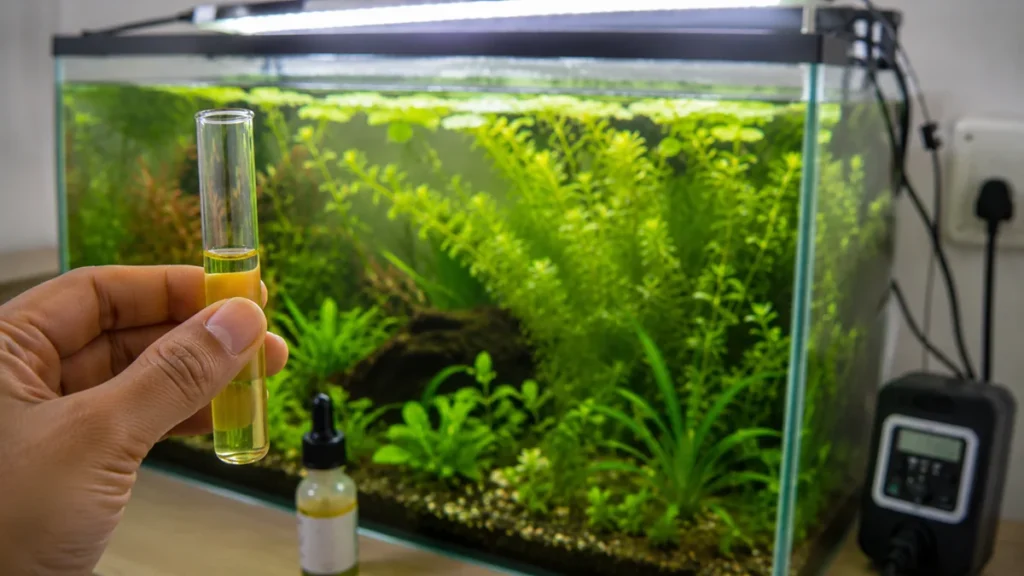
The simple cure for green hair algae freshwater tanks isn’t a product. It’s closing the gap between light and nutrients.
In practice, that means:
- Cutting your photoperiod back to 6–8 hours a day
- Testing nitrate and phosphate weekly instead of guessing
- Adding fast-growing stem plants or floaters that outcompete algae for the same nutrients
- Not overfeeding — leftover food is a direct nutrient source for algae
Treatment without this step is just a reset button. The algae comes back within a couple of weeks if the underlying balance hasn’t changed.
Hair Algae on Plants: Why Some Species Get Hit Harder
Hair algae on plants tends to target the slow growers — Anubias, Java fern, and similar low-light species. Their leaf turnover is too slow to outrun what’s attaching to them.
Faster-growing stem plants are naturally more resistant. They’re simply absorbing the same nutrients the algae wants, faster than the algae can use them.
If you keep losing the fight on one specific plant, it’s worth asking whether that plant is a poor light-and-growth match for your setup — not just treating it as an unwinnable algae battle.
Green Spot Algae Aquarium Problems: A Different Beast Entirely
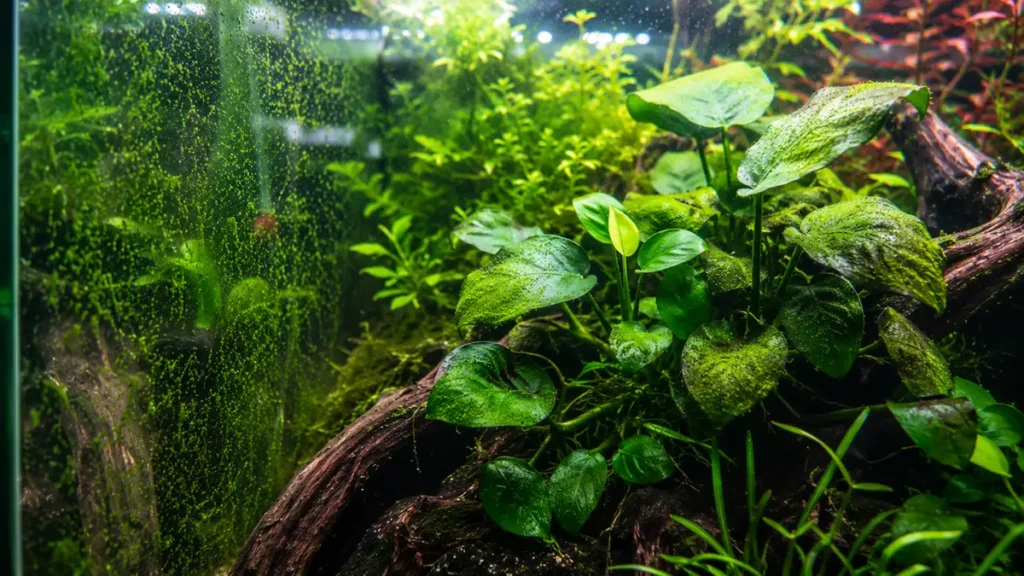
Green spot algae aquarium owners deal with gets confused with string algae constantly, but it behaves almost the opposite way. It isn’t fed by excess nutrients.
Green spot algae — the hard, round dots on glass and slow-growing leaves — is typically linked to low phosphate combined with strong lighting. That’s the reverse of the string-algae cause.
So the fix flips too: rather than cutting nutrients, you may need to correct a phosphate deficiency alongside dialing back light intensity.
Comparison: String/Hair Algae vs. Green Spot Algae vs. Diatoms
| Type | Appearance | Typical Cause | Best First Fix |
| String/hair (filamentous) algae | Long green threads, wraps around plants/decor | Excess nitrate + phosphate, too much light | Manual removal + hydrogen peroxide spot treatment |
| Green spot algae (GSA) | Hard, round green dots on glass and slow leaves | Low phosphate, strong direct light | Correct phosphate levels, reduce light intensity |
| Diatoms (brown algae) | Brown, dusty film on glass and substrate | Excess silicate, common in new tanks | Wipe manually, let tank mature, consider silicate-removing media |
FAQ
Does hydrogen peroxide kill fish along with the algae?
At the low doses used for spot treatment or a calculated full-tank dose, it’s generally safe. Overdosing or dosing without measuring your true water volume is where things go wrong — always start low.
Will algae-eating fish or shrimp get rid of string algae on their own?
They help manage light growth, but a heavy infestation usually needs manual removal first. Grazers like Amano shrimp or otocinclus rarely keep pace with an active bloom on their own.
How long does it take to get rid of string algae in an aquarium?
Most tanks show visible improvement within a few days of manual removal plus hydrogen peroxide. Full clearance usually takes one to two weeks, assuming you also fix the light and nutrient issue behind it.
Is hair algae a sign of a dirty tank?
Not necessarily dirty — it’s a sign of a nutrient and light imbalance. That can happen in a spotless, well-maintained tank just as easily as a neglected one.
Can I use hydrogen peroxide with live plants in the tank?
Yes, at recommended doses. Some delicate species like liverworts can be sensitive, so spot-treating rather than dosing the whole tank protects the plants you care about.
What’s the difference between hair algae and black beard algae?
Hair algae is fine and soft, and comes away easily in strands. Black beard algae is dark and bristly, and needs a stronger or repeated peroxide treatment.
Does turning off the lights kill string algae?
A short blackout of 2–3 days slows it by cutting off photosynthesis. It’s rarely a complete fix alone — pair it with manual removal and a nutrient check.
Next Steps: Resources You Should Read
Related FishioHub reading:
- How to Prevent Aquarium Algae — for keeping it from coming back once this outbreak is cleared
- Algae-Eating Fish for Freshwater Aquarium — natural grazers worth adding after treatment
- Do Amano Shrimp Eat Algae? Complete Guide — a closer look at one of the best algae-eating shrimp species
Scientific references:
- Rutgers NJAES, FS1231 — Filamentous Algae in Waterways
- Penn State Extension — Filamentous Algae
- USGS — Nutrients and Eutrophication
USA aquarium resources:
- Your local fish store’s water testing counter (many test nitrate/phosphate for free)
- API or Salifert freshwater test kits, widely available at US pet retailers
- r/PlantedTank and r/Aquariums for troubleshooting specific setups
Closing
Algae isn’t the enemy. It’s your tank telling you something’s out of balance. Fix the imbalance, and the green threads stop being a fight you have to keep having.
Was this guide helpful?
First-Hand Experience
Based on animals I've personally kept and bred - not summarized from other articles.
Zoological Foundation
Claims are checked against my M.Sc. Zoology training and published aquatic biology research, not recycled aquarium myths.
No Paid Influence
No sponsorship shaped this guide. Affiliate links, if any, are disclosed separately and never hidden.
Kept Current
Errors are corrected as soon as they're found, with the update noted at the bottom of the article.
Anil Satak M.Sc. Zoology · Founder, FishioHub
Grew up in a fishing family in India and holds a Master's in Zoology. FishioHub is a one-person operation - every guide is personally researched, kept-tested, and written by Anil. No team, no outsourced writers, no AI-generated content. Read his full bio →