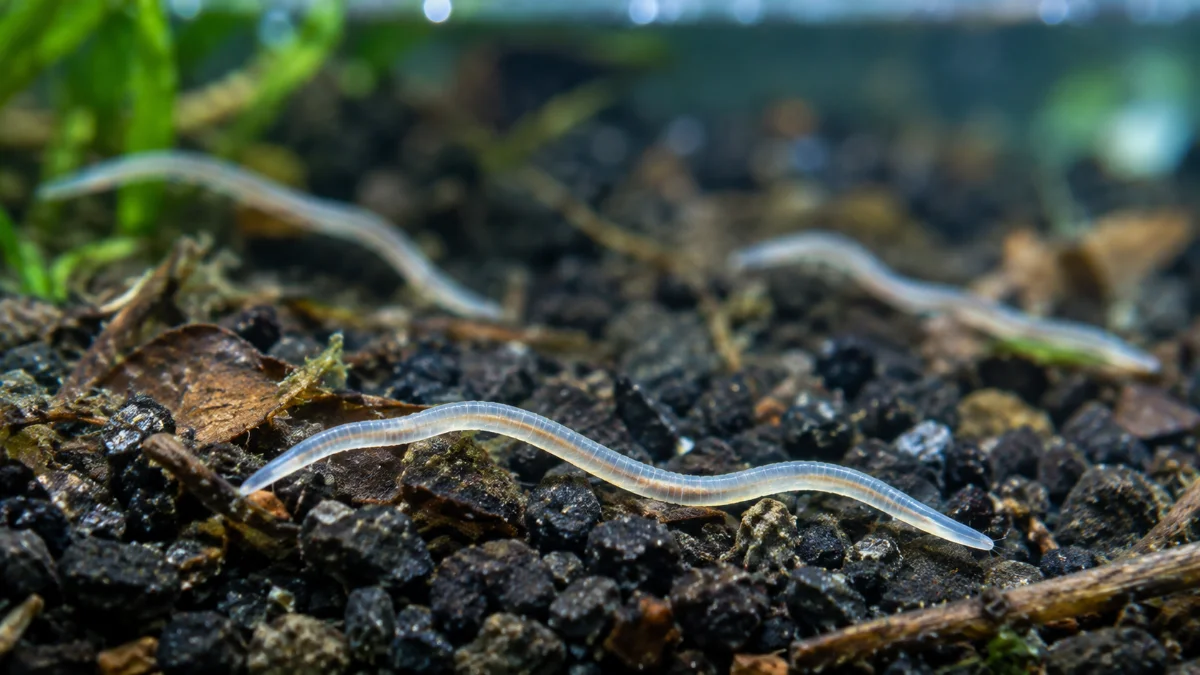
Spot a handful of thin, pale threads whipping around your substrate and your first instinct is probably panic. I get it — and the good news is you can learn how to get rid of detritus worms in an afternoon, not a week.
Here’s the direct answer: cut back feeding for a few days, deep-clean the substrate, rinse your filter media, and increase water changes for two to three weeks. Detritus worms can’t survive once their food source — excess organic waste — disappears.
I panicked the first time I saw them thrashing in my 20-gallon tank, instantly assuming they were deadly parasites. I almost nuked the tank with medications. Instead, I grabbed my gravel vacuum and realized the real issue: I was heavily overfeeding.
I skipped the chemicals, fasted the tank for three days, did a heavy water change while vacuuming the substrate, and cleaned the filter. Within 48 hours, they vanished.
If You Only Remember 3 Things
- Detritus worms (family Naididae) are harmless to fish and to people — they’re a symptom, not a disease.
- A sudden bloom almost always means overfeeding, a dirty substrate, or an overdue filter clean.
- You’ll get better, longer-lasting results learning how to get rid of detritus worms through starvation than through medication.
What Do Detritus Worms Look Like?
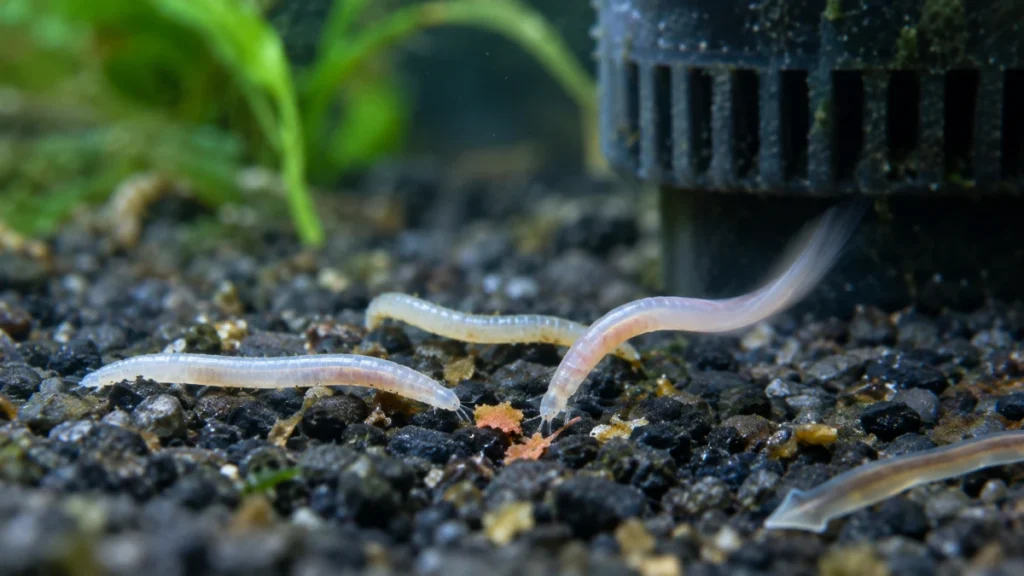
What do detritus worms look like the first time you spot them? Thin, pale, almost see-through threads, usually a quarter-inch to an inch long. They whip through the water in a fast, snake-like motion, or crawl slowly across glass and substrate like miniature earthworms.
They’re segmented, which is the fastest way to rule out planaria. Planaria are flat, arrowhead-headed flatworms that glide smoothly instead of whipping around.
Detritus worms are usually white, cream, or pale pink. You’ll spot them clustering near leftover food, hiding in the substrate, or drifting near the filter outflow once their numbers spike. Once you’ve confirmed that’s what you’re looking at, the section below covers exactly how to get rid of detritus worms step by step.
Where Do Detritus Worms Come From in Fish Tank Setups?
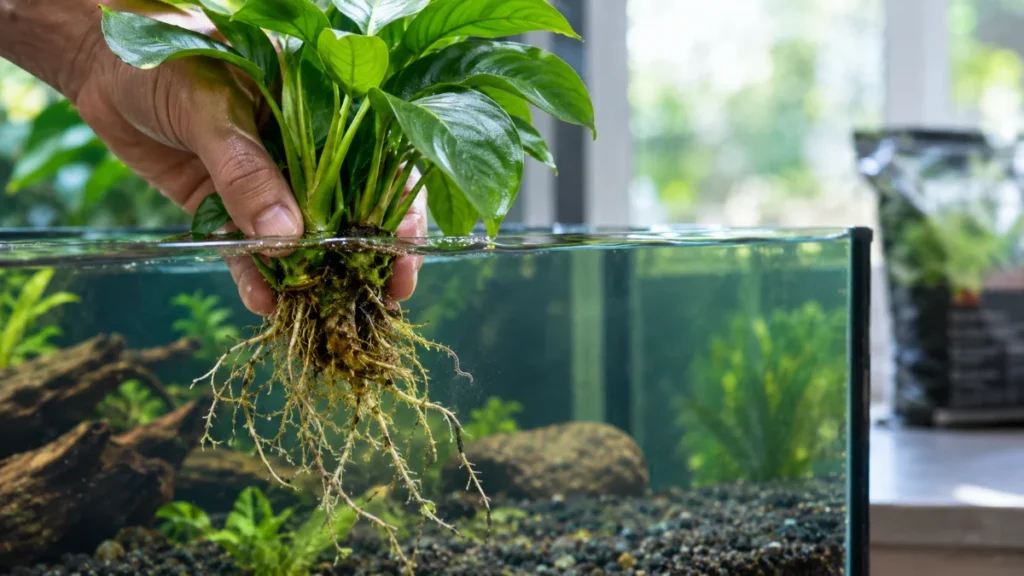
Where do detritus worms come from in fish tank water if you never added any on purpose? Almost always, they hitchhike in — on new live plants, in a bag of substrate, on decor from another tank, or in a batch of fish food.
They’re already present in most healthy aquariums in tiny, invisible numbers. You just don’t notice them until conditions swing in their favor.
How Do Detritus Worms Get in Aquarium Systems That Seem Spotless?
So how do detritus worms get in aquarium water that’s been running clean for months, with no new additions? The worms — or their eggs — were probably always there, riding along in the biofilm on your décor since setup day.
Naidid worms reproduce through architomy: splitting their own bodies in two, with each half regrowing into a full worm. That trick is documented in naidid reproduction research, and it’s why a tank can go from zero visible worms to a carpet of them in under a week once there’s a sudden surplus of food.
Are Detritus Worms Harmful?
Are detritus worms harmful to your fish, your shrimp, or you? In almost every case, no. They’re detritivores — they eat decaying food, plant matter, and waste, not living tissue, Detritus Worms have no mouthparts capable of biting anything.
I read one more thing, New Mexico State University’s Cooperative Extension Service notes that tubificid worms are simply tolerant of poor water conditions, and biologists use their high numbers as a pollution signal — not evidence the worms cause harm.
Confirming they’re harmless doesn’t mean you should ignore them, though. The section further down still shows how to get rid of detritus worms so your tank looks — and stays — clean.
Detritus Worms Harmful to Humans: What You Actually Need to Know
Detritus worms harmful to humans is one of the most-searched versions of this question, and the honest answer is essentially no. They’re not parasites, and they don’t transmit disease to people.
Normal tank maintenance — gravel vacuuming, water changes, handling decor — carries no meaningful risk. Wash your hands after tank work the way you would after any aquarium chore, and you’re fine.
Detritus Leech: Am I Actually Looking at a Leech?
If you searched detritus leech, something you saw probably looked longer, flatter, or more muscular than a typical worm. Fair question — the two do get confused.
True leeches have a visible sucker at one or both ends and move in a distinctive looping crawl, not the fast whip-and-wriggle of a naidid worm. Genuine fish-parasitic leeches are rare in home aquariums; they usually arrive on wild-caught fish or plants pulled from natural water.
If what you’re looking at has a sucker and is actively attached to a fish, that’s a leech situation needing quarantine and manual removal — not a detritus worm cleanup.
How to Get Rid of Detritus Worms in Fish Tank Systems
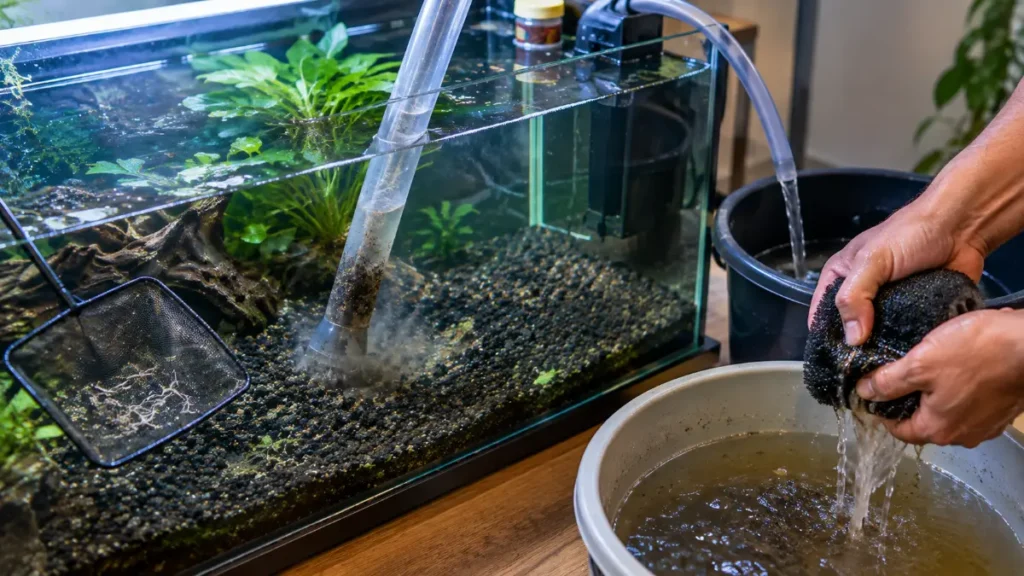
Here’s how to get rid of detritus worms in a fish tank once you’ve ruled out a leech situation. The whole approach comes down to removing their food source and physically pulling out as many as you can while the population resets.
- Cut feeding back for 5–7 days. Feed only what your fish finish in under two minutes, once a day. This alone starves out most blooms.
- Deep clean the substrate. Run a gravel vacuum through every inch, not just the top layer — worms live in the organic muck below the visible surface.
- Rinse (don’t replace) your filter media. Squeeze sponge and mechanical media in removed tank water to knock loose the buildup they’re feeding on, without wiping out beneficial bacteria.
- Increase water changes temporarily. Bump from your normal schedule to twice-weekly 25–30% changes for two to three weeks.
- Manually remove visible clusters. A turkey baster or fine net works well for pulling out clumps you can see.
Detritus Worms How to Get Rid of Them for Good
If you’ve been typing detritus worms how to get rid of into every forum search bar and getting conflicting advice, here’s the timeline i studied and recommends that actually works. Most blooms clear within one to two weeks of consistent feeding cuts and substrate cleaning.
The worms don’t vanish forever. A few will always remain in the biofilm, ready to bloom again the next time waste builds up — that’s normal, not a sign you failed.
How to Get Rid of Detritus in Aquarium Water and Substrate (Not Just the Worms)
How to get rid of detritus in aquarium substrate matters just as much as targeting the worms, since detritus is their entire food supply. Beyond gravel vacuuming, check your filter’s flow rate.
A filter that’s undersized for your tank volume lets more waste settle instead of getting pulled into mechanical filtration. Trim back overfeeding of bottom-feeders like corydoras or plecos too — sinking wafers left untouched overnight are a favorite worm food source.
What Kills Detritus Worms Fast?
What kills detritus worms fast, if you’d rather speed things up than wait out a slow starvation approach? A deep gravel vacuum paired with a 48-hour total feeding pause knocks a bloom down dramatically faster than gradual cuts alone — fish can safely skip two days of meals.
Skip the chemical dewormers and anti-parasitic medications. They’re formulated for internal fish parasites, not free-living detritivores, and dosing them here just stresses your fish for nothing.
How to Get Rid of Detritus Worms in Aquarium Filters and Hard-to-Reach Spots
Detritus worms love the gunk that collects in filter intake tubes, spray bars, and the crevices under décor — spots a gravel vac can’t reach. Pull those pieces out during your next cleaning and give them a proper scrub in removed tank water.
This step alone often clears worms that keep reappearing even after you’ve deep-cleaned the substrate twice.
How to Get Rid of Detritus Worms in Shrimp Tank Setups
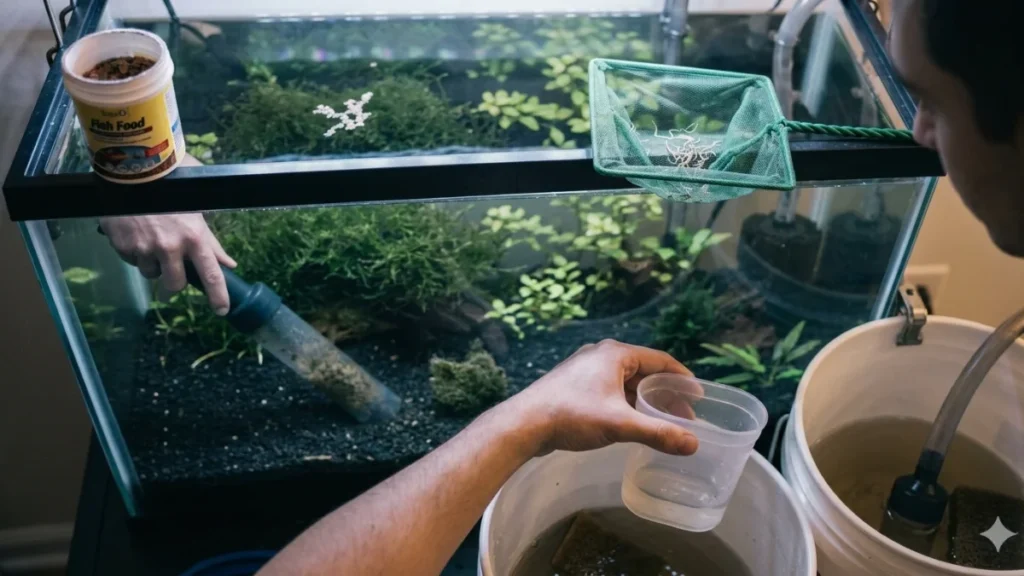
How to get rid of detritus worms in a shrimp tank calls for a gentler hand than a fish-only setup. Shrimp are far more sensitive to medications, ammonia spikes from aggressive substrate disturbance, and sudden parameter swings.
Stick to manual removal and gradual feeding reduction rather than anything chemical. Avoid most loach and larger fish solutions too, since they’ll eat your shrimp right along with the worms.
Cut supplemental feeding by half rather than pausing it entirely — shrimp graze on biofilm constantly, so full starvation isn’t necessary or kind. This usually clears a bloom without stressing the colony.
I nearly wiped out my breeding colony by adding a “shrimp-safe” chemical dewormer to my tank. It killed the worms, but the sudden rot triggered a massive ammonia spike overnight. When a second bloom happened later from overfeeding powdered food, I skipped the chemicals completely. I just cut feeding by half, and the population balanced itself out safely.
What Eats Detritus Worms in Aquarium Communities?
What eats detritus worms in aquarium setups can genuinely speed up cleanup, though no predator replaces fixing the actual feeding problem. Do fish eat detritus worms readily? Several species will snack on them opportunistically, though none should be added purely as a fix.
| Predator | Effectiveness Against Detritus Worms | Best Fit |
| Dwarf chain loach / Yoyo loach | High | Community tanks without shrimp |
| Assassin snail | Moderate (prefers snails, opportunistic on worms) | General community and snail-control tanks |
| Betta fish | Moderate (occasional snack, not reliable) | Betta-only or lightly stocked tanks |
| Gourami species | Moderate | Community tanks with peaceful tank mates |
| Killifish | High | Species-specific or biotope setups |
FAQ: Detritus Worms
Are detritus worms harmful to fish?
No — they’re detritivores with no ability to bite or infect fish; their presence signals excess waste, not disease.
Are detritus worms harmful to humans?
No, they’re not parasitic to people and pose no meaningful risk during normal tank maintenance.
How to get rid of detritus worms without harming my fish?
A 48-hour feeding pause, a full gravel vacuum, and rinsed filter media clear most blooms within one to two weeks without any medication.
I spotted one detritus worm in fish tank gravel — is that already an infestation?
No — a single worm is normal background biology; only a visible cluster or sudden population spike calls for action.
Are detritus worms in aquarium water something to worry about, or just the substrate?
They live in both, but the substrate holds the real population; worms drifting in open water usually mean that population has already overflowed.
What kills detritus worms without medication?
Consistent feeding cuts, a deep gravel vacuum, and rinsed filter media — no dewormer or anti-parasitic product is made for free-living detritivores.
How to get rid of detritus worms in shrimp tank setups without hurting the shrimp?
Rely on gradual feeding reduction and manual removal rather than medications or aggressive substrate disturbance, which stress shrimp more than the worms do.
How long does it take to clear a detritus worm bloom for good?
Most blooms clear within one to three weeks of consistent feeding reduction and substrate cleaning; small numbers return whenever waste builds back up, and that’s normal.
Next Steps: Resources You Should Read
Related FishioHub reading:
- Aquarium Bioload: Why Your Tank’s Carrying Capacity Matters
- How to Remove Ammonia From Fish Tank Naturally
- Most Common Aquarium Problems and Solutions
Scientific references:
- New Mexico State University Cooperative Extension Service — Stream Biomonitoring Using Benthic Macroinvertebrates, Circular 677.
- Detroit River–Western Lake Erie Basin Indicator Project — oligochaete density and pollution-tolerance data, University of Windsor.
USA aquarium resources:
- Aquarium Co-Op (community forum and water-quality guidance)
- Your local university extension office’s water-quality testing program (many offer low-cost test kits)
Closing
A tank full of wriggling white threads feels like a crisis the first time you see it. Really, it’s just your aquarium doing what it’s built to do — flagging a small imbalance before it becomes a big one.
Now you know how to get rid of detritus worms for good. Fix the feeding, clean the substrate, and in a couple of weeks you’ll barely remember they were there.
Was this guide helpful?
First-Hand Experience
Based on animals I've personally kept and bred - not summarized from other articles.
Zoological Foundation
Claims are checked against my M.Sc. Zoology training and published aquatic biology research, not recycled aquarium myths.
No Paid Influence
No sponsorship shaped this guide. Affiliate links, if any, are disclosed separately and never hidden.
Kept Current
Errors are corrected as soon as they're found, with the update noted at the bottom of the article.

Anil Satak M.Sc. Zoology · Founder, FishioHub
Grew up in a fishing family in India and holds a Master's in Zoology. FishioHub is a one-person operation - every guide is personally researched, kept-tested, and written by Anil. No team, no outsourced writers, no AI-generated content. Read his full bio →