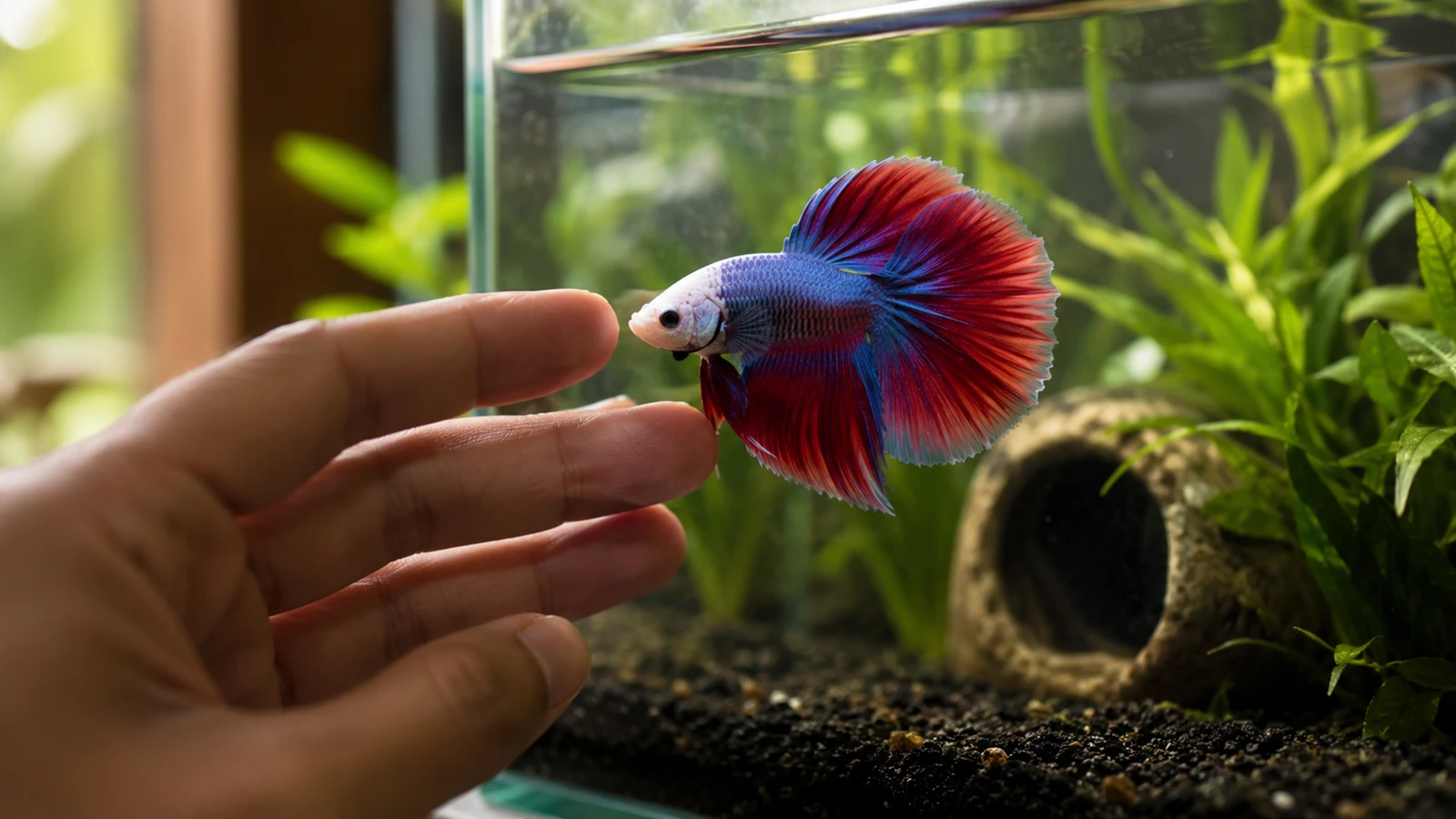
Can fish form bonds with humans? Yes — fish can form real bonds with humans, but not romantic or emotional bonds like mammals do. Research shows fish recognize individual human faces, learn feeding routines, and calm down around familiar people. It’s a trust-based, learned attachment, not love — but it’s genuine and measurable.
Quick Summary Fact Card
- Fish can recognize individual human faces — one study found 86% accuracy picking a familiar face from 44 strangers
- Real bonding takes 2 to 4 weeks of a consistent, calm routine
- Fish feel genuine stress and pain, confirmed through reversible pain-response experiments — not just reflex
- No evidence of romantic “love” — but a real, trust-based attachment does form
- Tapping the glass can undo a month of trust-building in a single afternoon
- Best bonding species: Betta, Oscar, Goldfish, Flowerhorn Cichlid
I used to think my first betta, Raja, just liked food. Every time I walked into the room, he’d swim straight to the glass. I figured it was pure Pavlov — food coming, fish excited, nothing more.
Then I started leaving the room without feeding him, just to sit nearby. He still came to the glass. He’d hover near my hand during tank maintenance, calm, not darting away as he did with strangers who visited. That’s when I stopped dismissing this as a coincidence.
As someone with an M.Sc. in Zoology and a family background in fishing going back generations, I’ve spent a long time watching how aquatic animals actually behave — not how we assume they behave. And the honest answer is: fish can form bonds with humans. Not the way a dog does. But it’s real, it’s documented, and once you know what to look for, you’ll see it in your own tank.
Do Fish Actually Recognize Their Owners, Or Is That Wishful Thinking?
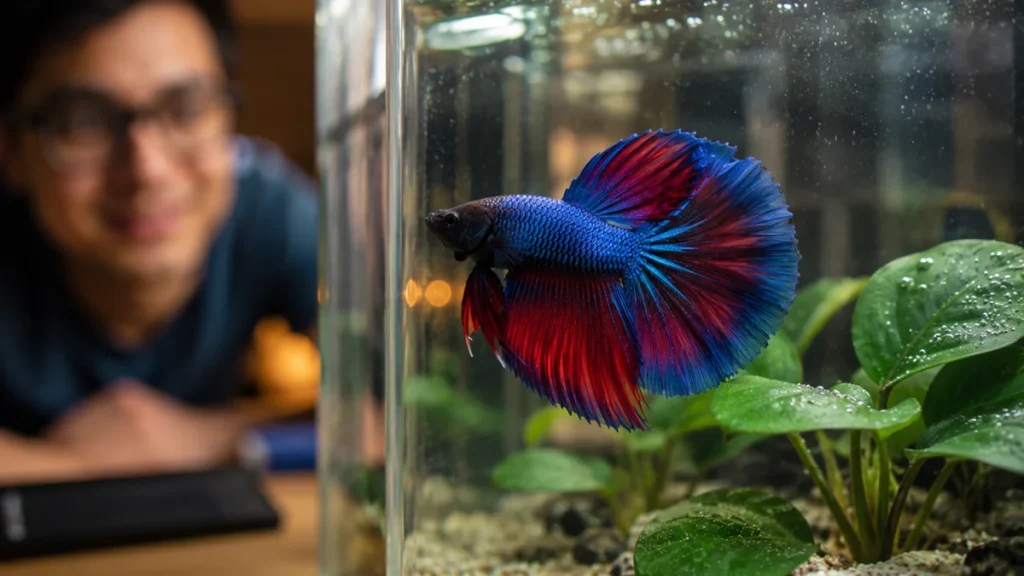
This is the question I get asked most, and the science backs it up more than most people expect.
A 2016 study from the University of Oxford and the University of Queensland tested archerfish — a species known for spitting jets of water to knock down insects — and found they could pick out one specific human face from a lineup of 44 unfamiliar faces, with roughly 86% accuracy. That’s not a lucky guess. That’s genuine visual recognition, in a brain a fraction the size of a mouse’s.
Fish that see the same person daily tend to build a working mental “file” on that person:
- Facial and body shape recognition (documented in archerfish and cichlids)
- Movement and posture patterns — fish notice if you approach slowly or suddenly
- Feeding timing — most fish anticipate meals within minutes of the usual time
- Vibration and sound cues through the lateral line
So can fish recognize and bond with their owners? Based on this research, yes — recognition is the foundation the bond is built on, not an afterthought.
The Real Signs Your Fish Likes You
Fish don’t wag tails. But they do have a behavioral vocabulary, and if you know it, you’ll start reading your tank differently.
Signs of genuine bonding:
- Swimming to the glass specifically when you approach, not just at feeding time
- Relaxed, spread fins in your presence versus clamped fins around strangers
- Following your finger along the glass without darting away
- Reduced hiding behavior when you’re nearby
- Coming out to “greet” you before you’ve even opened the food container
Can fish show affection to humans in a way we’d recognize? Not with cuddling — but a fish that stops hiding and starts approaching is doing the fish equivalent of relaxing around someone it trusts. That shift from wary to comfortable is the actual signal, and it’s the one most owners miss because they’re waiting for something more mammal-shaped.
Can Fish Feel Emotion? What the Science Actually Says
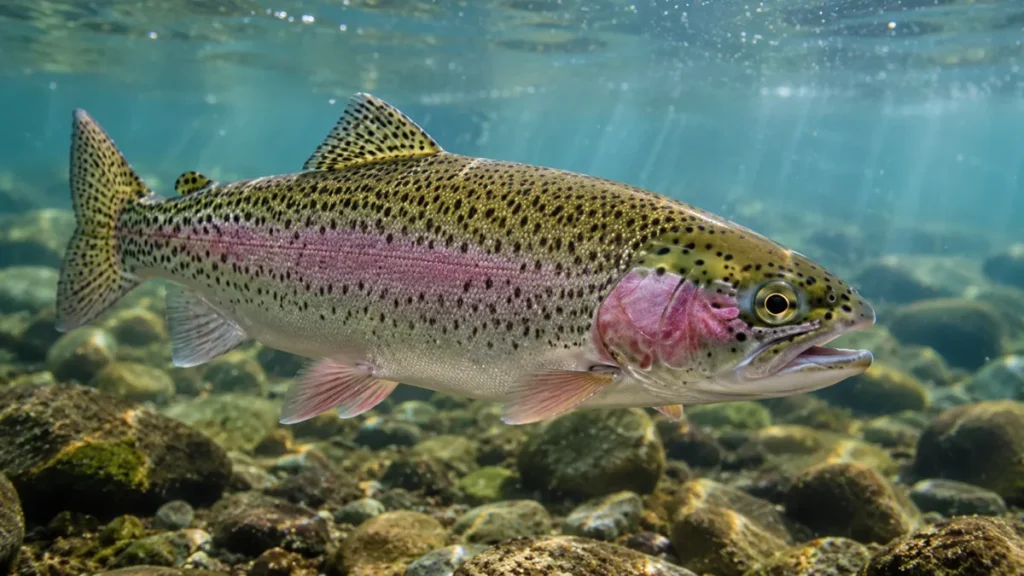
Fish have specialized nerve endings called nociceptors that detect and respond to painful or threatening stimuli — the same basic wiring humans use to register pain. In one well-known experiment, researchers applied a mild irritant to trout lips and watched them rub the affected area against tank surfaces and lose their normal caution around new objects. When given pain relief, that behavior reversed. That’s not a reflex. That’s a measurable emotional and physiological response.
Beyond pain, published research spanning three decades — reviewing hundreds of studies — has documented fish experiencing stress, fear, and what researchers describe as positive emotional states resembling pleasure, particularly around feeding, social contact, and calm environments.
So can fish feel emotion? Yes — simpler than ours, without our layered self-awareness, but real, physiologically grounded, and observable if you’re paying attention.
A number worth remembering: in the archerfish face-recognition trial, accuracy jumped to over 94% once the fish had a small reward tied to the correct choice — proof that the recognition sharpens with the exact kind of routine most home aquarium owners already keep.
Do Fish Fall in Love — Or Is That Just a Nice Story?
Here’s where I have to be the zoologist and pump the brakes a little. Can fish feel love the way a human means it — romantic, self-aware, permanent? No. That’s not supported by the evidence.
But some species come close to something structurally similar. Seahorses form pair bonds for a breeding season, sometimes longer, and perform a daily dance-like greeting ritual with their partner that researchers believe reinforces the pair bond. Certain monogamous fish species show measurably more pessimistic behavior after being separated from a long-term partner — a behavioral signature associated with something like grief in other animals.
What your pet fish feels toward you is best described as attachment through familiarity and safety, not love. That’s a real bond. It’s just not the one greeting cards are written about.
What’s Actually Happening in a Fish’s Brain
I get asked this constantly, so let’s break down the mechanism instead of just saying “it’s science.”
Think of it like this: every time you feed your fish calmly, at a consistent time, without startling it, you’re running a mini training program. The fish’s brain links “this shape, this movement pattern, this vibration” with “safety, food, no threat.” Over repeated exposure — usually two to four weeks for most community fish — that link becomes strong enough that the fish’s stress response measurably drops in your presence compared to a stranger’s.
This isn’t unique to fish. It’s the same basic learning process (classical conditioning) at work in dogs, cats, and honestly most animals with a nervous system. What’s different is the speed — some species, like guppies, can learn to distinguish and prefer a familiar shoal-mate over a stranger in as little as two weeks, based on published behavioral research. Fish just don’t get credit for the cognitive speed most people assume they don’t have.
Which Pet Fish Bond Hardest With Humans
Not every species is equally interactive. If bonding matters to you, species choice matters more than most people realize.
- Betta Fish — Highly food- and movement-responsive; widely reported to recognize owners within weeks
- Goldfish — Strong long-term memory (documented at 3+ months in controlled studies), good face and pattern recognition
- Oscars — Genuinely dog-like; many owners report them following hands around the glass and reacting to absence
- Cichlids — Use facial stripe patterns to individually recognize other cichlids, and show similar recognition toward regular human caretakers
- Flowerhorn Cichlids — Extremely owner-focused, often the most “clingy” species in the hobby
- Arowana — High behavioral complexity, strong feeding-response learning
If you’re shopping at a US big-box store like PetSmart or Petco, bettas and goldfish are the most accessible entry points for this kind of interaction — both typically run $5–$25 for the fish itself, making them a low-risk way to test whether bonding behavior is something you’ll enjoy watching for.
Can a Fish Bond With More Than One Person?
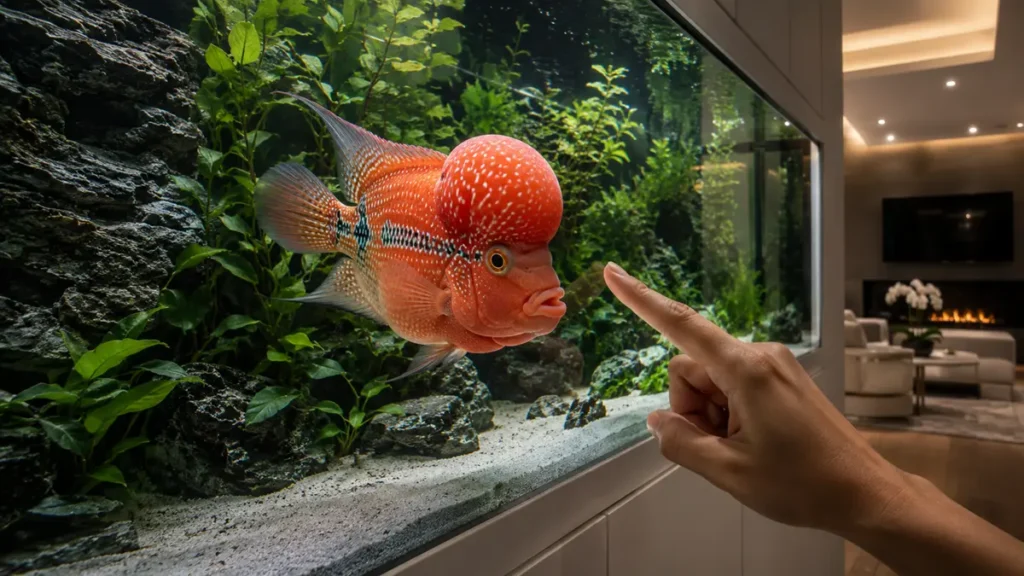
Nobody asks this one, but every multi-person household should. Yes — a fish can register more than one familiar human, but the strength of that recognition usually isn’t equal.
In my own experience, the person who does the feeding builds the fastest and strongest association, simply because food is the clearest, most repeated signal a fish can learn from. Other household members who just walk past the tank get a weaker, slower version of the same recognition — the fish calms down around them, but doesn’t actively approach the same way.
If you want a fish that bonds with the whole family, rotate feeding duties deliberately, at the same times each day, rather than leaving it to one person. It genuinely changes how broadly the fish generalizes “safe human” versus “safe person.”
What I Got Wrong My First Year Keeping Fish
Honestly? I tapped the glass. A lot. I didn’t know better at the time, and I thought it was harmless — like knocking on an aquarium at a public zoo.
It’s not harmless. Tapping sends a shockwave through the water that fish perceive as a genuine threat signal. My first mystery snail tank actually went through a phase where every fish in it hid for nearly an hour after each tap. I was accidentally undoing weeks of trust-building in a single afternoon, and I didn’t connect the dots until I noticed the pattern.
Once I stopped — completely, no exceptions — the recognition behavior I described earlier came back within about ten days. That gap between cause and effect is exactly why so many beginners misread their fish as “unfriendly” when the real problem is one habit undoing all the trust-building.
What Happens If You Never Interact With Your Fish
This is the flip side nobody talks about. Fish that are never handled calmly, never fed by a consistent presence, and live in a tank with constant disruption don’t just fail to bond — they stay in a low-grade stress state.
Chronically stressed fish show measurably elevated cortisol, reduced immune function, and higher susceptibility to disease outbreaks like ich. This isn’t a bonding footnote — it’s a welfare issue. A fish that never gets the chance to learn “this human is safe” is a fish whose baseline stress hormones likely stay elevated for its entire life. Bonding behavior isn’t just a nice bonus for owners — it’s a sign the fish’s environment is actually meeting its needs.
Fish Emotion Myths That Refuse to Die
Myth: Fish have a 3-second memory.
False. A controlled study on goldfish (Gee et al.) found they could learn to press a lever at a specific time of day to get food — and retained that learned behavior for at least three months.
Myth: Fish don’t feel pain, just reflexes.
False. Nociceptor-based pain responses in fish have been documented and reversed with analgesics in peer-reviewed experiments, confirming a real physiological pain pathway, not a simple reflex.
Myth: Fish are just tank decorations.
False. Fish demonstrate individual recognition, learning, memory retention, and measurable behavioral change based on social context — the building blocks of what we’d call personality in any other animal.
How to Actually Build a Bond With Your Fish
This takes weeks, not days. Here’s what actually works, based on both the research and what’s held up in my own tanks:
- Feed at the same time, every time. Consistency is what builds the association, not the amount of food.
- Move slowly near the tank. Sudden movement reads as predator behavior.
- Never tap the glass. See above — this alone can undo a month of progress.
- Talk softly nearby. Fish pick up vibration through the lateral line; a calm voice becomes part of their “safe” pattern.
- Keep water quality tight. A stressed fish in poor water won’t bond, no matter how gently you handle it — physiological stress overrides social learning.
- Spend time just observing, without feeding. This is how you’ll know if the recognition is genuine or just food-driven.
Most owners see the first real signs — approach behavior, reduced hiding — within two to four weeks of consistent routine.
FAQs on Can Fish Form Bonds With Humans
Can fish form bonds with humans?
Yes. Fish can form real, trust-based bonds with humans through recognition, routine, and reduced stress response — though it’s different from mammal bonding and shouldn’t be confused with emotional dependency.
Do fish recognize their owners after time apart, like a vacation?
Most fish retain learned recognition for weeks to months based on memory studies. A short trip won’t erase the bond, though the fish may take a few days to re-settle into the routine.
Is it safe to let a fish nudge or nibble my finger?
Generally yes for species like bettas and goldfish, but always wash hands first — soap, lotion, and oils on skin can harm fish. Avoid it with anything that has teeth or strong jaws, like larger cichlids.
What’s the biggest beginner mistake when trying to bond with a fish?
Tapping the glass to get attention. It signals a predator threat and undoes trust-building fast, even though it feels harmless to a new owner.
Does tank size affect how much a fish bonds with its owner, for US hobbyists?
Yes — undersized tanks (common with impulse buys at big-box stores) keep fish in a chronic stress state, which suppresses the calm behavior bonding depends on. A properly sized tank matters more than the species you pick.
Do fish have a 3-second memory?
No. This is a persistent myth. Controlled studies show goldfish retain learned behaviors for at least three months, and many species recognize individual humans for far longer.
Can fish feel love toward their owners?
Not romantic love as humans experience it. What fish show is attachment built on safety and familiarity — a real bond, just not love in the human sense.
Can fish miss their owners or notice when routine changes?
Yes — fish can show altered, more stressed behavior when a consistent caretaker is absent or when feeding routines shift suddenly, which suggests they register the change, not just the food gap.
Conclusion: Can Fish Form Bonds With Humans?
Yes — fish form bonds with humans through recognition, routine, and trust, not through the emotional playbook mammals use. My own bettas proved that to me long before I had the research to back it up. Give it consistency, patience, and a calm hand, and you’ll likely see it in your own tank too.
Next Steps: Resources You Must Read
- Related FishioHub reading: How to Buy Healthy Fish From an Aquarium Shop — pick fish that are already primed to bond, not stressed from the start.
- Scientific references: University of Oxford / University of Queensland (2016) facial recognition study in archerfish; Gee, Stephenson & Wright (1994), Journal of the Experimental Analysis of Behavior, goldfish memory retention; Sneddon (2003), Applied Animal Behaviour Science, pain response in trout.
Was this guide helpful?
First-Hand Experience
Based on animals I've personally kept and bred - not summarized from other articles.
Zoological Foundation
Claims are checked against my M.Sc. Zoology training and published aquatic biology research, not recycled aquarium myths.
No Paid Influence
No sponsorship shaped this guide. Affiliate links, if any, are disclosed separately and never hidden.
Kept Current
Errors are corrected as soon as they're found, with the update noted at the bottom of the article.

Anil Satak M.Sc. Zoology · Founder, FishioHub
Grew up in a fishing family in India and holds a Master's in Zoology. FishioHub is a one-person operation - every guide is personally researched, kept-tested, and written by Anil. No team, no outsourced writers, no AI-generated content. Read his full bio →