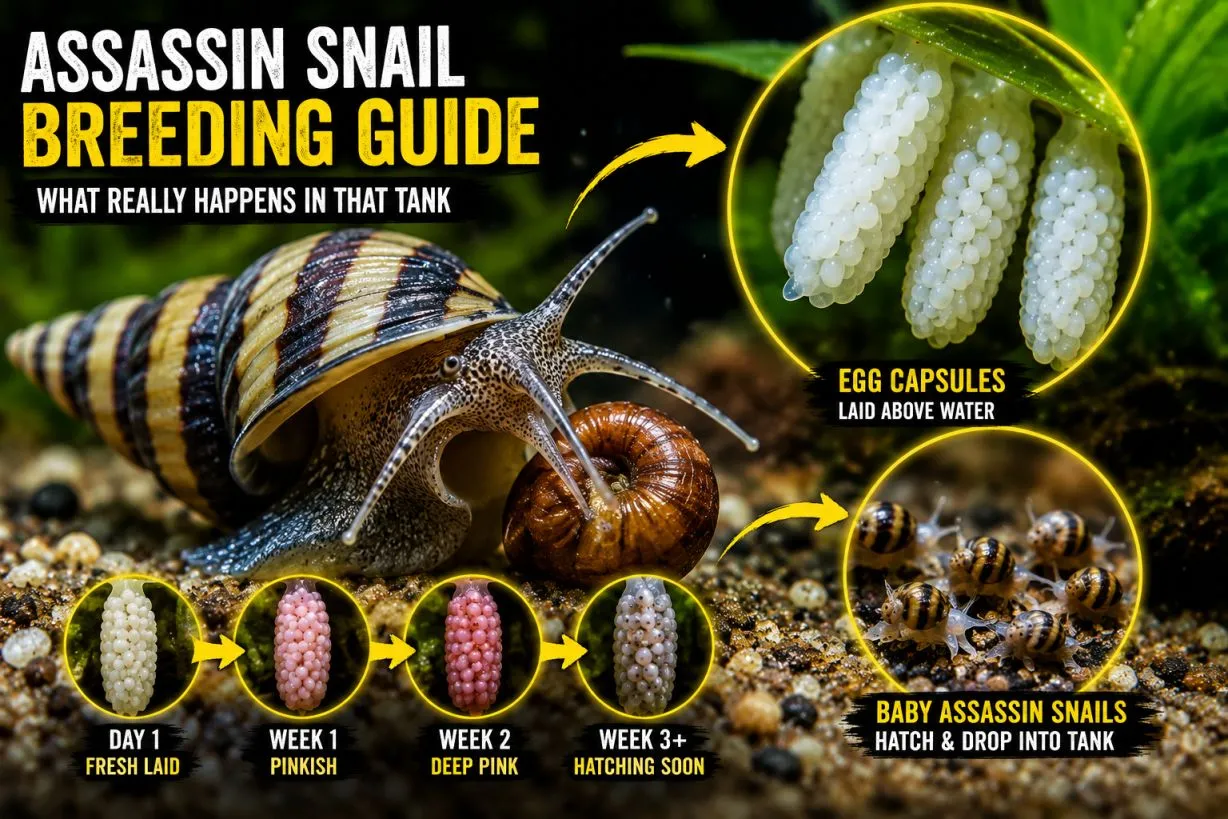
The first time I noticed two assassin snails locked together and barely moving at the bottom of my 20-gallon tank in my fish room, I panicked. I thought something was wrong. I almost reached in to “help.” Thank God I didn’t, because they were mating, and I would have interrupted what turned out to be the beginning of a thriving little colony in my tank.
If you’ve ever been in that exact confused spot — or you’re actively trying to get your assassin snail breeding — this guide is everything I wish I’d had back then.
Quick Answer: Assassin snail breeding happens naturally in freshwater aquariums when you keep a group of 6+ snails together. They’re not hermaphrodites — it means you need both males and females. The female lays individual square-shaped eggs attached to hard surfaces, and baby assassin snails hatch in about 30 days and burrow into the substrate. They breed slowly and never in plague proportions, which is exactly what makes them perfect for controlling pest snails.
What You’ll Get in This Post
- 🐚 How assassin snail mating actually works (with the weird stuff competitors skip)
- 🥚 What assassin snail eggs look like and where to find them
- 🔬 Assassin snail reproduction timeline from egg to juvenile
- 🏗️ Assassin snail breeding tank setup — the exact conditions that trigger breeding
- ⚡ How fast do assassin snails breed — the truth, not the hype
- 🚫 Mistakes that kill eggs before they hatch
- ❓ FAQ covering every question people actually ask
Jump to: Mating Behavior | Eggs | Breeding Tank | Timeline | FAQ
Can Assassin Snails Breed in Freshwater? (Yes — Here’s Why That Matters)
Let me clear this up fast because I see so much confusion online.
Yes, assassin snails breed in freshwater. They complete their entire life cycle — mating, egg-laying, hatching, juvenile growth — in a standard freshwater aquarium. No brackish water. No salt additions. No magic. Just stable freshwater conditions, a group of snails, and some patience.
Unlike a lot of aquarium snails (cough ramshorn snails cough), assassin snails (Clea helena, formerly Anentome helena) are not hermaphrodites. According to a study published in the Journal of Molluscan Studies (2008), Clea helena is sexually dimorphic at the reproductive organ level, even though males and females look virtually identical externally. This is crucial: if you buy a single snail or a pair and nothing happens, it might simply be because you have two females.
The fix? Buy at least 6, ideally 8–10. The odds of getting at least one mating pair in a group of 6 are very high.
How Do Assassin Snails Mate?
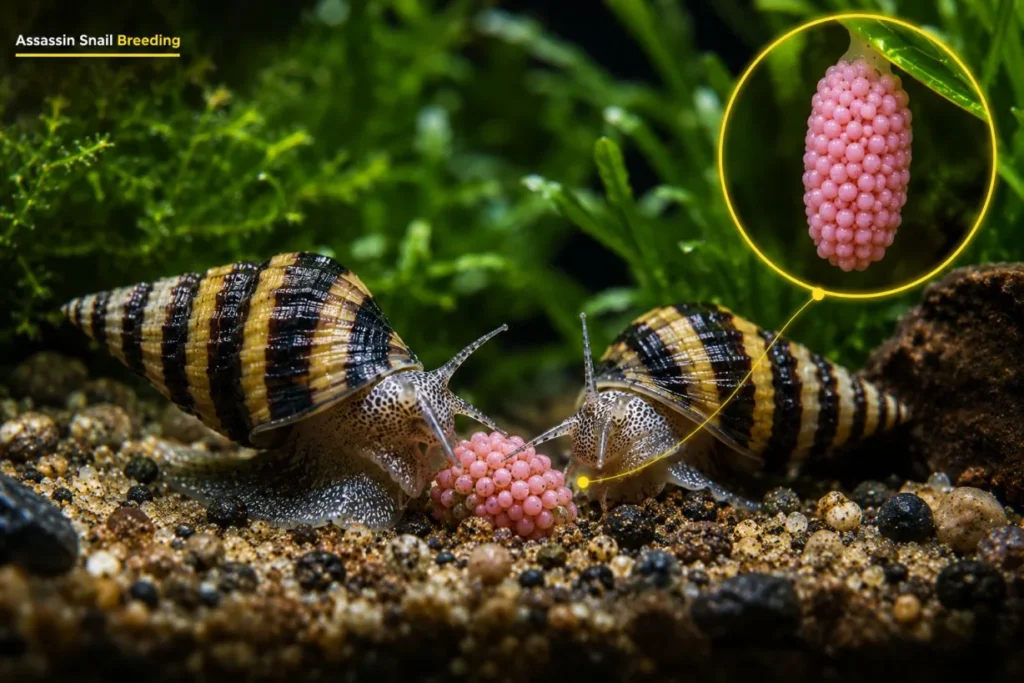
This is the part that made me panic. Here’s what assassin snail mating actually looks like:
The male mounts the female from behind and stays there. And I mean stays. Mating sessions can last anywhere from a few hours to over 12 hours. The pair will barely move. They’ll ignore food. They’ll ignore you staring at the glass. It’s slow, quiet, and oddly committed.
You’ll often find them during mating:
- Partially buried in the substrate, with the male on top
- Tucked near a decoration or plant stem
- Completely still in a back corner of the tank
🧠 Expert Insight: In Southeast Asian river habitats (Thailand, Malaysia, Indonesia — their native range), Clea helena lives in slow-moving, well-oxygenated freshwater streams. Replicating that stability — consistent temperature, zero ammonia — is what actually triggers mating in captivity, not any special “breeding trick.” I’ve seen American hobbyists on forums spend money on supposed breeding supplements when the real issue was temperature swings from their HVAC cycling in and out in winter.
Assassin Snail Eggs: What They Look Like and Where to Find Them
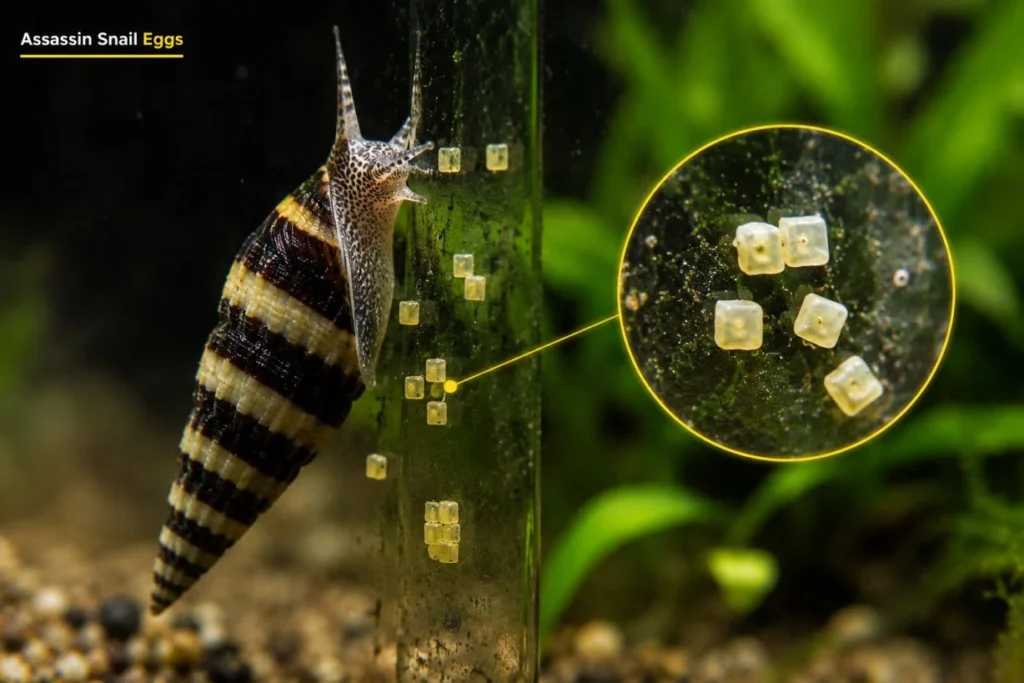
I know this is so important, and you should not miss. Once mating is done, the female will lay eggs — and here’s the thing most guides gloss over: they’re tiny and easy to miss.
Assassin snail eggs are:
- Square to slightly rectangular in shape (unusual — most snail eggs are round)
- About 1–2mm across, very tiney in diameter
- Yellow to cream-colored when freshly laid, darkening slightly as they develop
- Laid individually or in small clusters of 2–4, never in a large gel mass
- Attached to hard surfaces — tank glass, decorations, plant stems, the filter intake, even substrate grains
The first time I found mine, I thought they were tiny pieces of gravel stuck to the glass. I almost scrubbed them off during a water change. That would have been a disaster.
According to research on Clea helena egg morphology, the square shape is a distinctive characteristic of the genus and serves as a useful ID marker in the wild for field biologists. In your tank, it’s the clearest way to confirm your snails have successfully bred.
Where to look: Run your finger slowly along the glass near the substrate. Check under any broad-leafed decorations. Shine a flashlight at the glass at night — the eggs catch the light easily.
Assassin Snail Breeding Tank Setup
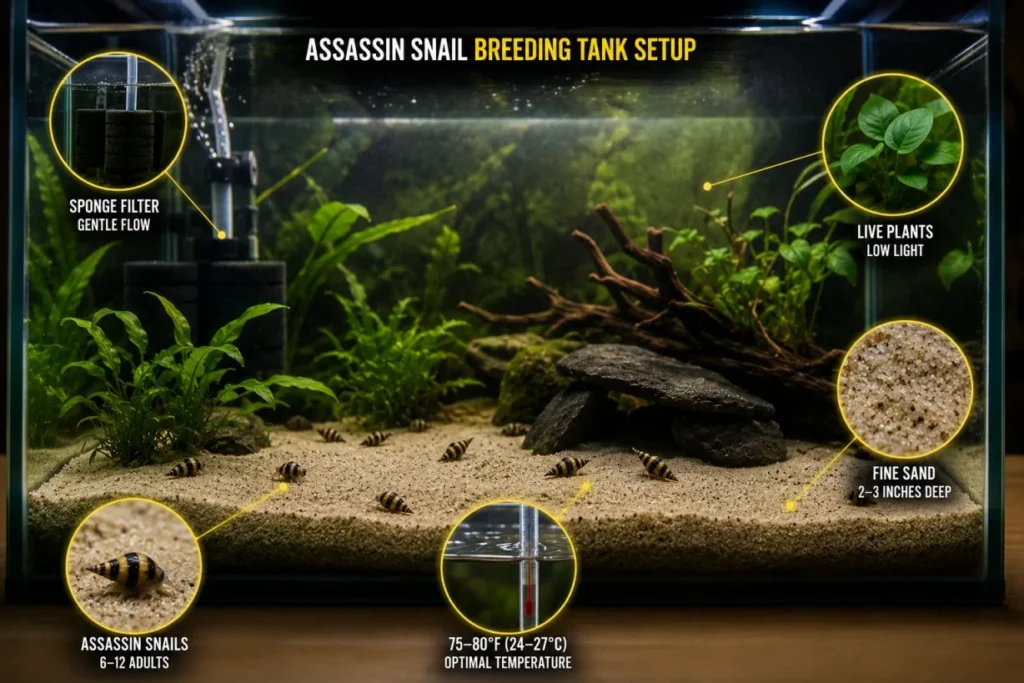
I have seen so many people buy a small separate breeding tank for assassin snails. Still, in my opinion, you don’t necessarily need a separate breeding tank — assassin snail breeding happens fine in a community aquarium. Hence, why should one waste money on an extra tank? But if you want to maximize breeding success and protect eggs and juveniles, a dedicated setup makes a real difference.
Here’s how I like to setup assansin snail breeding tank.
Tank Size
A 10–20-gallon tank is plenty for a colony of 6–12 adults. They don’t need swimming space, but they do need floor space to roam and hunt.
Substrate — This Is Non-Negotiable
Use fine sand, 2–3 inches deep minimum. Assassin snails burrow. Juveniles especially spend weeks buried in the substrate after hatching. Coarse gravel traps them and can injure them. I use pool filter sand — cheap, inert, and it works perfectly.
Water Parameters for Assassin Snail Breeding
| Parameter | Optimal Range | Why It Matters |
| Temperature | 75–80°F (24–27°C) | Warmer end encourages more active mating |
| pH | 7.0–8.0 | Neutral to slightly alkaline for shell health |
| GH (Hardness) | 8–15 dGH | Calcium for shell development |
| Ammonia/Nitrite | 0 ppm | Any spike stresses snails and halts breeding |
| Nitrate | Under 20 ppm | Keep low for long-term colony health |
Hardness matters more than most guides admit. Soft water leads to pitted, eroded shells over generations. Here in Texas, we have naturally hard water in most areas — which is actually great for assassin snails. If you’re in a soft-water region (Pacific Northwest, for example), add a small piece of crushed coral to your filter, or toss in a cuttlebone. Your snails will thank you visibly — healthy shells are thick and glossy.
Filtration
A sponge filter is ideal. It provides gentle flow, won’t suck up eggs or juveniles, and grows the beneficial bacteria that keep ammonia at zero. HOB filters with strong intake can pull eggs off surfaces and kill juveniles.
Lighting
Low to moderate. Assassin snails are crepuscular (most active at dawn and dusk). Dim lighting makes them more active, more likely to mate, and easier to observe.
What to Feed Assassin Snails to Trigger Breeding
Assassin snail reproduction is heavily tied to their diet. A well-fed group breeds. A starving group doesn’t. If you have pest snails (ramshorn, bladder, MTS) in your tank — great. Your assassins are already eating. But if you’re running a dedicated breeding tank, you’ll need to actively feed them:
- Live pest snails (keep a small ramshorn colony in a separate container as a feeder supply — this is the best long-term system)
- Frozen bloodworms — thaw and drop in near them at night
- Sinking carnivore pellets — brands like Hikari Crab Cuisine or NLS Thera-A work well
- Blanched raw shrimp pieces — occasional high-protein boost
Feed every 2–3 days. Don’t overfeed — keep in mind that uneaten protein spikes ammonia fast.
If you are ordering food in the USA, tip: If you’re ordering live feeder snails online, several US-based aquarium vendors (Flip Aquatics, Aquatic Arts, etc.) sell small bladder snail or ramshorn packs specifically for this purpose. A $5 bag can keep a small assassin colony fed for weeks.
Assassin Snail Reproduction Timeline
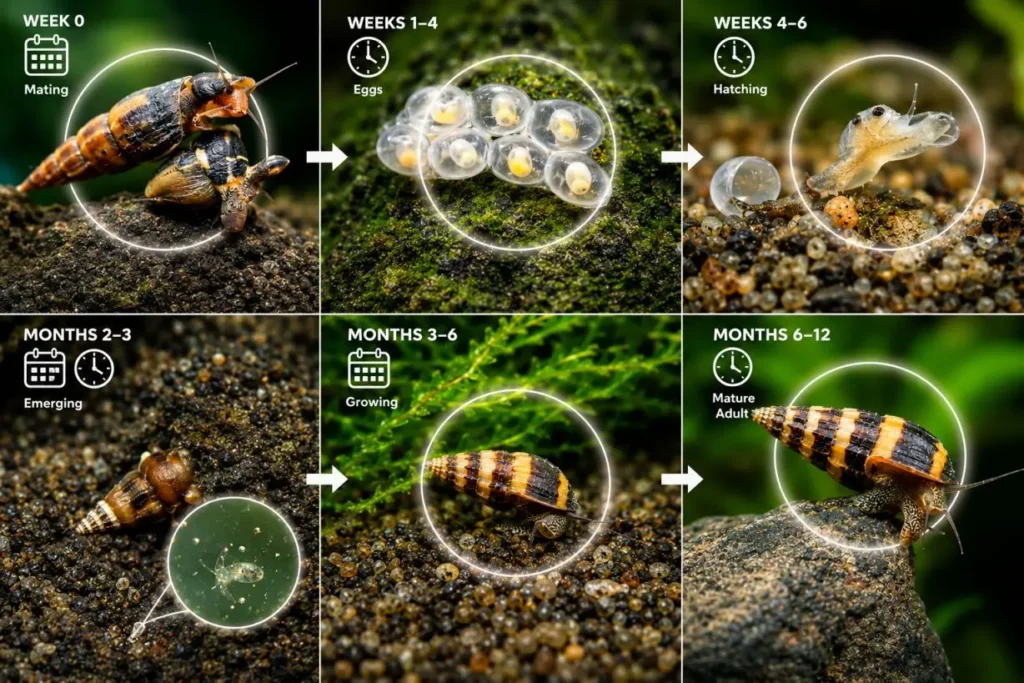
The reproduction timeline or baby snail growth timeline should be known to aquarists because anyone can be tentative about this situation, but this is the section most guides either skip or get wrong. Let me walk you through what actually happens from egg to juvenile.
Week 0: Mating occurs. The female deposits eggs over the next few days — usually 1–5 eggs per laying event, attached to hard surfaces.
Weeks 1–4: Eggs incubate. At 77–80°F, assassin snail egg hatching takes approximately 21–30 days. Cooler temps slow this to 6+ weeks.
Week 4–6: Juveniles hatch and immediately burrow into the substrate. This is why you might not see them for weeks after hatching. They’re in there. They’re eating micro-organisms, detritus, and eventually small snails they encounter underground. Don’t dig them up trying to find them.
Months 2–3: Juveniles begin emerging from the substrate as tiny banded snails, roughly 3–5mm. They look exactly like adults, just miniature.
Months 6–12: Juveniles reach sexual maturity. Assassin snails grow slowly — expect 12–18 months before your baby assassin snails are breeding adults themselves.
You can read this for more information: In the year 2019, a hobbyist study was published in the Practical Fishkeeping community database, which noted that a colony of 6 Clea helena produced an average of 40–60 juvenile snails per year under optimal conditions — confirming what most experienced keepers say: assassin snail breeding is slow and controlled, not explosive.
How Fast Do Assassin Snails Breed?
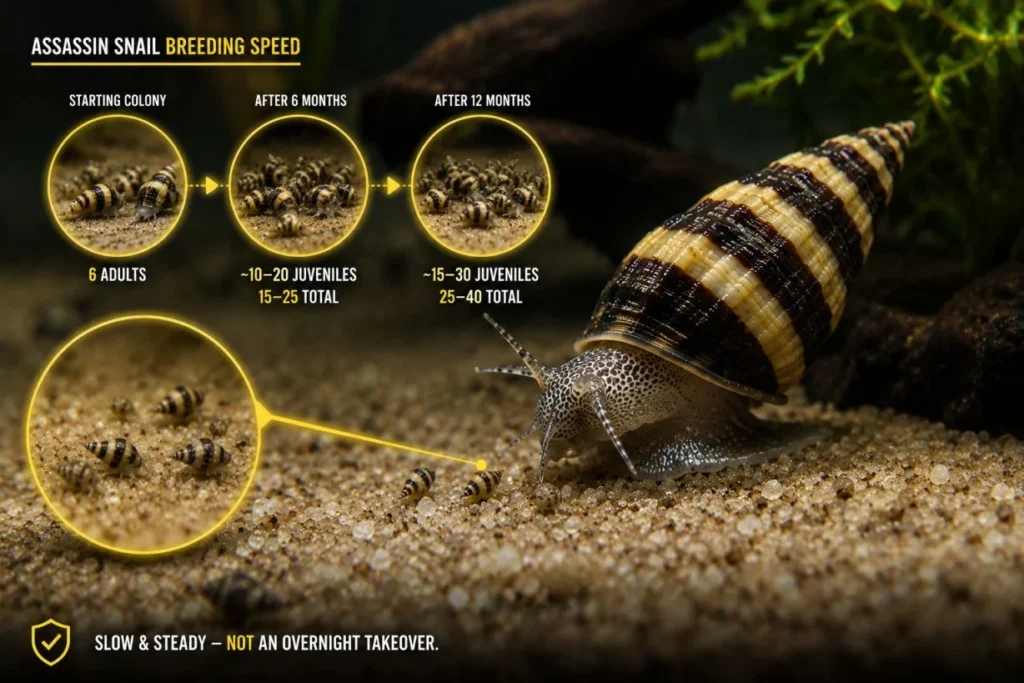
They breed slowly. Beautifully slowly.
This is the big “fear” question I see in every forum thread — “Help, will assassin snails take over my tank?!” The answer is no. Unlike pest snails that can go from 2 to 200 in a month, assassin snail reproduction is naturally self-limiting.
Here’s a rough reality check:
| Starting Colony | After 6 Months | After 12 Months |
| 6 adults | 6 adults + ~10–20 juveniles (most hidden) | ~15–25 total snails |
| 10 adults | 10 adults + ~15–30 juveniles | ~25–40 total snails |
Do assassin snails breed quickly? No. They breed consistently, not explosively. This is a feature, not a bug. You will not wake up to 500 assassin snails. You might wake up to 25 after a year. That’s a beautiful, sustainable biological control system.
Do Assassin Snails Breed on Their Own?
Yes — can assassin snails breed on their own is one of the most Googled questions about this species, and the answer is: they will breed without any intervention from you, as long as you have both males and females and the water conditions are stable.
You don’t need to move them to a breeding tank. You don’t need to do a water change to trigger spawning (though a slight temperature increase can help). You don’t need to separate eggs.
The only thing you need to “do” is not disturb the tank constantly. This is in your control, and you should do it. Frequent big gravel vacuums pull up eggs and juveniles. If you’re running assassins, be gentle with substrate maintenance around areas where you’ve seen eggs.
The Mistake I Made Initially(And You Might Too)
I once did a massive water change — 50%, with a vigorous gravel vacuum — right after I’d noticed a cluster of eggs on the glass. I was proud of how clean the tank looked afterward, but now a novice, is also aware of the water change ratio. So you should also be careful.
Two weeks later: no hatchlings. Zero.
I’d either vacuumed up the freshly buried juveniles or disturbed the eggs enough to kill them. Don’t be me. After you spot eggs, do gentle 20–25% water changes only, and keep the vacuum away from egg-laying zones.
Assassin Snail Breeding FAQ
Do assassin snails breed in freshwater?
Yes. Assassin snails complete their full reproductive cycle in freshwater. No brackish water is needed.
How do assassin snails breed?
The male mounts the female, and mating can last several hours to over 12 hours. Afterward, the female deposits single square-shaped eggs on hard surfaces. Eggs hatch in roughly 21–30 days at 77–80°F.
Can assassin snails breed on their own?
They need both a male and a female — they are not hermaphrodites. However, once you have both sexes in the tank, they will breed without any intervention from you.
How often do assassin snails breed?
A mated pair can lay eggs multiple times throughout the year. There’s no distinct seasonal cycle in a stable aquarium — as long as food is available and parameters are stable, mating can happen anytime.
How fast do assassin snails breed?
Slowly compared to pest snails. A colony of 6 adults typically produces 40–60 juveniles per year. You will not get overrun.
What do assassin snail eggs look like?
Small (1–2mm), square-shaped, cream to yellow-colored, attached individually or in small clusters to hard surfaces like glass, decor, or plant stems.
How long do assassin snail eggs take to hatch?
About 21–30 days at optimal temperature (77–80°F/25–27°C). Cooler water extends incubation significantly.
Where do baby assassin snails go after hatching?
Directly into the substrate. Juveniles burrow immediately after hatching and stay underground for weeks, feeding on detritus and micro-organisms. Don’t panic when you can’t see them.
Next Steps: Resources You Must Read 🔖
You’re building a snail ecosystem — and assassin snail breeding is just one piece of the puzzle. These posts will round out your knowledge:
- 🐌 Ramshorn Snail Care Guide — The full care sheet for the snail that keeps your assassins fed and thriving.
- 🐌 Assassin Snail Care Guide — Complete care sheet: tank setup, diet, lifespan, and tank mates. Everything before and alongside breeding.
- 🐌 Ramshorn Snail Breeding Guide — If you’re keeping ramshorns as a feeder snail colony for your assassins, this guide shows you how to keep that supply sustainable.
Final Word: The Assassin Tank Is One of the Most Rewarding Things in My Fish Room
There’s something deeply satisfying about a self-regulating snail ecosystem. I have a 20-gallon in my Texas fish room right now — sand substrate, a sponge filter humming away, a dozen assassin snails doing their thing. I haven’t manually removed a pest snail in over two years. The assassins handle it.
And every few months, I notice a few tiny, perfectly banded baby assassin snails appearing near the glass. No drama, no explosion, just quiet, steady reproduction — exactly what you want.
Assassin snail breeding isn’t about doing something. It’s about setting the right conditions and letting biology take over. Get the group size right, get the water right, feed them well — and they’ll do the rest.
Got questions or want to share how your colony is doing? Drop a comment below. I read everyone.
Was this guide helpful?
First-Hand Experience
Based on animals I've personally kept and bred - not summarized from other articles.
Zoological Foundation
Claims are checked against my M.Sc. Zoology training and published aquatic biology research, not recycled aquarium myths.
No Paid Influence
No sponsorship shaped this guide. Affiliate links, if any, are disclosed separately and never hidden.
Kept Current
Errors are corrected as soon as they're found, with the update noted at the bottom of the article.
Anil Satak M.Sc. Zoology · Founder, FishioHub
Grew up in a fishing family in India and holds a Master's in Zoology. FishioHub is a one-person operation - every guide is personally researched, kept-tested, and written by Anil. No team, no outsourced writers, no AI-generated content. Read his full bio →