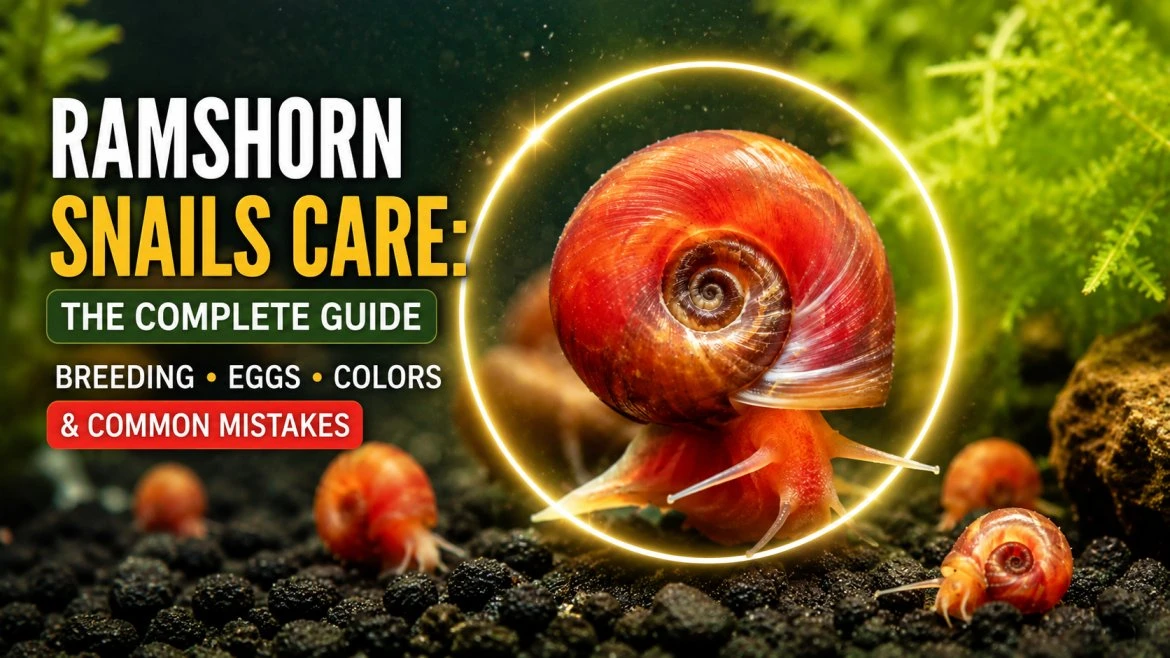
I’ll be honest with you — I almost flushed my first ramshorn snail down the toilet.
It was 2011. I was setting up my first planted 20-gallon community tank in my Home, excited, nervous, doing everything “right.” Then I noticed these tiny spiral-shelled creatures multiplying in the corner behind my Amazon sword. Six became sixty in what felt like two weekends. I panicked. I Googled “ramshorn snail infestation.” I nearly lost my mind.
What I didn’t know then — and what took me years to actually learn — is that ramshorn snails are one of the most useful, most misunderstood creatures you can have in a freshwater aquarium. Handled right, they’re your tank’s best janitor. Handled wrong, they’re a horror movie in a 10-gallon.
Here’s the short answer for ramshorn snails care: Ramshorn snails thrive in a well-cycled freshwater tank at 65–80°F, pH 7.0–8.0, with calcium-rich water, plant matter, and algae to graze on. They’re hardy, nearly self-sufficient, and genuinely easy to care for — once you understand their quirks.
This guide covers everything from the ramshorn snails care guide basics to breeding, egg hatching timelines, color morphs, and the population control tricks I wish I’d known in 2011.
What You’ll Get in This Post
- Who Are Ramshorn Snails? (Species Breakdown)
- Ramshorn Snails Care Sheet: Water, Tank & Setup
- Ramshorn Snails Food: What They Actually Eat
- Ramshorn Snail Eggs: Hatching Timeline & What to Expect
- Breeding Ramshorn Snails: How It Works (And Why It Happens So Fast)
- Color Variants: Red, Pink, Blue, Leopard & Giant
- Ramshorn Snails Lifespan & Health Warning Signs
- Population Control: The Real Talk
- Tank Mates: Who Plays Nice, Who Doesn’t
- FAQ
Jump to: Care Sheet | Eggs | Breeding | Colors | FAQ
Who Are Ramshorn Snails?
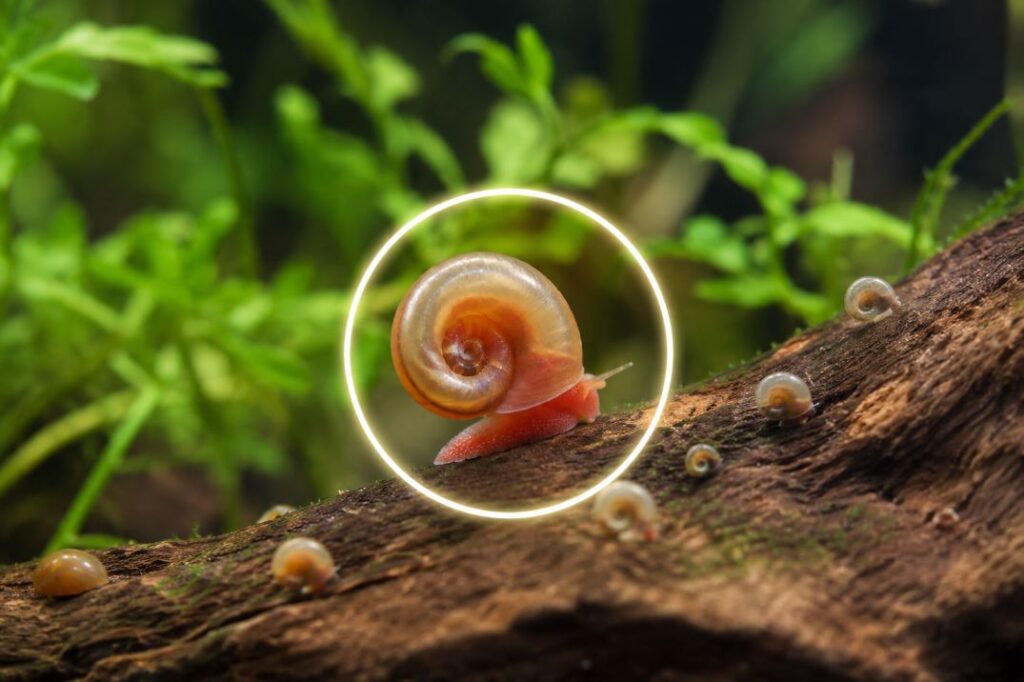
Before we talk ramshorn snails care, let’s make sure we’re talking about the same critter. The name “ramshorn snail” is actually used for two distinct freshwater snail groups popular in the US hobby:
- Planorbidae family (Planorbarius corneus, Planorbella duryi, etc.) — true ramshorns, flat coiled shell, red blood (haemoglobin-based), most common in US pet stores
- Marisa cornuarietis — the “giant ramshorn snail,” significantly larger and technically a different family
The flat, disc-like, ram’s-horn-shaped shell is the giveaway — it coils in a flat plane rather than a cone, like a miniature nautilus. They’re native to North America, South America, and Europe, which means many US hobbyists actually have native snails in their tanks without realizing it.
Fun fact: According to research published in the Journal of Molluscan Studies, ramshorn snails use haemoglobin—like protein in human blood — to oxygenate their tissues, unlike most mollusks, which use copper-based hemocyanin. That’s why they look slightly reddish when held up to light. (Source: Journal of Molluscan Studies, Oxford Academic, 2003)
Ramshorn Snail Care Sheet: Water, Tank & Setup
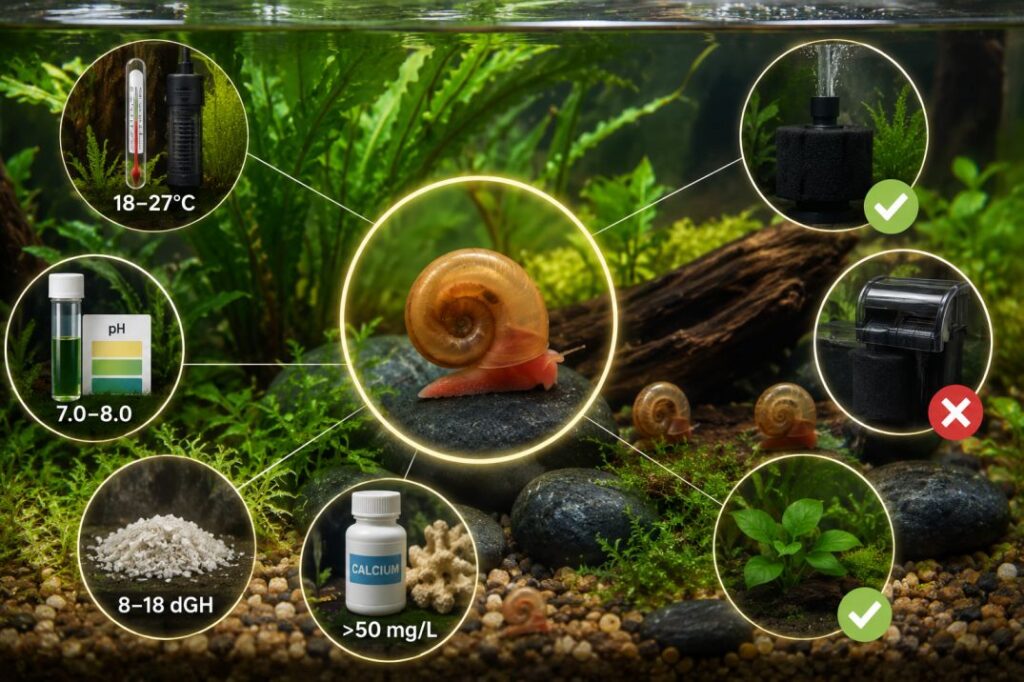
This is the part most guides get right, but I want to add some real-life context to the numbers.
Tank Size
Ramshorn snails don’t need much space themselves, but your tank size controls their population. In a 5-gallon, a small group can turn into hundreds within months because there’s limited space for predators or population control. I recommend at least a 10-gallon for keeping them intentionally, and a 20-gallon if you want a planted freshwater ramshorn snail setup that stays balanced long-term.
Water Parameters
| Parameter | Ideal Range | Why It Matters |
| Temperature | 65–80°F (18–27°C) | Most US homes stay in this range without a heater |
| pH | 7.0–8.0 | Acidic water (below 6.5) dissolves their shells |
| Hardness (GH) | 8–18 dGH | Calcium is essential for shell integrity |
| Ammonia/Nitrite | 0 ppm | They’re sensitive to ammonia spikes |
| Nitrate | <20 ppm | Higher is okay but keep it reasonable |
| Calcium | >50 mg/L | Non-negotiable for shell health |
The calcium piece is where most US hobbyists with soft tap water (hello, Pacific Northwest!) run into trouble. If your tap water is naturally soft — below 50 mg/L calcium — your snails will develop pitted, eroded, or cracked shells. Fix it with:
- Crushed coral in your filter
- Cuttlebone (yes, the bird cage kind — works great, cheap at any PetSmart)
- API pH UP or similar calcium-mineral supplements
Tank Setup Tips
Go heavy on live plants, make matured aquarium — java fern, anubias, hornwort. Ramshorn snails are algae and biofilm grazers; live plants give them surface area to graze AND keep the water clean. Add a sponge filter rather than a hang-on-back, because ramshorns (especially babies) can get sucked into HOB intakes. Substrate matters less — gravel, sand, or bare bottom all work fine.
What Do Ramshorn Snails Eat: What Food They Actually Eat
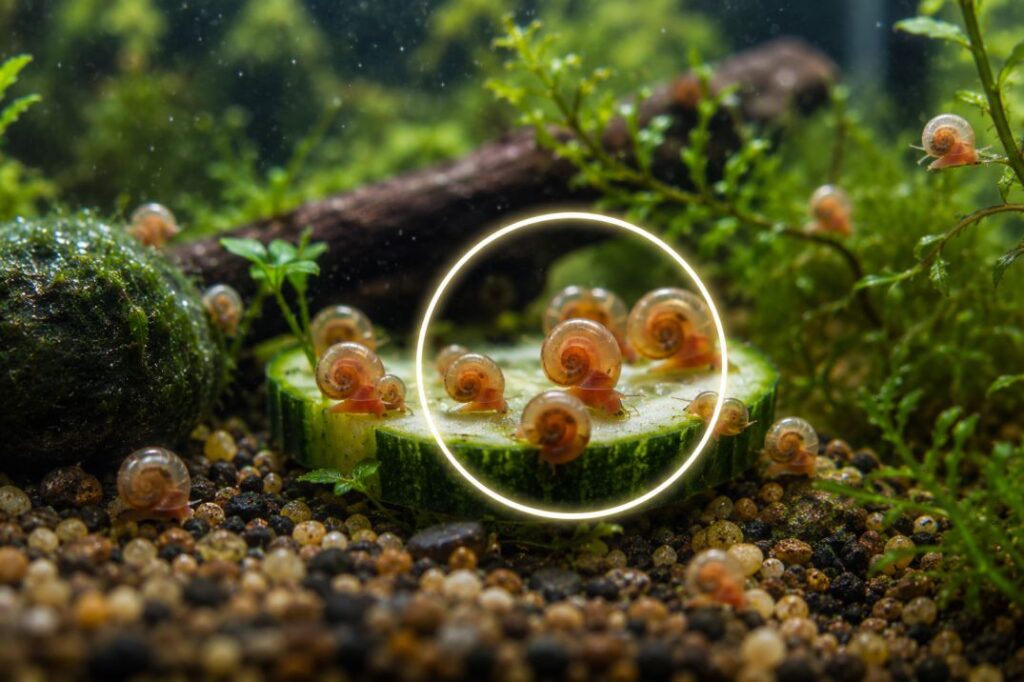
Here’s the thing about ramshorn snails’ food that no one tells you clearly: you probably don’t need to feed them at all in an established planted tank, but you should know what do ramshorn snails eat?
They are scavengers and grazers. Their diet in the wild — and in a well-maintained aquarium — consists of:
- Algae (all types: green spot, hair, BGA)
- Biofilm and bacterial colonies on surfaces
- Dead and decaying plant matter
- Fish waste and uneaten fish food
- Dead fish or invertebrates (yes, they’re nature’s cleanup crew)
In a new or lightly stocked tank with little organic waste, you can supplement with:
- Blanched zucchini or cucumber — drop a slice, watch 30 snails appear from nowhere in 20 minutes (it’s both terrifying and hilarious)
- Sinking algae wafers (Hikari or similar) — great once or twice a week
- Spinach or kale — blanched, then rinsed
- Repashy Soilent Green — excellent gel food popular in the US planted tank community
One big thing: don’t overfeed. Excess food = population boom. More food = more eggs = more snails. That’s how a peaceful tank turns into a snail apocalypse.
Ramshorn Snail Eggs: Hatching Timeline & What to Expect
Ah, the eggs. The moment every hobbyist either falls in love or reaches for the phone to call a snail exterminator.
Ramshorn snail eggs are laid in gelatinous, transparent clutches — oval blobs roughly 3–5mm across, containing 10–40 individual eggs each. They’re often found on:
- Aquarium glass
- Broad-leafed plants (anubias favorites)
- Decorations and driftwood
- Filter intakes
- Heater cords (yep)
They’re almost invisible when freshly laid — a tiny, water-clear blob. Within 24–48 hours, they’ll start to show tiny dark specks: the developing embryos.
Ramshorn Snail Eggs: How Long to Hatch?
At 72–76°F (22–24°C): 10–14 days to hatch
At 78–80°F (26–27°C): 7–10 days to hatch
Below 68°F: 3–4 weeks, sometimes longer
Once hatched, the baby snails are tiny (0.5mm) and nearly invisible. They immediately start grazing biofilm — they need no special food, no baby formula, nothing. Nature figured this one out without your help.
Important: According to a 2018 study in Aquatic Biology, ramshorn snail embryo survival rates are heavily linked to water calcium concentration — clutches in water with less than 30 mg/L calcium showed up to 40% lower hatching success than those in calcium-rich water. (Source: Aquatic Biology, Vol. 27, Springer, 2018) This means your shell supplement routine isn’t just for adults — it affects your eggs too.
Breeding Ramshorn Snails: How It Works (And Why It Happens So Fast)
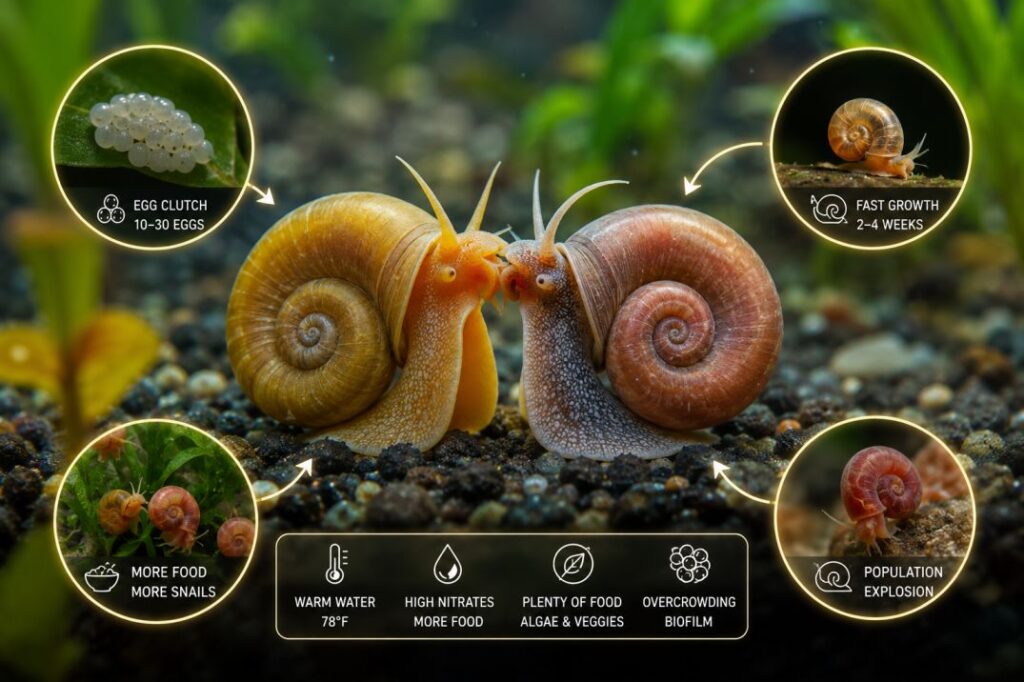
Breeding ramshorn snails is not something you do. It’s something that happens to you.
These snails are simultaneous hermaphrodites — every single individual has both male and female reproductive organs. That means any two snails can mate, and both can lay eggs afterward. No waiting for the right sex ratio. No conditioning pair. Just two snails, a tank, and ambition.
What’s even more remarkable: ramshorn snails can self-fertilize under certain conditions, though cross-fertilization is more common in practice. If you put a single snail in a tank, there’s a real possibility of eventually getting eggs.
Ramshorn Snails Reproduction: The Trigger Points
Population explosions are triggered by one thing above all else: food abundance. More food available = snails sense a stable environment = more eggs laid. This is evolutionary logic — when resources are plentiful, reproduce. When scarce, slow down.
That’s why population control through feeding restriction actually works (more on that below).
Other breeding triggers:
- Warm water (above 74°F accelerates reproduction)
- High nitrates (signals decaying organic matter = food)
- Overcrowded tanks with lots of biofilm buildup
Breeding Ramshorn Snails Intentionally (For Feeders or Sale)
Many US hobbyists breed ramshorn snails on purpose — they’re excellent live food for pea puffers, loaches, assassin snails, and some cichlids. If you want to breed them intentionally:
- Set up a dedicated 10-gallon “snail breeding tank.”
- Keep the temperature at 78°F
- Feed blanched vegetables every 2–3 days
- Add algae wafers regularly
- Don’t keep any predators
A single breeding tank can produce hundreds of feeder snails per month — and some hobbyists sell them on Facebook Marketplace or AquaBid for $5–15 per bag. It’s a real micro-hustle in the US aquarium community.
Color Variants: Red, Pink, Blue, Leopard & Giant
Here’s what the generic care guides miss completely: ramshorn snails aren’t just the brownish ones you find hitchhiking on plants from Petco. There are stunning color morphs that are actively bred and sold in the US hobby.
Red Ramshorn Snails Care
The most popular morph. The “red” color comes from the hemoglobin in their blood showing through a depigmented shell — they’re not truly red, just translucent enough for the blood color to show. Red ramshorn snails care is identical to standard care; they’re just a color variant, not a different species. Expect to pay $2–5 each at specialty stores or online.
Pink Ramshorn Snails Care
A lighter variant of the red morph, sometimes called “rose.” Pink ramshorn snails care requirements are the same — same tank, same water parameters, same food. They’re slightly rarer than red and beloved in planted tank aquascapes for the visual contrast against green plants.
Blue Ramshorn Snails Care
The unicorn of the ramshorn world. True blue ramshorn snails are a selective breeding achievement — the blue coloration comes from reduced pigmentation interacting with the snail’s internal chemistry. Blue ramshorn snails care requires the same conditions, but they’re more expensive ($5–15 each) and slightly less forgiving of water quality fluctuations based on my experience keeping them.
Leopard Ramshorn Snails Care
Spotted! Leopard morphs show irregular dark spots or blotches across the shell. Leopard ramshorn snails care is the same as standard, but these are genuinely eye-catching and do well in display tanks. They’re less common in US pet chains and more often found through hobbyist groups (look for AquaticArts, SnailsFromTheSea, or local Facebook aquarium groups).
Giant Ramshorn Snails Care
A completely different species (Marisa cornuarietis). These guys get up to 2 inches across — significantly larger than common ramshorns (which max out around 1 inch). Giant ramshorn snails care differs slightly: they need a larger tank (minimum 20 gallons), eat more, and are known to munch on live plants aggressively. Keep with caution in planted tanks. Warmer water (76–82°F) is preferred.
Ramshorn Snails Lifespan & Health Warning Signs
Ramshorn snails lifespan in a well-maintained freshwater aquarium: 1–3 years for common species, up to 3–5 years for giant ramshorns.
That’s shorter than most people expect, honestly. The rapid reproduction compensates — a colony essentially maintains itself across generations.
Shell Health: Your Early Warning System
How long do ramshorn snails live? It also depends upon certain conditions. The shell tells you everything. Check yours regularly:
- Pitting or erosion: Calcium deficiency or low pH — add cuttlebone immediately
- Pale or white patches: Could be calcium, could be early bacterial infection
- Cracked shell: Injury or severe calcium deficiency — often fatal
- Healthy shell: Smooth, uniform color, complete spiral without gaps
According to NOAA’s aquatic invertebrate research division, mollusk shell degradation in acidic freshwater conditions can accelerate by up to 300% for every 0.5-unit drop in pH below 6.5. This is why pH stability matters even more than the exact number. (Source: NOAA Technical Memorandum, Freshwater Invertebrate Health Reports)
Other Signs of Stress
- Milky or cloudy slime trail
- Floating at the surface (can be normal — they breathe surface air — but consistent floating indicates stress)
- Retreating deeply into the shell and not emerging
- Moving extremely slowly or not at all
Population Control: The Real Talk
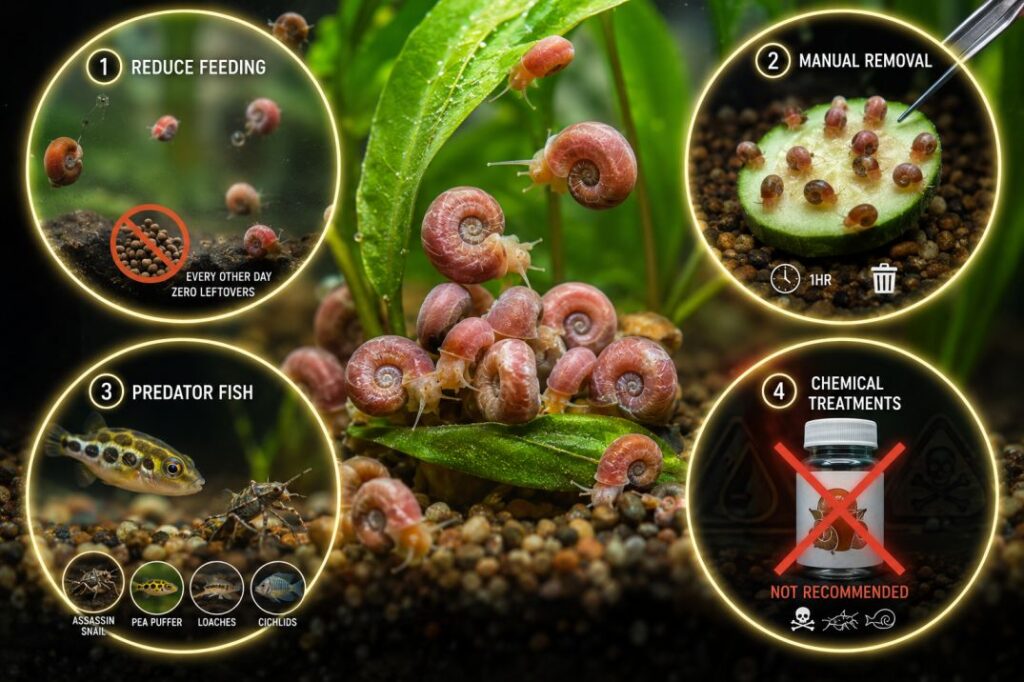
This is the section every ramshorn snail owner eventually needs.
Method 1 — Reduce feeding. The most effective. Cut back food to every other day, ensure zero leftover food sits in tank after 5 minutes. Population stabilizes within weeks.
Method 2 — Manual removal. Drop a piece of zucchini at night, wait an hour, pull it out covered in snails. Repeat 3x per week. Satisfying in a weird way.
Method 3 — Predator fish. Assassin snails (Clea helena) are the most targeted solution — they hunt and eat ramshorns without harming other tank inhabitants. Pea puffers, loaches (clown, yoyo, dwarf chain), and some cichlids (rams, apistogramma) also work well. This is my personal favorite approach — I added 3 assassin snails to my 30-gallon in 2019 and went from 200+ ramshorns to a stable, healthy colony of ~30 in about 2 months.
Method 4 — Chemical treatments. I strongly discourage this. Most snail-killing medications (copper-based) destroy the entire invertebrate population, including beneficial species, shrimp, and sometimes even scaleless fish. It’s a nuclear option that almost always causes more problems than it solves.
Tank Mates: Who Plays Nice, Who Doesn’t
Good tank mates for ramshorn snails:
- Tetras (all species)
- Corydoras catfish
- Bristlenose plecos
- Guppies and mollies
- Dwarf shrimp (cherry, amano — ramshorns won’t bother them)
- Mystery snails and nerite snails
Proceed with caution:
- Dwarf pea puffers (will eat your snails — which can be good or bad depending on your goal)
- Betta fish (individual dependent; many bettas ignore snails, some obsessively hunt them)
- Clown and yoyo loaches (enthusiastic snail eaters)
Avoid entirely:
- Any large South American predatory fish
- Large cichlids (will eat snails AND destroy planted tanks)
- Goldfish (will eat small snails and require different water parameters)
FAQ: Ramshorn Snail Questions Answered
Q: How long do ramshorn snail eggs take to hatch?
At 72–76°F, expect 10–14 days. Warmer water (78–80°F) speeds hatching to 7–10 days. Cooler water can push it to 3–4 weeks.
Q: Are ramshorn snails good or bad for my aquarium?
Good — they eat algae, decompose waste, aerate substrate, and are a sign of a healthy tank. Bad only when overpopulated, which is a feeding/management issue, not the snail’s fault.
Q: How to take care of ramshorn snails if my water is soft?
Add crushed coral to your filter or float a cuttlebone. Both slowly raise calcium and pH. Check your water hardness monthly with an API GH/KH test kit (widely available at Petco/PetSmart in the US).
Q: Can ramshorn snails live with shrimp?
Yes — they’re completely peaceful with all dwarf shrimp species. They won’t eat eggs, molt shrimp, or adults. Many planted tank hobbyists keep them together intentionally.
Q: Why are my ramshorn snails floating?
Ramshorns can trap air bubbles under their shell intentionally or accidentally and float. It’s often normal. If a snail floats for more than 24 hours and doesn’t respond to touch, it may be dead — do the “sniff test” (morbid but effective).
Q: How fast do ramshorn snails reproduce?
Fast. A single pair can produce a clutch every 1–2 weeks under optimal conditions. A clutch of 10–40 eggs hatches in 1–2 weeks. Do the math — it compounds quickly without management.
Q: Are ramshorn snails invasive in the US?
Some Planorbidae species are native to North America, so “invasive” is complicated. The Exotic Pest Plant Council and USFW both note that Marisa cornuarietis (giant ramshorn) is considered invasive in Florida and parts of the Gulf Coast. Never release aquarium animals into natural waterways — this applies to all species, not just snails.
Q: What’s the difference between a red ramshorn snail and a regular one?
Only color. Red ramshorn snails are a selectively bred color morph where reduced shell pigmentation allows their haemoglobin-rich blood to show through. Same care requirements, same behavior, just prettier.
Next Steps: Resources You Must Read
Ready to go deeper into freshwater invertebrate keeping? Here are three guides you’ll want to bookmark right now:
- 💧 How to Remove Ammonia From Fish Tank Naturally — Snail die-offs cause ammonia spikes. If you ever lose a chunk of your colony, this guide is your emergency playbook. Read it before you need it.
- 🐌 Mystery Snail Care Guide — The other big name in freshwater snails. Bigger, bolder, and a perfect companion species to ramshorns. Learn how their care differs and where they overlap.
- 🦐 Can Guppies Live With Shrimp? — If you’re building a community tank with ramshorn snails, you’re likely thinking about shrimp and small fish too. This covers exactly what works and what doesn’t.
Final Word: Why Ramshorn Snails Are Underrated
Here’s the truth after years of keeping tanks: ramshorn snails are one of the most underrated organisms in the freshwater hobby.
They ask for almost nothing. A cycled tank. Clean water. Enough calcium for their shells. In return, they work tirelessly — cleaning algae you’d never scrub, decomposing waste before it spikes your ammonia, aerating your substrate with their constant movement. They’re fascinating to watch. They reproduce in a way that’s genuinely incredible from a biology standpoint. And they come in colors that rival any fish you’ll find at your local store.
The population fear is real — I lived it. But it’s also manageable once you understand why it happens.
Don’t flush them. Don’t fear them. Learn them.
And if you do find yourself with 500 snails in a 10-gallon at 11 PM on a Tuesday… you’re not the first. You won’t be the last. Welcome to the hobby.
Was this guide helpful?
First-Hand Experience
Based on animals I've personally kept and bred - not summarized from other articles.
Zoological Foundation
Claims are checked against my M.Sc. Zoology training and published aquatic biology research, not recycled aquarium myths.
No Paid Influence
No sponsorship shaped this guide. Affiliate links, if any, are disclosed separately and never hidden.
Kept Current
Errors are corrected as soon as they're found, with the update noted at the bottom of the article.
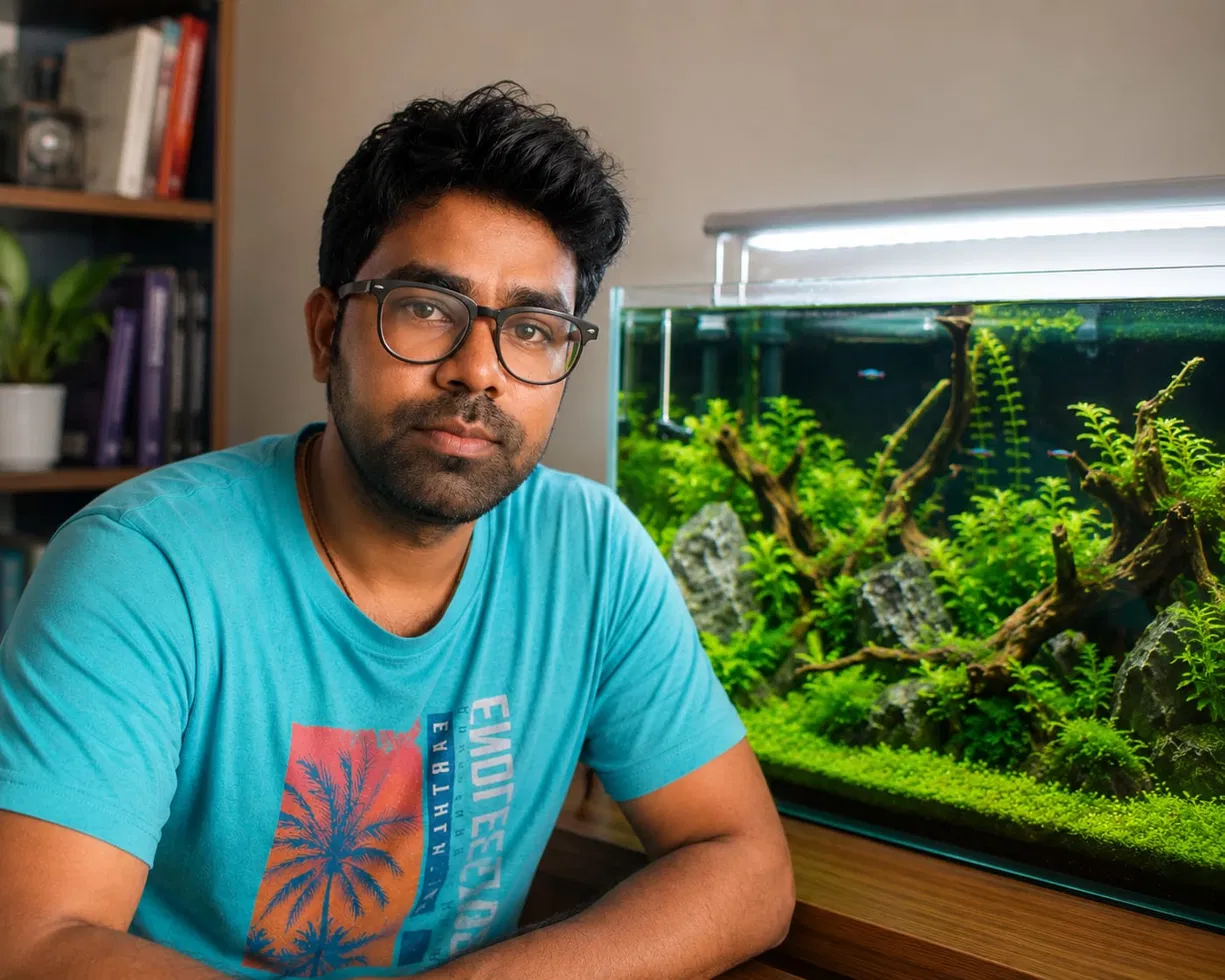
Anil Satak M.Sc. Zoology · Founder, FishioHub
Grew up in a fishing family in India and holds a Master's in Zoology. FishioHub is a one-person operation - every guide is personally researched, kept-tested, and written by Anil. No team, no outsourced writers, no AI-generated content. Read his full bio →