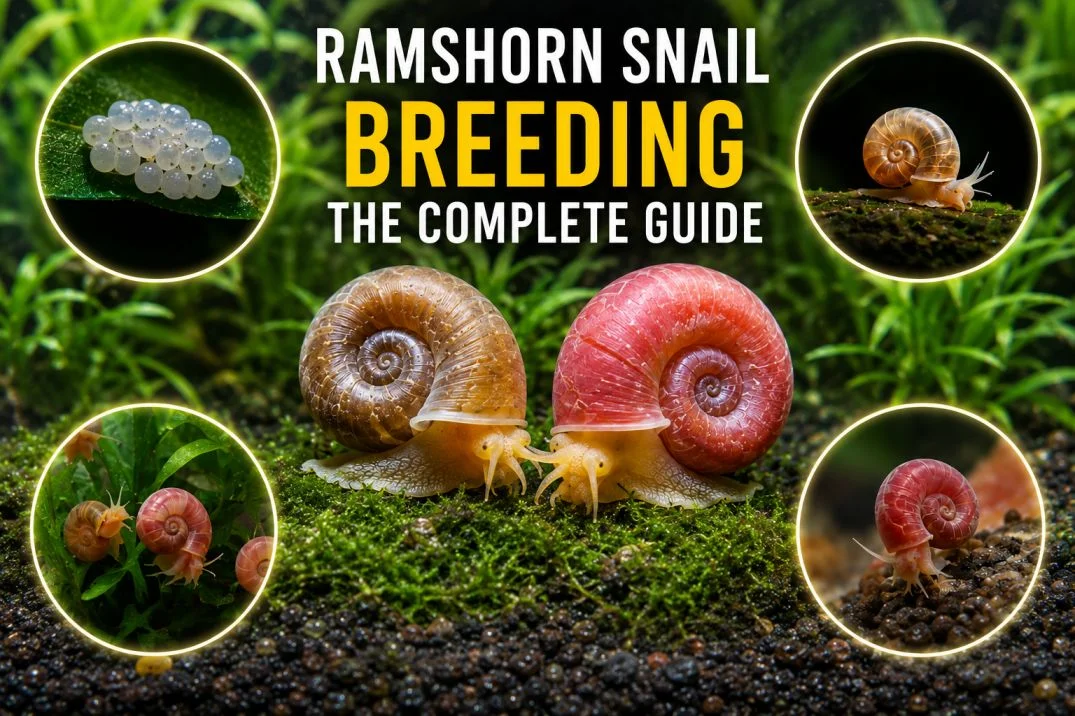
The first time I noticed ramshorn snail eggs in my 20-gallon planted tank in my home, I panicked. My first thought? “Did I just accidentally start a snail farm?” My second thought — after a quick Google at midnight — was that half the internet makes ramshorn snail breeding sound way more complicated, or way more terrifying, than it actually is.
Here’s the straight truth: ramshorn snail breeding is one of the most effortless reproduction events in the freshwater hobby. They’re hermaphrodites, so any two snails can mate. Eggs hatch in 1–2 weeks. Baby snails are independent from day one. Remember I said breeding ramshorn snails is effortless, but the real challenge isn’t getting them to breed — it’s deciding how much you want them to, and that’s very important.
Whether you’re intentionally cultivating a colony for live fish food, trying to grow a cleanup crew, or just desperately trying to understand what those clear jelly blobs stuck to your aquarium glass actually are — you’re in the right place.
What You’ll Get in This Post
Here’s exactly what’s covered; jump to whatever you need:
- What ramshorn snail breeding actually looks like
- What ramshorn snail eggs look like & where they lay them
- How long ramshorn snail eggs take to hatch
- How many eggs ramshorn snails lay & their breeding rate
- Setting up a ramshorn snail breeding tank
- Red ramshorn snail breeding & variants
- Giant ramshorn & Colombian ramshorn snail breeding
- What eats ramshorn snail eggs (population control)
- FAQ
Jump to: Breeding | Eggs | Breeding Tank | Colors | FAQ
What Ramshorn Snails Mating Looks Like
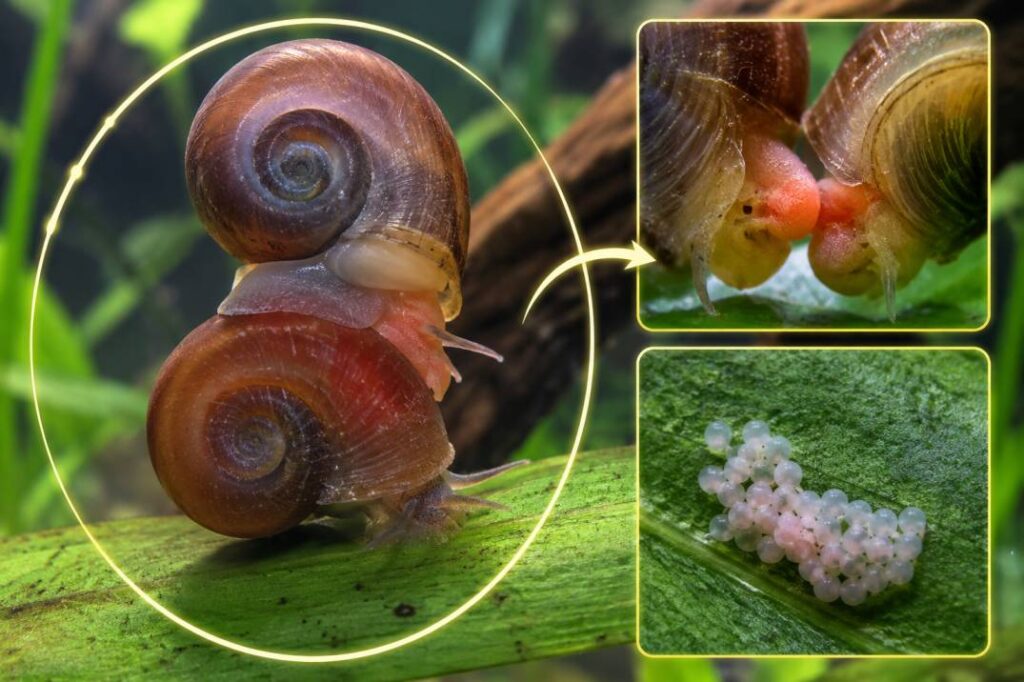
The first time you catch two ramshorns doing the deed, it’s… actually kind of fascinating. They’ll spend anywhere from 30 minutes to several hours locked together, gliding slowly across a leaf or piece of driftwood. Since they’re simultaneous hermaphrodites — meaning each individual has both male and female reproductive organs — both snails can fertilize each other during a single encounter.
What makes ramshorn snails reproduction even wilder is that a single snail can store sperm for weeks after mating. That’s why hobbyists who buy “just one” ramshorn often end up with a surprise colony a month later. One snail, already inseminated before you got it, is all it takes.
Expert Tip: If you see two snails “stacked” on top of each other and barely moving for hours — congratulations, you’re about to have babies.
What Do Ramshorn Snail Eggs Look Like?
This is one of the most-searched questions I see from new hobbyists, and I completely understand why — the eggs look nothing like what most people imagine.
Ramshorn snail eggs appear as small, clear or pinkish, gelatinous clusters. They’re usually circular or oval-shaped, roughly the size of a pencil eraser, with tiny individual eggs visible inside the jelly mass. Each cluster typically contains 10–12 eggs, though this varies by snail age and health.
You’ll find them stuck to:
- The undersides of broad-leaf plants (Java fern, Amazon sword)
- Aquarium glass — especially near the waterline
- Driftwood and hardscape surfaces
- Filter intakes and equipment
Ramshorn Snail Eggs on Leaf
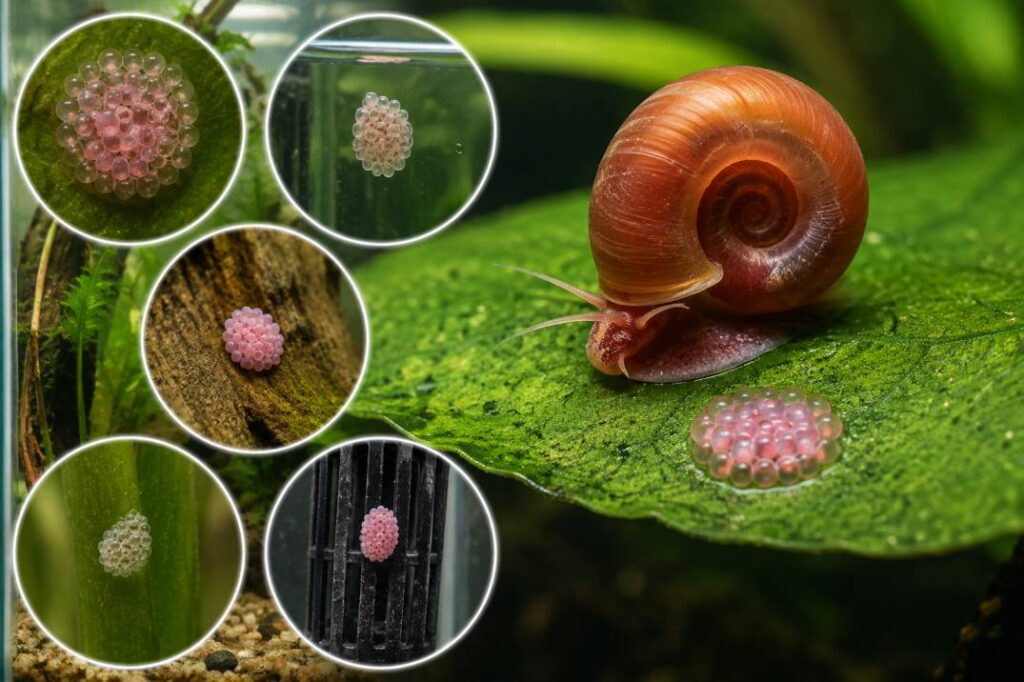
Finding ramshorn snail eggs on a leaf is incredibly common in planted tanks. The snail seems to prefer broad, flat surfaces. In my Texas tanks, my Amazon swords are practically an egg nursery. The eggs won’t harm your plants — the gel casing protects them without drawing nutrients from the leaf.
Ramshorn Snail Eggs: How Long to Hatch
Ramshorn snail eggs typically hatch in 10–14 days under normal aquarium conditions (72–82°F / 22–28°C). At warmer temperatures toward the upper end of that range, you may see hatching as early as 7–8 days. In cooler tanks, it can stretch to 3 weeks.
How Long Do Ramshorn Snail Eggs Take to Hatch — By Temperature
| Water Temp | Estimated Hatch Time |
| 68–72°F (20–22°C) | 18–24 days |
| 73–76°F (23–24°C) | 14–16 days |
| 77–80°F (25–27°C) | 10–12 days |
| 81–84°F (27–29°C) | 7–9 days |
Once hatched, the baby ramshorns emerge fully formed — tiny, maybe 1mm across, already wearing their little coiled shells. They don’t need a yolk sac or parental care. They immediately start grazing on algae and biofilm. It’s one of the things that makes ramshorn snail breeding so beginner-friendly: nature does everything literally.
Science fact: According to research published in the journal Invertebrate Biology (2003), planorbid snails like ramshorns show significantly accelerated embryonic development in temperatures above 25°C — one of the few aquarium invertebrates where warmer water has a near-linear positive effect on reproduction speed.
How Many Eggs Do Ramshorn Snails Lay?
A healthy adult ramshorn lays approximately 10–12 eggs per clutch and can deposit 3–5 clutches per week under ideal conditions. Do the math, and you’ll understand why people either love or fear these snails.
Ramshorn Snail Breeding Rate: The Real Numbers
- One snail pair → ~200 offspring per month in ideal conditions
- A colony of 10 adults can theoretically produce 2,000+ snails in 60 days
- They reach ramshorn snail breeding age at roughly 4–6 weeks old
That last point is what catches most hobbyists off guard. You don’t get a grace period. Your baby snails from week one are actively laying eggs by week five or six. This exponential growth is why population control matters — which we’ll cover shortly.
Scientific note: A 2018 study on Planorbella duryi (Florida ram’s horn snail, common in US hobbyist tanks) published in Aquatic Invasions found that under food-abundant, warm-water conditions, populations could increase by over 400% in a single month. The study highlighted this as a key concern for outdoor ornamental ponds across the southeastern United States.
How Fast Do Ramshorn Snails Reproduce (And How to Slow It Down)
How fast do ramshorn snails reproduce? Faster than you think, slower than you fear — if you manage it. The main environmental levers are:
They breed MORE when:
- Water temp is above 76°F
- Food is plentiful (algae, uneaten fish food, decaying plant matter)
- Calcium is high (helps shell formation, encourages clutch production)
- The tank is heavily planted with broad-leaf species
They breed LESS when:
- Food is limited (controlled feeding)
- Predators are present (see below)
- Water is soft/acidic (dissolves shells, inhibits breeding)
- Population density is high (natural crowding stress)
This is the single biggest thing competitors miss: ramshorn snail breeding rate is almost entirely diet-driven. Cut their food supply, and their population stabilizes remarkably fast. I learned this the hard way after a two-week vacation and an auto-feeder set too generously. Came home to what I can only describe as a snail apocalypse.
Ramshorn Snail Breeding Tank Setup
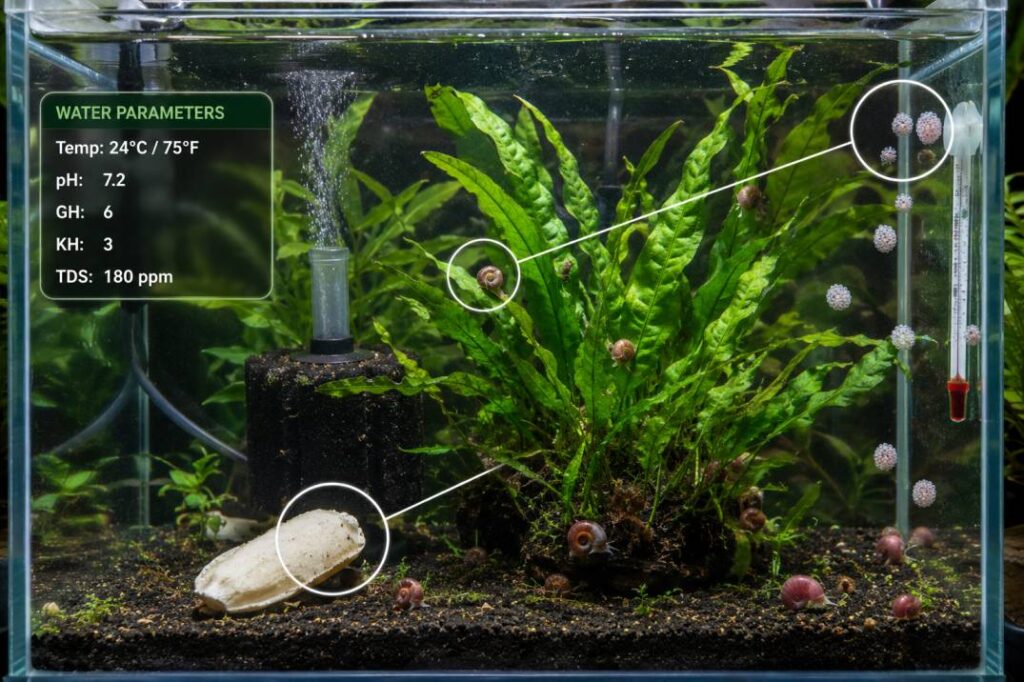
If you’re intentionally breeding ramshorn snails — whether as a food culture for pea puffers, assassin snails, or ornamental value — a dedicated ramshorn snail breeding tank makes the whole process a lot more controllable.
Ideal Breeding Tank Parameters
| Parameter | Ideal Range |
| Tank Size | 5–10 gallons (sufficient for a colony) |
| Temperature | 76–80°F (24–27°C) |
| pH | 7.0–8.0 |
| Hardness (GH) | 8–15 dGH |
| Ammonia / Nitrite | 0 ppm |
| Nitrate | Under 20 ppm |
| Calcium supplementation | Cuttlebone or crushed coral |
Key setup tips for a dedicated breeding tank:
- Add a sponge filter (baby snails won’t get sucked in)
- Keep lighting at 8–10 hours to encourage algae growth (free food)
- Add java fern, anubias, or amazon sword — broad-leaf surfaces for egg deposits
- Drop a small piece of cuttlebone in the tank for calcium — critical for shell health and egg production
- Feed blanched zucchini, spinach, or algae wafers every 2–3 days
Pro move: A 5-gallon quarantine tub from Petco (~$15) is the most common breeding setup among US hobbyists for feeder snail cultures. Label it clearly so your family doesn’t wonder why you have a tub of “mystery goo” in the garage.
Red Ramshorn Snail Breeding and Color Variants
Red ramshorn snail breeding works identically to any other variant — same parameters, same egg appearance, same timeline. But color is where things get interesting.
The red coloration comes from hemoglobin in their blood (unlike most mollusks that use hemocyanin). This makes them genuinely “red” — body and sometimes shell — and it’s a selectively bred trait in the aquarium trade.
How to breed for red ramshorns:
- Select only the deepest red individuals as breeders
- Cull brown or pale offspring consistently (every 2–3 generations)
- Higher protein diet (bloodworms, brine shrimp) tends to intensify color expression
- Keep pairings isolated so you don’t dilute with wild-type brown genetics
Pink and blue (actually albino with translucent blue-tinted shell) variants exist and follow the same selective breeding logic. In the US hobby market, red and pink ramshorns typically sell for $2–6 per snail at local fish stores, making a breeding project genuinely profitable at scale.
Giant Ramshorn Snail Breeding and Colombian Ramshorn Snail Breeding
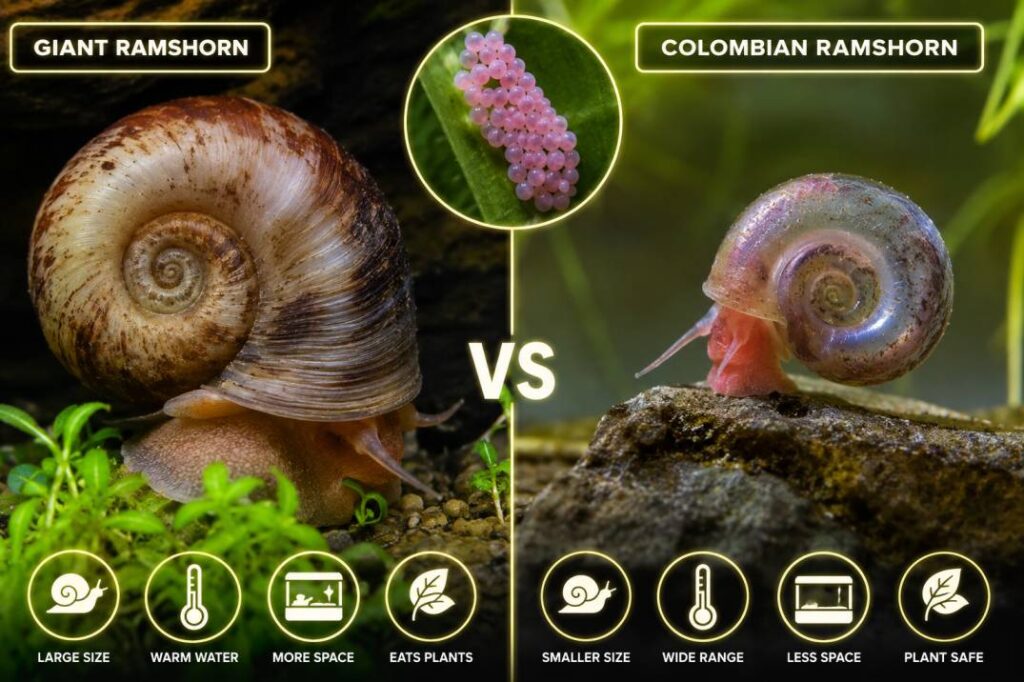
These are two species that get lumped together under “ramshorn” but deserve their own mention separately.
Giant ramshorn snail breeding (Marisa cornuarietis): These are significantly larger (up to 35mm shell diameter), from Central and South America, and are actually in a different family (Ampullariidae). Breeding is similar — hermaphroditic, egg clutch-based — but they need more space (minimum 20 gallons), warmer temps (78–84°F), and they will absolutely eat soft live plants. They’re in a different league from the common Planorbidae ramshorn.
⚠️ US hobbyists note: Marisa cornuarietis (Giant Ramshorn) is listed as a regulated invasive species in Florida, Texas, and several other Gulf states. Check your state’s regulations before purchasing or releasing outdoors. USDA APHIS lists it as a federal agricultural pest. Never release aquarium snails into local waterways.
Colombian ramshorn snail breeding (Planorbis sp.): Colombian ramshorns are essentially the standard Planorbidae ramshorn with regional origin labeling. Breeding behavior, eggs, and timeline are identical to what’s described throughout this guide.
What Eats Ramshorn Snail Eggs?
You know, most of the time people used to ask “How to breed?” regarding any snails or species, but in the case of ramshorn snails, you will see people usually asking: How to stop ramshorn snails breeding? I personally do not like to introduce something that eats ramshorn snails or eggs, but still, it is the best thing to control the overpopulation of ramshorn snails. Knowing what eats ramshorn snail eggs (and adult snails) is your best population control strategy. I personally do not like the predation method, and I always choose the non-predation method.
Egg-level predators:
- Loaches (especially Clown Loach and Yoyo Loach) — they’ll sniff out and destroy egg clusters before they hatch
- Some dwarf cichlids may pick at exposed clutches
- Assassin snails — won’t reliably eat eggs but devastate juveniles
Adult snail predators:
- Assassin snails (Clea helena) — the most popular and effective biological control in the US hobby
- Pea puffers — voracious snail eaters- will clear a colony fast
- Dwarf Chain Loach, Skunk Loach
- Larger cichlids (Jack Dempsey, Green Terror)
- Certain crayfish species
Non-predator control methods:
- Trap with a piece of blanched zucchini overnight, remove in the morning loaded with snails
- Manual removal of egg clutches (check glass and leaves weekly)
- Reduce feeding — less food = fewer eggs, always
Are Ramshorn Snails Good for Your Tank?
Yes, ramshorn snails are good for your tank when managed well. Here’s the objective breakdown.
What they do for you:
- Eat leftover fish food (reducing ammonia spikes)
- Consume dead plant matter and soft algae
- Aerate substrate by grazing
- Serve as a live food source for pea puffers, loaches, and pufferfish species
What they do against you (if unmanaged):
- Reproduce faster than you expect
- Can stress delicate plants in very large numbers
- Signal overfeeding (snail boom = feeding too much)
The consensus among experienced US hobbyists: ramshorn snails are an asset in a managed planted tank and a problem only when the keeper ignores population signals early. Think of them like a canary in the coal mine — if their numbers explode, check your feeding habits and water quality.
FAQ: Ramshorn Snail Breeding
Q: How do ramshorn snails reproduce — do they need a partner?
Technically no. They are simultaneous hermaphrodites and can self-fertilize in isolation, though cross-fertilization with another snail produces more genetic variation and is more common.
Q: How often do ramshorn snails lay eggs?
A healthy adult can lay eggs every 3–5 days under ideal conditions, producing 3–5 clutches per week.
Q: At what ramshorn snail breeding age do they start laying eggs?
Ramshorns reach sexual maturity at approximately 4–6 weeks of age, though 6–8 weeks is more typical in aquarium conditions.
Q: How long do ramshorn snail eggs take to hatch?
Between 10–14 days at 76–80°F. Cooler temps push that to 3 weeks; warmer temps can drop it to 7–8 days.
Q: What do ramshorn snail eggs look like on the glass?
Small, clear or pinkish gelatinous blobs, oval or round, roughly pencil-eraser sized. You can see tiny dot-shaped embryos inside the gel mass.
Q: Can ramshorn snails breed in a community tank with fish?
Yes, and they will — unless fish actively eat them. Most community fish ignore ramshorns. Even neon tetras, guppies, and danios pose zero threat to adult snails or their eggs.
Q: How do I stop ramshorn snails from over-breeding?
Reduce feeding to once daily with no excess food left after 5 minutes. Add assassin snails or a pea puffer. Manually remove egg clutches weekly. This three-pronged approach reliably stabilizes populations.
Q: Is ramshorn snail breeding good for beginners?
Absolutely — it’s probably the easiest invertebrate breeding project in the hobby. No special water parameters needed, no sex identification required, no specialized food. If you have ramshorns and a cycled tank, breeding is essentially automatic.
Next Steps: Resources You Must Read
Ready to go deeper into your snail and tank-mate knowledge? These posts are essential reading for any hobbyist managing a snail colony:
- Rabbit Snails Breeding — A completely different (and fascinating) breeding strategy compared to ramshorns. Worth reading back-to-back with this guide.
- Ramshorn Snails Care Guide — Full care sheet covering tank setup, diet, and compatibility. Start here if you’re new to ramshorns.
- Rabbit Snails Care Guide — If ramshorns aren’t slow enough for you, meet their giant, prehistoric-looking cousins. A surprisingly popular tank addition.
Final Word: Should You Breed Ramshorn Snails?
Ramshorn snail breeding is the one thing in this hobby that will humble you and impress you simultaneously.
They’re not just “pest snails.” A well-managed colony is a living ecosystem service — cleaning your tank, feeding your puffers, and giving you a front-row seat to one of nature’s most efficient reproductive strategies. But ignore them for a month? You’ll be scooping snails out with a net while questioning your life choices.
The key is simple: understand their cycle, set up the right environment, and stay ahead of the population curve. This guide gives you everything you need to do exactly that.
Now get that breeding tank set up — or at least go check your Java fern for egg clusters. I bet there’s already one there.
Written by Anil Satak — aquarium hobbyist, FishioHub founder, and the guy who once had overpopulation of 400 ramshorn snails and called it “a learning experience.”
Was this guide helpful?
First-Hand Experience
Based on animals I've personally kept and bred - not summarized from other articles.
Zoological Foundation
Claims are checked against my M.Sc. Zoology training and published aquatic biology research, not recycled aquarium myths.
No Paid Influence
No sponsorship shaped this guide. Affiliate links, if any, are disclosed separately and never hidden.
Kept Current
Errors are corrected as soon as they're found, with the update noted at the bottom of the article.
Anil Satak M.Sc. Zoology · Founder, FishioHub
Grew up in a fishing family in India and holds a Master's in Zoology. FishioHub is a one-person operation - every guide is personally researched, kept-tested, and written by Anil. No team, no outsourced writers, no AI-generated content. Read his full bio →