I planted my first Monte Carlo carpet on a Saturday afternoon, feeling completely confident. By Tuesday, I was staring at a tank full of tiny plants floating on the surface like green confetti. Every single cluster had pulled free from the substrate overnight.
One mistake I made was planting Monte Carlo too shallow, and not a single guide I had read about how to plant Monte Carlo in aquarium warned me about it clearly. Three weeks later, after understanding exactly what went wrong, I replanted the same batch correctly and watched one of the most satisfying things in the aquarium hobby unfold — a dense, lush green carpet spreading steadily across the tank floor over the following weeks.
That experience is why I wrote this guide. Not to repeat what every other post says — but to give you the honest, experience-backed steps that produce a carpet.
How to plant Monte Carlo in aquarium?
Separate Monte Carlo into tiny portions, plant each piece 1–2 inches apart using aquascaping tweezers, and provide stable light, nutrients, and consistent moisture around the roots. For faster carpet growth, use CO2, but Monte Carlo can also grow without CO2 in low-tech tanks if you’re patient.
What You’ll Get in This Post
- 🌱How to plant Monte Carlo in Aquarium- Steps
- 🏆The #1 mistake that kills most setups
- 🪴 How to plant Monte Carlo tissue culture — step by step
- 🌿 How to plant Monte Carlo aquarium plant from a pot
- 💧 How to grow Monte Carlo without CO2 — honest truth
- 🌾 How to grow Monte Carlo emersed — the fastest carpet method
- 🏜️ How to grow Monte Carlo carpet using the Dry Start Method
- ❓ FAQs
What Is Monte Carlo and Why Every Aquarist Should Try It
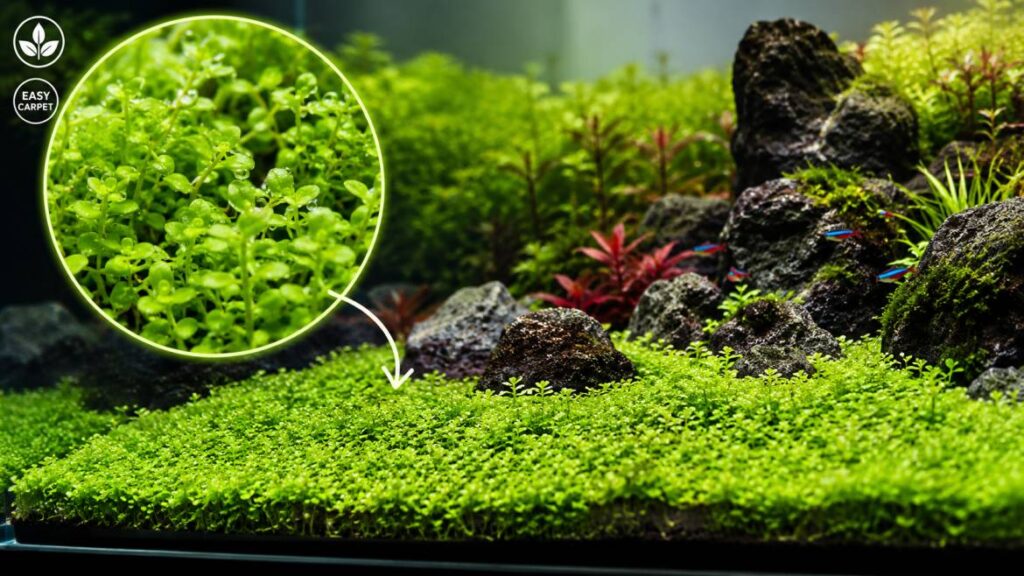
Monte Carlo, scientifically known as Micranthemum tweediei ‘Monte Carlo ( also called Bacopita or New Large Pearl Grass), is a low-growing carpeting aquarium plant popular in aquascaping. Compared to harder carpeting plants like Hemianthus callitrichoides (HC Cuba), Monte Carlo is easier to maintain and adapts better to beginner tanks.
Why hobbyists love it:
- Bright green compact leaves
- Spreads horizontally into a carpet
- Easier than dwarf baby tears
- Works in nano tanks and large aquariums
- Can grow with or without CO2
It’s especially popular in Nature Aquarium layouts inspired by Takashi Amano.
The #1 Mistake That Kills Most Monte Carlo Setups
Before the step-by-step guide, I want to address the mistake responsible for the majority of Monte Carlo failures across the USA and UK planted tank community, because if you make this mistake, nothing else in this guide matters.
Planting too shallow.
Monte Carlo stems are delicate, thin, and have almost no root when first planted. If you push each cluster only 5 to 8mm into the substrate that is too coarse, it feels enough, but when water moves, it takes out the plant from its base
The correct depth is 1 to 1.5cm — approximately half an inch. This sounds like a small difference. It is not. It is the difference between a plant that anchors and a plant that permanently drifts.
A 2021 study published in Aquatic Botany on substrate particle size and aquatic plant establishment also proves it.
How to Plant Monte Carlo in Aquarium Step-by-Step
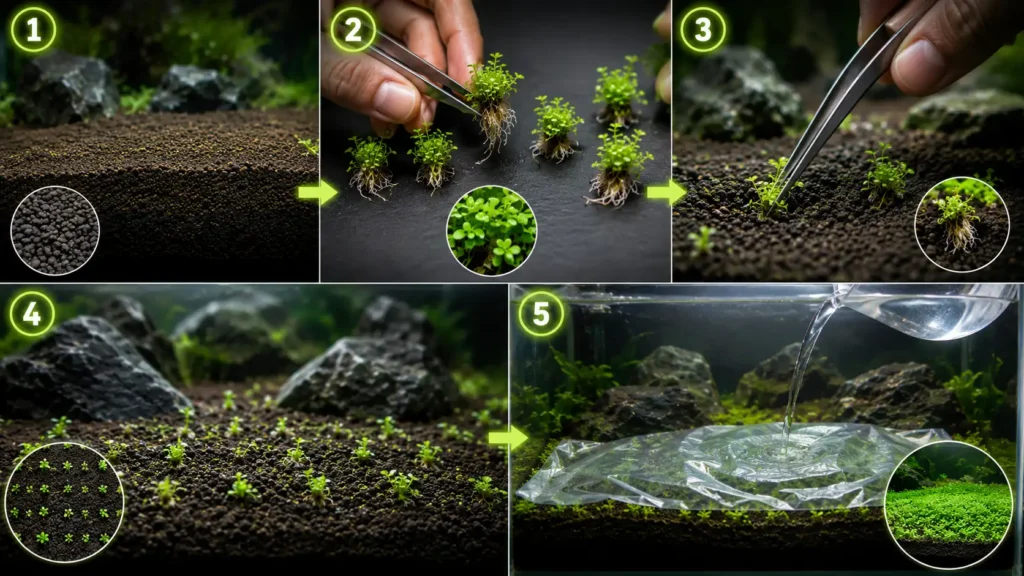
This is the exact process I now use after multiple failed attempts.
Step 1: Prepare the Substrate
Monte Carlo grows best in nutrient-rich aquarium soil. According to my experience and research, the best options include:
- Aquasoil
- Fluval Stratum
- ADA Amazonia
- UNS Controsoil
A 2021 aquatic plant substrate study found nutrient-rich planted substrates significantly improved root establishment and carpeting plant spread compared to inert gravel.
Avoid: Large gravel, big sharp stones, and very shallow substrate.
Ideal substrate depth:
- Front: 1.5 inches
- Back: 2–3 inches
Step 2: Divide the Plant Into Tiny Portions
This is where most people fail. They try to plant whole or in larger quantities. Do NOT plant one giant clump.
Instead:
- Separate Monte Carlo into tiny plugs
- Each portion should have 5–10 leaves
- Remove excess rock wool if present
Smaller portions root faster and spread more evenly. This single technique completely changed my carpet success rate.
Step 3: Use Long Tweezers
I’ve seen on social media so many aquarists doing so many things that they try planting with fingers, Monte Carlo often floats up. Instead of doing this, you should use aquascaping tweezers to push the roots into the substrate properly. This keeps roots anchored.
- Grab the plant gently at the roots
- Push roots deep into the substrate
- Angle tweezers at roughly 45 degrees
- Pull the tweezers out slowly
Step 4: Space the Portions Correctly
For thick carpets, space plugs 1–2 inches apart. If you do too close or too far planting, both will be bad. So space the portion correctly. The sweet spot is moderate spacing.
Too close:
- Causes melting
- Blocks circulation
Too far:
- Carpet takes months
Step 5: Fill the Tank Slowly
This will be one of the stupid mistakes, if any aquarists make, and I have seen many beginners destroy entire carpets:
dumping water directly onto the substrate. To protect the Monte Carlo fill tank slowly.
Instead:
- Place a plastic bag or plate on the substrate
- Pour water gently onto it
- Fill the tank slowly
This prevents Monte Carlo from uprooting.
How to Plant Monte Carlo Tissue Culture — Step by Step
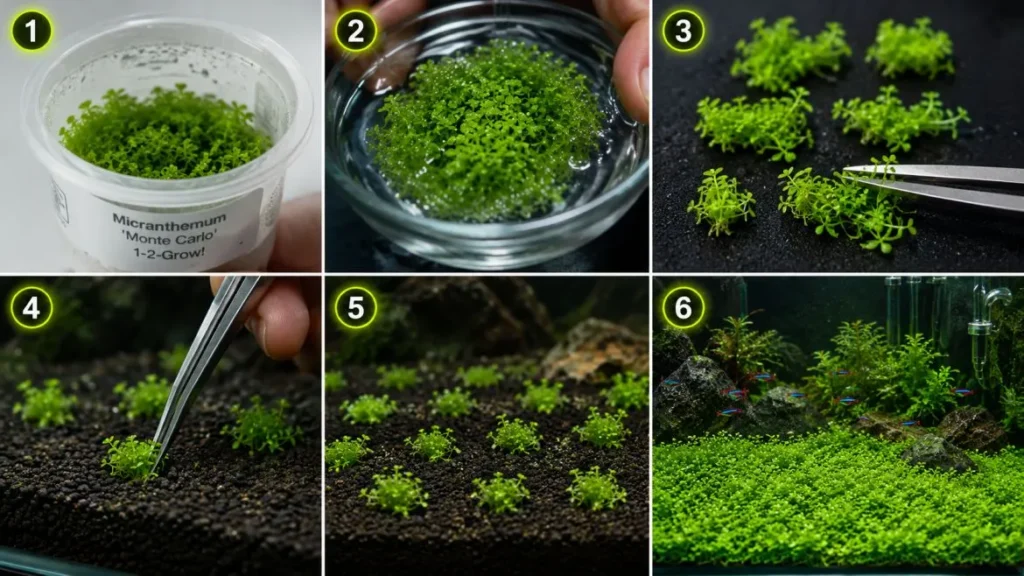
Learning how to plant Monte Carlo tissue culture properly matters because tissue culture plants behave differently from potted versions. Tissue culture is my recommended choice for every USA hobbyist without exception, but never plant the entire tissue culture cup as one chunk.
One thing is very clear: tissue culture takes time, but it has several benefits over normal planting. Here is why I recommend it: tissue culture Monte Carlo arrives pesticide-free, algae-free, and pest-free, in the desired quantity. If you keep shrimp in your tank, this matters enormously. Regularly potted Monte Carlo from fish stores can carry snail eggs, algae spores, and pesticide residue that devastates invertebrate populations. Tissue culture eliminates all three risks.
Most US retailers, including Aquatic Arts, Glass Aqua, and Amazon, carry tissue culture Monte Carlo for $8 to $15 per cup.
Step 1 — Remove from the cup. Open the tissue culture cup and remove the plant plug. It will be embedded in a clear nutrient gel. This gel is harmless to you but must be completely removed before planting.
Step 2 — Wash away the nutrient gel completely. Place the entire plug in a bowl of clean, room-temperature water and gently agitate for 2 to 3 minutes. The gel dissolves and separates from the plant. Rinse thoroughly — any remaining gel clouds your tank water and can promote bacterial growth.
Step 3 — Split into tiny pieces. Using clean fingers or aquascaping scissors, divide the plant mass into clusters of 3 to 5 stems each — approximately 1 to 2cm across. Smaller clusters spread faster and produce more uniform carpet coverage than large chunks. One standard tissue culture cup typically provides 15 to 25 planting clusters for a 10 to 15-gallon tank foreground.
Step 4 — Plant at the correct depth. Using long curved-tip aquascaping tweezers, grip each cluster at its base and push it into the substrate to a depth of exactly 1 to 1.5cm. The leaves and upper stems must remain above the substrate surface. Only the base and any existing root structure go below.
Step 5 — Space clusters 1 to 2 inches apart. Plant clusters in a grid pattern across your foreground, spacing each one 1 to 2 inches from its neighbors. This spacing allows lateral runners to spread and eventually connect into a continuous carpet. Tighter spacing fills in faster but costs more plants. Wider spacing takes longer but uses less of your starting stock.
Step 6 — Do not disturb for 1 to 2 weeks. After planting, leave the clusters completely undisturbed. Roots need uninterrupted time to grip the substrate. If individual clusters float free in the first 48 hours, replant immediately at slightly greater depth and temporarily reduce filter flow to minimize water movement disturbing the planting area.
How to Plant Monte Carlo From a Pot
If you bought a Monte Carlo from Petco, PetSmart, or another USA fish store, there’s one extra step before planting.
Step 1 — Remove the Pot
Take the plant out of the plastic pot. The roots will be wrapped in rock wool.
Step 2 — Remove All Rock Wool
Carefully remove every bit of rock wool and rinse the roots well. Leftover rock wool can make the tank messy, irritate fish, and clog filters over time.
Step 3 — Plant Like Tissue Culture
Once cleaned, divide the Monte Carlo into small portions and plant them 1–1.5cm deep, spacing each cluster about 1–2 inches apart.
One thing I noticed with USA store-bought pots — they usually melt a little at first while adjusting to your tank. Don’t panic. It’s normal, and healthy new growth usually follows soon after.
How to Plant Monte Carlo Mat — Best Method for Large Tanks
For bigger aquariums, this is the method I’d recommend. Instead of planting tiny pieces one by one, the mat method gives you a faster and more even Monte Carlo carpet from the start.
What You Need
- Fine stainless steel mesh (2–3mm openings)
- 3–5 tissue culture cups, depending on tank size
- Small smooth pebbles
How to Do It
- First, clean the tissue culture gel like normal. Then separate the Monte Carlo into 2–3 larger flat sections instead of tiny clusters.
- Lay the plant sections directly on the mesh. The roots usually grip the mesh naturally, so you don’t need glue or thread.
- Place the mesh flat on the substrate and use a few small pebbles on the edges to keep it down for about 1–2 weeks while the roots attach.
- After that, remove the pebbles and let the carpet spread naturally.
- Once the Monte Carlo fills in, the mesh becomes completely hidden, and you get a super clean, even carpet with way less effort than traditional planting.
How to Grow Monte Carlo Without CO2 — The Honest Truth
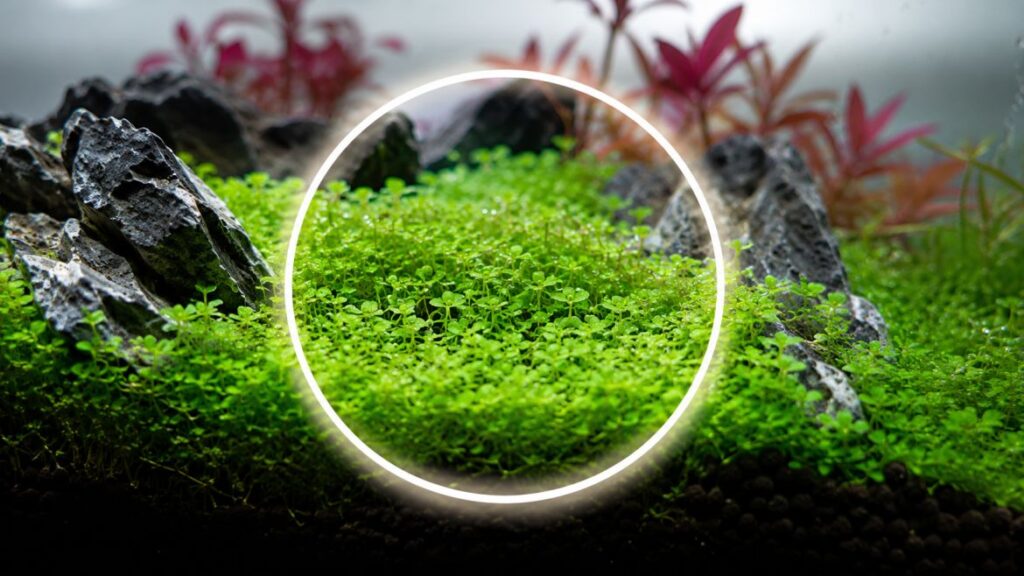
Yes, Monte Carlo can grow without CO2. I’ve done it myself in a low-tech tank. But I noticed slow growth, and most guides don’t mention that clearly.
How to Grow Monte Carlo Without CO2, you can realistically expect:
- Slower growth
- Carpet filling in after 2–4 months instead of a few weeks
- More upward growth instead of tight horizontal spreading
- More trimming to keep it compact
What Helps Monte Carlo Grow Without CO2
Strong Lighting
When we need to plant Monte Corlo without CO2, we all know that CO2 is very crucial for any plant to grow. In such a situation, lighting becomes extremely important in low-tech tanks. Aim for medium to strong LED lighting with good substrate coverage.
Popular USA options:
- Fluval Plant 3.0
- Finnex Planted+ 24/7
- Current USA Satellite Plus Pro
Liquid Carbon Helps
Products like Seachem Excel can improve growth noticeably. Just reduce the dose if you keep shrimp, because full strength can stress them.
Use Root Tabs
Root tabs help a lot in no-CO2 setups. Place them across the Monte Carlo area during setup to give the roots steady nutrients.
In my experience, patience is the biggest key with low-tech Monte Carlo. It grows more slowly, but once established, it can still create a beautiful carpet without running a full CO2 system.
How to Grow Monte Carlo Emersed — The Fastest Carpet Method
This is one of the fastest ways I’ve found to grow a thick Monte Carlo carpet. Instead of growing underwater first, you grow it in humid air before flooding the tank.
How to Grow Monte Carlo Emersed
- Set up your substrate normally, but don’t fill the tank with water yet.
- Plant the Monte Carlo the same way as tissue culture plants, then mist the entire surface with dechlorinated water 1–2 times daily. Keep the substrate damp, not soaked.
- Cover the tank with plastic wrap or a clear lid to trap humidity. If you see condensation inside, humidity is usually perfect.
- Run the lights for about 8–10 hours daily.
Why This Method Works So Well
Monte Carlo grows much faster immersed because it has unlimited access to atmospheric CO2. In my experience, carpets establish noticeably faster and grow much denser compared to submerged setups. You can usually get a fully rooted carpet in about 3–5 weeks.
Flooding the Tank
- Once the carpet is established, slowly raise the water level over 1–2 weeks instead of flooding everything at once.
- Some melt is completely normal during the transition because emersed leaves are not built for underwater growth. Don’t panic and don’t remove the plant. New submerged leaves usually appear within 1–2 weeks from the healthy root system underneath.
How to Grow Monte Carlo Carpet Using the Dry Start Method
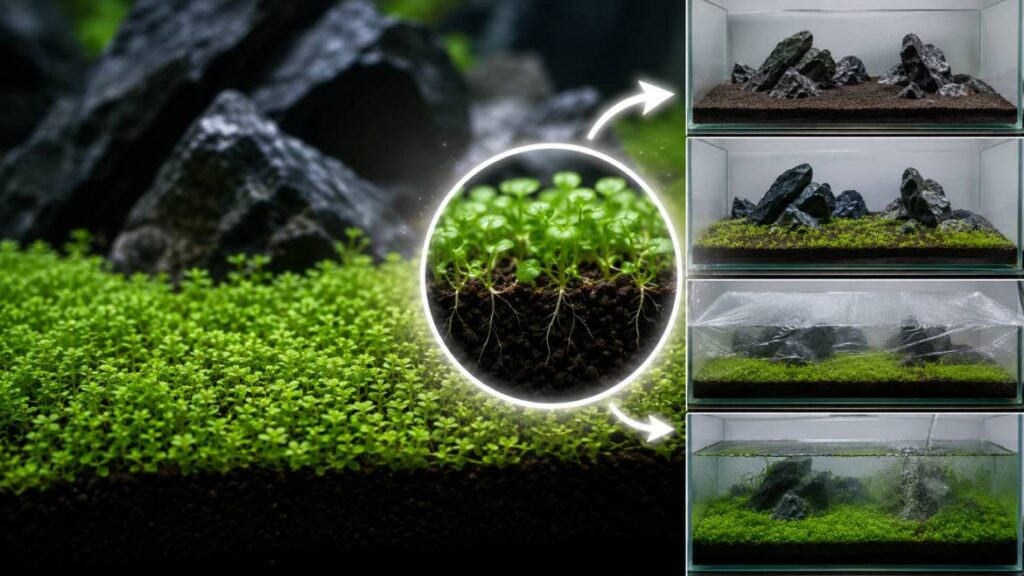
The Dry Start Method (DSM) is easily one of the best ways to grow a thick, clean Monte Carlo carpet. It takes more patience at the beginning, but the final results usually look far better than planting directly underwater.
How I Do the DSM Method
- First, fully set up the aquascape — substrate, rocks, driftwood, and plant layout. Don’t add water yet.
- Plant the Monte Carlo across the foreground about 1–1.5cm deep, then mist the substrate until it’s evenly damp but not flooded.
- Cover the tank tightly with plastic wrap or a glass lid to trap humidity. Run your lights around 8 hours daily.
- Every 1–2 days, check the substrate and mist again if it starts drying out.
What Happens After a Few Weeks
- After about 4–6 weeks, the Monte Carlo usually forms a thick rooted carpet that’s firmly attached to the substrate.
- At that point, slowly flood the tank over several days instead of filling it instantly.
Why DSM Works So Well
In my experience, DSM-grown Monte Carlo carpets are:
- More even
- Better rooted
- Less likely to float up
- Faster to spread after flooding
It also simplifies the early setup phase by focusing on humidity and plant growth before addressing full underwater tank stability.
How to Grow Monte Carlo Aquarium Plant — Key Conditions
In my experience, Monte Carlo grows successfully when 4 things stay consistent: good light, nutrient-rich substrate, fertilizers, and patience. If even one goes wrong, the carpet usually becomes patchy, leggy, or covered in algae.
Lighting
Monte Carlo needs medium to high light to spread horizontally rather than grow upward. I usually run my aquarium lights for around 8 hours daily because longer photoperiods often trigger algae.
Substrate
For how to grow Monte Carlo aquarium plants properly, nutrient-rich substrate makes a massive difference. I’ve had the best results with ADA Amazonia, Fluval Stratum, and Seachem Flourite in my planted tanks.
Fertilization
Monte Carlo feeds heavily through both roots and the water column. I personally combine root tabs with a weekly liquid fertilizer dose to keep the carpet dense, green, and fast spreading.
Water Parameters
| Parameter | Optimal | Acceptable | Notes |
|---|---|---|---|
| Temperature | 70–75°F (21–24°C) | 68–79°F | Cooler end promotes compact growth |
| pH | 6.0–7.0 | 5.5–7.5 | Slightly acidic preferred |
| Hardness | 4–8 dGH | 2–15 dGH | Wide tolerance |
| CO2 | 20–30 ppm | 0–30 ppm | Not required but accelerates growth |
| Lighting PAR | 30–50 at substrate | 20–70 | Higher = faster denser carpet |
| Substrate depth | 3–4 inches | 2–5 inches | Deeper allows better root development |
| Photoperiod | 8–10 hours | 6–12 hours | Longer = more algae risk |
| Fertilizer | Weekly liquid + root tabs | Monthly minimum | N, P, and K are all needed |
Common Monte Carlo Mistakes
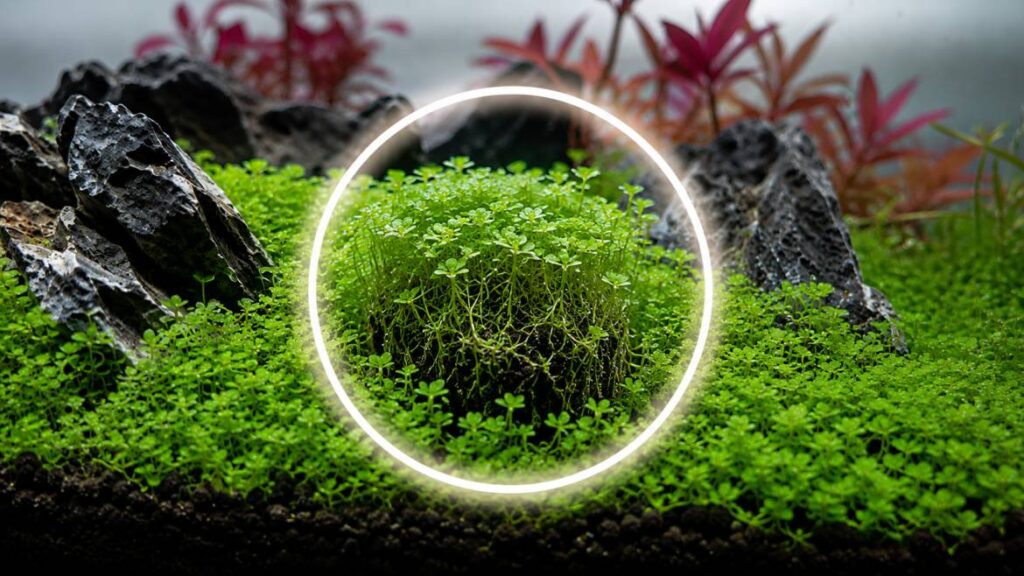
- Planting Huge Clumps: This prevents proper rooting. Always separate into tiny portions.
- Using Weak Light: Due to the need for light, plants grow upward. Weak light causes vertical stretching instead of carpeting.
- Skipping Nutrients: Monte Carlo isn’t “set and forget.” It needs feeding.
- Flooding Too Fast: Rapid filling uproots fresh plants.
- Ignoring Trimming: Overgrown carpets suffocate underneath.
FAQ: How to Plant Monte Carlo in Aquarium
How do you plant Monte Carlo in aquarium substrate?
Separate the plant into small portions and use tweezers to plant each section deep into nutrient-rich substrate about 1–2 inches apart.
Can Monte Carlo grow without CO2?
Yes, Monte Carlo can grow without CO2, but growth is slower and carpets may appear less compact.
How long does Monte Carlo take to carpet?
Usually 4–6 weeks with CO2 and high light, or 2–4 months in low-tech setups.
Does Monte Carlo need aquasoil?
Aquasoil is highly recommended because it provides nutrients and better root anchoring, though Monte Carlo can survive in gravel with root tabs.
Why is my Monte Carlo floating up?
This usually happens when portions are too large or planted too shallowly.
How to plant Monte Carlo in aquarium without floating?
To plant a Monte Carlo aquarium plant without floating, push the roots deeply into the aquasoil using aquascaping tweezers and fill the tank slowly afterward.
Can shrimp live with Monte Carlo?
Yes. Shrimp love Monte Carlo carpets because they trap biofilm and provide hiding areas.
How to Plant Monte Carlo in Aquarium with low tech?
To grow Monte Carlo carpet in low-tech aquariums, use moderate lighting, aquasoil, regular fertilizer dosing, and patience because growth will be slower without CO2.
Next Steps: Resources You Must Read
You now know how to plant Monte Carlo in aquarium using every method — tissue culture, potted, mat method, emersed growing, and Dry Start. The next step is building the complete planted tank environment that makes Monte Carlo thrive alongside your fish and shrimp.
Understand how fast-growing background plants help stabilize water parameters that benefit Monte Carlo growth
How to Plant Freshwater Aquarium Plants: Complete Beginner Guide — FishioHub
- Master substrate preparation, planting depth, and anchoring for every aquarium plant type
- Learn the complete planted tank layout strategy from foreground to background
- Understand which plants pair best with Monte Carlo in a complete aquascape
Cherry Shrimp vs Amano Shrimp: Which Is Right for Your Tank? — FishioHub
- Monte Carlo carpets are the perfect shrimp habitat — learn which shrimp species works best
- Amano shrimp provide outstanding algae control on Monte Carlo leaves without damaging the plant
- Understand water parameter overlap between shrimp species and Monte Carlo requirements
How to Plant Guppy Grass in Aquarium — FishioHub
- Complete your tank with a fast-growing midground plant that pairs beautifully with Monte Carlo foreground carpet
- Learn anchoring techniques that apply directly to planting Monte Carlo and other aquatic plants
Final Thoughts
A big part of how to plant Monte Carlo in aquarium is all about patience, depth, and setup. I’ve seen it fail fast when rushed — and thrive beautifully when planted right.
From my experience, success comes down to three things: correct planting depth, good substrate, and giving it enough time to establish. Do that, and the carpet always comes.
— Anil Satak
Master’s in Zoology | FishioHub
Was this guide helpful?
First-Hand Experience
Based on animals I've personally kept and bred - not summarized from other articles.
Zoological Foundation
Claims are checked against my M.Sc. Zoology training and published aquatic biology research, not recycled aquarium myths.
No Paid Influence
No sponsorship shaped this guide. Affiliate links, if any, are disclosed separately and never hidden.
Kept Current
Errors are corrected as soon as they're found, with the update noted at the bottom of the article.
Anil Satak M.Sc. Zoology · Founder, FishioHub
Grew up in a fishing family in India and holds a Master's in Zoology. FishioHub is a one-person operation - every guide is personally researched, kept-tested, and written by Anil. No team, no outsourced writers, no AI-generated content. Read his full bio →