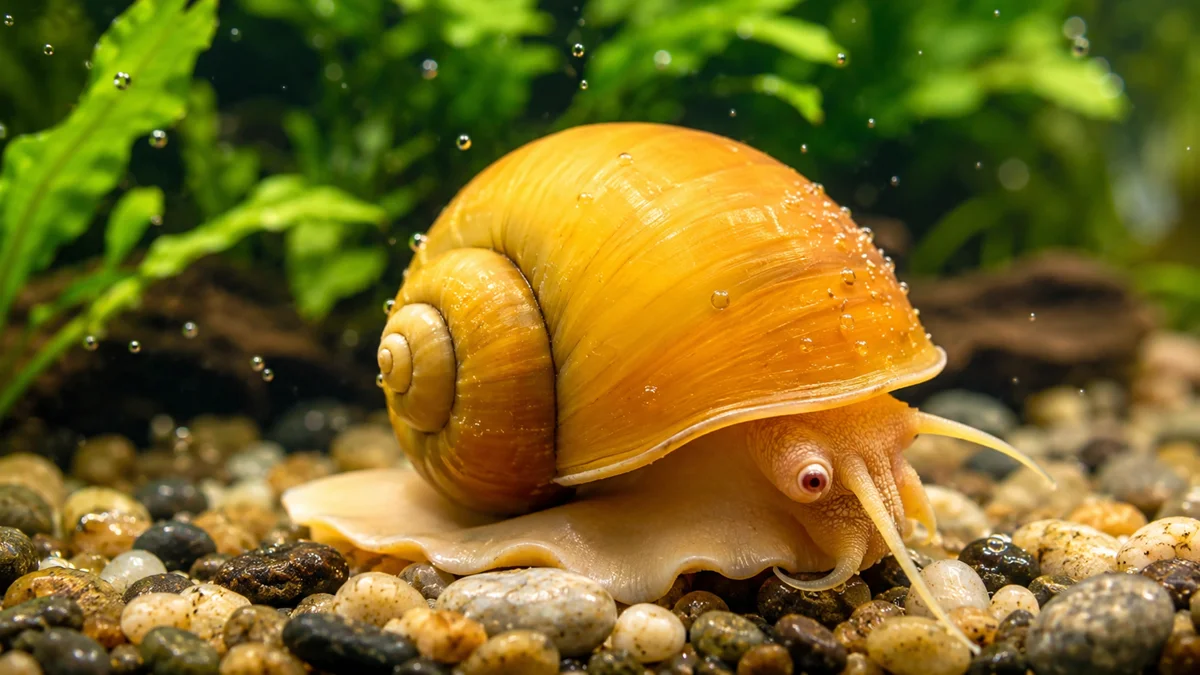
I still remember the first time one of my mystery snails went completely still for two days straight. I’d just finished my master’s in Zoology, and even I panicked a little.
Here’s the truth: a mystery snail not moving is usually alive and just resting — but sometimes it’s telling you something is wrong with the water.
Why is my mystery snail not moving? In most cases, it’s cold water, new-tank stress, low oxygen, poor water quality, or copper exposure. Check the operculum first — if it’s sealed tight with no smell, your snail is very likely alive. Fix the water conditions and most snails recover within 24–48 hours.
Here’s everything you need to check, in order.
Quick Summary Fact Card
| Question | Quick Answer |
| Is it normal? | Yes, for 12–48 hours, especially after a water change or new tank setup |
| Alive or dead? | Check smell + operculum first — no smell + sealed operculum = alive |
| Most common cause | Cold water (below 68°F/20°C) |
| Most dangerous cause | Copper exposure — even trace amounts can be fatal |
| When to worry | No movement for 5+ days, foul smell, or a loosely hanging body |
| Fastest fix | Raise temp to 72–82°F, test water, do a 30–40% water change |
Is It Alive or Dying? The 3-Second Check
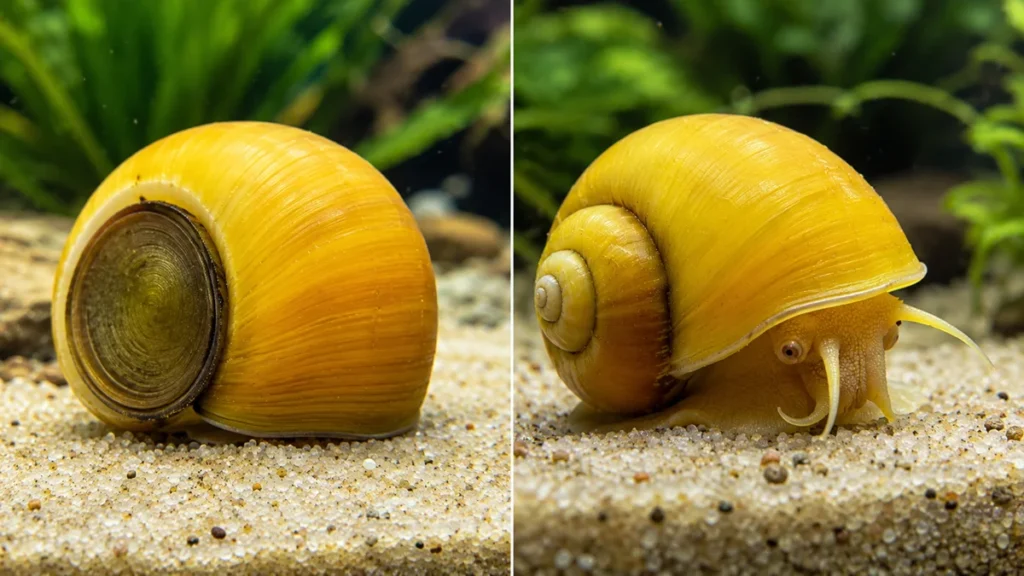
Before you do anything else, run this quick check. It takes less than a minute and tells you which direction to go.
Step 1: The smell test.
Gently lean in near the shell opening. A dead snail smells genuinely rotten — you will know it instantly. No smell means your snail is alive, just stressed or resting.
Step 2: Check the operculum.
This is the hard trapdoor covering the shell opening.
- Tightly closed, no smell → alive, resting or stressed
- Slightly open, reacts when touched → alive, likely just sleeping
- Wide open, body hanging loosely, foul smell → this is a dead snail
Step 3: The touch test.
Gently touch the exposed foot or antennae. A living snail will retract into its shell, even slowly. No reaction after a minute or two means you should move on to checking water conditions immediately.
A mystery snail not moving but alive almost always reactivates once temperature, oxygen, and water quality are corrected. In my experience, most snails “come back” within a day once you fix the actual problem instead of just waiting it out.
This 3-second check is really the fastest way to answer how do I know if my mystery snail is dying without guessing.
Why Is My Mystery Snail Not Moving? The 5 Real Causes
Here’s what’s actually causing it, ranked from most to least common in my own tanks and in the tanks I’ve helped other keepers troubleshoot.
1. Cold Water (The #1 Reason)
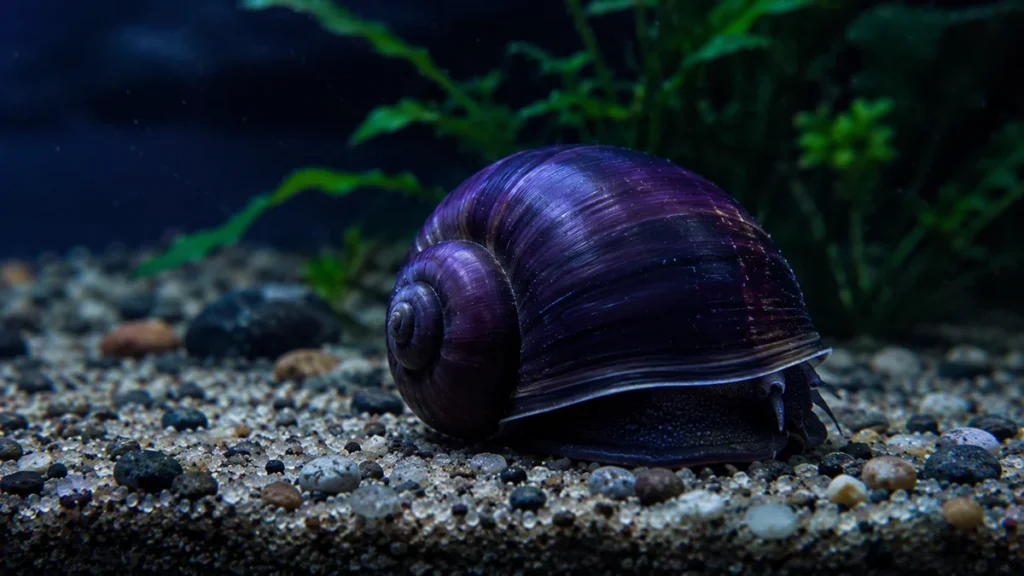
Mystery snails are ectotherms — meaning their body temperature, and therefore their metabolism, is directly controlled by the water around them. Below 68°F (20°C), their internal processes slow down enough that movement, feeding, and even breathing rate visibly drop. It’s not an illness. It’s biology doing exactly what it’s designed to do in cold conditions.
Treatment: Raise the temperature gradually to 72–82°F (22–28°C). Never spike it fast — a sudden jump causes its own kind of stress. A cheap adjustable heater from any US pet store solves this permanently.
2. New Tank or New Environment Stress
If you just brought your snail home, 12–48 hours of complete stillness is normal. The snail is adjusting to new water chemistry, lighting, and surroundings — this is called acclimation shock, and it’s the snail’s built-in survival response to a major environmental change.
Treatment: Use a slow drip acclimation over 30–45 minutes instead of just dumping it in. Then leave it alone. Poking it to “check” only adds more stress.
3. Low Oxygen Levels
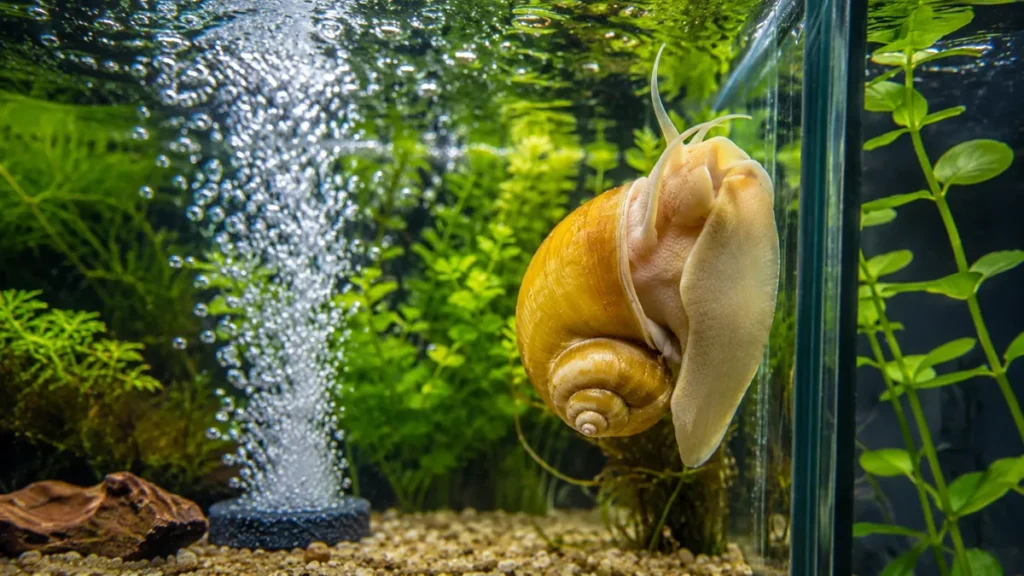
When dissolved oxygen drops, mystery snails often sit motionless at the bottom, or float near the surface trying to reach air. This is common in warmer tanks, since warm water holds less oxygen, or in tanks with weak filtration.
Treatment:
- Add an air stone for extra surface agitation
- Position your filter output to ripple the surface
- Clean a clogged filter sponge — reduced flow means reduced oxygen exchange
4. Poor Water Quality (Ammonia, Nitrite, Nitrate)
This is the one I’d check second, right after temperature. Ammonia becomes more toxic as pH rises — even a reading as low as 0.5 ppm of un-ionized ammonia can stress gill tissue enough to shut a snail down completely. Nitrite should always read zero, and nitrate should stay under 20 ppm.
Treatment:
- Test water immediately with a liquid test kit (the API Freshwater Master Test Kit, around $25 on Amazon, is the one I actually use)
- Perform a 30–40% water change
- Remove leftover food and waste — decaying food is the single biggest hidden ammonia source in beginner tanks
If your mystery snail is not moving for days, poor water quality is the first thing to rule out, right alongside temperature.
If ammonia is the likely culprit here, here’s exactly how to bring ammonia levels down fast without stressing the rest of your tank.
5. Copper Exposure (The Most Dangerous Cause)
Copper is toxic to snails and other invertebrates at concentrations low enough to be completely safe for fish. Even copper-based fish medications or copper leaching from old household plumbing can impair a snail’s nervous and muscular function. The EPA’s residential drinking water action level for copper is 1.3 ppm — a level that’s already risky for a snail’s soft tissue.
Treatment:
- Stop all copper-based medications in the tank immediately
- Switch to a water conditioner rated to neutralize heavy metals (Seachem Prime is the standard choice in the US)
- Add activated carbon to your filter to help absorb residual copper
If you’re also setting up long-term care once your snail recovers, my full mystery snail care guide covers diet, tank size, and lifespan basics in one place.
What to Do in the First 24 Hours
If your snail just went still, here’s the exact order I follow:
Hour 1: Do the smell + operculum check. No smell, sealed shell = don’t panic yet.
Hour 1–2: Test ammonia, nitrite, nitrate, and temperature. Write the numbers down.
Hour 2–3: Fix whatever’s off — raise temperature slowly, add aeration, or do a partial water change if ammonia/nitrite are elevated.
Hour 6: Leave the tank alone. Don’t keep touching or moving the snail — this adds stress on top of whatever’s already wrong.
Hour 24: Recheck. Most snails show at least partial movement — an extended antenna, a slightly open operculum — by this point if the issue was environmental.
Hour 48: If there’s still zero movement, zero reaction, and everything reads correctly, move on to the “Mystery Snail Not Moving for Days” section below.
What I Got Wrong My First Time
I panicked and thought Messy was dying when I found her floating tightly closed at the top of the tank. I made the mistake of scooping her out for a sniff test, completely unaware that mystery snails often float just to take a nap. Suddenly, her shell popped open, and she poked her antenna right against my nose, proving my panic was all for nothing!
Mystery Snail Not Moving for Days — What To Do
If inactivity has lasted longer than 48 hours, work through this list in order:
- Recheck temperature — must be above 72°F consistently
- Retest ammonia, nitrite, nitrate — don’t assume yesterday’s reading still holds
- Increase oxygen supply — add an air stone if you haven’t already
- Stop any copper medication immediately if you’ve used any recently
- Do a partial water change — 25–30%, properly conditioned
- Leave the snail completely undisturbed for several more hours
One thing competitors rarely mention: if your snail is over a year old, natural aging is a real possibility. Mystery snails typically live 1–2 years in home aquariums, and older snails naturally slow down significantly before reaching the end of their lifespan. This isn’t illness — it’s just age, and it’s worth ruling in before you assume something’s broken.
Most snails recover once conditions are corrected. The ones that don’t are almost always dealing with either copper exposure or genuine old age — not something you did wrong.
If you searched why is my mystery snail not moving and how can I treat it because it’s been days rather than hours, this timeline above is exactly the order I’d work through myself.
USA Buyer’s Note: Copper Pipes & Tap Water
If you’re in the US, there’s a specific risk worth knowing about: older homes with copper plumbing can leach trace copper into tap water — safe for humans, but potentially fatal for a snail, even at levels far below EPA drinking water limits for people. If you’re on well water or live in an older building, this is worth testing for specifically, not just assuming your conditioner handles it.
Also worth knowing: snails freshly shipped to PetSmart or Petco locations are often visibly stressed and motionless for the first day or two after purchase, purely from transport and handling. This is completely separate from a tank-condition problem — give a newly purchased snail at least 24 hours before assuming anything’s wrong.
A cloudy tank overnight can sometimes point to the same underlying bacterial or waste buildup causing your snail’s stress — here’s what that usually means and how to fix it.
Expert Tip
Mystery snails are more sensitive than they look. Always acclimate them slowly — sudden changes in temperature, pH, or hardness can cause a snail to stop moving for hours or even days, even when nothing else is technically “wrong” with your water.
Frequently Asked Questions
Why is my mystery snail not moving and how can I treat it?
Most often it’s cold water, new-tank stress, low oxygen, poor water quality, or copper exposure. Check the operculum and smell first, then raise temperature to 72–82°F, improve aeration, and test your water immediately.
How long can a mystery snail go without moving?
Healthy snails often stay still for 12–24 hours during normal rest or sleep cycles. Beyond 48 hours, check water parameters and the operculum closely — that’s when something is more likely actually wrong.
Is it dangerous if my mystery snail hasn’t moved for days?
Not automatically. Mystery snails can stay dormant for several days without harm if water conditions are stable. It becomes dangerous only alongside a foul smell, a hanging body, or confirmed toxic water readings.
What’s a common beginner mistake with an inactive snail?
Poking or flipping the snail repeatedly to “check” on it. This adds stress and can delay recovery. Test the water and wait — don’t handle the snail unless necessary.
Can copper pipes in my house harm my mystery snail?
Yes. US homes with older copper plumbing can leach trace copper into tap water, which is highly toxic to snails even at levels safe for humans. Always use a conditioner rated to neutralize heavy metals.
Is “my snail is probably just sleeping” actually true, or a myth?
It’s true — but only if the operculum is sealed, there’s no smell, and it reacts to touch. That combination is the real definition of a mystery snail not moving but alive. If any of those fail, sleeping is the wrong explanation and water quality should be checked immediately.
How do I know if my mystery snail is dying?
Watch for a loose, hanging body, an open unmoving operculum, no reaction to touch, and a strong foul odor. Any one of these — especially the smell — points to death rather than rest, and answers how do I know if my mystery snail is dying more reliably than guessing based on time alone.
Will my mystery snail move more at night?
Yes, mystery snails are partly nocturnal and often become more active after lights-out. Daytime stillness with overnight movement is completely normal behavior, not a warning sign.
Final Thoughts
A mystery snail not moving is usually resting, adjusting, or reacting to a fixable water condition. Run the smell-and-operculum check first, fix whatever the water is telling you, and give it time. Most snails bounce back within a day or two once the actual problem is corrected — not just waited out.
Next Steps: Resources You Should Read Next
- New to mystery snails? → Mystery Snail Care Guide — full setup, diet, and lifespan basics.
- Snail recovering and thinking ahead? → How to Breed Mystery Snails — what to know before you try.
- Is suspect ammonia the real problem? → How to Remove Ammonia From a Fish Tank Naturally — step-by-step fix.
Was this guide helpful?
First-Hand Experience
Based on animals I've personally kept and bred - not summarized from other articles.
Zoological Foundation
Claims are checked against my M.Sc. Zoology training and published aquatic biology research, not recycled aquarium myths.
No Paid Influence
No sponsorship shaped this guide. Affiliate links, if any, are disclosed separately and never hidden.
Kept Current
Errors are corrected as soon as they're found, with the update noted at the bottom of the article.

Anil Satak M.Sc. Zoology · Founder, FishioHub
Grew up in a fishing family in India and holds a Master's in Zoology. FishioHub is a one-person operation - every guide is personally researched, kept-tested, and written by Anil. No team, no outsourced writers, no AI-generated content. Read his full bio →