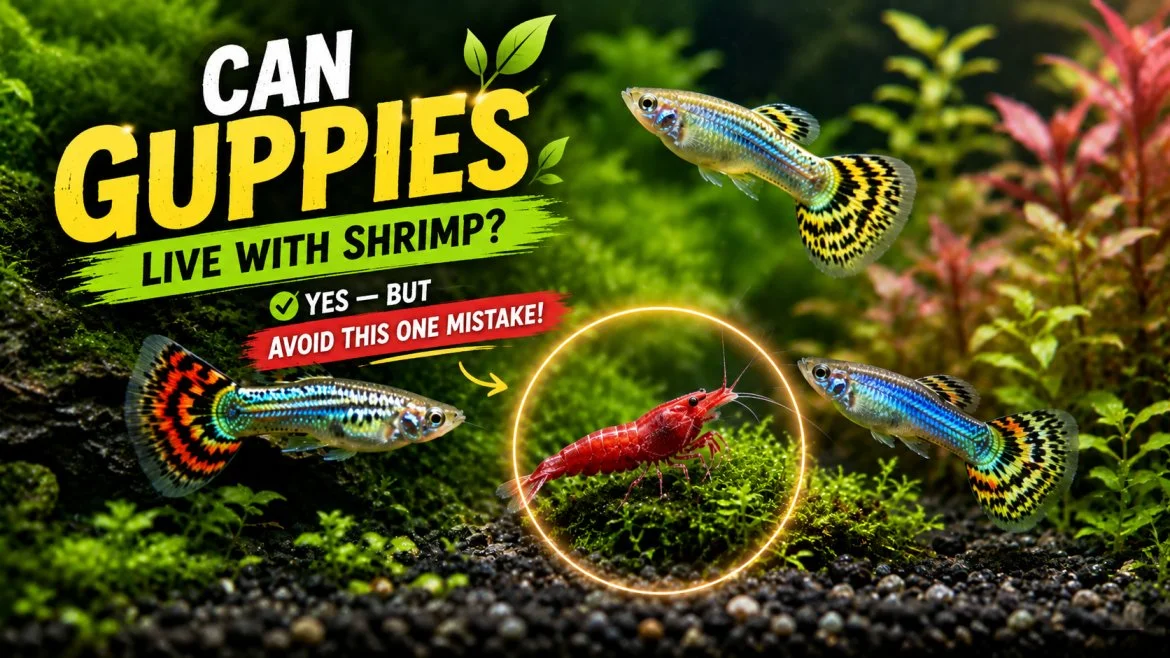
I dropped six vibrant cherry shrimp into my guppy tank on a Friday evening. By Sunday morning, three were gone. No shells. No signs. Just gone. I had no idea guppies could be that efficient.
That moment sent me down a rabbit hole — and honestly, most of what I found online was either too vague or just wrong. So here’s everything I’ve learned about keeping guppies and shrimp together, so that what happened to me doesn’t happen to you. This covers everything from what actually works to what will silently devastate your shrimp colony.
Can Guppies Live with Shrimp? Yes, guppies can live with shrimp in the same tank. With 2 conditions: Right tank Setup, and Right tank mate. Adult shrimp are generally safe, but baby shrimp and freshly molted shrimp are at serious risk of being eaten. Success depends on heavy planting, a well-fed guppy colony, and starting with at least 15–20 shrimp so the colony can sustain itself.
What You’ll Get in This Post
- Can Guppies Live with Shrimp — Yes or No? The direct answer to whether guppies and shrimp can share a tank?
- Will Guppies Eat Shrimp? — what guppy eat shrimp behavior actually looks like, and when they stop
- Can Guppies Live with Shrimp in a Tank — Setup Guide — the exact water parameters, plants, and filtration for a thriving guppy and shrimp tank
- Best Shrimp Species — whether can cherry shrimp live with guppies is a yes, plus ghost shrimp with guppies, Amano, and more
- Will Shrimp Eat Baby Guppies? — the reversed predation question and whether can guppy fry live with shrimp safely
- Can Guppies Live with Shrimp and Snails? — the triple combo answer for community tanks
- Do Guppies Eat Brine Shrimp? — shorter answer than you think
- Guppy and Shrimp Tank Mates — safe choices so shrimp and guppies live together without losses
Jump to: Can Guppies Live with Shrimp? | Will Guppies Eat Shrimp? | Tank Setup | Best Shrimp Species | Molting Window | Tank Mates | FAQ
Can Guppies Live with Shrimp? The Real Answer
Can guppies live with shrimp? Yes — but with a condition.
Guppies (Poecilia reticulata) are opportunistic feeders. They don’t hunt shrimp the way a cichlid does. But if something small fits in their mouth and moves, they’ll eat it. That’s just nature.
Full-grown adult shrimp — especially Amano shrimp (Caridina multidentata), which reach 2 inches — are usually too large to eat. But baby shrimp (shrimplets) and freshly molted shrimp are extremely vulnerable. A freshly molted shrimp is soft-bodied for 24–48 hours. That’s when guppies strike.
In my experience, the guppies don’t go hunting. They just happen to find a soft, slow, tiny creature — and do what fish do. The good news? Lots of people successfully keep guppies and shrimp together long-term. It just requires the right setup.
Where Do Guppies and Shrimp Come From? (Why It Matters)
This part matters more than people realize, because their natural habitats tell you exactly what they both need. This also makes it easier for us to know can guppies live with Shrimp.
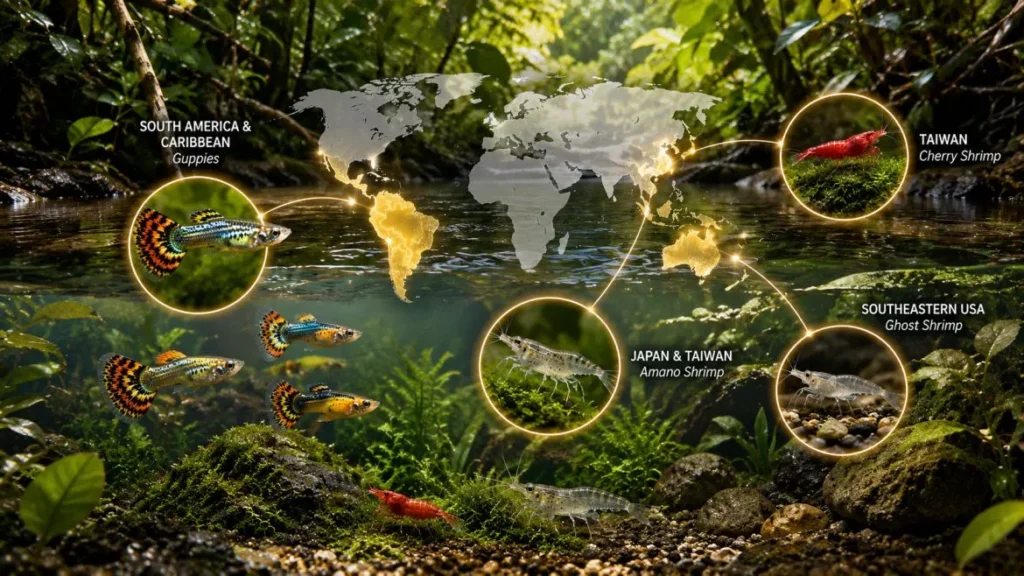
Guppies (Poecilia reticulata) are native to slow-moving freshwater streams and ponds across South America and the Caribbean — places like Trinidad, Venezuela, and Barbados. Their natural environment has dense vegetation, warm water, and plenty of hiding spots.
Cherry shrimp (Neocaridina davidi) originate from streams and rivers in Taiwan. Amano shrimp (Caridina multidentata) come from Japan and Taiwan. Ghost shrimp (Palaemonetes paludosus) are actually native to the southeastern United States — they’re found wild in Florida, Georgia, and the Carolinas.
Here’s the key takeaway: all three shrimp species and guppies evolved in heavily planted, slow-moving freshwater environments. That’s why a densely planted tank isn’t just decoration — it’s survival infrastructure for the shrimp.
Will Guppies Eat Shrimp?
Yes. Guppies will eat shrimp — but they have limits. Here’s exactly what guppies will and won’t eat in your tank:
Guppies WILL eat:
- Shrimplets (baby shrimp under 1 cm)
- Freshly molted shrimp (soft-bodied for 24–48 hours after molting)
- Sick or dying shrimp that aren’t escaping
- Any shrimp small enough to fit in their mouth
Guppies usually WON’T eat:
- Healthy adult cherry shrimp (they’re fast enough to escape)
- Amano shrimp (almost always too large)
- Any shrimp actively foraging in open water
The biggest mistake beginners make is adding 5 cherry shrimp to an established guppy tank and then wondering why they all vanish within a week. The colony was too small to sustain losses. Start with 20+ shrimp if guppies are already in the tank.
The Molting Danger Window (What Most Articles Skip)
This is the part nobody explains well — results: shrimp die in guppy tanks due to this half and insufficient information.
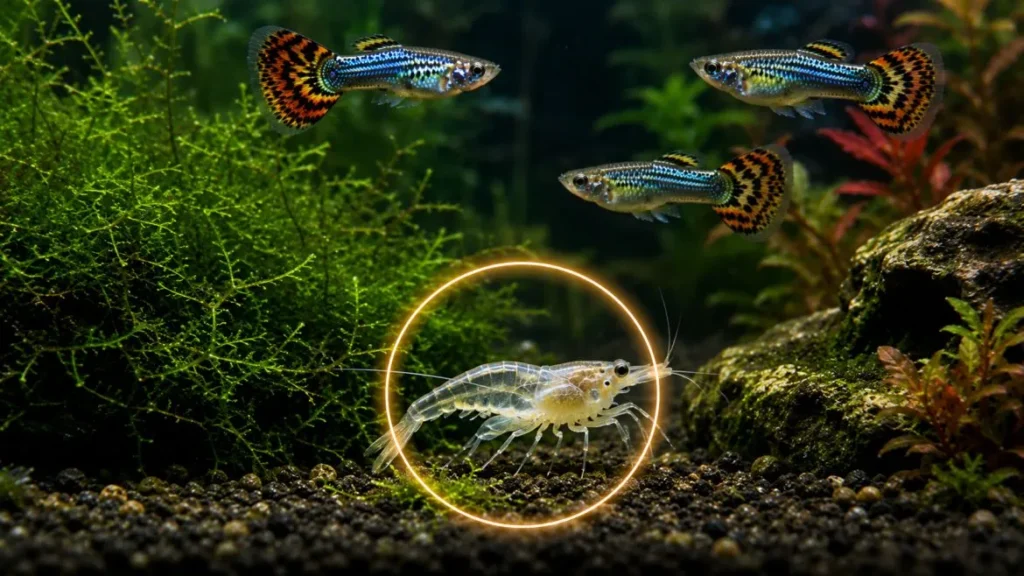
Shrimp grow by molting. They shed their exoskeleton completely, then spend 24 to 48 hours soft-bodied while the new shell hardens. During this window, the shrimp is extremely slow, has almost no defense, and releases chemical signals into the water.
Guppies can sense this. I was surprised to watch my guppies ignore a shrimp for weeks, then suddenly swarm a freshly molted one that was resting behind a rock.
What you can do in such situations: Dense moss like Java moss gives molting shrimp a place to hide deep enough that guppies can’t easily reach them. This alone saves more shrimp than any other single step.
Poor water quality can also trigger mass molting events; if your nitrate levels rise above 20 ppm, shrimp often molt simultaneously to cope with the stress. Consequently, you may suddenly find multiple soft-bodied shrimp appearing in your tank all at once. In this scenario, they become easy prey—and this is precisely when you will notice a significant number of shrimp mysteriously disappearing.
Guppy and Shrimp Tank Setup: The Exact Parameters
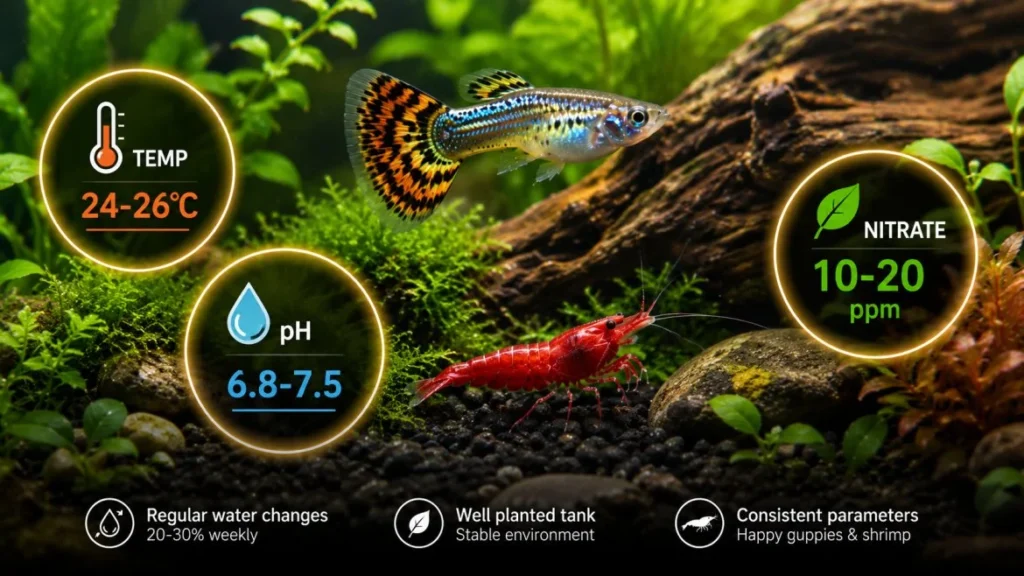
Both species overlap well on water chemistry — which is why they’re such a popular combination. Here are the exact numbers you need:
| Parameter | Guppies | Freshwater Shrimp | Safe Overlap Zone |
|---|---|---|---|
| Temperature | 72–82°F | 68–77°F | 74–77°F |
| pH | 6.8–7.8 | 6.5–7.5 | 7.0–7.5 |
| GH (hardness) | 8–12 dGH | 6–10 dGH | 7–10 dGH |
| KH | 4–8 | 2–5 | 3–5 |
| Ammonia | 0 ppm | 0 ppm | 0 ppm |
| Nitrite | 0 ppm | 0 ppm | 0 ppm |
| Nitrate | Under 40 ppm | Under 20 ppm | Under 20 ppm |
Critical note on nitrate: Guppies tolerate up to 40 ppm nitrate. But shrimp begin showing stress above 20 ppm — they molt more frequently, eat less, and become more vulnerable to guppies. Hence, I strongly recommend keeping nitrates below 20 ppm if you want a thriving shrimp colony.
I use an API Freshwater Master Test Kit (available at PetSmart for around $35) to test weekly. It’s the best investment you can make for any shrimp tank.
Best Tank Size for Guppies and Shrimp Together
Minimum: 10 gallons. But honestly? A 20-gallon long is where this combination really thrives. More water volume means more stable parameters, more plant space, more hiding zones, and more territory, so shrimp aren’t constantly bumping into hungry guppies.
If you’re starting from scratch, a 20-gallon long tank (available at Petco or PetSmart during dollar-per-gallon sales for $20–40) with a sponge filter and heavy planting is the ideal setup for guppies and shrimp living together.
Stocking Rule and Guidelines:
- Adding 1 shrimp per gallon is a reasonable starting ratio
- 6–8 guppies maximum in a 20-gallon tank (with shrimp)
- 20–30 shrimp to start a sustainable colony
Overall, can guppies live with shrimp is achievable in many community tanks when proper planning and habitat design are provided.
Filtration: Use a Sponge Filter
This is non-negotiable for a guppy and shrimp tank. A standard HOB (hang-on-back) filter has an intake that will suck in baby shrimp. I found a dead shrimplet stuck to the intake of my HOB filter three days after adding new baby shrimp. That was the day I switched to a sponge filter and never looked back.
Sponge filters provide gentle water movement that shrimp love, cultivate biofilm on their surface (which shrimp graze on constantly), and don’t suck in shrimplets.
If you want to keep your HOB filter, add a pre-filter sponge attachment to the intake. These cost about $5 on Amazon and are a lifesaver.
What Shrimp Can Live with Guppies? (Species Guide)
- Can cherry shrimp live with guppies? Yes — with the right setup.
- Can ghost shrimp live with guppies? Also, yes — and they’re actually better suited for it than most people think.
Here’s a practical breakdown of the most commonly available shrimp in the USA:
| Shrimp Species | Compatibility | US Price (LFS/Online) | Notes |
|---|---|---|---|
| Amano Shrimp (Caridina multidentata) | ⭐⭐⭐⭐⭐ Best | $4–6 each | Too large to eat; incredible algae eaters |
| Ghost Shrimp (Palaemonetes paludosus) | ⭐⭐⭐⭐ Very Good | $1–2 each (Petco/PetSmart) | Fast swimmers; transparent so guppies don’t notice them as easily |
| Cherry Shrimp (Neocaridina davidi) | ⭐⭐⭐ Good | $3–5 each | Adults are mostly safe; babies are at risk |
| Blue Dream / Yellow / Fire Red | ⭐⭐⭐ Good | $4–8 each | Same as cherry shrimp — Neocaridina varieties |
| Caridina Shrimp (Crystal Red, Bee) | ⭐⭐ Caution | $8–15 each | Expensive; prefer softer, cooler water than guppies |
| Whisker Shrimp | ⭐ Avoid | $2–4 | Semi-aggressive; can actually attack small guppies |
Can Cherry Shrimp Live with Guppies?
Yes — can cherry shrimp live with guppies in the same tank, and many hobbyists do it successfully. Adult Neocaridina shrimp are quick enough to dodge guppies in a planted tank. The real risk is always the shrimplets.
If you want a breeding cherry shrimp colony and guppies in the same tank, you’ll need Java moss coverage of at least 30% of the tank floor. That density gives shrimplets enough cover to survive and grow.
Ghost Shrimp with Guppies
Ghost shrimp with guppies is actually one of the most forgiving combinations for beginners. Ghost shrimp are fast, semi-transparent (guppies can’t see them as easily), cheap to replace, and native to freshwater environments very similar to where guppies live.
At PetSmart and Petco, ghost shrimp cost $1–2 each — meaning you can start with 20–30 shrimp for $20-30, which gives your colony the numbers it needs to sustain losses. This is the combination I’d recommend to any beginner.
In summary, “Can Guppies Live with Shrimp?” The best results typically come from pairing guppies with Amano or Ghost Shrimp in a densely planted tank.
Can Guppies Live with Shrimp and Snails Too?
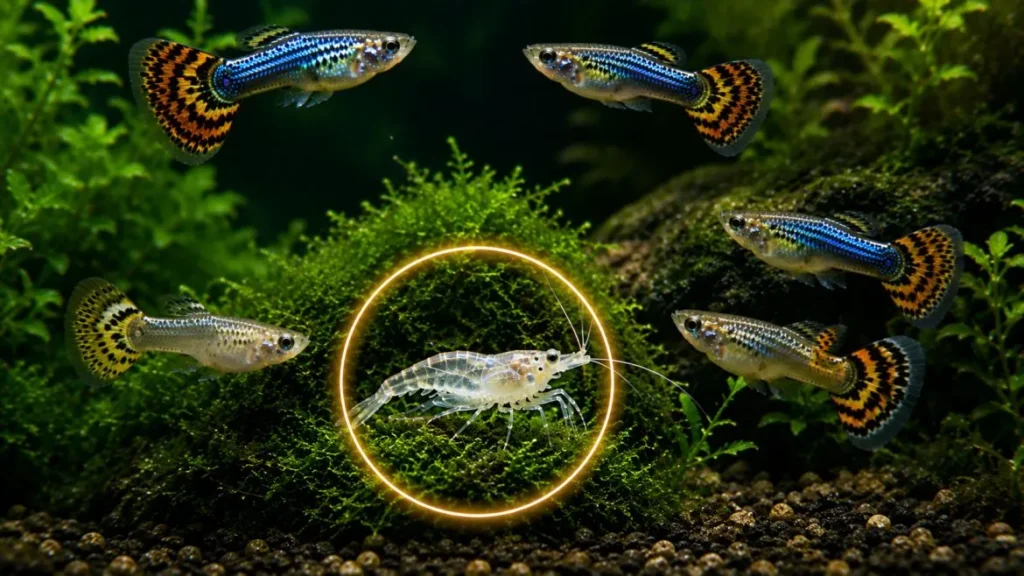
Good news: yes, guppies can live with shrimp and snails in the same tank — and the three-way combination is actually one of the most popular peaceful community setups in the hobby.
Nerite snails and mystery snails are completely ignored by guppies. They’re too large and too armored to be threatened. In fact, snails add value to a shrimp tank:
- Nerite snails eat algae off the glass and decor, competing with biofilm buildup that could cloud your water
- Mystery snails clean up leftover food before it decays and spikes your ammonia
- Both produce waste that adds to the nitrogen cycle gradually — which helps maintain a stable tank
The triple combo of guppies + shrimp + snails in a 20-gallon planted tank is genuinely one of the easiest, lowest-maintenance community setups you can build. I’ve had this running for over a year, and it’s mostly self-sustaining.
Can Guppy Fry Live with Shrimp? (The Reversed Question)
Here’s the question nobody asks but should: Can guppy fry live with shrimp?
The short answer is: shrimp won’t hurt guppy fry. Freshwater shrimp are detritivores and algae grazers — they’re not predators. Even larger Amano shrimp won’t attack guppy fry.
But there’s a twist: guppy fry are extremely vulnerable to adult guppies — the same shrimp hiding strategy works in reverse. Java moss provides shelter for guppy fry just as it does for shrimplets.
So can guppy fry live with shrimp? Yes — shrimp are harmless to guppy fry. The threat comes from adult guppies, not from the shrimp.
Do Guppies Eat Brine Shrimp?
Yes. Guppies eat brine shrimp (Artemia salina) readily, and it’s actually one of their best foods.
But here’s the important distinction: brine shrimp are a food item, not a tank mate. Live or frozen brine shrimp are protein-rich treats you feed guppies, not creatures that share their tank. You’d never keep live brine shrimp in a guppy tank as tank mates — they’d be eaten within minutes.
If you’re asking whether guppies eat brine shrimp as part of their diet: yes, absolutely. Frozen brine shrimp (Hikari brand, available at Petco for ~$7) is one of the best conditioning foods you can give breeding guppies.
Feeding Guide: What to Feed in a Guppy and Shrimp Tank
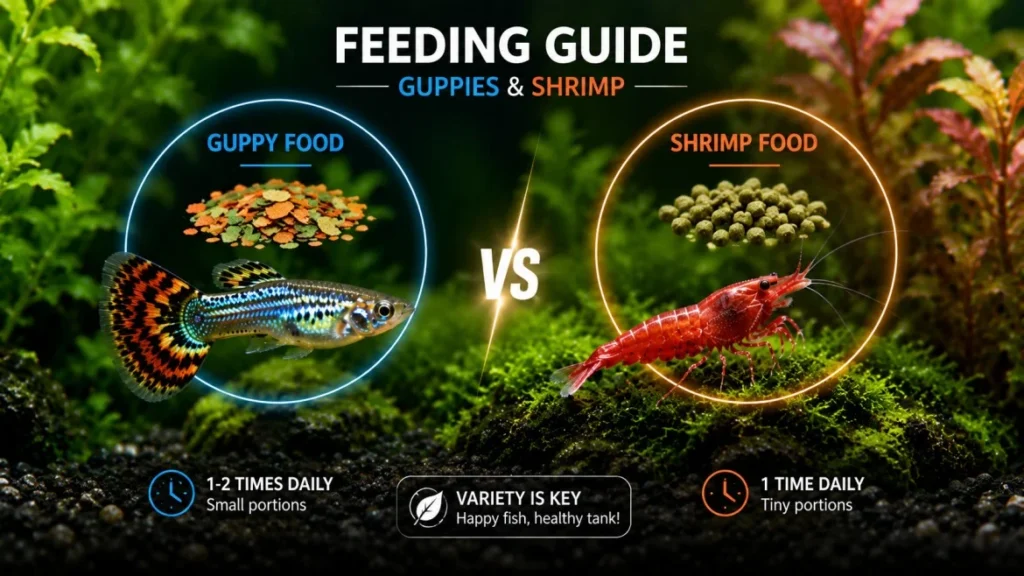
Feeding is where most people accidentally doom their shrimp. Here’s the honest breakdown:
Feeding Schedule for Guppies
- Frequency: 2x daily, small amounts (what they eat in 2 minutes)
- Staple: High-quality flake food (TetraMin, Omega One Freshwater Flakes)
- Protein boost: Frozen brine shrimp or daphnia 3x per week
- Vegetables: Blanched spinach or cucumber once a week
Feeding Schedule for Shrimp
- Frequency: 2–3x per week (they graze on biofilm the rest of the time)
- Staple: Shrimp-specific wafers (Hikari Shrimp Cuisine, ~$6 at PetSmart)
- Supplements: Blanched zucchini, spinach, or kale
- Mineral/calcium source: Cuttlebone or Seachem Equilibrium for strong shell development
The Critical Feeding Trick
When you drop shrimp food in the tank, your guppies will race for it before it reaches the bottom. Use a feeding tube (a simple turkey baster or dedicated shrimp feeding tube from Amazon for $4–8) to direct shrimp wafers directly to the substrate. This lets your shrimp actually get their food.
Alternatively, drop guppy flakes on one side of the tank to distract them, then drop the shrimp wafer on the other side.
The Tank Setup: What It Actually Looks Like
A successful guppy and shrimp tank isn’t just about parameters on paper. Here’s what the physical tank should look like:
Plants to add (in order of importance):
- Java moss — tied to rocks or driftwood- provides the #1 shelter for shrimplets and molting shrimp
- Guppy grass (Najas guadalupensis) — dense, floating, creates mid-water cover; guppies love it
- Hornwort — a fast-growing background plant that absorbs nitrates
- Anubias — low-light, attaches to driftwood; gives shrimp rough surfaces to graze on
- Java fern — another easy attacher; shrimp love grazing the textured leaves
Hardscape:
- Driftwood provides a biofilm growth surface + tannins that benefit both species
- Indian almond leaves: release antibacterial tannins, provide biofilm, and give shrimp tiny caves to shelter under
- River rocks or ceramic caves: guaranteed shrimp-only zones that guppies can’t access
Substrate: Fine sand or small-grain gravel. Shrimp love sifting through it for food particles. Avoid large gravel that traps debris and spikes ammonia.
What I Got Wrong My First Time (Anil’s Story)
I’ll be honest. The first time I tried keeping guppies and shrimp together, I failed completely.
I bought six Red Cherry Shrimp from a local fish store in my area — paid about $4 each, so a $24 investment. I had a 10-gallon guppy tank with six guppies that had been running for about three months. Some Java moss, a HOB filter. I thought it was a “mature tank,” so the shrimp would be fine.
By day three, I noticed two shrimp were missing. By day seven, I could only find two of the original six. I figured the others were hiding.
They weren’t hiding. They were gone. Here’s what I did wrong:
- I started with too few shrimp. Six shrimp can’t sustain losses. Even one or two disappearances reduce the colony below the recovery threshold.
- My HOB filter had no pre-filter sponge. I found a shrimplet stuck to the intake.
- My Java moss wasn’t dense enough. It was sparse — decorative, not functional.
- My guppies were slightly underfed. I was doing once-a-day small feedings. Hungry guppies are predatory guppies.
Second attempt: I set up a 20-gallon long. Added 20 cherry shrimp. Dense Java moss carpet on one side. Switched to a sponge filter. Fed guppies 2x daily. Result: thriving colony six months later, regularly seeing shrimplets and juveniles foraging in the open.
The difference was the setup — not the species.
Tank Mate Safety Check: What Else Can Go in This Tank?
If you’re building a community guppy and shrimp tank, here’s who you can and cannot add:
✅ Safe with guppies AND shrimp:
- Nerite snails
- Mystery snails
- Ramshorn snails
- Corydoras catfish (bottom dwellers; ignore shrimp)
- Otocinclus catfish (algae eaters; completely peaceful)
- Endlers livebearers (smaller than guppies; similar behavior)
⚠️ Use with caution:
- Kuhli loaches (usually fine, but some individuals get curious about shrimp)
- Dwarf gouramis (peaceful, but larger specimens may snack on shrimplets)
❌ Never mix with guppies + shrimp:
- Whisker shrimp (can attack small guppies)
- Betta fish (will kill both shrimp and guppies)
- Tiger barbs (nip fins and stress the entire tank)
- Cichlids of any kind
- Larger tetras (Buenos Aires tetras, etc.)
Science Corner: What Research Tells Us
Neocaridina Shrimp Research: Elevated nitrate levels (above 20 ppm) increase molting stress in shrimp, making them more vulnerable. Maintaining nitrates below 10–20 ppm helps support healthier shrimp colonies.
Aquaculture Research (2018): Studies found that guppies are more likely to prey on shrimp when their diet lacks sufficient protein. Well-fed guppies showed significantly lower levels of invertebrate predation.
USA Buyer’s Note: Where to Get Guppies and Shrimp
Ghost shrimp: Petco and PetSmart carry ghost shrimp nationwide, usually for $1.49–$1.99 each. They’re labeled “feeder shrimp” but work great as tank mates when you start with 20+.
Cherry shrimp: PetSmart carries Neocaridina varieties in some locations, but availability varies. Your best bet is a local fish store (LFS) or online from vendors like Aquatic Arts, Flip Aquatics, or Shrimpfever — usually $3–5 each with live arrival guarantees.
Amano shrimp: More widely available. PetSmart typically carries them for $4–6 each. Highly recommended as the safest option.
Guppies: Wildly available everywhere. Big box stores sell them for $2–4. Fancier strains from breeders run $8–20+.
Pro tip for USA hobbyists: If your tap water is hard (common in the Midwest and Southwest), you’re actually in luck — both guppies and Neocaridina shrimp prefer harder water. Check your local water report online at the EPA’s Safe Drinking Water database.
Step-by-Step: How to Set Up a Guppy and Shrimp Tank
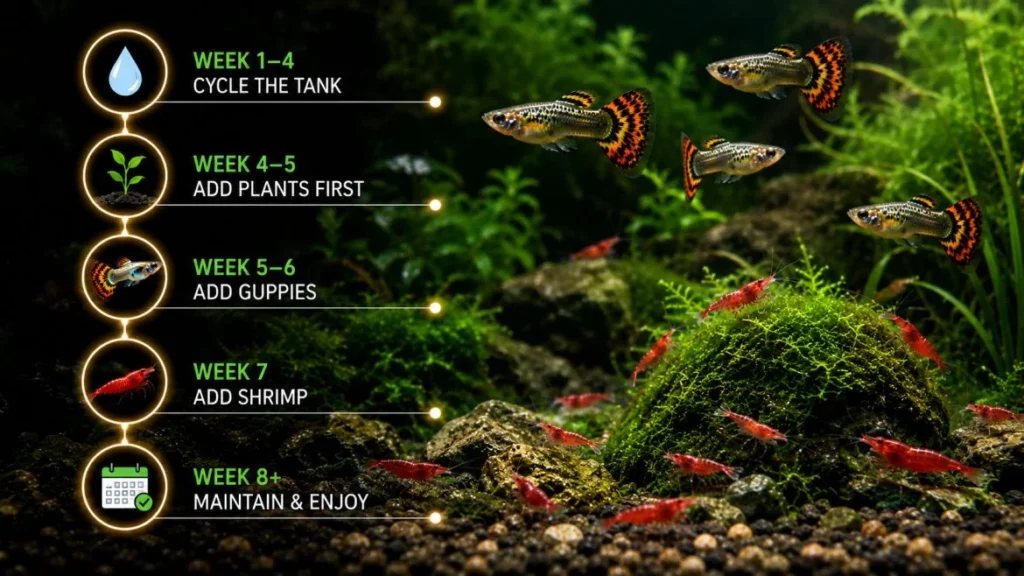
By following this setup guide, you’ll create the exact conditions that make Can Guppies Live with Shrimp? far more likely to work in a home aquarium.
Week 1–4: Cycle the tank first. Set up your tank, add substrate and plants, run the filter, and cycle it without any livestock. Use Dr. Tim’s Aquatics One & Only Nitrifying Bacteria (available at Petco) to speed up the cycle. Test daily with an API test kit. Wait until ammonia and nitrite both read 0 ppm.
Week 4–5: Add plants first. Plant Java moss, guppy grass, and any other plants. Let them establish for 1–2 weeks before adding fish. This builds biofilm for shrimp to graze on.
Week 5–6: Add guppies. Start with 4–6 guppies. Let the tank adjust for 2 weeks. Test water parameters.
Week 7: Add shrimp. Add 20+ shrimp (more is better). Drip-acclimate them over 30–45 minutes to prevent osmotic shock. Drop them in near the Java moss so they immediately find shelter.
Week 8+: Maintain 10–15% water change weekly. Test nitrates. Feed guppies 2x daily. Feed shrimp wafers 3x per week.
FAQ: Can Guppies Live with Shrimp?
Q: Can guppies eat full-grown adult shrimp?
Adult shrimp over 1 inch are generally too large and fast for guppies to eat. Amano shrimp, which reach 2 inches, are almost completely safe. Cherry shrimp adults are usually fine in a well-planted tank, though the occasional adult may be eaten if caught during molting.
Q: Why are my shrimp disappearing overnight? Is it the guppies?
Possibly — but your shrimp might also be hiding after molting. Shrimp often burrow deep into plants or under decor for 24–48 hours after a molt. Wait a full 48 hours before panicking. If they’re still gone after 48 hours, guppies ate them or water quality triggered a crash. Test your nitrates immediately.
Q: Can I keep cherry shrimp with guppies and actually breed them? Yes, but you need dense Java moss coverage and a colony of at least 20+ shrimp to start. Some shrimplets will be eaten — that’s unavoidable. But a large enough colony with enough cover will maintain and grow itself even with guppy predation.
Q: Will shrimp eat baby guppies (guppy fry)?
No. Freshwater shrimp do not eat live fish fry. They’re detritivores and algae grazers, not predators. Guppy fry are threatened by adult guppies — not shrimp.
Q: Is a ghost shrimp a better choice than cherry shrimp with guppies?
For beginners, yes. Ghost shrimp are faster, more transparent, hardier, cheaper (so starting with 25+ shrimp is affordable), and native to similar water conditions. They’re an excellent first choice.
Q: What’s the #1 mistake people make with guppies and shrimp?
Starting with too few shrimp. Every guide says “add some shrimp” but doesn’t say “add 20+.” Six shrimp can’t sustain even minor losses. A colony of 20+ creates enough numbers that the colony grows faster than guppies can eat them — especially with plants for cover.
Q: Can guppies live with shrimp and snails in the same tank?
Absolutely. Nerite snails and mystery snails are completely ignored by guppies. The three-way combination is one of the most beginner-friendly community setups available — peaceful, colorful, and largely self-sustaining.
Q: I just added guppies to my shrimp tank. What do I do right now?
First: add more shrimp if you have fewer than 15–20. Second: feed your guppies immediately and generously (twice a day). Third: add Java moss or any dense plant if you don’t have it. Fourth: check nitrates — if they’re above 20 ppm, do a 20% water change. Don’t wait on any of these steps.
Q: Do guppies eat brine shrimp?
Yes — but brine shrimp (Artemia salina) are a food item, not a tank mate. Guppies readily eat live, frozen, or freeze-dried brine shrimp as a protein supplement. You’d never keep live brine shrimp in a guppy community tank — they’d be eaten within minutes.
Q: At what size can ghost shrimp live safely with guppies?
Ghost shrimp reach about 1.5 inches when fully grown and are fast swimmers — making them reasonably safe with guppies. Their transparency helps too, since guppies are visually oriented predators. Start with 20+ ghost shrimp so even if a few are eaten initially, the colony sustains.
Next Steps: Resources You Must Read
Want to go deeper on your freshwater shrimp and fish setup? These posts will answer your next questions before you even think to ask them:
- Do Amano Shrimp Eat Algae? Complete Expert Guide — Learn exactly what Amano shrimp eat, how much algae they clear, and whether they’re worth it for your tank.
- Why Do My Fish Die After a Water Change? 6 Reasons — If you’re doing water changes and losing fish or shrimp afterward, this explains the #1 overlooked cause.
- Can Neon Tetras Live with Shrimp? — Building a community tank? Here’s how tetras stack up compared to guppies as shrimp tank mates.
Final Verdict: Can Guppies Live with Shrimp?
Yes. Guppies and shrimp can live together — and when done right, it’s one of the most rewarding combinations in the freshwater hobby.
Here’s the honest summary:
Adult shrimp (especially Amano and ghost shrimp) are almost always fine. Cherry shrimp work with heavy planting and a 20+ colony size. The triple combo of guppies + shrimp + snails is beginner-friendly and beautiful. Baby shrimp and freshly molted shrimp are always at risk — plan for it. Don’t attempt this with fewer than 15 shrimp, a bare tank, or an underfed guppy colony
The setup does 90% of the work. Get the plants, get the numbers, keep the guppies fed — and you’ll have a thriving, colorful, self-sustaining tank that people will stop and stare at.
Was this guide helpful?
First-Hand Experience
Based on animals I've personally kept and bred - not summarized from other articles.
Zoological Foundation
Claims are checked against my M.Sc. Zoology training and published aquatic biology research, not recycled aquarium myths.
No Paid Influence
No sponsorship shaped this guide. Affiliate links, if any, are disclosed separately and never hidden.
Kept Current
Errors are corrected as soon as they're found, with the update noted at the bottom of the article.
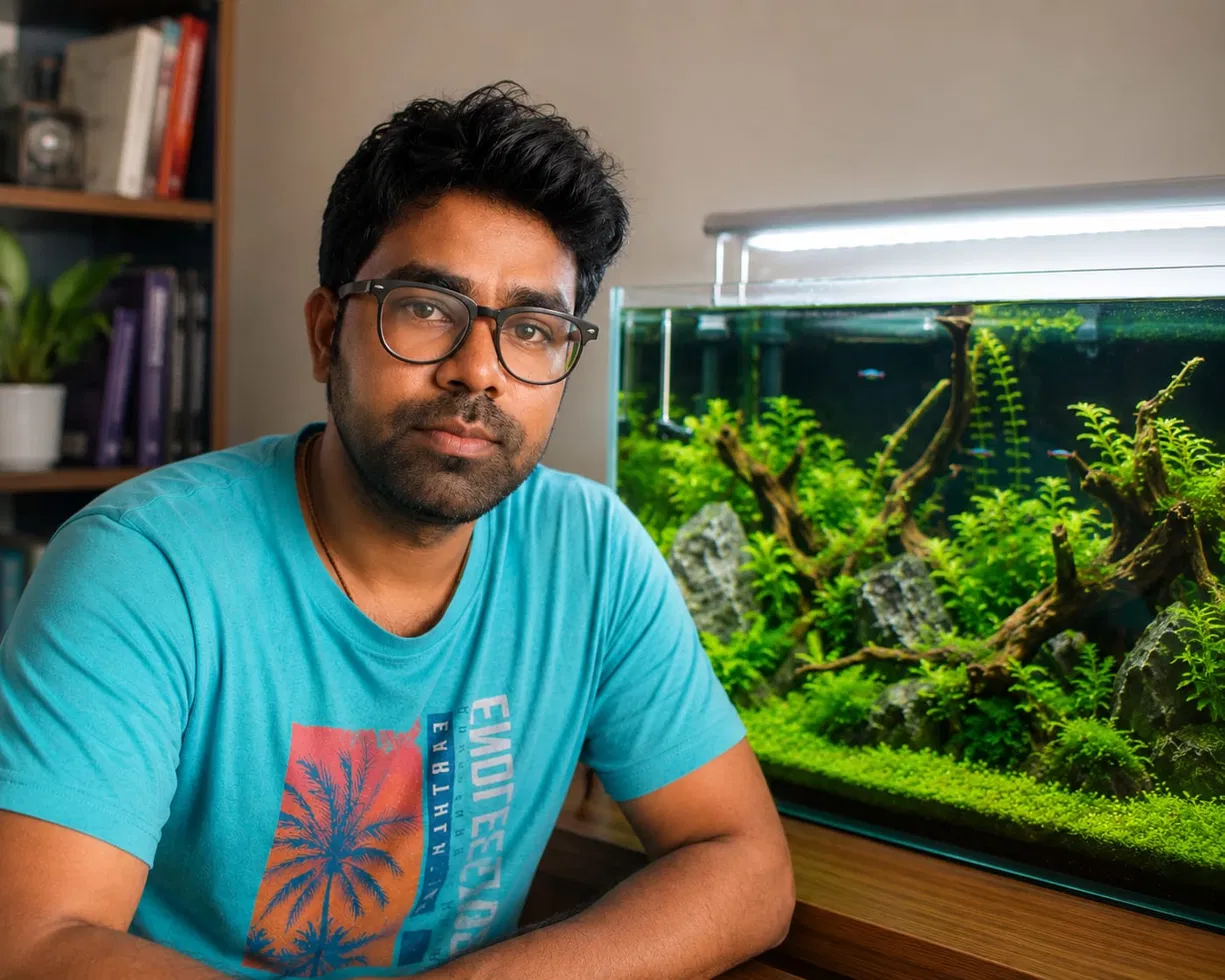
Anil Satak M.Sc. Zoology · Founder, FishioHub
Grew up in a fishing family in India and holds a Master's in Zoology. FishioHub is a one-person operation - every guide is personally researched, kept-tested, and written by Anil. No team, no outsourced writers, no AI-generated content. Read his full bio →