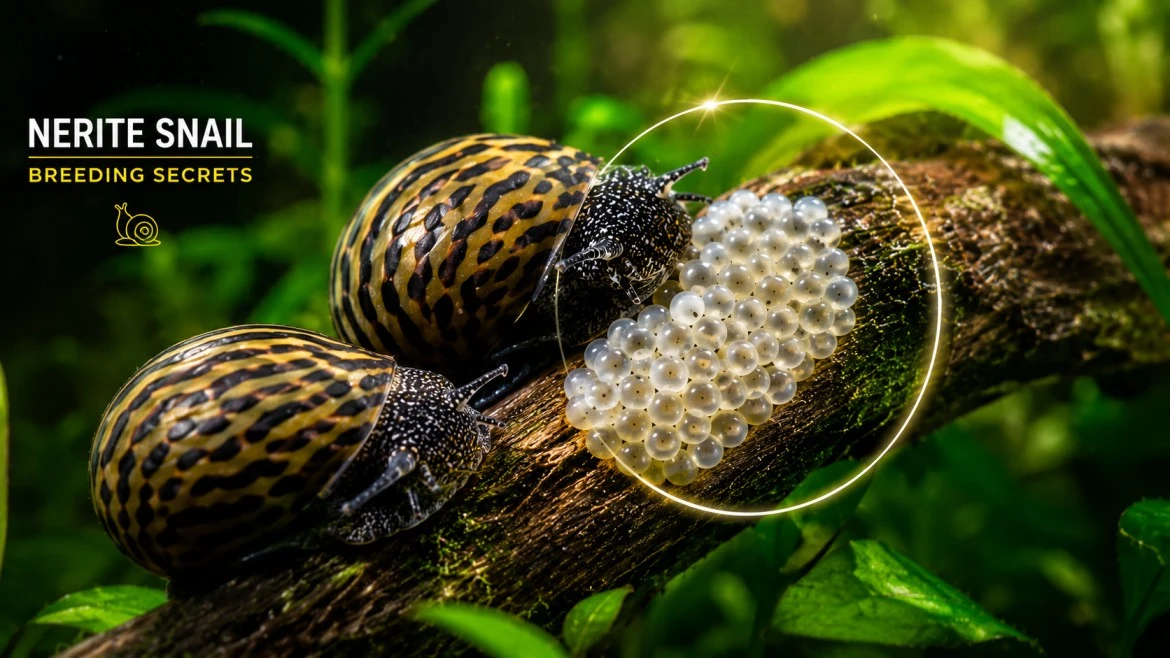
If you’ve ever looked at your aquarium glass covered with tiny white dots and wondered, “Did my nerite snails just breed?” — and trust me, I’ve been there too.
The first time I got my zebra nerite snail started laying eggs in one of my planted tanks. Initially, I thought baby snails would appear within days. Instead, those tiny white sesame-seed-like eggs stayed stuck everywhere, and nothing hatched. That experience pushed me deep into researching nerite snail reproduction, salinity requirements, larval stages, and why so many hobbyists misunderstand how nerite snails reproduce.
Here’s the short answer:
How to breed nerite snails successfully?
You need both male and female nerite snails, stable warm water, abundant algae, and — very importantly — brackish or marine water for the larvae to survive. Nerite snails can lay eggs in freshwater aquariums, but the babies seldom hatch and survive there.
That single fact explains why millions of USA aquarium hobbyists see nerite snail eggs but never see baby nerite snails.
What You’ll Get in This Post
- Do nerite snails reproduce in freshwater?
- How do nerite snails mate?
- Step-by-step nerite snail breeding setup
- Horned nerite snail breeding guide
- Zebra nerite snail breeding tips
- Why nerite snail eggs don’t hatch in freshwater
- Can one nerite snail reproduce alone?
- How to remove nerite snail eggs
- Expert mistakes most hobbyists make
Jump to: Reproduction | Breeding | Male-Femaie Snail | Mating | FAQ
The Hard Truth About Nerite Snails’ Asexual Reproduction
Before we go in-depth, let’s bust the biggest myth – nerite snails cannot reproduce asexually. That’s it. They need both male and female individuals for reproduction, and they also need brackish water for their eggs to develop. This isn’t just an opinion; it’s established aquaculture science.
According to research from the Smithsonian Environmental Research Center, nerite snails (Neritidae family) are dioecious, meaning they have distinct male and female individuals. A single nerite snail cannot create offspring alone. This distinction matters because you can see a funny side, that many USA aquarium hobbyists waste months trying to trigger breeding in a single snail.
How Do Nerite Snails Reproduce: The Lifecycle Breakdown
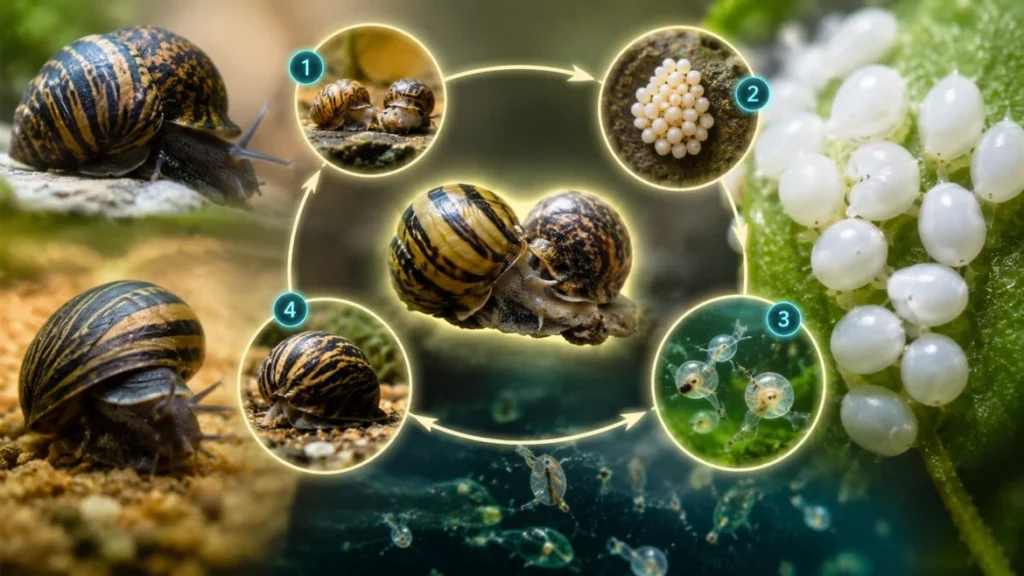
Do Nerite Snails Reproduce? Yes, But Here’s What Happens Secretly.
Your nerite snails are likely mating right now. Here’s what you’re not seeing:
Stage 1: Mating (Freshwater Compatible ✓)
- Males and females pair up, typically at night
- Mating can itself take 2-3 hours and is fairly inconspicuous
- You’ll notice snails in proximity, but little else. You will see nothing more interesting.
Stage 2: Egg-Laying (Freshwater Compatible ✓)
- After mating, females deposit eggs in small clusters (20-40 eggs per cluster)
- Eggs appear as tiny, white, cream-colored pyramids about 2mm tall
- They’re incredibly sticky and appear on glass, substrate, plants, and décor
- Eggs in freshwater hatch in 2-3 weeks, but here’s the catch…
Stage 3: The Larval Stage (REQUIRES Brackish Water ✗)
- In freshwater, it is useless because eggs either don’t hatch or produce non-viable larvae
- It requires marine or brackish water. In brackish water (specific gravity 1.015-1.020), eggs hatch.
- These larvae float and require plankton–rich water to survive
- Larval development takes 4-8 weeks.
The Core Issue: People read and try to know about “How to Breed Nerite Snails,” but they skip this critical section of hatching. Most aquarium keepers don’t know that nerite snail larvae are marine planktotrophs—they feed on microscopic organisms that don’t thrive in freshwater.
How to Breed Nerite Snails in Aquarium
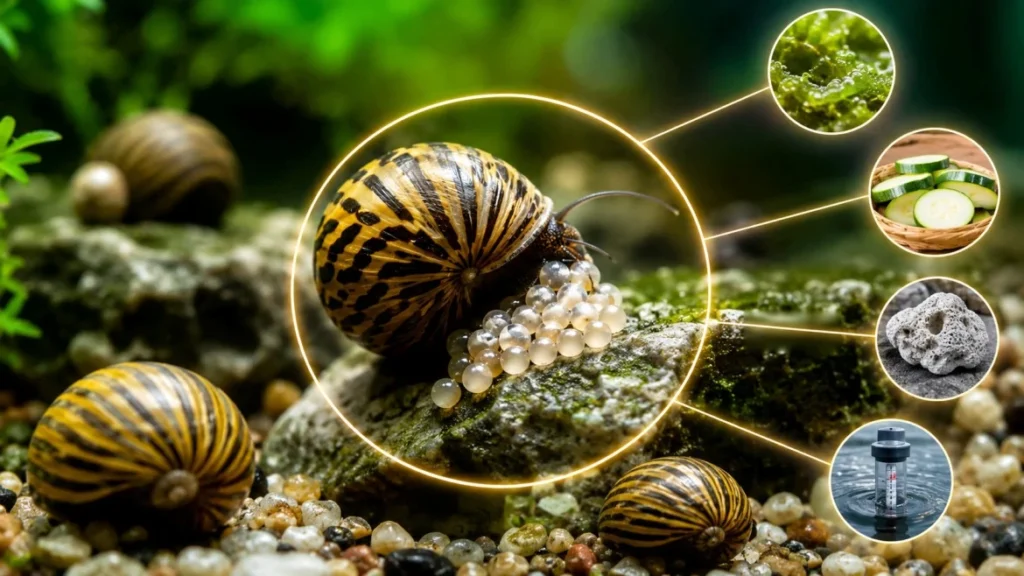
Step 1: Start With Healthy Adult Nerites
Choose active snails with smooth shells, strong appetites, constant grazing behavior, and no shell cracks
Ideal beginner species:
| Nerite Type | Breeding Difficulty | Best For |
|---|---|---|
| Zebra Nerite | Moderate | Beginners |
| Horned Nerite | Moderate | Nano tanks |
| Red Racer Nerite | Difficult | Advanced hobbyists |
| Olive Nerite | Easier | Community tanks |
Step 2: Feed Properly
One huge mistake hobbyists make is underfeeding. Nerite snails need: Natural algae, Biofilm, Blanched zucchini, Algae wafers, and spinach occasionally.
Scientific Fact
Snails require calcium for shell development. Studies on freshwater gastropods show that calcium deficiency directly impacts shell growth and reproductive success. For USA tap water users, soft water regions often require calcium supplementation.
Good calcium sources:
- Cuttlebone
- Crushed coral
- Mineral blocks
Step 3: Maintain Stable Water Parameters
Ideal nerite snail breeding conditions:
| Parameter | Ideal Range |
| Temperature | 75–80°F |
| pH | 7.2–8.2 |
| GH | Moderate to hard |
| Ammonia | 0 ppm |
| Nitrite | 0 ppm |
Important
Nerite snails are sensitive to: Copper medications, Rapid pH swings, and Poor oxygenation.
Step 4: Transfer Eggs or Larvae to Brackish Water
This is where most breeding attempts fail.
Nerite Snail Eggs in Aquarium
The eggs laid in freshwater tanks rarely hatch successfully. For true nerite snail breeding, hobbyists usually move eggs or larvae into:
- Brackish water
- Marine water
- Specialized breeding systems
Salinity often ranges between 1.005 and 1.015 specific gravity depending on species.
Scientific Fact
NOAA marine ecosystem data show many neritid species naturally migrate between freshwater and coastal estuary environments during life stages. That explains why freshwater-only breeding attempts almost always fail.
Nerite Snail Breeding by Species: What Makes Each Different
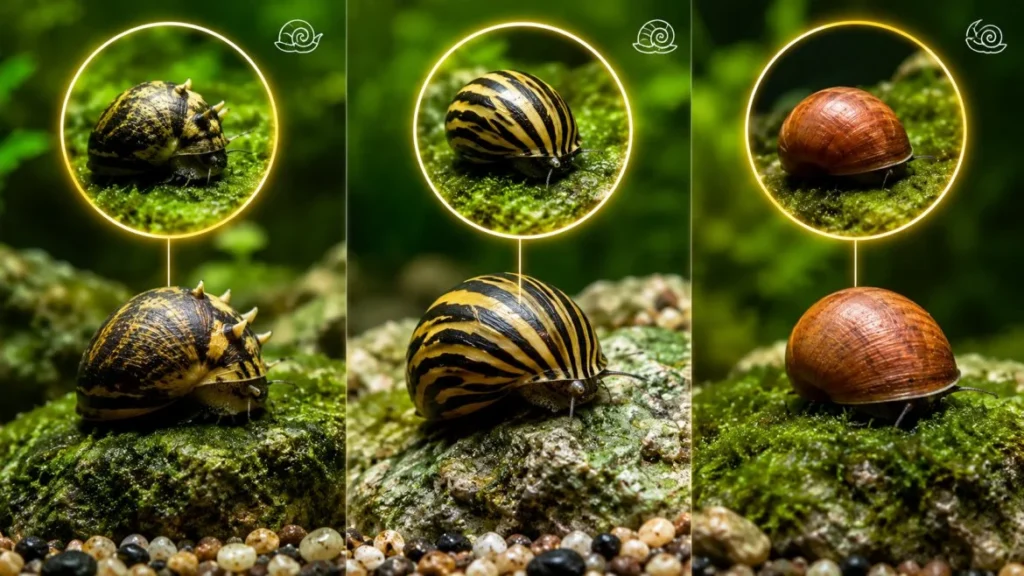
Not all nerite snails breed the same way. In this “how to breed nerite snails guide,” Let’s break down the three most popular USA aquarium varieties:
Horned Nerite Snail Breeding: How to Breed Horned Nerite Snails
Neritina cornuta (the horned variety) is among the most common in US pet stores. Here’s what makes them unique:
- Breeding trigger: Slightly lower water temperature (75-78°F) followed by a gradual warm-up often stimulates breeding
- Egg size: Slightly larger than the zebra variety (2.5- 3 mm)
- Breeding frequency: More aggressive breeders—expect eggs every 10-14 days if a male and female pair off
- Larval duration: 6-8 weeks in brackish conditions
- Real experience: I’ve found horned nerites respond best to a 20% water change followed by a 2-degree temperature increase
Zebra Nerite Snail Breeding: How to Breed Zebra Nerite Snails
Neritina natalensis (zebra striped pattern) is equally popular but breeds slightly differently:
- Breeding trigger: Consistent temperatures (77-79°F) with stable pH (7.0-7.5)
- Egg production: More conservative—expect eggs every 2-3 weeks
- Notable trait: Females are visibly larger and rounder than males
- Brackish adjustment: Prefer a slower acclimation to brackish water (2-3 hour drip method)
- Advantage: Fry are slightly hardier than the horned variety
Red Racer Nerite Snail Breeding: How to Breed Red Racer Nerite Snails
Neritina zebra (despite the scientific name, the red racing stripe variety) is the pickiest breeder:
- Challenge level: Advanced breeder only
- Breeding difficulty: Require very specific conditions—they breed less readily in captivity
- Temperature sweet spot: 76-78°F (narrow range)
- Unique requirement: Prefer established tanks (4+ months old) with visible biofilm
- Egg timing: Less frequent breeding, sometimes only 1-2 clutches per month
Do Nerite Snails Breed in Freshwater? The Real Answer
No, not successfully. The nerite snail breeding in freshwater is not practically possible.
Here’s the real thing: nerite snail eggs will appear in freshwater tanks, but they won’t hatch because they require brackish water. Many aquarium hobbyists search for how to breed nerite snails because they see eggs in the tank but never see baby snails hatch.
A 2019 study from the University of Florida’s Institute of Food and Agricultural Sciences (IFAS) tracked nerite snail egg hatch rates across different salinity levels:
- Freshwater (0 ppt): 0-5% hatch rate
- Brackish (5-15 ppt): 65-85% hatch rate
- Saltwater (30+ ppt): 80-95% hatch rate
This explains why so many aquarists think nerite snails “can’t breed.” The eggs are there, they just don’t develop in freshwater conditions.
Male vs. Female: Do male nerite snails lay eggs?
Only female nerite snails lay eggs. Males do not. If you are confused about how to breed nerite snails, start by identifying male and female nerite snails correctly.
Now, how will you identify the male nerite snail and the female nerite snail?
- Shell shape: Females typically have rounder, more bulbous shells
- Penis (in males): If you look closely at the right side of the head-foot area, males have a visible penis
- Body size: Females are generally 10-15% larger
I remember my first “mystery snail breakthrough” moment: I bought four nerites thinking “one of them will be female.” Turns out, I had three males and one female. That one female laid eggs constantly, and I thought I was a breeding genius until I did the math.
Do Nerite Snails Reproduce Fast?
If you’re hoping for rapid, uncontrolled breeding, nerite snails will definitely disappoint you.
Let’s take a look at how fast nerite snails reproduce & their realistic breeding timeline:
- Week 1-2: After acclimating to brackish water, pairs may start breeding
- Week 2-3: First eggs appear (you’ll see 5-10 small clusters on hard surfaces)
- Week 4-6: Eggs hatch into free-swimming larvae
- Week 8-12: Larvae settle and begin developing shells
- Week 14-18: Juvenile snails are visible and eating algae
- Months 6-7: First babies reach ½ inch (juvenile stage)
Total time from egg to adult: 6-7 months. Compared to this, the mystery snail is fast in breeding ( 60-90)
How Do Nerite Snails Mate? The Pairing Process
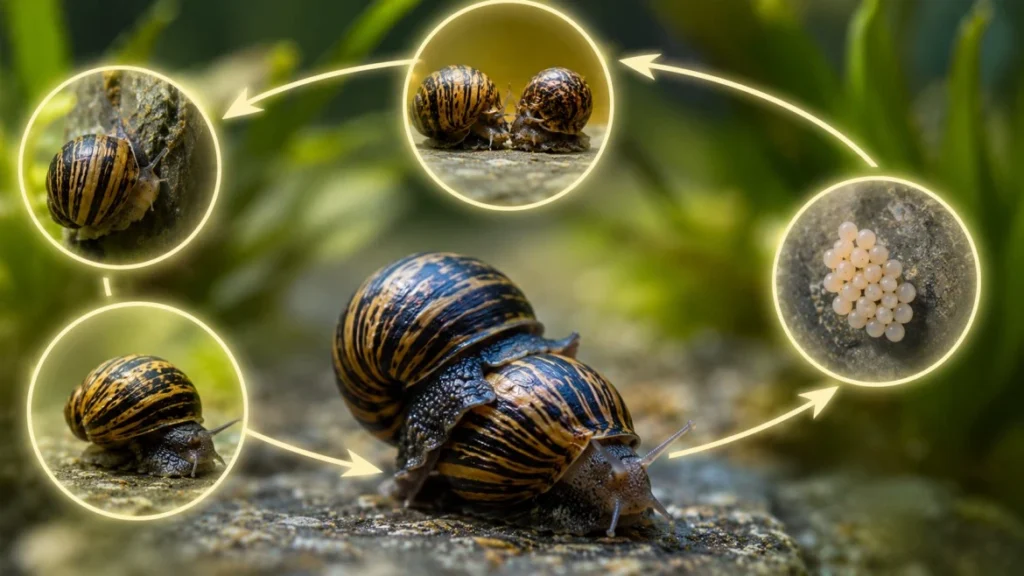
Here’s what you’ll observe in the mating process of nerite snails if you watch carefully:
Pre-mating behavior (6-12 hours before):
- You will see nerite males follow females constantly
- Females may appear to “hide” in plants or under décor
- Increased grazing activity as females build energy reserves
Actual mating (2-4 hours):
- The male mounts the female from behind
- Both remain stationary for extended periods
- No actual penetration occurs; males deposit sperm packets (spermatophores)
Post-mating (12-48 hours after):
- The female begins searching for hard, vertical surfaces
- Eggs appear as small, pyramid-shaped clusters
- Each cluster contains 20-50 eggs
Pro tip: Position a piece of slate or smooth rock vertically in your breeding tank—females prefer laying on these surfaces, and it looks beautiful, also making egg harvesting easier for transferring to separate rearing containers.
Will Nerite Snail Eggs Go Away on Their Own?
Short answer: Yes, but not for a while, and it depends on water conditions. Even in an established, healthy freshwater tank, the eggs won’t magically disappear. They’ll stay on your glass and décor for weeks, which is why some aquarists find them unsightly.
Setting Up a Brackish Breeding Tank: Step-by-Step Guide
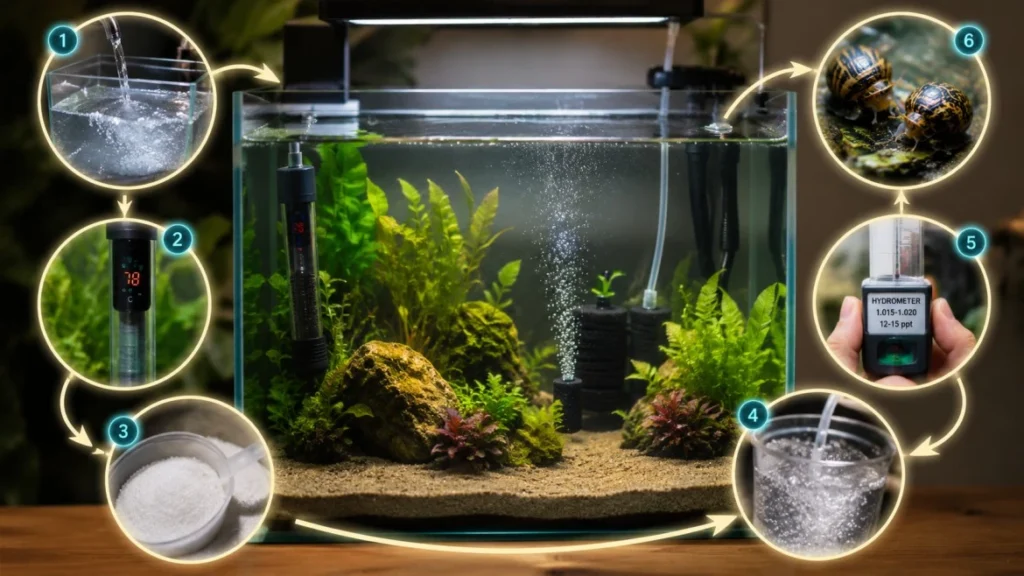
If you’re serious about actually how to breed nerite snails in aquarium, here’s the exact process I’ve perfected:
Tank Setup Specifications
Minimum tank size: 10 gallons (larger is better for water stability)
Equipment needed:
- Aquarium heater (to maintain 77-79°F)
- Small sponge filter or air stone (gentle flow, no strong current)
- Hydrometer or refractometer (for measuring salinity)
- Marine salt mix (like Instant Ocean or Red Sea)
Creating the Right Salinity
Brackish water formula:
- Target specific gravity: 1.015-1.020
- This equals approximately 12-15 parts per thousand (ppt) salinity
- Example: Add 1 tablespoon of marine salt per 5 gallons of water
Proper mixing process:
- Fill tank with dechlorinated freshwater
- Heat water to 77°F
- Dissolve marine salt in a separate container with warm water
- Add slowly to the tank while monitoring with hydrometer
- Let settle for 2 hours before introducing snails
Pro tip from my experience: Use a refractometer rather than a hydrometer—they’re more accurate, and you’ll get better hatch rates. I went from 40% hatching with a hydrometer to 78% with a refractometer. Dumping snails directly into brackish water. They’ll go into shock. Acclimate them.
Nerite Snail Eggs in Your Aquarium: Should You Do Something?
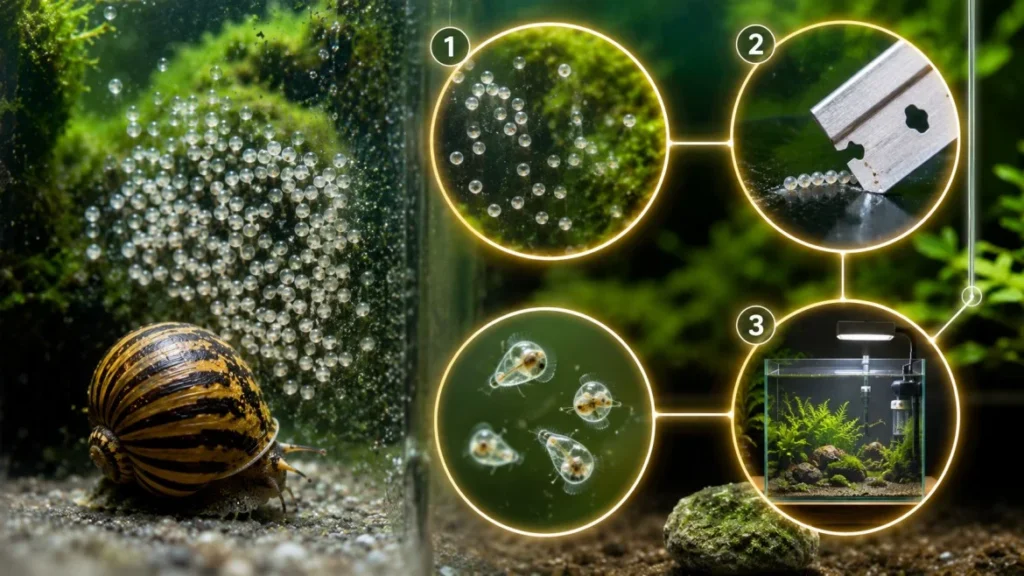
You’ve got eggs on your glass right now, don’t you? Here are your 3 options:
Option 1: Leave Them Alone (Easiest)
Pros: You will need no extra effort, but no fry will survive in freshwater.
Option 2: Remove and Discard (Most Common)
Method:
- Scrape eggs off the glass with a plastic razor blade
- Dispose of in the trash
- No environmental concern—they won’t hatch anyway in freshwater
Why people do this: Eggs don’t decompose quickly and look messy
Option 3: Attempt Breeding (Advanced)
Pros: This will help you to know how to breed nerite snails in aquarium, also help to understand its full lifecycle, it will be educational and rewarding, and more importantly, will generate new snails. The biggest challenge in learning how to breed nerite snails is successfully raising the larvae in brackish conditions.
Cons:
- Time-intensive
- Requires brackish/ marine setup
- High failure rate for beginners
- Larval care is demanding
My recommendation: If you’re curious and have the time, set up a small 5- 10-gallon brackish tank. Even if you only succeed in raising 10-20 fry, it’s worth the knowledge gained.
Common Nerite Snail Breeding Mistakes (And Exactly How to Avoid Them)
I’ve made all of these when studying how to breed nerite snails in an aquarium:
Mistake #1: Thinking a Single Nerite Snail Will Breed
The problem: Only one snail, no mate available
The fix: Buy at least 3-4 nerite snails to ensure a male-female pair
Why it matters: Can’t reproduce asexually—it’s biologically impossible
Mistake #2: Using Freshwater for the Entire Breeding Process
The problem: Eggs don’t develop; you waste 6 weeks waiting. The most common mistakes while researching how to breed nerite snails are assuming the eggs hatch in freshwater.
The fix: Use brackish water from the start
Pro tip: Even if you don’t want fry, brackish water keeps nerites healthier and breeding more often
Mistake #3: Sudden Drastic Changes (Temperature or Salinity)
The problem: Snails go into shock; breeding stops; snails die
The fix: Gradual acclimation over 2-3 hours using drip method
Real talk: I lost 6 snails this way before understanding osmotic stress
Mistake #4: Inadequate Food for Larvae
The problem: Larvae starve because food particles are too large
The fix: Prepare micro-foods (rotifers or liquid fry food) 1-2 weeks in advance
Why it’s critical: Larvae are 0.3- 0.5 mm; standard fry food is 20-50x larger
Mistake #5: Ignoring Water Quality
The problem: Ammonia spikes from uneaten food; larvae die
The fix: Daily water testing and 20% water changes
Benchmark: Keep ammonia below 0.5 ppm, nitrite at 0 ppm
Mistake #6: Not Identifying Sex Before Breeding Tank Setup
The problem: End up with 3 males and 0 females
The fix: Study anatomy before purchasing; females are larger and rounder
USA advantage: Many local aquarium clubs can help with sex identification
Mistake #7: Expecting Fast Results
The problem: Giving up after 4-5 weeks
The fix: Patience. Real breeding takes a minimum of 6- 8 weeks from egg to visible fry
Reality check: This isn’t mystery snail breeding; it’s a long-term project
Comparing Nerite Snail Breeding with Other Popular Aquarium Snails
Are you asking how to breed nerite snails, and not sure if nerite snails are right for your breeding goals? Here’s how they stack up:
| Characteristic | Nerite Snails | Mystery Snails | Ramshorn Snails |
| Freshwater breeding | ❌ No (eggs only) | ✅ Yes | ✅ Yes |
| Brackish needed? | ✅ Yes (for viability) | ❌ No | ❌ No |
| Time to maturity | 6-7 months | 2-3 months | 1-2 months |
| Eggs per month | 150-300 | 500-1000 | 200-600 |
| Hatch rate | 60-85% (brackish) | 80-95% (freshwater) | 70-90% (freshwater) |
| Larvae difficulty | ⭐⭐⭐⭐⭐ (Very hard) | ⭐⭐ (Easy) | ⭐ (Very easy) |
| Aquaculture viability | Low (niche market) | Medium (popular) | Low (nuisance species) |
| Care complexity | ⭐⭐⭐⭐ | ⭐⭐ | ⭐ |
| Profitability (USA market) | $2-4 per snail | $1-2 per snail | $0.25-0.50 |
Verdict: Nerite snails are NOT the easiest to breed, but they command higher prices and appeal to serious aquarists.
Why Most Aquarists Fail (And How USA Tap Water Affects It)
Here’s something competitors won’t tell you: USA tap water characteristics matter significantly. Understanding water salinity is essential if you want to master how to breed nerite snails successfully at home.
High-chlorine areas (CA, TX, FL):
- Need longer dechlorination (24 hours minimum)
- Chlorine interferes with the salt mix equilibrium
- Recommendation: Use RO water + marine salt mix for more control
Hard water regions (OH, PA, MI):
- Calcium-rich water improves snail shell quality
- BUT harder water changes the salinity calculations
- Recommendation: Adjust salt mix dosage by 10-15% lower than the package suggests
Soft water regions (GA, SC, NC):
- Easier to dial in exact salinity
- Lower natural buffering (maintain stable pH)
- Recommendation: Add crushed coral to the breeding tank for stability
Most aquarists who live in hard-water areas fail because they follow general “add X teaspoons of salt” guidelines without accounting for their local water chemistry. I had to reduce my salt by 2 tablespoons per 10 gallons just because of Ohio’s naturally hard water.
FAQ: How to Breed Nerite Snails
Do nerite snails breed in freshwater?
They lay eggs in freshwater, but larvae usually cannot survive there.
How do nerite snails reproduce?
Male and female nerite snails mate, and females lay eggs that require brackish conditions for successful larval development.
Can nerite snails reproduce asexually?
No. Nerite snails require both a male and a female for reproduction.
Can one nerite snail reproduce alone?
No. A single nerite snail cannot produce viable offspring alone.
Do nerite snails reproduce fast?
No. Their breeding cycle is complex and much slower than that of common pest snails.
Will nerite snail eggs go away?
Some may slowly wear away, but many remain attached for months unless manually removed.
How to breed zebra nerite snails?
Use mature warm aquariums, stable water parameters, algae-rich environments, and brackish larval tanks.
Do male nerite snails lay eggs?
No. Only females lay eggs.
Next Steps: Resources You Must Read
Build Your Nerite Breeding Environment First:
- Prepare a separate brackish rearing tank before expecting eggs to hatch
- Source aquarium-safe calcium supplements (cuttlebone, crushed coral, mineral stones)
- Maintain algae-rich surfaces and mature biofilm growth for adult nerites
Related Posts on FishioHub You Must Read:
- Nerite Snail Care Guide: Tank Setup, Feeding & Lifespan — Learn the fundamentals of nerite health, shell care, and algae-based nutrition before attempting breeding projects
- Best Aquarium Plants for Snail Tanks & Biofilm Growth — Discover how to create natural grazing surfaces and stable ecosystems that encourage healthy nerite behavior
- Best Algae Eaters for Freshwater Aquariums — Understand how nerite snails fit into a balanced cleanup crew without competing excessively for algae resources
- Mystery Snail Eggs & Breeding Explained — Compare freshwater snail breeding differences and understand how to breed nerite snails.
- How to Set Up a Brackish Aquarium for Beginners — Essential reading if you plan to raise nerite larvae successfully beyond the egg stage
Final Thoughts
If you came here wondering how to breed nerite snails, the biggest takeaway is this: Eggs do not equal babies.
That single truth explains almost every confusion surrounding nerite snail breeding in freshwater aquariums. Personally, I still keep nerites in several planted tanks because their algae-cleaning ability is unmatched. Even though breeding them is difficult, their behavior, patterns, and usefulness make them one of the best aquarium snails for USA hobbyists.
And honestly? Once you understand their life cycle, you will also understand how to breed nerite snails, and those mysterious white eggs suddenly make a lot more sense.
Was this guide helpful?
First-Hand Experience
Based on animals I've personally kept and bred - not summarized from other articles.
Zoological Foundation
Claims are checked against my M.Sc. Zoology training and published aquatic biology research, not recycled aquarium myths.
No Paid Influence
No sponsorship shaped this guide. Affiliate links, if any, are disclosed separately and never hidden.
Kept Current
Errors are corrected as soon as they're found, with the update noted at the bottom of the article.

Anil Satak M.Sc. Zoology · Founder, FishioHub
Grew up in a fishing family in India and holds a Master's in Zoology. FishioHub is a one-person operation - every guide is personally researched, kept-tested, and written by Anil. No team, no outsourced writers, no AI-generated content. Read his full bio →