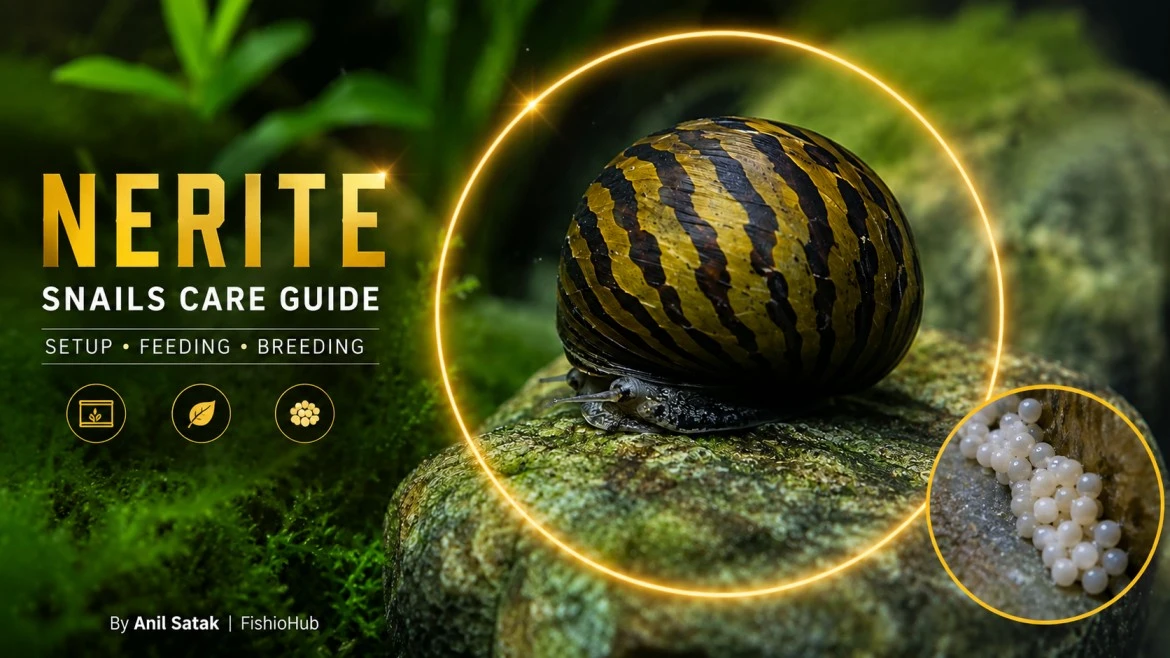
When I first added nerite snails to one of my planted aquariums, I honestly expected them to behave like most aquarium snails, thought they would eat some algae, reproduce everywhere, and eventually become another maintenance headache.
I was wrong, and sometimes you get better than what you expected. If You Keep Just One Cleanup Crew Snail, Make It a Nerite
Within a week, the glass looked cleaner than it had in months, green spot algae started disappearing, and unlike bladder or ramshorn snails, the population never exploded. Years later, nerites remain one of the first animals I recommend to beginner and experienced aquarium keepers alike.
If you’re searching for a complete nerite snails care guide, the short answer is simple:
Nerite snails are hardy algae-eating freshwater snails that thrive in stable aquariums with temperatures between 72–78°F (22–26°C), plenty of biofilm and algae, calcium-rich water, and peaceful tank mates. They are among the best cleanup crew members for freshwater aquariums because they rarely reproduce successfully in freshwater.
This guide covers everything from feeding and tank setup to nerite snail eggs, lifespan, breeding, and common mistakes that most care sheets ignore.
What You’ll Get in This Post
- 🐌 What Are Nerite Snails?
- 📑 Nerite Snails Care Sheet
- 🌿 Best Nerite Snail Tank Setup
- 🥬 Nerite Snail Food Guide
- ⏰ Nerite Snail Lifespan Explained
- 🥚 Nerite Snail Eggs and Breeding
- 🐟 Best Tank Mates for Nerite Snails
- 🛠️ Common Problems and Solutions
- ❔ Frequently Asked Questions
Jump to: Tank Setup | Parameters | Food Guide | Breeding | FAQ
What Are Nerite Snails?
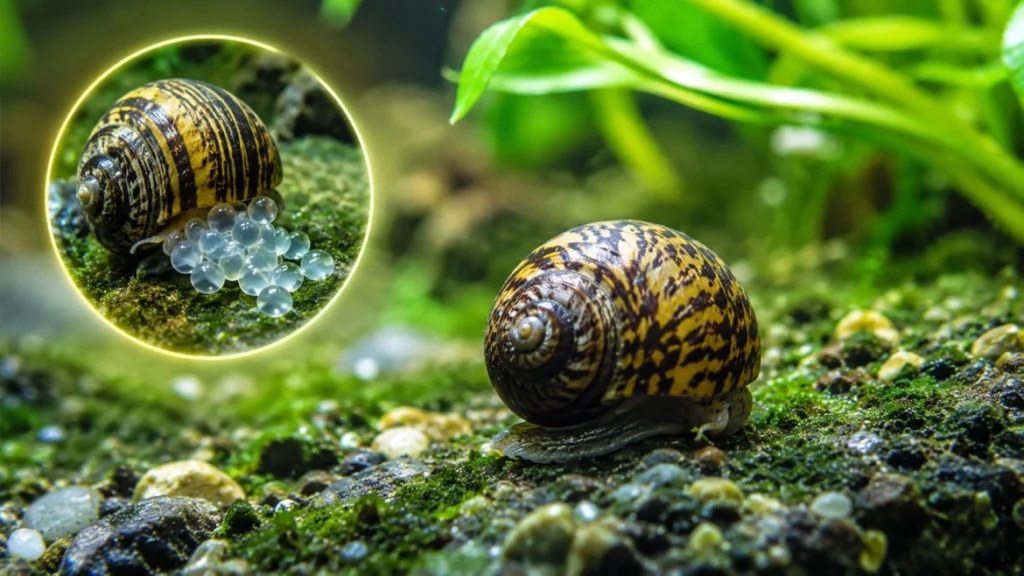
Nerite snails belong to the Neritidae family and are famous among aquarium hobbyists for their exceptional ability to eat algae. It means they are good for looking and for eating algae. They are primarily found in coastal rivers, estuaries, mangroves, and tropical waterways in Asia, Africa, and parts of the Pacific.
Nerite snails have a unique reproductive cycle, requiring saltwater for larval development. This means that, in general, they will not reproduce significantly in your freshwater aquarium.
Why Aquarists Love Nerite Snails
- Excellent algae control ability
- Absolutely Safe for live plants
- Minimal bioload
- Peaceful temperament
- Attractive shell patterns
- Rarely reproduce in freshwater tanks
For many hobbyists in the USA, a nerite snail for aquarium use is often more effective than chemical algae treatments, and one more thing, a nerite snail is a universally better choice for aquarists over a mystery snail. It is a low-maintenance, hard-working snail.
What Are the Different Nerite Snail Types?
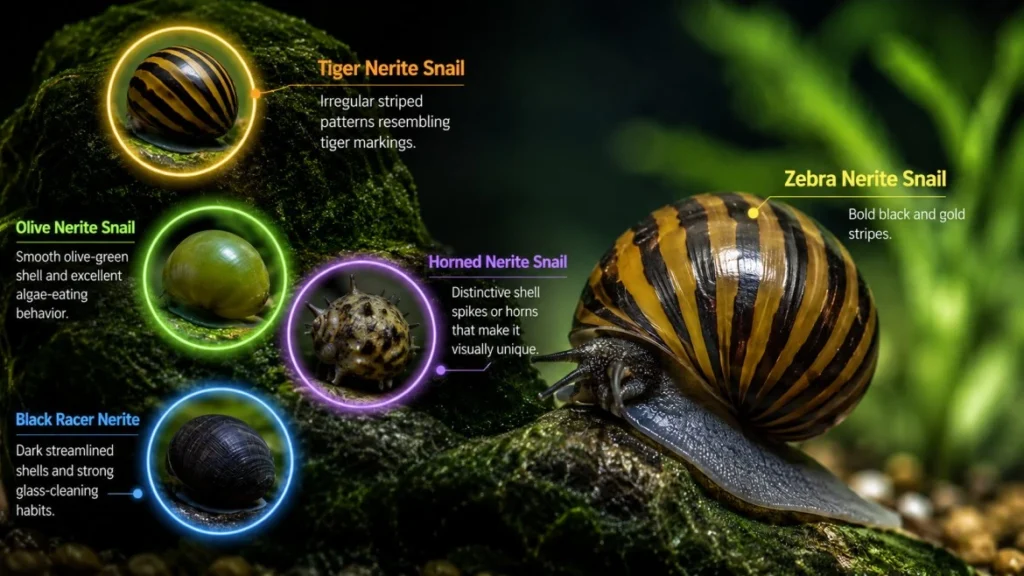
One thing many beginner guides skip is the diversity of nerite snail types available.
Zebra Nerite Snail
The most popular variety featuring bold black and gold stripes.
Tiger Nerite Snail
Has irregular striped patterns resembling tiger markings.
Olive Nerite Snail
Displays a smooth olive-green shell and excellent algae-eating behavior.
Horned Nerite Snail
Features distinctive shell spikes or horns that make it visually unique.
Black Racer Nerite
Known for dark streamlined shells and strong glass-cleaning habits.
Among all nerite snail varieties, Zebra and Horned Nerites are the most commonly available in American fish stores.
Quick Nerite Snails Care Sheet
| Parameter | Recommended Range |
|---|---|
| Tank Size | 5+ gallons |
| Temperature | 72–78°F (22–26°C) |
| pH | 7.0–8.5 |
| GH | 6–18 dGH |
| KH | 3–12 dKH |
| Lifespan | 1–3 years |
| Diet | Algae, biofilm, wafers, vegetables |
| Temperament | Peaceful |
| Plant Safe | Yes |
| Breeding Difficulty | Very Difficult in Freshwater |
This simple nerite snails care sheet covers the essential requirements for long-term success.
Nerite Snail Temperature Requirements
According to this nerite snails care guide and experienced aquarists, proper nerite snail temperature management significantly impacts activity levels and longevity.
The sweet spot is: 72–78°F (22–26°C)
- At lower temperatures, metabolism slows, and activity decreases.
- At temperatures above 82°F (28°C), stress increases, and lifespan may shorten.
For most planted community aquariums in the United States, standard tropical fish temperatures work perfectly.
Water Quality Matters More Than Most People Realize
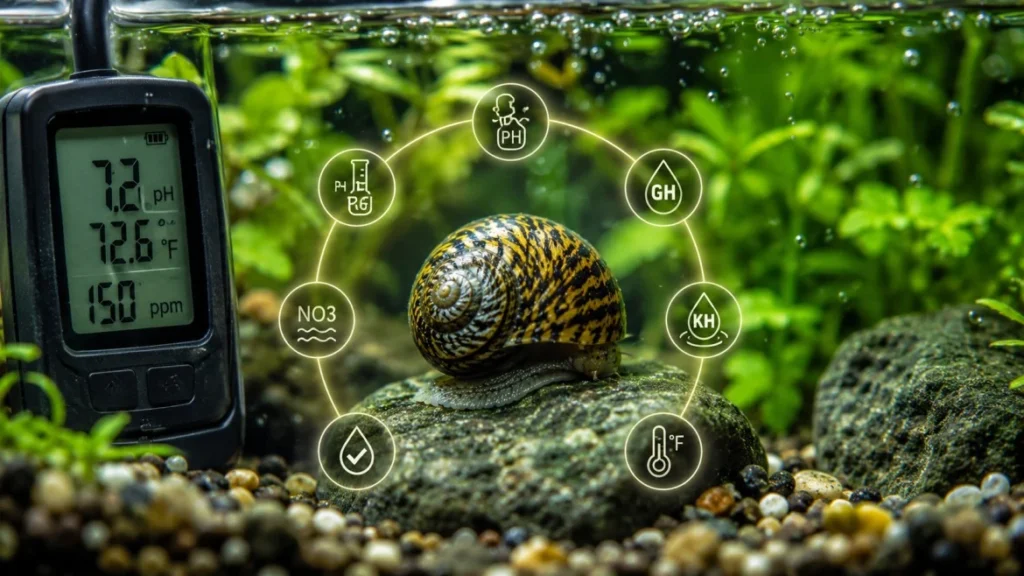
The water parameters are extremely important for nerites because the nerites are surprisingly sensitive to unstable water conditions. According to my nerite snails care guide, I will prefer these water parameters.
| Parameter | Ideal Range | Tolerance | Why It Matters |
| Temperature | 72-78°F | 65-82°F (brief) | Shell growth; metabolic rate |
| pH | 7.0-7.5 | 6.5-8.0 (avoid extremes) | Shell calcification requires alkalinity |
| GH (General Hardness) | 8-15 dGH | 6+ dGH minimum | Calcium availability for the shell |
| KH (Carbonate Hardness) | 4-6 dKH | 3+ dKH minimum | Calcium buffering; pH stability |
| Ammonia | 0 ppm | 0 (non-negotiable) | Even 0.25 ppm causes respiratory stress |
| Nitrite | 0 ppm | 0 (non-negotiable) | Toxic to nerite snails at any level |
| Nitrate | <40 ppm | <80 ppm (high tolerance) | They tolerate it; prefer lower |
| TDS (Total Dissolved Solids) | 150-250 ppm | 100-300 ppm | Shows mineral content (calcium presence) |
Water parameters to maintain:
- Ammonia: 0 ppm
- Nitrite: 0 ppm
- Nitrate: Under 20 ppm
- Stable pH above 7.0
Remember, the Low pH water can gradually dissolve the shell. A calcium-rich environment is especially important because shells consist primarily of calcium carbonate.
Scientific Fact
According to the National Oceanic and Atmospheric Administration, shell-forming mollusks rely on calcium carbonate availability, and acidic conditions can impair shell growth and maintenance.
Nerite Snails Care Guide: Complete Tank Setup Guide
Minimum Tank Size for Nerite Snail
I’ve seen in many forums, the first question every USA hobbyist asks: “Can I put a nerite snail in a 5-gallon?” Few respond to them, yes, but a realistic answer: You’ll struggle.
Recommended minimums:
| Setup Type | Tank Size | Why This Works |
| Single nerite snail (solo) | 10+ gallons | Easier parameter stability; room for food sources |
| 1-2 nerite snails (community) | 20+ gallons | Buffer against ammonia spikes; coexist with fish |
| 3-5 nerite snails (algae crew) | 40+ gallons | Sufficient algae growth; territory spacing |
| Breeding group (5-10) | 55+ gallons | Brackish setup required; separate breeding tank |
My Real experience note: I’ve kept single nerite snails alive in 5-gallon tanks, but they showed lethargy, discomfort, slow growth, and shell erosion by month 4. In 10+ gallon systems with consistent care, they thrive visibly.
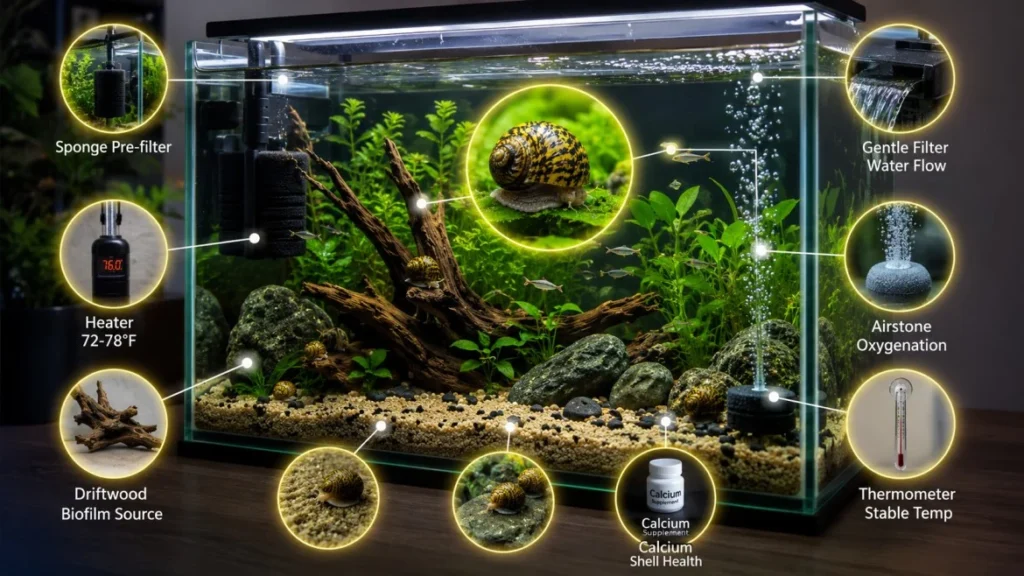
Essential Equipment for Nerite Snail Care ( Total setup cost: $100-200 (aquarium not included))
| Equipment | Why It Matters | Budget |
| Gentle water filter | Creates flow (critical); removes waste | $30-60 |
| Sponge pre-filter | Prevents snails from getting suctioned into the intake | $8-12 |
| Heater (25-50W) | Maintains stable temperature 72-78°F | $20-40 |
| Airstone or powerhead | Gentle water movement; oxygen | $5-15 |
| Thermometer | Monitors temperature consistency | $5-10 |
| Calcium supplement | Critical for shell health; prevents erosion | $8-15 |
| Driftwood or hardscape | Natural grazing surfaces; biofilm source | $10-30 |
Substrate & Hardscape for nerite snail tank
Nerite snails graze on biofilm, microscopic algae, and bacteria that colonize surfaces. Your hardscape is their grocery store.
Best options for nerite snail care:
- Driftwood (highest value) – Creates maximum surface area; darkens water slightly (adds tannins they benefit from)
- Smooth river rocks – Stable; good biofilm surface
- Substrate (sand or fine gravel) – They graze the surface constantly
- Planted vegetation – Not primarily for nerite food, but improves water quality and biofilm growth
My experienced tip: Boil driftwood before adding (removes tannin initially, then allows gradual release, which stabilizes pH—nerite snails love this).
Most important from my side: Marny nerite snails care guide won’t tell you this truth. The Nerites are surprisingly adventurous. I’ve personally found them exploring filter tubing, airline hoses, and even aquarium rims. So i prefer to use a tight-fitting lid, covered filter openings, and a stable water level.
Nerite Snail Food Guide
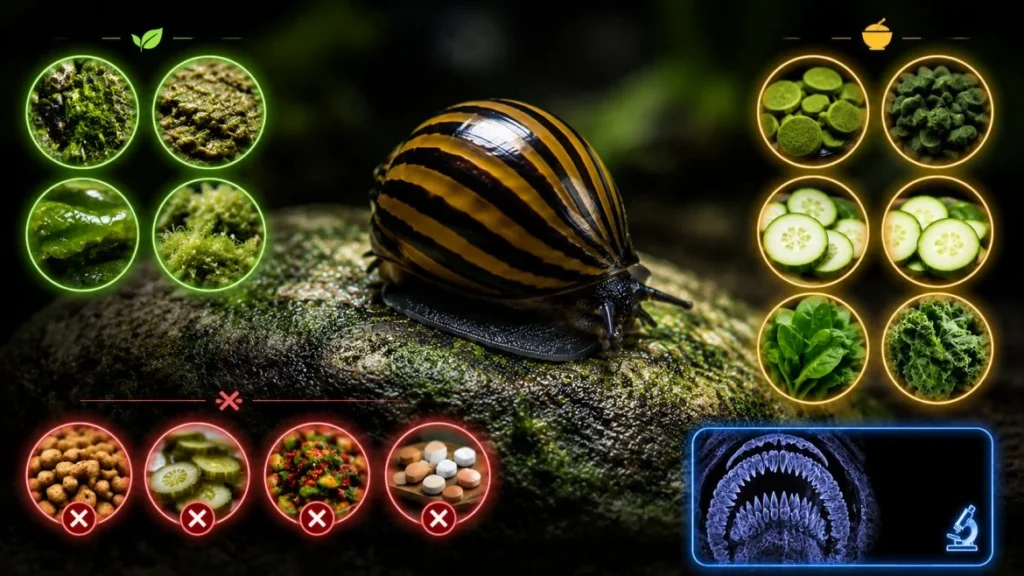
There are so many answers around many forum threads on: What Do Nerite Snails Eat?, but the more different answers create confusion, so in this nerite snails care guide, it is my prime responsibility to give you the exact and best nerite snail food list.
Preferred foods include:
- Green algae– the best food for nerite snail overall
- Brown diatoms
- Biofilm
- Soft algae coatings
Supplemental Foods
If algae becomes scarce, provide:
- Algae wafers
- Spirulina wafers
- Blanched zucchini
- Blanched cucumber
- Spinach and kale
Foods to Avoid
- Excess protein-heavy foods
- Salty vegetables
- Seasoned vegetables
- Copper-containing medications
Scientific Fact
Published research on freshwater mollusks shows that many species of nerites have specialized radula structures adapted for scraping layers of algae and microorganisms from hard surfaces.
Nerite Snail Lifespan Explained: How Long Do Nerite Snails Live?
The average nerite snail lifespan ranges from 1 to 3 years. Some Exceptional specimens occasionally exceed three years under ideal conditions.
These are the Factors affecting nerite snails’ lifespan:
- Water quality
- Calcium availability
- Diet quality
- Stable temperatures
- Stress levels
Signs of a Healthy Nerite
A healthy snail is usually active throughout the aquarium, constantly grazing on surfaces and exploring the tank. You’ll notice strong, vibrant shell coloration, clean and intact shell edges without cracks or erosion, and consistent movement instead of staying motionless for long periods.
Signs of Trouble
- Long inactivity
- Shell erosion
- Floating frequently
- Persistent retraction
A healthy Nerite snail lifespan is usually longest in mature planted aquariums with stable mineral content.
Nerite Snail Eggs and Breeding
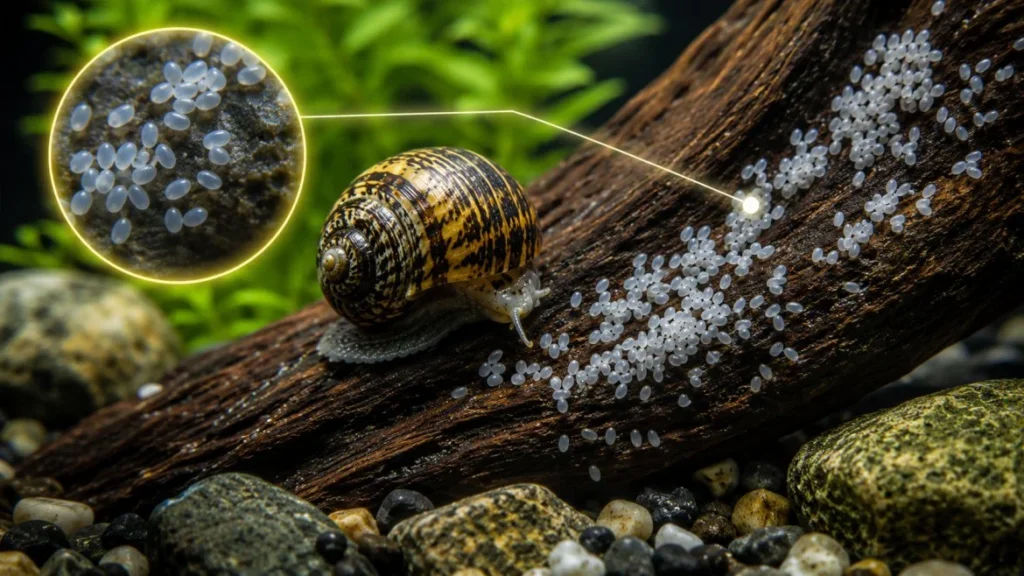
Why Do Nerite Snails Lay Eggs Everywhere? One of the most searched questions involves nerite snail eggs. Female nerites frequently lay tiny white sesame-seed-like capsules on:
- Glass
- Driftwood
- Decorations
- Rocks
- Equipment
These eggs are harmless but can be visually noticeable.
Nerite Snail Breeding Explained
Many hobbyists assume egg laying equals successful reproduction. In reality, nerite snail breeding is far more complicated.
The Unique Life Cycle
- A female lays eggs
- Eggs hatch into larvae
- Larvae require brackish water
- Juveniles later transition toward freshwater habitats
Because freshwater aquariums lack the required salinity stage, successful breeding is uncommon.
Scientific Fact
Studies of neritid snail reproduction demonstrate that larval development typically requires brackish or marine conditions rather than pure freshwater environments.
Can Nerite Snails Breed in Freshwater?
Technically, they can lay eggs in freshwater, but rarely complete their life cycle there. Breeding in freshwater is near impossible, which requires blackish water. This is precisely why nerite snails for freshwater aquarium setups remain so popular. You get algae control without population explosions.
Best Tank Mates for Nerite Snails
Great Tank Mates Choices
- Neon tetras , Ember tetras
- Harlequin rasboras
- Corydoras catfish
- Otocinclus
- Kuhli loaches
- Cherry shrimp, Amano shrimp
Avoid
- Puffers
- Large cichlids
- Crayfish
- Aggressive loaches
- Shell-crushing fish
A peaceful community environment is one of the biggest contributors to successful nerite snails care.
Common Problems and Solutions
Nerite Snail Not Moving
Possible causes: Common causes behind inactivity or health issues in aquarium snails include acclimation stress after being introduced to a new tank, poor water quality with unstable parameters, low oxygen levels in the aquarium, and natural aging in older snails.
Fix: Test the water immediately before assuming the snail is dead.
Shell Damage
Usually caused by: Shell damage in aquarium snails is commonly linked to low pH levels, calcium deficiency, and overly soft water, all of which can slowly weaken the shell and cause cracks, erosion, or thinning over time.
Fix: Use crushed coral, mineral supplements, or calcium-rich foods.
Floating Nerite Snail
Occasional floating in aquarium snails is completely normal, but persistent floating can sometimes point to stress, illness, or water parameter issues that may need immediate attention.
White Marks on Shell
Often result from mineral deficiencies or acidic conditions rather than disease.
Expert Insight: The Biggest Nerite Snail Mistake
In this Nerite snail care guide, I want to clearly say that the biggest mistake I see is adding nerites solely as an algae solution. Nerites should be viewed as living animals first and a cleanup crew second.
When hobbyists buy several snails to eliminate algae in a brand-new aquarium, the algae often disappear before a sustainable food source develops. The snails then slowly starve.
My recommendation:
Always ensure natural algae, biofilm, or supplemental foods are consistently available. This single adjustment dramatically improves long-term success.
Next Steps: Resources You Must Read
Understand Nerite Snail Fundamentals:
- Test your tap water GH and KH before setting up nerite snails (API Master Kit, $35, or Aquarium Co-op kit)
- Source crushed coral substrate or liquid calcium supplement and Prepare driftwood (boil for 30 minutes, cool completely)
Set Up Proper Infrastructure:
- Install a heater with a reliable thermostat (Aqueon submersible, $25-35), and add gentle water movement
- Establish biofilm by waiting 3-4 weeks post-tank setup before adding snails
Related Posts on FishioHub You Must Read:
- How to Set Up a Freshwater Aquarium Plants(Complete Beginner Setup Guide) – Master the aquarium planting before addding snails
- Mystery Snail Care Guide: Complete Setup, Breeding & Tank Requirements – Understanding another freshwater snail species
- Best Freshwater Fish Tank Fish for Beginners: Easy, Beautiful & Hard to Kill – Ideal nerite snail tank mates
Frequently Asked Questions
Are nerite snails good for aquariums?
Yes. They are among the best algae-eating snails and are generally safe with live plants.
How many nerite snails per gallon?
A common guideline is one nerite snail per 5 gallons, depending on algae availability.
What is the ideal nerite snail temperature?
72–78°F (22–26°C) is ideal for most freshwater aquariums.
Do nerite snails reproduce in freshwater?
They lay eggs in freshwater, but larvae usually require brackish water to develop.
What do nerite snail eggs look like?
Small white oval capsules resembling sesame seeds attached to hard surfaces.
How long is the nerite snail lifespan?
Most live between 1 and 3 years under proper care.
Can nerite snails eat fish food?
Yes, but algae and biofilm should remain their primary diet.
Are nerite snails safe with shrimp?
Absolutely. Nerites coexist peacefully with cherry shrimp, Amano shrimp, and most dwarf shrimp species.
Conclusion
A proper nerite snails care guide comes down to four essentials: stable water parameters, abundant algae or supplemental foods, adequate calcium, and peaceful tank mates.
Whether you choose Zebra, Horned, Olive, or Tiger nerites, these snails provide exceptional algae control without turning into a pest population. Their fascinating life cycle, attractive shell patterns, and low-maintenance nature make them one of the most valuable cleanup crew members available for freshwater aquariums.
For beginners and experienced aquarists alike, nerites remain one of the safest and most effective additions to a well-maintained aquarium.
Was this guide helpful?
First-Hand Experience
Based on animals I've personally kept and bred - not summarized from other articles.
Zoological Foundation
Claims are checked against my M.Sc. Zoology training and published aquatic biology research, not recycled aquarium myths.
No Paid Influence
No sponsorship shaped this guide. Affiliate links, if any, are disclosed separately and never hidden.
Kept Current
Errors are corrected as soon as they're found, with the update noted at the bottom of the article.

Anil Satak M.Sc. Zoology · Founder, FishioHub
Grew up in a fishing family in India and holds a Master's in Zoology. FishioHub is a one-person operation - every guide is personally researched, kept-tested, and written by Anil. No team, no outsourced writers, no AI-generated content. Read his full bio →