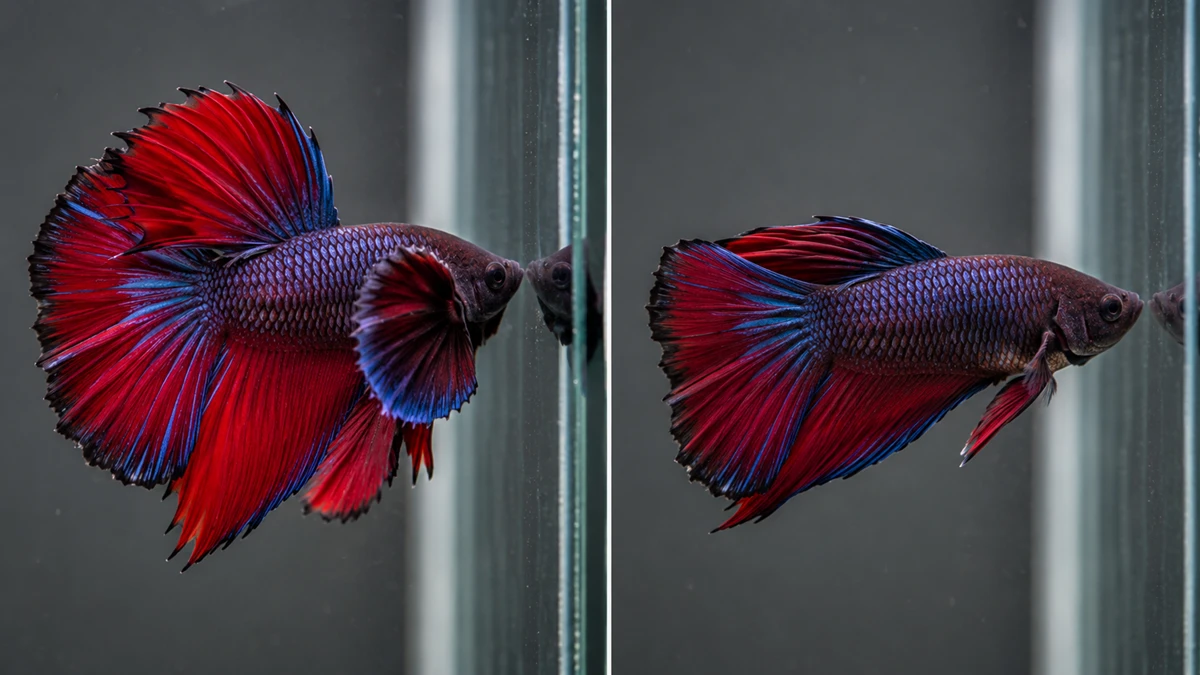
Bettas flare at their reflection because they genuinely mistake the mirror image for a rival male invading their territory — it’s not confusion, and it’s not showing off for you. I see this constantly with my betta fish.
It does every morning. Does betta flare at the glass specifically, or at his heater/thermometer/another reflective surface? Note the actual trigger and how long it usually lasts. The gill covers snap open, the fins go rigid, and for a few seconds he looks twice his size. Then he stops, swims off, and acts as if nothing happened. That’s the version of flaring most keepers see and don’t worry about — and mostly, they’re right not to.
The version worth worrying about is the betta that does this for twenty minutes straight, stops eating, and starts looking washed out by the following week. Both are called “flaring.” They are not the same thing, and conflating them is where most of the bad advice online comes from.
- A glare that turns the tank into a mirror at certain times of day.
- Flaring at you — this is usually a recognition and interest response, not aggression. Bettas can distinguish faces and colors reasonably well, and flaring when a person approaches is more often tied to feeding anticipation than to a fight response. This is the flare hobbyists mean when they ask “why does my betta flare at me” — and it’s generally the least concerning version.
- Female flaring — less dramatic, shorter fin spread, usually tied to establishing the pecking order in a sorority tank rather than mate attraction. Females flare less often and recover faster than males.
- Breeding-context flaring — directed at another betta through a divider or during conditioning, often accompanied by bubble-nest building. This is situational and self-limiting once breeding is over.
- Novel-environment flaring — new tank, new tankmate, rearranged décor. Settles within days as the fish reads the space as no longer contested.
The “lunar flare betta” phrasing some keepers search for isn’t a distinct behavior — it’s people noticing flaring intensity shifts with lighting changes (moonlight LEDs, dusk settings) that alter how visible the reflection is, not a lunar-cycle biological effect.
When Flaring Is Fine — and When It Isn’t
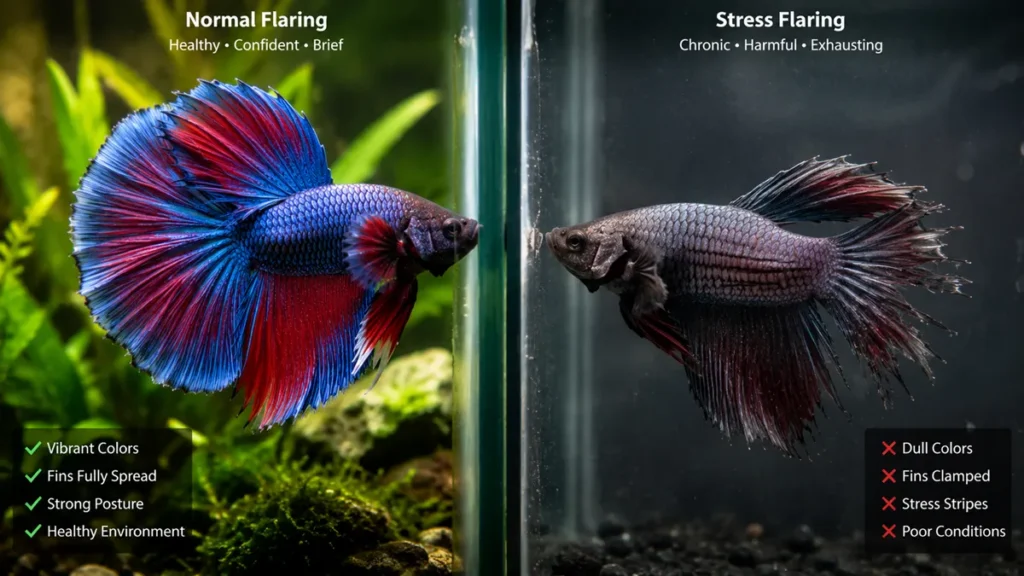
This is the part most articles skip past with a vague “everything in moderation” line. Here’s the actual line to watch for.
| Signal | Normal / Manageable | Cause for Intervention |
| Duration per episode | Seconds to 1–2 minutes, then the fish disengages on its own | 10+ minutes, or the fish won’t stop until you physically block the reflection |
| Frequency | A few times a day, tapering off after the first week in a tank | Constant, all-day flaring that resets every time you check |
| Recovery | Full color and normal swimming return within a minute of stopping | Dull color, clamped fins, or lethargy persisting after the flare ends |
| Appetite | Unaffected | Reduced interest in food, especially over 2+ consecutive feedings |
| Fin condition | Fins remain intact, edges clean | Fraying, ragged edges, or fin-nipping-style damage (self-inflicted from repeated aggressive display against hard glass or décor) |
| Body posture between episodes | Active exploring, normal resting on leaves/substrate | Stress stripes (horizontal bars), bottom-sitting, glass surfing |
If your betta is consistently landing in the right-hand column, the fix isn’t “manage the flaring” — it’s “remove the trigger.”
How to Stop a Betta From Seeing Its Reflection
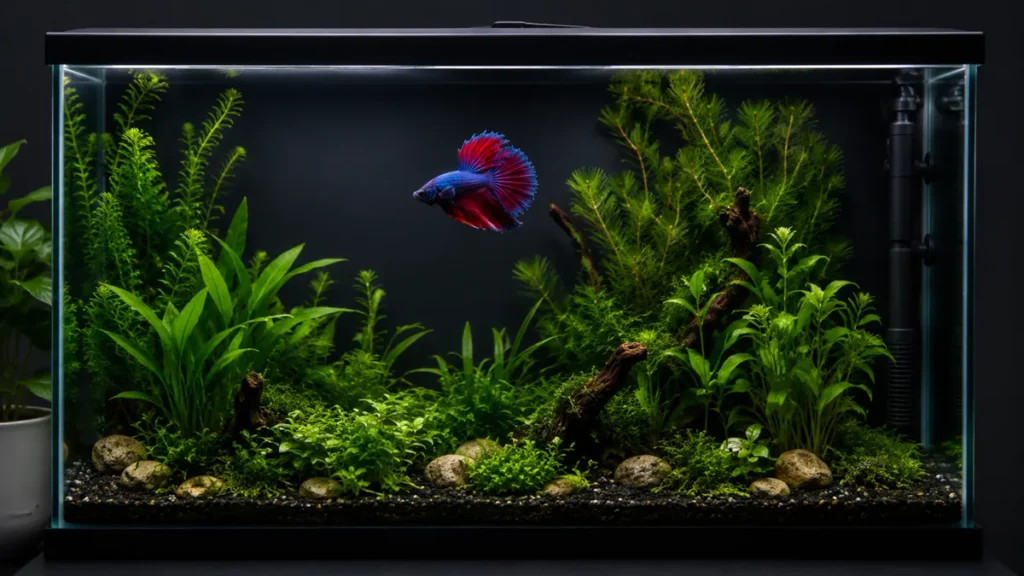
- Background the reflective sides. A matte black or dark blue background applied to the back and sides of the tank (not the front viewing panel) cuts down the glass-mirror effect dramatically. Vinyl backing sheets sold for reptile tanks work fine and cost a fraction of aquarium-branded versions.
- Check your lighting angle, not just the tank. A tank lit from directly above with no side ambient light turns the glass into a mirror at night when room lights are on and tank lights are off. Match your room and tank lighting schedules, or add a dim ambient light behind the tank during the transition hours.
- Move it away from other reflective surfaces. Stainless heater shafts, glass thermometers, and shiny background decorations can all trigger the same response as the tank wall itself. Swap a mirror-finish heater for a matte or fully submerged inline one if this is a repeat issue.
- Add visual clutter at fish-eye level. Dense planting or tall décor along the sides breaks the sightline before it becomes a full reflection. This does double duty as enrichment.
- Don’t rely on tank size alone to fix it. A bigger tank reduces stress generally, but a 20-gallon tank with bare glass on three sides will produce just as much reflection flaring as a 5-gallon one. Background matters more than volume for this specific problem.
Is Flaring Good for Betta Fish? Should You Encourage It?
Researchers found in a 2005 Animal Behaviour study that this display genuinely costs them oxygen, since bettas flare less under low-oxygen conditions.
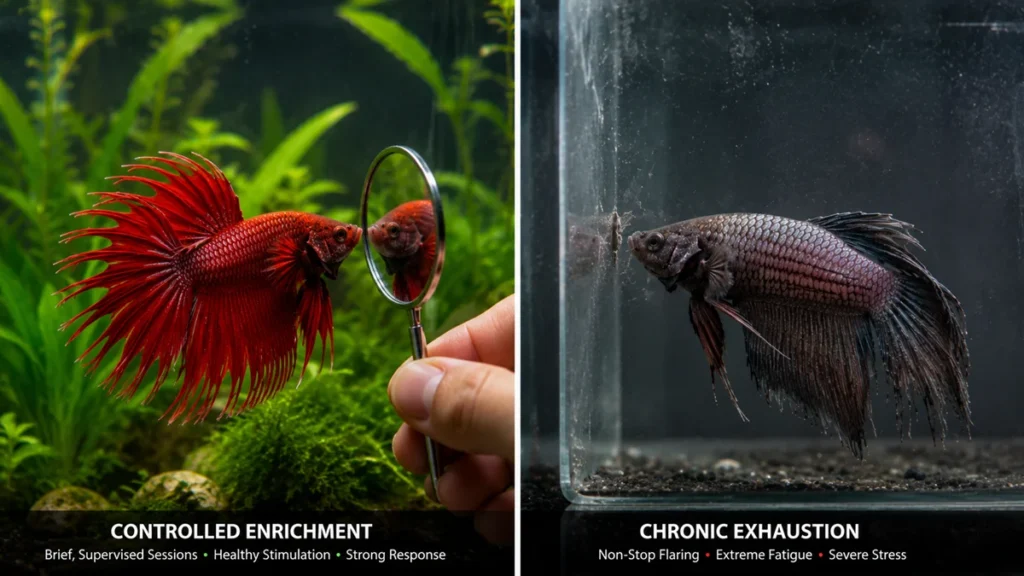
Some breeders use brief, supervised flaring — showing the fish a small hand mirror for a controlled window, then removing it — to check fin symmetry and color development ahead of shows, or simply as enrichment. If you want to do this deliberately rather than let an uncontrolled reflection do it constantly, the practical rule is: keep sessions short, infrequent, and always ended by you removing the trigger — not by the fish giving up. A fish that “gives up” mid-flare and just stops responding is not calm; it’s fatigued.
Uncontrolled, all-day reflection flaring is a different category entirely. It’s not exercise — it’s an unresolved fight with no winner, running on a loop.
FAQ on Bettas Flare at Their Reflection
Is flaring good or bad for a betta fish?
Neither, on its own — duration and recovery decide that. A betta that flares for a minute and goes back to normal swimming is fine. One that flares for long stretches without recovering, or stops eating afterward, is under real stress. Watch the pattern, not the single episode.
Why does my betta flare his gills at me specifically?
Most of the time this is recognition, not aggression — bettas learn to associate a person approaching with feeding time, and flaring can be part of that excited response. It’s worth ruling out a reflective surface behind you (a window, a phone screen) before assuming it’s about you at all.
Can female bettas flare too?
Yes, though less dramatically and less often than males. In sorority tanks it’s usually about establishing rank rather than mate attraction, and it tends to resolve faster once the hierarchy settles.
How do I stop my betta from flaring at his reflection permanently?
You generally can’t make the instinct disappear, but you can remove the trigger — background the tank, check for reflective décor or heater shafts, and manage lighting so the glass doesn’t mirror at night. Most bettas stop responding within a week or two once the reflection is gone.
Is it cruel to show my betta a mirror on purpose?
A short, supervised session isn’t cruel by itself, but it’s easy to overdo. If you’re doing it deliberately, keep it brief and end it yourself rather than letting the fish flare until it’s worn out.
Was this guide helpful?
First-Hand Experience
Based on animals I've personally kept and bred - not summarized from other articles.
Zoological Foundation
Claims are checked against my M.Sc. Zoology training and published aquatic biology research, not recycled aquarium myths.
No Paid Influence
No sponsorship shaped this guide. Affiliate links, if any, are disclosed separately and never hidden.
Kept Current
Errors are corrected as soon as they're found, with the update noted at the bottom of the article.

Anil Satak M.Sc. Zoology · Founder, FishioHub
Grew up in a fishing family in India and holds a Master's in Zoology. FishioHub is a one-person operation - every guide is personally researched, kept-tested, and written by Anil. No team, no outsourced writers, no AI-generated content. Read his full bio →