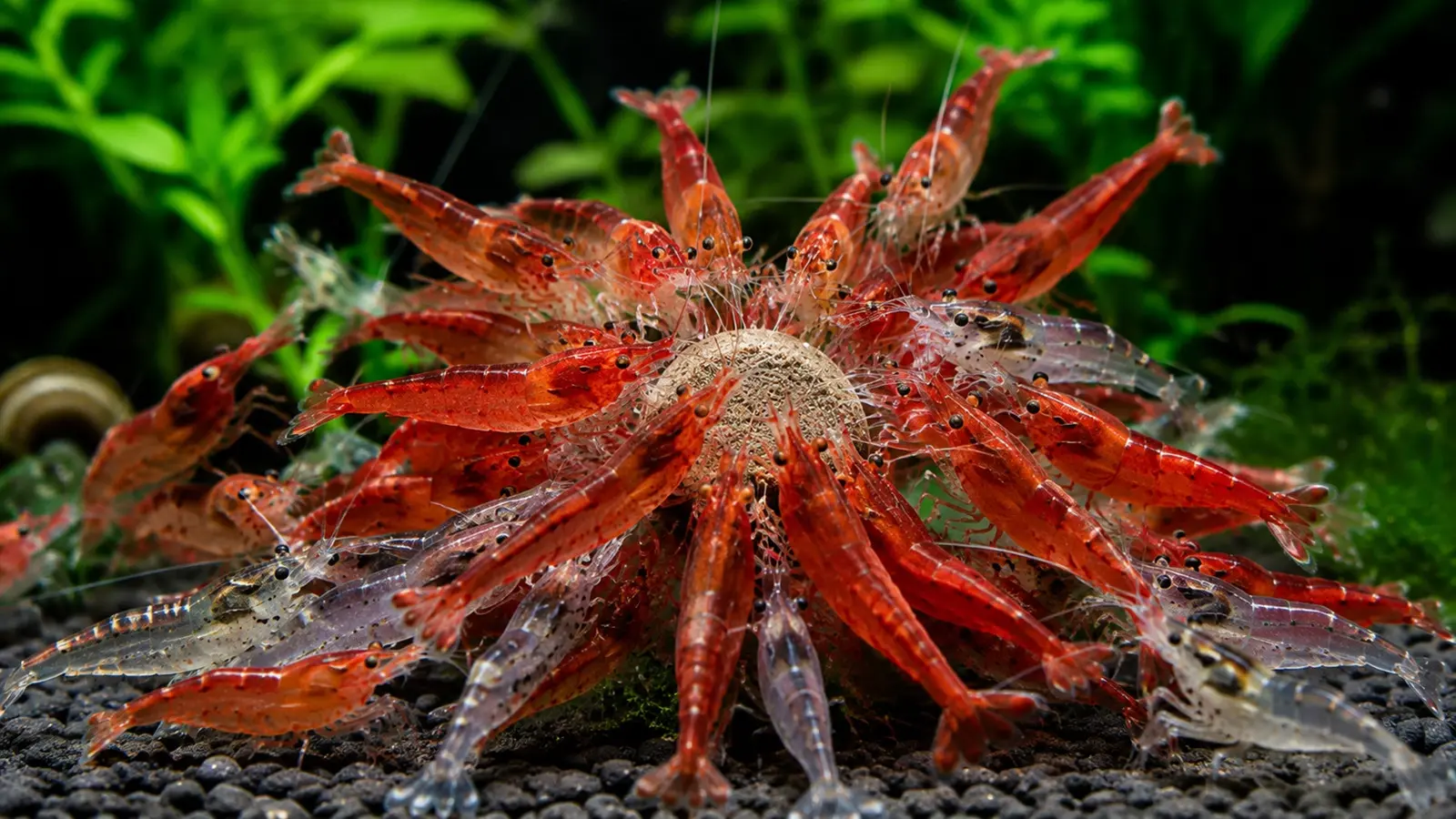
Most beginners assume aquarium shrimp are just tank janitors that can survive solely on leftover fish flakes and algae. As a zoologist, I’ve analyzed their digestive needs and found that a lack of specialized minerals is the #1 cause of the dreaded ‘White Ring of Death’ during molting. Here is exactly what your shrimp need to eat to build thick, vibrant shells and breed continuously.
When I was making the aquarium, the question in my mind was What Do Aquarium Shrimp Eat? I’m sharing my experiences with you, and after that, you will tell me, Are You Starving Your Aquarium Shrimp? Foods for Explosive Colony Growth.
Quick answer: Aquarium shrimp eat algae, biofilm, and decaying plant matter naturally, plus commercial shrimp pellets, blanched vegetables, and occasional protein for breeding and molting support. Freshwater shrimp are omnivorous scavengers — but what they eat determines whether they molt safely or die trying.

In this ultimate guide ( What Do Aquarium Shrimp Eat? ), you’ll learn:
- Natural vs. supplemental shrimp diets.
- What shrimp eat in fish tanks, freshwater aquariums, and breeding tanks.
- The truth about algae, detritus, and fish poop.
- Best foods for breeding shrimp.
- Homemade shrimp food recipes.
- Feeding strategies for community tanks.
- Downloadable shrimp feeding PDFs and checklists.
- FAQs to answer every shrimp feeding question.
By the end of this post, you’ll have everything needed to maintain vibrant, healthy shrimp — and downloadable content to make it easy.
What Do Aquarium Shrimp Actually Eat? (Not What You’d Guess)
Here’s the honest answer to what do aquarium shrimp eat: mostly things you can’t see.
Shrimp are grazers first, eaters second. In the wild and in your tank, they spend most of their day picking at surfaces — not chasing food that drops in.
Biofilm is the real answer. It’s a thin layer of bacteria, algae, and microorganisms that coats every rock, leaf, and piece of driftwood in a mature tank. I didn’t understand this for months. I kept dumping in pellets, wondering why my shrimp ignored them and grazed on my moss instead.
That’s when it clicked: what do shrimp eat in freshwater tanks isn’t primarily “food” in the human sense. It’s a living film most aquarists never notice.
Natural foods shrimp eat:
Biofilm — bacteria, fungi, and algae on hard surfaces. This is their main food source, full stop.
Soft algae — green film algae and diatoms — are constantly grazed.
Decaying plant matter — fallen leaves and moss debris, broken down for fiber.
Detritus — organic particles settled on substrate and decorations.
Supplemental foods you provide:
- Commercial shrimp pellets (Hikari, Dennerle, Shrimp King — widely sold online and increasingly at Petco, roughly $8–$15 per container in the US)
- Blanched zucchini, spinach, cucumber, and peas
- Spirulina powder for color and protein
Honestly? A tank with zero live plants and zero biofilm will starve a shrimp colony no matter how much pellet food you throw in. Feed the tank, not just the shrimp.

Do Aquarium Shrimp Eat Algae? Yes — But Not the Kind You’re Fighting
Absolutely! But there’s a catch most beginners miss: they are natural algae grazers:
- Consume film algae, diatoms, and soft green algae.
- Limited ability to eat hard green spot algae or hair algae.
I made this mistake early on. I added cherry shrimp specifically to “fix” a hair algae outbreak. They ignored it completely and kept nibbling the easy, soft stuff instead. I still had to scrub the glass myself.
Use shrimp as part of your cleanup crew, not the whole crew. They’ll handle film algae and biofilm beautifully. Everything else is still on you.
⚡ What I think: Use shrimp as part of an algae management plan, but do not rely on them alone. Regular maintenance is essential.
Do Shrimp Eat Poop? The Answer Surprises Most Beginners
This is one of the most common myths in the hobby, and I get asked it constantly.
Do shrimp eat poop? They investigate it, sometimes pick through it — but they aren’t extracting real nutrition from fish waste. It’s mostly undigested material with little food value left.
Shrimp aren’t eating poop for calories. They’re eating the bacteria and biofilm that start growing on it a day or two later. That’s a subtle but important difference — it’s the microbial layer they want, not the waste itself.
Do shrimp eat plankton? In the wild and in large outdoor ponds, yes — filter-feeding species like bamboo shrimp actively trap zooplankton and fine particles from the water column with their fan-like front legs. In a standard home aquarium, though, plankton density is usually too low to matter for grazing species like cherry or crystal shrimp. Their “plankton” in your tank is really just fine detritus and microorganisms in the biofilm.
Correct approach: feed a mix of algae, biofilm, blanched vegetables, and shrimp-specific pellets. Don’t rely on fish poop, and don’t expect meaningful plankton grazing in a typical nano tank.

What Do Shrimp Eat in a Fish Tank?
In a community tank, shrimp share space with fish, so their diet is slightly different:
- Leftover fish food – Flakes or sinking pellets that fall to the bottom.
- Algae and biofilm – Best, and naturally occurring on decorations and plants.
- Dead organic matter – Occasional decaying plant bits or uneaten food.
⚠️ Myth-Buster: Shrimp cannot survive solely on fish food. Proper supplementation is crucial for color, molting, and breeding.

Best Shrimp Food for Breeding
The best shrimp food for breeding centers on calcium and protein balance — not just “more food.”
Calcium availability directly determines exoskeleton hardness after each molt. Low-GH water (soft water, common with RO/DI setups popular for crystal shrimp) means shrimp can’t pull enough calcium from the water column alone — they need it from food instead.
Recommended breeding foods:
- High-protein shrimp pellets — support egg development
- Powdered baby shrimp food — for shrimplets in early stages
- Blanched zucchini, spinach, and peas — fiber and vitamins
- Spirulina powder — color and general health, fed 2–3x weekly
My feeding advice: feed small amounts 2–3 times a week, and remove uneaten food after 2–3 hours. Ammonia builds fast in small breeding tanks, and a crashed cycle can wipe out a season’s worth of berried females in a day.
Homemade Food for Shrimp

Easy Homemade Options
- Blanched zucchini, spinach, peas, cucumber Vegetables
- Nettle leaves (blanched or dried)
- DIY Shrimp Gel Food – Agar-based mix with spirulina and fish flakes
📥 Download Free PDF: Homemade Shrimp Food Recipes
💡 My Personal View: Freeze portions to maintain freshness. Rotate veggies to prevent nutritional deficiencies.
Feeding Shrimp in a Community Tank Without Starving Them
In a community tank, shrimp are competing with fish for every bite. Here’s what actually reaches them:
- Leftover flakes and sinking pellets that make it to the bottom before fish grab everything
- Algae and biofilm on decorations, which fish usually ignore
- Dead organic matter — decaying plant bits, uneaten food fragments
Myth-buster: shrimp cannot survive on fish food alone long-term. Fish flakes are formulated for fish digestion, not shrimp, and they’re designed to float — while shrimp feed from the bottom. By the time flakes sink and break down, most of the nutrition is gone.
What I do differently now:
- Use sinking pellets, never flakes, when feeding shrimp directly.
- Target-feed with a pipette, dropping food right near shrimp clusters.
- Feed 2–3 times a week, only supplementing if biofilm and algae look scarce.
- Feed after lights-out, when fish are calmer and less competitive.
It took me a full tank cycle to figure out how much timing mattered here.
3 Foods That Are Quietly Poisoning Your Shrimp Tank
Not everything you’d assume is safe actually is. Three foods to avoid completely:
- Anything containing copper. Shrimp are extremely sensitive to heavy metals. Copper shows up in some medicated fish foods and naturally in krill-based products. Even trace amounts can be lethal to a shrimp colony over time — this is one of the few “a small amount is fine” rules that doesn’t apply here.
- Fruit — bananas, mango, citrus. Fruit breaks down fast and spikes ammonia before shrimp can finish it. Citrus also shifts your tank’s pH, which stresses soft-water species like crystal shrimp especially hard.
- Excess protein. This one surprises people. Too much protein pushes rapid growth that can outpace a shrimp’s ability to build a new shell during molting — directly contributing to the “White Ring of Death” I mentioned earlier. A plant-forward diet with moderate protein is the actual safe formula, not a protein-heavy one.
Shrimp Feeding Mistakes to Avoid
When I was a beginner, I used to overfeed. The following are a few common mistakes that one should avoid while feeding the shrimp in an aquarium.
- Overfeeding → causes ammonia spikes and water quality drops.
- Relying solely on fish food → poor nutrition.
- Ignoring algae/biofilm → don’t over-clean the tank.
- Feeding one food type only → lack of variety = nutrient deficiencies.
💡 My View: While feeding, observe shrimp behavior. You can feed them each odd day or 3-4 times a week — Observe lethargy or color fading, which indicates dietary issues. For more insight on this, you can check this PDF on feeding shrimp.
What I Got Wrong My First Time
Honestly, my biggest mistake wasn’t overfeeding, as I knew about it earlier. Mine was under-trusting my tank.
I had a six-month-old planted nano tank, loaded with biofilm and soft algae, and I still fed pellets every single day because it felt like the responsible thing to do. Within three weeks, I had an ammonia spike that killed two shrimp and stressed the rest into hiding for a week.
What I didn’t understand yet: a mature tank is already feeding your shrimp. Adding pellets daily— it’s just extra waste sitting in the substrate.
Now I skip a full day of feeding once a week, sometimes two. My shrimp graze the tank itself, ammonia stays at zero, and honestly, I see more shrimp out and active than when I was “feeding well” every day. Less really was more.
USA Buyer’s Note
If you’re shopping in the US, here’s what’s actually worth buying.
Hikari Shrimp Cuisine and Shrimp King Complete are the two most consistently recommended pellet foods among US breeders, running roughly $10–$14 for a container that lasts months in a small colony. Both are widely stocked online and increasingly at Petco.
Fluval Bug Bites (shrimp/bottom feeder formula) is a solid budget option, usually under $8, and easy to find at PetSmart.
Skip anything labeled generically as “bottom feeder tablets” without a shrimp-specific formula — many are built for plecos and catfish, with a protein ratio too high for a shrimp-only tank.
On water: most US tap water runs moderately hard, which actually favors calcium uptake for molting ( See. Greenaway, P. (1985). “Calcium Balance and Moulting in the Crustacea.” Biological Reviews)— good news if you’re keeping cherry or ghost shrimp. If you’re keeping crystal or bee shrimp, which need soft water, you’ll likely need RO/DI water plus a remineralizer, since most municipal US supplies run harder than they prefer.
What Do Aquarium Shrimp Eat? [Downloadable 3 PDFs]
To make feeding easy, we’ve prepared 3 downloadable PDFs:
- Shrimp Feeding Guide PDF – Safe foods, feeding schedule, tips for all tank types.
📥 Download Free PDF: Shrimp Feeding Guide
Contents:
- Daily/weekly feeding schedule for shrimp
- Safe natural foods and supplements
- Species-specific tips (Cherry, Amano, Ghost)
- Color-coded sections for easy reading
- FishioHub branding + emojis for engagement
- Homemade Food Recipes PDF – DIY shrimp meals with prep instructions.
📥 Download Free PDF: Homemade Food Recipes
Contents:
- 5 easy DIY shrimp foods:
- Blanched zucchini mix
- Spinach-pea medley
- Nettle leaf treats
- Agar-spirulina gel
- Shrimp protein bites (powdered flakes + spirulina)
- Step-by-step prep guide
- Storage tips
- Community Tank Feeding Checklist PDF – Step-by-step strategy for feeding shrimp with fish.
📥 Download Free PDF: Community Tank Feeding
Contents:
- Feeding strategy for shrimp with fish
- Sinking pellet instructions
- Night feeding tips
- Target feeding guide (pipette method)
What Overfeeding Actually Looks Like in a Real Tank
You’ll usually smell it before you see it. A faint sulfur or “swampy” smell near the substrate is often the first sign.
Visually, watch for: cloudy water within a few hours of feeding, shrimp clustering at the surface instead of grazing normally, or a film building on the water’s surface.
The fix is simple but requires discipline: only feed what disappears within 2–3 hours, and physically remove anything left after that window with a turkey baster or pipette. Siphon your substrate during weekly water changes — uneaten food hides there longer than people expect.

Next Steps: Resources You Must Read
- Cherry Shrimp vs. Amano Shrimp — which species actually fits your tank size and feeding routine
- Why Did My Shrimp Turn White and Die? — what a failed molt really looks like, and how to catch it early
- Can Guppies Live With Shrimp? — feeding strategy for mixed community tanks
FAQs About What Do Aquarium Shrimp Eat
Q1: Do shrimp eat dead fish?
Yes, shrimp may scavenge small dead fish, but this is not their main food.
Q2: Can shrimp survive without feeding?
It depends on the condition. If the tank has sufficient algae and biofilm, they can survive for weeks. In a clean tank, feeding is necessary.
Q3: Do shrimp clean the tank?
Yes, they eat algae and detritus, but do not replace regular maintenance.
Q4: Can shrimp eat fish food?
Yes, they can eat leftover flakes/pellets, but balance with shrimp-specific foods.
Q5: Can shrimp eat snail eggs?
Yes, occasionally, but they should not rely on this as a protein source.
Q6: How long can shrimp survive without food?
Up to 2–3 weeks if biofilm/algae is abundant. It doesn’t mean that you should not feed them for that long duration.
Q7: Can shrimp eat moss balls?
Yes, they nibble on the biofilm growing on moss balls, not the moss itself.
Q8: Is spirulina safe for shrimp?
Yes, spirulina boosts the color and overall health of shrimps.
Q9: What Do Aquarium Shrimp Eat?
Aquarium shrimp eat algae, biofilm, leftover fish food, decaying plant matter, and specially formulated shrimp pellets or wafers.
Conclusion
So — what do aquarium shrimp eat? Mostly the tank itself: biofilm, soft algae, and decaying plant matter, topped up with quality pellets, blanched veggies, and occasional protein for breeding.
The real skill isn’t finding food. It’s restraint. My worst shrimp-keeping mistakes came from feeding too much, too often, not from feeding too little.
✅ Keep the diet varied.
✅ Trust a mature tank to do more feeding than you think.
✅ Watch for the signs above before your next feeding, not after.
Grab the free feeding guide PDF below, and you’ll have everything you need to keep a colony that molts clean and breeds steadily.
Was this guide helpful?
First-Hand Experience
Based on animals I've personally kept and bred - not summarized from other articles.
Zoological Foundation
Claims are checked against my M.Sc. Zoology training and published aquatic biology research, not recycled aquarium myths.
No Paid Influence
No sponsorship shaped this guide. Affiliate links, if any, are disclosed separately and never hidden.
Kept Current
Errors are corrected as soon as they're found, with the update noted at the bottom of the article.
Anil Satak M.Sc. Zoology · Founder, FishioHub
Grew up in a fishing family in India and holds a Master's in Zoology. FishioHub is a one-person operation - every guide is personally researched, kept-tested, and written by Anil. No team, no outsourced writers, no AI-generated content. Read his full bio →