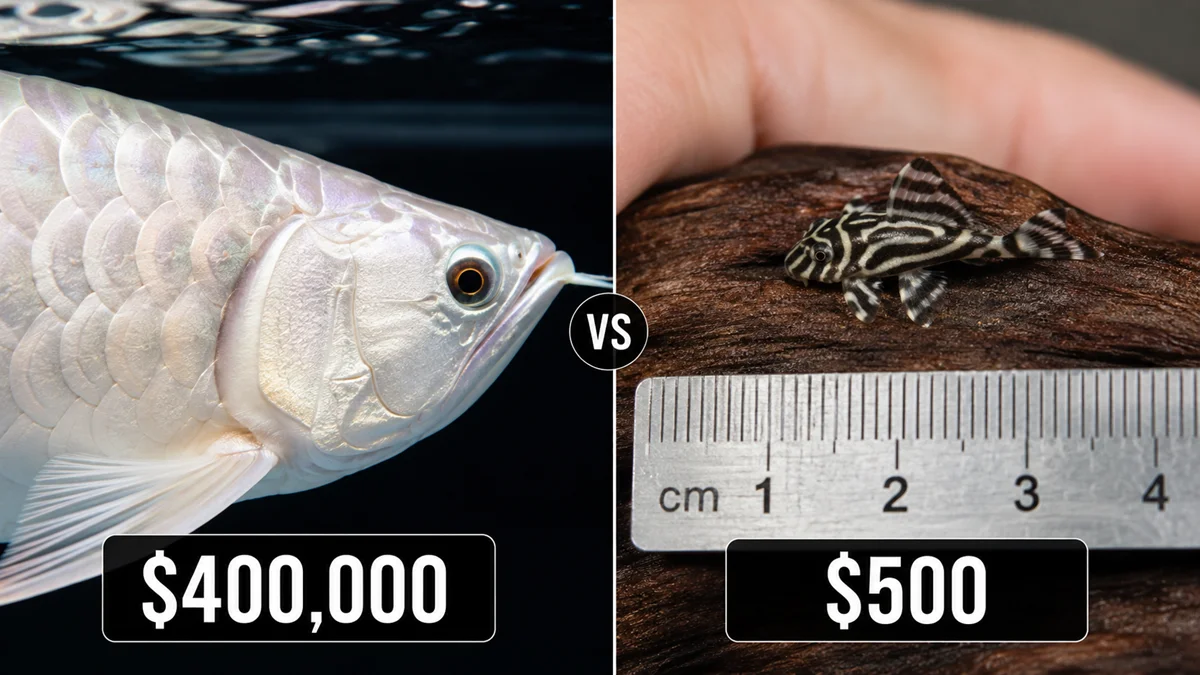
In my zoology coursework, the fish that got the most attention in class were rarely the ones that got the most attention at auction. That disconnect is the whole story of the most expensive freshwater fish in the hobby. A six-inch pleco can cost more per inch than a fish the size of your forearm. A “dragon” fish that’s supposed to bring good fortune is a federal crime to own in the US. None of this tracks the way price normally tracks in fishkeeping — and that’s exactly why it’s worth breaking down properly instead of repeating the usual “top 10 rare fish” listicle.
This isn’t a buying guide in the normal sense. Most readers here aren’t going to drop six figures on a fish. But understanding why these four command the prices they do tells you something real about rarity, genetics, and export law that applies even if you’re stocking a 20-gallon.
The Koi That Sold for $1.8 Million
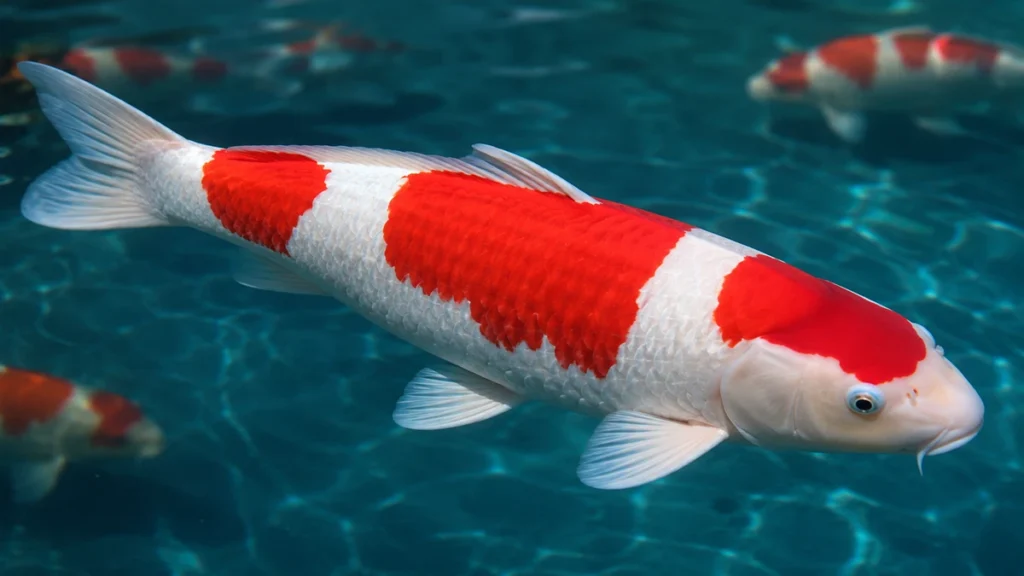
Start with the highest confirmed sale in the hobby: a Kohaku named S Legend, sold in 2018 at Sakai Fish Farm in Hiroshima, Japan, for $1.8 million, after an intense bidding war between collectors. The buyer, Ying Ying Chung, wasn’t gambling on an unknown — S Legend had already won Grand Champion at the All Japan Koi Show in 2017, so the price followed a documented competition record, not just good looks. Kohaku is the classic red-and-white pattern — the one most people picture when they think “Koi” — but the fish that command these numbers aren’t just pretty. Judges and breeders are grading:
- Pattern symmetry — the red (hi) patches need clean, balanced placement, not just “some red on white”
- Color purity — the white (shiroji) has to stay bright with no yellowing, and the red can’t be blotchy or fade toward orange
- Bloodline — top auction Koi trace back to specific breeder lines in Niigata, Japan, the same way a racehorse’s price depends on pedigree, not just how fast it currently runs
This is the one entry on this list that’s really an art-and-livestock market hybrid, closer to prize cattle breeding than typical aquarium keeping. Nobody’s putting a $1.8 million Koi in a standard pond without serious filtration, security, and insurance behind it.
Live Price Monitor: Price of Sakai Fish Online at the Chennai Aquarium.
Platinum Arowana: The $400,000 “Dragon” Fish
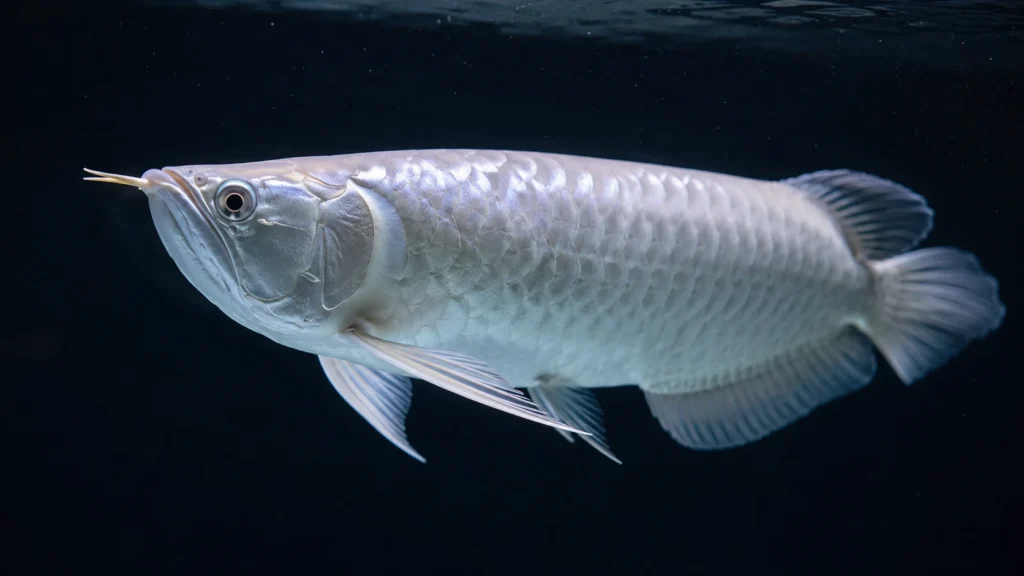
The Platinum Arowana is a pure white genetic mutation of the Asian Arowana (Scleropages formosus), and it’s the fish most likely to come up if you search “most expensive freshwater fish for aquarium.” Prices run up to $400,000 depending on scale, quality, and lineage.
Two things drive that number, and they’re different from each other:
Rarity is legally enforced, not just natural. Asian Arowana are CITES-listed due to their endangered wild status, which means every legally traded specimen needs CITES certification — microchipped, documented, traceable. You’re not buying a fish; you’re buying a fish with a paper trail.
Cultural demand adds a premium on top of biology. In parts of Asia, Arowana are kept as a status symbol and a “living dragon” believed to bring luck and wealth. That demand exists independent of the fish’s actual rarity, which is part of why platinum specimens — the whitest, most symmetric-scaled individuals — get bid up so aggressively.
Here’s the part most US-based content skips or gets wrong: owning a true Asian Arowana is illegal in the United States under the Endangered Species Act. Not “needs a permit” illegal — flat-out prohibited for the general public. If you’re in the US and see one for sale, either it’s misrepresented (likely a Silver Arowana, a different and legal species) or something’s off with the listing.
Live Price Monitor: ExpoMX Arowana Inventory Tracker.
Freshwater Polkadot Stingray: The $100,000 Outlier
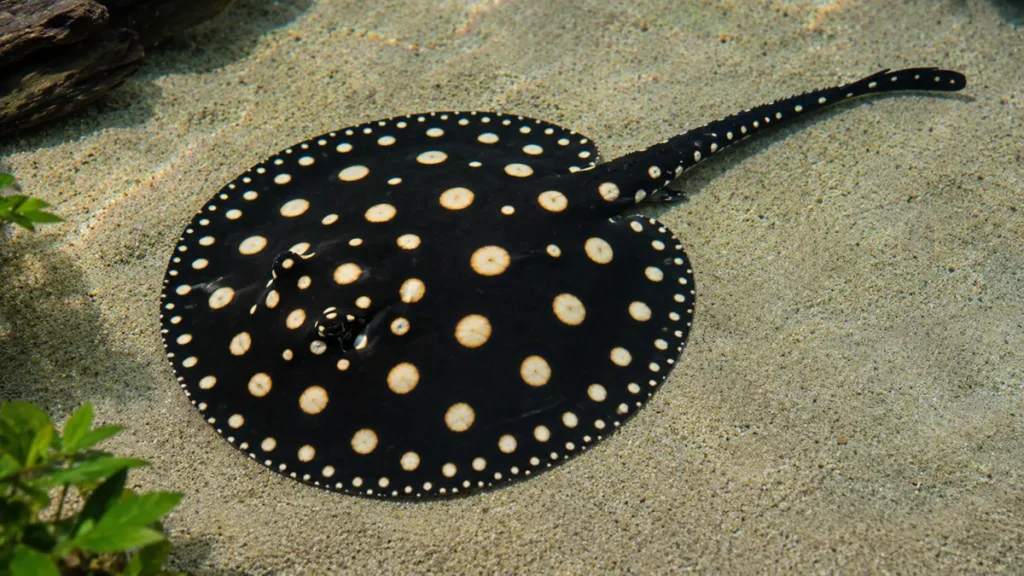
The Freshwater Polkadot Stingray, also called the Xingu River Ray (Potamotrygon leopoldi), is native to Brazil’s Xingu River. You’ll see “$100,000” attached to this species constantly, and it’s a real number — but it’s worth being precise about what it actually represents: a specimen shown at a Taiwan expo, notable for an unusual U-shaped head, not a symmetric spot pattern. It’s a one-off, not a price you should expect for a great-looking morph.
The realistic range for a genuinely striking Polkadot Stingray runs $1,500 to $20,000, depending on pattern quality and breeder. Still serious money for a fish — just not six-figure territory unless you’re chasing a physical anomaly rather than a pattern.
What separates this fish from the Koi and Arowana entries is that the price isn’t really about status. It’s about a genuinely brutal keeping requirement layered on top of rarity:
- Minimum tank size: 180 gallons for a single adult. Not a suggestion — the ray’s disc size and swimming pattern need floor space, not height. A tall tank does nothing for a stingray, and a mated pair needs meaningfully more than that.
- Venomous spine. Every water change, every net, every substrate cleaning is a task done with the ray’s tail position in mind. This isn’t a fish you multitask around.
- Acclimation risk compounds with rarity. Wild-caught rays already have a rough acclimation period. A wild-caught ray that also survives shipping and quarantine cleanly is a smaller pool than the pattern rarity alone suggests.
If you’re pricing out a Polkadot Stingray, the tank and life-support system usually cost more relative effort than the fish itself — even before you get anywhere near expo-outlier pricing.
Live Price Monitor: Predatory Fins Stingray Shop.
Zebra Pleco: The “Cheap” Fish That’s Actually the Rarest
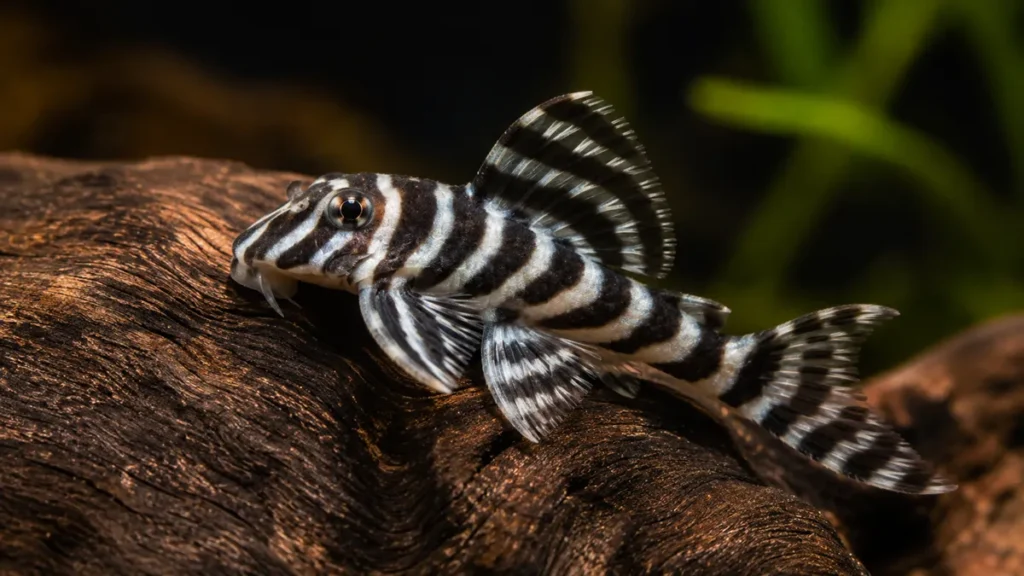
This is the one that surprises people. The Zebra Pleco (Hypancistrus zebra) isn’t priced in the hundreds of thousands — high-grade captive-bred or wild-caught specimens run $300–$600+. That’s real money for a fish that fits in your palm, but it’s nothing next to a six-figure Arowana.
Here’s why it still belongs on this list: the Brazilian government strictly restricted exports from the Xingu River after dam construction disrupted the species’ native habitat. That’s not a marketing rarity — it’s a supply that was deliberately, legally cut off at the source. Every Zebra Pleco in the trade now is either older wild stock or captive-bred, and captive breeding of this species is genuinely difficult, which keeps prices firm instead of collapsing the way “rare” fish prices often do once breeders catch up.
Per inch of fish, a $500 Zebra Pleco is arguably a better rarity-to-price ratio than a $400,000 Arowana. Worth sitting with, if you’re new to the luxury side of this hobby.
Live Price Monitor: AQUAStore Live L046 Portal.
Price Comparison Table
| Fish | Price Range | Native Range | What Drives the Price |
| S Legend (Kohaku Koi) | $1.8 million (2018 record sale) | Japan (bred) | Pattern symmetry, color purity, Grand Champion pedigree |
| Platinum Arowana | Up to $400,000 | Southeast Asia | CITES-restricted trade + cultural status demand |
| Freshwater Polkadot Stingray | Typically $1,500–$20,000 (rare outliers to $100,000) | Xingu River, Brazil | Pattern rarity + extreme keeping difficulty |
| Zebra Pleco | $300–$600+ | Xingu River, Brazil | Government export ban after dam construction |
The Legal Reality Nobody Puts in the Headline
The throughline across three of these four fish is Brazil and CITES — not a coincidence. The Xingu River alone produces two entries on this list (the Stingray and the Zebra Pleco) because a single piece of infrastructure, a dam, changed export law for an entire ecosystem’s worth of species. And the Arowana’s price isn’t just about beauty; it’s about the fact that in the US, wanting one and being legally allowed to own one are two completely separate things.
If you’re chasing rarity in this hobby, the honest takeaway is that legal restriction is a bigger price driver than most people assume — often bigger than the actual biological rarity of the fish itself.
FAQ
Why is arowana fish so expensive?
Arowana prices come from two separate forces stacking together: CITES restricts trade of the wild-endangered Asian Arowana, so every legal specimen needs certification and a paper trail, and Asian cultural demand treats the fish as a luck and wealth symbol, which pushes bidding well past what rarity alone would justify.
What makes the Platinum Arowana aquarium fish so rare and expensive?
Platinum coloration is a rare genetic mutation within an already CITES-restricted species, so breeders are selecting for a rare trait inside a small, legally controlled gene pool — that scarcity-on-scarcity is why platinum specimens sell for far more than standard-colored Asian Arowana.
What is the specialty of Arowana fish?
Arowana are prized for their large metallic scales, upward-facing mouth, and long barbels — features that resemble East Asian dragon imagery — plus a documented lineage and, in premium specimens, a microchip that authenticates the fish when sold.
Is it legal to own an Asian Arowana in the US?
No. True Asian Arowana (Scleropages formosus) are illegal to own in the US under the Endangered Species Act. If you see one listed for sale domestically, it’s very likely a Silver Arowana, a different and legal species — worth double-checking before you buy.
Why is a Zebra Pleco so expensive if it’s not endangered globally?
It’s not about global endangerment — it’s about a Brazilian government export restriction from the Xingu River following dam construction. That cut off wild supply directly, and captive breeding is difficult enough that prices haven’t come back down.
What tank size does a Freshwater Polkadot Stingray actually need?
Minimum 180–200 gallons, and that’s floor space, not just volume — rays need horizontal swimming room more than height. Anything smaller isn’t a long-term option for this species.
Do these prices reflect how hard the fish are to keep, or just how rare they are?
It’s a mix, and it varies by fish. The Stingray’s price ties closely to keeping difficulty (venomous spine, tank size, diet). The Koi’s price is almost entirely about pattern and pedigree, not difficulty — a Kohaku isn’t especially hard to keep relative to its price tag.
Is a Platinum Arowana the same fish as a regular Silver Arowana?
No — Platinum is a specific white genetic mutation of the Asian Arowana species, which is the CITES-restricted one. Silver Arowana is a different, unrelated, legally tradeable species in the US. Don’t assume “Arowana” on a listing means the same legal status.
Next Steps: Resources You Must Read (your standard 3-part CTA, closing section)
Scientific References
- CITES species database entry for Scleropages formosus
- IUCN Red List entries for Potamotrygon leopoldi and Hypancistrus zebra
Bottom line: Price in this hobby doesn’t track size or difficulty — it tracks legal restriction. Three of these four fish get their price tag from a law or a trade ban, not biology alone. A $500 Zebra Pleco is arguably rarer than a $400,000 Arowana. And if you’re in the US, owning the actual “most expensive” fish on this list (a true Asian Arowana) isn’t a budget problem — it’s a federal one.
Was this guide helpful?
First-Hand Experience
Based on animals I've personally kept and bred - not summarized from other articles.
Zoological Foundation
Claims are checked against my M.Sc. Zoology training and published aquatic biology research, not recycled aquarium myths.
No Paid Influence
No sponsorship shaped this guide. Affiliate links, if any, are disclosed separately and never hidden.
Kept Current
Errors are corrected as soon as they're found, with the update noted at the bottom of the article.

Anil Satak M.Sc. Zoology · Founder, FishioHub
Grew up in a fishing family in India and holds a Master's in Zoology. FishioHub is a one-person operation - every guide is personally researched, kept-tested, and written by Anil. No team, no outsourced writers, no AI-generated content. Read his full bio →