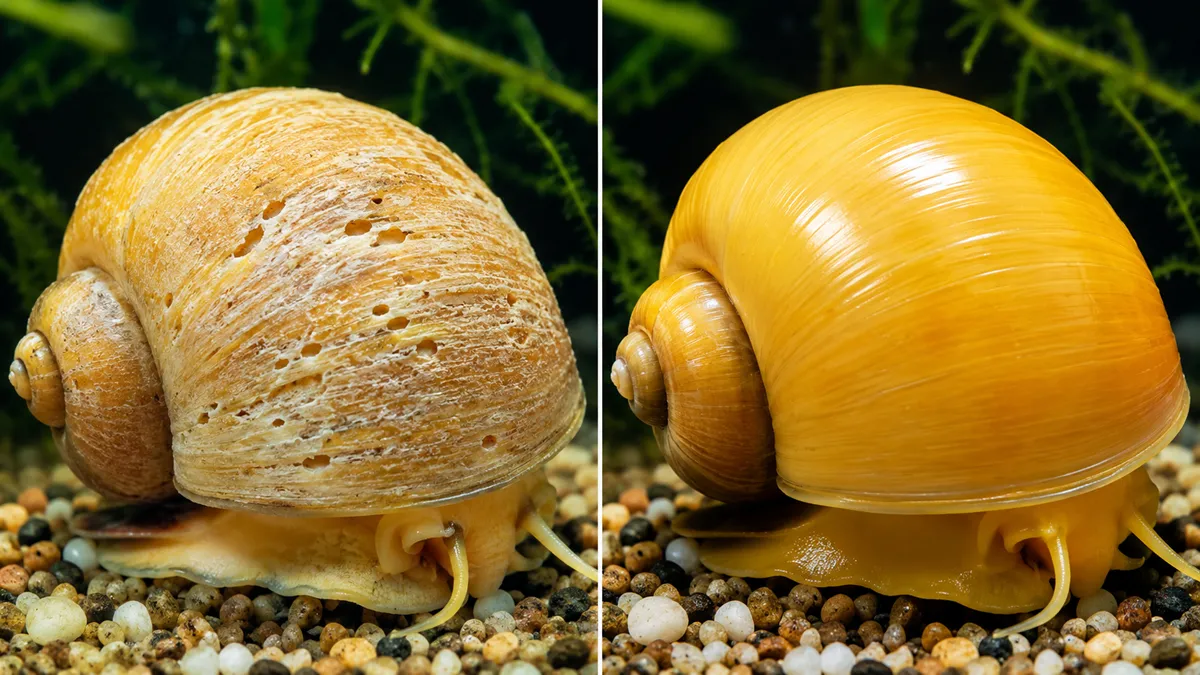
Honestly, gold mystery snail care isn’t complicated once you know the basics — you just need the water hard enough (GH above 150 ppm or so), keep it somewhere between 70–78°F, toss in some calcium-rich food now and then instead of just letting it graze algae, and give it around 5 gallons to itself. Do that, and you’re looking at 1–2 years, no drama.
I used to think mystery snails were foolproof until I found one of my golds looking like its shell had been sandblasted. I totally panicked and assumed it was some weird fungal disease. Turns out, it was just straight-up calcium starvation. Every generic care sheet out there calls these guys “easy beginner pets,” but they completely skip over this massive failure point.
What You’re Actually Keeping
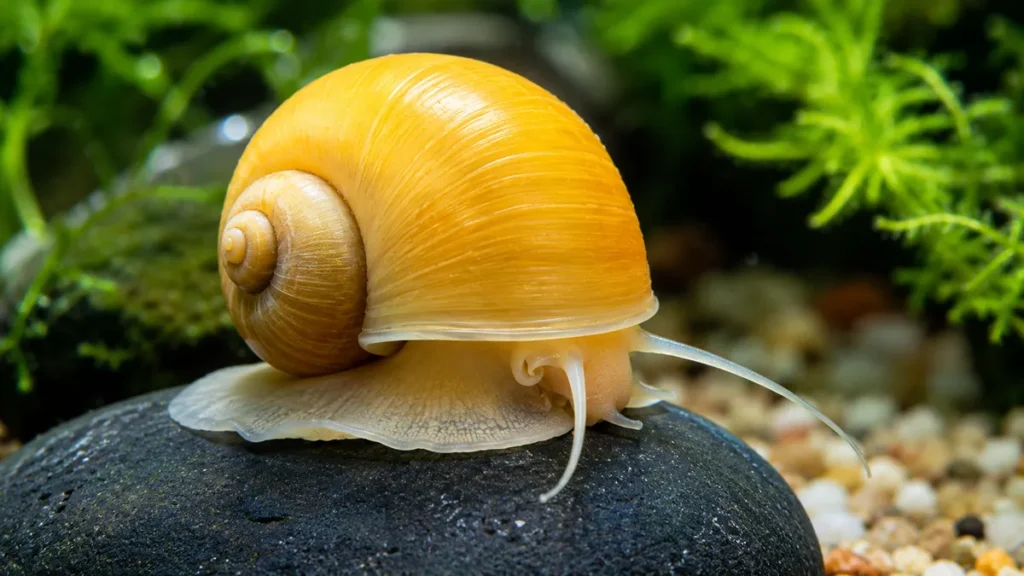
Gold mystery snail size tops out around 2 inches (5 cm) in shell diameter, reached over 9–12 months in a well-mineralized tank. The gold color comes from a lack of dark pigment in the shell and mantle — it’s a straightforward recessive color morph, not a sign of inbreeding or weakness, though breeders do note gold lines can run slightly smaller than the wild-type brown form.
Lifespan averages 1–2 years, occasionally longer in cooler water, since a lower metabolism slows aging. If yours dies at 8 months, look at temperature first — mystery snails kept consistently above 78°F (26°C) burn through their lifespan faster.
Water Parameters (Don’t Skip This Part)
This is where most gold mystery snail care guides miss, and snail deaths actually start, and it’s rarely mentioned with real numbers:
| Parameter | Requirement | Why it matters |
| Temperature | 70–78°F (21–26°C) | Higher-end speeds grow but shorten lifespan |
| pH | 7.2–8.0 | Below 7.0, shell erosion accelerates |
| GH (General Hardness) | 150+ ppm (8+ dGH) | Directly builds shell material — soft water = pitted shell regardless of diet |
| KH | 4–8 dKH | Buffers pH swings that stress the mantle |
| Tank size | 5 gallons minimum per snail | Bioload from waste production is higher than people expect from something this small |
If your source water is naturally soft (RO, rainwater-fed, or anywhere with GH consistently under 100 ppm), you need a remineralizer in the water column — not just calcium in the food. Snails pull calcium from the water to build their shells, and diet alone won’t fix a soft-water tank.
Gold Mystery Snail Food
They’re scavengers first, algae grazers second. In a tank with decent biofilm, a gold mystery snail will get by on leftover flake, dead plant matter, and algae film on the glass — but that’s a maintenance diet, not a growth diet.
For actual shell growth and to avoid the pitting problem above:
- Blanched spinach, kale, or zucchini once or twice a week
- Algae wafers or sinking pellets with visible calcium content
- Crushed calcium carbonate (unflavored antacid tablets work, but don’t overdo it — a pinch per week in a 10-gallon tank is plenty)
- Avoid relying on live plants as a food source — mystery snails will occasionally rasp on soft or melting leaves, not healthy ones, so if yours is shredding new growth, that’s a food shortage signal, not normal behavior.
What does gold mystery snail poop look like? Long, stringy, and often visibly colored by whatever they just ate — if you’re feeding orange or dark foods, don’t be alarmed by orange or dark waste trails on the glass. It’s cosmetic, not a health issue, unless it’s accompanied by the snail staying shut and unresponsive.
Gold Mystery Snail Eggs & Breeding
This is the part most guides get vague on. Mystery snails do not lay eggs underwater — the clutch is laid above the waterline, which is why a tight lid and reduced water level matter if you’re trying to breed them (or want to stop them).
To encourage breeding:
- Drop the water line 3–4 inches (8–10 cm) from the top of the tank.
- Increase feeding frequency for 1–2 weeks before you expect a lay.
- Keep a humid air gap under a tight-fitting lid — dry air causes the egg casing to harden and fail before hatching.
The clutch itself: pink to reddish when fresh, roughly the size and shape of a small elongated blackberry. It turns a duller, grayish-white color as it nears hatching — that color shift is normal, not a sign the eggs died, and it trips up a lot of first-time breeders who toss viable clutches.
Do gold mystery snails reproduce easily? Yes, if you have both sexes — and that’s the catch. Sexing juveniles under an inch is close to impossible without a lab-grade look at internal anatomy. The practical fix is buying a group of 5–6, since the odds of getting both sexes in that batch are high, rather than trying to sex two individuals at the store.
Hatch time runs 2–4 weeks depending on temperature, and the babies emerge as fully formed miniature adults — no larval stage to manage, which is one advantage over a lot of other freshwater invertebrate breeding projects.
If you want to stop breeding instead: keep the water within 1.5 inches (4 cm) of the rim so there’s no dry surface to lay on, and keep it to a single snail per tank since a female can store sperm for months after a single mating.
Gold Inca Snail vs Mystery Snail — Is There a Real Difference?
No. Every “vs” comparison searched for these pairs, the same species against itself under two names. The only genuine variation worth tracking is color morph (gold, ivory, purple, brown, blue, black) — those do carry minor, mostly anecdotal differences in growth rate and hardiness among breeders, but nothing established in peer-reviewed literature. Skip any guide that tells you gold and Inca have different care requirements; they don’t.
Tank Mates and What to Avoid
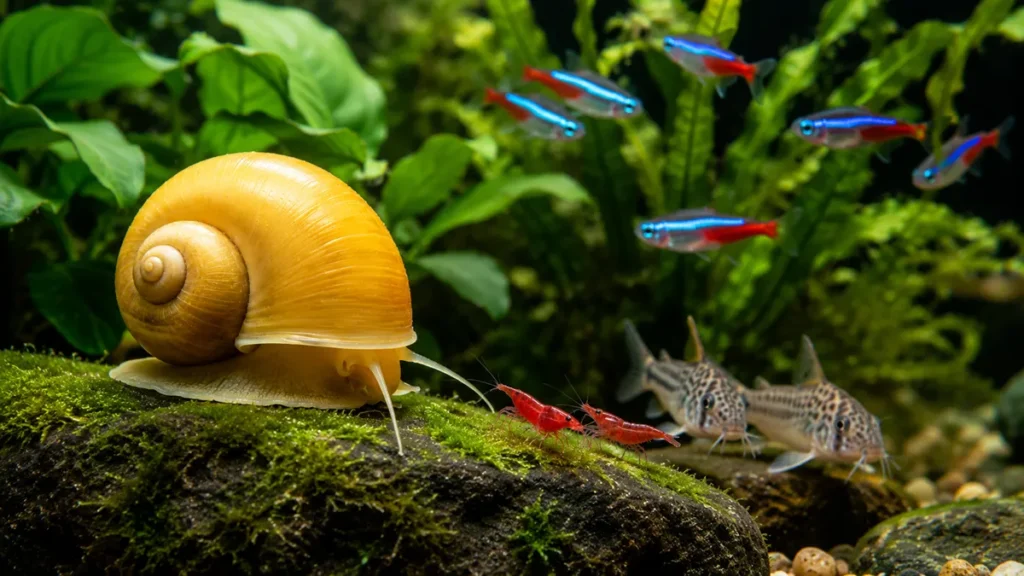
Peaceful community fish that tolerate harder, higher-pH water work fine — tetras, corydoras, calmer betta individuals, kuhli loaches. Skip anything in the loach family known for snail-cracking (clown loaches, dojo loaches), pufferfish, and larger cichlids that view a 2-inch shell as a snack with a built-in spoon.
Dwarf shrimp coexist without issue — mystery snails don’t prey on shrimp and mostly ignore them entirely.
FAQ
How do I know if my gold mystery snail is dead or just sleeping?
If it hasn’t moved in 24–48 hours, gently lift it out. A live snail usually reacts to being handled. A strong rotten smell means it’s gone — pull it immediately, since a decomposing snail will spike ammonia fast in a small tank.
Why is my gold mystery snail’s shell turning white or pitted?
Almost always low GH or inconsistent calcium supply — see the water parameters table above. It’s rarely a disease. Add a remineralizer and calcium-rich food, and new shell growth should come in smoothly within a few weeks, though existing pits won’t repair themselves.
Can gold mystery snails live with plants?
Yes, for the most part — they target dying leaves and biofilm, not healthy tissue. The one real exception is duckweed and other soft floating plants, which they will eat readily if hungry.
Do gold mystery snails need a filter?
Not strictly to survive, but they do need clean, oxygenated water — they’re heavier bioload producers than their size suggests. A sponge filter or pre-filter sponge over the intake also protects any baby snails from getting pulled into the filter.
How many gold mystery snails can I keep together?
One per 5 gallons is the safe baseline. Beyond that, you’re managing bioload, not just space — three or more adults in a 10-gallon community tank will push your nitrate cycle harder than most people expect from snails.
Next to Read
- Why your mystery snail might not be moving→ If your snail is inactive, read our diagnostic guide on why your mystery snail is not moving.
- Dwarf shrimp tank mates that won’t bother your snails → Before you add a gold mystery snail to your tank, know well their tankmates.
Was this guide helpful?
First-Hand Experience
Based on animals I've personally kept and bred - not summarized from other articles.
Zoological Foundation
Claims are checked against my M.Sc. Zoology training and published aquatic biology research, not recycled aquarium myths.
No Paid Influence
No sponsorship shaped this guide. Affiliate links, if any, are disclosed separately and never hidden.
Kept Current
Errors are corrected as soon as they're found, with the update noted at the bottom of the article.

Anil Satak M.Sc. Zoology · Founder, FishioHub
Grew up in a fishing family in India and holds a Master's in Zoology. FishioHub is a one-person operation - every guide is personally researched, kept-tested, and written by Anil. No team, no outsourced writers, no AI-generated content. Read his full bio →