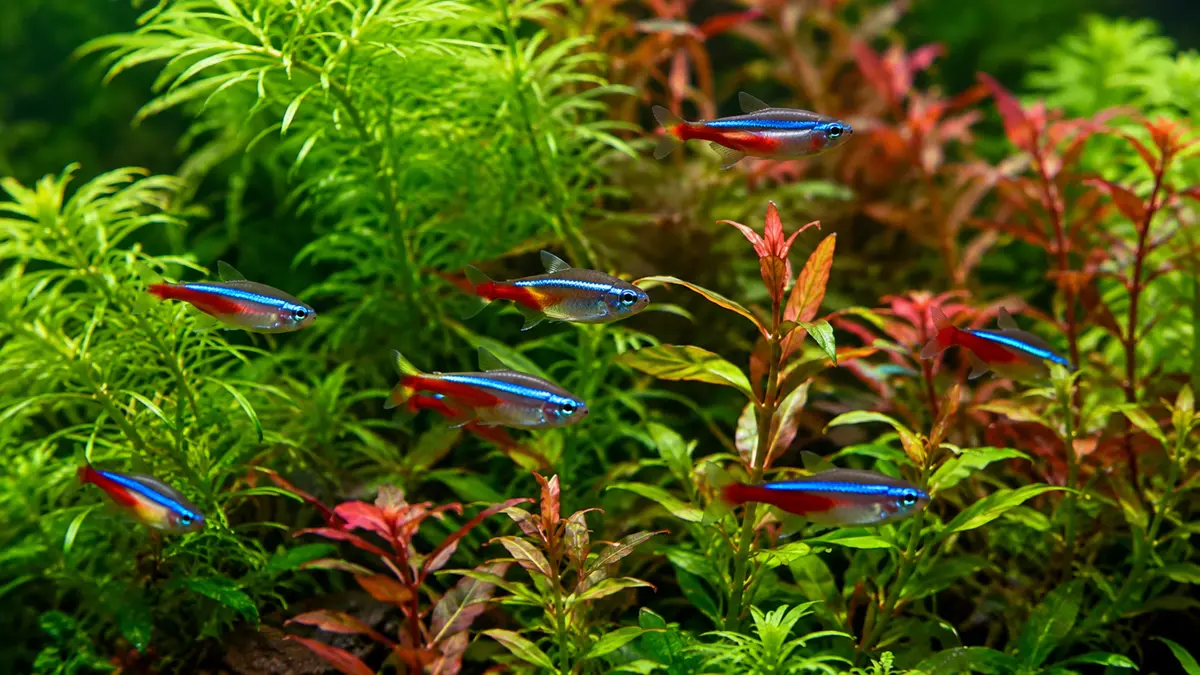
I used to make do with just a few plastic ferns in a tank that lacked real plants. But once I realized my mistake, I felt a bit foolish for having wasted so much time. Drawing on that experience, now sharing the real planted aquarium benefits that I experienced.
Here’s the direct answer: the biggest planted aquarium benefits are ammonia, nitrate, and co2 removal through the leaves, extra oxygen from daytime photosynthesis, cover for nervous or bullied fish, and starved-out algae that can’t compete for nutrients anymore. That’s the whole case in one sentence — everything below is just the proof.
Switching to live plants in my 40-litre tank instantly dropped nitrates from 40 ppm to 5 ppm. This completely cured my betta Raja’s frayed fins and stopped him from hiding.
If you only remember three things:
- Plants absorb ammonia through their leaves faster than through their roots — they’re cleaning the water, not just decorating it
- A well-planted tank forgives small mistakes; a skipped water change doesn’t spiral into an ammonia spike as fast
- Fish measurably calm down around plant cover. This isn’t hobbyist folklore — it shows up in cortisol data from lab studies
So What Are the Real Planted Aquarium Benefits?
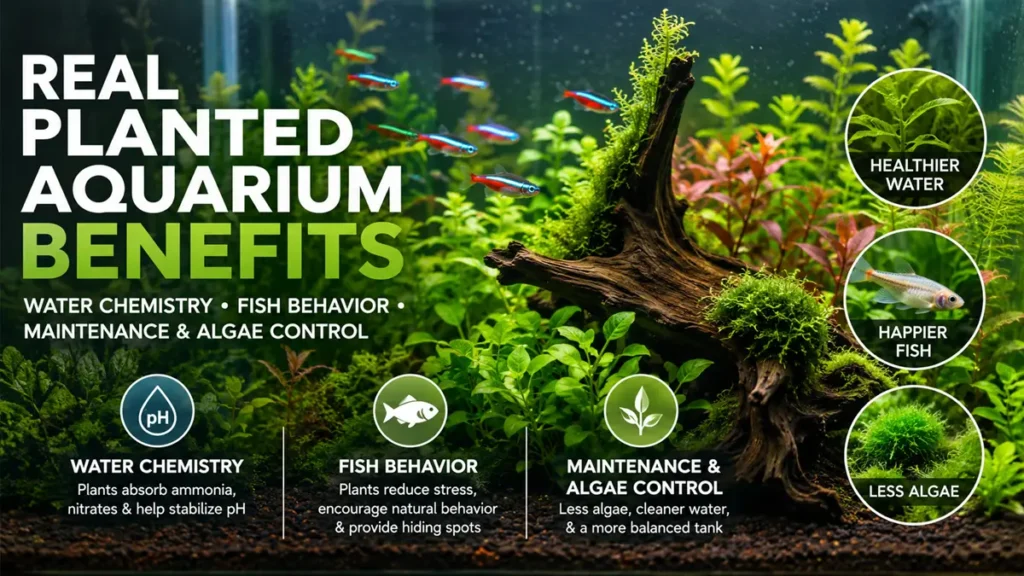
The planted aquarium benefits hobbyists talk about most fall into three buckets: water chemistry, fish behavior, and Tank maintanance-algae control. I’ll go through each one with the actual research behind it, not just what sounds nice on a forum post.
None of this requires CO2 injection or a fertilizer schedule to start seeing these planted aquarium benefits. Even a handful of low-tech stems does measurable work.
The Benefits of Live Aquarium Plants for Water Quality
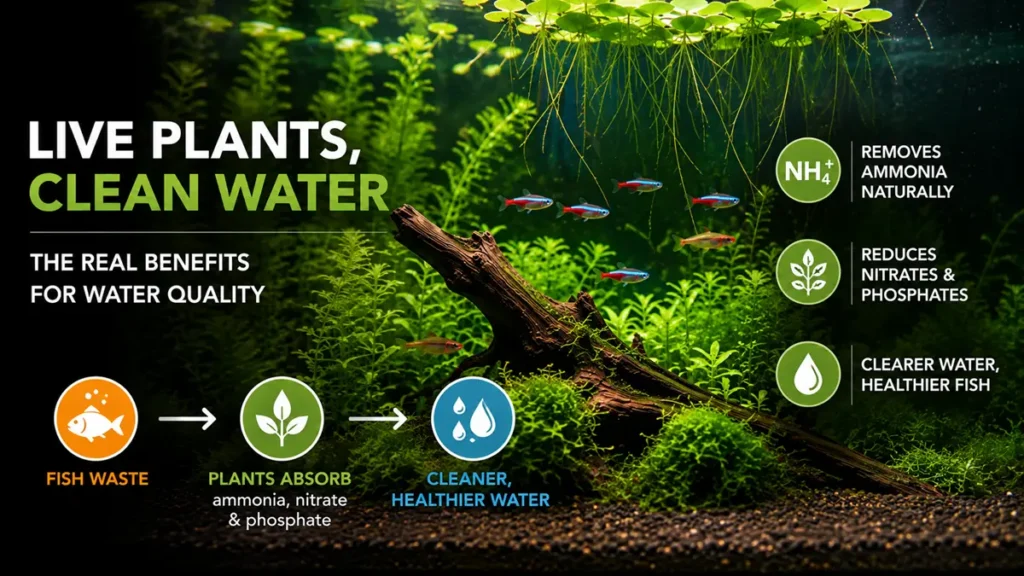
The benefits of live aquarium plants — one of the clearest planted aquarium benefits overall — start with something most beginners don’t expect: plants would rather eat your fish’s waste than pull nutrients from the substrate.
A 2024 study in the North American Journal of Aquaculture tested Najas grass and Java moss in aquarium-scale ornamental fish tanks. Both species measurably reduced nitrate and phosphate in the water, and Najas grass in particular showed fast, aggressive nutrient uptake.
Older nitrogen-uptake research explains why this works so fast. In split-chamber experiments on eelgrass, when ammonium was added to the leaf and stem zone, root uptake of ammonium dropped by 77 percent. The plant simply preferred grabbing it through the leaves first.
Translate that to your tank: your stem plants and floaters are pulling ammonia directly from the water your fish are breathing, before your biofilter bacteria even get involved. That’s a faster pathway than waiting on nitrifying bacteria alone, and it’s the main reason planted tanks cycle more smoothly.
The Benefit of Live Plants in Aquarium Stress and Behavior
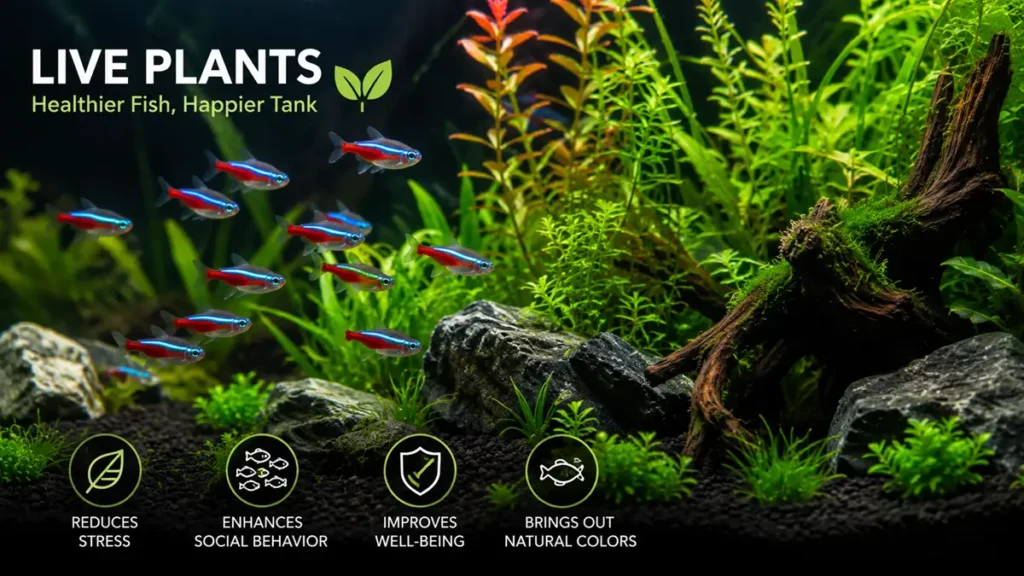
Water chemistry is only half the story. The other benefit of live plants in aquarium setups shows up in behavior, and this is the part that actually surprised me when I dug into the research.
Zebrafish labs have studied plant enrichment closely, mostly because research facilities have historically kept fish in bare tanks. The welfare data isn’t subtle. A 2022 review in the journal Zebrafish found that live and artificial aquatic plants improved fecundity, lowered stress, increased social behavior, and reduced anxiety-like behaviors in zebrafish.
The same review noted that plants let subordinate fish escape the constant pressure of a dominant tankmate.
A 2023 study measured this directly through water-borne cortisol. Fish moved into a physically enriched tank showed no significant rise in cortisol at all, unlike the barren-tank control group. Simple structure in the water reduced their stress response.
If your tetras look washed-out and jumpy in a bare tank but color up and school confidently once you add cover, that’s not your imagination. It’s measurable physiology.
Benefits of Live Plants in Fish Tank Behavior and Breeding
The benefits of live plants in fish tank setups show up in day-to-day behavior you’ll notice without any equipment. Shy species like corydoras and dwarf gouramis spend more time out in the open once they have a retreat available. Fry get somewhere to hide from adult fish that would otherwise treat them as a snack.
Egg-scattering species like tetras also get real spawning surfaces instead of laying on bare glass, where the eggs get picked off almost immediately. Floating plants like guppy grass or salvinia create a nursery layer near the surface that fry use for cover on instinct.
Fine-leaved plants like Java moss add something else: a biofilm layer newly hatched fry can graze on. None of this needs a dedicated breeding tank to start helping.
Heavily Planted Aquarium Benefits vs a Few Stray Stems
There’s a real difference between tossing in two or three plants and running a genuinely dense setup. The heavily planted aquarium benefits compound rather than just add up — more leaf area means more ammonia uptake, more shaded refuge, and more competition against algae for the same nutrient pool.
Here’s how the two approaches actually compare in practice:
| Factor | Lightly Planted (2–3 plants) | Heavily Planted (70%+ coverage) |
| Ammonia/nitrate buffering | Modest — still relies mainly on bacteria | Strong — plants compete directly with algae and biofilter |
| Algae pressure | Can still spike if light and nutrients drift out of balance | Algae struggles to get a foothold at all |
| Fish stress and hiding options | Limited refuge, more exposed swimming | Multiple hiding layers; subordinate fish can retreat |
| Maintenance | Lower plant upkeep, water changes matter more | More trimming and dosing, but the tank is more stable |
| Fry survival in community tanks | Low without a separate breeding tank | Noticeably higher — natural cover plus biofilm grazing |
Neither approach is wrong. A lightly planted low-tech tank still beats a bare one by a wide margin. But if your goal is a tank that forgives the occasional missed water change, density is doing real work for you.
Early on, I believed the myth that a few fake plants were enough as long as I had a strong mechanical filter. I underestimated how critical live plants are, leading to a massive ammonia spike in a new setup because I thought “good bacteria” in the filter could handle everything alone.
One myth worth killing here: plants don’t replace your filter or your water changes. They reduce how hard those systems have to work, and they widen your margin for error — they’re a supplement, not a substitute.
FAQ
What are the real planted aquarium benefits for a beginner tank?
The main planted aquarium benefits for beginners are a wider margin for error on water quality, less algae competing for nutrients, and visual cover that keeps fish calmer while you’re still learning to read your parameters.
Do live plants really lower ammonia in a fish tank?
Yes — live plants absorb ammonium through their leaves, often faster than through their roots, so they’re actively pulling it out of the water your fish live in.
Can heavily planted aquarium benefits include fewer water changes?
Plants slow down how fast ammonia and nitrate build up between changes, but they don’t remove the need for them — fish waste and uneaten food still accumulate no matter how many plants you have.
Do plants actually reduce fish stress, or is that a hobbyist myth?
It’s backed by data. Cortisol-based studies on enriched tanks found fish in planted or structurally complex environments showed a lower stress response than fish in bare control tanks.
What’s the benefit of live plants in aquarium setups with aggressive fish?
Plants create visual barriers and hiding spots, which let subordinate fish get out of a dominant tankmate’s sightline and cuts down on how often chasing happens.
Do I need CO2 injection to get the benefits of live plants in fish tank environments?
No. Low-light plants like Java moss, Java fern, and Anubias absorb nutrients and provide cover with zero CO2 supplementation.
Will live plants get rid of algae completely?
Not completely, but they compete with algae for the same light and nutrients, which usually cuts algae growth noticeably once the plants are established and actively growing.
Are floating plants worth adding if I already have substrate plants?
Yes. Floating plants like guppy grass or salvinia have exceptionally fast nutrient uptake and add a shaded surface layer that fish and fry both use as cover.
Next Steps: Resources You Should Read
Related FishioHub reading:
- How to Plant Freshwater Aquarium Plants — the hands-on planting guide to pair with this one
- How to Fertilize Aquarium Plants Naturally — for keeping your plants healthy enough to actually deliver these benefits
- Aquarium Plants That Don’t Need CO2 — a low-tech starting point if planted tanks are new to you
Scientific references:
- Removal of nitrate and phosphate by aquatic plants during aquarium-based ornamental fish production, North American Journal of Aquaculture
- Rearing in a Physically Enriched Environment Affects Shoaling and Stress Responses of Zebrafish
- Leaf-root ammonium uptake interaction, referenced via Nitrogen Uptake by Aquatic Plants (Diana Walstad)
USA aquarium resources:
- American Cichlid Association and local aquarium societies — many US clubs run plant trading tables
- University extension aquaculture programs — several state extensions publish freshwater plant and water-quality guides
- Established US live-plant retailers for verified, quarantine-safe stock
Closing
Every planted tank I’ve watched come together taught me the same thing: the planted aquarium benefits show up in the fish before they show up on a test strip. Add real plants, and you’ll see it. Fins relax, colors deepen, and fish that used to bolt for cover start living out where you can actually enjoy them.
Was this guide helpful?
First-Hand Experience
Based on animals I've personally kept and bred - not summarized from other articles.
Zoological Foundation
Claims are checked against my M.Sc. Zoology training and published aquatic biology research, not recycled aquarium myths.
No Paid Influence
No sponsorship shaped this guide. Affiliate links, if any, are disclosed separately and never hidden.
Kept Current
Errors are corrected as soon as they're found, with the update noted at the bottom of the article.

Anil Satak M.Sc. Zoology · Founder, FishioHub
Grew up in a fishing family in India and holds a Master's in Zoology. FishioHub is a one-person operation - every guide is personally researched, kept-tested, and written by Anil. No team, no outsourced writers, no AI-generated content. Read his full bio →