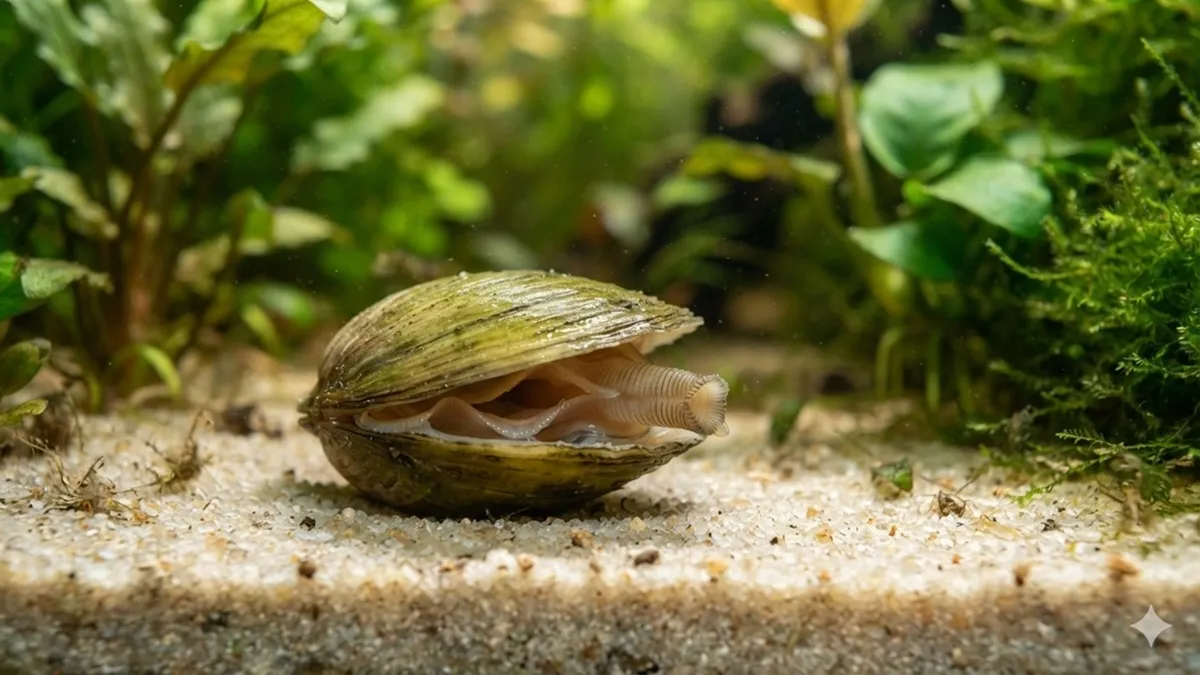
Freshwater mussels for aquarium tanks sound like the ultimate cleanup crew. The short answer: most native species are protected by law, hard to feed long-term, and rarely what a pet store actually sells you.
Quick answer: True native mussels (family Unionidae) need a fish host to reproduce and rarely survive long without live phytoplankton. What’s usually sold as an “aquarium mussel” is a different, non-native bivalve — knowing that difference before you buy is the whole game.
I still remember; once i bought three “aquarium mussels” thinking they would clean my tank. Instead, they buried themselves immediately, plowing through my substrate and uprooting my plants. They did clear up the water for a bit, but then one died hidden under the sand. The sudden ammonia spike nearly killed all my shrimp before I found it.
If you only remember 3 things:
- Native U.S. mussels are protected in most states. You generally can’t collect, possess, or sell them without a permit.
- What’s sold online as an “aquarium mussel” is almost always a non-native species like the Asian gold clam (Corbicula fluminea), not a true unionid.
- One mussel filters roughly 8–15 gallons of water a day U.S. Fish & Wildlife Service, but that power doesn’t translate cleanly into home-tank care.
What Are Freshwater Mussels?
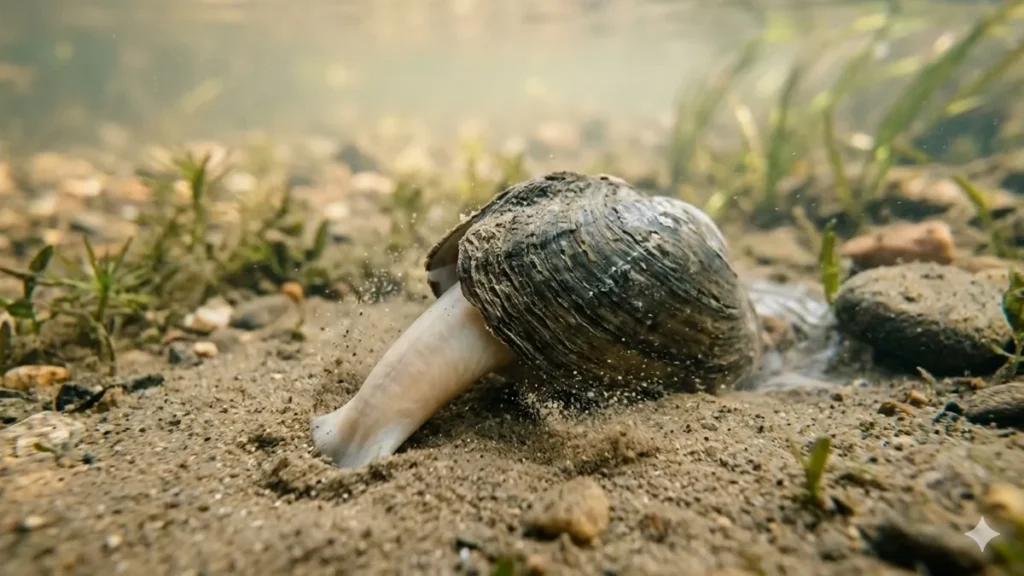
They’re bivalve mollusks in the order Unionida — cousins of the marine mussels on a dinner plate, but built for rivers and lakes instead of tide pools. More than 900 freshwater mussel species exist worldwide, and roughly 300 are native to North America Xerces Society.
Unlike snails, mussels have no head, eyes, or tentacles. A single muscular “foot” lets them burrow into sand or mud. Their gills pull both oxygen and food out of the passing water.
Types of Freshwater Mussels
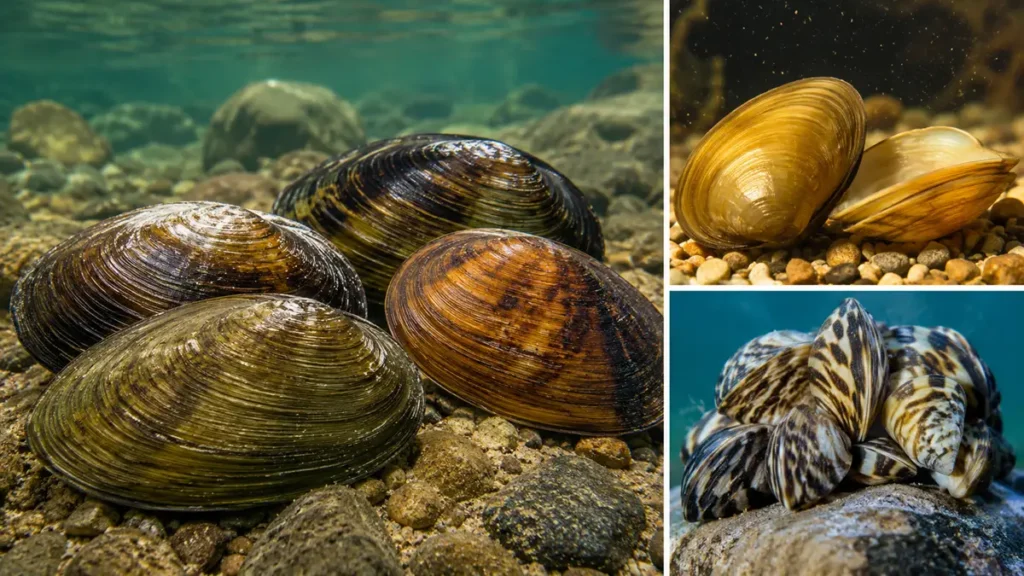
Most people picture one generic animal, but the diversity is enormous. North American genera range from the Eastern elliptio (Elliptio complanata), common along the Atlantic slope, to the western pearlshell (Margaritifera falcata), which can live for a century U.S. Fish & Wildlife Service.
Then there’s the group people actually meet in pet stores: invasive, non-native species like the Asian gold clam and zebra or quagga mussels (Dreissena spp.). They’re unrelated to true unionids but get lumped into the same search results.
Freshwater Mussels for Aquarium Tanks — Can You Actually Keep One?
Most care sheets go quiet here. A freshwater mussel sounds like a dream cleanup crew, but the reality is more complicated than “add water and watch it clear up.”
Long-Term Survival Is the Real Problem
Short-term, a mussel often does fine. Long-term, most don’t make it — even in a tank that looks perfectly healthy. Native species are filter-feeding specialists that need a steady supply of live phytoplankton, something a typical aquarium doesn’t produce in useful quantities, so they slowly starve in water that still looks crystal clear.
For true native species, keeping one for years the way you’d keep a mystery snail is genuinely difficult — and in many states it’s illegal without a permit. Mussel keepers know the pattern well: a slow, invisible decline followed by a sudden ammonia spike when the animal dies unnoticed. A mussel decomposing inside its shell is one of the fastest ways to crash water quality.
There’s a second wrinkle. Many species reproduce using glochidia, a parasitic larval stage that must attach to a specific host fish’s gills or fins to develop. In a mixed community tank, that can mean mild irritation to tankmates — not usually dangerous, but not something most fishkeepers plan for.
Freshwater Mussels Care
If you’ve decided to move ahead — with a legally obtained, non-native species rather than a wild-collected one — care comes down to four things: stable cool water, soft substrate, gentle flow, and a phytoplankton food source most fishkeepers aren’t set up for.
| Care Factor | What Mussels Need | Common Mistake |
| Temperature | ~68–72°F, stable | Warm tropical setups meant for bettas or tetras |
| Substrate | Soft sand or fine gravel | Bare-bottom or coarse gravel they can’t burrow into |
| Food | Live phytoplankton or green water | Assuming leftover fish food and algae wafers are enough |
| Water quality | Very stable, low nitrate | Sudden parameter swings during water changes |
| Tankmates | Peaceful fish, no aggressive bottom-dwellers | Loaches, puffers, and cichlids that eat or harass them |
I completely underestimated how much they eat. I assumed they would just filter out leftover fish flake dust and micro-algae from the glass, but they actually starved until I started target-feeding them live phytoplankton.
What Do Freshwater Mussels Eat?
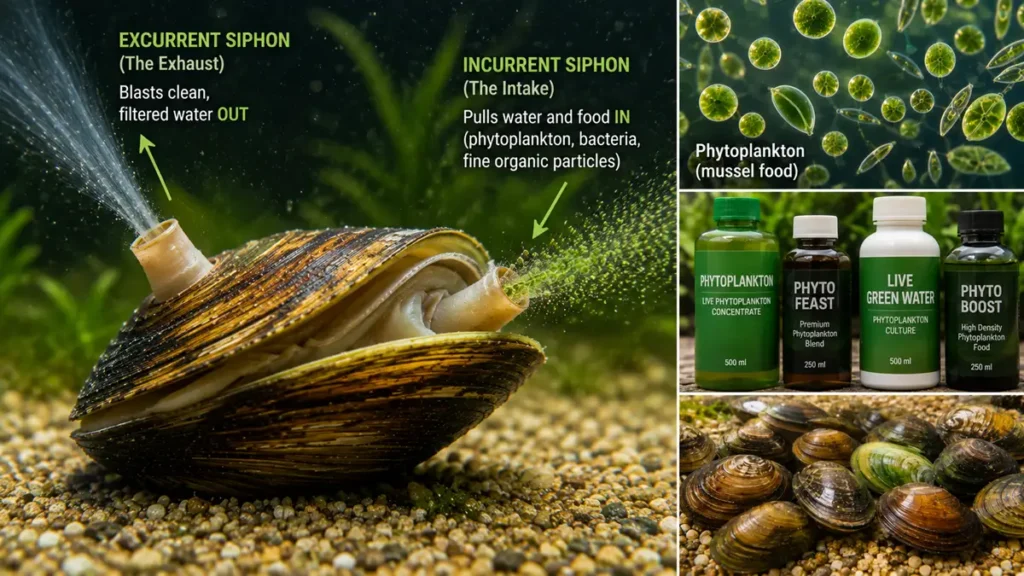
In one sentence: phytoplankton, suspended bacteria, and fine organic particles pulled directly from the water column. Not flake food, not algae wafers, and not fish waste in any meaningful quantity.
In the wild, mussels pull water through one siphon and expel it through another, straining out microscopic food as it passes their gills. In captivity, that means dosing green water cultures or commercial phytoplankton concentrates almost daily — a maintenance step most tank owners aren’t set up for, and a big reason long-term success stories stay rare outside dedicated setups.
Freshwater Aquarium Mussels, Shellfish, and What You’re Actually Buying
“Freshwater aquarium mussels” covers a wide range of animals in casual use. “Freshwater shellfish for aquarium” pulls an even broader mix, since retailers group clams, mussels, and crayfish together.
When freshwater aquarium shellfish is marketed specifically for algae or debris control, it’s almost always the Asian gold clam rather than a true mussel. That’s not automatically a dealbreaker — gold clams are legal in most (not all) states — but it’s worth knowing you’re not getting the animal from the nature documentaries.
Where to Buy Freshwater Mussels for Aquarium Use Safely
Freshwater mussels for sale online almost never means wild native Unionidae. Reputable sellers know that collecting or selling native mussels without a scientific or aquaculture permit is illegal in most states, so live tank-ready mussels are typically a cultured, non-native species instead.
Buying responsibly comes down to two steps: check your state wildlife agency’s rules first, then buy only from a seller who can confirm the exact species and its legal status where you live. A listing with no species name attached is a red flag, not a bargain.
Can You Eat Freshwater Mussels?
Technically, yes — some species are edible and were historically eaten by Indigenous communities as a traditional food source. This isn’t a “grab dinner from your tank” situation, though.
Wild native mussels are protected in most states, can bioaccumulate heavy metals and pollutants from the water they filter, and harvesting them without a permit is illegal across the vast majority of U.S. jurisdictions. This is a legal and conservation question first, a culinary one a distant second.
Do Freshwater Mussels Have Pearls?
Some species can, yes — the freshwater pearl mussel family is named for exactly that ability. Cultured freshwater pearls, grown commercially and mostly overseas, come from related species.
Wild North American mussels producing gem-quality pearls is rare, though, and cracking one open to check isn’t a responsible reason to collect a protected animal.
The Numbers Behind the Hype
- A single freshwater mussel filters between 8 and 15 gallons of water per day U.S. Fish & Wildlife Service.
- North America is home to roughly 300 native species out of more than 900 worldwide Xerces Society.
- Roughly 70% of North American mussel species are threatened, vulnerable, or endangered Virginia Chapter, The Nature Conservancy — one of the most imperiled animal groups on the continent.
FAQ
Are freshwater mussels for aquarium tanks legal to own?
It depends entirely on the species and your state. Non-native cultured species like Asian gold clams are generally legal to buy; native Unionidae are protected in most states and require a permit.
Are freshwater mussels good for a fish tank?
They improve water clarity through filtration, but most species are hard to feed correctly long-term.
Do freshwater mussels need a filter?
Yes. They supplement your tank’s mechanical and biological filtration — they don’t replace it — and still need stable water parameters like any other livestock.
Can freshwater mussels live with fish?
Many can, but skip loaches, puffers, and larger cichlids, which may eat or damage them. Some species also use fish as a temporary larval host.
How long do freshwater mussels live?
Lifespans vary enormously by species. Some live only a few years, while the western pearlshell can reach a century in the wild.
What eats freshwater mussels in a home tank?
Loaches, some catfish, crayfish, and larger cichlids will actively prey on smaller mussels, so tankmate selection matters as much as water parameters.
Why did my freshwater mussel die suddenly?
Slow starvation from inadequate phytoplankton is the most common cause, and it can look fine for weeks before a sudden decline. Remove any dead mussel immediately — decomposition spikes ammonia fast.
Next Steps: Resources You Should Read
Related FishioHub reading
- Types of Freshwater Aquarium Snails
- Small Freshwater Crabs for Aquarium
- Algae-Eating Fish for Freshwater Aquarium
Scientific references
- U.S. Fish & Wildlife Service — “Mussels: The Muscles of a Healthy Waterway” fws.gov
- U.S. Fish & Wildlife Service — “Western Pearlshell (Margaritifera falcata)” species profile fws.gov
- Xerces Society — “About Freshwater Mussels” xerces.org
- Virginia Chapter, The Nature Conservancy — “Mussels: Nature’s Original Water Filters” vcnva.org
USA aquarium resources
- Your state Department of Natural Resources / Fish & Wildlife agency (for species-specific possession rules)
- Xerces Society Western Freshwater Mussel Conservation program
- A local fish store or aquaculture-licensed vendor who can confirm species identity before purchase
Closing
Most “aquarium mussel” content sells the fantasy of a self-cleaning tank. The real story is quieter: these are some of the longest-lived, most quietly essential animals in North American waterways. The most respectful thing a hobbyist can do is understand them before bringing one home — or, just as often, deciding not to.
Was this guide helpful?
First-Hand Experience
Based on animals I've personally kept and bred - not summarized from other articles.
Zoological Foundation
Claims are checked against my M.Sc. Zoology training and published aquatic biology research, not recycled aquarium myths.
No Paid Influence
No sponsorship shaped this guide. Affiliate links, if any, are disclosed separately and never hidden.
Kept Current
Errors are corrected as soon as they're found, with the update noted at the bottom of the article.

Anil Satak M.Sc. Zoology · Founder, FishioHub
Grew up in a fishing family in India and holds a Master's in Zoology. FishioHub is a one-person operation - every guide is personally researched, kept-tested, and written by Anil. No team, no outsourced writers, no AI-generated content. Read his full bio →