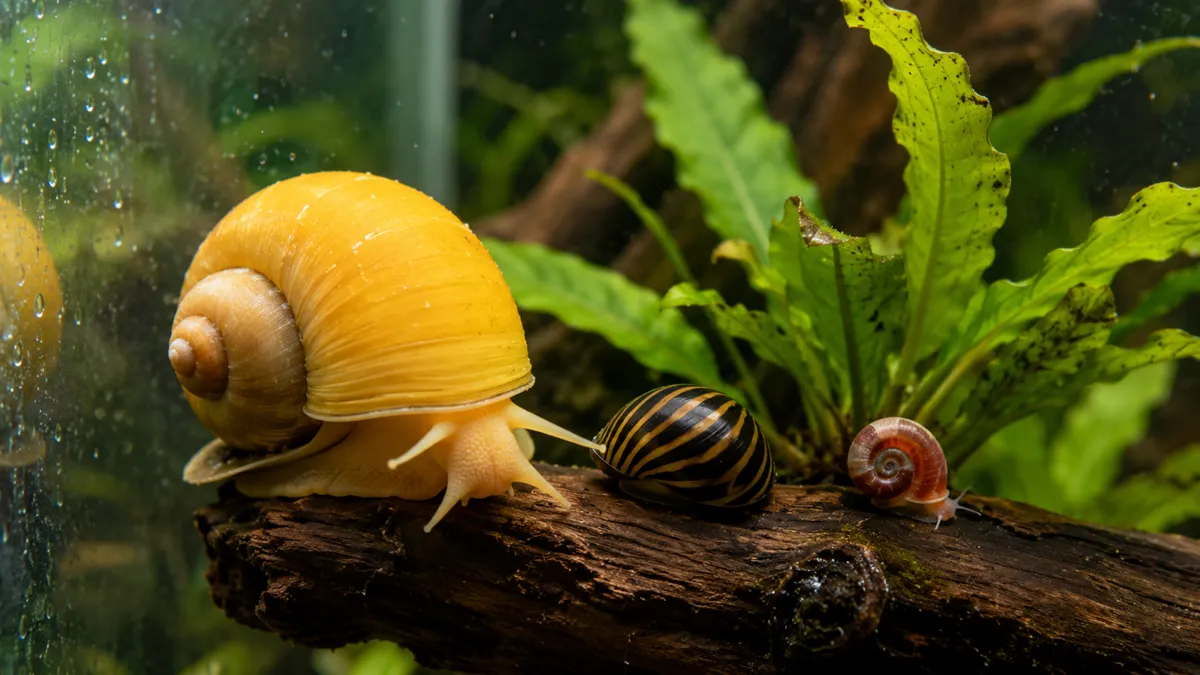
Stand in front of a fish store’s snail tank long enough, and you’ll ask yourself the same question every beginner does: which freshwater aquarium snails species won’t wreck my plants, bother my fish, or turn into two hundred snails by next month? Here’s the short answer.
Mystery, nerite, and rabbit snails are the safest picks for most tanks. Ramshorn and pond snails are the ones that sneak in and multiply. Apple snails need real research before you buy one, full stop.
I’ll never forget finding my golden mystery snail chilling on the carpet three feet away from the tank. He survived his midnight stroll completely unfazed, but it taught me a permanent lesson about keeping a tight lid.
If You Only Remember 3 Things
- Nerite snails are the best algae eaters, and they physically can’t overpopulate your tank. Their eggs need brackish water to hatch, so a freshwater setup stays egg-covered but snail-count-stable.
- Mystery snails are the friendliest, most colorful, and easiest of all the freshwater aquarium snails species for beginners. They’re gonochoristic (separate sexes), though, so two can become two hundred fast.
- Not every “aquarium snail” belongs in your tank. Apple snails (Pomacea maculata/canaliculata) are regulated invasive species in parts of the U.S. Releasing any aquarium snail into local waterways is illegal almost everywhere.
Types of Freshwater Aquarium Snails: A Quick Overview
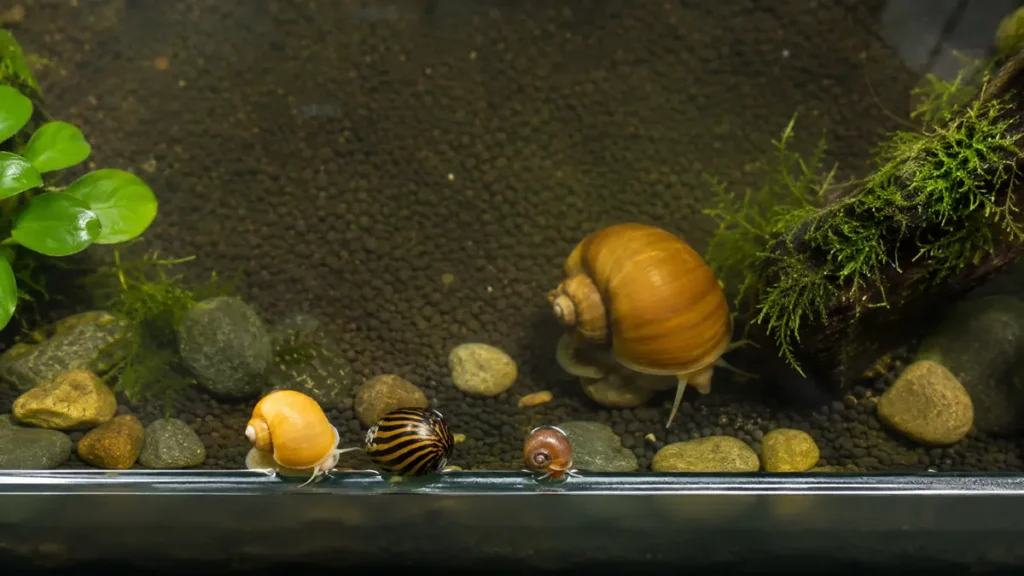
There are more types of freshwater aquarium snails than most beginners expect, and they split into two breathing groups. Gilled snails breathe through actual gills and stay submerged — nerites, mystery snails, and most apple snails fall here. Pulmonate snails breathe air through a modified lung and have to surface — that’s ramshorns, bladder snails, and pond snails, the ones you’ll find halfway up the glass at 2 a.m.
Freshwater aquarium snails types also split by why people keep them. There’s cleanup crew (nerites, mystery snails, Malaysian trumpet snails), pest control (assassin snails, which hunt other snails), and “started as a hitchhiker and now I have hundreds” — that last group is almost always ramshorn or pond snails.
Common Freshwater Aquarium Snails You’ll Actually See at the Store
The common freshwater aquarium snails sold in the U.S. hobby are a short list. Mystery snails (Pomacea bridgesii/diffusa), nerite snails (Neritina and Vittina species), ramshorn snails, Malaysian trumpet snails, rabbit snails (Tylomelania), and assassin snails cover roughly 90% of what you’ll be offered — intentionally or not. That short list accounts for nearly every freshwater aquarium snails species you’ll run into in the U.S. hobby.
Large Freshwater Aquarium Snails for Bigger Tanks
If you want large freshwater aquarium snails, mystery snails top out around 2 inches across. Rabbit snails and the giant ramshorn (Marisa cornuarietis) can approach golf-ball size in a mature, well-fed tank.
At the end, invasive apple snails such as Pomacea maculata are documented growing to roughly 4 inches across in the wild, with round shells made up of 4 to 5 whorls, according to the Alabama Cooperative Extension System’s Amazonian apple snail profile. That’s not a size you want appearing uninvited in a 20-gallon tank — which is exactly why sourcing matters (more on that below).
Best Freshwater Aquarium Snails Species (My Actual Picks)
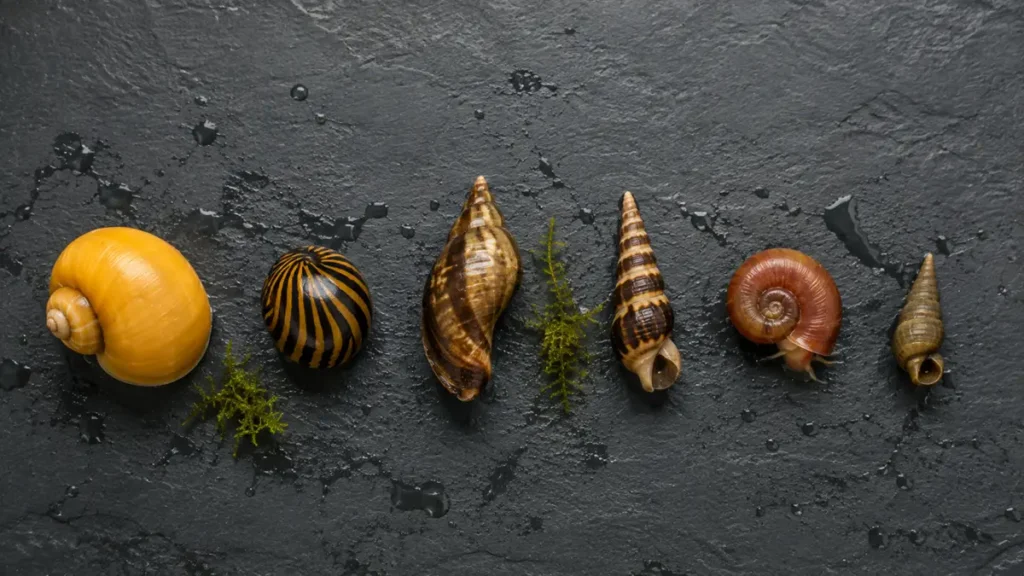
Here are the freshwater aquarium snails species I’d actually recommend, one at a time.
Mystery snails (Pomacea bridgesii/diffusa). Peaceful, colorful — yellow, blue, ivory, gold — and they actively forage on algae and leftover food instead of shredding live plants. That combination makes them probably the single best freshwater aquarium snails species for a first-timer.
A peer-reviewed life-history study on Pomacea bridgesii found hatching success averaged around 94.5%, with juveniles reaching sexual maturity roughly 192 days after hatching. Translation: get a male and a female, and you will have babies on a schedule.
Nerite snails. My pick for pure algae control. They devour diatoms and green film algae that mystery snails mostly ignore.
They also can’t take over your tank, since their eggs require brackish or marine conditions to hatch that a standard freshwater setup never provides.
Rabbit snails (Tylomelania species). Slow, social, and live-bearing — they release fully-formed baby snails one at a time instead of laying eggs. Pricier than the others, which naturally keeps numbers in check.
Assassin snails. Not a cleanup crew snail — a predator. If ramshorn or pond snails have taken over, assassin snails are the most reliable freshwater fix, hunting other snails down over a few weeks.
Ramshorn snails. Useful in small numbers, a headache in large ones. They’re simultaneous hermaphrodites, so a single hitchhiker on a plant can start a colony on its own.
Malaysian trumpet snails. Burrow through substrate and aerate it, rarely seen during the day, and reproduce both sexually and asexually. Another species that usually arrives free on a plant rather than bought on purpose.
Here’s how these freshwater aquarium snails species compare at a glance:
| Species | Best for | Breeds easily in freshwater? | Adult size |
| Mystery snail | Beginners, color variety | Yes (needs male + female) | Up to 2 in |
| Nerite snail | Pure algae control | No (eggs won’t hatch) | Up to 1 in |
| Rabbit snail | Community, slow tanks | Slowly (live-bearing) | Up to 3 in |
| Assassin snail | Pest snail control | Yes, but predatory | Up to 1 in |
| Ramshorn snail | Free cleanup, not recommended alone | Very easily (hermaphroditic) | Up to 1 in |
| Malaysian trumpet snail | Substrate aeration | Very easily (asexual + sexual) | Up to 1 in |
Ready to stock one of these? You can shop live snails at The Shrimp Farm — they ship direct with live-arrival guarantees, which matters more with snails than with almost anything else in the hobby.
Freshwater Aquarium Snails Care: The Basics That Actually Matter
Whichever freshwater aquarium snails species you choose, care comes down to three things most beginners skip: calcium, stable water parameters, and a lid.
Shell health depends almost entirely on dissolved calcium. Soft or acidic water (low GH) will pit and erode a shell over months even if everything else looks fine — a cuttlebone or crushed coral in the filter fixes this cheaply.
Ammonia and copper are the two silent killers. Copper-based medications dosed for fish will wipe out every snail in the tank, so always check labels before treating a community aquarium.
And yes, a lid matters. Mystery snails and apple snails are notorious escape artists when water quality dips — it’s instinct, driving them to seek fresher water or air.
Not only care but proper care is very important; Early on, I treated my fish for ich without checking the medication label. I saved the fish but wiped out my entire snail population overnight. It was a brutal lesson in just how sensitive they are to copper.
Snails Fish Aquarium Compatibility: Will They Hurt My Fish?
The most common worry I hear is whether snails and fish aquarium setups actually mix safely. For the freshwater aquarium snails species covered here, the answer is yes — mystery, nerite, and rabbit snails are peaceful scavengers that ignore healthy fish entirely.
The exception is bettas and some cichlids, which will occasionally nip at snail antennae out of curiosity or territory. It’s rarely fatal, but worth watching the first week.
Snails can, however, be eaten. Loaches, larger cichlids, and pufferfish are specifically kept by some hobbyists because they hunt snails, so pairing those species with a deliberate snail population defeats the purpose.
Picking the Right Freshwater Snail for Fish Tank Size and Goals
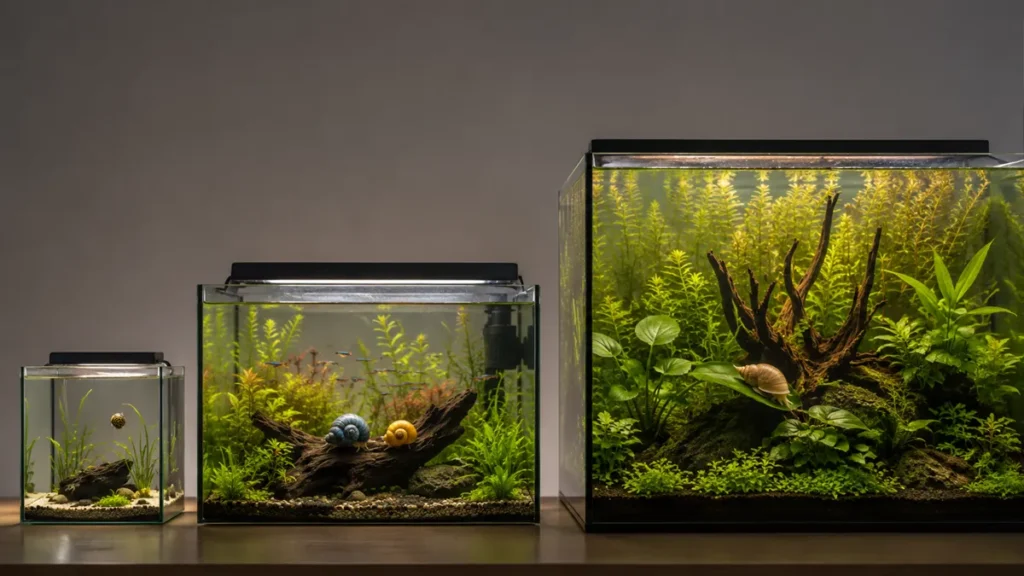
The right freshwater snail for fish tank setups depends more on tank size and goals than on looks. Under 10 gallons, stick to one or two nerite snails — small, efficient, and unable to overpopulate a nano tank.
In a 20-gallon-plus community tank, a small group of mystery snails adds color without any risk to your plants. If pest snails have already invaded, an assassin snail or two solves it without chemicals.
And if you specifically want large, characterful, low–reproduction snails for a mature planted tank, rabbit snails are the freshwater snail for fish tank setups built around slow-stocked aquascapes.
Where to Find Live Freshwater Aquarium Snails for Sale
Live freshwater aquarium snails for sale are easiest to source from a local fish store where you can see the animal before buying, or from a specialist online retailer that ships direct and guarantees live arrival. I’ve bought both shrimp and snails from The Shrimp Farm and had good experiences with their live-arrival policy.
Whatever the source, quarantine new snails for at least a week before adding them to an established tank. It’s the single best way to avoid importing pest snail eggs, parasites, or medicated-water residue along with the animal you actually wanted.
FAQ
What is the best freshwater aquarium snail for beginners?
Mystery snails are the easiest freshwater aquarium snails species for beginners — hardy, colorful, and simple to feed on algae wafers and blanched vegetables.
Which freshwater aquarium snails species multiplies the fastest?
Ramshorn and pond snails, by a wide margin. Both are simultaneous hermaphrodites, so a single individual can start a full colony without a mate.
Do freshwater aquarium snails need a filter?
Yes. Snails add to a tank’s bioload and are sensitive to ammonia spikes, so stable filtration and regular water changes matter as much for snails as for fish.
Can freshwater aquarium snails live with betta fish?
Generally yes — nerite and mystery snails coexist peacefully with most bettas, though occasional fin-nipping toward antennae can happen and is worth monitoring.
How do I stop freshwater aquarium snails from taking over my tank?
Cut back on feeding, since excess food drives reproduction. Manually remove visible egg clutches, or add an assassin snail to hunt down an existing pest population.
Are large freshwater aquarium snails dangerous to keep?
Some are legally restricted. Apple snails in the genus Pomacea are classified as invasive in parts of the U.S., so check your state’s regulations before buying any large apple snail species.
What do freshwater aquarium snails eat?
Algae, biofilm, leftover fish food, blanched vegetables like zucchini and spinach, and calcium-rich supplements for shell health.
How long do freshwater aquarium snails live?
It varies by species. Mystery snails typically live 1–3 years in captivity, while nerite snails tend to live 1–2 years under good care.
Next Steps: Resources You Should Read
Related FishioHub reading
Scientific references
- Alabama Cooperative Extension System — Amazonian Apple Snail species profile
- Arkansas Game & Fish Commission — Aquatic Nuisance Species (ANS) apple snail profile
- Peer-reviewed life-history study on Pomacea bridgesii reproductive biology and aquaculture potential
USA aquarium resources
- The Shrimp Farm — U.S. specialist retailer for live snails, direct-shipped with a live-arrival guarantee
Closing
Snails don’t ask for much — a little calcium, a lid, and a tank you’re not medicating with copper. In return, they quietly do work most of us forget needs doing.
Pick the right freshwater aquarium snails species for what you actually want, and a tank full of snails stops being a problem to solve. It becomes one of the most relaxing things to watch in the whole aquarium.
Was this guide helpful?
First-Hand Experience
Based on animals I've personally kept and bred - not summarized from other articles.
Zoological Foundation
Claims are checked against my M.Sc. Zoology training and published aquatic biology research, not recycled aquarium myths.
No Paid Influence
No sponsorship shaped this guide. Affiliate links, if any, are disclosed separately and never hidden.
Kept Current
Errors are corrected as soon as they're found, with the update noted at the bottom of the article.

Anil Satak M.Sc. Zoology · Founder, FishioHub
Grew up in a fishing family in India and holds a Master's in Zoology. FishioHub is a one-person operation - every guide is personally researched, kept-tested, and written by Anil. No team, no outsourced writers, no AI-generated content. Read his full bio →