
I still remember watching a school of Cardinal Tetras in their natural Amazon blackwater habitat—thousands of tiny fish moving together like a glowing ribbon of blue and red. That moment made me realize why these fish are so popular in aquariums worldwide.
But here’s what usually happens in real life. You walk into a Petco or PetSmart in the U.S., see Neon Tetras and Cardinal Tetras side by side, and instantly wonder: “Cardinal Tetra vs Neon Tetra– Which one should I actually buy?”
Quick answer:
In the cardinal tetra vs neon tetra comparison, cardinal tetras have brighter, full-body red coloration and perform better in stable, planted tanks. In contrast, neon tetras are cheaper, more beginner-friendly, and adapt more easily to typical U.S. tap water. However, neons are generally more susceptible to Neon Tetra Disease and slightly more sensitive to water quality fluctuations. If you have a mature 20+ gallon tank with soft, acidic water, cardinals are the better choice, for smaller 10 to 15 gallon setups or beginners, neon tetras are the safer option. Both species can live together peacefully in the right conditions.
After keeping both species in my own tanks and observing their behavior over time, I’ll break down exactly cardinal tetra vs neon tetra which is better for you—without the usual “it depends” confusion.
If You Are in a Hurry — What Should You Buy?
Buy Neon Tetra if:
- You are a beginner or have a smaller tank
- Your budget is low, under $3 per fish
- Your tap water is neutral to slightly hard
- You want fish that adapt quickly and forgive mistakes
Buy Cardinal Tetra if:
- You have a well-matured and planted tank, 20 gallons or larger
- You want the most visually stunning schooling fish available
- You have soft acidic water or use RO water
- You are an intermediate hobbyist comfortable with stable parameters
You Can Buy Both if:
- Your tank is 30 gallons or larger with mature and dense planting
- You want a mixed schooling display
What You’ll Get in This Post
- How to tell them apart — the one visual trick that works every time
- Size comparison — does it actually matter?
- Cardinal tetra vs neon tetra hardiness — the truth
- Neon Tetra Disease — the risk most guides skip
- Water parameters — where the real difference lies
- Cardinal tetra vs neon tetra care comparison
- Cardinal tetra vs neon tetra breeding
- Price in the USA — what you actually pay
- Which is better for a planted tank?
- Can they live with shrimp?
- Full comparison table
- FAQs
How to Tell Them Apart — The One Visual Trick That Works Every Time

From a distance, Neon Tetras and Cardinal Tetras look almost identical, and many beginners often mistake one for the other when making a purchase. So, first and foremost, I want to clear up the confusion that leads most people to seek information on this topic.
The most reliable way to distinguish between the two is by observing the red stripe. Take a close look at the lower portion of the fish’s body:
Cardinal Tetra (Paracheirodon axelrodi): The red stripe extends continuously from just behind the eye all the way to the tail. The entire lower section of the body is red. When you look at a Cardinal Tetra, you see a solid band of red stretching from its nose right back to its tail.
Neon Tetra (Paracheirodon innesi): The red stripe covers only the rear half of the body, extending roughly from the midpoint of the fish to the tail. The front portion of the Neon Tetra’s lower body is white, not red.
It really is that simple. A full red stripe running from eye to tail means—Cardinal. A half-stripe starting from the middle of the body means—Neon.
There is one other difference you might notice: the body shape of the Cardinal Tetra is more rounded and torpedo-like, appearing somewhat more uniform in contour. The belly of a female Neon Tetra is often slightly rounder, which causes a subtle kink or curve in her blue stripe. This is a subtle distinction that is typically only spotted by experienced aquarists.
Key Differences Between Neon Tetra and Cardinal Tetra
1. Color & Appearance (The Biggest Visual Clue)
As we earlier discussed, this is the biggest difference between the neon and cardinal tetra.
- Cardinal tetra: Bright red stripe runs from head to tail ( through the full body)
- Neon tetra: Red stripe only covers the lower half ( through the half body)
In my experience, cardinal tetras look more “premium” under aquarium lighting, especially in planted tanks. Their colors pop like crazy. If you love aesthetics aquarium, go for cardinals.
2. Cardinal Tetra vs Neon Tetra Size Difference
- Cardinal tetra grows slightly larger (up to ~2 inches)
- Neon tetra stays smaller (~1.5 inches)
Both fish are small, and the slight difference in size has no significant impact on the tank’s conditions. In fact, once both species reach adulthood, the difference in size becomes almost negligible. Visually, however, the Cardinal Tetra appears slightly more robust, while the Neon Tetra looks more delicate.
3. Natural Habitat Insight (Important for Care)
I have often noticed that hardly anyone discusses the natural habitats of Cardinal and Neon Tetras; yet, when you intend to keep them in your aquarium, this information matters.
- Cardinal Tetras originate from the ‘blackwater’ rivers of the Amazon.
- Neon Tetras come from clear-water streams.
According to research by the National Oceanic and Atmospheric Administration (NOAA), blackwater environments are characterized by low pH, high tannin content, and chemical stability.
Cardinal Tetra vs Neon Tetra Hardiness — The Honest Truth
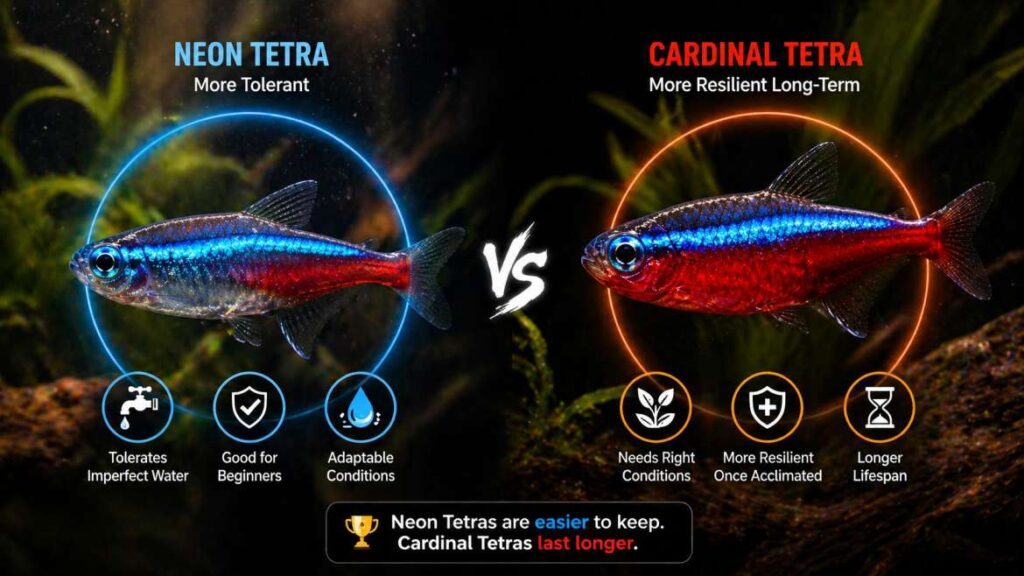
This is precisely where I encounter the most contradictory information online. The common perception is that Neon Tetras are more tolerant. And this is indeed true: Neon Tetras can withstand a wide range of water parameters, particularly pH and hardness, because they have been commercially bred in captivity for generations. Consequently, they are well-adapted to the conditions typically found in home aquariums across the United States.
However, here is the point that most guides completely overlook.
Most Neon Tetras sold in the U.S. are bred on commercial farms, primarily located in Southeast Asia. As a result, these Neon Tetras are genetically weaker, more susceptible to disease, and more delicate than their wild ancestors.
In contrast, Cardinal Tetras are primarily wild-caught from the blackwater river systems of the Rio Negro and Upper Orinoco regions in South America. While wild-caught fish require extra care when introduced to an aquarium environment, they prove to be exceptionally hardy. Many experienced aquarists note that a school of properly acclimated Cardinal Tetras, once established, tends to live for a very long time.
Real-world data from “Glass Box Diaries,” a respected aquarium blogger who meticulously tracked the outcomes in his own tanks, reveals that despite their greater tolerance for varying water conditions, Neon Tetras actually suffer higher mortality rates; a phenomenon frequently observed within the U.S. aquarium hobbyist community.
The honest conclusion is this: Neon Tetras tolerate imperfect water conditions more readily, making them a superior choice for beginners. However, Cardinal Tetras, once properly acclimated to the right conditions, prove to be the more resilient and long-lived fish in the long run.
Neon Tetra Disease — The Threat Most People Overlook
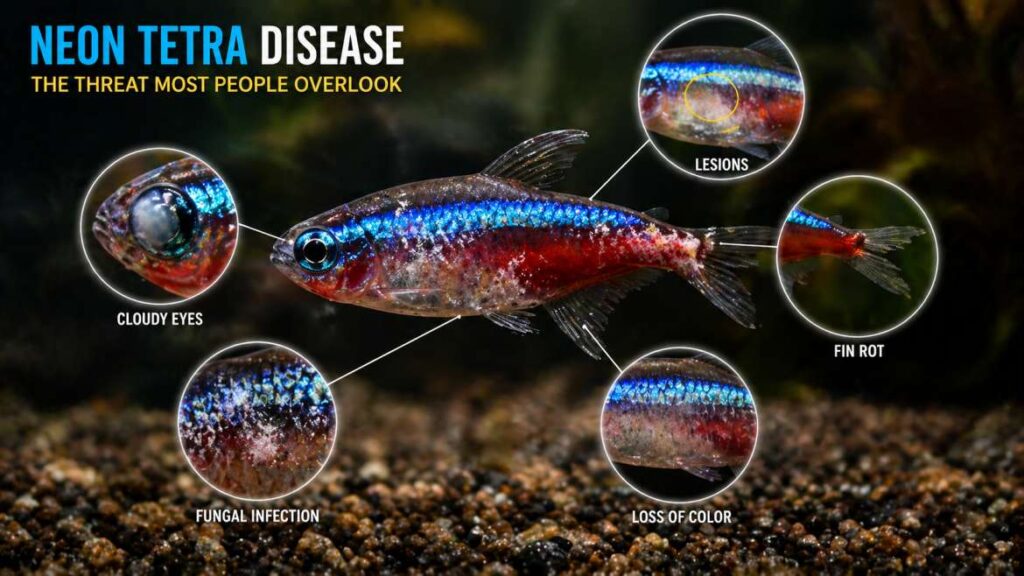
Although Neon Tetras are generally hardy, there is one crucial fact that most care guides fail to mention—and it matters significantly.
Neon Tetra Disease (NTD) is a lethal parasitic infection that attacks fish from the inside. There is no definitive cure for it, and once it takes hold, it can rapidly wipe out an entire school of fish.
Early Symptoms: If you observe signs in your aquarium such as fading or patchy coloration (particularly along the blue stripe), white or gray spots, spinal curvature, bloating, or weak/erratic swimming behavior, a fish can go from looking “perfectly fine” to “dead” in just a matter of days.
The Reality:
Neon Tetras are at a higher risk (largely due to mass-breeding practices, which increase their likelihood of exposure to disease).
My Personal Advice:
- Always quarantine Neon Tetras (for 2–4 weeks).
- Never introduce a fish that appears even slightly unwell.
- Cardinal Tetras also require quarantine, though primarily to ensure safe acclimation to their new environment.
Conclusion:
Neon Tetras are easy to keep, but they carry a higher risk of disease. If cared for properly, Cardinal Tetras represent a safer, more reliable choice for the long term.
Neon vs Cardinal Tetra Water Parameters — Real Difference
Neon Tetra (Flexible): Works fine in most U.S. tap water with basic dechlorination, adapts to water conditions.
- pH: 6.0–7.5
- Hardness: 1–10 dGH
- Temp: 70–81°F
Cardinal Tetra (Sensitive): Needs soft, acidic water to thrive, needs you to make them adapt.
- pH: 4.5–6.5 or RO water or Indian Almond leaves (Catappa)
- Hardness: 1–6 dGH
- Temp: 73–81°F
What this means for you:
- Soft water areas (PNW, Southeast, New England): Cardinal tetra are easier
- Hard water areas (Midwest, Southwest, like Texas, Arizona): Neon tetra are safer
Cardinal Tetra vs Neon Tetra Care
Day-to-day care is almost the same for both. Care is easy for both; just keep it natural, planted, and stable.
Feeding: both cardinal and neon are omnivores, loves high protein foods. You can feed them flackes, micro pallets, brine shrimp, dalphia, etc. Feed twice daily in a small amount.
Tank Setup: Cardinal and neon tetra prefer plants aquarium setup, low light, and dark substrate. Add Java moss, floating plants, and driftwood. Colors look much brighter in natural setups. Keep at least 6, ideally 10+. They can be kept together in larger tanks
Tank Mates (USA setups): They can gel peacefully with corydoras, rasboras, dwarf gouramis, and small livebearers. Don’t add angelfish with tetra.
Cardinal Tetra vs Neon Tetra Breeding
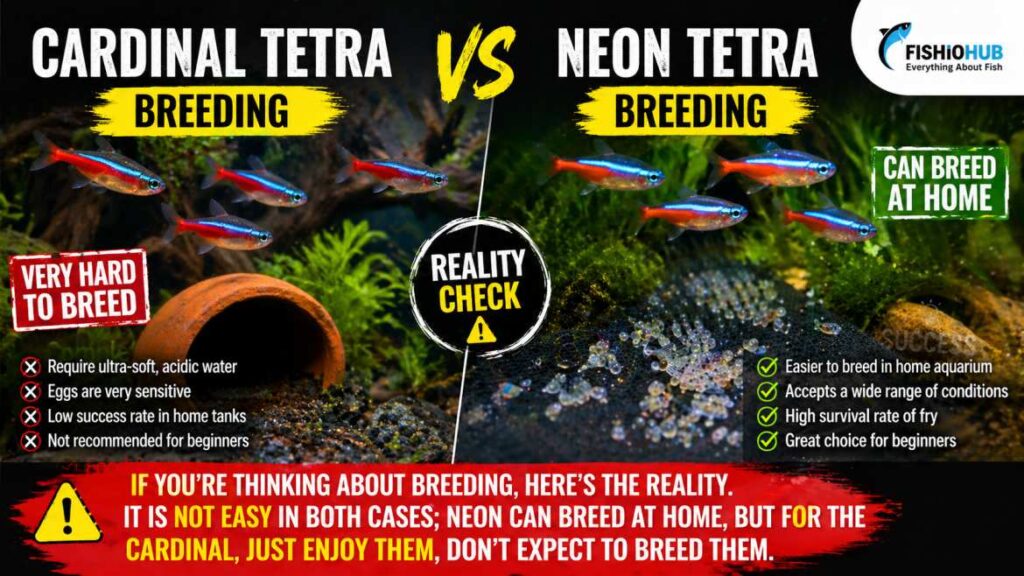
If you’re thinking about breeding, here’s the reality. It is not easy in both cases; neon can breed at home, but for the cardinal, just enjoy them, don’t expect to breed them.
Neon Tetra (Possible at Home)
- Needs a separate tank, soft acidic water (pH ~5.5–6.5)
- Low light, fine plants, or spawning mop
- Remove adults (they eat eggs)
Eggs hatch in ~24 hrs, fry need infusoria → baby brine shrimp
Cardinal Tetra (Very Difficult)
- Requires extreme conditions (pH ~4.5–5.5, ultra-soft water, near darkness)
- Rarely bred at home
Most hobbyists can’t breed them successfully
Important Insight (Most Will Hide This)
- Most cardinal tetras are wild-caught from the Amazon
- This trade actually supports rainforest conservation by providing income to local communities
Cardinal Tetra vs Neon Tetra Price in the USA

Here’s what you can expect in the USA market. The cardinal tetra price is on the higher side because it is harder to breed, wild-caught, and in higher demand due to its premium look. You should initially start with neon tetra and upgrade later to cardinals.
Neon Tetra Price (Budget Choice)
- Petco/PetSmart: $1.50–$3 per fish
- Online: $2–$4 + shipping
School of 12 = $18–$36
Cardinal Tetra Price (Premium Choice)
- Stores: $4–$8 per fish
- Online: $5–$9 + shipping
School of 12 = $60–$108
Which Is Better for a Planted Tank?
For most U.S.-planted tanks, cardinal tetras are the better choice. Their full-body red stripe and bright blue line create a much stronger contrast against green plants, especially in low-light, natural setups with dark substrate and driftwood. They simply “pop” more and give that premium aquascape look. Neon tetras still look good, but their partial red stripe and white belly make them slightly less striking in comparison.
Can They Live With Shrimp?
Since FishioHub covers freshwater shrimp extensively, this is a question I want to address directly, because many US aquarists keep both tetras and shrimp in the same tank.
Yes, both neon and cardinal tetras are safe with adult shrimp like cherry and Amano shrimp. But here’s the catch: they will eat baby shrimp (shrimplets) if they get the chance. If you want shrimp to breed, you’ll need dense moss (like Java or Flame moss) for hiding spots. Read the complete guide here: Cardinal Tetra With Shrimp: Safe or Total Disaster?
Cardinals are slightly larger, so they may pose a bit more risk, but in real-world tanks, both are considered shrimp-safe for adults.
Full Comparison Table — Cardinal Tetra vs Neon Tetra
| Feature | Neon tetra Features | Cardinal tetra Features |
| Scientific name | Paracheirodon innesi | Paracheirodon axelrodi |
| Red stripe | Partial — mid-body to tail | Full — eye to tail |
| Adult size | 1.2–1.5 inches | 1.5–2 inches |
| pH range | 6.0–7.5 | 4.5–6.5 |
| Hardness tolerance | Moderate — adapts to harder water | Low — needs soft water |
| Temperature | 70–81°F | 73–81°F |
| Hardiness once established | Moderate | High |
| NTD susceptibility | Higher | Lower |
| Captive bred or wild | Mostly captive bred | Mostly wild caught |
| Breeding in home tank | Possible with effort | Very difficult |
| USA price per fish | $1.50–$3 | $4–$8 |
| Availability in USA | Widely available — chain stores | Specialty stores and online |
| Best for beginners | Yes | Intermediate |
| Planted tank visual impact | Good | Excellent |
| Lifespan | 3–5 years | 3–5 years |
| Shrimp safe (adults) | Yes | Yes |
| Minimum group size | 6 — ideally 10+ | 6 — ideally 10+ |
| Minimum tank size | 10 gallons | 20 gallons |
FAQs About Cardinal Tetra vs Neon Tetra
- Are cardinal tetras more aggressive than neon tetras?
No, both are peaceful schooling fish and ideal for community tanks. - Can cardinal and neon tetras live together?
Yes, they can coexist peacefully if the water parameters suit both. - Which tetra is hardier?
Cardinal tetras are hardier in stable tanks, while neon tetras struggle more with poor water quality. - What is the cardinal tetra vs neon tetra lifespan?
Cardinal tetras typically live 4–5 years, while neon tetras usually live 3–4 years. With stable water and proper care, both can reach their maximum lifespan, but cardinals often last slightly longer. - Which is better for planted tanks?
Cardinal tetras, their colors pop beautifully in greenery. - How many tetras should be kept together?
At least 6–10 for proper schooling behavior. - Do cardinal tetras grow bigger than neon tetras?
Yes, slightly about 0.5 inches larger on average. - Cardinal tetra vs neon tetra — which is better for beginners?
Neon tetras are the better choice for beginners. - Where can I buy cardinal tetras in the USA?
Cardinal tetras are less commonly available at chain pet stores. Your best sources in the USA are specialty aquarium shops, local aquarium club sales, and online retailers including Aquatic Arts, Imperial Tropicals, and Live Aquaria. Always ask about the origin and acclimation period of the fish before purchasing.
You Love Tetra-Compatible Tank Mates — Now Explore the Shrimp Question
Both neon and cardinal tetras share their tanks beautifully with freshwater shrimp — but which shrimp species works best, which one eats algae more effectively, and can different shrimp species live together peacefully? I covered that complete comparison in the FishioHub shrimp cluster.
👉 Read next: Cherry Shrimp vs Amano Shrimp: Which One Is Right for Your Tank? — FishioHub
Final Thoughts
I think the cardinal tetra vs neon tetra isn’t about which is better; it’s about what fits your tank.
If you’re a beginner in the U.S. with standard tap water and a tight budget, neon tetras are the smart, easy choice. But if you’re running a planted tank with soft, acidic water, cardinal tetras will give you a next-level, premium look that’s hard to beat.
One thing most people get wrong: neon tetras aren’t always the “safer” option. Neon Tetra Disease and inconsistent quality are real issues, and losses can happen even in good tanks.
Hence, know your water. Know your setup. The right choice becomes obvious.
— Anil Satak
Master’s in Zoology | Founder, FishioHub
Was this guide helpful?
First-Hand Experience
Based on animals I've personally kept and bred - not summarized from other articles.
Zoological Foundation
Claims are checked against my M.Sc. Zoology training and published aquatic biology research, not recycled aquarium myths.
No Paid Influence
No sponsorship shaped this guide. Affiliate links, if any, are disclosed separately and never hidden.
Kept Current
Errors are corrected as soon as they're found, with the update noted at the bottom of the article.

Anil Satak M.Sc. Zoology · Founder, FishioHub
Grew up in a fishing family in India and holds a Master's in Zoology. FishioHub is a one-person operation - every guide is personally researched, kept-tested, and written by Anil. No team, no outsourced writers, no AI-generated content. Read his full bio →