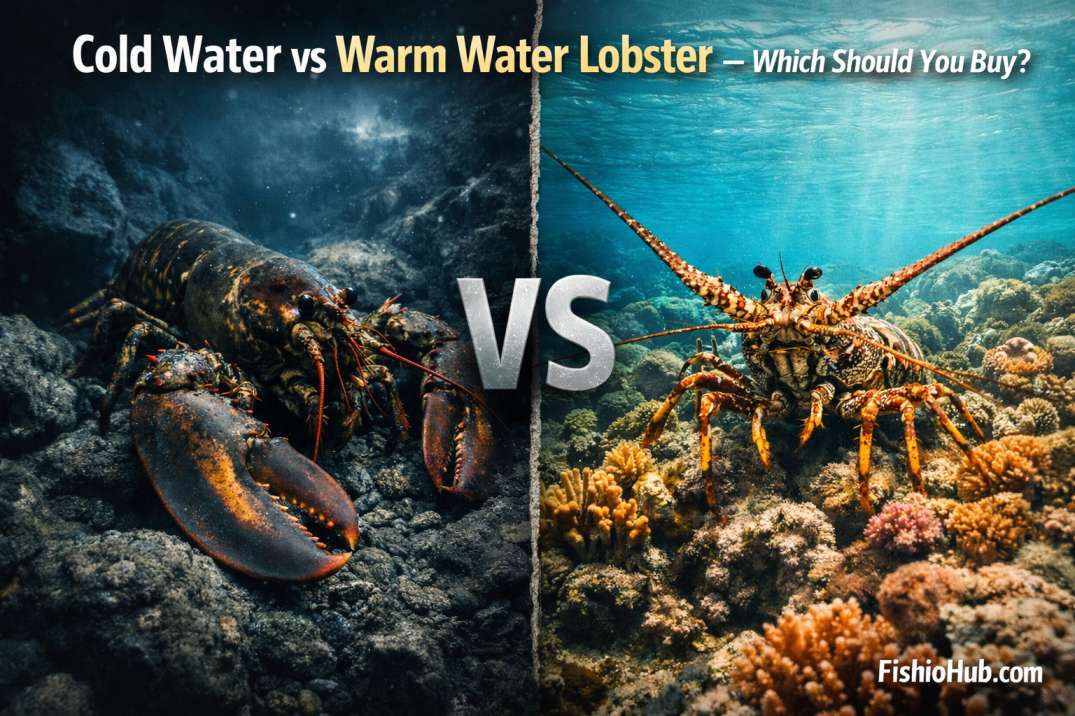
No matter how many days go by, there are some things we never forget. I still remember the first time I ordered lobster at a restaurant; I thought to myself, “A lobster is just a lobster… right?”
But when the plate arrived, something felt off. The texture was softer, the flavor less sweet—and that’s when I learned there’s a huge difference between cold water lobster vs warm water lobster.
Since then, I have paid close attention to this detail, whether I am catching, buying, or tasting seafood, and believe me, “their habitat”, that seemingly small factor, can completely transform your entire experience.
Quick Answer (Straight to the Point)
When comparing cold water lobster vs warm water lobster, cold-water lobster is generally considered better due to its sweeter flavor, firmer texture, and higher meat quality. Often, it is regarded as premium seafood. Whereas Warm water lobster is usually cheaper but softer, sometimes mushy, and often lacks claws.
📌 What You’ll Get in This Post
- 🦞 Key differences: cold water lobster vs warm water lobster
- 🍽️ Which lobster tastes better (real answer)
- 🧊 Cold water lobster tails vs warm water
- ⚠️ Why some warm water lobster feels mushy
- 🛒 Which one you should actually buy
- ❓ FAQs buyers always ask
Cold Water vs Warm Water Lobster: What’s the Difference?
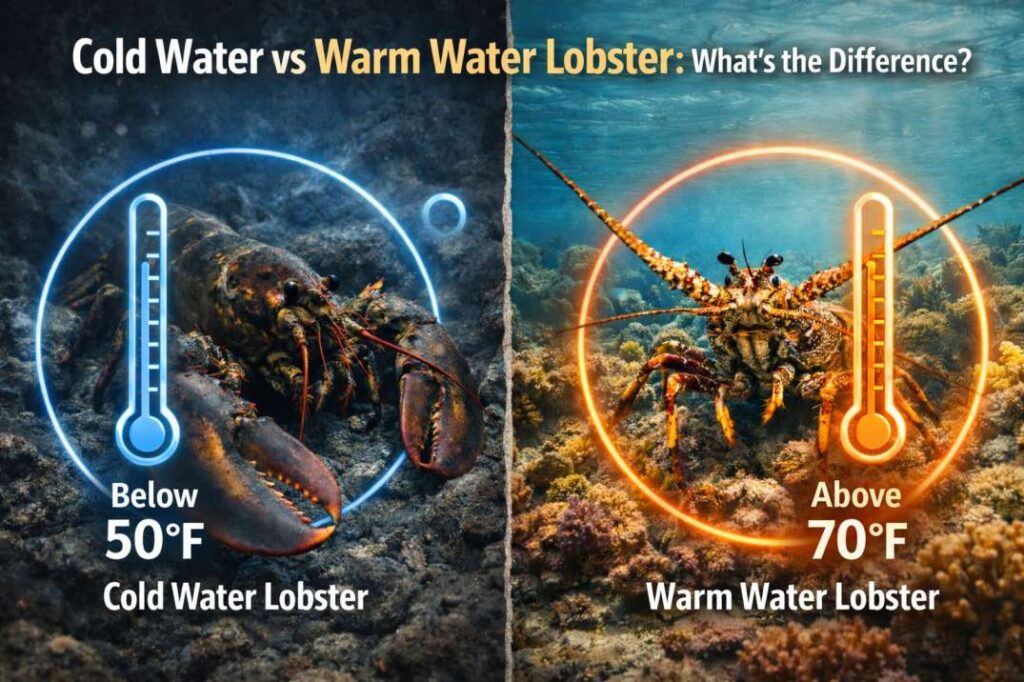
Let’s break it down. Before comparing both lobsters, let us try to understand their habitat and biology.
Cold Water Lobster
“Cold water lobsters” refer to those clawed lobsters found in cold oceans, where the temperature remains below 50°F year-round. Particularly in regions like the North Atlantic, they are renowned for their sweeter, firmer meat and overall superior quality. Chefs and seafood enthusiasts worldwide highly covet cold water lobsters, and for precisely this reason, they command such high prices.
- Found in cold regions like the North Atlantic waters
- Has large claws
- Meat is firm, white, and sweet
- Slower growth = better texture
🔥 Want to Know What Makes Cold Water Lobster Truly Premium?
If you’re serious about taste, texture, and getting the best value for your money, don’t stop here. Discover the real difference in quality, flavor, and buying tips inside this detailed guide:
➡️ Read Now: Cold Water Lobster: Why It’s So Expensive & How to Buy the Best?
💡 Avoid common mistakes buyers make, and learn how to choose restaurant-quality lobster every time.
Warm Water Lobster
Warm-water lobsters refer to those spiny lobster species found in tropical and subtropical oceans, where temperatures remain above 70°F year-round. They do not possess large claws and are prized primarily for the meat in their tails, which has a mild flavor and a soft texture.
- Found in tropical regions (Caribbean, Florida, etc.)
- Usually no claws (spiny lobster)
- Meat is softer and sometimes watery
- Faster growth = lower-density meat
🌴 Thinking About Buying Warm Water Lobster? Read This First
If you know what to expect (and what to avoid).
👉 Before you buy, check this complete guide to understand:
- Real taste & texture differences
- When it’s worth buying (and when it’s not)
- Common mistakes that lead to mushy lobster
➡️ Read Now: Warm Water Lobster: Is It Worth Buying or Just Cheaper?
💡 Make the right choice for your budget, and avoid disappointing results.
Full Comparison Table — Cold Water Lobster vs Warm Water Lobster
| Feature | Cold water lobster | Warm water lobster |
|---|---|---|
| Primary species | American, European, NZ rock lobster | Caribbean spiny, Brazilian spiny |
| Scientific name | Homarus americanus (main US species) | Panulirus argus (main US species) |
| Water temperature | Below 50°F | Above 70°F |
| Has claws | Yes — crusher and cutter | No — tail only |
| Meat texture | Firm, dense, robust | Softer, lighter, less dense |
| Flavor intensity | High — sweet, complex, briny | Mild — subtle, clean |
| Growth rate | 5–7 years to market | 2–3 years to market |
| Shell appearance | Uniform, mottled brown-green | Spotted, banded patterns |
| US retail tail price | $35–$65 per tail | $15–$30 per tail |
| Protein per 3.5oz | ~19g at ~89 calories | ~17–19g at ~95–100 calories |
| Overcooking risk | Lower — more forgiving | Higher — becomes rubbery faster |
| Best for simple preparations | Yes — flavor shines | Less ideal |
| Best for sauced dishes | Good — but expensive | Excellent value choice |
| Sustainability certification | MSC available (Maine, NZ) | MSC available (varies by source) |
| Wild caught | Almost exclusively | Primarily yes |
| Claw meat available | Yes | No |
| Lifespan | Up to 100 years (American lobster) | 7–10 years |
Which Tastes Better? (Honest Answer)
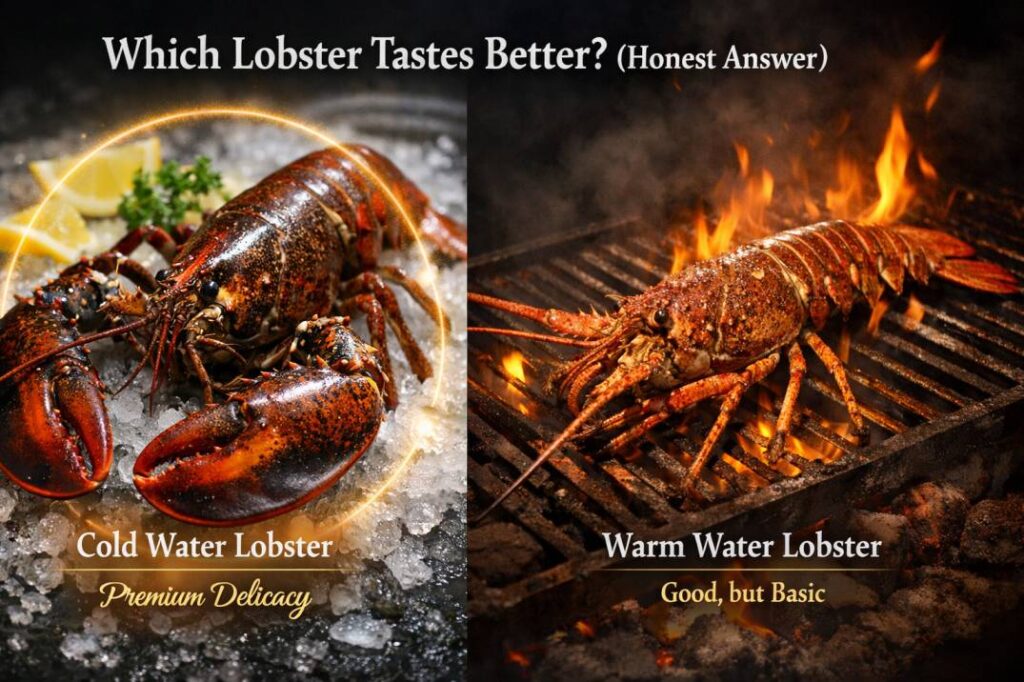
“Do cold-water lobsters taste better, or warm-water ones?”
I don’t find any mistake in saying which lobster tastes better. It is my belief, shared by many seafood experts worldwide, that cold-water lobsters possess a naturally exquisite sweetness. Food connoisseurs often categorize them as a premium delicacy. Truly, when it comes to flavor, they are simply unrivaled.
However, if you wish to enjoy the lobster experience on a more modest budget, warm-water lobsters are a viable option; their flavor tends to be milder and, at times, somewhat bland. In the debate of cold water lobster vs warm water lobster, most chefs prefer cold water lobster for its premium quality.
🧠 Why Is This the Case? (Scientific Insight)
There is one primary reason behind this: the water temperature. Cold water slows down metabolism, resulting in:
- The development of firmer muscle fibers.
- The preservation of natural sugars within the meat.
📊 According to marine research supported by NOAA:
Due to the slower growth rate of species found in cold waters, their muscle structure is denser, and they retain their flavor for a longer duration. This is precisely why chefs around the globe almost invariably prefer cold-water lobsters. It means the key difference in cold water lobster vs warm water lobster is their habitat, which directly affects taste and texture.
Cold Water Lobster Tails vs Warm Water Lobster Tail
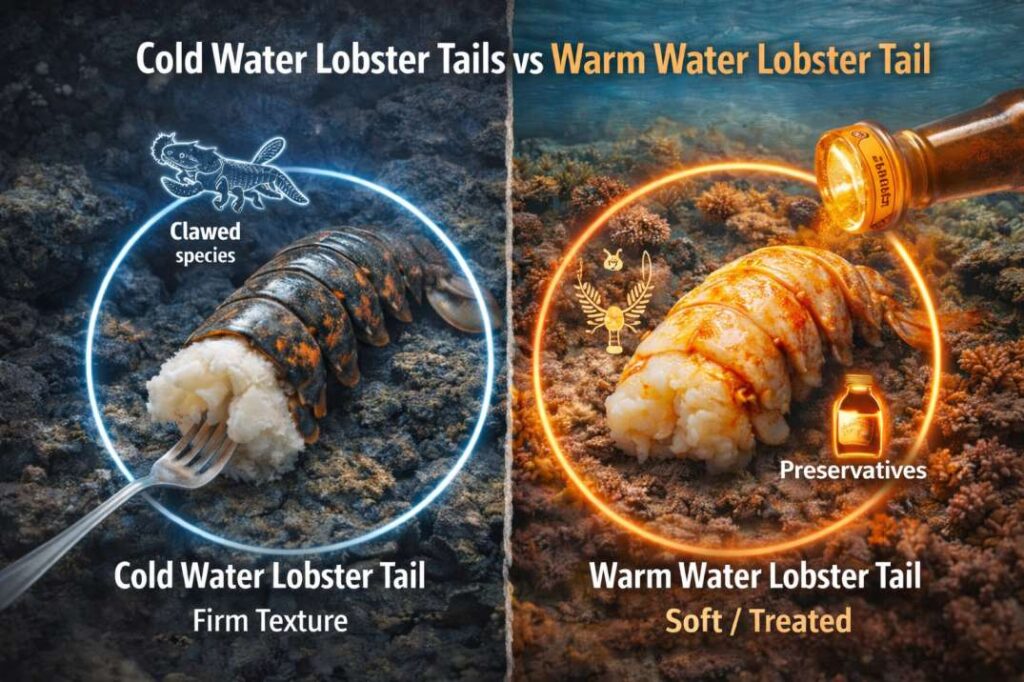
If you enjoy lobster claws, and every seafood lover knows this, cold-water lobsters have claws, whereas warm-water lobsters do not. However, when the choice comes down to the lobster tail itself, that is precisely where most buyers get confused. You may or may not agree with my opinion on this matter. So let’s try to figure out the difference between cold water and warm water lobster tail.
What is Cold Water Lobster Tail?
- It comes from a clawed cold-water lobster species.
- It has a firm and slightly chewy (pleasantly substantial) texture.
- It holds its shape and does not fall apart during cooking.
What is Warm Water Lobster Tail?
- They typically come from spiny lobster species.
- They can be rubbery or soft in texture.
- Sometimes, preservatives (such as sodium tripolyphosphate) are added to them.
An Essential Tip When Buying Lobster Tails:
If a lobster tail looks:
- Excessively white
- Waterlogged
- Or unusually soft
Then it is likely a warm-water lobster.
Why Warm Water Lobster Can Be Mushy?
I have often noticed that warm-water lobsters tend to be soft—a detail that many buyers frequently overlook.
The scientific explanation behind this, it turns out, is that warm-water lobsters grow rapidly; consequently, their muscle fibers are looser, and they retain a higher amount of water within their tissues.
📊 Studies in marine food science indicate:
- Rapidly growing crustaceans often possess meat that is less dense, resulting in a softer texture.
This is precisely one of the reasons why warm-water lobster sometimes tastes the way it does.
Do Warm Water Lobsters Have Claws?
Short answer: No, most warm-water lobsters don’t have claws. They are called spiny lobsters, and instead of claws. They use antennae for defense, and their Meat is mainly in the tail. This is one of the BIG differences in warm water lobster vs cold water lobster
🛒 Which One Should You Buy? (Real Buyer Guide)
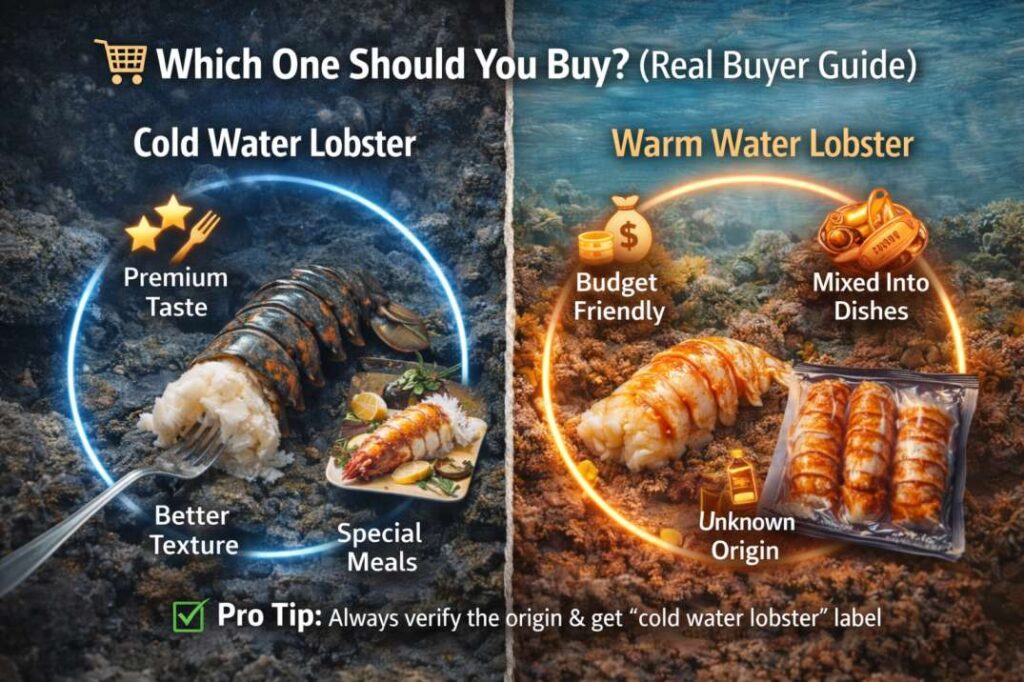
Let me keep this practical. For buyers comparing cold water lobster vs warm water lobster, cold water lobster is ideal for grilling and premium dishes.
Choose Cold Water Lobster If:
- You want premium taste
- You love about texture
- You’re cooking for guests
- You want a restaurant-quality experience
Choose Warm Water Lobster If:
Texture or taste isn’t your top priority. You’re on a budget, or you’re mixing it into dishes (pasta, curry).
Pro Tip (From My Experience)
If you’re buying online or frozen, you must check all these things:
✔ Always check the origin of lobster
✔ Look for the “cold water lobster tail” label
✔ Avoid overly cheap “lobster deals.”
👉 Because most cheap deals you will get a warm water lobster.
📊 Real Facts You Should Know
🦞 Cold water lobster meat contains less water content, they are firm, improving cooking quality
🧊 Cold water lobsters grow slower, leading to firmer meat structure (NOAA marine data)
🌡️ Warm water lobsters grow faster, which reduces the muscle density of the lobster
❓ FAQs (Cold water lobster vs Warm water lobster)
- What’s better: cold water lobster vs warm water lobster?
Cold water lobster is better in terms of flavor, texture, and overall quality. - Is warm water lobster good?
Yes, it’s still edible and widely used—but it’s not considered premium. - Why is cold water lobster more expensive?
Because of slower growth, they become rich in taste, higher in demand, and of very good meat quality. - Do warm water lobsters have claws?
No, most warm-water lobsters (spiny lobsters) do not have claws. - Can you tell the difference by taste?
Yes. Cold water lobster is sweeter and firmer, while warm water lobster is softer and milder. - Which lobster is used in restaurants?
High-end restaurants mostly use cold water lobster. - Are warm vs cold water lobster tails different?
Yes, cold water tails are firmer and higher quality, while warm water tails are softer. - Why does my lobster taste rubbery?
It’s often due to overcooking or a warm water lobster.
🦞 Before You Eat That Lobster… Read This First
👉 Not all parts of a lobster are safe to eat — and many people don’t even realize it. If you’re enjoying lobster for its taste, make sure you’re not accidentally eating the wrong parts.
✅ Learn which parts to avoid
✅ How to identify them easily
✅ And what chefs actually remove before serving
👉 Don’t risk it — read this next: What Parts of Lobster Not to Eat
Final Thoughts (My Honest Take)
If you ask me personally, after trying both multiple times, I always go for cold water lobster when I want the real experience. Warm water lobster isn’t “bad,” but it’s definitely not the same level.
👉 If you taste the difference at least once, you won’t go back.
Was this guide helpful?
First-Hand Experience
Based on animals I've personally kept and bred - not summarized from other articles.
Zoological Foundation
Claims are checked against my M.Sc. Zoology training and published aquatic biology research, not recycled aquarium myths.
No Paid Influence
No sponsorship shaped this guide. Affiliate links, if any, are disclosed separately and never hidden.
Kept Current
Errors are corrected as soon as they're found, with the update noted at the bottom of the article.

Anil Satak M.Sc. Zoology · Founder, FishioHub
Grew up in a fishing family in India and holds a Master's in Zoology. FishioHub is a one-person operation - every guide is personally researched, kept-tested, and written by Anil. No team, no outsourced writers, no AI-generated content. Read his full bio →